
Most motorsport fans spend months planning which stages to watch, which hotels to book, and which hospitality packages to reserve. Transport gets added as an afterthought. That instinct is understandable, and it is also one of the most reliable ways to miss half the rally. The role of transfers in tourism is rarely more visible than at an event like Rallye Monte-Carlo, where winter mountain roads, remote Alpine stage villages, and a tight spectator schedule demand ground transport that is not merely adequate but genuinely expert. This guide covers what you need to know before January 2026 arrives.
Role of transfers in Rallye Monte-Carlo tourism
The 2026 Rallye Monte-Carlo returns to its traditional winter calendar, with competitive stages threading through the Alpes-Maritimes and Alpes-de-Haute-Provence. Stages are scattered across villages such as La Bollène-Vésubie, Saint-Martin-Vésubie, and Lucéram. None of these are accessible by public transport during the event. The roads are narrow, frequently icy, and subject to sudden closures as service parks and stage timing crews take over.
This is the geographical reality that makes transfer planning so consequential. Nice Côte d’Azur Airport (NCE) sits roughly 20 kilometres from Monaco, a journey of around 30 to 35 minutes on a clear day. In January, with rally traffic converging on the Principality from multiple directions, that same journey can stretch considerably. The drive from Nice Airport to a stage village like La Bollène-Vésubie takes approximately 60 to 75 minutes under reasonable winter conditions, and longer when snow falls on the higher passes.
The importance of transportation in tourism at events like this is not abstract. It is the difference between watching a stage and standing in a car park watching your watch. Understanding the terrain is only part of it.
Winter roads and the last-mile problem
Rally events consistently face what logistics specialists call the last-mile problem. Stage access is often restricted, with direct vehicle entry closed to spectators in the final kilometres before any competitive section. Experienced visitors plan 20 to 30 minute buffers and use designated remote parking areas rather than attempting to drive to the stage entrance itself.
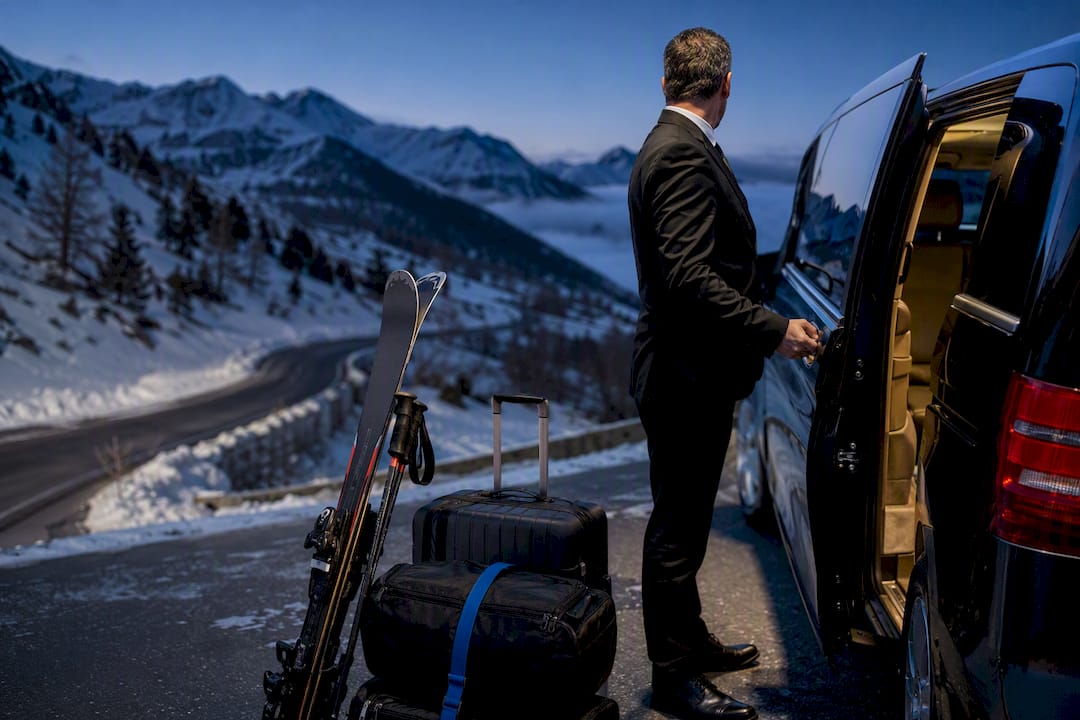
A private chauffeur handles this differently to a hire car. Your driver knows the approved drop-off points, monitors road conditions in real time, and waits at a suitable location rather than abandoning you in a field. The distinction matters enormously when temperatures are below zero and the next stage starts in 40 minutes.
The key transport challenges specific to Rallye Monte-Carlo transfers include:
- Unpredictable weather: January in the Alpes-Maritimes frequently brings snow above 800 metres. Isola 2000, a ski resort at 2,000 metres and a regular rally service area, requires winter tyres as a legal minimum.
- Stage road closures: Routes are closed for hours around stage times, requiring precise knowledge of alternative access roads.
- Spectator volume: Monaco’s streets handle roughly 300,000 visitors during the event. Parking is effectively impossible without pre-arrangement.
- Split itineraries: Many visitors watch a morning stage in the mountains, return to Monaco for afternoon hospitality, and head back to an Alpine resort for an evening stage. Each leg demands its own logistical precision.
Pro Tip: Book your chauffeur to collect you from your hotel at least 90 minutes before any mountain stage start time. The roads leading to popular spectator points fill up far faster than rally programmes suggest, and buffer time is not wasted time when you are watching WRC cars at close range.
Fleet options and 2026 fixed rates
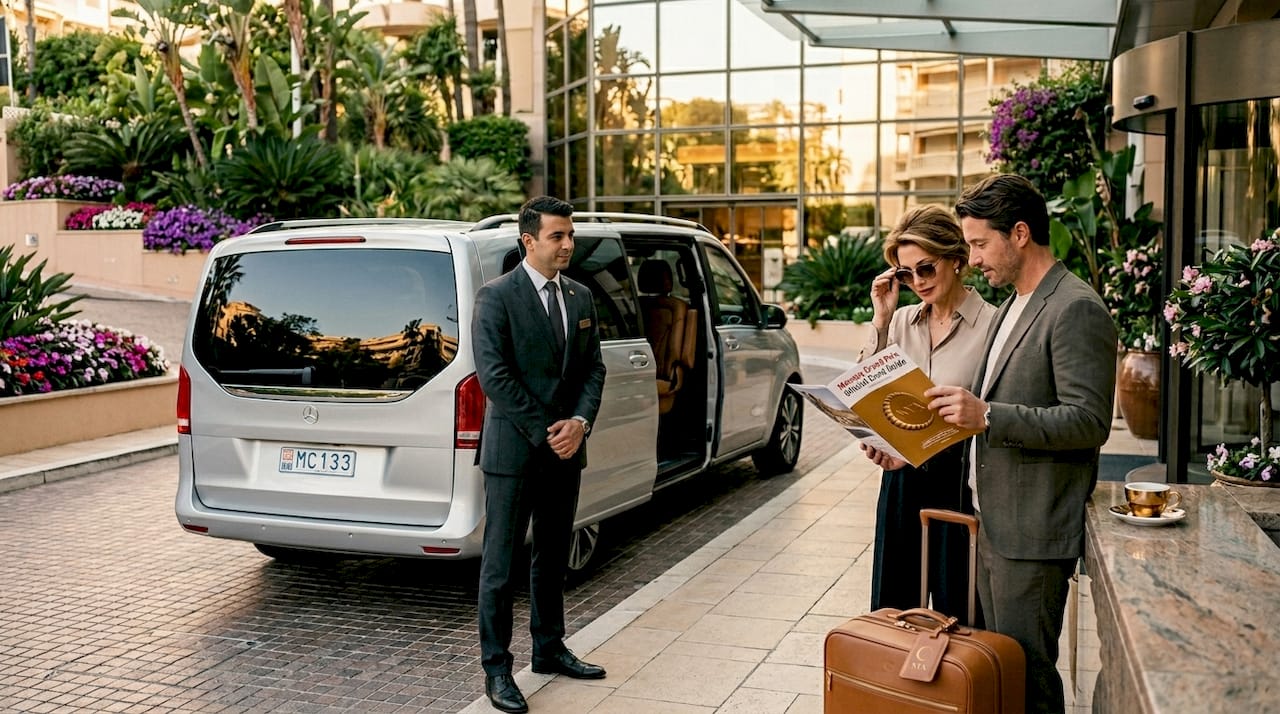
Transponyx operates an exclusively Mercedes-Benz fleet, structured to serve every group size attending Rallye Monte-Carlo. Each vehicle is equipped with Wi-Fi, air conditioning, chilled water, and phone chargers as standard. Child seats are available on request, which is relevant for family groups travelling to lower-altitude spectator points.
The four categories serve distinct needs:
- Standard Sedan: Up to 3 passengers. Ideal for couples or solo travellers transferring from Nice Airport to Monaco or a central stage-access hotel.
- Business Sedan: Up to 3 passengers with premium interior finish. Suited to VIP guests, team representatives, and journalists requiring both comfort and a degree of privacy.
- Van 7 pax: Up to 7 passengers. The practical choice for friend groups or small corporate parties covering multiple stage locations in a single day.
- Van 8 pax: Up to 8 passengers. Well suited to hospitality groups, fan clubs, or manufacturer guests requiring coordinated transport across the full rally itinerary.
All 2026 rates are fixed per vehicle, confirmed at the time of booking with no surge pricing. This matters particularly during Rallye Monte-Carlo because demand concentrates intensely over a short window. The table below presents representative 2026 rates for the most common routes.
| Route | Standard Sedan | Business Sedan | Van 7 pax | Van 8 pax |
|---|---|---|---|---|
| Nice Airport (NCE) to Monaco | From €90 | From €110 | From €150 | From €165 |
| Nice Airport to La Bollène-Vésubie | From €130 | From €155 | From €200 | From €220 |
| Nice Airport to Isola 2000 | From €180 | From €210 | From €270 | From €295 |
| Monaco to Alpine stage village (one way) | From €100 | From €125 | From €170 | From €190 |
| Monaco to Auron or Valberg | From €160 | From €190 | From €245 | From €265 |
Rates are indicative and confirmed at booking. Contact Transponyx directly for specific itinerary pricing.
For comparative context, integrated rally packages at events such as Secto Rally Finland 2026 cost around €1,090 per person for four days including accommodation and shuttle transfers. A private chauffeur arrangement at Rallye Monte-Carlo, covering two or three people across several days, can compare very favourably when the per-person cost is shared across a full vehicle.
The benefits of premium event transport at an event like this extend beyond comfort. Fixed pricing removes the anxiety of surge fares during peak demand. Flight monitoring on every airport pickup means your driver adjusts if your connection runs late. The 60-minute free waiting period on all airport collections is included as standard, with no extra charge for flight delays.
How transfer quality shapes visitor satisfaction
The relationship between transport reliability and overall trip satisfaction is consistently documented in travel research. 61% of frequent travellers rank ground transport reliability among the top three factors influencing how positively they assess a trip. At a rally event, where every spectator session is time-sensitive and geographically demanding, that figure almost certainly climbs higher.
“Pre-arranged shuttle services operate as the most reliable transfer option for international visitors, building confidence particularly in destinations lacking comprehensive public transport.” Transport convenience research
The transfers impact on travel extends beyond individual satisfaction. Local economies around rally routes benefit directly from visitors who are able to reach remote stage locations without difficulty. A village café at La Bollène-Vésubie, a small hotel at Valberg, a farm selling cheese near a spectator point outside Lucéram: all of these depend on visitors actually arriving. Fragmented, unreliable transport discourages fans from venturing beyond Monaco and concentrates spending in the Principality rather than distributing it across the wider regional economy.
The WTTC forecasts 3.3% annual tourism demand growth and 4.6% annual infrastructure investment growth through 2035, which reflects a global recognition that transport connectivity is not a secondary concern. It is a primary driver of whether destinations remain competitive. For the Côte d’Azur, where Rallye Monte-Carlo represents one of January’s most significant visitor events, the quality of available transfers is inseparable from the event’s reputation.
The digital dimension of booking also shapes satisfaction before the journey begins. Visitors arriving in 2026 expect to confirm transfers online, receive confirmations with driver details, and track vehicle location in advance of pickup. Advance booking 24 to 48 hours ahead is the industry standard for barrier-free service quality. With Rallye Monte-Carlo, where daily itineraries can shift as stage times are confirmed, having a professional driver who responds to WhatsApp and adjusts pickup times without penalty is a practical necessity rather than a luxury extra.
How transfers affect tourism at an event with this level of complexity is visible in the contrast between visitors who plan ground transport in advance and those who do not. The former group tends to watch more stages, spend more widely across the region, and return in subsequent years. The latter group tends to spend more time in Monaco traffic and less time watching cars on mountain roads.
Practical advice for booking your 2026 rally transfers
Securing private chauffeur transfers for Rallye Monte-Carlo 2026 requires earlier action than most visitors expect. The event typically runs across the third and fourth weeks of January, and professional chauffeur availability in Monaco and Nice diminishes quickly once the rally calendar is confirmed.
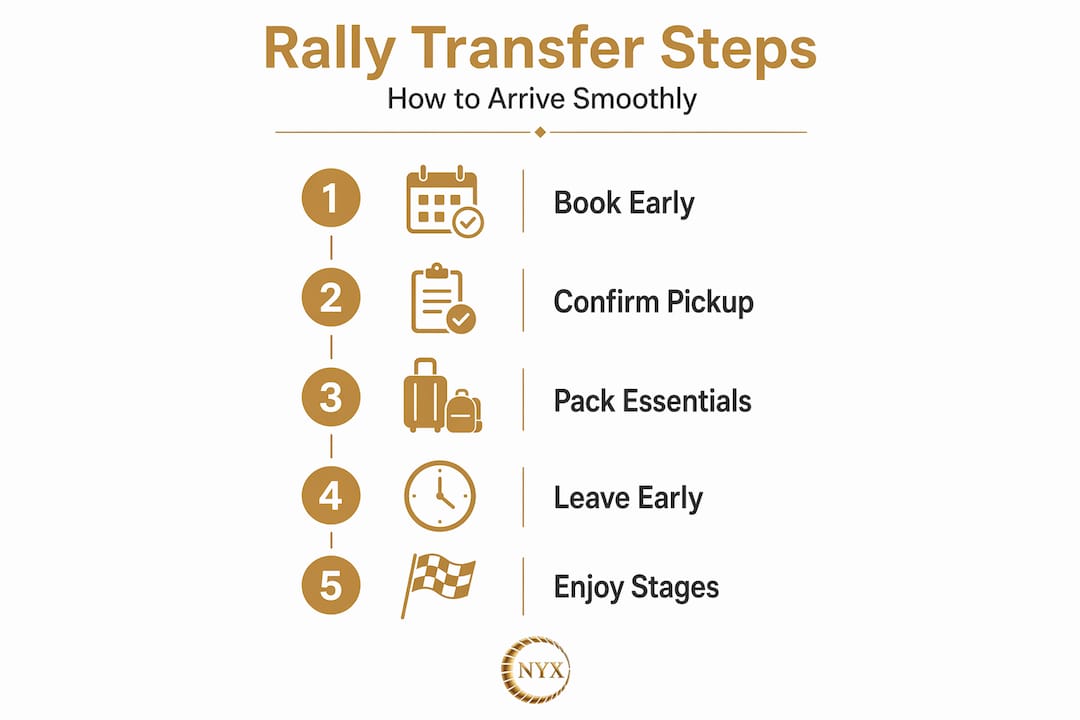
A reliable planning sequence looks like this:
- Confirm your stage schedule first. The full stage list and spectator access points for 2026 are published by the Automobile Club de Monaco in the weeks before the event. Build your transport itinerary around confirmed stage times rather than approximations.
- Book your chauffeur immediately after booking accommodation. Do not treat transport as something to arrange once you arrive. Transponyx operates 24 hours a day, 7 days a week, and reservations can be made by phone at +33 6 10 30 71 84 or via WhatsApp at +33 7 67 78 10 26.
- Match vehicle choice to group size and daily itinerary. A solo traveller covering two stages per day from a Monaco base needs a Standard Sedan. A group of six covering all four competitive days and including ski resort accommodation at Auron or Valberg needs a Van 7 pax with a driver who knows the mountain roads.
- Confirm winter driving expertise explicitly. Not every private hire driver is familiar with the Alpes-Maritimes in January. Transponyx drivers are licensed VTC professionals who regularly operate on routes to Isola 2000, Auron, and Valberg. Winter tyre fitment is standard. Snow chain handling is known.
- Plan inter-stage transfers in advance. If your itinerary includes a morning stage at Saint-Martin-Vésubie and an afternoon service park visit in Monaco, that is roughly a 70-kilometre drive each way under normal conditions. The timing needs to be agreed with your driver before the day, not improvised on a mountain road.
- Use driver briefings. Before each day, spend two minutes confirming the pickup address, drop-off point, and contingency plan if a stage is delayed or access is restricted. Your Transponyx driver will have this information, but the brief conversation saves time when conditions change.
Pro Tip: If your accommodation is in an Alpine resort village such as Auron or Valberg rather than Monaco, arrange for your chauffeur to position there overnight rather than returning to Nice. The additional cost is modest compared with the time saved on the first transfer of the following morning, particularly when roads are icy at dawn.
For group logistics at larger events, the guide to group transport for major events offers a useful framework adaptable to rally itineraries.
My view on what transfers really mean at an event like this
I have spent years covering luxury ground transport on the French Riviera, and the pattern I observe every January is remarkably consistent. Visitors who have never attended Rallye Monte-Carlo arrive assuming the hard part is getting to Nice. It is not. The hard part is getting from Nice to the right Alpine village at the right time on a road that may or may not have been closed 45 minutes ago.
What I have seen repeatedly is that the quality of a visitor’s rally experience correlates almost exactly with the quality of their ground transport arrangements. The fans who reach La Bollène-Vésubie at dawn and watch the cars under snowfall, who make it back to Monaco for the podium ceremony, and who get out to a stage near Valberg in the late afternoon; those fans universally had their transfers sorted before they boarded their flight.
The role of transport services in travel is often framed as facilitation. I think that undersells it. A good driver at an event like this is not simply moving you from A to B. They are making editorial decisions about timing, routing, and contingency in real time, based on years of experience with these specific roads in these specific conditions. That is not facilitation. That is expertise.
Where I think the sector could go further is in the integration of rally-specific intelligence into booking. Knowing which stages have restricted access windows, which roads close two hours before the start car, which parking areas are remote but genuinely serviced: that information should be part of the transfer booking process, not something a visitor has to research independently. The best chauffeur services are already moving in this direction.
For 2026, the visitors who will remember Rallye Monte-Carlo most vividly will be the ones who trusted their ground transport to a professional and spent their attention on the rally itself.
— Dany
Book your Rallye Monte-Carlo transfer with Transponyx
Transponyx provides private chauffeur transfers across the French Riviera, with particular expertise on the Alpine routes that define the Rallye Monte-Carlo experience. The full Mercedes-Benz fleet, from the Standard Sedan to the Van 8 pax, is available throughout the January 2026 event period at fixed 2026 rates confirmed at booking with no surge pricing. Every airport pickup from Nice Côte d’Azur Airport includes 60 minutes of free waiting time and full flight monitoring, so delays never become your problem.
Key routes covered include Nice Airport to Monaco, Monaco to Alpine stage villages including La Bollène-Vésubie and Saint-Martin-Vésubie, and connections to ski resorts at Isola 2000, Auron, and Valberg. Drivers are bilingual licensed VTC professionals with winter mountain road expertise.
Contact Transponyx to book: +33 6 10 30 71 84 or WhatsApp +33 7 67 78 10 26. Full service details and booking at transponyx.com.
FAQ
What is the role of transfers in motorsport tourism?
Transfers determine whether spectators can reach remote rally stages, coordinate multi-location itineraries, and return safely on winter mountain roads. Without reliable private transport, access to the most spectacular sections of events like Rallye Monte-Carlo is effectively impossible.
How long does the transfer from Nice Airport to Monaco take?
Under normal conditions, the Nice Côte d’Azur Airport to Monaco transfer takes approximately 30 to 35 minutes by private chauffeur. During Rallye Monte-Carlo in January, allow up to 60 minutes depending on event traffic and weather.
Why book a private chauffeur rather than hire a car for Rallye Monte-Carlo?
Stage access roads are often restricted, winter conditions require specific driving expertise, and individual hire car logistics) add complexity that private chauffeur services remove entirely. A fixed-rate professional driver also waits for you, monitors your flight, and adjusts to itinerary changes without penalty.
How far in advance should transfers be booked for the 2026 rally?
Book as early as your accommodation is confirmed. Professional chauffeur availability in Monaco and the Alpes-Maritimes during Rallye Monte-Carlo is limited. Booking 6 to 8 weeks ahead is advisable for guaranteed availability across multiple days.
Can Transponyx reach Alpine stage villages and ski resorts from Monaco?
Yes. Transponyx regularly operates on routes to Isola 2000, Auron, Valberg, La Bollène-Vésubie, and Saint-Martin-Vésubie. All vehicles are winter-equipped and drivers are experienced on Alpine mountain roads in January conditions.

0 commentaires