
Travel recommendations are defined as personalised suggestions for destinations, activities, or transport options, matched to a traveller’s preferences, budget, and timing. The practice of explaining travel recommendations goes further: it articulates the why behind each suggestion, giving travellers the reasoning they need to decide with confidence. Platforms like DeepSeek and advisors such as Wendy Perrin and Indagare have made transparency their competitive edge, and the results are measurable. Transponyx applies the same principle to luxury ground transport on the French Riviera, ensuring every client understands exactly what they are booking and why it suits their journey.
What are travel recommendations and why do travellers need explanations?
Travel recommendations fall into three broad categories: AI-generated lists, expert-curated itineraries, and platform-driven suggestions. Each serves a different purpose, but all share a common weakness when presented without context. A list of the best travel destinations without supporting reasoning is, in practice, little more than a catalogue.
Travellers distrust what they cannot evaluate. Transparent rationale builds cognitive trust, reducing the suspicion that a recommendation is driven by hidden commercial incentives rather than genuine fit. That suspicion is not irrational. Affiliate-driven content, sponsored placements, and algorithm-optimised rankings are widespread, and experienced travellers have learned to question them.
The shift in how trust is formed is significant. Research shows that traveller trust has moved from evaluating the content of a recommendation to evaluating the process that produced it. In other words, travellers no longer ask only “Is this a good destination?” They ask “Why is this being recommended to me, and by what method?” That is a fundamentally different question, and it demands a fundamentally different answer.
Common traveller expectations when seeking travel tips and advice include:
- Clear reasoning: why this destination or activity suits their specific profile
- Transparency on constraints: budget limits, travel dates, physical requirements, and group size
- Personalised options: not generic top-10 lists, but choices calibrated to their situation
- Contingency awareness: what happens if conditions change, flights are delayed, or plans shift
- Source credibility: who is making the recommendation and on what basis
New travellers, in particular, value advisors for emotional reassurance as much as for logistical guidance. Media coverage of international travel risks creates anxiety that no algorithm fully addresses. A human advisor who explains their reasoning provides comfort that a ranked list cannot replicate.
How does explainability improve booking outcomes?
The commercial case for explained recommendations is direct. Platforms providing personalised one-line explanations for travel suggestions increase conversion rates by 18–25%. That figure represents the difference between a traveller who browses and leaves, and one who books with confidence.
The mechanism is psychological. When a traveller understands why a recommendation fits their situation, perceived usefulness rises. Perceived usefulness is the primary driver of booking intent. A recommendation for a Business Sedan transfer from Nice Côte d’Azur Airport (NCE) to Monaco carries more weight when accompanied by a clear rationale: fixed 2026 pricing, 60 minutes of free waiting time included, flight monitoring active, and a bilingual driver familiar with the Principauté’s access restrictions during the Monaco Grand Prix.
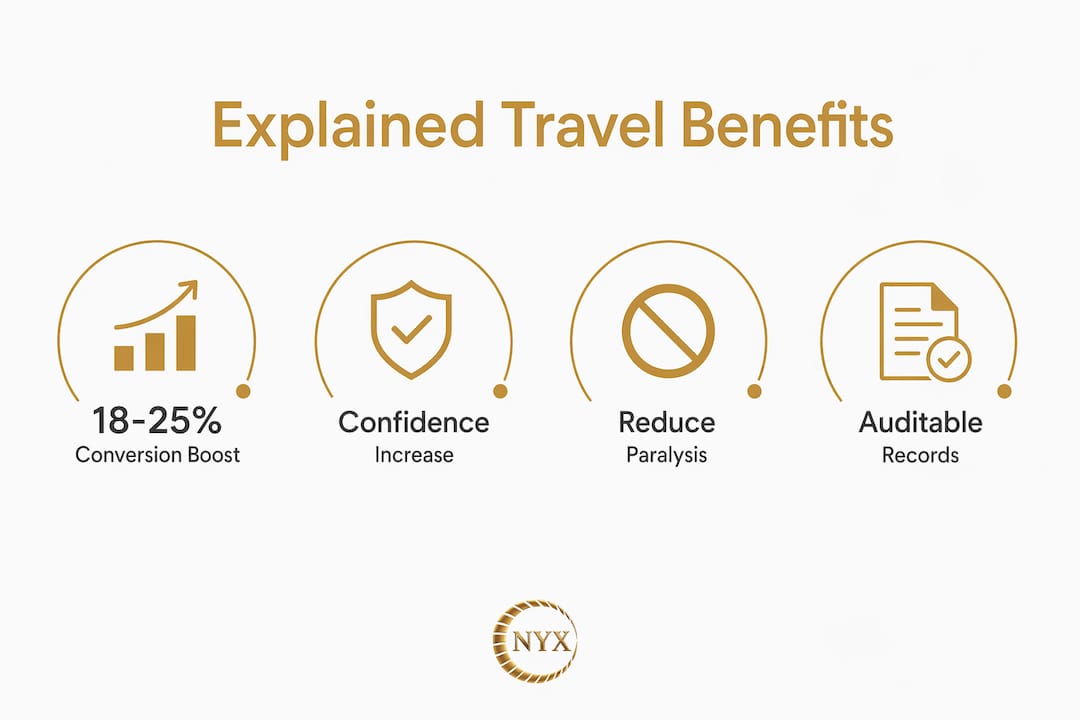
AI systems displaying recommendation logic boost decision confidence significantly. DeepSeek, for instance, surfaces its reasoning chain rather than presenting conclusions as facts. That transparency improves the traveller’s ability to evaluate argument quality and source credibility, which in turn increases adoption of the suggestion.

Pro Tip: When assessing any AI-generated travel itinerary, ask the platform to show its reasoning. If it cannot explain why a hotel, route, or activity was selected, treat the suggestion with caution.
Explained recommendations also reduce decision paralysis and buyer’s remorse. A traveller who understands the tradeoffs between staying in Cannes versus Antibes during the Cannes Film Festival can commit to a choice rather than second-guessing it after booking. Generic top-10 lists create the opposite effect: they present options without priorities, leaving the traveller to resolve the tradeoffs alone.
Audit trails matter in corporate travel as well. Business travellers and travel managers increasingly require audit-ready rationales behind digital recommendations to satisfy internal policy and expense approval processes. A recommendation that cannot be documented is a recommendation that cannot be approved.
What frameworks do elite planners use to explain recommendations?
Elite travel planners do not present ten options. They present three, each positioned with explicit tradeoffs. This three-option methodology forces travellers to confront their real priorities rather than deferring a decision. It is faster, clearer, and produces higher satisfaction than exhaustive lists.
The three positions typically follow a structure: the conservative choice (lower cost, lower risk, proven track record), the recommended choice (best fit for stated preferences), and the aspirational choice (higher cost or complexity, but maximum reward if conditions align). Each option carries a brief explanation of what the traveller gains and what they sacrifice.
Wendy Perrin and the Indagare network apply this logic to destination selection, accommodation, and activity sequencing. The rationale is always explicit: why this property over that one, why this week rather than the following one, and what local events or conditions influenced the timing.
Timing and pacing rules are a core part of explained recommendations. Jet-lag arrival logic is one example: experienced guides schedule day one as a low-intensity buffer, with no significant sightseeing. That single rule, when explained to a traveller, transforms their first day from a frustrating underperformance into a deliberate recovery strategy.
The table below summarises the main explanation models used in travel planning and their practical benefits.
| Explanation model | Core principle | Traveller benefit |
|---|---|---|
| Three-option positioning | Present conservative, recommended, and aspirational choices | Faster decisions, clearer priorities |
| Audit trail reasoning | Document the logic behind each suggestion | Trust, policy compliance, reduced regret |
| Pacing rules | Schedule intensity across days based on arrival and energy | Sustainable enjoyment, fewer disruptions |
| Personalised constraint mapping | Match recommendations to budget, dates, and group profile | Relevance, reduced irrelevant options |
| Local event integration | Adjust suggestions based on festivals, closures, and peak periods | Accurate timing, avoided conflicts |
Pro Tip: Before accepting any itinerary, ask your advisor to identify the one recommendation they would change if your budget were 20% lower. The answer reveals how well they understand your actual priorities.
Local event integration deserves particular attention. Recommending a private sightseeing tour along the Côte d’Azur during MIPIM in Cannes or the Cannes Lions festival requires awareness of road closures, hotel occupancy, and transfer demand. A recommendation that ignores those conditions is not a recommendation. It is a guess.
How to interpret and use explained travel recommendations
The first question to ask of any travel recommendation is whether it includes a reason. If the rationale is absent, the recommendation is incomplete. Travellers planning trips to Nice, Monaco, Cannes, Antibes, Menton, or Saint-Tropez should seek advisors and platforms that provide reasoning transparency as a standard, not an optional extra.
Assessing a recommendation requires evaluating five factors in sequence:
- Destination fit: does the location match the traveller’s stated interests, mobility, and group composition?
- Timing: are local conditions, events, and seasonal factors accounted for? A transfer to Cannes during the Cannes Film Festival in may requires advance booking and fixed-rate pricing to avoid surge exposure.
- Cost transparency: are all costs itemised, including transfers, accommodation, meals, and contingency? Experts advise setting a 10–15% financial buffer over projected trip costs to absorb unexpected disruptions without resorting to credit.
- Insurance timing: Cancel-for-Any-Reason policies require purchase within 24 hours to 2 weeks after initial deposit. Travellers who delay lose this protection entirely.
- Contingency planning: what is the backup if the primary recommendation fails? A luxury transfer service with 24/7 availability and flight monitoring removes one significant contingency risk from the equation.
Financial planning is an underrated component of travel advice. High-interest debt used to finance travel can inflate the overall trip cost substantially, making dedicated savings preferable to credit financing. An explained recommendation that includes a realistic cost breakdown helps travellers plan within their means rather than discovering the true cost after departure.
Flexibility matters more than perfection. The best travel guides for beginners consistently emphasise building slack into itineraries: a free afternoon in Nice, an unscheduled morning in Monaco, or a buffer day before a connecting flight from NCE. Explained recommendations make that flexibility visible by showing where the schedule is tight and where it is not.
For solo travellers, explained recommendations carry additional weight. Recommendations for solo travellers should address safety, local transport options, and the specific character of each destination at different times of day. A solo traveller arriving at Nice Côte d’Azur Airport at 23:00 benefits from knowing in advance that a private airport transfer is available at a fixed rate, with a driver who speaks English and monitors the flight in real time.
The personalised transfers model used by premium chauffeur services on the French Riviera demonstrates how explained recommendations translate into ground transport. Each booking confirmation includes the vehicle category, driver language, waiting time policy, and fixed fare. Nothing is left to interpretation.
Why I believe transparency is the most undervalued skill in travel planning
The travel industry has spent two decades perfecting the art of the list. Best beaches, top restaurants, must-see museums. What it has not perfected is the art of the explanation. After years of working with travellers arriving on the French Riviera for events ranging from the Monaco Grand Prix to MIPCOM in Cannes, I have observed one consistent pattern: the clients who arrive most confident are the ones who were told why, not just what.
A traveller who books a Van 7 pax transfer from Nice NCE to Isola 2000 in january because their advisor explained the road conditions, the journey time of approximately two hours, and the advantage of a fixed 2026 rate over a metered taxi in mountain terrain arrives relaxed. The traveller who booked the cheapest option without explanation arrives anxious, often with questions that should have been answered before departure.
AI tools like DeepSeek are improving the quality of reasoning in travel planning. They surface logic chains, flag constraints, and present tradeoffs in ways that generic search results never could. But they do not replace the judgement of an advisor who knows that the Promenade des Anglais in Nice is gridlocked during the Cannes Lions week, or that a Business Sedan is the correct choice for a client who needs to arrive at a Monaco hotel looking composed after a transatlantic flight.
Transponyx applies explained recommendations to every transfer it operates. The fixed rate is confirmed at booking. The driver’s language skills are matched to the client. The waiting time policy is stated clearly. That is not a marketing claim. It is what transparency looks like in practice, and it is the standard every travel recommendation should meet.
— Dany
Transponyx: luxury transfers with transparent pricing on the French Riviera
Transponyx operates a fleet of Mercedes-Benz vehicles across four categories: Standard Sedan, Business Sedan, Van 7 pax, and Van 8 pax, all available 24 hours a day, 7 days a week from Nice Côte d’Azur Airport to Monaco, Cannes, Antibes, Menton, Saint-Tropez, and Alpine ski resorts including Isola 2000 and Auron.
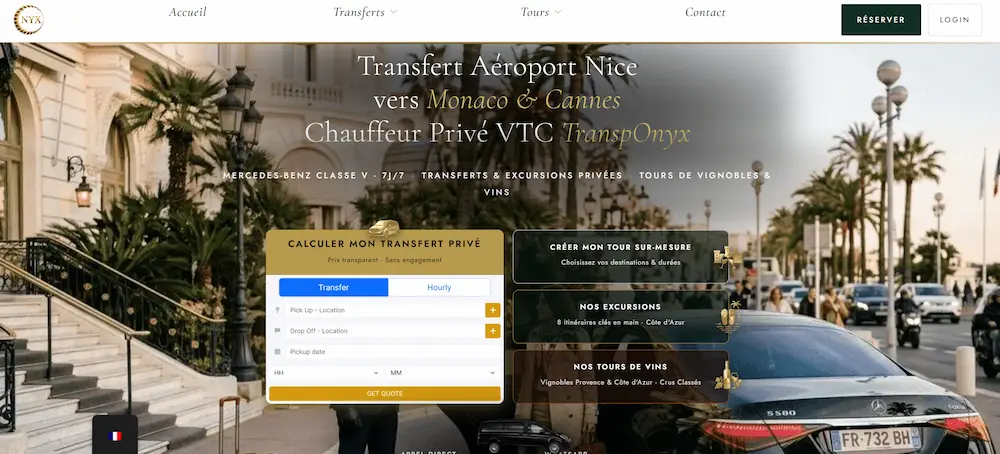
Every booking includes a fixed 2026 rate confirmed at reservation, 60 minutes of free waiting time on airport pickups, and full flight monitoring. Drivers are bilingual VTC professionals, with several also speaking Italian, Spanish, Russian, or Arabic. For travellers attending the Cannes Lions, MIPIM, or Monaco Grand Prix, advance booking at a fixed luxury rate eliminates surge pricing entirely. Contact Transponyx at +33 6 10 30 71 84, via WhatsApp on +33 7 67 78 10 26, or visit transponyx.com to confirm your transfer.
FAQ
What are travel recommendations?
Travel recommendations are personalised suggestions for destinations, activities, or transport options matched to a traveller’s preferences, budget, and timing. They differ from generic lists by accounting for individual constraints and providing a rationale for each suggestion.
Why does explaining travel recommendations improve booking rates?
Platforms that provide one-line explanations for their suggestions increase conversion rates by 18–25%. Transparent reasoning raises perceived usefulness, which is the primary driver of booking intent.
How do AI tools like DeepSeek improve travel advice transparency?
DeepSeek surfaces its reasoning chain rather than presenting conclusions alone. AI systems displaying recommendation logic improve travellers’ ability to evaluate argument quality and source credibility, increasing confidence in the final decision.
What financial buffer should travellers set when planning a trip?
Experts recommend a 10–15% buffer above projected trip costs to cover unexpected disruptions. Financing travel on high-interest credit can inflate the total cost significantly, making dedicated savings the preferable approach.
When should Cancel-for-Any-Reason travel insurance be purchased?
Cancel-for-Any-Reason policies must be purchased within 24 hours to 2 weeks of the initial trip deposit to remain valid. Travellers who delay beyond this window lose access to the broadest cancellation protection available.



0 commentaires