
Reserve a licensed, fixed-price private chauffeur transfer with flight monitoring well before your travel date, and give the booking team your flight number, terminal and the precise resort address rather than relying on a scheduled shuttle. Choose your vehicle by passenger count and ski equipment, and build in extra time beyond the published winter journey minimums. This single step removes most of the risk that disrupts winter transfers between Nice and the Alpine resorts.
What to include when you book: fields every concierge and travel agent must capture
A transfer only runs smoothly when the chauffeur has everything needed before the wheels turn. We ask every concierge, travel agent and direct client for the same core details, because a missing field is the most common cause of a delayed pickup or a driver waiting at the wrong door.
- Flight number, airline and scheduled arrival time, plus the terminal at Nice NCE
- A mobile number for the lead guest, so the driver can send SMS or WhatsApp updates on arrival
- The exact postal address of the hotel, chalet or apartment, not just the resort name, along with the name under which the guest is checking in
- A full passenger list and a precise luggage inventory: suitcases, skis, snowboards, boots and any oversized items
- Confirmation of waiting time and whether flight monitoring is included
Pro Tip: Treat the booking form like a small logistics manifest rather than a reservation: the more specific the address and equipment count, the less room there is for confusion at the kerb.
Flight monitoring and waiting allowances matter most when a flight lands late or a gate changes. Every airport pickup we run includes flight tracking and 60 minutes of free waiting time, with 20 minutes applied to pickups from any other address; to understand what it means and how to vet providers, see our detailed guide on VIP airport transfer. Those margins exist because winter schedules shift more than summer ones, and a chauffeur who already knows the actual landing time never has to guess.
Choosing the right vehicle: matching sedan or van to the booking
Vehicle choice is rarely about preference alone. It is about passengers, luggage and the physical reality of ski equipment taking up more space than a typical weekend bag.
- One to three passengers with light luggage generally suit a Standard Sedan or Business Sedan, the latter offering a more premium finish for corporate or VIP guests
- Four to seven passengers travelling with full ski kit are better served by a Van 7 pax, which stows boards and boots without repeated repacking
- Groups of seven to eight with bulkier equipment, including multiple snowboard bags or childcare gear, need the Van 8 pax
A van reduces handling time at both ends of the journey: ski bags go in once, in a dedicated compartment, rather than being shuffled between a boot and a roof box. For travellers who expect a certain standard regardless of distance, it is worth confirming amenities before departure. Every vehicle in our fleet carries Wi-Fi, phone chargers, chilled water and climate control, so a two-hour mountain approach feels no different from a short airport run along the coast.
Timing and margin: what the published journey times actually mean
Resort-published distances give a useful starting point, but they describe optimal conditions, not a January evening after fresh snowfall. Isola 2000 is commonly listed at roughly 70 to 90 kilometres from Nice, with driving times quoted from about 1 hour 10 minutes to 1 hour 30 minutes, though some winter conditions push that closer to 90 minutes. Valberg sits around 86 kilometres from Nice Airport, with scheduled winter journeys running up to roughly 1 hour 45 minutes. Auron is typically listed at around 90 kilometres, with a journey of about 1 hour 30 minutes under normal winter conditions.
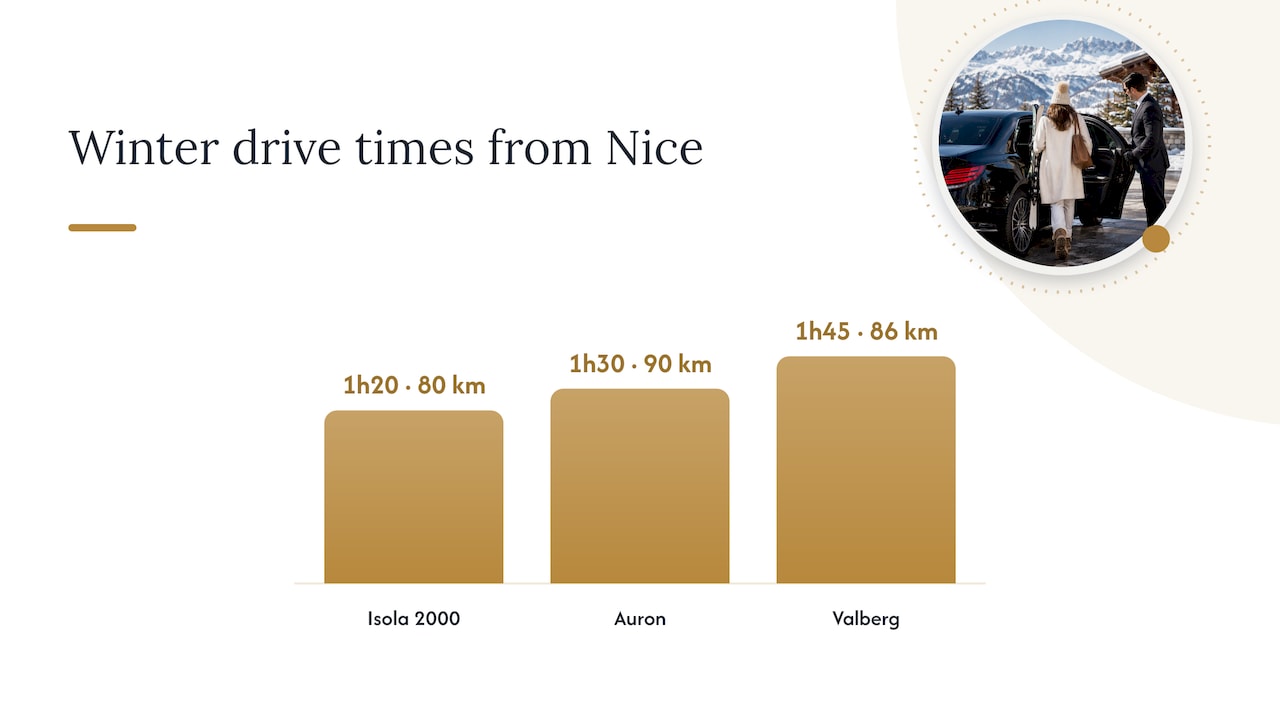
These ranges exist because mountain approaches behave differently from valley roads: the final kilometres into any of the three resorts climb in altitude, narrow in places and depend on how recently they have been cleared. A chauffeur who drives these routes through the season builds in contingency for weather, traffic at ski-season weekends and the extra minutes needed to load or unload ski equipment at the accommodation door.
For airport arrivals, we recommend allowing an extra 30 to 60 minutes beyond the published minimum, particularly for groups travelling with full ski kit or arriving on the first wave of weekend flights. That buffer rarely gets used in full, but when it is needed, it is the difference between a calm arrival and a stressful one.
Resort-specific access and reservation quirks
Each resort has its own last-mile arrangement, and getting this wrong is the easiest way to end up at the wrong drop-off point.
- Isola 2000: the final approach runs through Isola village before the last stretch up to the resort station, a segment of around 17 kilometres that forms part of the published journey time. Always confirm with your chauffeur whether the destination is the village, the station or a specific chalet address, since published ranges can vary depending on which point is used as the reference.
- Auron: access commonly routes via Saint-Étienne-de-Tinée, and public shuttle options operate on a timetable tied to the resort’s seasonal travel scheme, which needs prior reservation rather than turning up on the day.
- Valberg: some scheduled bus services require reservation and online payment before noon the day before travel, a constraint that catches out travellers who assume a shuttle will simply be running when they land.
The instruction that follows from all three is the same: give your chauffeur the exact hotel or chalet address at the time of booking, and confirm whether the agreed meeting point is the resort station or the accommodation door itself. Our Isola 2000 transfer page walks through this specific routing for travellers heading to that resort.
French VTC rules that affect winter transfers and airport pick-ups
Private hire in France operates under a specific legal framework, and it shapes how airport pickups actually work. VTC services carry passengers by prior reservation only; drivers are not permitted to solicit passengers on the street or wait around terminals hoping for a fare, which is precisely why a confirmed booking matters before you land.
- Vehicles must seat between four and nine people including the driver, so it is worth checking your passenger count against the vehicle category at booking stage
- A driver must be able to show proof of reservation at pickup, which is one reason flight monitoring and a confirmed booking reference work together
- Because roaming pickups are not allowed, fixed waiting times exist precisely to give both driver and passenger a clear, lawful window rather than an open-ended wait
These rules are not red tape for its own sake. They are the reason a confirmed, pre-booked transfer is the only way to guarantee a chauffeur will legally be there when your flight lands.
Why a private chauffeur beats a scheduled bus for most winter travellers
A scheduled shuttle can work for a solo traveller on a tight budget who is happy to fit their trip around someone else’s timetable. For most winter travellers, particularly groups, families or business guests, the calculation looks different.
A private chauffeur offers door-to-door delivery and the flexibility to shift pickup time when a flight is delayed or a gate changes at the last minute, something no fixed timetable can accommodate. Luggage goes into a dedicated vehicle once, handled by one driver, rather than being transferred between a bus, a station and a second vehicle at the resort. Fewer touchpoints mean fewer chances for a ski bag to go missing or a connection to be missed.
The simple test is this: if your itinerary has any flexibility requirement at all, whether that is a flight time, a late checkout or an evening dinner reservation, a scheduled service adds risk a private transfer removes.
Safe driving techniques specific to snowy and icy conditions in the Alps
Mountain roads above 1,000 metres behave differently from coastal routes, and the habits that work on a dry road near Nice do not transfer well to a snow-covered pass. Reduced speed is the first adjustment: braking distances on packed snow can run several times longer than on dry tarmac, so gaps between vehicles need to widen accordingly. Gentle, early braking well ahead of a bend avoids the wheel lock that triggers a skid, and steering inputs should stay smooth rather than sudden, since a sharp correction on a loose surface is often what turns a minor slide into a loss of control.
Engine braking, using a lower gear to slow the car rather than relying solely on the brake pedal, helps maintain traction on long descents, a technique that matters more on the switchbacks leading into resorts such as Isola 2000 or Auron than on flatter approach roads. Headlights should stay on through the day in poor visibility, not just at dusk, since low cloud and falling snow cut sightlines quickly on mountain bends.
Experienced winter drivers also read the road surface itself: a matt, slightly grey sheen often signals black ice where wet tarmac would look glossy. Professional chauffeurs who run these routes through the season build this kind of observation into every climb, which is one of the practical advantages of a driver who knows the terrain rather than a one-off rental booking.
How to prepare a car for winter conditions before the drive
Preparation matters as much as technique once the car is on the road. Tyres sit at the top of the list: winter or snow tyres with adequate tread depth provide meaningfully more grip than summer tyres left on through a ski season, and worn tread is one of the most common causes of lost control on compacted snow.
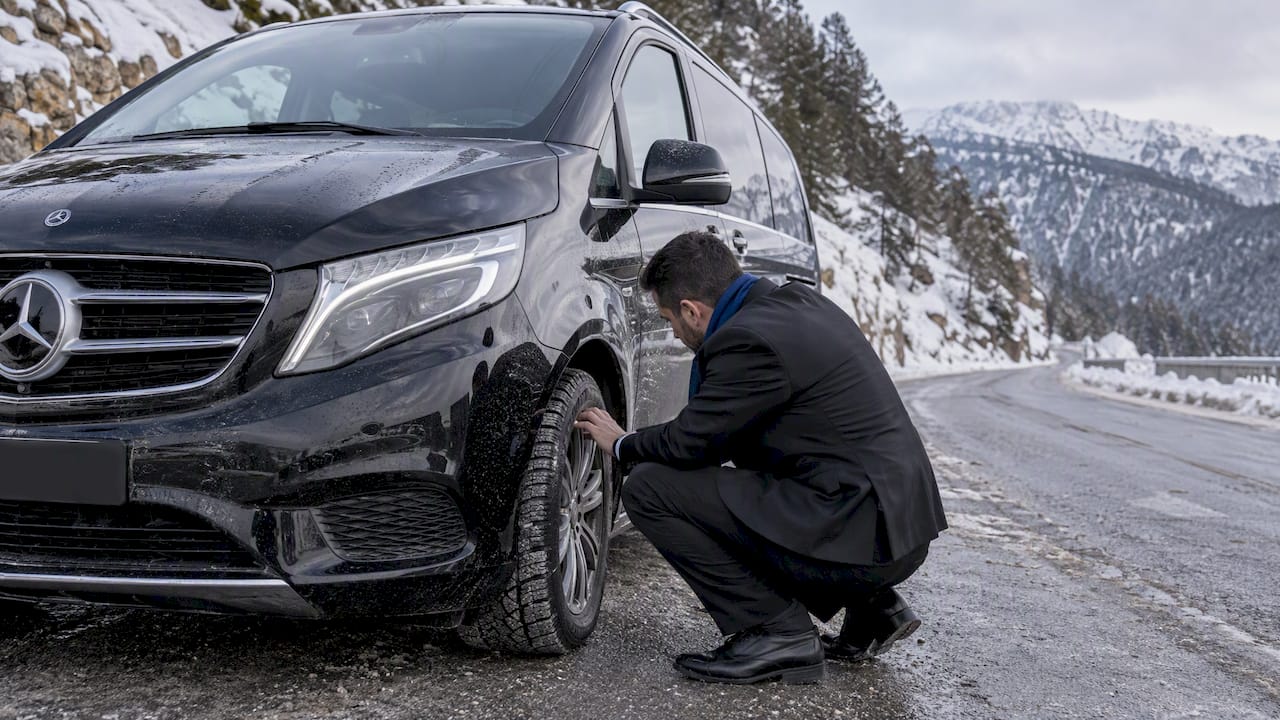
Fluid levels deserve a check before any mountain trip. Screen wash needs a winter-strength mix rated well below freezing, since a frozen reservoir leaves a windscreen unclearable at the worst possible moment, and coolant should carry enough antifreeze to handle sustained sub-zero temperatures at altitude. A battery that struggles in cold weather is worth testing before departure, since low temperatures reduce starting power and winter driving puts heavier demand on heating and lighting systems.
Lights and wipers are easy to overlook until they fail. Checking that all exterior lights work, that wiper blades are not cracked from summer heat, and that washer jets are not blocked takes a few minutes and avoids a genuinely dangerous situation on an unlit mountain road at dusk. None of this replaces professional maintenance, but it is the baseline any driver, professional or otherwise, should confirm before a winter ascent.
Dealing with black ice, snowdrifts and sudden weather changes
Three hazards account for most winter incidents on Alpine approach roads, and each calls for a different response. Black ice forms where road surfaces cool faster than the air around them, commonly on bridges, in shaded valleys and on sections exposed to wind, and it is often invisible until the car is already on it. The safest response is anticipation rather than reaction: easing off the accelerator and avoiding braking or steering changes on stretches known to ice over, since any sudden input is what causes a slide once traction is already reduced.
Snowdrifts build quickly during heavy falls, particularly on exposed sections above the treeline, and can narrow a usable road width without warning. Slowing well before a suspected drift and maintaining a steady line through it, rather than attempting a sudden correction, keeps a vehicle predictable even when the surface beneath it is not.
Weather in the Alps can shift within a single ascent: clear skies at the valley floor say nothing about conditions 800 metres higher. Checking a resort’s own conditions page before departure, rather than relying on forecasts for the coast, is a habit worth building. For travellers using a chauffeur-driven service, this is one of the quieter advantages: a driver who runs the route daily through the season has a feel for where conditions change, built from repetition rather than a single morning’s forecast.
Legal requirements for winter driving across Alpine countries
Winter driving rules are not uniform across the Alpine countries, and anyone self-driving across a border should check the specific requirement for each one rather than assuming a single standard applies everywhere. France requires winter equipment, either fitted snow tyres or carried snow chains, on designated mountain roads during the winter period, with signage marking the zones where the rule applies. Austria requires winter tyres to be fitted during winter months on vehicles using its roads, a stricter standing obligation than the zone-based French approach. Switzerland does not mandate winter tyres nationally in the same way, but strongly recommends them, and insurers may contest liability after an incident if a vehicle was clearly unequipped for the conditions it was driving in.
These differences matter for anyone planning a self-driven leg of a longer Alpine trip, since a requirement that applies in one country may not apply the moment a vehicle crosses a border. For transfers that stay within a single, well-defined route, such as the approach from Nice NCE into Isola 2000, Auron or Valberg, the relevant standard is the French one, and any professional driver operating on those roads should already carry the equipment the law requires for the route.
Emergency kits and what to carry for a winter drive
A basic winter kit costs little to assemble and solves problems that are otherwise disproportionately disruptive at altitude. A torch, a warm blanket, a few hours’ worth of water and some high-energy food cover the scenario of a longer than expected delay on an exposed stretch of road. A fully charged phone and a car charger matter more in the mountains than almost anywhere else, since signal gaps are common and a dead battery removes the ability to call for help at the one moment it might be needed.
Reflective warning triangles and a high-visibility vest are useful if a stop becomes necessary on a narrow mountain road with limited sightlines, and a small ice scraper with de-icer fluid solves the everyday problem of a windscreen glazed over after a cold night. Snow chains, even where not strictly required on a given day, are worth carrying through the winter season on routes that climb through multiple weather zones, since conditions at the top of a pass can differ sharply from those at the bottom.
None of this is exotic advice, but it is the kind of preparation that turns a minor winter inconvenience into nothing more than a short delay, rather than a genuine problem on an unlit road above the treeline.
A concierge’s checklist, from experience
The single most common pitfall we see is a booking that names the resort but not the building: “Isola 2000” tells a driver nothing about which chalet or hotel entrance to find. The fix is simple and worth repeating every time: flight number, terminal, mobile number, exact accommodation address, passenger and luggage count, and the vehicle class that matches them. Confirm all six before the booking is locked, and most winter transfer problems never happen at all.
— Dany
Booking a winter transfer with TranspOnyx
We run chauffeur-driven transfers from Nice NCE to Isola 2000, Auron and Valberg throughout the winter season, with fixed 2026 rates confirmed at the time of booking rather than adjusted for demand. Every airport pickup includes flight monitoring and 60 minutes of free waiting time, with 20 minutes applied to collections from any other address, and the service runs 24 hours a day, seven days a week.
- Fleet choice across Standard Sedan, Business Sedan, Van 7 pax and Van 8 pax, matched to passenger numbers and ski equipment
- Fixed 2026 rates for Nice Airport transfers to Isola 2000, Auron and Valberg, quoted between 240 and 350 euros per vehicle per trajet
- Bilingual, licensed VTC drivers, with some also speaking Italian, Spanish, Russian or Arabic
For groups, corporate accounts or multi-resort itineraries, the quickest route is a direct call to +33 6 10 30 71 84, or a booking confirmed through Transponyx. Our airport transfer page covers the pickup process for anyone wanting the detail before they call.
FAQ
How far is Isola 2000 from Nice Airport?
Isola 2000 is commonly listed at roughly 70 to 90 kilometres from Nice, with driving times ranging from about 1 hour 10 minutes to 1 hour 30 minutes depending on conditions. The final stretch includes a 17 kilometre approach between Isola village and the resort station, which is worth confirming at booking stage.
Do I need snow chains for a private transfer to the Alps?
Winter equipment requirements apply to the vehicle, not the passenger, so a professional chauffeur operating these routes is responsible for carrying the equipment French law requires on designated mountain sections. If you are self-driving instead, check the signed zones along your specific route, since the requirement is location-based rather than blanket.
Can I book a transfer directly to my chalet rather than the resort centre?
Yes, and this is the detail most likely to go wrong if it is left out. Giving the exact postal address of your accommodation, rather than just the resort name, lets the driver confirm in advance whether the drop-off is at the door or at a nearby station.
How much advance notice do I need to book a VTC transfer?
French VTC services operate strictly by prior reservation, so a confirmed booking is required before pickup rather than arranged on the spot. Booking as early as your travel plans allow gives the best chance of securing your preferred vehicle class during peak weeks such as school holidays.
What happens if my flight is delayed in winter?
Flight monitoring is included on every airport transfer we run, so the pickup time adjusts automatically to your actual landing time rather than the original schedule. Airport pickups also include 60 minutes of free waiting time, which covers most delays without any extra charge.


0 commentaires