
Choose the Alpilles if you want a compact, cultivated landscape of olive groves and vineyards where culture and outdoor activity fit into a single day. Choose the Luberon if you want more space, more perched villages and a wilder backdrop of cliffs, gorges and ochre. Both are superb, neither is a wrong answer, and the real decision comes down to how much time you have and how you plan to move between villages. What follows is a practical comparison, written from the Riviera side of the border with Provence, where many of our guests ask the same question before they leave Nice.
Two landscapes, two moods
The Alpilles are a small, low limestone range, and they feel made by hand. Le Figaro’s comparison of the two areas describes a human-shaped countryside of vineyards and olive groves lying between the Rhône, the Durance and the Crau plain, with the Tour des Opies reaching about 500 metres. That modest height is part of the charm. Nothing is remote, the road is never far away, and the light on the pale rock in late afternoon is the kind painters have been chasing for well over a century.
The Luberon is larger and less uniform. The same Figaro piece lists hilltop villages, forests, gorges, cliffs, dry grasslands and ochre formations within it, and anyone who has driven across the massif will recognise the shift in mood as the road climbs from vineyard to cedar and back to red earth. It rewards a slower rhythm. Where the Alpilles feel composed, the Luberon feels expansive, with long views across valleys and a village on almost every ridge.
If you want a single sentence to carry into your planning, it is this: the Alpilles are intimate and tidy, the Luberon is broader and more varied. Which of those you prefer is a matter of temperament rather than quality.
The villages worth your time
Villages are the main reason people come, so this is where the two areas differ most in practice.
In the Alpilles
Saint-Rémy-de-Provence is the natural centre, with its markets, cafés and plane-tree squares. Just outside it sits Saint-Paul-de-Mausole, the former monastery associated with Van Gogh’s stay. Les Baux-de-Provence, built on its rocky spur beside the ruins of a medieval fortress, is the most dramatic setting of the lot and also the busiest. Le Figaro also points travellers towards Maussane-les-Alpilles, Eygalières and Le Paradou, which are quieter, more agricultural and good for a long lunch.
The Alpilles’ strength is concentration. The places above sit close together, so a day can include a morning market, a monastery, a fortress and an olive-oil mill without feeling hurried.
In the Luberon
The Luberon offers a longer list. Le Figaro names Lourmarin, Cucuron, Bonnieux, Lacoste, Ménerbes, Oppède-le-Vieux, Gordes and Roussillon as the key choices, and suggests Rustrel, Gargas or Roussillon for the ochre landscapes. Gordes and Roussillon draw the crowds, for good reason: one is a stack of pale stone houses against the hillside, the other a village of warm reds and oranges. Lourmarin and Cucuron are gentler, with fountains, shade and a more lived-in feel. Ménerbes, Lacoste and Bonnieux sit along ridges that make for some of the best driving in the region.
The practical consequence is that the Luberon is a place to choose from rather than to see in full. Two or three villages done well beat six done quickly.
What you actually do there
In the Alpilles, the outdoor menu is broad for such a small range: hiking, horse riding, mountain biking, climbing and cycling circuits, according to Le Figaro. Those pursuits pair easily with the cultural stops, which is why the same article singles out the Alpilles as the better choice for a day that mixes sightseeing and activity. Distances are short enough that you can walk in the morning and still reach a tasting or a gallery before closing.
The Luberon leans towards slower, longer outings. Walkers can explore the ochre formations and gorges or enter the cedar forest, and cyclists are well served. The Michelin Guide’s feature on the Luberon valley notes that visitors commonly come for the ancient villages and for cycling, with road, mountain and electric-bike options all available. Electric bikes in particular make the hillier stretches realistic for a mixed group.
Markets are worth building a day around. The same Michelin feature highlights the Saturday market in Apt, the Tuesday morning market in Gordes and the Friday morning market in Lourmarin. Markets run to a weekly pattern, so check the current day and hours with the local tourist office before you fix your route.
Seasonality matters too. If your heart is set on purple fields, the Luberon area sits within the wider Provence lavender belt, and we have written separately on the Provence lavender season and how a chauffeur helps with it. Timing there is everything.
Wine is a thread through both areas. Estates in the Alpilles and across the Luberon welcome visitors, and a tasting changes the whole logic of a day, because nobody wants to be the person with the car keys. Our Onyx Wine Collection exists for precisely this reason.
Getting around: where a car earns its place
This is the question that decides more itineraries than any list of villages.
The Alpilles are the easier area without your own transport, up to a point. Saint-Rémy-de-Provence lies 24 km south of Avignon, reached by the D571 and D34, according to a cycling guide produced by Bouches-du-Rhône Tourisme, which also refers visitors to LePilote for public-transport timetables. Tripstou’s Provence guide describes Saint-Rémy as partly reachable by bus from Avignon and as a natural base, while Les Baux is harder to reach without a car.
Once you are inside the range, distances are short. A 2025 mobility guide to the Alpilles gives approximate road times of 15 minutes between Saint-Rémy and Les Baux, 25 minutes between Saint-Rémy and Arles, and 15 minutes between Arles and Fontvieille. The same guide calls a car the most practical way to explore freely, recommends parking on the edge of villages in summer, and warns that roads towards Les Baux can become congested between 10:00 and 16:00 in high season. That last point is useful. A driver who knows to arrive early, or to come in late in the afternoon, saves you an hour of queuing in a hot car.
The Luberon is more dispersed. Tripstou’s assessment is that a car is useful for linking its villages and sights, and that matches what we hear from guests who tried it by public transport and gave up after a day. Villages are separated by winding roads, and the best ones are not on any single line. If you intend to see Gordes, Roussillon and Lourmarin in one outing, you need either a rental car with a patient designated driver or a private chauffeur.
A chauffeur has one particular advantage here. Hill villages have tight lanes and limited parking, and a driver who drops you at the top and collects you from the right gate removes the most tiresome part of the visit. For a group, our Mercedes V-Class seating guide explains how the Van 7 pax and Van 8 pax differ once luggage is counted in.
How long to allow, and whether to do both
There is no official rule for this, so what follows is editorial judgement drawn from how the two areas are laid out.
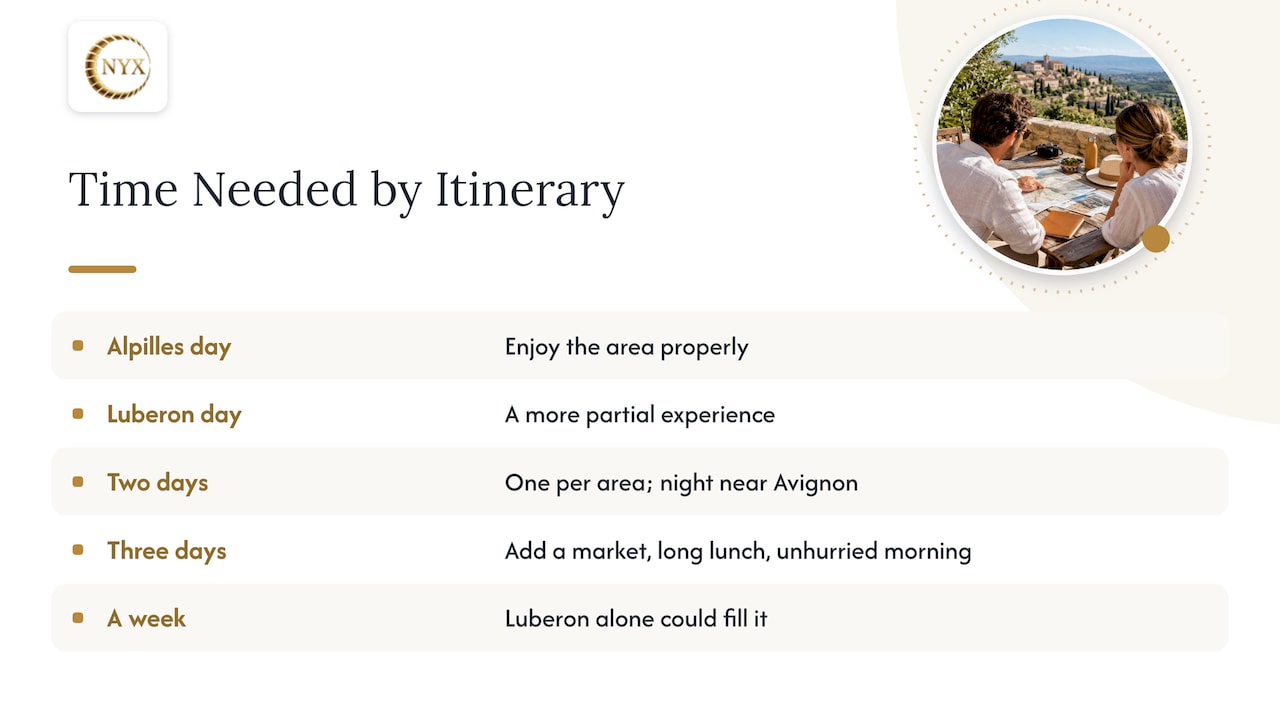
A single day is enough to enjoy the Alpilles properly. Start in Saint-Rémy for the market and coffee, visit Saint-Paul-de-Mausole, reach Les Baux before the midday congestion window, and finish with a slow drive through Maussane and Le Paradou. You will feel you have seen the area, because its heart really is that compact.
A single day in the Luberon is a more partial experience. You can do it well by choosing one corridor: for example Gordes, then Roussillon for the ochre, then a late lunch in a quieter village such as Bonnieux or Lacoste. Trying to add Lourmarin and Cucuron to that same day means more time in the vehicle than out of it.
Two days allow a sensible split, one for each area, ideally with a night in between near Avignon or Saint-Rémy. Three days let you add a market, a long lunch and an unhurried morning. Beyond that, the Luberon alone could fill a week.
Can you do both on one trip? Yes, and many visitors do. The two ranges are neighbours, and the sensible approach is to treat them as separate days rather than weave them together in a rush. If you are choosing a base, our comparison of Aix-en-Provence and Avignon as bases sets out how each city works for onward travel.
Our point of view
We drive guests from Nice every week, and most are not choosing between two Provence regions out of curiosity. They have a limited number of days on the Riviera and want one clean excursion away from the coast. Our advice is shaped by that.
First, do not underestimate how tiring a day of self-driving in unfamiliar hills can be, especially after a flight. Second, the best Provence days we see are the ones with a firm plan for only three or four stops, with lunch treated as a destination rather than a pause. Third, guests who want wine should have somebody else at the wheel, and this is a plain safety point rather than a sales one.
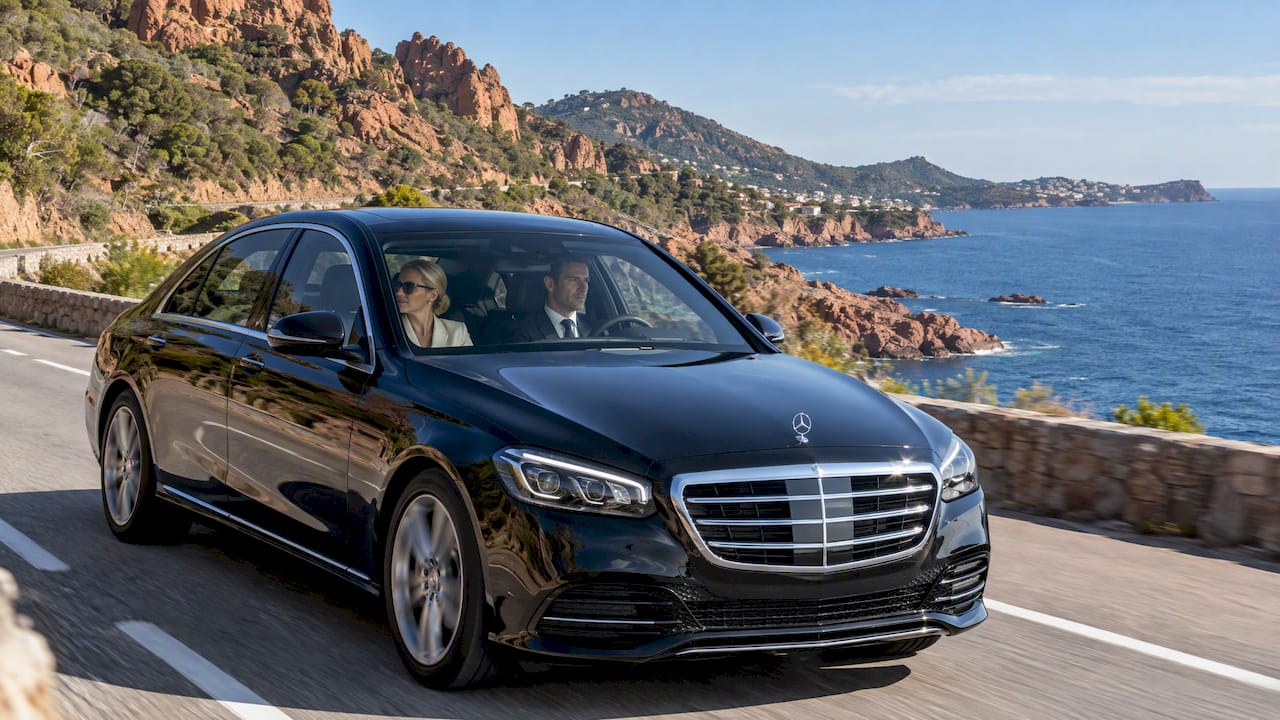
Our drivers are licensed VTC professionals, bilingual in English and French at a minimum, and our fleet is entirely Mercedes-Benz: Standard Sedan and Business Sedan for up to three passengers, Van 7 pax and Van 8 pax for larger parties. Every vehicle has Wi-Fi, air conditioning, chilled water and phone chargers. For a Provence day, the practical benefit is simple: you spend the long motorway stretch resting, working or reading, and arrive with energy left for the villages.
If you have to pick one area from the Riviera, we usually point first-timers to the Alpilles when time is tight, and to the Luberon when they have at least two days and an appetite for scenery.
— Dany
Arranging Provence from the French Riviera
Provence is a long-distance run from Nice rather than a short excursion, so it is best planned in advance. We arrange private chauffeur journeys on a fixed-rate basis, confirmed at booking, with no surge pricing. For a day that begins at Nice Côte d’Azur Airport (NCE), or at a hotel in Monaco, Cannes or Antibes, tell us your number of passengers, your luggage and the villages you would like to see, and we will confirm the vehicle and the rate. Provence routes do not carry a published price on our site, so we quote them individually.
For a more flexible day, our bespoke private tours let you set the pace and the stops. Published 2026 rates for tours are 70 to 100 euros per hour for a tailored tour, 350 to 500 euros for a half-day tour of five hours, and 630 to 900 euros for a full day of nine hours, per vehicle. You can see the full range on our Onyx Tours page. If you are arriving by air first, our airport transfer service from Nice includes flight monitoring and 60 minutes of free waiting time on airport pickups. To discuss a Provence plan, call +33 6 10 30 71 84 or visit transponyx.com.
For context on coastal work, our 2026 fixed rates for single journeys from Nice airport run from 90 to 140 euros to Monaco and 90 to 150 euros to Cannes, and a Nice to Cannes private chauffeur journey is 75 to 110 euros, all per vehicle. The Riviera is where most guests start, and Provence is where many of them choose to spend a day away from it.
Making the choice
A few situations make the decision clearer than a general comparison can.
If you are travelling with older relatives or small children, the Alpilles are kinder. Distances are short, the terrain is gentler and a day does not demand much transit time. If you are a photographer or a walker, the Luberon gives more variety, from ochre cliffs to forest paths. If your trip is built around a long lunch and a few well-chosen visits, either works, but the Alpilles make it easier to avoid feeling rushed.
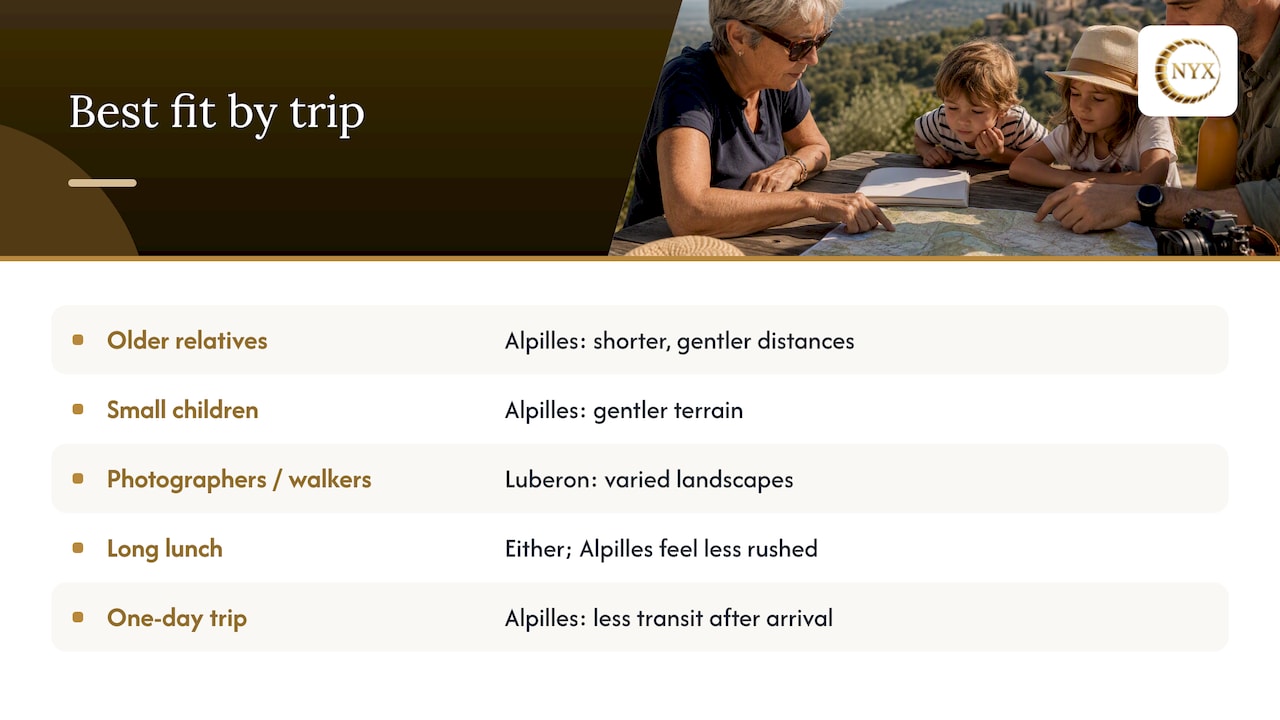
If you are coming from the Riviera for just one day, the Alpilles are the more realistic target, because you spend less time in transit once you arrive. If you can give Provence a full weekend, the Luberon becomes the better prize.
Business travellers who have a free day around a major Riviera event, such as MIPIM, the Cannes Film Festival, Cannes Lions or MIPCOM, often ask for something quiet and scenic rather than a second round of meetings. For that purpose the Luberon’s villages and long views serve better, though the Alpilles are easier if the free window is only a morning and an afternoon. If your Riviera plans also include the coast, a half-day to Èze village is a convenient alternative to a full Provence trip.
Frequently asked questions
Is the Luberon or the Alpilles better for a first visit to Provence?
For a short first visit, the Alpilles are the easier choice, as the attractions are close together and a day can combine culture and outdoor activity. If you have two or more days and want the greatest choice of perched villages, the Luberon offers more. Le Figaro’s comparison reaches the same conclusion.
Do I need a car in the Luberon and the Alpilles?
In the Alpilles you can reach Saint-Rémy by bus from Avignon, but Les Baux is harder without a car. In the Luberon the villages are spread out, so a car or a private driver is far more practical. A chauffeur also removes parking worries in busy hill villages.
Can I visit both the Luberon and the Alpilles in one day?
It is possible on paper, but it is not a pleasant way to see either. Each area has enough villages to fill a day, and the roads between them are slow. We recommend one area per day, or a night in between if you can manage it.
Can TranspOnyx take me from Nice to Provence?
Yes. We offer long-distance transfers to Provence from Nice and the wider Riviera, with licensed bilingual drivers and Mercedes-Benz vehicles. Provence journeys are quoted at booking and the rate is confirmed in advance. You can reach us on +33 6 10 30 71 84.
Which area is better for wine?
Both have estates open to visitors, so the choice depends on your route rather than the quality of the wine. The Alpilles suit a short tasting inside a compact day, while the Luberon suits a longer circuit. Either way, arrange a driver so that everyone can taste.

0 commentaires