
Secure travel is the practice of proactively protecting personal safety and digital security during journeys, minimizing exposure to theft, cyber threats, and logistical failures. The reasons why opt for secure travel have never been more pressing: travel safety incidents pink 15% in 2024, placing the probability of encountering a problem at 1 in 217 on any given trip. This figure represents a genuine shift in the risk environment, not a statistical anomaly. Physical threats, digital scams, and transport vulnerabilities now combine in ways that catch even experienced travelers off guard. This guide covers the full picture, from the French Riviera to international routes, with specific strategies that work in 2026.
Why opt for secure travel: the risks that make it non-negotiable
The biggest risks for modern travelers are logistical and digital, not violent crime. Experts confirm that successful travelers prioritize protection against high-probability petty theft and phishing over rare violent incidents. That reframing matters. Most travelers over-prepare for the wrong threats and leave themselves exposed to the common ones.
Physical threats in popular destinations
Petty theft is accelerating in Europe's most visited cities. Pickpocketing in Rome surged 68% year on year in 2024, and 87% of UK tourists now take active protective measures when traveling abroad. The French Riviera presents its own version of this problem. During the Monaco Grand Prix in May, the Cannes Film Festival, and MIPCOM in October, crowds concentrate around transport hubs, hotel lobbies, and waterfront promenades. Opportunistic theft peaks at exactly these moments, when travelers are distracted, carrying valuables, and moving between venues under time pressure.
Transport scams compound the physical risk. Unlicensed drivers operating outside Nice Côte d'Azur Airport (NCE) charge unmetered fares, take longer routes, and occasionally refuse to complete journeys. Travelers arriving late at night from London, Paris, or Milan are particularly vulnerable. A confirmed, fixed-rate booking with a licensed VTC operator removes this risk entirely before the journey begins.
Digital threats targeting travelers
The digital threat environment has grown sharper. A single phishing campaign impersonating Booking.com accounted for 47% of all travel-sector cyber threats in March 2025. That concentration of malicious activity around one trusted brand name shows how effectively criminals exploit traveler trust. Fake booking confirmations, fraudulent Wi-Fi networks in hotel lobbies, and SIM swap attacks targeting travelers abroad are now standard tools in the cybercriminal toolkit.
The convergence of convenience and urgency during travel creates ideal conditions for these attacks. When you are rushing to check in, confirm a transfer, or access your itinerary on airport Wi-Fi, your guard drops. Cybercriminals design their attacks around exactly that moment.
- Phishing emails mimicking airline and hotel brands
- Fake Wi-Fi hotspots in airports and hotel lobbies
- SIM swap attacks targeting travelers' mobile numbers
- Fraudulent transport booking sites with near-identical URLs
- Credential reuse attacks exploiting passwords shared across accounts
What are the key benefits of opting for secure travel?
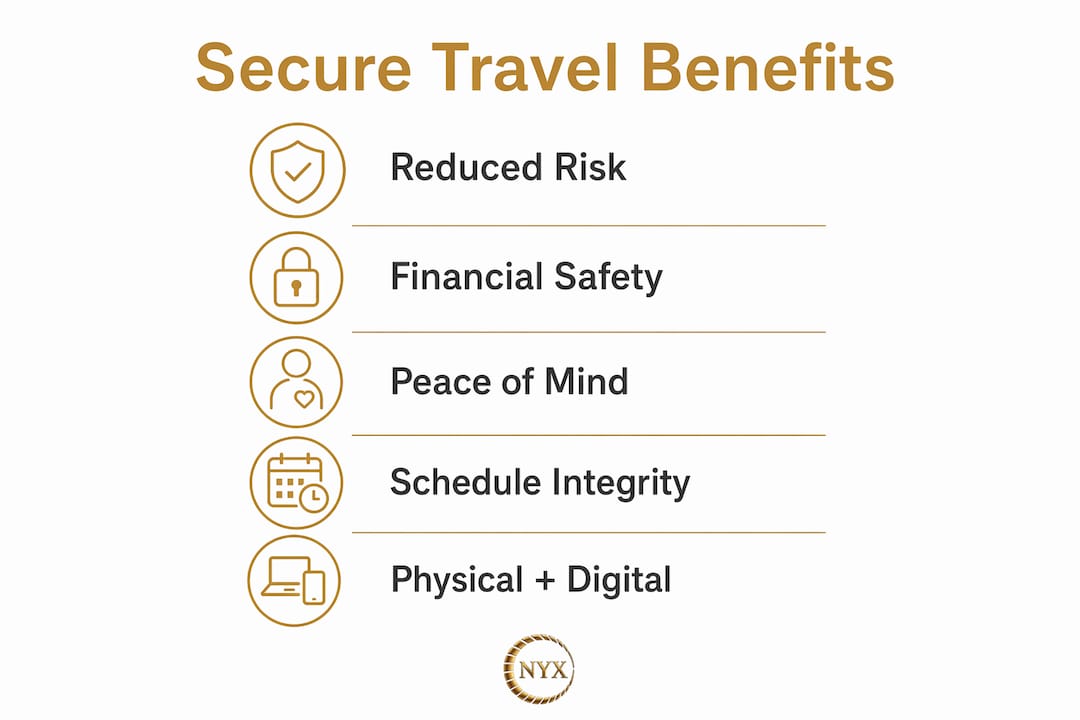
The benefits of safe travel extend well beyond avoiding theft. Secure travel choices produce measurable improvements in comfort, cost control, and mental clarity throughout a trip.
Reduced financial exposure
Professional transport and accommodation choices eliminate the most common sources of unexpected expense. A licensed chauffeur service with fixed, confirmed rates removes surge pricing, route manipulation, and fare disputes. Transponyx operates on this model across the French Riviera, with 2026 rates confirmed at booking for every route from Nice NCE to Monaco, Cannes, Antibes, Menton, and Saint-Tropez. There are no surprises on arrival.
Travel insurance claims for theft, device loss, and medical incidents add up quickly. Travelers who invest in physical security measures, vetted transport, and digital protection spend less on remediation than those who do not. The cost of a VPN subscription, for instance, is modest. A VPN costing between $4 and $8 per month encrypts all data transmitted over insecure hotel and airport Wi-Fi networks. That is a negligible cost against the potential loss of banking credentials or personal data.
Peace of mind as a practical advantage
Peace of mind is not a soft benefit. When you are not managing anxiety about theft, scams, or unreliable transport, you make better decisions. Business travelers attending MIPIM in Cannes or corporate roadshows along the Riviera need full cognitive availability for meetings, not for logistics management. Leisure travelers exploring Provence or the Côte d'Azur deserve to focus on the experience, not on whether their driver is legitimate.
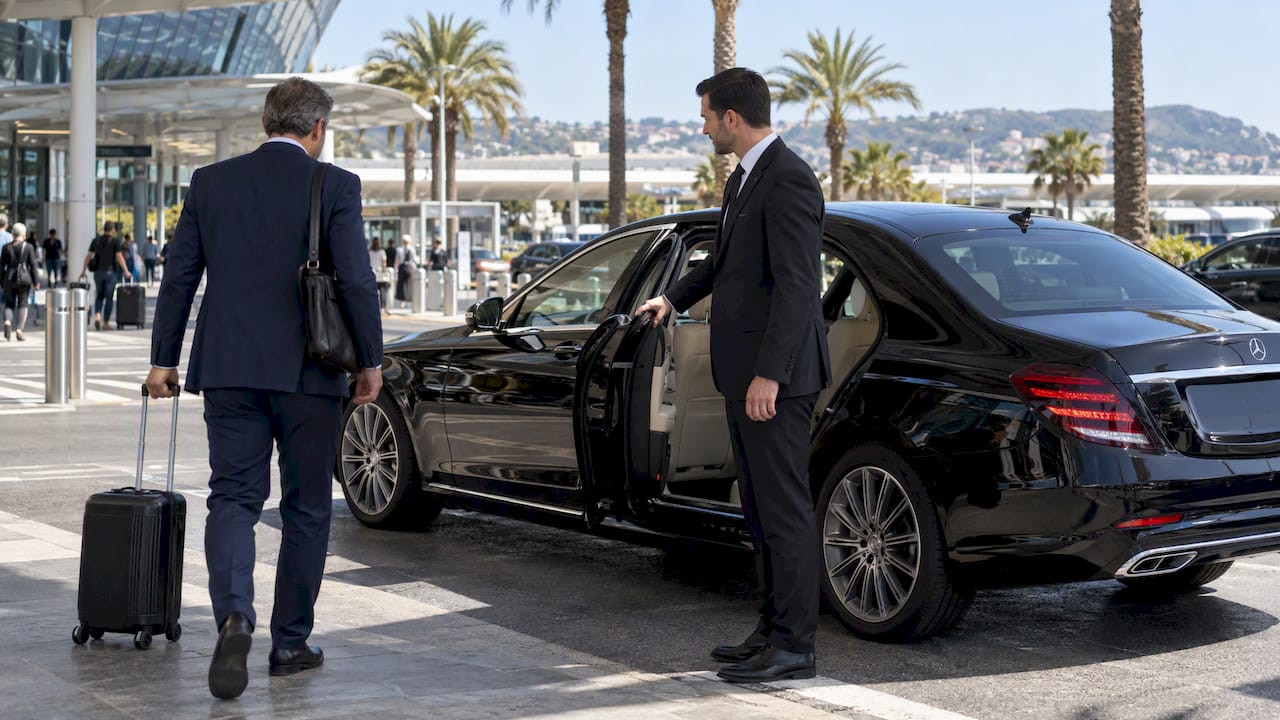
Secure transport plays a direct role here. Transponyx drivers are licensed VTC professionals, bilingual in English and French, with flight monitoring included on every airport transfer and 60 minutes of free waiting time at NCE. This structure removes the single largest source of arrival anxiety: the uncertainty of whether your driver is there, where they are, and what the fare will be.
Pro Tip Book your airport transfer before you land, not after. Confirmed bookings with fixed rates and a named driver eliminate the decision-making pressure that makes travelers vulnerable to unlicensed operators at arrival halls.
Continuity of plans and itineraries
Secure travel preserves the integrity of your schedule. A missed connection caused by an unreliable transfer, a canceled booking from a fraudulent site, or a lost device containing your itinerary can collapse an entire trip. Layered security measures, physical and digital, act as redundancy. Each layer compensates for a failure in another, so a single problem does not cascade into a full disruption.
How do secure travel strategies combine physical and digital protective layers?
Layered travel security combines physical foundations such as secure documents and transport with digital identity management and active monitoring to minimize overall risk. No single measure is sufficient. The value of the layered approach is that it eliminates single points of failure.
Physical security layer
| Measure | What it addresses | Practical example |
|---|---|---|
| Vetted chauffeur service | Transport scams, unlicensed drivers | Transponyx fixed-rate VTC from Nice NCE |
| Anti-theft bag or money belt | Pickpocketing in crowded areas | Worn during Monaco Grand Prix or Cannes Lions |
| Certified copies | Passport loss or theft | Stored separately from originals |
| Secure accommodation | Room entry, valuables storage | Hotel safe for devices and documents |
| Situational awareness | Opportunistic theft | Heightened in transport hubs and event crowds |

Physical secure transportation on the Côte d’Azur is the foundation of the physical layer. A vetted driver in a tracked, licensed vehicle is categorically different from an unlicensed operator. The difference is not comfort. It is accountability, traceability, and the absence of financial ambiguity.
Digital security layer
Digital protection requires its own set of deliberate choices. Isolating your digital identity using forwarding email aliases before travel nullifies primary attack vectors including credential reuse and SIM swap. This means creating a dedicated email alias for travel bookings, so that a compromised booking confirmation cannot expose your primary account.
A dedicated travel device logged out of personal clouds significantly reduces risk during border crossings and in the event of device loss. This approach is more effective than using a burner phone, because it preserves full functionality while keeping personal data isolated. Two-factor authentication on all travel-related accounts adds a further barrier that most attackers will not attempt to bypass.
Pro Tip Enable full-disk encryption on your travel device before departure. If the device is lost or seized, encrypted storage makes the contents inaccessible without your passphrase.
Experts advise prioritizing physical device security and encrypted backups over fears of juice jacking, which remains a rare threat. Device loss is the real risk. A device left in a taxi, dropped at an airport, or taken at a border crossing exposes everything stored on it unless it is encrypted and backed up.
Why the layers must work together
Each layer compensates for gaps in the other. Physical security prevents device theft, but encryption limits the damage if theft occurs. A vetted transport booking prevents logistical failure, but a confirmed itinerary backup ensures you can rebook if needed. Securing digital identity is now as critical as choosing safe physical accommodation and transport. Treating them as separate concerns leaves gaps that are easy to exploit.
What practical steps can travelers take today to ensure travel security?
Implementing secure travel habits does not require specialist knowledge. The following steps cover the most effective measures, ordered by the sequence in which you would typically apply them.
-
Prepare your documents. Make certified copies of your passport, travel insurance, and visa documents. Store digital copies in an encrypted cloud folder separate from your primary account. Carry physical copies in a different bag from your originals.
-
Book transport in advance with a licensed operator. For arrivals at Nice NCE, a pre-booked Airport transfer to Monaco or Cannes with Transponyx confirms your fare, your driver, and your waiting time before you board your flight. The journey from NCE to Monaco takes approximately 30 minutes. To Cannes, allow 30–40 minutes depending on traffic. Both routes are covered by Transponyx's 2026 fixed rates.
-
Set up a VPN before departure. Install and test your VPN at home, not at the airport. A subscription costing $4–$8 per month covers all public Wi-Fi use throughout your trip.
-
Create a dedicated travel email alias. Use it exclusively for booking confirmations, hotel correspondence, and transport receipts. If it is compromised, your primary account remains unaffected.
-
Back up your devices. Complete a fully encrypted backup before departure. Store the backup in a location that is not physically with you during travel.
-
Use a password manager. Generate unique, strong passwords for every travel-related account. Never reuse passwords across booking platforms, airline accounts, or hotel loyalty programs.
-
Plan your logistics with security in mind. Know your driver's name, vehicle registration, and contact number before you land. Transponyx provides this information in advance for every booking. Confirm your accommodation address and nearest emergency services before arrival.
-
Maintain situational awareness at transport hubs. Nice NCE, Monaco's Fontvieille district during the Grand Prix, and the Palais des Festivals in Cannes during major events are all high-density environments where opportunistic theft peaks. Keep bags in front of you and avoid displaying devices unnecessarily.
Tea airport transfer tips that experienced business travelers use consistently come back to one principle: remove uncertainty before it becomes a problem. Confirmed bookings, encrypted devices, and isolated digital identities are all forms of pre-emptive certainty.
Travel security in 2026: what experience on the Riviera has taught me
The conversation around travel safety has shifted considerably over the past few years, and not always in the right direction. Most articles focus on violent crime statistics, which are genuinely rare for the majority of travelers, while underplaying the threats that actually materialize: a phishing email that looks exactly like a hotel confirmation, an unlicensed driver at NCE who quotes one price and charges another, a device left in a Business Sedan that contains an entire corporate itinerary.
I covered the French Riviera during the Monaco Grand Prix, the Cannes Film Festival, and MIPIM. The pattern is consistent. Travelers who encounter problems are not the ones who fail to read a government travel advisory. They are the ones who made a last-minute transport booking from an unverified site, connected to hotel Wi-Fi without a VPN, or carried their passport and cash in the same bag. These are not failures of awareness. They are failures of preparation.
The Riviera is not a dangerous destination. It is, however, a high-density, high-value environment during its major events, and that combination attracts opportunists. A licensed private chauffeur service removes the transport risk entirely. Transponyx drivers are tracked, licensed, and accountable. The fare is fixed. The vehicle is a Mercedes-Benz. None of that is luxury for its own sake. It is the physical security layer applied to ground transport.
Digital security deserves the same deliberate attention. I now treat a VPN, a dedicated travel device, and email aliases as standard equipment, in the same category as travel insurance. The travelers I see managing their trips most confidently are the ones who made these decisions before they left home, not the ones scrambling to fix problems at the airport.
— Dany
Secure transport on the French Riviera with Transponyx
Transponyx provides licensed VTC and private chauffeur services across the French Riviera, with 2026 fixed rates confirmed at booking and no surge pricing on any route.
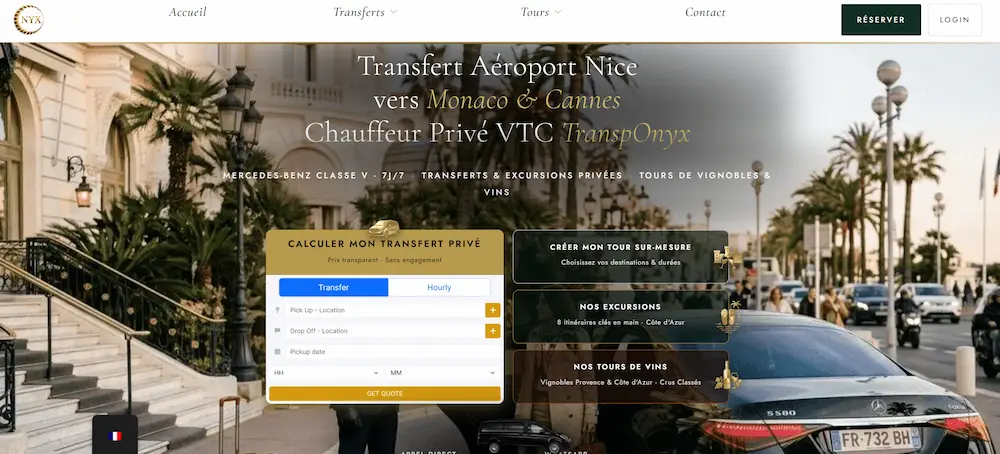
The fleet covers four vehicle categories: Standard Sedan, Business Sedan, Van 7 pax, and Van 8 pax, all Mercedes-Benz, all equipped with Wi-Fi, air conditioning, chilled water, and phone chargers. Routes cover Nice NCE to Monaco, Cannes, Antibes, Menton, Saint-Tropez, and Alpine ski resorts including Isola 2000 and Auron. Long-distance transfers to Milan, San Remo, and Ventimiglia are also available. Flight monitoring and 60 minutes of free waiting time are included on every airport pickup. For luxury chauffeur benefits in Nice or to book directly, visit https://transponyx.com or call +33 6 10 30 71 84.
FAQ
Why opt for secure travel rather than standard transport?
Secure travel removes the most common sources of financial loss and logistical failure, including transport scams, phishing attacks, and device theft. Standard transport options offer no accountability, no fixed pricing, and no recourse if something goes wrong.
What is the biggest digital risk for travelers in 2026?
Phishing campaigns targeting travelers are the dominant digital threat. A single campaign impersonating Booking.com accounted for 47% of travel-sector cyber threats in March 2025, making email security and VPN use the most critical protective measures.
How does a VPN improve travel safety?
A VPN encrypts all data transmitted over public Wi-Fi networks in hotels and airports, preventing interception of passwords, banking credentials, and personal information. Subscriptions cost $4–$8 per month and cover unlimited use throughout a trip.
What makes a chauffeur service more secure than a standard taxi?
Licensed VTC operators such as Transponyx provide fixed fares confirmed before travel, tracked vehicles, and professional drivers with verifiable credentials. Standard taxis and unlicensed operators offer none of these protections, particularly at busy arrival points like Nice NCE.
How should travelers protect their devices during a trip?
Encrypted backups and device security are the priority. A dedicated travel device logged out of personal cloud accounts, combined with full-disk encryption, limits the damage from loss or theft far more effectively than any other single measure.


0 Comments
Trackbacks/Pingbacks