
A group transfer is defined as the coordinated movement of multiple passengers in a single pre-booked vehicle or fleet of vehicles, traveling from a shared origin to a shared destination. On the French Riviera, where events like the Cannes Film Festival, Monaco Grand Prix, and MIPIM draw thousands of delegates, corporate teams, and leisure travelers simultaneously, getting this right is not optional. Transponyx, a licensed VTC operator based in Nice, provides group transfer services across the Côte d'Azur, covering routes from Nice Côte d'Azur Airport (NCE) to Monaco, Cannes, Antibes, Menton, and Saint-Tropez. This guide to group transfers covers everything from assessing your group's needs to communicate with participants on the day.
What does a guide to group transfers actually cover?
Group transfers differ from individual bookings in one fundamental way: every decision you make affects multiple people at once. A missed pickup, an undersized vehicle, or a vague meeting point creates a cascade of delays that no single passenger can resolve alone. The stakes are higher, and the planning must be proportionally more thorough.
The industry term used by licensed VTC operators and transport planners is “group ground transport coordination.” The phrase covers vehicle selection, route planning, timing buffers, and passenger communication. This article uses both terms interchangeably, but the underlying discipline is the same regardless of what you call it.
For the French Riviera specifically, group transport planning carries additional complexity. Narrow coastal roads, restricted loading zones in Cannes and Monaco, and the sheer volume of simultaneous arrivals during major events all demand local knowledge. A planner organizing transfers for a corporate delegation attending Cannes Lions in June, for example, faces very different conditions from one arranging a wedding party transfer from Nice NCE to a villa in Antibes in September.
How do you assess your group's size, luggage, and event needs?
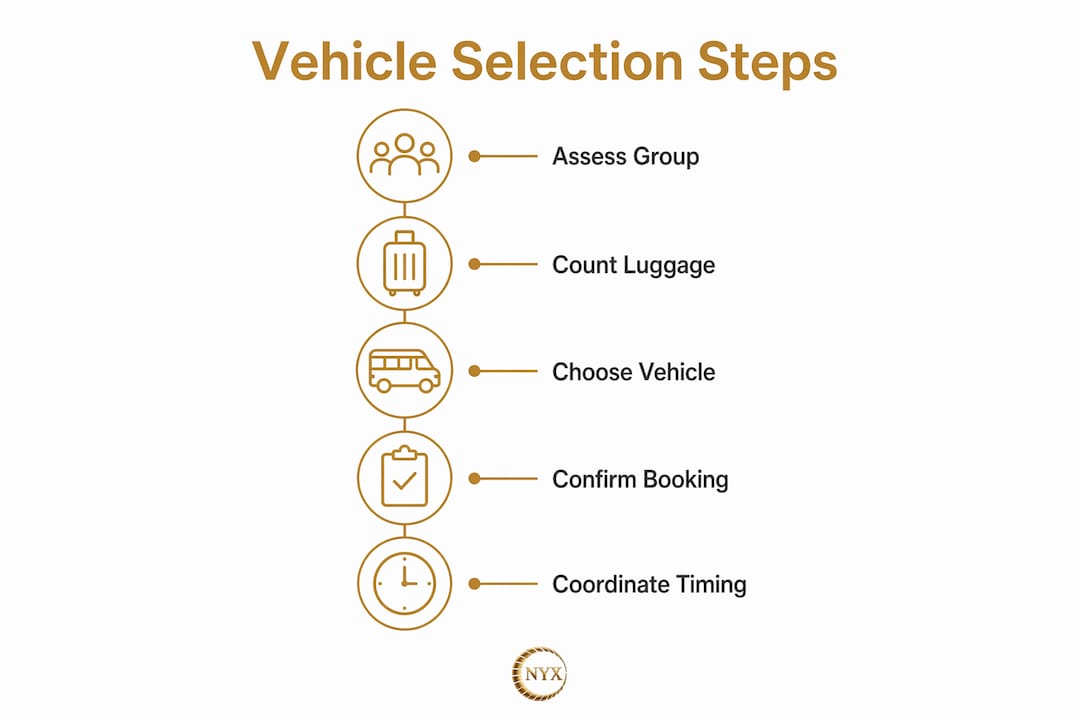
The first step in organizing group transportation is an honest count of two things: passengers and luggage. Most planners count heads correctly but underestimate bags. Luggage volume accounts 25–40% more space than the passenger count alone suggests, particularly for multi-day conferences or weddings where formalwear and large cases are standard. That figure changes every vehicle calculation you make.
Group type also determines what the transfer needs to deliver beyond simple transport. A corporate delegation attending MIPIM in Cannes expects Wi-Fi, phone chargers, and a bilingual driver who can brief them on the schedule. A wedding party traveling from Nice NCE to a reception in Saint-Tropez needs luggage space, child seats if applicable, and a driver who understands that timing is ceremonial, not merely logistical. Conference attendees at MIPCOM in Cannes may need staggered pickups across multiple hotels.
The table below maps common group profiles to the appropriate vehicle from Transponyx's fleet.
| Group type | Passengers | Luggage profile | Recommended vehicle |
|---|---|---|---|
| Couple or executive pair | 1–3 | Light carry-on | Standard Sedan |
| Small corporate team | 1–3 | Laptop bags, 1–2 cases | Business Sedan |
| Family or small leisure group | 4–7 | Mixed, including large cases | 7-passenger van |
| Wedding party or conference group | 5–8 | Heavy, including formalwear bags | Van for 8 people |
| Split corporate delegation | 6–16 | Mixed | Two vehicles in convoy |
Pro Tip Count every piece of luggage before you book, not after. A group of six traveling from Nice NCE with six large suitcases and six carry-ons will fill a Van 7 pax to capacity, leaving no room for comfort. The Van 8 pax is the correct choice in that scenario.
Which vehicle should you choose for group comfort and efficiency?
Transponyx operates an exclusively Mercedes-Benz fleet in four categories. The Standard Sedan carries up to three passengers and suits small groups traveling light. The Business Sedan also carries up to three passengers but offers a premium interior finish, making it the right choice for executive arrivals or client-facing transfers. The Van 7 pax accommodates up to seven passengers, while the Van 8 pax extends that to eight. All four vehicle types include Wi-Fi, air conditioning, chilled water, and phone chargers as standard.
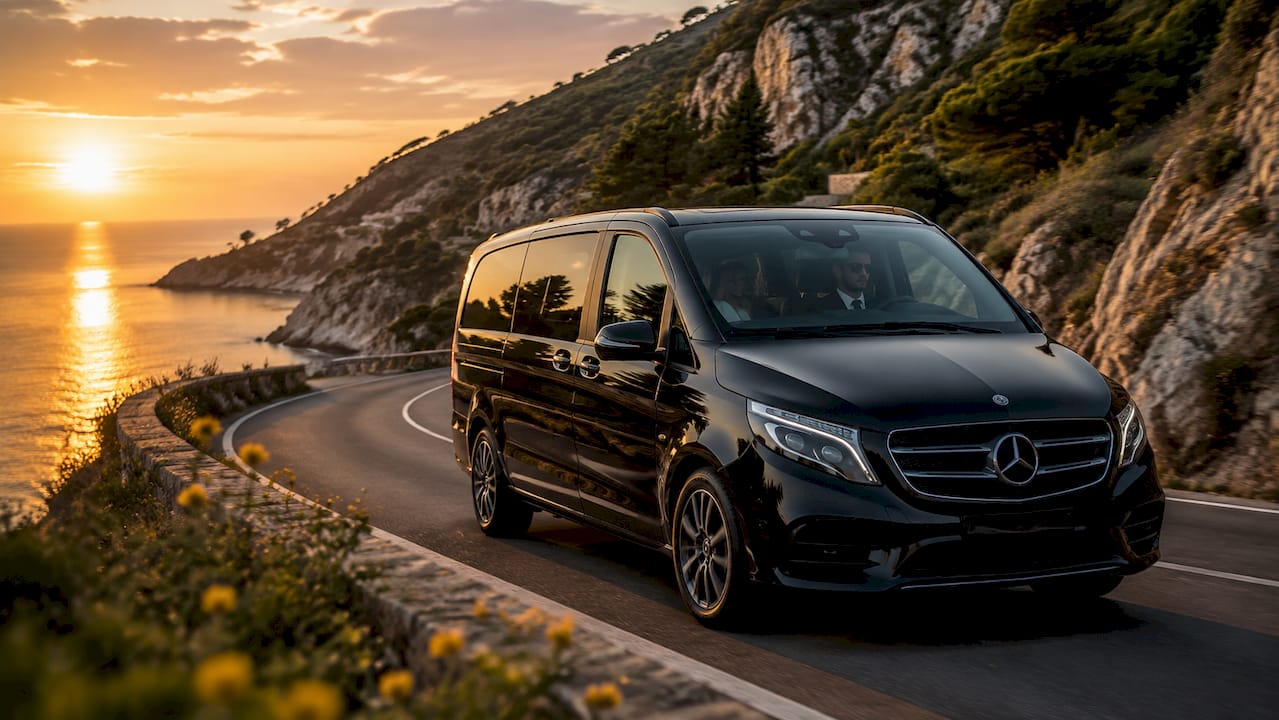
The principle that overestimating vehicle size improves comfort and prevents delays is well established in professional ground transport. Booking a Van 8 pax for six passengers gives each person genuine space, keeps luggage accessible, and removes the risk of a last-minute vehicle upgrade request that disrupts the schedule. The marginal cost difference is almost always worth it for special occasions.
Matching vehicles to common Riviera routes
Route distance and travel time directly influence which vehicle configuration works best. Nice to Monaco covers 21 kilometers and takes approximately 30 minutes in normal traffic. Nice to Saint-Tropez covers 87 kilometers and takes approximately one hour and thirty minutes. For shorter routes like Nice to Monaco, a Business Sedan works well for a small executive group. For longer journeys to Saint-Tropez or the Alpine ski resorts of Isola 2000, Auron, or Valberg, the Van 7 pax or Van 8 pax provides the comfort that a 90-minute or longer transfer demands.
- Standard Sedan: Airport runs for 1–3 passengers with minimal luggage; short point-to-point transfers in Nice or Antibes.
- Business Sedan: Executive arrivals at Nice NCE; client transfers to Monaco or Cannes where presentation matters.
- Van for 7 people: Family groups, small wedding parties, or leisure groups with mixed luggage heading to Cannes or Menton.
- Van for 8 people: Full conference groups, large wedding parties, or any group where luggage volume is high relative to passenger count.
Professional chauffeured transfers guarantee vehicle quality, punctuality, and logistical coordination that rideshare platforms cannot replicate. For groups attending tight-schedule events like MIPIM or Cannes Lions, that reliability is the product, not a bonus feature.
How do you organize timing, pick-up points, and multi-stop itineraries?
Timing is where most group transfer plans fail. Planners build accurate journey times but forget to account for boarding, luggage loading, and the simple reality that eight people do not arrive at a meeting point simultaneously. A realistic buffer of 15–20 minutes for boarding and luggage handling prevents a single late arrival from making the entire group miss a conference session or a flight connection.
For large events, staggered departures using an early departure and a final call reduce stress and prevent overcrowding at a single pickup point. During the Monaco Grand Prix, for example, road closures and pedestrian crowds make a single mass pickup from a central location impractical. Splitting the group into two departure windows, 30 minutes apart, keeps the operation manageable and the vehicles on schedule.
Coordinating arrivals at Nice NCE
Nice Côte d’Azur Airport presents a specific logistical challenge. Airport transfers require buffers for staged vehicle positioning, as vehicles cannot idle curbside indefinitely at a busy international terminal. Transponyx includes 60 minutes of free waiting time on every airport pickup and monitors flights in real time, so the driver adjusts to actual landing times rather than scheduled ones. This combination removes the most common source of airport transfer stress.
For groups arriving on multiple flights, the most efficient approach is to designate a single meeting point inside the terminal, typically the arrivals hall, and have all passengers gather there before moving to the vehicle. This is far more reliable than attempting to coordinate individual pickups at the curb.
- Confirm all flight numbers and estimated landing times at least 48 hours before departure.
- Designate one meeting point inside the arrivals hall, not at the curb.
- Assign a group contact who stays in communication with the driver via WhatsApp or phone.
- Build a 20-minute buffer between the last expected arrival and the vehicle departure time.
- Share the driver's name, vehicle plate, and a contact number with every group member before traveling.
Multi-stop itinerary planning
Wedding and conference transfers often require multi-stop routing: hotel to ceremony venue, ceremony to reception, reception to hotel. Each stop adds time, and narrow Riviera streets in towns like Èze or Mougins can restrict where a Van 8 pax can legally stop for passenger loading. Local knowledge of permitted loading zones is not a minor detail. It is the difference between a smooth transfer and a vehicle circulating the block while guests wait on a pavement.
Pro Tip For any multi-stop itinerary, share the full route with your driver at least 24 hours in advance. A professional chauffeur with local knowledge will flag access restrictions before they become problems on the day.
Booking group transport 3–6 months in advance is the standard recommendation for peak seasons on the Riviera. During the Cannes Film Festival in May or the Monaco Grand Prix in May, vehicle availability tightens significantly. Early booking also locks in 2026 fixed rates, which Transponyx confirms at the time of reservation with no surge pricing applied later.
How do you communicate effectively with your group and service provider?
Clear communication is the single most controllable variable in group transfer planning. A single point of contact, often called a bus captain in professional event transport, coordinates between the driver and the group. This person holds the driver's number, knows the vehicle plate, and is responsible for confirming that everyone is present before departure. Without this role, information fragments across a group chat and critical messages get missed.
The information every group member needs before traveling is straightforward:
- The exact pickup location, including a landmark or map pin, not just a street name.
- The departure time, stated as the time the vehicle leaves, not the time to arrive at the pickup point.
- The driver's first name and the vehicle's registration plate.
- A contact number for the driver or the booking office.
- Any specific instructions for the destination, such as a gate code or a venue entrance point.
Over-communication with group members, including SMS reminders sent the evening before and the morning of travel, measurably reduces delays and improves group cohesion at departure. A reminder sent at 8:00 PM the night before, followed by a confirmation message two hours before pickup, is the standard that professional event logistics teams use.
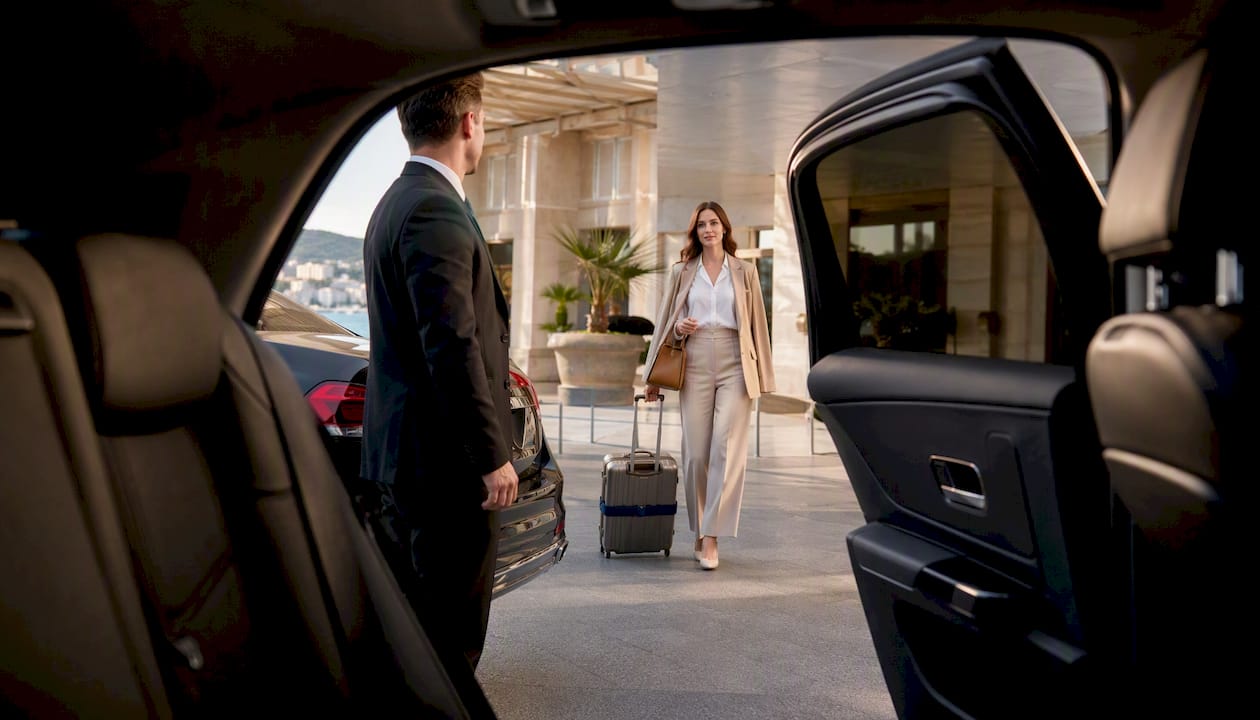
Transponyx drivers are bilingual in English and French as a minimum, with several also speaking Italian, Spanish, Russian, or Arabic. For international groups attending events like MIPCOM, that language capability removes a layer of friction that generic transport options cannot address. The meet-and-greet service at Nice NCE, where the driver waits in the arrivals hall with a name board, is particularly effective for groups whose members may not know each other on arrival.
Event logistics professionals consistently stress the value of flexibility in vehicle assignment when last-minute changes occur. A group of seven that loses one member on the day of travel does not need a different vehicle. A group of five that gains two late additions at the airport does. Confirming final passenger numbers with your provider 24 hours before departure gives the operator time to adjust without disrupting the schedule.
What I have learned from planning group transfers on the Riviera
The most common mistake I see planners make on the French Riviera is treating group transport as a scaled-up version of an individual taxi booking. It is not. The moment you have more than four passengers, luggage becomes a structural problem, timing becomes a coordination exercise, and communication becomes a professional discipline.
The Riviera's geography amplifies every error. A vehicle that cannot legally stop outside a venue in Cannes adds ten minutes to a transfer that was already tight. A group of eight waiting at the wrong terminal exit at Nice NCE during the Cannes Film Festival is not a minor inconvenience. It is a missed dinner reservation and a frustrated client.
What actually works is specificity. Specific pickup locations with map pins. Specific departure times communicated as “the vehicle leaves at 2:30 p.m., not 'around 2:30'.‘ Specific driver contact details shared with every passenger, not just the group organizer. The group travel planning steps that experienced operators follow are not bureaucratic. They exist because every shortcut in group logistics eventually costs more time than it saves.
For 2026, demand for professional group ground transport on the Riviera is growing, particularly around MIPIM in march, the Monaco Grand Prix in May, and Cannes Lions in June. The groups attending these events are larger, the schedules are tighter, and the expectation of a professional experience is higher than it was five years ago. A Van 8 pax with a bilingual driver, fixed pricing, and real-time flight monitoring is not a luxury in that context. It is the baseline.
— Dany
How Transponyx handles group transfers across the Côte d’Azur
Transponyx provides group transfer services across the French Riviera with fixed 2026 rates confirmed at booking, a Mercedes-Benz fleet covering groups of up to eight passengers per vehicle, and licensed VTC chauffeurs who know the Riviera's roads, events, and access restrictions in detail.
For larger delegations, Transponyx coordinates multiple vehicles in convoy, ensuring consistent arrival times across the group. All airport pickups at Nice NCE include 60 minutes of free waiting time and real-time flight monitoring. Whether you are organizing transfers for a corporate team attending MIPIM, a wedding party traveling from Nice to Saint-Tropez, or a leisure group heading to the Alpine resorts, Transponyx provides a luxury chauffeur service built around your schedule. Contact the team on +33 6 10 30 71 84, via WhatsApp on +33 7 67 78 10 26, or at transponyx.com.
FAQ
What is a group transfer?
A group transfer is a pre-booked vehicle service that moves multiple passengers from a shared origin to a shared destination under a single reservation. It differs from individual bookings in that vehicle size, luggage capacity, and timing coordination are planned in advance for the whole group.
How far in advance should I book group transport on the French Riviera?
Booking 3–6 months ahead is the standard for peak periods such as the Cannes Film Festival, Monaco Grand Prix, and MIPIM. Early booking secures vehicle availability and locks in fixed rates before demand peaks.
How many passengers can a Transponyx vehicle carry?
The Van 8 pax carries up to eight passengers and is the largest single vehicle in the Transponyx fleet. For groups exceeding eight, Transponyx coordinates multiple vehicles traveling in convoy to maintain schedule consistency.
Does luggage affect which vehicle I should book?
Yes. Luggage volume typically requires 25–40% more space than the passenger count suggests. A group of seven with large suitcases and carry-ons will exceed the practical capacity of a Van 7 pax. Always count bags separately when selecting a vehicle.
What happens if a flight is delayed on an airport group transfer?
Transponyx monitors all flights in real time on every airport pickup. The driver adjusts to the actual landing time, and 60 minutes of free waiting time is included on all airport transfers, so short delays do not include additional charges.


0 Comments