
For private chauffeur and VTC services on the French Riviera, regional coverage means the specific geographical area and named routes where a licensed operator accepts prior bookings, from Nice Côte d'Azur Airport (NCE) to Monaco, Cannes, Antibes, Menton and Saint-Tropez, through to Alpine ski resorts such as Isola 2000, Auron and Valberg, and cross-border transfers into Italy via Ventimiglia and San Remo. It is not a marketing phrase, but a defined service boundary that determines whether your driver can legally pick you up, where they can take you, and at what confirmed rate.
Transponyx covers this full territory with four Mercedes-Benz fleet categories: Standard Sedan, Business Sedan, Van 7 pax and Van 8 pax, all at 2026 fixed rates confirmed at booking. Reach the team on +33 6 10 30 71 84 or at Transponyx.
Representative bookings within that coverage include:
- Nice NCE to Monaco (approximately 20 km, 25–35 minutes)
- Nice NCE to Saint-Tropez (approximately 100 km, 90–120 minutes depending on traffic)
- Cannes to Antibes (approximately 12 km, 15–25 minutes)
- Nice to Isola 2000 ski resort (approximately 90 km, 90 minutes)
- Nice NCE to Ventimiglia, Italy (approximately 45 km, 40–55 minutes)
What does a provider's regional coverage actually include?
A credible coverage claim has four components: geography, service types, fleet capacity and the way those commitments are published.
Geography and named routes are the foundation. On the Côte d'Azur, VTCs operate by prior booking at fixed prices for airport transfers and day hires, and they differ from taxis precisely because they cannot be hailed in the street and charge no meter fare. A provider's stated coverage should list specific towns and airports, not vague zones. Transponyx publishes named destinations: NCE, Monaco, Cannes, Antibes, Menton, Saint-Tropez, Provence and cross-border Italy.
Service scope within that geography matters equally. Point-to-point airport transfers, by-the-hour hire, multi-stop day excursions, event transfers for occasions such as the Cannes Film Festival or Monaco Grand Prix, and yacht-side pickups at Antibes or Villefranche all require different scheduling and fleet allocation. A provider whose coverage list omits service types is giving you only half the picture.

Fleet categories determine capacity and pricing. A VTC vehicle must carry between four and nine seats, which in practice means the Standard Sedan and Business Sedan suit groups of up to three, while the Van 7 pax and Van 8 pax serve larger parties or those traveling with substantial luggage. Vehicle age expectations in the commercial sector typically run to six years or fewer, though the regulatory minimum is set by the operator's insurance and fleet policy.
How coverage is published is the final test. Reputable providers list routes, fleet categories and 2026 per-vehicle rates on a public booking page or supply them directly to B2B accounts. If a provider cannot send you a written rate and route confirmation before you commit, that is a gap in their coverage documentation, not a gap in your knowledge.
French regulations that define what VTC coverage may legally include
French law shapes every coverage claim a VTC operator can make, and bookers who understand the framework are far harder to mislead.
The VTC register and reservation requirement are the starting point. Operators must be registered on the national VTC register and must demonstrate professional aptitude and continuous training. Every journey must be booked in advance; a VTC cannot respond to a street hail or a spontaneous wave from the pavement.
A VTC driver is legally defined as a professional who transports passengers on prior reservation in a vehicle with four to nine seats. Operating without registration on the VTC register, or accepting a journey without a prior booking, is not a coverage gap — it is a criminal offense under French transport law.
Tea VTC driver's professional card is the driver's individual license. Prefectures issue and renew it, and the application process has been digitalized through prefectural digital services. Drivers must display it; bookers should ask to see it.
Insurance for paid passenger transport is a separate obligation from standard motor insurance. A vehicle covered only by a personal policy is not legally operating as a VTC, regardless of what its driver claims.
Airport and station rules are specific. A VTC may wait at Nice NCE or a rail station for a reserved client, but only for a limited period before pickup and only with proof of reservation available for inspection. Prefectural guidance is explicit: cruising for passengers, soliciting clients outside a booking, or waiting without a reservation document are all prohibited.
Penalties for violations include substantial fines, license suspension and vehicle immobilization. For serious or repeated offenses, criminal sanctions apply.
What regional coverage means in practice for bookers and concierges
Knowing the legal framework is one thing. Translating it into a smooth booking is another.
Advance booking is not optional; it is the legal basis of the service. For airport transfers at Nice NCE, booking 24 hours ahead is standard practice, though Transponyx accepts shorter notice subject to availability. For event transfers during the Monaco Grand Prix, MIPIM, Cannes Lions or MIPCOM, corporate accounts and concierge desks typically block vehicles days or weeks in advance. The 2026 fixed per-vehicle rate is confirmed at the moment of booking, with no surge pricing applied later.
Proof of reservation has a defined legal content. The booking confirmation must include the provider's name and contact details, the client's name and contact, the reservation date and time, and the pickup date, time and location. Transponyx issues this automatically on every booking.
Flight monitoring and waiting time are the operational commitments that distinguish a professional operator from a casual one. Transponyx monitors every inbound flight at NCE and adjusts driver arrival accordingly. Free waiting time is 60 minutes on all airport pickups and 20 minutes at any other address. Charges apply only beyond those windows, and the policy is stated in writing at booking.
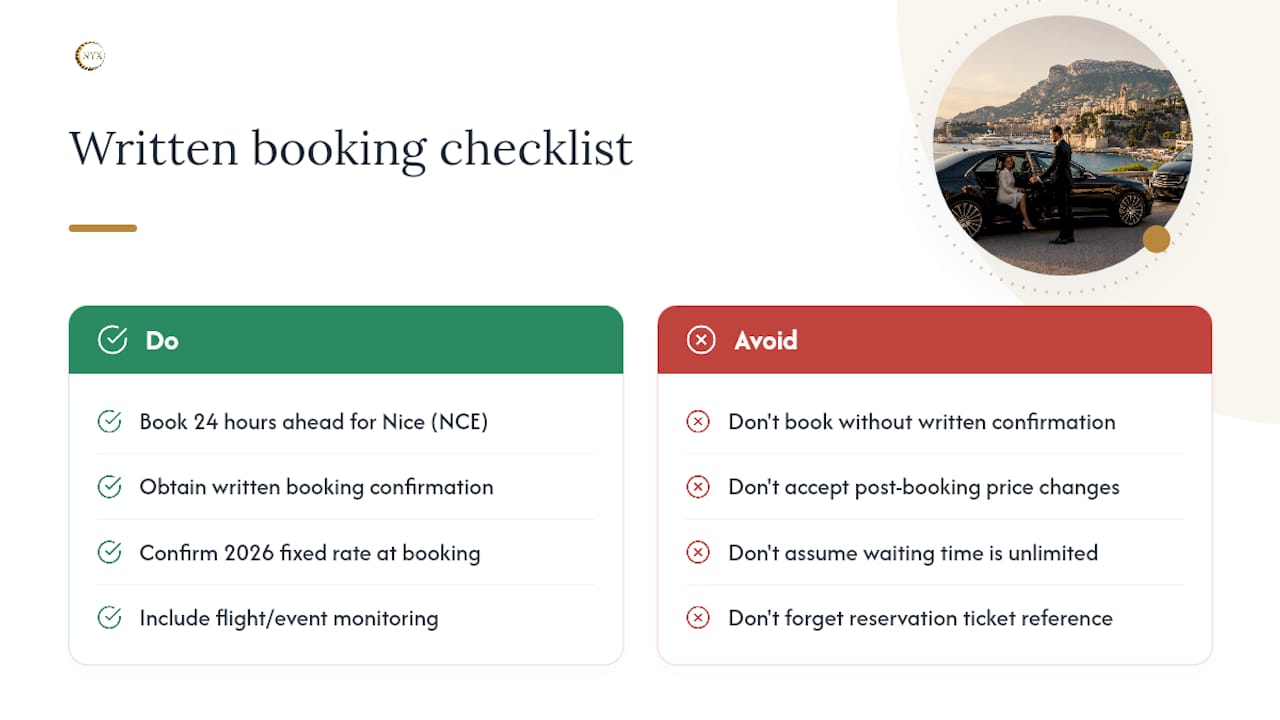
For concierges and corporate travel managers, a written booking checklist should confirm: route and destination, fleet category, 2026 fixed rate, flight or event monitoring inclusion, free waiting time policy, driver name and professional card number, and the reservation ticket reference. Contact Transponyx directly at +33 6 10 30 71 84 or via Transponyx to receive all of these in writing before travel.
Pro Tip When booking for a group arriving on separate flights, request individual reservation tickets for each passenger and confirm whether the Van 7 pax or Van 8 pax can consolidate the pickup into a single vehicle once the last flight lands.
How do you confirm a provider's coverage before booking?
Six questions resolve most coverage uncertainty before you commit.
- Is this specific route confirmed as within your service area?
- Are the 2026 fixed rates confirmed in writing at the time of booking?
- Which fleet category will be assigned, and does it match the passenger count?
- Is flight monitoring included, and what is the free waiting time at NCE?
- Is the driver registered on the VTC register and in possession of a valid professional driver license?
- Will a reservation ticket be issued with all legally required fields completed?
Beyond questions, request three documents: the booking confirmation ticket (with provider registration number), the driver's professional card on display at pickup, and an insurance attestation for paid passenger transport if the booking is for a corporate account.
A concierge or travel manager can paste this sentence into an email or messaging channel to confirm coverage: “Please confirm in writing that the route from Nice NCE to [destination] is within your registered service area, that the 2026 fixed rate applies, and that a reservation ticket will be issued prior to travel.” That single sentence surfaces any gap immediately. For booking a VTC transfer on the French Riviera, Transponyx provides all confirmation documents as standard.
Typical Riviera routes, distances and journey times
The figures below reflect normal traffic conditions. Event periods, including the Cannes Film Festival, Monaco Grand Prix, Cannes Lions and MIPCOM, can add additional time to coastal routes and should be factored into any schedule.
Mountain routes to ski resorts such as Isola 2000, Auron and Valberg add altitude and winding roads to the calculation; winter conditions can extend those times further. Coastal routes between Cannes and Monaco are particularly sensitive to event-period congestion, where a 30-minute journey can stretch to 75 minutes without a time buffer. Transponyx drivers familiar with local travel patterns on the Riviera often route around known bottlenecks, which is one practical advantage of booking a driver with genuine territorial knowledge rather than a generic platform assignment.
Red flags that suggest a coverage claim is not legitimate
Not every provider claiming Riviera coverage is operating within the law. These signals warrant immediate caution.
- A driver offering to pick you up on the street or at a taxi rank without a prior booking is operating outside VTC rules, regardless of what vehicle they are driving.
- Refusal to issue a reservation ticket, or a ticket missing the provider's registration number, is a legal deficiency, not an administrative oversight.
- Pricing described as approximate, subject to traffic, or adjustable after the journey contradicts the fixed-rate obligation that defines legitimate VTC service.
- A driver who cannot produce a visible professional VTC driver card is not legally authorized to carry paying passengers.
- No stated airport waiting policy, or a policy that charges from the moment of landing rather than from the end of the free waiting window, suggests the operator is unfamiliar with standard practice.
The consequences of accepting these risks are not trivial. Insurance gaps mean an accident during an unlicensed journey may not be covered. Canceled pickups with no reservation ticket leave you with no legal recourse. If a provider's registration status is in doubt, Public Service Guidance and prefectural contacts can verify a provider's status before travel.
A travel journalist's view on what coverage really means
The phrase “regional coverage” is used loosely across the private transport industry, and that looseness costs travelers time and money. A provider who lists Monaco and Cannes on their website but has never driven the D6007 coastal road during the Monaco Grand Prix weekend does not have operational coverage of those routes. They have a marketing list.
What distinguishes genuine coverage from a claim is the combination of legal registration, published fixed rates, documented waiting policies and drivers who know the territory. On the French Riviera, where a 20-minute delay at Nice NCE can cascade into a missed connection at Cannes or a late arrival for a Monaco business dinner, the operational detail is the product.
Transponyx publishes its coverage, its 2026 rates, its fleet categories and its waiting-time policy because those commitments are verifiable. That transparency is not a courtesy. It is what the law requires and what professional operation looks like.
Book with Transponyx: confirmed coverage across the French Riviera
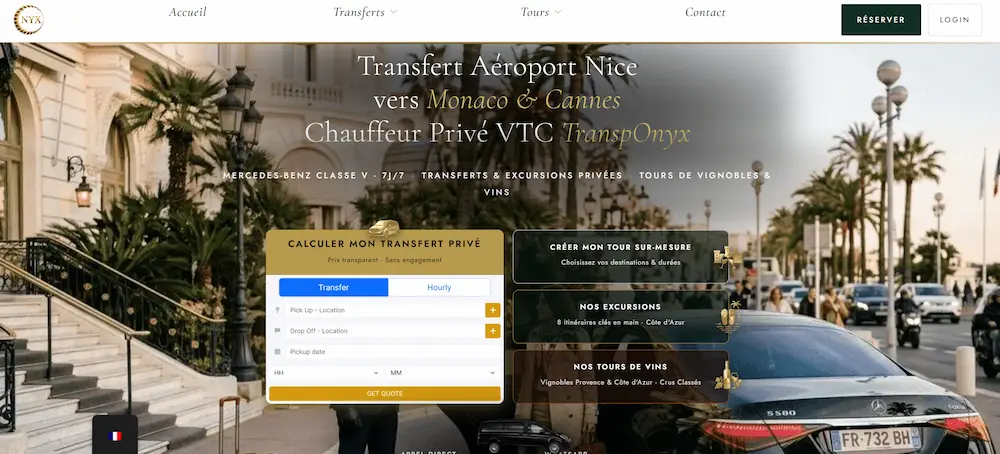
Transponyx operates a fleet of Mercedes-Benz vehicles across the full Riviera territory: Standard Sedan, Business Sedan, Van 7 pax and Van 8 pax, all at 2026 fixed per-vehicle rates with no surge pricing. Every airport transfer at Nice NCE includes 60 minutes of free waiting time and active flight monitoring. Drivers are bilingual, licensed VTC professionals available 24 hours a day, seven days a week.
Confirm your route, rate and fleet category before travel. Visit Transponyx or call +33 6 10 30 71 84. For a full comparison of luxury chauffeur service options on the Riviera, the Transponyx booking page sets out every commitment in writing.
Sources
Official French sources allow concierges and corporate bookers to verify a provider's legal status before committing to a booking.
- VTC information booklet (prefecture – Bas-Rhin)
- Becoming a private hire driver | Public Service Entrepreneurship
- Private hire vehicles with driver (Savoie prefecture)
- How to Hire a Private Driver (VTC) on the French Riviera
Corporate bookers can use the INPI registry search to confirm that a provider's trade name corresponds to a registered VTC operator. Requesting the operator's registration number at the point of enquiry and cross-referencing it against prefectural records takes under five minutes and removes any ambiguity about whether a provider's claimed coverage is backed by a valid license.
FAQ
What is the definition of regional coverage for a VTC service?
Regional coverage for a private chauffeur or VTC service is the specific geographical area and named routes where a licensed operator accepts prior bookings. On the French Riviera, this typically spans Nice NCE, Monaco, Cannes, Antibes, Menton, Saint-Tropez, Alpine ski resorts and cross-border transfers into Italy.
Can a VTC pick me up without a prior booking?
No. French law requires all VTC journeys to be booked in advance. A driver who offers a street pickup or accepts a spontaneous fare is operating outside the legal framework, regardless of the vehicle they drive.
What documents should a legitimate VTC booking include?
A valid reservation ticket must state the provider's name and contact, the client's name and contact, the reservation date and time, and the pickup date, time and location. The driver must also display a valid professional VTC driver card.
How far in advance should I book a Riviera chauffeur transfer?
For standard airport transfers at Nice NCE, 24 hours' notice is typical. For event periods such as the Monaco Grand Prix, Cannes Film Festival or MIPCOM, corporate accounts and concierge desks should book days or weeks ahead to secure the required fleet category and 2026 fixed rate.
How do I check whether a VTC provider is legally registered?
Ask the provider for their VTC register number and cross-reference it using the INPI profession directory or your local prefecture's VTC guidance pages. Service Public also publishes the obligations operators must meet, making it straightforward to identify whether a provider's claims align with their legal status.



0 Comments