
The motorway is the sensible choice when you must arrive at a set time, and the coastal road is the one to take when the journey is the point. From Nice, both routes cover roughly 100 to 113 km, but the time they take differs sharply, and the last 45 km into Saint-Tropez are the same narrow roads which ever way you come. This guide sets out the real trade-offs: distances, tolls, the Corniche d'Or, summer congestion and what a private chauffeur changes. It is written by TranspOnyx, the Nice-based chauffeur company, which drives this corridor every week.
The two routes at a glance
Saint-Tropez has no railway station and no motorway junction of its own. Every road visitor, whether leaving Nice Côte d'Azur Airport (NCE), a Cannes hotel or a villa in Antibes, ends on the departmental roads of the Gulf. The official 2024 mobility plan for the Gulf of Saint-Tropez counts five main land access routes, none wider than one lane in each direction apart from occasional overtaking sections. That single fact explains most of what follows.
The choice therefore concerns the first 60 to 70 km, not the last. You can stay on the A8 toll motorway as far as Le Muy and then cut south through the Var, or you can leave the motorway at Cannes and follow the sea along the Corniche d'Or before joining the coast road at Fréjus.
| Motorway (A8, exit 36) | Coastal road (Corniche d'Or) | |
|---|---|---|
| Road | A8 to Le Muy, then D125, D25, D559 | A8 to Cannes area, then D559 and D98A along the sea |
| Typical time from Nice without traffic | About two hours | Noticeably longer |
| Tolls | Yes, including Le Muy | Largely avoided |
| Character | Fast, predictable until the Gulf | Winding, scenic, several stops |
| Best for | Flights, meetings, dinner reservations | Leisure, photography, a relaxed day |
Mappy's Nice to Saint-Tropez route comparison gives car routes of 100 to 113 km, taking between 1 h 36 and 2 h 41, with tolls from nothing to €9.50. That spread is the whole debate in one line: the quick motorway option and the slow free option sit at opposite ends of it.
The motorway route: fast until the Gulf
The usual approach from Nice leaves the A8 at exit 36, Le Muy, then follows the D125, the D25, the D559 and the N98A for about 45 km, according to a long-standing French Riviera driving guide. Kimkim's route notes describe it the same way and put the journey at about two hours without traffic.
From Cannes the arithmetic is similar. Mappy's Cannes to Saint-Tropez roadbook shows a short A8 segment, exit 36 and a €6.00 toll at Le Muy before the departmental roads begin.
The motorway portion is the dependent part of the day. Lanes are wide, signage is clear, and the French motorway companies' federation, ASFA, publishes a traffic forecast tool and real-time information. Both are worth opening before you leave, because normal journey times say little about a Friday afternoon in August.
There is also a variant. Leaving the A8 one exit earlier, at exit 35, puts you on the D558 through La Garde-Freinet. The same guide notes it tends to be slightly less clogged. The official mobility plan confirms that the RD558 links the Gulf to the A57/A8 interchange near Le Cannet-des-Maures and to Vidauban. It is a pleasant forest road, but it is slower in absolute terms and it does not remove the final bottleneck.
French autoroutes charge by vehicle type and distance, and card payment or electronic toll lanes shorten queues at the barrier, as SeeSaintTropez's driving page explains. For a private transfer the toll is built into the rate you are quoted, so there is nothing to handle at the booth.
The coastal road: the Corniche d’Or and beyond
The coastal alternative is not a single road. It begins on the Esterel section, known as the Corniche d'Or, which runs for 30 km between Saint-Raphaël and Cannes, past turquoise water, small coves and the red rocks of the Estérel massif, as the Estérel Côte d'Azur tourist office describes it. Kimkim's account of the slower option reads A8 past Cannes, then the narrow, winding D559 through Théoule-sur-Mer, Anthéor and La Dramont, then the D98A.
This is the stretch that earns the route its reputation. The regional tourism board's Corniche d'Or itinerary lists Cap Dramont, the Île d'Or, the Massif des Maures, Grimaud's castle, Cogolin's pipe-making tradition, the Corniche des Maures, Mont Vinaigre and Cap Roux as worthwhile scenery or stops around the wider circuit. In practice the best photographs come early, when the light lies low across the red rock and the road is quiet.
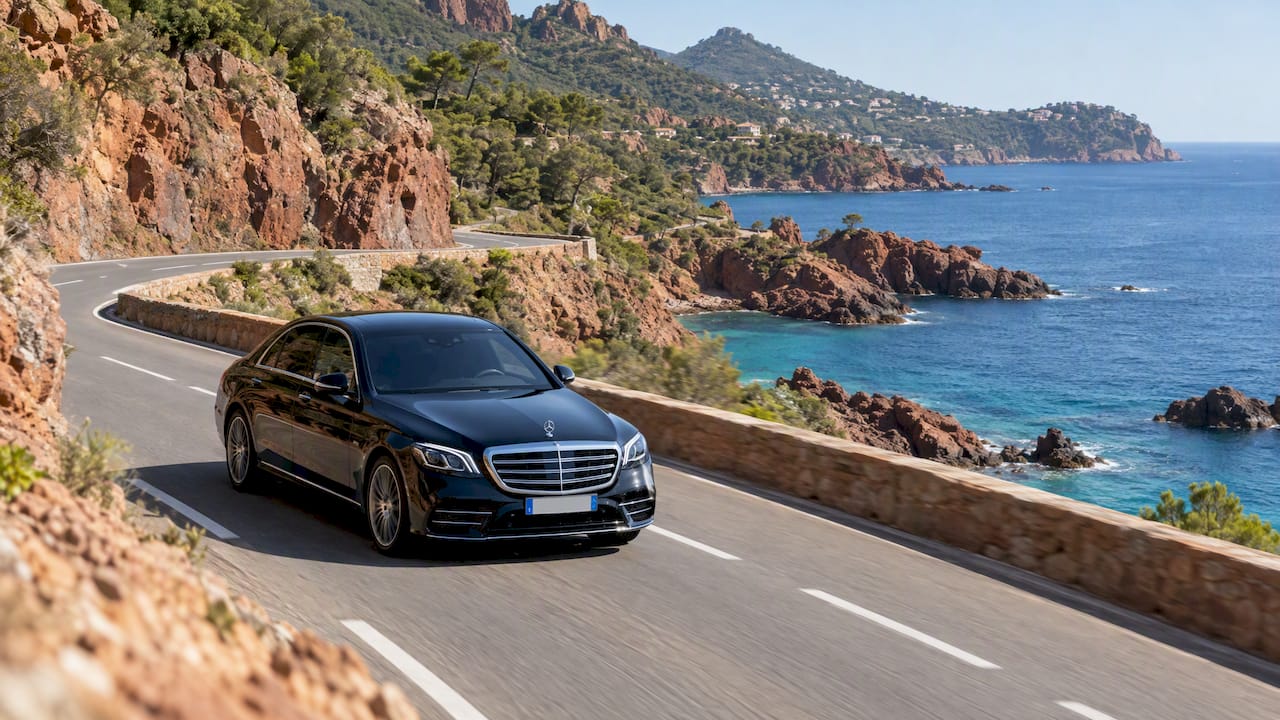
The cost is time and concentration. The road is narrow, bends are tight, and a cyclist or a slow camper van can set the pace for many kilometers. SeeSaintTropez's travel guidance puts it plainly: the scenic back roads generally save motorway tolls but cost time, while offering countryside, viewpoints and places to stop. A passenger in the back seat enjoys the view. A driver unfamiliar with the road does not.
Two things are worth knowing before you commit. First, the coastal route does not bypass the congestion near Saint-Tropez; it merely arrives at it by a prettier road. Second, it only makes sense if you have slack in the day. A flight to catch, a lunch table at Pampelonne or a Monaco Grand Prix weekend schedule leaves no such slack.
Traffic, seasons and the final 20 minutes
The last stretch decides your day more than the route chosen 80 km earlier. The mobility plan identifies the RD559 as the main artery of the Gulf and states that summer demand repeatedly exceeds capacity, causing severe saturation. Kimkim's guidance gives driving from Nice as roughly two to three and a half hours once traffic is counted, and warns that the final approach can become gridlocked in July and August.
That range deserves a closer look. In April or October the motorway route behaves almost exactly as the map suggests. In high summer the same journey can take well over an hour more, and nearly all of that extra time increased after you leave the motorway, in the strip between Sainte-Maxime and Saint-Tropez. Departure time matters as much as route. An early start usually clears the Gulf before the beach traffic builds, while a late-morning arrival joins it at its worst.
The pattern also bends around the Riviera's calendar. Cannes fills for the Film Festival, MIPIM, MIPCOM and Cannes Lions, hotel transfers back up on the A8, and those who plan a leisure escape to Saint-Tropez during these weeks start from a congested Cannes. Monaco Grand Prix weekend adds its own pressure further east, so a departure from Monaco or Menton needs a longer margin before the A8 even begins.
A sensible rule for the Gulf itself: assume the motorway is reliable, assume the last 45 km are not, and set your arrival time with that in mind.
Which route suits which journey
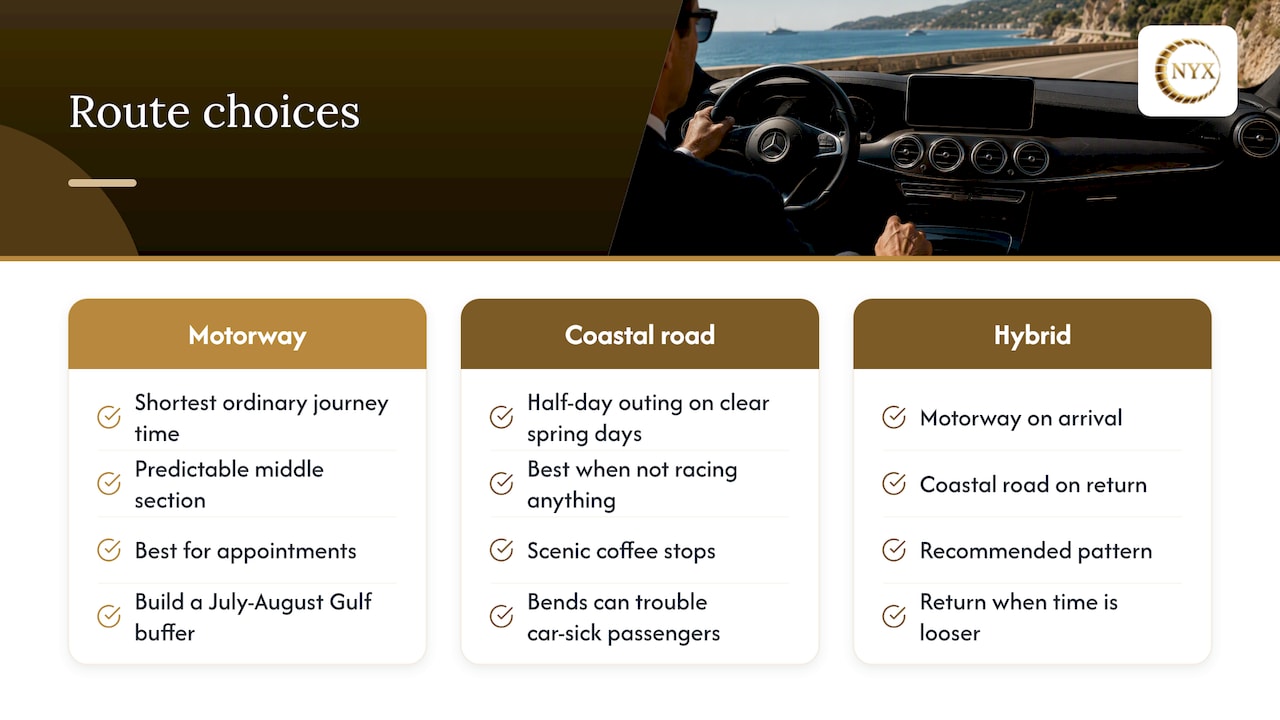
The motorway is the right answer for any journey that ends in an appointment. That includes a landing at Nice airport with a boarding pass for the yacht, a client lunch in the port, or a wedding where the ceremony will not wait. It has the shortest ordinary journey time and the most predictable middle section. Even so, build in a buffer for the Gulf in July and August.
The coastal road is the best answer when you are not racing anything. Arriving from Cannes on a clear morning in spring, with a coffee stop in Théoule-sur-Mer and another near the red rocks, turns a transfer into half a day out. It suits couples, small groups and photographers. It does not suit anyone with a tight connection, small children who pull easily or a passenger prone to car sickness on bends.
Many visitors do a hybrid. They take the motorway one way, usually on arrival when they are tired and want the hotel, and the coastal road on the way back when luggage is unpacked and time is looser. This is the pattern we recommend most often, and it works because the two routes complement rather than compete.
There is a third option for anyone who finds both roads tiresome. Saint-Tropez can be reached by sea in season, and our Saint-Tropez day trip guide explains how to plan a day around the boat timetable instead of the traffic.
Our view from the driver's seat
We drive to Saint-Tropez from Nice and Cannes all year, and our advice is consistent. Use the motorway when time is fixed, use the Corniche d'Or when time is free, and never confuse the two on a day that matters. A beautiful road is a poor reward for missing a flight home or arriving flustered at a wedding.
What clients usually underestimate is the final approach. The A8 feels effortless, then the Gulf narrows to a single lane each way and the afternoon slows. Our drivers know where the queues form, which departure times avoid them, and when the quieter D558 through La Garde-Freinet is worth the detour. That local knowledge is the difference between a transfer that merely works and one that feels unhurried.
We also think the debate is slightly mis-framed. Clients ask which road is better, but the more useful question is how much of the day they want to spend in the car. If the answer is as little as possible, go by motorway and leave early. If the answer is a few relaxed hours with the Estérel outside the window, book the coast and treat it as an excursion rather than a transfer.
Our flight monitoring on airport pickups and 60 minutes of free waiting mean a late landing does not disturb the plan. The rest is a matter of agreeing the route and the hour in advance.
— Dany
Making the journey with a private chauffeur
For the direct run from Nice airport to Saint-Tropez and Ramatuelle, our 2026 fixed rate is €260 to €400 per vehicle, confirmed at booking with no surge pricing. This figure covers the motorway toll and the driver's time, and the rate does not change when the Gulf is busy. Flight monitoring is included on every airport transfer, and we allow 60 minutes of free waiting on airport pickups and 20 minutes at any other address. Our drivers are licensed VTC professionals, at least bilingual in English and French, and the Mercedes-Benz fleet includes the Standard Sedan, the Business Sedan, the Van 7 pax and the Van 8 pax, each with Wi-Fi, air conditioning, chilled water and phone chargers.
If you prefer the scenic road, there are two sensible ways to book it. By-the-hour hire costs €60 to €90 per hour, and our bespoke tour is €70 to €100 per hour, so a slower coast drive is simply a matter of time on the clock. You can read the details on our Nice to Saint-Tropez private transfer page, see all airport rates on our airport transfer rates page, or call +33 6 10 30 71 84. Our service runs 24 hours a day, every day, at transponyx.com.
What the journey costs by each method
The toll difference between the two roads is small next to the cost of getting the timing wrong. Mappy's range for Nice to Saint-Tropez shows tolls of up to €9.50 and fuel of roughly €12.63 to €14.75, so a self-drive trip costs under €25 in running costs, before hire-car charges, parking in the village and the stress of the Gulf. Parking in Saint-Tropez itself is a separate problem for drivers in high season, one that a driver removes by dropping you at the door.
A fixed chauffeur rate is not the cheapest way to cover the distance, and we do not pretend it is. What it replaces is the hire car, the risk of arriving late and the need to find somewhere to leave the vehicle. For a party of five to eight, our Van 7 pax and Van 8 pax split that cost across the group, and a single vehicle is easier to manage in the Gulf than two cars.
Compare that with other ways to happen. A taxi from the airport is metered or priced at a flat tariff for the airport zone, and our Nice airport transport guide sets out how fixed taxi fares and a pre-booked pickup differ. For longer trips such as Saint-Tropez, a fixed price agreed in advance is generally easier to budget than a metered fare that rises with the traffic.
Planning around events and groups
Group movements are where route choice gets expensive. A conference delegation leaving Cannes after MIPIM or MIPCOM, or a wedding party traveling from Nice to a venue near Ramatuelle, cannot split across two roads and expect to meet at the same minute. One vehicle per group, one route and one departure time keep everyone together. Event planners looking for a template can use our chauffeured French Riviera itineraries as a starting point.
For weddings, golf, yacht and VIP events we organize transport on request. These services carry no published price, so please contact us for a quote.
FAQ
How long does it take to drive from Nice to Saint-Tropez?
Expect about two hours on the A8 and D25 route without traffic, and between roughly 1 h 36 and 2 h 41 on Mappy's range of car routes. In July and August, the final approach can add a long delay. We recommend leaving early and checking live motorway conditions before you set off.
Is the coastal road to Saint-Tropez worth it?
Yes, if the journey is the point and you have a flexible day. The Corniche d'Or between Cannes and Saint-Raphaël is 30 km of cliffs, coves and red rock. It is slower and winding, so it is a poor choice before a flight or a fixed appointment.
Are there tolls on the way to Saint-Tropez?
On the motorway route there are, including a €6.00 toll at Le Muy on the Cannes route according to Mappy. The coastal road largely avoids them. If you book a transfer with us, the fixed rate is confirmed in advance, so no toll is paid at the barrier.
How much is a private transfer from Nice airport to Saint-Tropez in 2026?
Our 2026 fixed rate for Nice airport to Saint-Tropez and Ramatuelle is €260 to €400 per vehicle. It is confirmed at booking, with no surge pricing, and includes flight monitoring and 60 minutes of free waiting. Call +33 6 10 30 71 84 or visit transponyx.com to confirm your journey.
Sources
- Simplified Mobility Plan, Gulf of Saint-Tropez
- Mappy: Nice to Saint-Tropez
- Mappy: Cannes to Saint-Tropez
- Getting to Saint-Tropez
- Kimkim: Nice to Saint-Tropez
- ASFA traffic forecast tool
- ASFA real-time traffic information
- SeeSaintTropez: Driving to Saint-Tropez
- Estérel Côte d'Azur: Corniche d'Or
- Provence-Alpes-Côte d'Azur: The Corniche d'Or and the Forêt des Maures Road

0 Comments