
Good business chauffeur etiquette comes down to five things: a polished appearance, courtesy, punctuality, discretion and real attention to your comfort. The Fédération Française de Grande Discount (FFGR) names these as the foundations of professional chauffeured transport in France. Everything else, from the way a driver takes your suitcase to the way he or she handles a phone call you would rather keep private, grows out of them. This guide sets out what a well-run service does on the French Riviera, what you can reasonably ask for, and how to brief a driver so that the journey runs quietly and on time.
We are TranspOnyx, a private chauffeur and VTC company based in Nice, and what follows reflects how we expect our own drivers to work. You can reach our reservations line on +33 6 10 30 71 84 or through transponyx.com.
What business chauffeur etiquette actually covers
Etiquette in this trade is not about ceremony. It is about removing friction from a working day. A chief executive landing at Nice Côte d'Azur (NCE) at 08:40 with a 10:30 meeting in Monaco does not want conversation, theater or surprises. They want a driver who is exactly where promised, a car that is spotless and cool, and a route chosen without fuss.
The FFGR charter, which governs members of the French grande discount sector, ties ethics towards the client directly to the quality of the welcome. It asks operators to act in good faith, with full transparency and exemplary professionalism, in order to protect the prestige of chauffeured transport in France. Its own wording is worth reading if you book regularly, because it shows what a serious operator signs up to.
In practice, etiquette divides into six moments:
- The booking and the information you give.
- The meeting point and the greeting.
- Luggage and boarding.
- The journey itself, including conversation and privacy.
- Arrival and drop-off.
- Payment, gratuity and follow-up.
The sections below take them in order.
The booking: where good service really begins
A chauffeur can only be as discreet and punctual as the brief allows. Before a journey, a good operator needs the passenger's name, the flight number for an airport pickup, the number of people and bags, the exact destination address, and any special requirement such as a child seat or a second stop.
Two details are routinely forgotten and cause most of the awkward moments we see. The first is the true passenger count. A Standard Sedan or Business Sedan takes up to three passengers, so four colleagues with cabin bags need a Van 7 pax or Van 8 pax instead. The second is the identity of the person who will actually travel. Assistants often book on behalf of an executive; give the driver the traveler's name for the sign and a mobile number that will be answered.
If the passenger prefers silence, say so at booking. If they would like to work, mention it, so the driver knows to keep the cabin quiet. Our vehicles carry Wi-Fi, air conditioning, chilled water and phone chargers, so a working journey needs no preparation on your side beyond a laptop.
For firms that book regularly, our corporate car service in Nice page explains how accounts and repeat bookings are handled.
The meet and greet
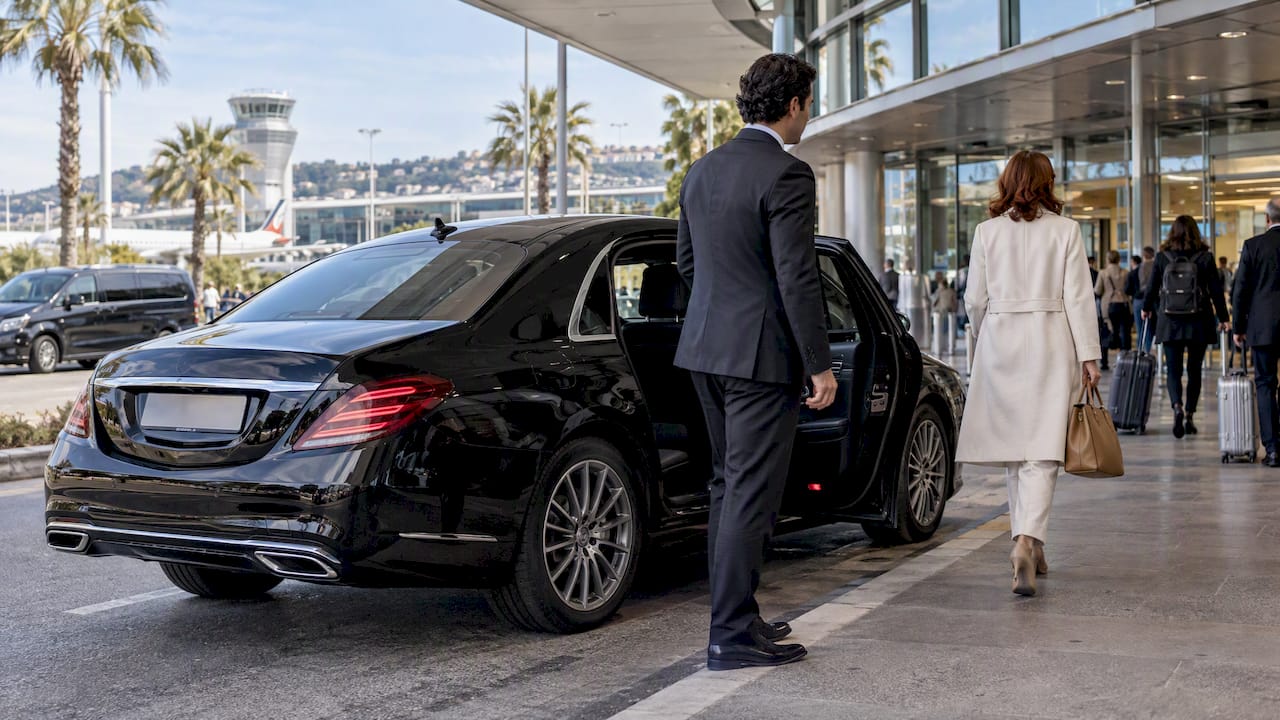
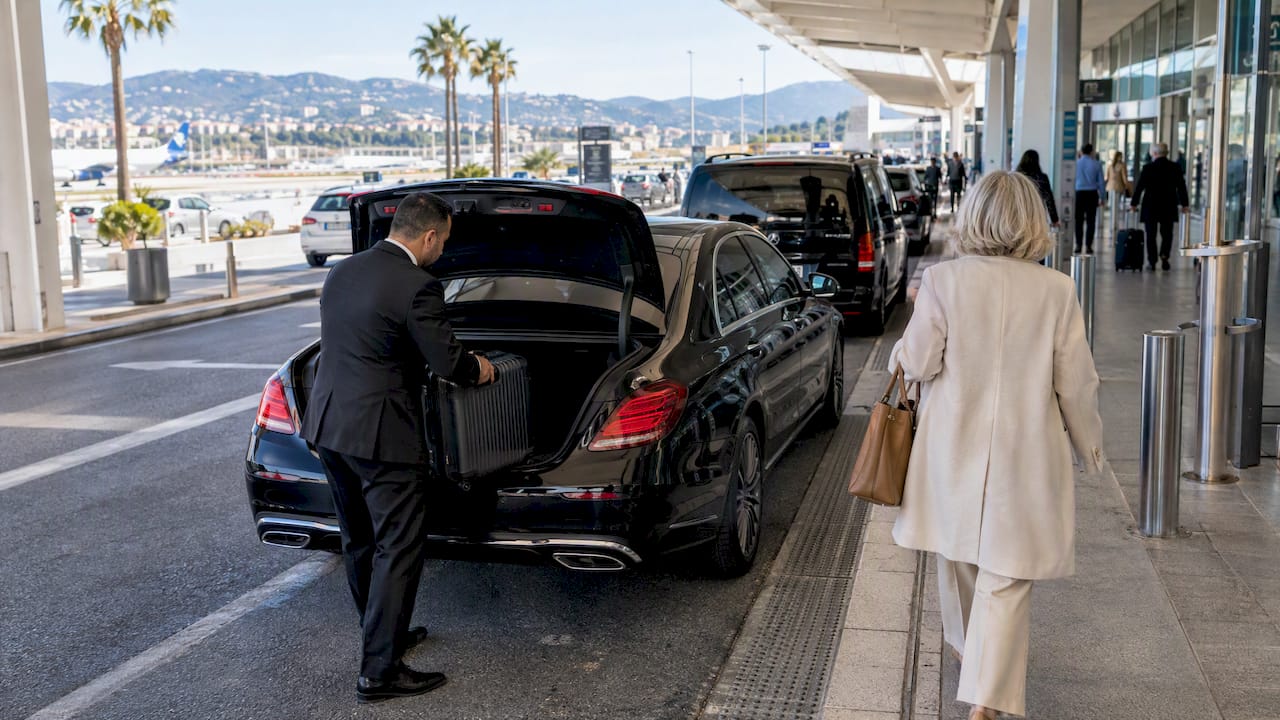
At an airport, the greeting sets the tone. The standard a good operator follows is simple: the driver waits at the arrivals hall with a sign bearing the passenger's name or the company logo, greets the passenger by name, introduces himself or herself briefly, and takes the luggage. A French meet-and-greet checklist recommends taking heavier pieces first and asking about fragile items, which is exactly the sort of detail that distinguishes a professional from a taxi rank.
The same checklist describes accompanying the passenger at their own pace to the vehicle, opening the doors, loading the bags and confirming the destination before departure. We would add one point from experience: a driver should never rush a passenger who has just stepped off a long-haul flight and is looking for a phone signal. Walking at the passenger's speed is a form of courtesy.
On our airport transfers, flight monitoring is included, so the driver knows if a delayed aircraft has moved your landing time. We include 60 minutes of free waiting on every airport pickup, and 20 minutes for any other address. That matters at NCE in particular, where immigration queues and baggage delivery are unpredictable in July and during the film festival fortnight. Our executive meet and greet at Nice airport page describes the arrivals process in more detail.
Forms of address
In France the default is formal. A driver addresses passengers as Monsieur or Madame, or by surname, and uses the formal register in French (vous, never tu). Our drivers are bilingual in English and French as a minimum, and some also speak Italian, Spanish, Russian or Arabic. If you are more comfortable in another language, tell us at booking and we will allocate accordingly where we can. A good driver follows your lead: if you suggest first names, he or she may use them, but will return to formality in front of your clients.
Luggage, doors and boarding
The driver loads and unloads. You shouldn't need to lift anything. For golf bags, skis, wheelchair-folded frames or oversized cases, mention them in advance so that the right vehicle is sent; a Business Sedan with three passengers and three large suitcases is tight, and a Van 7 pax solves it without comment.
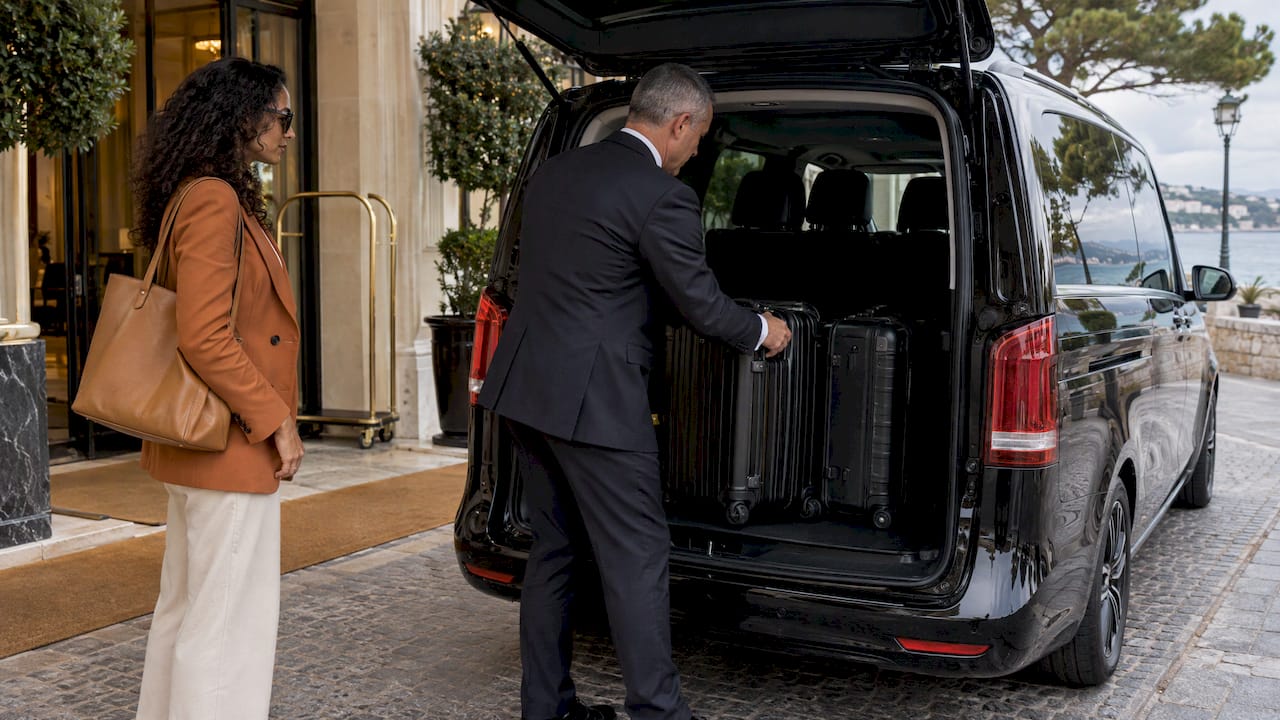
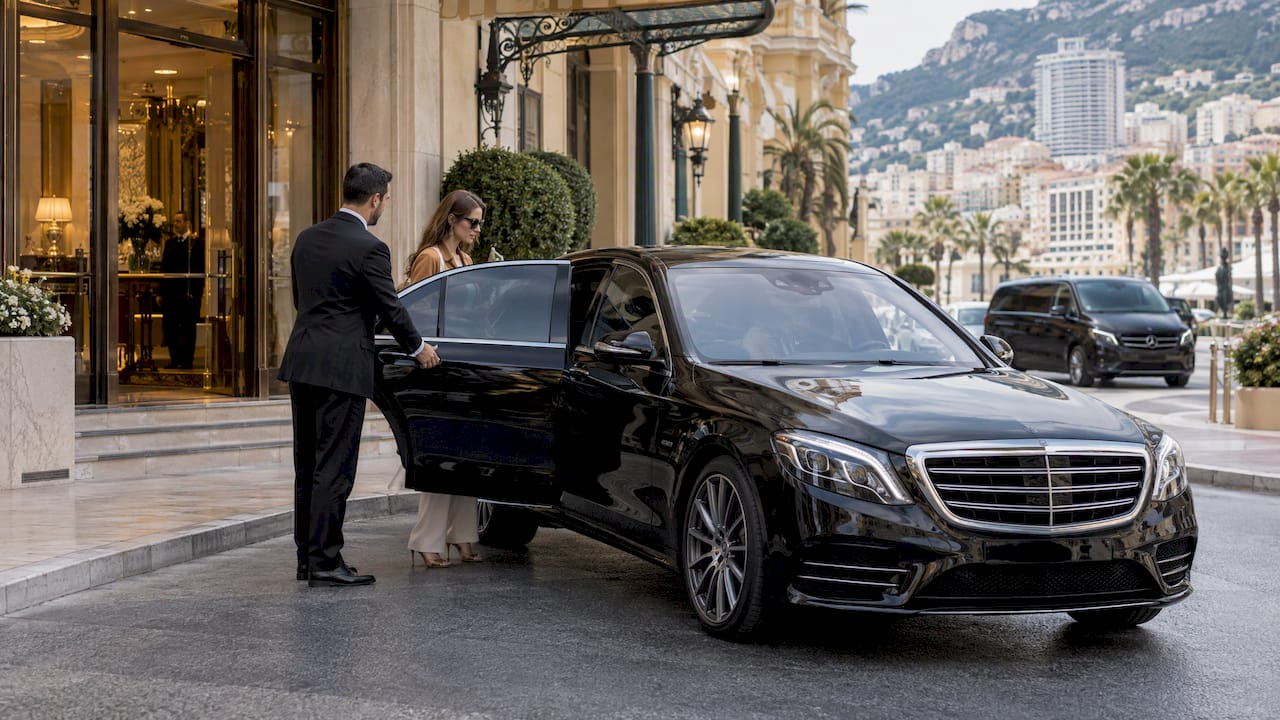
Seating is the passenger's choice. Most executives sit behind the front passenger seat, but a driver should offer, open the door on the curb side where traffic allows, and close it without slamming. Seat belts are checked quietly. If a child seat has been requested, it is fitted before you arrive, not during the pick-up. Child seats are available on request with us, so state the child's age and weight when you book.
For a more detailed account of what luggage help should include, see our guide to baggage assistance for travelers.
Punctuality and the courtesy period
Punctuality in this trade means arriving before the passenger, not at the same moment. The FFGR charter describes a 15-minute courtesy period for clients, and it requires the vehicle to be kept in impeccable condition for cleanliness, safety and comfort. Treat these as the baseline when you compare operators.
Our own approach goes further for airport work, with the free waiting times above. The reasoning is straightforward: a transfer between Nice and Monaco is not a long journey, but a missed slot at a meeting is expensive. Our planning figures, which vary with traffic and season, run roughly like this:
| Route from Nice Côte d'Azur airport | Typical distance | Planning time outside peak periods | 2026 fixed rate, per vehicle |
|---|---|---|---|
| Antibes, Juan-les-Pins | about 20 km | 25 to 35 minutes | €68 to €110 |
| Cannes | about 30 km | 35 to 50 minutes | €90 to €150 |
| Monaco, Monte Carlo | about 25 km | 30 to 45 minutes | €90 to €140 |
| Menton, Beausoleil | about 35 km | 40 to 55 minutes | €108 to €158 |
| Saint-Tropez, Ramatuelle | about 110 km | 1 hour 45 to 2 hours 15 | €260 to €400 |
| Isola 2000, Auron, Valberg | 70 to 100 km | 1 hour 30 to 2 hours | €240 to €350 |
The ranges reflect vehicle category and the exact address. Rates are fixed per vehicle, confirmed at booking, with no surge pricing, so a rainy Friday or a Grand Prix weekend does not change the figure you were quoted. The full list sits on our airport VTC page.
During MIPIM, Cannes Lions, MIPCOM, the Cannes Film Festival and the Monaco Grand Prix, the coast road and the A8 slow dramatically, and the planning times above can double. Book earlier, share the first meeting time and let the driver recommend a departure time. A chauffeur who tells you to leave 20 minutes sooner is practicing etiquette, not being cautious.
The vehicle: what flawless means
The FFGR charter asks for vehicles that comply with regulations, have a recent first registration (with exceptions for classic, electric or hybrid cars) and are kept in impeccable condition. For the passenger this translates into practical things you can see on boarding: clean glass and upholstery, no odor, a comfortable temperature, water within reach and a charger that works.
Our fleet is exclusively Mercedes-Benz, in four categories:
- Standard Sedan, up to 3 passengers.
- Business Sedan, up to 3 passengers, with a premium finish.
- 7-passenger van, up to 7 passengers.
- Van for 8 people, up to 8 passengers.
Every vehicle has Wi-Fi, air conditioning, chilled water and phone chargers. For a client you wish to impress, the Business Sedan is the usual choice. For a delegation, a van keeps the group together and avoids the awkwardness of splitting colleagues between two cars.
Conversation, privacy and confidential calls
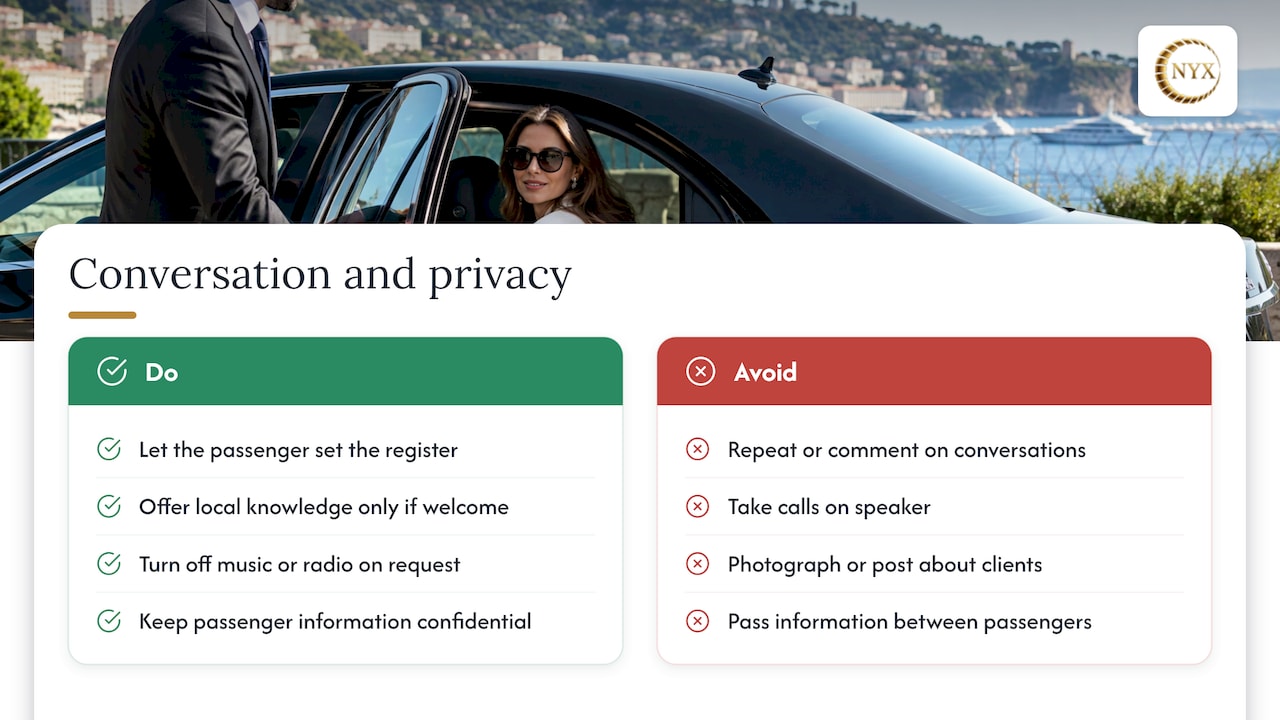
This is the area where etiquette matters most and is written about least. The basic rule is that the passenger sets the register. A driver greets, offers water, confirms the route and then stays quiet unless addressed. Local knowledge is offered briefly and only if welcome: a word about a road closure in Cannes, a note on the best entrance at the Palais des Festivals.
What is said in the car stays in the car. Business travelers discuss pricing, mergers, casting and property deals on the back seat. A professional driver does not repeat, comment on or react visibly to any of it, does not take calls on speaker while a passenger is working, and does not photograph or post about well-known clients. The FFGR places discretion among its core professional qualities, alongside punctuality and courtesy.
If you need to take a sensitive call, you can simply ask for the music or radio to be off, or for a few minutes of silence. A good driver will not take offense. Our article we confidential chauffeur services goes into privacy during Riviera events and the data side of passenger information.
In a shared car with several colleagues, the same rule applies, with one addition: the driver should not pass any information between passengers or answer questions about previous clients.
Corporate events and group transfers
Event weeks demand a different discipline. A conference arrival may involve 40 delegates landing on six flights over five hours, each with a different hotel in Cannes, Antibes or Monaco. Etiquette here is mainly organizational:
First, send a single arrivals list with names, flights, hotels and a contact for each group. Second, decide who holds the sign and whose logo it carries; branded signs make the arrivals hall far easier for delegates. Third, confirm the vehicle mix: Van 7 pax and Van 8 pax for teams, Business Sedan for principals. Fourth, name one point of contact on your side who can authorize changes by phone or WhatsApp on the day.
We coordinate multi-vehicle movements for weddings, private parties, yacht events and corporate hospitality, and our reasons for using a single supplier are laid out in why choose a chauffeur service for Riviera events. For executive roadshows that hop between Nice, Sophia Antipolis, Cannes and Monaco, see the corporate roadshow driver page.
At private events, the chauffeur's role is more discreet still: he or she waits out of sight, stays sober, keeps the vehicle ready and does not join the party. Our note on the role of a chauffeur at a private villa party covers it in full.
Tipping in France
Tipping a chauffeur in France is a gesture of thanks, not an obligation, and there is no fixed percentage. Many business travelers round up or leave a small amount for particularly helpful service, such as a long wait, heavy luggage or a complicated multi-stop day. Corporate clients often prefer to add nothing, as their policies cover ground transport. Either choice is perfectly acceptable, and a good driver will not hint or comment.
Because our rates are fixed per vehicle and confirmed at booking, you will not find extras added to the fare at the end of the journey. Anything you choose to give is entirely yours to decide.
What to tell the driver in advance
A short, complete brief makes a polished journey. The details that help most are these, in rough order of importance: the exact pickup point and time, a reachable mobile number, the flight number, the number of passengers and bags, and the final address with any gate code or security desk. Then the softer information: whether you want quiet, whether you will be on calls, whether you need a stop for a pharmacy or a coffee, and whether a colleague is joining halfway.
If you are an assistant booking for someone else, add the passenger's preferred language, any mobility need and the point at which they should be called if the flight is early. Changes of plan are normal on the Riviera. Tell the driver as soon as you know, by phone on +33 6 10 30 71 84 or WhatsApp on +33 7 67 78 10 26. Both lines are open at all hours, since the service runs 24 hours a day, seven days a week.
Our perspective
We have driven enough executives, producers and delegates along the coast road to know that etiquette is mostly invisible. When it works, the passenger notices only that the day went smoothly.
Our drivers are licensed VTC professionals, bilingual in English and French as a minimum, and we ask them to arrive early, to wait without complaint and to say very little unless the passenger wishes otherwise. We believe a fixed, per-vehicle rate confirmed at booking is part of good manners too: nobody should have to negotiate with the person holding their luggage.
The free waiting time (60 minutes at airports, 20 minutes elsewhere) and flight monitoring are not luxuries for us. They are how we make sure the driver is there, calm, when a delayed aircraft finally lands. That is the standard we hold ourselves to, and the one we recommend you look for in any chauffeur you book.
Dany
Book a driver who works to this standard
Our airport transfers, point-to-point journeys and hourly hire all follow the practices described above. Hourly hire is priced from the published range of €60 to €90 per hour, depending on the vehicle, and is well suited to roadshow days with several stops. Our Cannes point-to-point service runs at €75 to €110 per journey, and Onyx Tours provides private excursions, with the half-day tour at €350 to €500 and the full day at €630 to €900.
You can see the full 2026 fixed rates and book on our Nice airport transfer page, review hourly chauffeur rates in Nice, or speak to us directly on +33 6 10 30 71 84. Our guide for travelers and bookers on rates and etiquette is a handy reference to forward to colleagues.
Frequently asked questions
Should I speak to my driver during the journey?
Only if you wish to. A professional driver greets you, confirms the route and then follows your lead. If you want to work or take calls, say so at the start and the driver will keep the cabin quiet.
How long should a driver wait for me?
The FFGR charter refers to a 15-minute courtesy period. With TranspOnyx, free waiting time is 60 minutes on all airport pickups and 20 minutes at any other address, and flight monitoring is included on airport transfers.
Do I need to tip a chauffeur in France?
No. Tipping is a personal gesture of thanks with no set amount. Our fares are fixed per vehicle and agreed at booking, so there are no hidden additions to the price at the end of the journey.
What should I tell the driver before the journey?
Give the traveler's name, the flight number, the number of passengers and bags, the exact pickup and drop-off addresses and a mobile number that will be answered. Add any wish for quiet or any child seat requirement at the same time.
Which vehicle suits a business trip?
For one to three people, the Business Sedan offers a premium finish, while the Standard Sedan covers the same capacity. For four to seven passengers choose the Van 7 pax, and for eight the Van 8 pax.
0 Comments