by Daniel AIT GOUGAM | July 6, 2026 | news
Booking a VTC transfer is defined as the process of arranging a pre-confirmed, private chauffeur-driven journey tailored to your exact itinerary, departure time, and passenger count. VTC stands for Private car with driver, the French regulatory category for licensed private hire vehicles, and it is the standard industry term used across France for this class of service. On the French Riviera, where Nice Côte d'Azur Airport (NCE) feeds a constant stream of travelers heading to Monaco, Cannes, Antibes, Menton, and Saint-Tropez, knowing how to book a VTC transfer correctly determines whether your arrival is effortless or stressful. Transponyx, based in Nice and reachable at +33 6 10 30 71 84, operates 24 hours a day, 7 days a week with fixed 2026 fares confirmed at the point of booking and no surge pricing at any hour.
How to book a VTC transfer: what you need before you start
The single biggest cause of booking errors is incomplete information. A VTC reservation is not a taxi hail; it is a contract between you and a licensed driver for a specific vehicle, route, and time. Arriving at the booking form without the right details forces guesswork, and guesswork produces wrong vehicle categories, missed flights, and avoidable costs.
Gather the following before you open any booking platform or dial a provider:
- Pickup address. For airport arrivals at Nice NCE, note the terminal number. For hotels in Monaco or Cannes, confirm the full street address, not just the hotel name.
- Drop-off address. Long-distance transfers to San Remo or Milan require the exact destination, as pricing varies significantly by distance.
- Flight or event details. Your flight number is not optional. Providers like Transponyx use it for real-time flight monitoring, which adjusts the driver's arrival time automatically if your flight lands early or late.
- Passenger count and luggage. This determines your vehicle category. Three passengers traveling with standard cabin bags fit a Standard Sedan. A group of six with ski equipment for Isola 2000 or Auron needs a Van 7 pax or Van 8 pax.
- Special requirements. Child seats, wheelchair access, or a specific language preference should be stated at booking, not on the day.
Understanding vehicle categories before you book saves time and prevents the frustration of arriving to find an undersized car. The table below summarizes the key information required for four common Riviera journeys.
| Journey |
Recommended vehicle |
Passengers |
Key info needed |
| Nice NCE to Monaco |
Standard Sedan or Business Sedan |
Up to 3 |
Flight number, terminal, hotel address |
| Nice NCE to Cannes |
Van (7 pax) or Van (8 pax) |
Up to 8 |
Flight number, number of bags, event date |
| Monaco to Saint-Tropez |
Business Sedan or Van (7 pax) |
Up to 7 |
Pickup time, drop-off address, return needed? |
| Nice NCE to Isola 2000 |
Van (7 pax) or Van (8 pax) |
Up to 8 |
Ski equipment count, chalet address, departure time |
Fixed 2026 pricing means the fare you see at the time of booking is the fare you pay. There are no meter surprises and no surge charges during the Cannes Film Festival or the Monaco Grand Prix. Confirm the cancellation policy before you pay: premium providers commonly offer a 24-hour free cancellation window, which gives you flexibility if plans change.
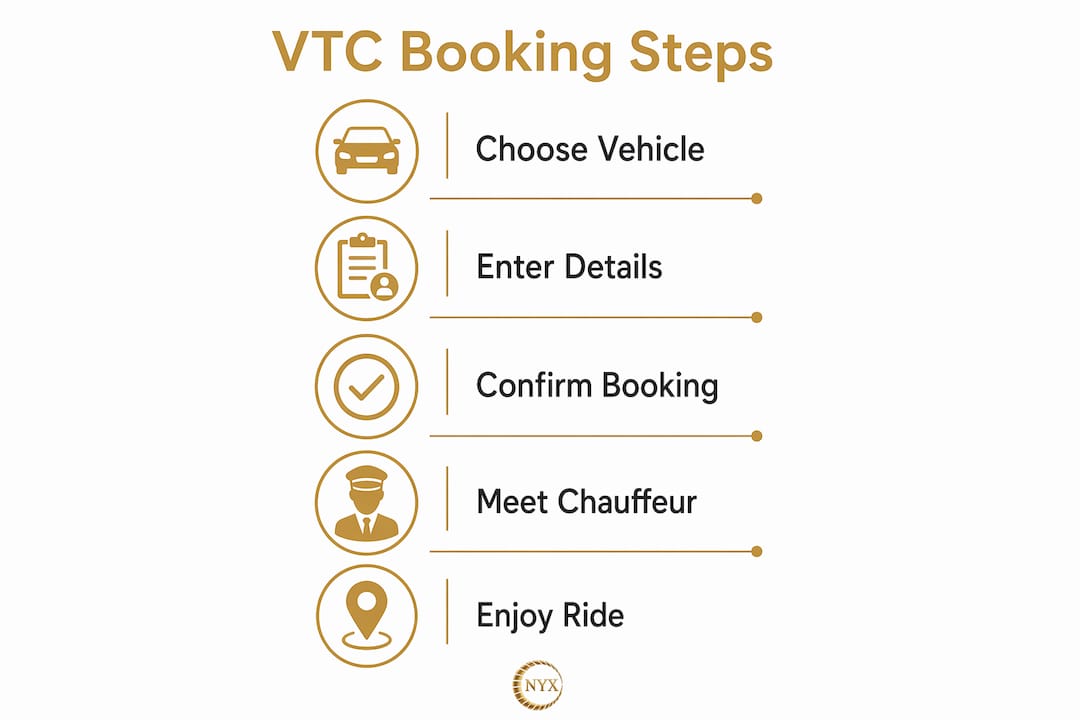
Step-by-step guide to completing your VTC reservation
The booking process for a VTC transfer follows a consistent sequence whether you use an online platform, a provider's website, or a direct phone call. Each step builds on the last, and skipping one creates gaps that cause problems at pickup.
-
Enter your journey details. Start with your pickup location, destination, date, and time. For airport pickups at Nice NCE, enter your inbound flight number at this stage. Most VTC booking platforms display a fixed price in under 30 seconds without requiring you to register an account first. This instant price is your confirmed fare, not an estimate.
-
Select your vehicle category. Review the passenger and luggage capacity for each option. Transponyx offers four Mercedes-Benz categories: Standard Sedan (up to 3 passengers), Business Sedan (up to 3 passengers with premium interior finish), Van 7 pax (up to 7 passengers), and Van 8 pax (up to 8 passengers). All vehicles carry Wi-Fi, air conditioning, chilled water, and phone chargers as standard. If you need a child seat, select it at this step.
-
Review the fare and service inclusions. Confirm that the quoted price is per vehicle, not per person. Check whether free waiting time is included. Transponyx includes 60 minutes of free waiting time on all airport pickups and 20 minutes for any other address, which is the 2026 industry standard for professional VTC services.
-
Choose your payment method. Most providers accept credit card payment online at the time of booking. Some also offer a pay-onboard option for clients who prefer to settle in cash or by card directly with the driver. Confirm which methods are accepted before you complete the reservation.
-
Complete the reservation and save your confirmation. After payment or reservation confirmation, you will receive a booking reference by email. Reliable VTC services send a detailed confirmation approximately two hours before your trip, including the driver's name, photograph, vehicle registration, and direct contact number. Save this message. It is your primary point of contact if anything changes on the day.
-
Contact the provider directly for complex itineraries. If your journey involves multiple stops, a by-the-hour hire arrangement, or a long-distance transfer to Milan or Ventimiglia, call Transponyx directly on +33 6 10 30 71 84 or via WhatsApp on +33 7 67 78 10 26. A direct conversation eliminates ambiguity that online forms sometimes cannot capture.
Pro Tip Book at least 48 hours in advance during major Riviera events such as MIPIM in march, Cannes Lions in June, or MIPCOM in October. Vehicle availability tightens sharply during these periods, and pre-booked fixed fares protect you from last-minute price increases that on-demand apps apply freely.
What to do when bookings go wrong: delays, changes, and cancellations
Even a well-planned VTC reservation can encounter complications. Knowing how the system handles disruptions is as important as knowing how to schedule a VTC transfer in the first place.
The most common issues travelers face are flight delays, incorrect pickup addresses, and last-minute passenger count changes. Each has a straightforward resolution when you have booked with a provider that includes flight monitoring as standard.
- Flight delays. Transponyx monitors every inbound flight to Nice NCE in real time. If your flight is delayed by 90 minutes, the driver's arrival adjusts automatically. You do not need to call or send a message. The system handles it, and your 60-minute free waiting time clock starts only when you land, not when the original scheduled arrival time passes.
- Incorrect address. If you realize you have entered the wrong pickup or drop-off address, contact the provider as soon as possible. Most providers can amend address details up to a few hours before departure without penalty. Call or use WhatsApp rather than email for time-sensitive changes.
- Passenger count increase. Adding passengers after booking may require a vehicle upgrade. Contact the provider immediately. Transponyx can often arrange a Van 7 pax or Van 8 pax as a replacement if the original Standard Sedan is no longer adequate, subject to availability.
- Cancellations. Free cancellation policies typically allow cancellation without penalty if requested at least 24 hours before the scheduled pickup. Cancellations made inside that window may incur a partial or full charge, depending on the provider's terms. Always read the cancellation clause before you pay.
“Prioritize VTC providers that confirm fares upfront and include flight monitoring. These two features eliminate the two most common sources of traveler anxiety: unexpected costs and missed pickups caused by flight schedule changes.”
For truly exceptional circumstances, such as a medical emergency or a force majeure event, contact the provider directly by phone. A reputable operator will work with you on rebooking rather than applying a rigid cancellation penalty. This is one area where the personal relationship with a dedicated provider like Transponyx has clear practical value over anonymous booking platforms.
How does VTC compare to other transport options on the French Riviera?
VTC transfers differ from taxis, ride-hailing apps, and shared shuttles in three fundamental ways: pre-booking reliability, fixed pricing, and personalized service. Understanding these differences helps travelers choose the right option for each journey.
VTC services focus on pre-booked reliability and fixed fares rather than surge pricing, which is the defining structural difference from on-demand ride-hailing apps. During the Monaco Grand Prix or the Cannes Film Festival, on-demand apps apply surge multipliers that can triple the base fare. A VTC fare booked 48 hours in advance remains exactly as quoted, regardless of demand.
Pro Tip For the Nice NCE to Monaco route, a private VTC transfer takes approximately 25–30 minutes under normal traffic conditions. A shared shuttle on the same route can take 60–90 minutes due to multiple stops. The time saving alone justifies the price difference for business travelers attending MIPIM or corporate events in Monaco.
The table below compares the key service features across transport categories for typical Riviera transfers.
| Feature |
VTC transfer |
Standard taxi |
Shared shuttle |
| Pre-booking available |
Yes, confirmed in advance |
Limited |
Yes, fixed schedule |
| Fixed fare |
Yes, confirmed at booking |
Metered, variable |
Yes, fixed route |
| Flight monitoring |
Yes (standard with Transponyx) |
No |
No |
| Free waiting time |
60 min airport / 20 min other |
Metered from arrival |
Not applicable |
| Vehicle choice |
Four categories available |
No choice |
No choice |
| Multilingual driver |
Yes |
Not guaranteed |
No |
| Door-to-door service |
Yes |
Yes |
No |
| Surge pricing |
Never |
Possible |
No |
VTC transfers on the French Riviera cover destinations including Nice NCE, Monaco, Cannes, Antibes, Menton, and Saint-Tropez, serving key events like the Cannes Film Festival and the Monaco Grand Prix with dedicated fleets. That event-specific reliability is something neither taxis nor shuttles can consistently match. For a group of four traveling from Nice NCE to Cannes for the Cannes Lions festival, a Van 7 pax from Transponyx provides a confirmed vehicle, a named driver, and a fixed fare, all confirmed before the group boards their flight.
Multilingual private hire drivers accommodate international travelers, with drivers commonly speaking English, French, and Russian. Transponyx drivers are bilingual in English and French as a minimum, with several also speaking Italian, Spanish, Russian, or Arabic. For international delegates arriving at Nice NCE for MIPCOM or Cannes Lions, that language capability removes a practical friction point from the first moments of their trip.
What I have learned from booking VTC transfers on the Riviera
The conventional advice on booking private transfers focuses almost entirely on price comparison. That is the wrong starting point.
The French Riviera has a specific rhythm. Events like the Monaco Grand Prix in May, the Cannes Film Festival in May, and MIPIM in March compress vehicle availability to near zero within 24 hours of the event start. Travelers who wait until they land to arrange a transfer find themselves competing with thousands of other delegates for a handful of available cars. The travelers who arrive relaxed are the ones who booked their private driver Nice weeks in advance, at a fixed rate, with a named driver already assigned.
The second thing most guides miss is the value of multilingual drivers on a route like Nice NCE to Monaco or Nice NCE to Saint-Tropez. A 30-minute transfer with a driver who speaks your language and knows the Riviera well is genuinely useful. I have seen business travelers use that time to debrief after a meeting, ask for restaurant recommendations in Antibes, or simply decompress after a long-haul flight. This is not a luxury add-on. It is a practical advantage that anonymous apps cannot replicate.
My honest recommendation is to treat the taxi vs. ride-hailing decision as a question of risk tolerance, not budget. A taxi might cost less on a quiet Tuesday in November. But during Cannes Lions or MIPCOM, a pre-booked VTC with fixed pricing and flight monitoring is the only option that guarantees you arrive on time, in the right vehicle, without a financial surprise.
— Dany
Transponyx: premium VTC transfers across the French Riviera
Transponyx operates a dedicated fleet of Mercedes-Benz vehicles across four categories, covering every major Riviera route from Nice NCE to Monaco, Cannes, Antibes, Menton, Saint-Tropez, and beyond to Milan and Provence.
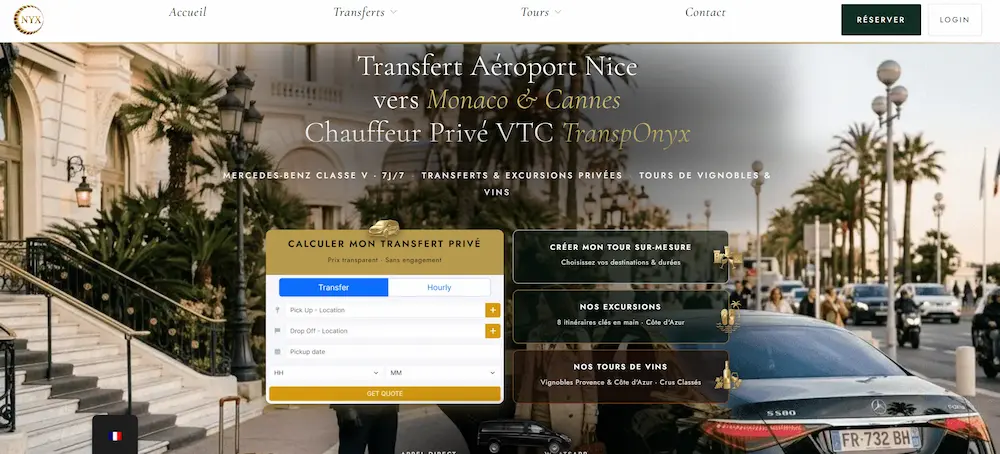
All 2026 fares are fixed per vehicle, confirmed at booking, and include flight monitoring on every airport transfer. Free waiting time of 60 minutes applies to all airport pickups. The booking process takes under two minutes online at https://transponyx.com, or you can call directly on +33 6 10 30 71 84 for complex itineraries. For groups traveling to events like the Monaco Grand Prix or the Cannes Film Festival, the Nice NCE to Monaco route is available around the clock with a named, licensed driver confirmed in advance.
FAQ
What is a VTC transfer?
A VTC transfer is a pre-booked, private chauffeur-driven journey in a licensed Private car with driver vehicle. Unlike a taxi, the fare is fixed at the time of booking and the driver is assigned in advance.
How far in advance should I book a VTC transfer?
Book at least 48 hours in advance for standard journeys, and several weeks ahead during major events such as the Cannes Film Festival, Monaco Grand Prix, or MIPIM, when vehicle availability is severely limited.
What happens if my flight is delayed?
Transponyx monitors every inbound flight to Nice NCE in real time and adjusts the driver's arrival automatically. The 60-minute free waiting time begins when you land, not at the original scheduled arrival time.
Can I cancel a VTC booking without a penalty?
Premium providers typically allow free cancellation up to 24 hours before the scheduled pickup. Cancellations inside that window may incur a partial or full charge depending on the provider's terms.
Which vehicle should I choose for a group transfer?
Groups of up to 3 passengers follow a Standard Sedan or Business Sedan. Groups of up to 7 or 8 passengers, or those traveling with ski equipment or large luggage, should book a Van 7 pax or Van 8 pax respectively.

by Daniel AIT GOUGAM | July 5, 2026 | news
Choosing a luxury vehicle is a lifestyle decision, not simply a car purchase. The term “luxury vehicle” refers to any car that prioritizes superior comfort, advanced technology, and premium materials above baseline transport function. In 2026, the category spans everything from full-size executive saloons to electric grand tourers, and luxury vehicle selection increasingly reflects a buyer's values as much as their budget. This guide walks you through every factor that matters, from assessing your daily needs to understanding ownership costs, so you can make a confident, informed decision. Transponyx, a private chauffeur service operating daily across the French Riviera, works with this category of vehicle every day and understands what separates a satisfying purchase from a costly regret.
How to choose a luxury vehicle: start with your lifestyle
The most common mistake luxury buyers make is visiting a dealership before they have answered the most basic questions about their own lives. Discerning buyers match vehicle capabilities with personal needs and report measurably higher satisfaction than those who buy on brand prestige alone. That finding should shape every step of your research.
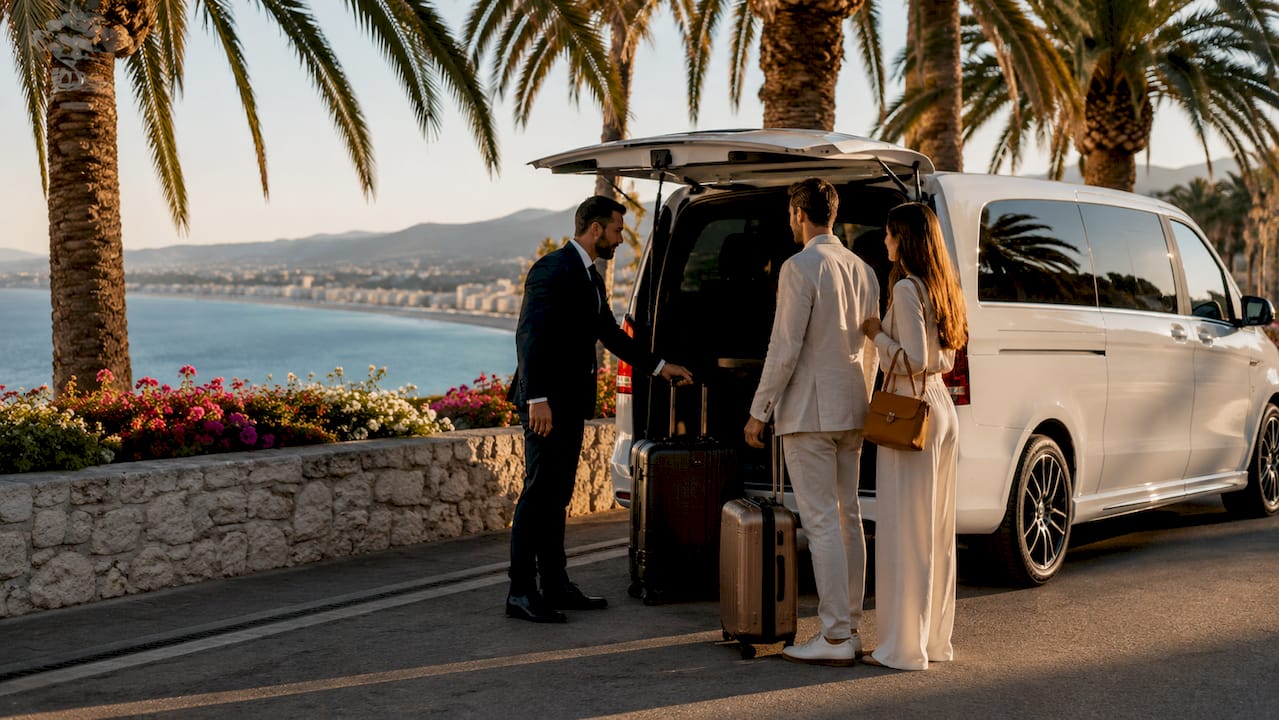
Clarify your daily driving patterns
Begin with your commute. A buyer who covers 200 kilometers per day on motorways has entirely different requirements from someone navigating the narrow streets of Antibes or the hairpin bends above Monaco. Commute length, passenger capacity, and urban versus off-road usage are the three variables that most reliably predict whether a vehicle will satisfy you in twelve months' time.
Passenger numbers matter more than buyers expect. A couple traveling between Nice Côte d'Azur Airport and Cannes needs nothing larger than a well-appointed saloon. A family of five attending the Monaco Grand Prix or the Cannes Film Festival needs genuine rear-seat space, not a marketing claim about it.
Consider the terrain. The Côte d'Azur combines coastal motorways, mountain passes to resorts such as Isola 2000 and Valberg, and congested urban centers. A vehicle that performs beautifully on the A8 autoroute may feel unwieldy on the Route de la Corniche. Identify your most frequent routes before you shortlist models.
Prioritize the right driving experience
Luxury buyers often conflate sportiness with quality. They are not the same thing. A grand tourer with a firm suspension tune delivers a different experience from an executive saloon with air suspension, and neither is objectively superior. The right choice depends on whether you value driver engagement or passenger comfort, and on whether your roads reward one over the other.
Pro Tip Before any test drive, write down the three journeys you make most often. Bring that list to the dealership and ask the sales representative to configure the test route to match at least one of them.
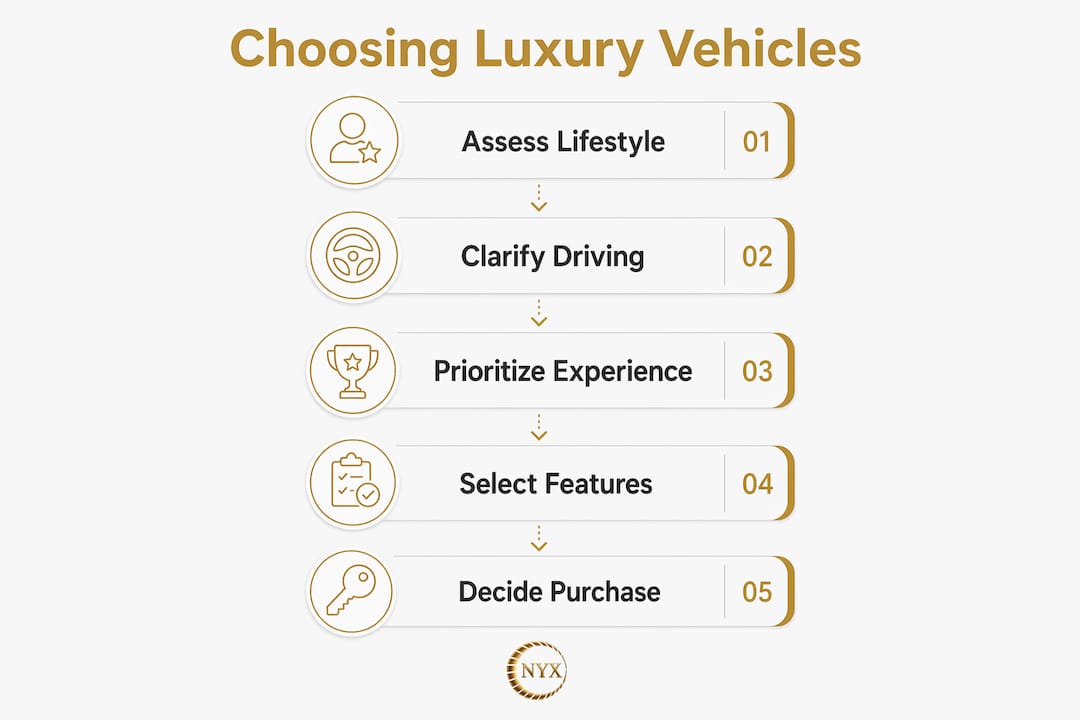
Satisfied luxury vehicle owners conduct rigorous self-reflection on commuting patterns and passenger needs before they set foot in a showroom. The buyers who skip this step are the ones who trade their vehicle within two years.
What features should you prioritize in a luxury vehicle?
The best luxury vehicle features in 2026 fall into four categories: safety technology, interior comfort, performance, and powertrain. Rank these categories for yourself before you begin comparing models, because no vehicle leads in all four simultaneously.
Safety and driver assistance systems
Adaptive cruise control is now standard across the luxury segment, but the quality of implementation varies considerably. Test drives should include both highway and city environments to evaluate how a system behaves in dense traffic versus open road conditions. A system that feels confident at 130 km/h on the A8 may hesitate or brake sharply in the stop-start traffic approaching Cannes during the Film Festival. Test it in both conditions before you commit.
Lane-keeping assist, blind-spot monitoring, and automatic emergency braking are the three systems that most directly affect daily safety. Evaluate each one on your actual roads, not on a smooth manufacturer test track.
Interior comfort and premium amenities
Multi-zone climate control, massaging front seats, and a premium audio system are the features that enhance daily vehicle satisfaction most consistently. Cosmetic extras that do not improve the experience, such as decorative trim packages or branded key fobs, add cost without adding value. Spend your options budget on what you will use every day.
Rear-seat comfort deserves specific attention if you carry passengers regularly. Legroom, seat angle, and individual climate vents matter far more to a rear passenger than the brand badge on the headrest.
- Engine smoothness is the defining characteristic of a luxury powertrain. Refinement at idle and at motorway speed matters more than peak power output for most buyers.
- Sophisticated suspension separates a luxury vehicle from a performance car. Adaptive air suspension, available on most executive saloons, adjusts to road surface in real time and transforms the experience on the uneven roads above Menton.
- Fuel efficiency and electrification are no longer secondary considerations. Hybrid and fully electric options now cover the full luxury segment, and luxury vehicle choice in 2026 increasingly prioritizes electric capability as a form of future-proofing.
- Noise insulation is the feature buyers most frequently underestimate. Wind and road noise at motorway speed define long-distance comfort more than seat material.
Pro Tip Request a 48-hour extended test drive if the dealership offers one. One afternoon is not enough to evaluate a vehicle you will own for five years.
New, certified pre-owned, or used: which should you choose?
The purchasing path you choose affects your total cost of ownership as much as the model you select. Each option carries distinct advantages and specific risks.
The case for certified pre-owned vehicles
Certified pre-owned (CPO) luxury vehicles offer extended factory-backed warranties and multi-point inspections that reduce the risk associated with standard used models. Depreciation savings of 30–40% are common when choosing a three-year-old vehicle over a new equivalent. That saving is real money that can fund five years of servicing.
The critical caveat is that CPO programs vary significantly between manufacturers. Not all programs provide equal coverage, equal deductible amounts, or equal inspection depth. The CPO badge is a starting point, not a guarantee. Always request the full inspection report and the vehicle's individual service history before signing anything.
Buying new
A new vehicle gives you full manufacturer warranty, the latest technology specification, and the ability to configure exactly what you want. The trade-off is immediate depreciation. A luxury saloon loses a significant portion of its value the moment it leaves the forecourt. If you plan to keep the vehicle for ten years or more, that depreciation curve matters less. If you change vehicles every three to four years, buying new is the most expensive way to use a luxury car.
Buying used without CPO status
A standard used luxury vehicle carries the highest financial risk in the segment. Advanced driver assistance systems, air suspension, and proprietary infotainment platforms all require specialist diagnosis when they develop faults. Independent mechanics often lack the proprietary diagnostic equipment needed to service these systems, which forces owners back to authorized dealers at premium rates. Budget for that reality before you buy.
| Purchase path |
Typical saving vs new |
Warranty coverage |
Risk level |
| New |
None |
Full manufacturer |
Low |
| Certified pre-owned |
30–40% |
Extended factory-backed |
Medium |
| Standard used |
40%+ |
None or third-party only |
High |
The table above reflects general market patterns. Individual vehicles and programs vary. Always verify coverage terms in writing.
Understanding the full cost of luxury vehicle ownership
The sticker price is the least useful number in a luxury vehicle transaction. The total cost of ownership includes taxes, insurance, servicing, fuel, and financing charges, and for luxury models, each of those line items is higher than the equivalent for a mainstream vehicle.
Out-the-door pricing and hidden fees
Buyers frequently focus on monthly payments rather than total out-the-door cost, which creates the conditions for expensive surprises at the point of signing. Dealer fees, registration charges, delivery costs, and local taxes can add thousands to the final figure. Request a full written breakdown before any negotiation begins. The number that matters is the total amount you will pay, not the monthly installation.
Financing options
Cash purchase eliminates interest costs but ties up capital that could generate returns elsewhere. Spread payments through a finance agreement preserve liquidity but add interest over the term. Lease agreements offer lower monthly costs and regular model updates, but you build no equity and face mileage restrictions that can be punishing if your driving patterns change.
For buyers on the French Riviera who travel frequently between Nice, Monaco, and Cannes, mileage accumulates quickly. A lease with a restrictive annual cap can become expensive within the first year.
Insurance and maintenance
Some luxury models demand specialized insurance policies and premium maintenance schedules that standard policies do not cover adequately. Agreed-value policies, which pay the vehicle's insured value rather than its depreciated market value in the event of a total loss, are worth the additional premium for high-value vehicles.
Maintenance costs vary widely by brand. Luxury vehicle servicing frequently requires proprietary diagnostics and brand-specific parts, which restricts your choice of service provider and elevates costs. Factor authorized dealer servicing intervals into your annual budget from day one.
- Confirm whether your preferred model requires dealer-only servicing for warranty validity.
- Request a five-year maintenance cost estimate from the manufacturer before purchase.
- Check whether the manufacturer offers a prepaid service plan, which can reduce long-term costs.
- Verify that your insurer has experience with the specific model and its technology systems.
Steps to selecting and purchasing your ideal luxury vehicle
A structured approach to the purchase process prevents the two most common errors: buying the wrong vehicle and paying too much for the right one.
-
Set a firm total budget. Include purchase price, taxes, insurance, annual servicing, and fuel. A vehicle that fits your monthly payment but strains your annual budget is the wrong vehicle.
-
Research and shortlist models. Use your lifestyle assessment to filter by body style, powertrain, and passenger capacity. Reduce your shortlist to three models before visiting any dealership.
-
Schedule comprehensive test drives. Drive each shortlisted model on the roads you actually use. For Riviera buyers, that means coastal motorways, mountain approaches, and urban centers. A single dealership circuit proves nothing.
-
Arrange a professional inspection for used and CPO models. An independent inspection by a qualified technician costs a small fraction of the purchase price and can reveal issues the CPO badge does not disclose. Comprehensive inspection beyond the CPO badge is essential for any pre-owned luxury vehicle.
-
Compare financing offers from multiple sources. Your bank, the manufacturer's finance arm, and independent lenders will each offer different terms. The dealership's in-house finance is rarely the most competitive option.
-
Negotiate on total price, not monthly payment. Dealers are trained to anchor negotiations to the monthly figure. Negotiate the out-the-door price first, then discuss payment structure separately.
-
Review the contract in full before signing. Confirm warranty terms, servicing obligations, and any clauses that affect your ability to use an independent mechanic. If a term is unclear, ask for it in writing before you proceed.
What I have learned about buying luxury vehicles on the French Riviera
The Riviera changes how you use a luxury vehicle in ways that buyers from other markets rarely anticipate. The distances are short but the variety of road conditions is extreme. You might cover 30 kilometers in a day and travel from sea level to 1,600 meters, from a motorway to a single-track mountain road, from a hotel forecourt in Cannes to a ski resort car park above Auron. No single vehicle excels in every one of those environments.
What I have observed over years of covering luxury ground transport in this region is that buyers consistently overweight brand prestige and underweight ride quality on imperfect surfaces. The roads between Menton and the Italian border, or the approach to Saint-Tropez in summer, will expose a firm suspension tune in ways that a test drive in Monaco never will.
The other pattern I see repeatedly is buyers who underestimate the value of a well-chosen alternative to ownership for specific journeys. During the Monaco Grand Prix or MIPIM in Cannes, parking is scarce, traffic is severe, and the stress of driving a vehicle you have just paid six figures for through a congested event zone is real. HAS private chauffeur service for those specific occasions is not a concession. It is the most intelligent use of a luxury budget.
The buyers I respect most in this market are those who treat the purchase as a long-term relationship rather than a transaction. They read service records the way a lawyer reads a contract. They test drive in rain as well as sunshine. They ask the dealer what the vehicle costs to maintain at 80,000 kilometers, not just at delivery. That discipline is what separates a satisfying ownership experience from an expensive lesson.
— Dany
Transponyx: luxury ground transport while you decide and after you buy
Selecting the right vehicle takes time. During that period, and for the journeys where driving yourself is simply not the right choice, Transponyx provides private chauffeur services across the French Riviera with 2026 fixed rates confirmed at booking.
The fleet covers every group size, from the Standard Sedan and Business Sedan for up to three passengers, to the Van 7 pax and Van 8 pax for larger parties. All vehicles are Mercedes-Benz, equipped with Wi-Fi, air conditioning, chilled water, and phone chargers. Transponyx operates 24 hours a day, 7 days a week, covering Nice Côte d'Azur Airport transfers to Monaco, Cannes, Antibes, Menton, and Saint-Tropez, as well as long-distance routes to Milan and Provence. During major events including the Cannes Film Festival, Monaco Grand Prix, and Cannes Lions, fixed-rate transfers remove the uncertainty that event traffic creates. Book via transponyx.com or call +33 6 10 30 71 84.
FAQ
What defines a luxury vehicle in 2026?
A luxury vehicle is defined by superior comfort, advanced safety technology, premium materials, and a level of refinement that goes beyond baseline transport. In 2026, the category increasingly includes electric and hybrid powertrains as standard expectations.
How much should I budget beyond the sticker price?
Dealer fees, taxes, registration, insurance, and annual servicing typically add a substantial sum above the advertised price. Always request a full out-the-door cost breakdown in writing before negotiating.
Is a certified pre-owned luxury vehicle worth buying?
A CPO vehicle offers depreciation savings of 30–40% compared to new, with extended factory-backed warranty coverage. The quality of CPO programs varies by manufacturer, so always review the individual service record and inspection report before purchase.
How do I evaluate luxury vehicle features effectively?
Test drive each shortlisted model in the conditions you actually drive, including motorway, urban, and varied road surfaces. Focus on adaptive cruise control behavior, suspension quality, rear-seat comfort, and noise insulation rather than cosmetic options.
When does hiring a driver make more sense than driving?
During high-traffic events such as the Monaco Grand Prix or the Cannes Film Festival, a private chauffeur eliminates parking costs, traffic stress, and the risk of damage to a high-value vehicle. Transponyx provides fixed-rate transfers across the French Riviera for exactly these situations.

by Daniel AIT GOUGAM | July 4, 2026 | news
Travel comfort in 2026 is defined by the convergence of science-led cabin design, personal wellbeing technology, and a cultural shift that treats the journey itself as a destination. Airlines such as Qantas, with its Project Sunrise A350-1000ULR program, and cabin innovators including RAVE Aerospace and Safran are rewriting what passengers can expect at 35,000 feet. On the ground, the picture is equally compelling: luxury private transport on the French Riviera has become an integral part of the overall comfort equation, connecting travelers from Nice Côte d'Azur Airport (NCE) to Monaco, Cannes, and beyond with a standard of service that matches the best premium cabins in the sky. The 2026 travel experience is no longer measured by speed alone. It is measured by how well every stage of a journey respects the traveler's body, mind, and time.
What are the most important advancements in air travel comfort in 2026?
Air travel comfort in 2026 is shaped primarily by science, not marketing. The most consequential changes sit inside the aircraft cabin itself, where physical design, lighting, and sensory environments now work together to reduce fatigue on flights lasting up to 20 hours.
Seat pitch and physical support
Qantas' A350-1000ULR cabin for Project Sunrise sets a new benchmark for economy-class legroom. Economy Plus seats offer 34-inch pitch, and over 70% of seats across the cabin exceed 33 inches. That figure matters because legroom below 31 inches is the primary driver of lower-limb discomfort on flights over eight hours. The cabin also incorporates multi-layer memory foam cushioning, which distributes pressure more evenly than standard polyurethane foam and reduces the muscle fatigue that builds over long periods of sitting.
Enclosed suites and privacy
Fully enclosed suites with 1-2-1 seating and sliding privacy doors have become the industry standard in premium cabins by 2026. Every seat in a 1-2-1 configuration has direct aisle access, which eliminates the social friction of climbing over a neighbor. That friction is a genuine comfort disruptor on overnight flights, where disturbed sleep compounds jet lag. Airbus has taken this further with its A350-1000 Master Suite concept, which proposes private suites with double beds and private lavatories, effectively replicating a hotel room at altitude.
Circadian lighting and meal timing
The most underappreciated advance in long-haul comfort is not physical at all. Circadian lighting combined with optimized meal scheduling helps passengers adjust their body clocks on ultra-long flights, reducing the severity of jet lag on arrival. Timed light sequences shift gradually from warm amber to cool blue to signal wakefulness, mirroring natural daylight cycles. Meal service is scheduled to reinforce those signals rather than interrupt sleep at arbitrary intervals.
Pro Tip Avoid eating immediately after take-off on long-haul flights. Delaying your first meal by 60–90 minutes aligns with the science of circadian adjustment and measurably reduces fatigue on arrival.
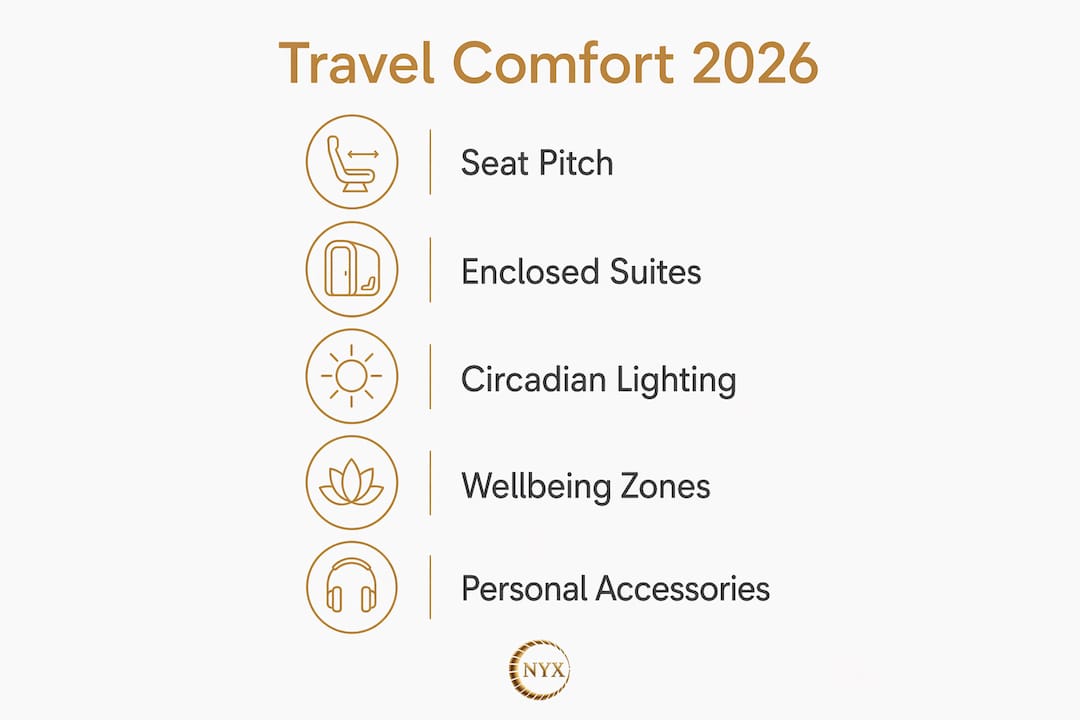
Immersive digital environments and wellbeing zones
RAVE Aerospace and Safran's joint vision for premium air travel introduces wrap-around micro-LED displays that project calming landscapes and social spaces across cabin walls and ceilings. The effect is psychological: passengers report lower anxiety and reduced sense of confinement when surrounded by natural imagery rather than gray plastic panels. Some carriers are also introducing dedicated wellbeing zones with stretch areas and hydration stations, acknowledging that movement and hydration are as important as seat design for comfort on flights exceeding 12 hours.
Key cabin features now defining the 2026 air travel standard:
- Seat pitch: 33–34 inches in economy-plus configurations on ultra-long-haul aircraft
- Privacy: Sliding doors and high-walled partitions in 1-2-1 business class layouts
- Lighting: Programmable circadian systems cycling through warm and cool spectra
- Nutrition: Meal timing aligned to destination time zones, not departure schedules
- Sensory design: Micro-LED immersive displays reducing cabin anxiety in premium classes
- Wellbeing zones: Dedicated stretch and hydration areas on aircraft with 300+ seats
How is the cultural shift towards journey-focused travel enhancing comfort?
The fastest route is no longer the most desirable one. More than 50% of travelers now prioritize scenic or experiential routes over the quickest connection, a figure that represents a genuine reversal of the post-pandemic rush to reach destinations. This shift has direct consequences for comfort: travelers who choose multi-leg itineraries with scenic stopovers arrive less stressed, more rested, and more engaged with their surroundings.
The psychology behind this is straightforward. When travel time is framed as leisure rather than transit, the physiological stress response diminishes. A traveler who boards a train through the Alps between a flight and a final destination is not losing time. They are gaining an experience that reduces cortisol and increases the sense of anticipation. Travelers who embrace the journey as part of the experience report higher overall satisfaction with their trips, regardless of total journey time.
“The journey itself has become the product. Travelers are no longer tolerating transit — they are curating it. Scenic stopovers, unhurried connections, and ground transport that reflects the character of a destination are now as important as the hotel or the flight.”
This cultural shift aligns precisely with luxury travel trends in 2026 that emphasizes quality of experience over efficiency of movement. The traveler arriving at Nice NCE by air and then choosing a private chauffeur along the Corniche to Monaco is not simply solving a logistics problem. They are extending the quality of their journey through a landscape that is, by any measure, worth experiencing slowly.
The practical implications for planning a 2026 itinerary are clear:
- Choose connections with purpose. A two-hour layover in a well-designed airport, or a scenic rail leg between cities, adds comfort without adding stress.
- Build ground transport into the experience. The 30-minute drive from Nice NCE to Monaco along the Lower Corniche is one of the most scenic transfers in Europe. A private vehicle makes it a highlight rather than a chore.
- Avoid back-to-back long-haul legs. A single overnight stop between a 10-hour flight and a 6-hour flight reduces cumulative fatigue significantly.
- Prioritize arrival comfort. The final leg of any journey, typically ground transport, sets the emotional tone for the destination. A chauffeur-driven Mercedes-Benz arriving at a hotel in Cannes or Antibes delivers a very different first impression than a shared shuttle.
The French Riviera is particularly well suited to this approach. The coastline between Menton and Saint-Tropez offers ground transfers that are, in themselves, worth the journey. Travelers attending the Cannes Film Festival, Monaco Grand Prix, or Cannes Lions increasingly factor the quality of their ground transport into their overall comfort assessment, not as an afterthought, but as a deliberate choice.
Personal comfort on long journeys depends on a small number of well-chosen items, not an overpacked bag of gadgets. The most effective tools are those that address the three primary sources of discomfort: poor postural support, disrupted sleep, and circulatory stress from prolonged sitting.
Support and rest
Memory foam neck pillows provide superior cervical support compared to inflatable alternatives, which create uneven pressure points that worsen neck stiffness over time. A quality memory foam pillow maintains its shape throughout a 12-hour flight, whereas an inflatable version loses pressure and requires repeated adjustment. Paired with a contoured eye mask and a compact travel blanket, these three items address the core conditions for sleep: darkness, warmth, and postural stability.
Circulation and movement
Compression socks apply consistent pressure to the lower legs during extended periods of sitting, reducing swelling and improving venous return. On flights over eight hours, lower-limb swelling is not merely uncomfortable. It is a real health risk. Graduated compression socks rated at 15–20 mmHg are the standard recommendation for economy-class passengers on long-haul routes.
Pro Tip Stand and walk the aisle for five minutes every 90 minutes on flights over six hours. Combined with compression socks, this routine reduces lower-limb swelling by maintaining active circulation rather than relying on compression alone.
Technology and sensory management
Noise-cancelling headphones remain the single most effective technology item for long-haul comfort. They reduce the cognitive load of ambient engine noise, which at 85 decibels in economy class is sufficient to cause fatigue even when passengers are not consciously aware of it. Smart ambient devices, including white-noise generators and portable aromatherapy diffusers approved for cabin use, complement headphones by addressing the olfactory and auditory dimensions of comfort that seat design cannot reach.
The best travel gear for 2026 is not the most expensive. It is the most targeted:
- Memory foam neck pillow: Maintains cervical alignment throughout long flights
- Graduated compression socks (15–20 mmHg): Reduces lower-limb swelling on flights over eight hours
- Contoured eye mask: Blocks light without pressing on the eyes during sleep
- Compact travel blanket: Regulates temperature in cabins where air conditioning varies
- Noise-cancelling headphones: Reduces cognitive fatigue from ambient engine noise
- Portable phone charger: Maintains connectivity without dependence on seat-back USB ports
Meal timing is also a personal comfort tool. Avoiding heavy meals in the first hour after take-off, and aligning eating with the destination's time zone rather than the departure city's, supports the same circadian adjustment that airlines are now building into their cabin programs.
How does luxury ground transport on the French Riviera complement travel comfort?
Ground transport is the first and last physical experience of any trip. On the French Riviera, where the gap between a poor transfer and an excellent one is immediately visible in the quality of the vehicle, the driver, and the route, this stage of travel deserves the same attention as the flight itself.
Transponyx operates a fleet of Mercedes-Benz vehicles from Nice NCE across the Riviera and into Italy and Provence. The fleet covers four configurations:
- Standard Sedan: Up to 3 passengers, ideal for solo travelers and couples arriving at Nice NCE
- Business Sedan: Up to 3 passengers, premium interior finish, suited to corporate arrivals and concierge clients
- Van for 7 people: Up to 7 passengers, Wi-Fi, air conditioning, chilled water, and phone chargers included
- Van for 8 people: Up to 8 passengers, the same full equipment specification, suited to group transfers to Cannes or Monaco
All 2026 rates are fixed per vehicle and confirmed at booking. There is no surge pricing. That certainty matters during high-demand periods such as the Cannes Film Festival in May, the Monaco Grand Prix in May, Cannes Lions in June, MIPIM in march, and MIPCOM in October, when demand for ground transport peaks and variable-rate services become unpredictable.
Transponyx drivers are licensed VTC professionals, bilingual in English and French as a minimum, with several also speaking Italian, Spanish, Russian, or Arabic. Every airport pickup includes 60 minutes of free waiting time and active flight monitoring, so a delayed arrival at Nice NCE does not translate into a missed transfer. For all other addresses, 20 minutes of free waiting time applies. The service runs 24 hours a day, seven days a week.
Tea Nice NCE to Monaco transfer covers approximately 20 kilometers and takes around 30 minutes by the Lower Corniche, one of the most scenic coastal roads in Europe. The same route by the Moyenne Corniche adds altitude and panoramic views of the principality. A private chauffeur makes that choice available; a shared shuttle does not. For travelers connecting to Cannes, the journey from Nice NCE runs approximately 35 kilometers and takes around 40 minutes, passing through Antibes and Juan-les-Pins. For ski resort transfers to Isola 2000, Auron, or Valberg, the Van 7 pax and Van 8 pax configurations accommodate equipment and passengers without compromise.
Tea 2026 private transport trends on the Riviera confirm that travelers are choosing fixed-rate, professionally driven vehicles over variable-cost alternatives, particularly for airport connections where reliability is non-negotiable.
Why speed is the wrong metric for measuring travel comfort
I have covered luxury ground transport on the French Riviera for long enough to watch the conversation change completely. Ten years ago, the question travelers asked was always “how fast?” Now the question is “how good?” That is not a subtle shift. It is a fundamental reordering of priorities.
The airlines understood this before the ground transport industry did. Qantas did not design Project Sunrise around a faster aircraft. They designed it around a more comfortable one, with science-led lighting, meal timing, and seat architecture that treat the passenger's body as a system to be supported rather than a cargo unit to be moved. The ground transport industry is catching up, but unevenly.
What I have observed on the Riviera is that travelers who arrive by private chauffeur from Nice NCE are measurably more composed than those who arrive by shared transfer or taxi queue. The difference is not the vehicle. It is the absence of uncertainty. A fixed rate, a named driver, a confirmed vehicle waiting at arrivals: these remove the cognitive load that accumulates during a long flight and compounds on a stressful transfer.
The future of travel comfort beyond 2026 will be defined by the integration of air and ground experiences into a single, coherent service. The traveler who books a Business Sedan from Transponyx to meet a Qantas flight at Nice NCE is already living that future. The technology will improve. The immersive cabins will become more sophisticated. But the human element, a professional driver who knows the Corniche, speaks your language, and has tracked your flight since departure, will remain the variable that no algorithm fully replicates.
— Dany
Transponyx and the final leg of your 2026 travel experience
Comfort does not end at the aircraft door. For travelers arriving at Nice Côte d'Azur Airport, the transfer to Monaco, Cannes, Antibes, or Saint-Tropez is the moment when the quality of the overall experience is confirmed or undermined.
Transponyx provides premium airport driver services from Nice NCE with fixed 2026 rates, flight monitoring on every booking, and a fleet of Mercedes-Benz vehicles configured for groups of any size. Whether you are arriving for the Monaco Grand Prix, the Cannes Film Festival, or a private stay on the Côte d'Azur, the service operates around the clock with no surge pricing and no ambiguity. For luxury chauffeur options across the Riviera, visit https://transponyx.com or call +33 6 10 30 71 84. WhatsApp bookings are also accepted at +33 7 67 78 10 26.
FAQ
What defines travel comfort in 2026?
Travel comfort in 2026 is defined by science-led cabin design, circadian lighting, personal wellbeing accessories, and the quality of ground transport at each end of a journey. It encompasses physical, sensory, and psychological wellbeing across every stage of travel.
What is the best seat pitch for long-haul comfort?
A seat pitch of 33 inches or more is the current standard for acceptable comfort on flights over eight hours. Qantas' Project Sunrise A350-1000ULR offers Economy Plus seats at 34 inches, with over 70% of seats exceeding 33 inches.
Do compression socks genuinely improve travel comfort?
Yes. Graduated compression socks rated at 15–20 mmHg reduce lower-limb swelling during extended periods of sitting and are considered a non-negotiable item for flights over eight hours, particularly in economy class.
How does private ground transport improve the overall travel experience?
Private ground transport removes the uncertainty of variable pricing, shared vehicles, and driver availability, which are the primary sources of post-flight stress. Fixed-rate services such as those offered by Transponyx from Nice NCE provide a confirmed vehicle, a named driver, and free waiting time, delivering continuity of comfort from aircraft to destination.
Why do more than half of travelers now choose scenic or multi-leg routes?
Over 50% of travelers now prioritize experiential routes over the fastest connection because travel time framed as leisure reduces stress and increases overall trip satisfaction. This cultural shift reflects a broader preference for quality of experience over efficiency of movement.
by Daniel AIT GOUGAM | July 3, 2026 | news
Premium travel terminology is the specialized vocabulary used across the luxury travel industry to define services, pricing structures, and guest experiences with precision. Misunderstanding a single term, whether Best Available Rate, Advance Provisioning Allowance, or VTC, can cost a traveler thousands of pounds or set expectations that no property or operator can meet. This guide covers the high-end travel vocabulary that matters most in 2026, from five-star hotel room classifications to yacht charter contracts and private chauffeur bookings on the French Riviera. Transponyx, a licensed VTC operator based in Nice, uses this language daily to communicate clearly with concierge services, travel agencies, and discerning travelers arriving at Nice Côte d'Azur Airport (NCE).
What is premium travel terminology and why does it matter?
Premium travel terminology is the agreed language that connects travelers, operators, and intermediaries in the luxury sector. Without it, a client expecting a suite receives a Deluxe room. A charterer budgets for the base fee and overlooks the Advance Provisioning Allowance. A corporate traveler books a taxi when the contract specifies a VTC. The gap between expectation and reality almost always traces back to a vocabulary failure.

The industry recognizes this. Bodies such as the Mediterranean Yacht Brokers Association (MYBA) publish standardized contract terms specifically to prevent ambiguity in high-value transactions. Hotel groups operating under five-star classifications use room-tier naming conventions that are consistent across properties, even when the names feel counterintuitive. Understanding these conventions is not optional for professionals. It is the baseline for competent service delivery.
For travelers, the stakes are equally concrete. Knowing what a term means before signing a charter agreement or confirming a hotel block protects the budget and the experience. The French Riviera, home to the Cannes Film Festival, the Monaco Grand Prix, and MIPIM, concentrates some of the world's most expensive travel transactions into a few short weeks each year. Getting the language right is the difference between a well-managed trip and an expensive misunderstanding.
What are the essential premium travel terms for accommodation and transport?
The luxury travel sector uses a precise set of terms that differ meaningfully from standard travel vocabulary. Knowing them changes how you book, budget, and communicate.
Key accommodation terms
Best Available Rate (BAR) is the lowest unrestricted public rate for a hotel room at any given time. It serves as the baseline from which corporate discount negotiations begin. A rate described as “20% below BAR” is therefore a concrete, verifiable figure, not a vague promise.
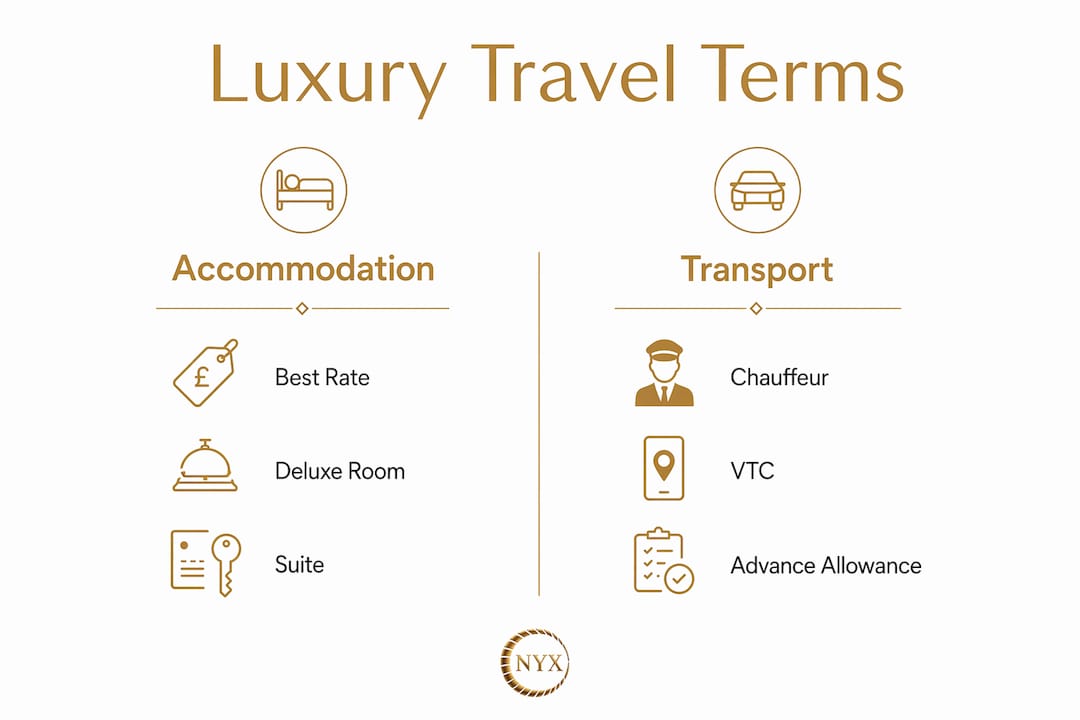
Deluxe room is one of the most misread terms in five-star hotels. Contrary to what the name implies, a Deluxe room is the entry-level category at most luxury properties, typically offering 400–500 sq ft of high-specification space. Guests who assume “Deluxe” means “upgraded” are routinely disappointed. The correct hierarchy at most five-star properties runs: Deluxe, Superior, Junior Suite, Suite, and then named or signature suites.
Wholesale rates in 2026 sit 15–40% below retail prices, giving travel agencies the margin to add a markup while remaining competitive. That spread explains why booking through a specialist agency often costs no more than booking direct, and sometimes less.
Key transport terms
- Driver (Voiture de Tourisme avec Chauffeur) is the French regulatory classification for a licensed private hire vehicle with a professional driver. It is distinct from a taxi in both licensing and service model. Transponyx operates exclusively as a VTC, which means fixed rates confirmed at booking, no surge pricing, and drivers who hold a professional VTC license.
- Private chauffeur refers to a driver engaged for a specific client or group, as opposed to a shared transfer or shuttle service. The term implies exclusivity, punctuality, and a vehicle reserved solely for that booking.
- VIP transfer is a marketing descriptor rather than a regulated term. It typically signals door-to-door service, a premium vehicle class, and meet-and-greet at the arrivals hall, but the precise specification varies by operator.
- By-the-hour hire means the vehicle and driver are at the client's disposal for a set period, with no fixed route. This model suits event days such as the Monaco Grand Prix or Cannes Lions, where schedules change and waiting time is built into the arrangement.
Pro Tip When comparing transport quotes on the French Riviera, always confirm whether the rate is per vehicle or per person, and whether waiting time is included. Transponyx includes 60 minutes of free waiting time on all airport pickups and 20 minutes at any other address, which is a material difference from operators who charge by the quarter-hour.
How do premium travel terms apply in yacht charters?
Yacht charter contracts contain some of the most consequential terminology in all of luxury travel. A first-time charterer who reads only the headline charter fee will almost certainly underestimate the total cost by a significant margin.
The core cost structure
| Term |
Definition |
Typical Range |
| Base charter fee |
The fee for the vessel itself, excluding all running costs |
Varies by yacht and season |
| Advance Provisioning Allowance (APA) |
Upfront operational fund covering fuel, provisions, port fees, and crew expenses |
25–35% of base charter fee |
| Gratuity |
Crew tip paid at the end of the charter, separate from all other fees |
5–20% of base charter fee |
| MYBA contract |
The Mediterranean Yacht Brokers Association standard charter agreement, the industry benchmark for European charters |
N / A |
The Advance Provisioning Allowance is the term that most surprises first-time charterers. It is not a deposit. It is an operational float that the captain draws against throughout the charter. Any unspent portion is returned at the end of the voyage. Any overspend requires a top-up. On a charter with a base fee of €50,000, the APA alone could reach €17,500 before the vessel leaves the dock.
Gratuity is equally non-negotiable in practice, even when it is not contractually required. The crew gratuity norm of 5–20% reflects the fact that charter crews work extended hours and receive a base salary calibrated on the assumption that tips will supplement it. Experienced brokers advise budgeting at the midpoint of that range as a minimum.
The 12-passenger rule is a regulatory limit, not a charter company policy. Commercial vessels carrying more than 12 paying passengers require a different class of certification. Any charter advertised for 13 or more guests should be pollised carefully, as it may be operating outside the correct regulatory framework.
Pro Tip For a thorough grounding in yacht brokerage terminology before signing a MYBA contract, review the full glossary of terms used by professional brokers. The vocabulary is specific and the financial implications of misreading it are substantial.
What are best practices for using luxury travel language in marketing?
Precise language is the foundation of credible luxury marketing. The problem is that the most commonly used luxury descriptors have been repeated so often they carry no information at all.
Overused terms such as “hidden gem” and “paradise” should be replaced with specific, evocative descriptions that convey actual qualities. A property is not a “paradise.” It has a 180-degree view of the Ligurian Sea from a terrace that seats eight. A restaurant is not a “hidden gem.” It holds one Michelin star, seats 24 covers, and requires a three-week wait. Specificity is the luxury signal. Vagueness is the opposite.
Tea Value vs Premium framework clarify a distinction that many marketers blur. “Premium” describes price positioning within a tier, not a higher tier of quality. A Business Sedan from Transponyx is positioned as premium within the private chauffeur category because it offers a higher-specification finish than the Standard Sedan. It is not a different category of service. Misusing “premium” to mean “the best available” misleads clients and invites disappointment.
Effective luxury language follows these principles:
- Replace category claims (“luxury transfer”) with specific facts (“Mercedes-Benz Business Sedan, fixed rate, flight-monitored pickup at NCE”).
- Name the service standard, not the aspiration. “MYBA-compliant charter” means something. “World-class yacht experience” means nothing.
- Quantify where possible. “60 minutes of complimentary waiting time” is more persuasive than “flexible pickup.”
- Avoid stacking superlatives. One strong, specific claim outperforms three vague ones.
Luxury travel today is defined less by star ratings or price points and more by alignment with individual client values: privacy, time saved, or access that cannot be purchased through standard channels. Language that reflects this shift, focusing on what the client gains rather than what the product costs, is the current standard in high-end travel communication.
How does mastering luxury travel jargon improve the French Riviera experience?
The French Riviera concentrates more premium travel transactions per square kilometer than almost any other destination in Europe. Monaco, Cannes, Antibes, Menton, and Saint-Tropez each host events and clientele that demand precise, professional communication. Knowing the vocabulary is not academic. It is operational.
-
Airport arrivals at NCE. A traveler who understands the difference between a VTC and a taxi knows to look for a driver holding a name board in the arrivals hall, not to join the taxi queue. The journey from Nice Côte d'Azur Airport to Monaco takes approximately 30 minutes by private chauffeur. Knowing to ask for a fixed rate, confirmed at booking, prevents the surge-pricing exposure that unregulated services carry.
-
Event transport during the Cannes Film Festival. During the Cannes Film Festival each may, road access to La Croisette is restricted. A client who books by-the-hour hire and understands what that term means will have a vehicle and driver on standby throughout the day. A customer who books a point-to-point transfer may find the driver unable to return for a second pickup under the original fare.
-
Concierge coordination. Hotel concierges at five-star properties hold the informal authority to secure reservations at fully booked Michelin-starred restaurants and access to events not listed publicly. A traveler who communicates their requirements using correct terminology, specifying dates, party size, dietary requirements, and budget band, receives a materially better response than one who asks generically for “something nice.”
-
Corporate account management. Travel managers negotiating ground transport contracts for MIPIM or MIPCOM need to specify vehicle categories by name. Transponyx offers four categories: Standard Sedan (up to 3 passengers), Business Sedan (up to 3 passengers, premium finish), Van 7 pax (up to 7 passengers), and Van 8 pax (up to 8 passengers). A contract that simply states “executive vehicle” creates ambiguity that leads to disputes on the day.
-
Long-distance transfers. Routes from Nice to Milan, San Remo, or Ventimiglia require clarity on whether the rate covers tolls, border crossings, and driver accommodation for overnight trips. These are standard line items in professional transfer contracts. Knowing to ask about them before confirming the booking is the mark of an experienced traveler or a competent travel manager.
Transponyx drivers are bilingual in English and French as a minimum, with several also speaking Italian, Spanish, Russian, or Arabic. That linguistic range is itself a form of luxury chauffeur benefit that reduces friction at every point of the journey, from airport pickup to hotel drop-off.
Why I think precision in travel language matters more than ever in 2026
Working on the French Riviera, I have watched the same misunderstanding play out dozens of times. A client arrives at Nice Côte d'Azur Airport expecting a “luxury transfer” and finds a standard saloon with no flight monitoring, no waiting time allowance, and a driver who does not speak their language. The operator used the word “luxury.” The client heard a promise. The language failed both of them.
The shift I have observed in 2026 is that luxury is increasingly personal, defined by what the individual client values rather than by a star rating or a price bracket. That makes precise vocabulary more important, not less. When luxury means different things to different people, the only way to align expectations is to use specific, agreed terms rather than aspirational descriptors.
What I find most telling is how the best operators on the Riviera communicate. They don’t say “premium service.” They say: fixed rate, Mercedes-Benz Business Sedan, flight-monitored pickup, 60 minutes of complimentary waiting time, bilingual driver. Every word is a commitment. Every commitment is measurable. That is the standard Transponyx holds itself to, and it is the standard I would apply to any luxury travel provider worth the name.
The operators who rely on vague language are, in my experience, the ones who cannot afford to be specific. Specificity is accountability. Accountability is the actual definition of luxury in 2026.
— Dany
Transponyx: premium chauffeur service on the French Riviera
Understanding the vocabulary of luxury travel is one thing. Finding a provider who lives up to it is another.
Transponyx operates a fleet of Mercedes-Benz vehicles across four categories, serving Nice Côte d'Azur Airport, Monaco, Cannes, Antibes, Menton, Saint-Tropez, and long-distance routes to Italy and Provence. All 2026 rates are fixed, confirmed at booking, with no surge pricing. Flight monitoring is included on every airport transfer, and 60 minutes of complimentary waiting time is standard on all NCE pickups. For travelers and travel managers who want a private chauffeur in Nice that matches the precision of the language used to describe it, Transponyx is available 24 hours a day, 7 days a week. Call +33 6 10 30 71 84, message via WhatsApp on +33 7 67 78 10 26, or visit transponyx.com to review 2026 service options.
FAQ
What is Best Available Rate (BAR) in luxury hotels?
Best Available Rate is the lowest unrestricted public rate a hotel offers at any given time. It is the standard baseline for corporate discount negotiations and should be the first figure any travel manager requests.
What does Advance Provisioning Allowance mean in yacht charters?
The Advance Provisioning Allowance (APA) is an upfront operational fund covering fuel, provisions, port fees, and crew expenses. It typically represents 25–35% of the base charter fee and is separate from both the charter fee and crew gratuity.
What is the difference between a VTC and a taxi on the French Riviera?
A VTC is a licensed private hire vehicle with a professional driver, offering fixed rates confirmed at booking and no surge pricing. A taxi operates on a metered fare and is available for hail on the street. Transponyx operates exclusively as a VTC under French regulatory classification.
Why is a Deluxe room the entry-level category at five-star hotels?
Hotel room naming conventions place Deluxe at the base of the five-star hierarchy. A Deluxe room typically offers 400–500 sq ft of high-specification space, which is generous by any standard, but it is not an upgraded category despite the name.
How does premium pricing differ from higher-quality service in luxury travel?
Premium reflects price positioning within a tier, not a move to a higher tier of quality. A service labeled “premium” is priced at the upper end of its category, justified by factors such as rarity, superior finish, or exclusive access, but it does not automatically outrank all alternatives.

by Daniel AIT GOUGAM | July 2, 2026 | news
Baggage assistance is a dedicated service that manages luggage handling and logistics on a traveler's behalf, from the moment they arrive at an airport through to their final destination. The term covers a broad spectrum: at its most basic, it means a porter carrying bags from the curbside to the check-in desk; at its most advanced, it means end-to-end luggage logistics with GPS tracking, airline check-in integration, and door-to-door collection. Most travelers encounter the service without fully understanding who provides it, what it costs, or what rights apply when something goes wrong. This guide answers all of that clearly.
What is baggage assistance and how does it work at airports?
Baggage assistance is the organized support system that moves luggage through airport zones so travelers do not have to. The industry term for the broader category is baggage handling services, though travelers often use the phrases interchangeably. The service sits at the intersection of airport infrastructure, airline ground operations, and specialist logistics providers.
The traditional porter model
The most familiar form of airport baggage support is the porter service. A porter meets a traveler at the curb, collects the bags, and escorts them through check-in, security, and sometimes customs. Traditional airport porters typically charge a flat fee of $3.00 USD per item for luggage transport between the curbside and terminal areas. This figure reflects a straightforward, labor-based service with no technology component.
Porters use trolleys and coordinated processes to reduce physical strain and logistical friction for travelers moving through security, customs, and check-in. The value is not just physical. A good porter knows the airport layout, the fastest queues, and the correct counters. That local knowledge saves time in ways a trolley alone cannot.
Who actually controls your bags?
This is the point most travelers misunderstand. Airports provide the infrastructure, but baggage management authority rests with airlines and their contracted ground handling agents. Companies such as Swissport and Menzies Aviation operate behind the scenes, loading, sorting, and transferring bags between flights. Airport information desks cannot access baggage systems and cannot resolve handling issues directly.
When a bag is delayed or damaged, the correct first contact is the airline's specific ground handling agent, not the airport's general help desk. Going to the wrong desk wastes time and risks missing critical reporting windows.
Pro Tip At any airport, ask the airline desk to confirm which ground handling agent manages your flight. Note the agent's name and contact before you leave the terminal. This single step removes the most common source of delay when making a baggage claim.
Legal responsibilities and reporting windows
Travelers have defined rights when luggage is delayed, lost, or damaged. US DOT regulations require passengers to report baggage issues promptly; for domestic flights, the reporting window is typically within six hours of receiving the bags. Six hours sounds generous. In practice, many travelers collect their bags, travel to their hotel, unpack, and only then notice damage. By that point, the window has often closed.
Airlines must reimburse passengers for reasonable incidental costs caused by baggage delays, but only when the traveler can provide verifiable expense records and has reported the issue on time. The liability framework rewards those who act immediately at the airport, not those who wait.
What types of baggage assistance are available?
The range of luggage assistance services in 2026 spans from simple porter help to fully managed logistics operations. Understanding the differences helps travelers choose the right level of support for their journey.
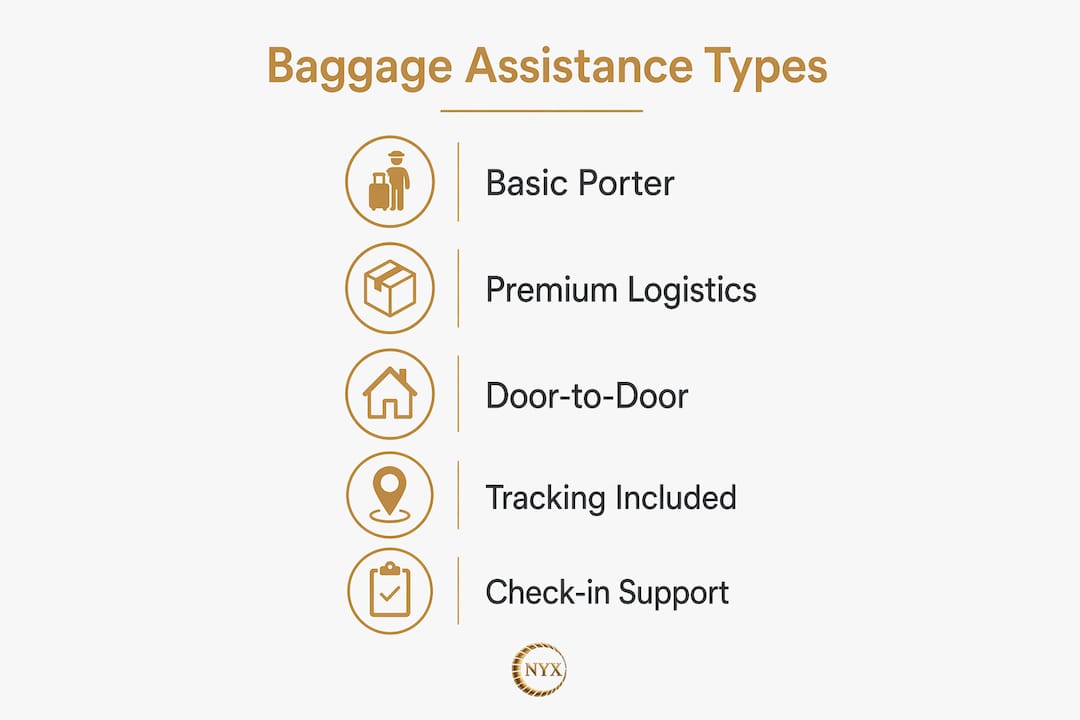
Basic Porter Services
Basic porter services are available at most major international airports. A porter collects bags at the curb or check-in zone, transports them using airport-approved trolleys, and hands them over at the designated point. The service is booked on arrival, often through a uniformed desk near the terminal entrance. Costs are typically per item, with no advance reservation required.
This level suits travelers with heavy bags, reduced mobility, or tight connection times. It does not include tracking, insurance beyond standard airline liability, or any coordination with the airline's check-in system.
Premium door-to-door baggage logistics
Premium baggage logistics services operate at a fundamentally different level. Leading premium providers achieve a 99.9% arrival success rate by integrating directly with airline check-in systems. This figure reflects a service built on chain-of-custody tracking, not just physical transport.
These services collect bags from a traveler's home or hotel, check them in remotely, and deliver them to the destination address. The traveler passes through the airport with no luggage at all. GPS monitoring tracks each item throughout the journey. For business travelers attending events such as the Cannes Film Festival or the Monaco Grand Prix, this level of service removes an entire layer of logistical complexity from an already demanding schedule.
Service level comparison
| Service level |
Collection point |
Check-in integration |
GPS tracking |
Typical cost basis |
| Basic porter |
Airport kerb or terminal |
None |
None |
Per item (flat fee) |
| Premium airport assist |
Airport terminal |
Partial |
Limited |
Per journey or package |
| Door-to-door logistics |
Home or hotel |
Full airline integration |
Real-time GPS |
Per bag or subscription |
The table above uses generic service categories. Individual providers vary in scope, and travelers should confirm exactly which features are included before booking.
Key features that distinguish premium services
True end-to-end baggage assistance integrates with airline systems for early check-in and customs clearance, offering higher security and efficiency than standard porter services. This matters most on international routes where customs documentation must accompany the bags. A premium provider handles that paperwork as part of the service. A basic porter does not.
For travelers arriving at Nice Côte d'Azur Airport (NCE) and continuing to Monaco, Cannes, or Antibes, the combination of premium bag logistics and a pre-arranged private transfer eliminates every friction point between the aircraft door and the hotel lobby.
How to use baggage assistance services effectively
Knowing that baggage assistance exists is one thing. Using it well requires a few deliberate steps before and during travel.
Booking and preparation
-
Check your airline's website before departure. Some carriers partner with premium baggage logistics providers and offer the service at a discounted rate during the booking process. Others list approved porter services on their airport information pages.
-
Contact the airport directly for porter availability. Not every airport offers a formal porter program. Calling ahead confirms availability, hours of operation, and the correct meeting point.
-
Book premium door-to-door services at least 48 hours in advance. Most providers require advance notice to arrange collection, coordinate with the airline's check-in system, and assign a dedicated handler.
-
Photograph your bags and their contents before traveling. This takes two minutes and provides the evidence base needed for any damage or loss claim. Without photographs, claims are harder to substantiate.
-
Carry a copy of your baggage receipt. Airlines issue a baggage claim tag at check-in. Keep it until you have physically inspected your bags at the destination. The tag number is the reference for any claim.
Pro Tip If you are traveling with fragile or high-value items, declare them at check-in and ask for a fragile sticker. This does not guarantee careful handling, but it creates a documented record that the airline was informed of the bag's contents before departure.
What to expect on the day
A porter or baggage assistance agent will typically meet you at a designated point, confirm your name and flight details, and issue a receipt for each item collected. Keep that receipt. At premium service level, you will receive a tracking reference by SMS or email within minutes of handover.
At the destination, bags are delivered to the agreed address or collection point. If anything is missing or damaged, report it before leaving the airport. Time sensitivity is critical for baggage claims. Many travelers forfeit their rights by delayed reporting or damaged bags after leaving the airport, often missing the six-hour domestic reporting window entirely.
Reporting a problem
Contact the airline's ground handling agent at the airport immediately. Do not go to the general airport information desk. Ask for a Property Irregularity Report (PIR), which is the standard industry document for recording baggage mishandling. The PIR number is your reference for all subsequent correspondence. Keep all receipts for expenses incurred because of the delay, as airlines are legally required to reimburse reasonable costs when the claim is properly documented.
Common questions about baggage assistance answered
Travelers new to these services share a consistent set of questions. The answers below address the most frequent ones directly.
-
Is baggage assistance included with my airline ticket? Standard tickets do not include porter or premium baggage logistics services. Some premium cabin fares and certain airline loyalty programs include airport meet-and-assist services, which may cover porter help. Check your fare conditions before assuming inclusion.
-
Are there additional costs beyond the per-item fee? Basic porter services charge per item, with gratuity expected but not always mandatory. Premium door-to-door services charge per bag or per journey, and may include insurance as part of the package. Always confirm the full cost at the time of booking.
-
Can baggage assistance help with connecting flights? Basic porters operate within a single terminal or airport zone. Premium providers can coordinate inter-terminal transfers and, in some cases, manage bags across connecting flights on the same booking. Confirm this capability explicitly before booking if you have a connection.
-
What liability covers damaged or lost baggage? Airline liability under international conventions covers a defined maximum per kilogram or per bag. Passengers should contact their airline's ground handling agent directly for baggage problems, not the airport desk. Premium baggage logistics providers often carry additional insurance, which is worth confirming before travel.
-
Does baggage assistance cover customs clearance? Basic porter services do not include customs support. Premium end-to-end providers may assist with documentation for international routes, but customs clearance remains the traveler's legal responsibility. The provider facilitates; the traveler is accountable.
Why baggage assistance matters more than most travelers realize
I have watched hundreds of travelers arrive at Nice Côte d'Azur Airport looking composed, only to unravel at the baggage carousel. The bags are late. The ground handler desk is on the other side of the terminal. The taxi is waiting outside. The Cannes Lions conference starts in three hours. Every one of those problems was avoidable.
The real value of professional baggage assistance is not the physical act of carrying a bag. It is the removal of uncertainty. When you know your bags are tracked, checked in, and confirmed on your flight, your attention is free for everything else. That mental clarity is what seamless travel in 2026 actually means. It is not a luxury concept. It is a practical one.
What I have also noticed is that travelers who invest in good baggage assistance and then arrange their own ground transport are solving only half the problem. The bag arrives smoothly, but the transfer from the airport is chaotic. A private driver who monitors your flight, waits the full 60 minutes if you are delayed, and loads your bags into a Mercedes-Benz without you lifting a finger is the other half of that equation. On the French Riviera, where distances between Nice NCE, Monaco, and Cannes are short but traffic during events like MIPIM or the Monaco Grand Prix is not, that coordination is the difference between arriving calm and arriving frazzled.
The travelers I see getting this right are not necessarily the wealthiest. They are the most organized. They book the bag service. They book the transfer. They confirmed both the night before. They are coming.
— Dany
Transponyx: luxury transfers that complete the picture
Professional baggage assistance gets your luggage to the right place. Transponyx gets you there in the same condition.
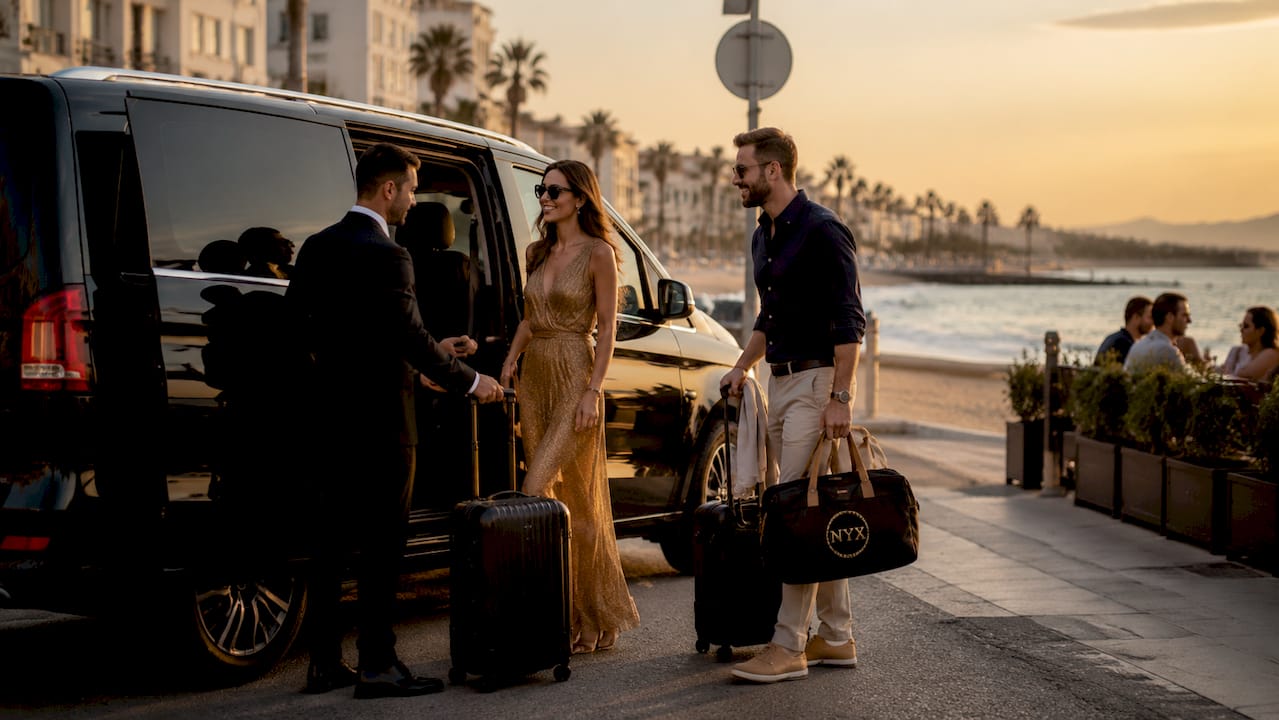
Transponyx operates premium airport transfers from Nice Côte d'Azur Airport (NCE) to Monaco, Cannes, Antibes, Menton, and Saint-Tropez, with fixed 2026 rates confirmed at booking and no surge pricing. The fleet covers every group size: Standard Sedan and Business Sedan for up to three passengers, Van 7 pax and Van 8 pax for larger parties. Every vehicle carries Wi-Fi, air conditioning, chilled water, and phone chargers. Flight monitoring is included on every airport pickup, with 60 minutes of free waiting time. For groups attending the Cannes Film Festival, MIPCOM, or the Monaco Grand Prix, Transponyx also offers luxury chauffeur services by the hour. Book via https://transponyx.com or call +33 6 10 30 71 84.
FAQ
What is baggage assistance at an airport?
Baggage assistance is a service that manages luggage handling on a traveler's behalf, ranging from porter support at the curb to full door-to-door logistics with GPS tracking and airline check-in integration.
How much does airport porter service cost?
Traditional airport porter services typically charge a flat fee of $3.00 USD per item for transport between the curbside and terminal areas, with gratuity often expected in addition.
Contact your airline's specific ground handling agent at the airport immediately and request a Property Irregularity Report. Do not use the general airport information desk, as airport staff do not have access to airline baggage systems.
How long do I have to report a damaged bag?
For domestic US flights, the reporting window is typically within six hours of receiving the bag. Waiting until you reach your hotel frequently means missing the deadline and forfeiting compensation rights.
Is premium baggage assistance worth the cost?
For travelers with tight connections, high-value luggage, or demanding schedules such as attending major events on the French Riviera, premium door-to-door baggage logistics removes significant logistical risk and pairs naturally with a pre-arranged private transfer for a fully managed arrival experience.

by Daniel AIT GOUGAM | July 1, 2026 | news
A VIP transfer is defined as a tailored, chauffeur-driven ground transport service designed to meet the precise requirements of discerning travelers, executives, and event guests. Knowing how to arrange VIP transfers correctly is the difference between a dignified, punctual arrival and a costly logistical failure. On the French Riviera, where the Cannes Film Festival, Monaco Grand Prix, Cannes Lions, and MIPCOM compress thousands of high-profile movements into narrow windows, the margin for error is effectively zero. Transponyx operates as a licensed VTC provider from Nice Côte d'Azur Airport (NCE), covering Monaco, Cannes, Antibes, Menton, and Saint-Tropez with fixed 2026 rates and no surge pricing.
How to arrange VIP transfers: what you need before you book
The most common planning error is treating vehicle selection as the first decision. Service design precedes vehicle choice to avoid wasted budget and mismatched logistics, particularly in congested urban settings like Monaco or the Croisette in Cannes. Define the service first. The vehicle follows.
Before contacting any operator, gather the following information:
- Passenger count and roles. A solo executive requires different protocols from a family of five or a delegation of eight. Vehicle categories differ accordingly: a Standard Sedan accommodates up to 3 passengers, a Business Sedan offers the same capacity with premium finish, while a Van 7 pax or Van 8 pax handles larger groups.
- Arrival type. Confirm whether the pickup is from a commercial terminal such as Nice NCE, a private fixed-base operator (FBO) facility, a helipad, or a hotel address. Each location carries different access protocols and timing requirements.
- Luggage volume. Ski equipment for Isola 2000, multiple suitcases for a two-week Riviera stay, and a carry-on for a Monaco day trip each request a different vehicle configuration.
- Special requests. Child seats, specific language-speaking drivers, chilled water, or security team coordination must be flagged at the outset, not after confirmation.
- Flight or itinerary reference. No professional operator can build a reliable schedule without a confirmed flight number or departure time. This is the baseline for every subsequent decision.
On timing, book luxury transfers 1 to 3 days in advance as a minimum, and significantly earlier during peak Riviera events. During the Monaco Grand Prix or Cannes Film Festival, availability in premium vehicle categories tightens days before the event opens.
Pro Tip Prepare a one-page traveler brief before calling any operator. Include passenger names, flight references, pickup addresses, drop-off addresses, and any special requirements. This single document eliminates back-and-forth and ensures the operator quotes accurately from the first contact.
What does the booking process for private transfers actually involve?
A structured booking workflow prevents the fragmented communications that cause delays and misunderstandings. The process has a clear sequence, and skipping steps creates compounding problems.
- Submit a comprehensive brief. Provide the operator with all traveler details in a single message or call. Include pickup and drop-off addresses with private access points where relevant, such as a hotel service entrance or a yacht marina gate.
- Define the service pattern. Specify whether you need a one-way transfer, a return journey with standby, a multi-stop itinerary, or hourly hire. Each pattern is priced and managed differently.
- Request written confirmation of all operational details. This means the driver's name, the vehicle category (Standard Sedan, Business Sedan, Van 7 pax, or Van 8 pax), the confirmed pickup time, and the agreed itinerary.
- Clarify waiting time and fee structures. Transponyx includes 60 minutes of free waiting time on all airport pickups and 20 minutes for any other address. Understand what applies before you confirm.
- Establish a single communication channel. One clear communication channel reduces coordination errors and eliminates the confusion that arises when multiple people contact the operator independently.
- Designate an authorized contact for amendments. Identify one person who can approve itinerary changes after hours. This is particularly critical during multi-day event programs where schedules shift without notice.
- Confirm contingency protocols. Ask the operator directly: what happens if the flight entertains, if a guest is delayed at customs, or if a meeting overruns? A professional operator has a defined answer.
Pro Tip Always request confirmation in writing, even if the initial booking is made by phone. A written record protects both parties and gives the driver a precise reference document on the day.
The table below summarizes the key details to confirm before any VIP transfer is finalized.
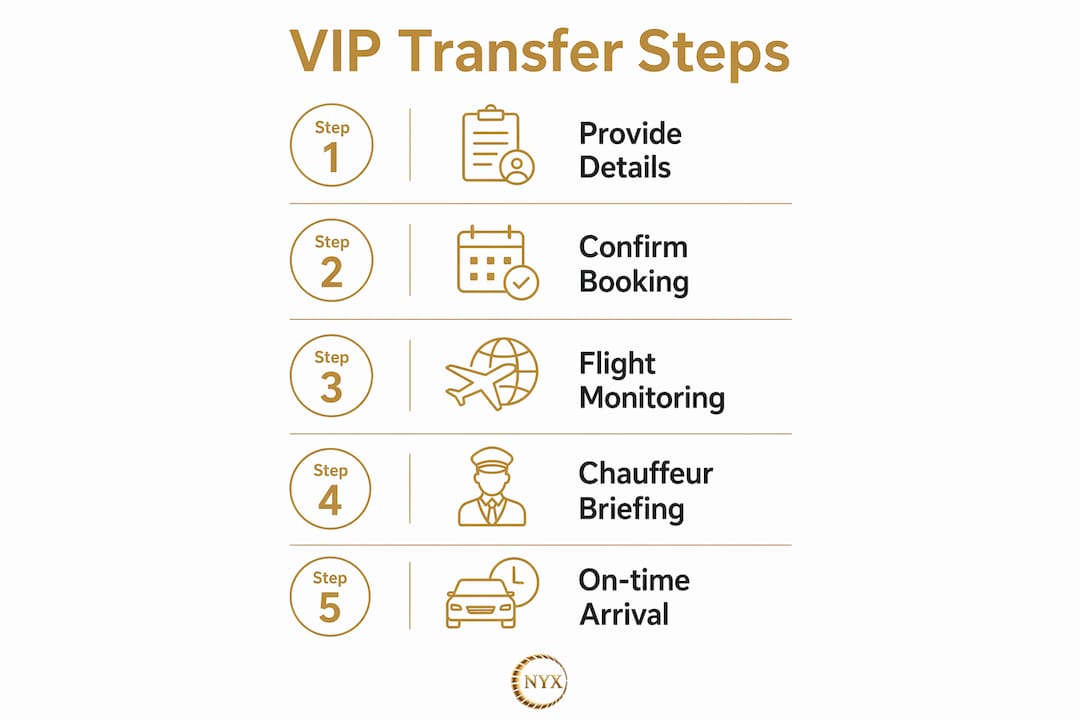
| Details to be confirmed |
Why it matters |
| Driver name and contact number |
Allows direct communication on arrival day |
| Vehicle category and registration |
Confirms capacity and helps guests identify the vehicle |
| Pickup time and buffer allowance |
Prevents confusion between scheduled and actual departures |
| Waiting time policy |
Clarifies cost exposure if the guest is delayed |
| Flight monitoring included |
Confirms the operator adjusts automatically to delays |
| Fixed rate confirmation |
Eliminates surprise charges after the journey |
How does real-time coordination ensure a flawless VIP arrival?
The visible part of a VIP transfer is the driver holding a name board at arrivals. The invisible part is what separates a professional operator from a basic booking service.
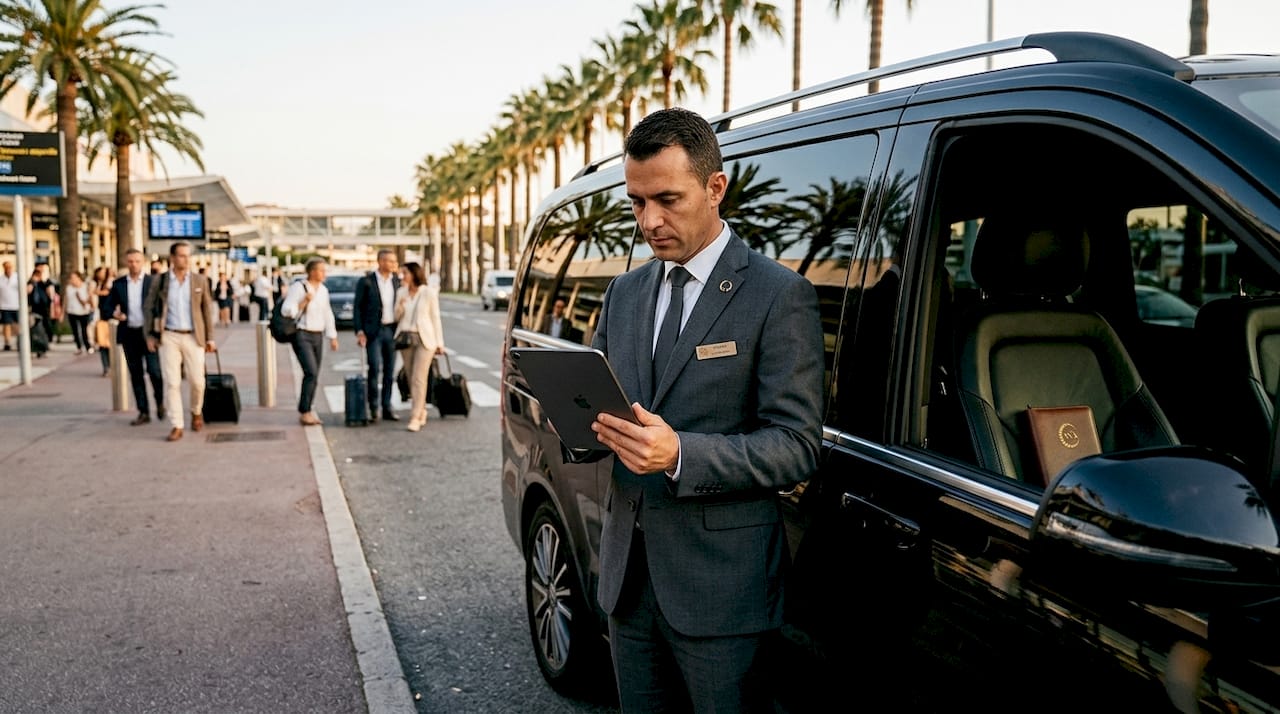
Flight tracking is the foundation of reliable airport transfers. Transponyx monitors every inbound flight on airport pickups, adjusting the driver's dispatch time automatically when a flight lands early or late. This means guests arriving at Nice NCE from London, Paris, or Milan are met without delay regardless of schedule changes. Integrated flight tracking eliminates tarmac dwell time and prevents the frustrating scenario of a guest waiting alone at arrivals.
For private aviation, the coordination requirement is more demanding. FBO coordination 24 hours in advance minimizes tarmac dwell time and prevents security friction. Private jet arrivals at Nice NCE's FBO facilities follow different access procedures from commercial terminals. The driver must be cleared, positioned, and briefed before the aircraft doors open.
Buffer management with hard and soft deadlines allows real-time route adjustments without disrupting the traveler. A hard deadline is a fixed departure time, such as a Monaco Grand Prix hospitality event with a defined start. A soft deadline allows flexibility, such as a hotel check-in with no strict window. Treating every transfer as a hard deadline wastes resources and creates unnecessary pressure. Distinguishing between the two allows the operator to absorb minor delays without escalation.
“Operational silence is the hallmark of a well-run VIP transfer program. When the event organizer receives no calls from the transport team, the logistics are working exactly as designed.”
Driver briefing protocols matter as much as route planning. A well-briefed chauffeur knows the client's preferred greeting style, whether to initiate conversation or maintain discretion, the confirmed route, and any security considerations. On the French Riviera, where reliable luxury transport is expected as standard by high-profile guests, these details define the quality of the experience.
What are the most common mistakes when organizing luxury transfers?
Errors in VIP transfer planning cluster around the same recurring failures. Recognizing them in advance is the most direct way to avoid them.
- Booking without confirmed traveler details. Arranging a vehicle before knowing the passenger count, luggage volume, or arrival time produces a transfer that fits no one's actual needs.
- Mismatching vehicle type to group size. A Business Sedan booked for four passengers creates an immediate problem at pickup. A Van 7 pax booked for two passengers wastes budget. Vehicle selection must follow a confirmed headcount.
- Ignoring private aviation access requirements. Commercial terminal pickups and FBO pickups are operationally distinct. Sending a chauffeur to the wrong zone at Nice NCE causes delays that compound quickly, particularly when the client has a connecting commitment in Monaco or Cannes.
- Failing to coordinate with security teams. For high-profile guests, the protection team's requirements affect vehicle positioning, route selection, and timing. These details must be integrated into the brief from the outset, not added as an afterthought.
- Mediating every minor changes personally. Avoiding micromanagement of every amendment and establishing a clear delegation protocol produces smoother execution. When an executive assistant tries to relay every small change personally, response times slow and errors multiply.
- Underestimating buffer time during peak periods. The A8 motorway between Nice and Cannes during the Cannes Film Festival or Cannes Lions can add 40 minutes to a journey that normally takes 25 minutes. Transfers planned without traffic buffers fail predictably.
- Neglecting to confirm the meeting point protocol. A chauffeur waiting at the wrong exit of Nice NCE arrivals hall, or holding a name board with an incorrect spelling, creates an avoidable first impression. Confirm the exact meeting point, signage format, and driver contact number before the day.
Reputable operators demonstrate a 99.8% on-time execution rate for complex VIP ground transport programs. This figure is achieved through systematic planning, not luck.
How do group and event transfers differ from standard VIP arrangements?
Group transfers introduce a layer of logistical complexity that individual bookings do not carry. The core challenge is coordinating multiple passengers with varying schedules, luggage volumes, and drop-off points, while maintaining the quality standard expected of a VIP service.
The financial case for group booking is clear. Booking group transport for 10 or more passengers saves approximately 20% compared to individual rideshares or taxis, while reducing coordination delays. That saving is meaningful across a multi-day event program such as MIPCOM in Cannes or a corporate incentive trip across the Riviera.
Vehicle mix is the first operational decision. A group of 14 arriving at Nice NCE might require two Van 8 pax vehicles, or one Van 8 pax and two Business Sedans for senior delegates who require separation from the wider group. The right mix depends on the group's internal hierarchy, luggage volume, and whether the event transport programme requires simultaneous or staggered departures.
Pro Tip For groups of six or more, prepare a passenger manifest before the transfer day. Include each person's name, flight number, and mobile number. Share it with the operator 24 hours in advance. This single document allows the chauffeur team to manage arrivals independently without requiring constant contact from the organiser.
Pre-arrival manifest management also covers luggage handling. Large groups traveling with ski equipment for Auron or Valberg, or with exhibition materials for MIPIM, require advance notice so the operator can confirm boot capacity and, if necessary, arrange a separate luggage vehicle.
On-site coordination during festivals like Cannes Lions or the Monaco Grand Prix requires a dedicated transport manager or a designated tour leader within the group. This person holds the operator's direct contact, approves schedule changes, and communicates updates to the chauffeur team. Without this single point of contact, group transfers fragment into individual requests that overwhelm the operator and delay departures.
The table below illustrates how vehicle selection aligns with group size for Riviera event transfers.
| Group size |
Recommended vehicle mix |
Notes |
| 1–3 passengers |
Standard Sedan or Business Sedan |
Ideal for executive arrivals at Nice NCE |
| 4–7 passengers |
7-passenger van |
Single vehicle, efficient for hotel transfers |
| 8 passengers |
Van for 8 people |
Maximum single-vehicle capacity |
| 9–16 passengers |
Two vans, 8 pax vehicles |
Allows simultaneous arrival and departure |
| Mixed delegation |
Business Sedan plus Van 7 pax |
Separate senior delegates from wider group |
What I have learned from arranging VIP transfers on the French Riviera
Client expectations in 2026 have shifted in one clear direction: guests want complete operational transparency before the day, and complete operational silence on the day itself. They want to know the driver's name, the vehicle registration, and the confirmed pickup time in advance. Then they want to hear nothing until the car arrives.
What surprises many first-time organizers is how much the Riviera's event calendar compresses the available window for quality operators. During the Monaco Grand Prix in May, or the Cannes Film Festival in the same month, the gap between a well-planned transfer and a last-minute booking is not just a matter of price. It is a matter of whether a suitable vehicle exists at all. I have seen corporate travel managers attempt to book Business Sedans for executive arrivals at Nice NCE two days before the Grand Prix, only to find the entire category committed weeks earlier.
The other misunderstanding I encounter regularly is the assumption that all licensed VTC operators on the Riviera offer equivalent service. They don't. The difference lies in the operational infrastructure behind the booking: flight monitoring, FBO coordination, driver briefing protocols, and the ability to absorb schedule changes without escalating to the client. These are not visible at the point of booking. They become visible at 23:00 when a flight from London entertains to Marseille and the client needs a solution within the hour.
Transponyx operates 24 hours a day, 7 days a week, with bilingual drivers and fixed 2026 rates across all routes from Nice NCE to Monaco, Cannes, Antibes, Menton, and Saint-Tropez. That operational depth is what makes the difference between a transfer that works and one that requires managing. For anyone VIP transport schedule around a major Riviera event, the planning conversation should start weeks before the event, not days.
— Dany
Transponyx: VIP chauffeur services for the French Riviera in 2026
Transponyx provides licensed VTC chauffeur services across the French Riviera, operating from Nice Côte d'Azur Airport (NCE) to Monaco, Cannes, Antibes, Menton, Saint-Tropez, and the Alpine ski resorts of Isola 2000, Auron, and Valberg. All 2026 rates are fixed per vehicle and confirmed at booking, with no surge pricing and no hidden charges.
The fleet covers every group size: Standard Sedan, Business Sedan, Van 7 pax, and Van 8 pax. All vehicles are Mercedes-Benz, equipped with Wi-Fi, air conditioning, chilled water, and phone chargers. Flight monitoring is included on every airport pickup, with 60 minutes of free waiting time. For a full comparison of luxury chauffeur options on the Riviera, or to book directly, contact Transponyx at +33 6 10 30 71 84 or visit https://transponyx.com.
FAQ
What is a VIP transfer?
A VIP transfer is a pre-booked, chauffeur-driven ground transport service tailored to the specific requirements of the traveler, including vehicle type, pickup location, waiting time, and personalized service protocols.
How far in advance should I book a VIP airport transfer?
Book at least 1 to 3 days in advance for standard periods, and several weeks ahead during major events such as the Cannes Film Festival or Monaco Grand Prix, when premium vehicle availability is severely limited.
You need the passenger count, flight number or confirmed arrival time, pickup and drop-off addresses, luggage details, and any special requests such as child seats or language preferences. Providing this in a single brief produces the most accurate quote and confirmation.
How does flight monitoring work on VIP airport transfers?
The operator tracks the inbound flight in real time and adjusts the driver's dispatch time automatically. Transponyx includes flight monitoring on every airport pickup, ensuring the driver is present regardless of early or late arrivals at Nice NCE.
Is group booking more cost-effective than individual VIP transfers?
Group transport for 10 or more passengers saves approximately 20% compared to individual rideshares or taxis, while reducing coordination complexity across multi-stop or multi-day event programs.