by Daniel AIT GOUGAM | August 24, 2026 | news
Circulation restrictions in Monaco are scheduled and severe for named event dates in 2026, above all the Monaco Grand Prix (early June) and the Monaco Yacht Show (mid September). Outside those windows, ordinary traffic rules apply with only minor seasonal tweaks.
- Grand Prix build, race and dismantle: expect closures from late May through mid June, with the harbor circuit fully sealed on race days.
- Campervans and vehicles over 3.5 tonnes are banned from the principality on race weekend and often on Tour de France or La Vuelta passage days.
- CAM buses run free across the network during major event weeks.
- Check the official Grand Prix transport plan and Monaco's permit pages before you travel.
What events cause traffic restrictions in Monaco?
Three recurring events reshape Monaco's road network each year, and each follows a predictable rhythm once you know what to watch for.
- Monaco Grand Prix (early June): grandstand and barrier installation starts roughly three weeks before hand, with the harbor perimeter gradually closing during the final period. Race days themselves bring dawn-to-dusk closures on the full circuit, and dismantling can take multiple days.
- Monaco Yacht Show (mid September): quaysides around Port Hercule close to general traffic for around a week either side of the show itself, governed by a dedicated Ministerial Decree that sets pedestrian corridors and vehicle prohibitions street by street.
- Tour de France or La Vuelta passages: when either race routes through the principality, expect a single-day ban on through traffic and campervans, confirmed only weeks ahead once the official stage route is published.
None of these dates move much year to year, but the exact hours do, so always check the current schedule rather than assuming last year's schedule repeats.
Which roads and vehicle types face Monaco traffic rules?
Grand Prix closures follow a well-worn pattern. The Sainte-Dévote tunnel, the Auréglia slip road, Avenue des Papalins, Quai des Amériques and Quai Antoine Ier all close to general traffic during build and race phases. Several become one-way in reverse or temporary two-way to manage emergency and service access. Drivers unfamiliar with the principality often lose twenty minutes simply hunting for the diversion that replaces their usual route.
Vehicle-specific rules matter more than most visitors expect:
- Vehicles over a certain weight limit are typically barred from the circuit perimeter on race days.
- Campervans face an outright ban across race weekend under the Grand Prix transport plan; a vehicle the size of a long-wheelbase panel van conversion will not be permitted anywhere near the harbor that week.
- Vehicles not registered in Monaco sometimes face additional checks at perimeter access points, particularly during the Yacht Show's regulated zones.
- Streets normally running one direction get reversed for the event, and roads that are one-way year round temporarily allow two-way flow to feed exit routes.
Pro Tip Screenshot the current diversion map before you drive in. Mobile signal drops near the tunnels, and you will not have time to reload a page while queuing at a barrier.
Where can pedestrians walk during events Monaco?
Harbour-front pavements and the circuit's inner perimeter close to general pedestrians during build, race and dismantle phases, not only on the headline race days. Anyone walking to a hotel, restaurant or meeting near Port Hercule during Grand Prix week should expect a longer, signposted route around the barriers rather than a straight line along the quay.
Ticket holders and accredited personnel move through the closed zones on authorized routes, with passes issued directly by the event organizer or Monaco police rather than sold generally. The same applies during the Yacht Show, where the Ministerial Decree defines specific pedestrian corridor widths and reserved crossing points along the quays.
- Reduced-mobility visitors should confirm accessible crossing points in advance; several standard pedestrian bridges close entirely during build phases.
- If you rely on walking to reach a taxi rank or meeting point, build in an extra fifteen to twenty minutes near event perimeters.
- Hotel concierge teams usually hold the most current pedestrian access maps, often more current than what is published online.
Where does parking disappear during Monaco events?
Parking suspensions cluster tightly around the harbour. Darse Sud, Quai Louis II, pier Lucciana and the Pierrefroid areas around Port Hercule all lose their normal parking allocation for the duration of build, event and dismantle phases, and enforcement starts earlier than most visitors expect.
Several Monaco ON charging points inside the harbor perimeter go offline for the same period, since event transport plans routinely take EV infrastructure out of service within the closed zone, sometimes for a week or more either side of the event itself. Anyone driving an electric vehicle to Monaco during Grand Prix week should plan to charge outside the restricted perimeter, not within it.
- Suspended parking: Darse Sud, Quai Louis II, Lucciana pier, Pierrefroid sector.
- EV chargers affected: multiple Monaco ON stations inside the harbor perimeter, offline across the build and dismantle window.
- Residents and blue badge holders displaced by suspensions should contact the local police station in advance; some exceptions are granted case by case rather than automatically.
How does public transport change in Monaco during events?
The Prince's Government routinely makes CAM bus travel free across the entire network during Grand Prix week, a deliberate move to pull cars off roads that are already narrowed by barriers. Routes divert around closed sections and extra services often run to cover demand that would otherwise queue for taxis.
Whoa! intercity coaches connecting Monaco to Nice and Menton also see route restrictions during build and race phases, particularly where their normal stops sit inside the closed perimeter.
- Free CAM travel typically covers the entire event week, not just race day itself.
- Diverted routes are published shortly before the event; check the network's live updates rather than a printed timetable.
- Shuttle services and scheduled transfers fill gaps where regular buses cannot reach, though seats fill fast on race mornings.
- A pre-booked private transfer with a fixed pickup time avoids the queuing that affects both taxis and shuttles on the busiest event days.
How do you get a permit for restricted zones in Monaco?
Two separate permits cover most access needs, and neither is complicated once you know which one applies.
- Monaco-Ville access badge: residents and those with a genuine need to drive into the old town apply with proof of residence or business address. When the file is complete, the permit is issued on the spot at the guardroom of the Directorate of Public Security, and it remains valid for a year.
- CIGM authorization for semi-pedestrian zones: anyone needing vehicle access to a regulated pedestrian area must submit the published form to the Integrated Mobility Management Center at least five days ahead, via [email protected].
- Deliveries, medical visits and professional access: these follow the same CIGM route but often need supporting documents (medical appointment letters, delivery manifests), so allow more than the minimum five days during event weeks when processing slows.
How do event restrictions affect private transfers in Monaco?
A fixed-rate, pre-booked transfer can reduce uncertainty from event-week closures. Transponyx runs its 2026 rates on a per-vehicle, confirmed-at-booking basis across the Standard Sedan, Business Sedan, 7-pax van and 8-pax van categories, with bilingual licensed drivers who know exactly where the current perimeter sits.
During Grand Prix week, journeys between Nice Côte d'Azur Airport and Monaco that normally take 35 to 40 minutes can stretch to over an hour once diversions around Sainte-Dévote and the harbor quays kick in. Transponyx drivers build that buffer into pickup timing automatically and monitor incoming flights so a delayed arrival never means a missed handover. For readers arranging travel around the Grand Prix transport plan, calling +33 6 10 30 71 84 ahead of the event secures a staging point outside the closed perimeter.

Do Monaco's seasonal traffic rules apply outside major events?
Monaco does not run a low-emission zone or a congestion charge comparable to those found in larger European cities, and there is no daily toll for entering the principality by car. Day-to-day circulation restrictions outside event weeks are limited and mostly concern speed limits, which are lower on several stretches than equivalent French roads, and a general note from French diplomatic guidance that Monaco's rules differ from France's in specific respects even though both use the same currency and open border.
Where restrictions do bite year round is parking. Monaco's paid parking system covers most street spaces and multi-storey car parks, and enforcement is consistent rather than seasonal. Some residential streets near Monaco-Ville require the macaron described earlier, and that requirement doesn't relax outside event periods.
Summer brings a second layer worth noting: increased pedestrian volume along the harbor and Larvotto beach frontage during July and August leads police to informally tighten enforcement on double-parking and loading, even without a published arrest. It's a practical reality rather than a formal rule change, but it catches out visitors who assume quieter roads mean relaxed enforcement.
For anyone driving into Monaco from Nice, Cannes or the Italian border, the absence of a formal environmental zone is good news, but it doesn't mean circulation is unregulated. Monaco's compact street grid and near-constant construction activity around Fontvieille and the harbor mean short-term lane closures happen throughout the year, independent of any major event calendar.
Where can you check live traffic updates for Monaco?
The most reliable source remains the government's own transport notices, published in English and French on monservicepublic.gouv.mc ahead of each major event, with precise closure times updated as the build phase progresses. These notices are far more current than most third-party travel guides, which tend to repeat the previous year's schedule.
For legal texts underpinning any restriction, including full arrests with street-by-street detail, the Journal de Monaco publishes the original order, and France's own legal repository, Legifrance, hosts related cross-border administrative guidance where relevant.
Local radio remains a genuinely useful tool during event weeks. Riviera Radio broadcasts in English and covers live traffic disruption around the principality, often faster than official social media updates during fast-moving situations like sudden road closures for security sweeps.
For day-to-day navigation, mainstream mapping apps such as Google Maps and Waze pick up Monaco's temporary closures reasonably quickly once local authorities feed the data through, though there is sometimes a lag of an hour or two during the first day of a new closure. Drivers heading in from Nice or Cannes during event week should treat any app-suggested route through the harbor with caution and cross-check it against the official transport plan before committing.
Hotel concierge desks in Monaco and neighboring Menton and Beausoleil often hold more current information than any app, since many are briefed directly by event organisers.
Can emergency vehicles reach Monaco during restrictions?
Emergency access is built into every official transport plan rather than treated as an afterthought. Fire, ambulance and police vehicles retain designated corridors through closed perimeters during the Grand Prix and Yacht Show, and these corridors are marked and enforced separately from the general traffic diversions affecting private cars.
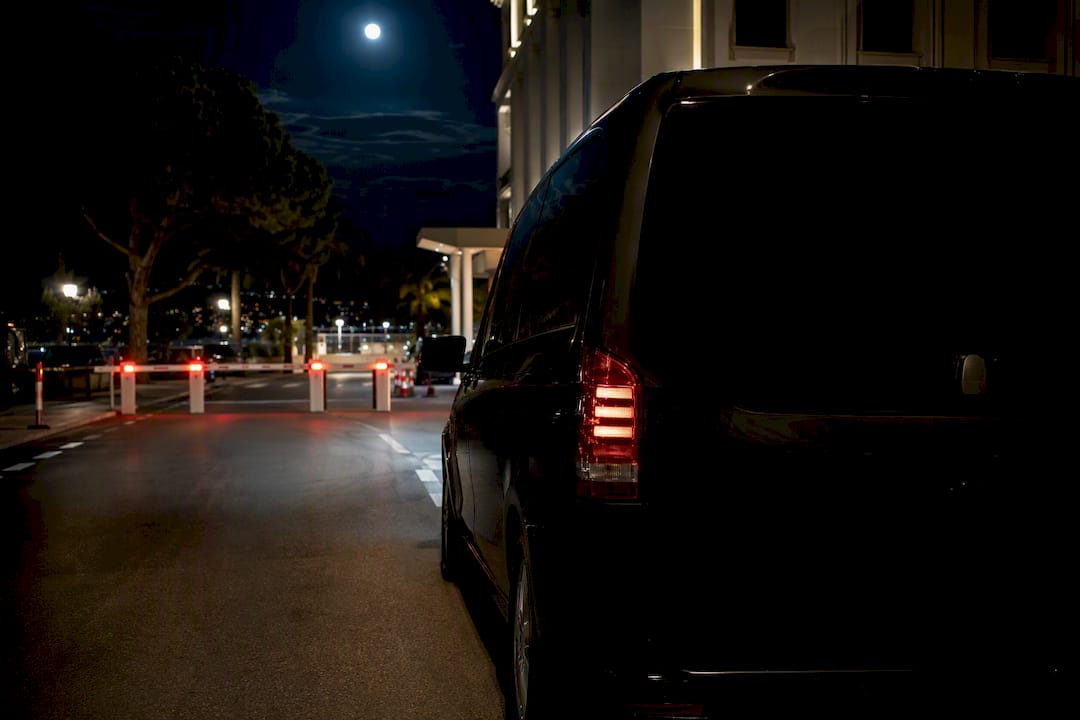
Outside major events, Monaco's compact geography means emergency response times remain short even where a street is closed for construction or a temporary event, since the principality's small footprint gives responders multiple alternative approaches. The same doesn't fully apply during the most intensive Grand Prix build days, when barrier installation genuinely narrows some approach roads, so residents in the immediate harbor area are sometimes advised to keep a phone number for the local police station handy during that specific week.
Medical appointments and deliveries requiring vehicle access to a restricted zone follow the CIGM authorization route described earlier, and applicants citing a genuine medical need are generally processed with more flexibility on the standard five-day notice period, though this isn't guaranteed and depends on the specifics of the request.
A practical note on last-minute plans
Every event week, someone assumes they'll simply drive to their hotel and sort parking on arrival. It rarely works out that way once the barriers are up and the one-way system reverses without warning. The single habit that prevents most disruption is booking a fixed transfer or building in a genuinely generous buffer, rather than trusting the same route that worked the week before. Readers wanting guaranteed access can arrange this through Transponyx's booking page.
Getting through Monaco's restrictions without the guesswork
Transponyx is the practical alternative to arriving in Monaco unsure which quay is closed or where the diversion leads. The fleet runs across four categories, Standard Sedan, Business Sedan, Van 7 pax and Van 8 pax, all Mercedes-Benz, all booked at fixed 2026 rates confirmed before you travel, with no surge pricing when event demand spikes.
On Grand Prix and Yacht Show days, that predictability matters more than usual. Drivers stage vehicles outside the restricted perimeter, monitor incoming flights automatically on every airport transfer, and liaise directly with permit checkpoints so passengers aren't left explaining themselves at a barrier. Every driver is bilingual in English and French at minimum, and the service runs 24 hours a day, seven days a week, with 60 minutes' free waiting time on airport pickups.
Compare the options at the luxury chauffeur services overview or call +33 6 10 30 71 84 to confirm a fixed-rate transfer for your event dates before the roads close around you.
Sources
FAQ
Does Monaco have different traffic laws to France?
Yes. Monaco sets its own speed limits, parking rules and event-specific orders independently of France, even though the two countries share an open border and the euro.
Can I enter Monaco with my car during a major event?
Usually yes outside the immediate closed perimeter, but vehicles over 3.5 tonnes and campervans face outright bans during Grand Prix race weekend, and the exact perimeter shifts daily during build and dismantle phases.
Are Monaco citizens also French citizens?
No. Monaco nationality is distinct from French nationality, and most Monaco residents are actually French, Italian or other foreign nationals rather than Monegasque citizens.
Can you travel freely between Monaco and France?
Yes, the border is open with no routine checks, though French government travel guidance notes that Monaco's specific traffic and parking rules still apply once you cross into the principality.
What is the fastest way to avoid Monaco's event-week traffic disruption?
Pre-booking a fixed-rate private transfer, such as those run by Transponyx, avoids the diversions and parking suspensions that catch out drivers relying on their usual route into Monaco.
by Daniel AIT GOUGAM | August 23, 2026 | news
The Standard Sedan and Business Sedan reach most single-lane villa approaches without difficulty, provided the lane holds a width of roughly 2.4 meters or more. The Van 7 pax and Van 8 pax handle groups and luggage well but need wider turning space, so they can struggle on the hairpin lanes common above Saint-Jean-Cap-Ferrat or in the hills behind Menton. When a driveway is genuinely too narrow, the fix is rarely complicated: a kerbside meeting point, an authorized loading bay, a short assisted walk with luggage carried the last stretch. In Saint-Tropez, occasionally a dock handover.
The single most useful thing a traveler, concierge or hotel can do before arrival is send Transponyx the full address, GPS pin, gate code and a photo of the approach. That step, more than any vehicle choice, determines whether the transfer runs smoothly.
- Standard Sedan / Business Sedan: best default for single-lane villas, tight gates, formal entrances
- 7-pax van / 8-pax van: needed for groups or heavy luggage, but flag narrow lanes in advance
- No drive access: curbside pickup, loading bay, short walk, or dock transfer near the coast
Access snapshot: most narrow-lane villa transfers on the Riviera need only 5 to 20 extra minutes once the vehicle and meeting point are matched correctly in advance, according to Riviera peak-season transfer guidance.
Which vehicle suits a narrow villa approach?
Lane width, not engine size, decides which car gets to the gate. A Standard Sedan or Business Sedan measures close to the width of an ordinary family car, which lets it clear the stone walls, blind bends and single-track sections typical of hillside villas above Villefranche-sur-Mer or Eze. A van, by contrast, needs meaningfully more room to complete a three-point turn or reverse into a gateway, and that extra meter or so of swept width is exactly what a switchback lane will not give it.
Transponyx runs private driver services across the French Riviera using a fleet built entirely around this trade-off.
Standard Sedan and Business Sedan (up to 3 passengers each) follows the majority of villa transfers where the lane is genuinely single-track or the entrance sits behind a tight stone gateway. The Business Sedan adds a premium finish for clients who want the same maneuverability with a more formal arrival, useful for a business trip into Cannes or a discreet drop at a private estate near Antibes.
7-pax van and 8-pax van solve a different problem: family groups, wedding parties, or anyone traveling with ski bags or extra luggage from Isola 2000. Editorial guidance on Riviera transfers is consistent on this point: a business van suits families and larger luggage loads, but the same source warns against sending a full-size van up a single-track hill lane where it becomes, in practical terms, a liability rather than an asset, as Riviera peak-season transfer guidance notes.
A workable rule of thumb: if the lane measures under roughly a certain narrow width, book a Sedan. If the group size or luggage genuinely needs a van and the lane is tight, stage a luggage transfer at a wider point, or agree a drop location with the property manager before booking.
Pro Tip Ask the villa manager for the width of the tightest point on the approach, not the average width. One narrow pinch point near the gate is what stops a van, even if the rest of the lane is comfortable.
Where should the driver meet you if the gate is unreachable?
- Nearest public parking bay or lay-by. The most common fallback for hillside villas, usually adding only a five-minute walk with luggage carried by hand or trolley.
- Villa manager or concierge door. Many properties have a staffed side entrance that the driver can reach even when the main gate cannot take a car; confirm this point by name before the transfer, not on arrival.
- Authorized loading bay. Common in dense villages such as the old town areas near Antibes or Menton, where municipal loading zones allow a brief stop for luggage handling.
- Airport kerb at Nice NCE. For guests connecting straight to a villa transfer, this remains the standard, unproblematic starting point regardless of how narrow the destination lane is.
- Port or dock handover in Saint-Tropez. During peak season, the D559 approach into the peninsula becomes so congested that a boat transfer to a quayside point can genuinely outpace a car, a pattern local coverage of Saint-Tropez summer congestion documents in detail.
Licensed operators with municipal authorization can secure drop-offs in Saint-Tropez that generic transfer bookings simply cannot access, a point FFGR Monaco's Saint-Tropez guidance makes explicitly. Whichever point you choose, ask the property for written confirmation and a photo of the gate itself, not just a description. A photo settles disputes about width and surface before the driver is halfway up the hill.
Extra time depends on how far the vehicle has to stop short of the door, and how much help is needed once it does. A short walk with hand luggage typically adds a few minutes more. A gated approach that needs a call to property staff to open a barrier or unlock a side gate usually adds some additional time. Complex cases, an authorized access permit, a staged luggage transfer, or a dock handover in Saint-Tropez, can add substantially more time once waiting and coordination are included.
| Scenario |
Typical extra time |
Example location |
| Short walk, hand luggage |
a few minutes |
Hillside villa, Villefranche-sur-Mer |
| Gated approach, staff assistance needed |
extra time added |
Private estate, Antibes or Menton |
| Authorized access or dock transfer |
significantly more time |
Saint-Tropez peninsula, peak season |
Peak events multiply these figures sharply. During the Cannes Film Festival, MIPIM or the Monaco Grand Prix, road closures and diversions around Monaco and Cannes can turn a normal 35-minute transfer from Nice NCE into well over an hour, so event-driven transport scarcity is worth building into any booking made for those weeks. For Saint-Tropez in July and August, operators recommend booking at least three weeks ahead and arranging any municipal or venue authorization in advance, according to FFGR Monaco, because the peninsula's single main approach leaves almost no fallback route.
The buffer that saves the transfer: 60 minutes of free waiting time on every Transponyx airport pickup, with flight monitoring included as standard, absorbs most of the delay that narrow-lane access adds. Fixed 2026 per-vehicle rates mean none of that extra handling time triggers an overload.
What to send the driver before you arrive
Send this before booking confirmation, not on the day:
- Full postal address and a GPS pin, since some villa entrances sit some distance from the address a satnav returns
- Gate code or intercom instructions
- Preferred unloading spot, if the villa manager has already identified one
- Photos of the approach lane and the gate itself
- Direct contact for the property manager or housekeeper
Confirm these details 24 to 48 hours before arrival:
- Flight or train number, so flight monitoring can track any delay automatically
- Expected arrival time and number of guests traveling
- Luggage volume, plus any child seat or accessibility requirement
- Agreed waiting point if the driver cannot reach the gate
- A backup contact number for the day itself, in case plans shift
This checklist mirrors what serious Riviera operators ask for as standard practice, confirmed by editorial guidance on villa transfer logistics: exact address, access notes and a clear answer on where the car will actually stop.
Keeping the handoff smooth when the lane gets tight
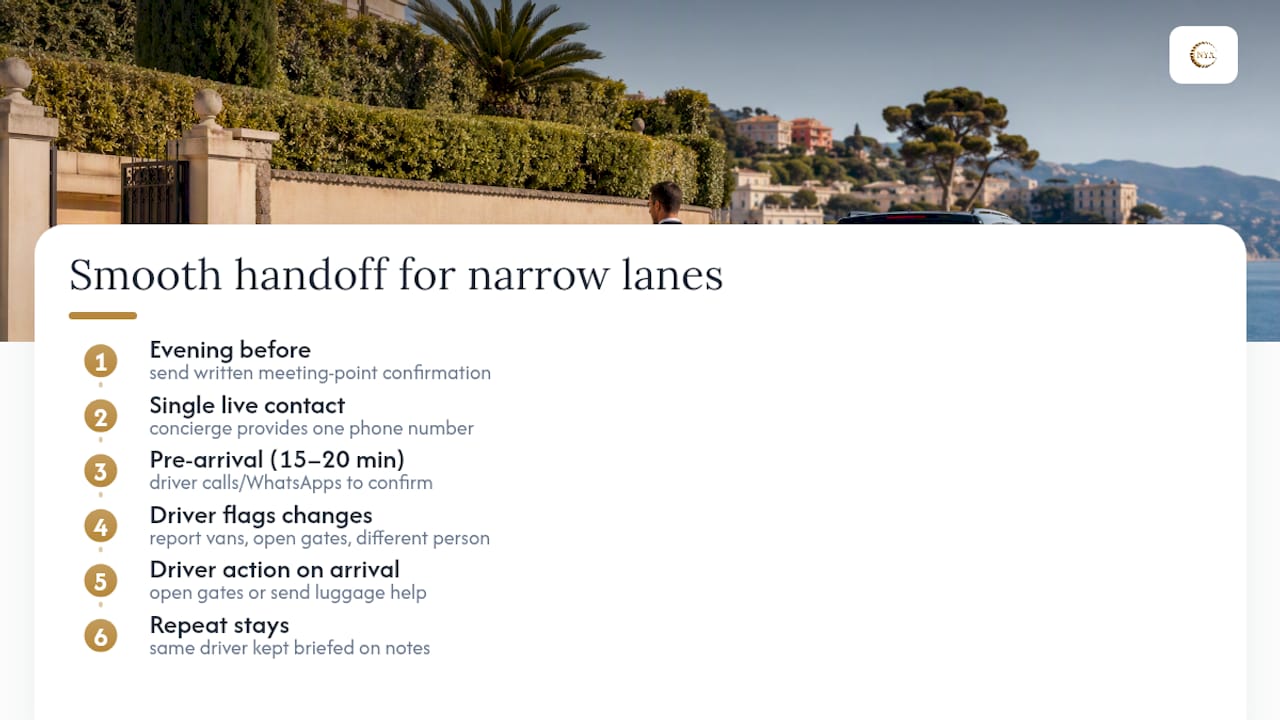
Good communication on the day matters more than any app or tracking link. The most reliable pattern is a short call or WhatsApp message from the driver roughly 15 to 20 minutes before arrival, confirming the exact meeting point agreed at booking and flagging anything that has changed, a delivery van blocking the lane, a gate left open, a different family member waiting outside.
For groups arriving from Nice NCE, this matters most in the final stretch: the driver knows the flight has landed through flight monitoring, but a second message once the vehicle is closed to the villa lets property staff open gates or send someone down to help with luggage. Transponyx drivers, all licensed VTC professionals and bilingual in English and French at minimum, are trained to make that call directly rather than leaving it to the guest to chase.
Concierges and hotels booking on a guest's behalf should ask for a single point of contact number that stays live throughout the transfer, not a booking reference passed between departments. Transponyx supports villa guest logistics through a dedicated villa rental service, which keeps the same driver briefed on access notes for repeat stays rather than starting from scratch each time. Written confirmation of the meeting point, sent the evening before rather than assumed, removes almost all of the friction that narrow-lane transfers otherwise create on the day.
Safety habits that matter on narrow Riviera lanes
Speed is rarely the risk on these roads; visibility and judgment are. A lane that hugs a stone wall on one side and a drop on the other rewards a driver who knows exactly where the passing points are, and that knowledge tends to come from repetition rather than satnav guidance. Local driving knowledge of market days, back roads and short-cuts routinely saves more time than any difference in vehicle spec, as Riviera transfer guidance points out.
Luggage handling deserves the same care as the driving. On a steep or uneven approach, wheeled cases can tip or roll, so a driver carrying bags the final stretch on foot is safer, and faster, than trying to maneuver a case over gravel or cobbles. Passengers stepping out on a narrow lane should always exit on the wall side rather than the drop side where the road allows it, and children should be moved out of the vehicle first if the stop is on a bend with limited sightlines.
Night arrivals raise the stakes further: unlit gates and unmarked yards are common outside villages near Grasse or in the hills above Cannes. A driver who has made the same run before, rather than one navigating purely by GPS, tends to spot a hazard before it becomes a problem.
Author perspective: local knowledge decides the outcome
Guests flying into Nice NCE and heading straight to a villa above Cannes during festival week rarely appreciate how much depends on the driver's memory of that specific lane, not the satnav. The three things that actually determine a calm arrival: matching the vehicle to the lane, sending full access details before booking, and building in a time buffer rather than assuming a straight run. Transponyx builds its fleet and its booking process around exactly that discipline, with fixed 2026 rates and drivers reachable directly on +33 6 10 30 71 84.
Booking the right vehicle for your villa in 2026
Transponyx is the practical fix for narrow-lane villa access on the Riviera: instead of guessing which car will fit, you tell us the lane and we send the right one. The fleet covers every scenario this article has described, Standard Sedan and Business Sedan for tight single-lane approaches, Van 7 pax and Van 8 pax for groups and luggage where the lane allows it, alongside private guided tours and dedicated villa guest services for repeat stays.
Every booking comes with a licensed, bilingual VTC driver, flight monitoring on airport pickups, and fixed 2026 per-vehicle rates with no surge pricing, whatever the Cannes Film Festival or Monaco Grand Prix does to local traffic. The service runs 24 hours a day, so a late change to a gate code or arrival time never has to wait until morning.
Send your villa's address, gate code and an approach photo when you book through the Nice airport transfer page, or call +33 6 10 30 71 84 to talk through the lane before you commit to a vehicle. That single step is what turns a narrow-road villa transfer from a guessing game into a fixed, confirmed arrival.
Sources
FAQ
Can a Van 8 pax reach any villa on the Riviera?
Not always. Vans need more turning space than a lane under roughly 2.4 meters wide allows, so tight hillside approaches often call for a Standard Sedan or Business Sedan instead, with luggage staged if needed.
What happens if the driveway is too narrow for any vehicle?
The driver meets you at the nearest safe point, a kerbside bay, an authorized loading zone, or the villa's side entrance, and luggage is carried the final stretch on foot.
Extra time varies: a few minutes for a short walk, more when property staff need to open a gate, and significantly more for authorized access or a Saint-Tropez dock transfer.

No. Transponyx applies fixed 2026 per-vehicle rates with no surge pricing, and includes 60 minutes of free waiting time on airport pickups and 20 minutes elsewhere.
What should I send the driver before arrival?
Send the full address, GPS pin, gate code, a photo of the approach and gate, and the property manager's contact number, ideally at booking rather than on the day.

by Daniel AIT GOUGAM | August 22, 2026 | news
An excursion to the Gorges du Verdon breaks down into four practical approaches: a scenic drive along the clifftop lookouts, a hiking descent into the canyon itself, a paddle or raft on the water below, and paragliding for those who want the view from above. Most visitors from the Riviera choose either a half-day scenic loop or a full day combining a short walk with time on Lake Sainte-Croix. Families and photographers tend towards the drive and lookout route; hikers and sportier travelers head for the trails and the river.
Driving across the gorges from end to end takes roughly 1 hour 30 minutes, which sets the pace for any day trip. For travelers based on the coast, the fastest route to securing a seat is a fixed-rate private transfer with TranspOnyx: call +33 6 10 30 71 84, quote a 2026 rate on the vehicle class you need, and the itinerary is locked in before you leave the hotel.
- Scenic drive and lookouts: half-day, suits families and photographers
- Hiking trails: half to full day, suits fitter walkers
- Water activities: half to full day, suits groups wanting an adrenaline element
- Paragliding: short flights, suits thrill seekers with time for one activity only
What activities does the Gorges du Verdon offer?
The canyon rewards different types of travelers in different ways. Drivers get the Route des Crêtes and a string of clifftop lookouts without leaving the car for long. Walkers get direct access to the canyon floor via marked trails. Paddlers get flat lake water at Sainte-Croix or a proper river run further down, and operators across the region list rafting, canyoning, canoeing, aquatic hiking and paddleboarding as core products, each with its own minimum age and skill level. Paragliding operates seasonally from a handful of launch sites above the canyon.

Water activities are strongly seasonal. Most rafting and canyoning outfits run from late spring to early autumn, and operators can suspend river trips at short notice if flow rates spike after rain. Lake activities on Sainte-Croix run for longer in the calendar but still close in high wind.
Where do excursions start and how do you get there?
Four villages anchor almost every excursion: La Palud-sur-Verdon and Rougon, the two main start points for hikers heading into the canyon; Castellane, the eastern gateway and a common base for rafting operators; and Moustiers-Sainte-Marie, the western village most linked to lake activities and a lunch stop.
From the coast, a private transfer covers real distance. Travel time from Nice NCE to Moustiers-Sainte-Marie by road is approximately two and a half hours; Cannes and Monaco add modest extra time depending on traffic through the Var. That single transfer number matters more than any other planning figure, because it defines whether a day trip is realistic at all.
- La Palud-sur-Verdon: Blanc-Martel trailhead, shuttle departures
- Rougon: alternative hike starting point, quieter than La Palud
- Castellanerafting and canyoning base
- Moustiers-Sainte-Marie: lake access, restaurants, village visit
Parking fills early at Sublime Point in July and August, and the La Palud shuttle for the Blanc-Martel trail runs limited departures at peak season. Arriving before 9am avoids most of the congestion; arriving by private car with a driver who already knows the parking pattern avoids it entirely.
Which hiking trails follow different fitness levels?
Blanc-Martel Trail is the signature route: roughly 14 kilometers one way, typically 6 to 7 hours, starting near the Chalet de la Maline and finishing at Point Sublime, with genuine elevation change and two tunnels underfoot. It demands sturdy boots, at least 1.5 liters of water and a booked shuttle back to your starting car, since the trail is one-way.

The Imbut branches off Blanc-Martel and adds a scramble along the riverbed with chains and ladders in places, pushing total time closer to 9 hours for the full loop. It suits confidant, fit hikers only.
For families, several short discovery paths near La Palud and Rougon run 45 minutes to 2 hours with modest elevation gain, offering canyon views without the commitment.
- Blanc-Martel: ~14km, 6–7 hours, moderate to hard
- The Imbut: full loop up to 9 hours, hard, technical scrambling
- Short family trails45 minutes–2 hours, easy, near La Palud/Rougon
How do kayaking, rafting and boat trips on the Verdon work?
Water activities split cleanly into calm and adrenaline categories. On Lake Sainte-Croix and around Castillon, pedal boats, electric boats and swimming areas suit anyone, including young children, and are typically rented by the hour with no booking required in low season. Further upriver, in the lower gorges near Castellane, guided rafting and canyoning trips involve a qualified instructor, a wetsuit, a helmet and, for canyoning, a harness for abseiling sections.
Operators generally set the minimum age for family-friendly rafting or aquatic hiking at six years old, while canyoning routes with abseiling usually require a higher minimum age and a reasonable level of swimming confidence. Aquatic hiking is pitched as the gentler alternative, since it skips the ropework that canyoning demands.
| Water activity |
Rental |
Typical price |
Minimum age |
| Pedal/electric boat |
Lake Sainte-Croix, Castillon |
moderate hourly rental fees |
None (supervised) |
| Guided canoe/kayak |
Lake and calmer sections |
moderate per person fees |
6+ |
| Rafting |
Lower gorges near Castellane |
moderate per person fees |
6–8+ |
| Canyoning |
Lower gorges, technical sections |
moderate per person fees |
10–12+ |
Wind can shut down paddling on the open lake with little warning, and river flow after storms can suspend rafting for a day or more. Booking ahead secures a slot, but flexibility around the exact hour still pays off.
Which viewpoints and driving routes show the best scenery?
The classic sequence starts at Sublime Point, moves along the Route des Crêtes loop above La Palud, then continue to the Sublime Corniche on the southern rim and finishes at the Balconies of the Mescla, where the Verdon meets the Artuby gorge far below.
- Point Sublime (north rim, near Rougon)
- Route des Crêtes loop (clifftop viewpoints near La Palud)
- Corniche Sublime (D71, south rim)
- Balconies of the Mescla (confluence viewpoint)
The left bank (D952) passes through La Palud and Rougon; the right bank (D71/D19) runs via Comps-sur-Artuby and Trigance. Both are single-lane in places with limited overtaking, so a mid-morning start beats the midday coach convoy, and each of the four lookouts rewards ten minutes on foot away from the car park.
How much time do you need for a Verdon day trip?
A half-day covers the drive and one stop comfortably. A full day allows a walk or water activity plus lunch in a village. Small-group excursions from Nice commonly run 10 to 12 hours door to door, which reflects the round-trip distance more than the activity itself.
Half-day itinerary: 8am pickup from Nice or Cannes, arrives Moustiers-Sainte-Marie by 10:30am, an hour at a lookout and the village, lunch, return by 4pm.
Full-day itinerary: 7:30am pickup, arrive La Palud by 10am, a 3-hour partial hike or two hours on the lake, village lunch at Moustiers, afternoon drive along the Corniche Sublime, back on the coast by 7:30pm.
| Block |
Half-day |
Full day |
| Travel (outbound) |
approximately two and a half hours |
approximately two and a half hours |
| Activity |
1–1.5 hours |
3–4 hours |
| Lunch |
45 minutes |
1 hour |
| Travel (return) |
approximately two and a half hours |
approximately two and a half hours |
| Buffer |
30 minutes |
1 hour |
What safety steps and gear does each excursion need?
Summer is the main window for water activities and the busiest period for crowds at every car park and viewpoint; late spring and early autumn offer quieter trails with most facilities still open. Wind can close paragliding and lake paddling within the hour, and heavy rain upstream can suspend rafting.
Pack accordingly: proper boots and 1.5 liters of water minimum for Blanc-Martel or l'Imbut, sun protection for exposed lookouts, a swimsuit for lake activities and a wetsuit (usually supplied) for canyoning.
Always check trail and left-bank access on the morning of departure. Official reopening notices and webcams from Lacs et Gorges du Verdon catch closures that guidebooks miss, and operators publish their own age and fitness limits alongside their booking pages.
- Boots and layered clothing for hikes
- High-factor sun protection at every lookout
- Swimwear for lake stops, wetsuit supplied for canyoning
- Confirm running shuttle times before setting out
Book a private guided excursion with Onyx Tours
There is real value in one supplier handling the whole day rather than juggling a coach timetable and a separate activity booking. Onyx Tours, the excursion brand run by TranspOnyx, builds private guided transfers into the Gorges du Verdon from Nice NCE, Cannes, Monaco and other Riviera hubs, timed around whichever hike, paddle or drive you have planned.
The fleet runs to four classes: the Standard Sedan for up to three passengers on a straightforward transfer, the Business Sedan for couples or business travelers wanting a premium finish, and the 7-passenger van gold Van for 8 people for families and small groups who want to travel together with luggage and hiking kit stowed properly. Every vehicle carries Wi-Fi, air conditioning, chilled water and phone chargers, with child seats available on request. All journeys run on fixed 2026 rates per vehicle, agreed at booking, so a full-day Verdon excursion costs the same whether the Route des Crêtes is quiet or the coastal road out of Cannes is choked with Cannes Film Festival or Monaco Grand Prix traffic. Drivers are bilingual VTC professionals who know the parking patterns at Point Sublime and the shuttle timing at La Palud, which removes the two biggest sources of wasted time on a Verdon day.
To reserve a vehicle class for a Gorges du Verdon excursion, call +33 6 10 30 71 84 or book through Transponyx, available 24 hours a day, seven days a week.
Why a private chauffeur matters when time is limited
Time is the one resource a day trip cannot buy back. A private chauffeur who already knows which car park fills first and how long the D71 takes at 10am saves the hour that a coach itinerary or a rental car spends guessing. That matters even more during Cannes Film Festival or the Monaco Grand Prix, when coastal traffic swells and a fixed 2026 rate protects the budget regardless of delays. For readers who want one supplier managing transfers, timing and local knowledge in a single booking, TranspOnyx is the sensitive route.
Where to check before you travel
Confirm shuttle and trail status directly with Lacs et Gorges du Verdon tourism, which publishes seasonal notices and webcams. For operator-specific questions, activity age limits and equipment lists, check the booking page of the rafting, canyoning or paddling provider directly, since limits vary by route. For authentic local guiding context beyond the transfer itself, a knowledgeable guide adds real value to a first visit.
- Verdon Lakes and Gorges: closures, webcams, seasonal notices
- Individual operator pages: age limits, equipment, sport levels
- La Palud shuttle office: Blanc-Martel departure times
Sources
FAQ
What is the best time to visit the Gorges du Verdon?
Late spring and early autumn offer quieter trails and open facilities, while summer is the main season for water activities but brings the heaviest crowds at car parks and lookouts.
What is the most beautiful spot in the Gorges du Verdon?
The Balcons de la Mescla, where the Verdon meets the Artuby gorge, and Point Sublime near Rougon are widely considered the two standout viewpoints along the Route des Crêtes.
Where should I start a visit to the Gorges du Verdon?
Most visitors start at either La Palud-sur-Verdon or Rougon for hiking, or Moustiers-Sainte-Marie for lake activities and a village visit; a private transfer from Nice, Cannes or Monaco can route directly to which ever suits your plan.
How can I tour the Gorges du Verdon in a day?
A full day combining a private transfer, a short hike or lake activity and a village lunch is realistic within a 10 to 12 hour window from the Riviera, and booking a fixed-rate vehicle with TranspOnyx removes the transfer planning entirely.

by Daniel AIT GOUGAM | August 21, 2026 | news
Yes, you can cancel a private transfer, and in most cases, cancellation is free up to 24 hours before pickup. After that, providers typically charge a fee based on the time remaining before departure, ranging from a partial refund to full payment for the journey.
If you need to cancel now, two things matter above all else:
- Call or write to the service provider, quoting your booking reference and the scheduled time of the transfer.
- Keep your e-confirmation ticket: it is your only proof in case of a dispute over the refund.
At Transponyx, no reservation is considered cancelled until written confirmation has been sent by our team. To contact customer service, please call +33 6 10 30 71 84 or consult the terms and conditions directly on Transponyx.
What the cancellation terms of a private transfer actually stipulate
The pricing structures for private transfers are almost all based on the same principle: the earlier you cancel, the more money you get back. Holiday Extras displays free cancellation up to 24 hours before the transfer, a threshold that has become the reference displayed by most aggregators.
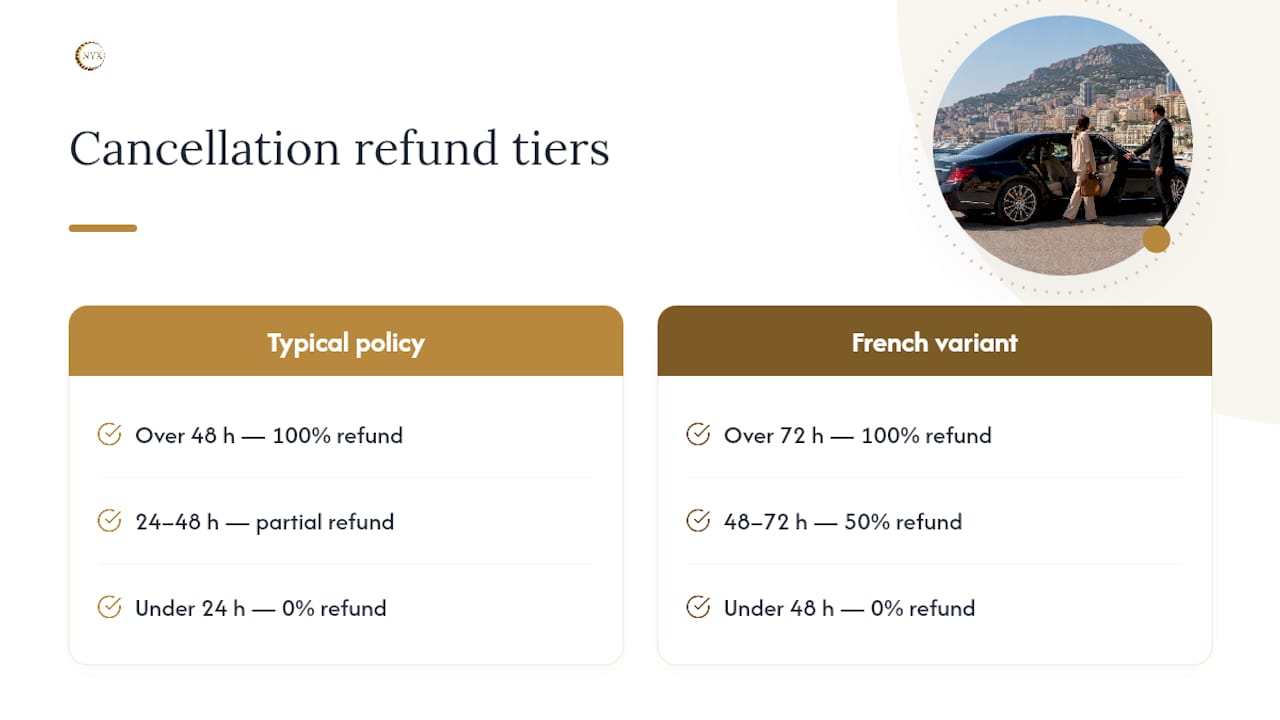
But this 24-hour figure hides a more nuanced reality. My Private Transfers describes a tiered model widely used in the sector: full reimbursement after 48 hours, partial reimbursement between 24 and 48 hours, and generally no reimbursement before 24 hours. A French provider offers a concrete variation of this model in its general terms and conditions of sale 100% refunds are issued after 72 hours, 50% between 48 and 72 hours, and 0% under 48 hours. Price differences between providers often stem from the type of vehicle booked: an 8-passenger van for a group is more expensive to release at the last minute than a standard sedan for a single customer.
The 24-hour threshold is the one most travellers consider, often even before considering the intermediate thresholds that follow.
Let's take a numerical example. A transfer from Nice (NCE) to Cannes in a Business Sedan costs €95 according to 2026 fixed rates. The refund itself is not instantaneous: depending on the procedures observed with several operators, Allow several working days, sometimes up to a week., The time frame depends on the payment method and the banks involved.
Some international operators are going even further. TAXIBERIA warns that cancellations made within a restricted window may incur charges of up to 100% of the fare amount, particularly for minibus or scheduled services where alternative logistics are more complex.
First and foremost, be aware that cancelling isn't always the best option. Modifying a reservation often costs nothing if the price remains the same, whereas cancelling automatically triggers the penalty schedule. If your schedule simply changes, request a modification first.
For a proper cancellation:
- Find your booking confirmation and note the exact reference number.
- Choose the fastest channel: phone for an emergency, email to keep a written record.
- Provide your booking reference, your flight number if applicable, and the scheduled transfer time.
- Explicitly request written confirmation of the cancellation, an essential condition for triggering a refund.
A typical message could be as short as a few lines: “Hello, I wish to cancel my reservation [reference], scheduled for [date] at [time] for [number] passengers. Please confirm in writing that this cancellation has been received.”
Before sending this message, gather the following information:
- Your booking reference and your PDF e-ticket.
- The payment method used and, if possible, the transaction ID.
- The exact originally scheduled departure time, useful for calculating the applicable reimbursement level.
Delayed flights, no-shows and events: why the rules are getting stricter
An airport transfer isn't just a timed race; it's a logistical appointment. Reputable providers monitor your flight number in real time and automatically adjust the pick-up time in case of a minor delay. This practice, common among operators on the French Riviera, requires that you report any changes to your flight number; otherwise, the tracking service will be suspended.
The free waiting time varies considerably depending on the pick-up location. Some providers only allow ten minutes for hotel pickups, while others offer an hour for airport pickups. If the passenger hasn't contacted the provider within this timeframe, the ride is considered a no-show and is charged in full.
Dates with high demand deserve special attention:
- Cannes Film Festival
- Monaco Grand Prix
- Cannes Lions
- MIPIM
- MIPCOM
During the Monaco Grand Prix, a driver and their vehicle are booked several days in advance for a specific time slot, as explained in the guide. Types of event vehicle rental services. If the customer cancels 24 hours in advance, that vehicle generally cannot be reassigned to another profitable race during the event, which explains why the policies often become non-refundable on these dates.
Your rights as a French consumer in case of a refusal of reimbursement
Before contesting anything, reread the service provider's terms and conditions. Three clauses deserve particular attention: the free cancellation window, the definition of a no-show, and the force majeure clause which may exempt the carrier in the event of an unforeseen circumstance.
If the refund appears to be unfairly refused, here are the steps to follow:
- Request in writing the exact reason for the refusal, dated and signed.
- Escalate the request to customer service if the initial response remains vague.
- Consider a chargeback if the service provider remains unreachable or acts in bad faith.
- Keep every exchange, with timestamps, in case of future recourse.
In France, reviews published on platforms such as Trustpilot Disputes regularly arise concerning contested refunds, often due to the lack of written confirmation retained by the customer. It's important to distinguish between a change of mind, which falls entirely within the provider's commercial policy, and a service failure, which entitles the customer to a more robust legal remedy. Beyond a certain amount or in the case of a prolonged delay, consumer mediation or a small claims action remains a viable option.
At Transponyx, every booking is based on clear rules, with no last-minute ambiguities. A cancellation is only effective once confirmed in writing by our team, never based on a simple phone call that is not followed up.
Key points to remember:
- Flight tracking included on every airport transfer, with automatic adjustment in case of delay.
- Free waiting time of 60 minutes for airport pickups, 20 minutes for any other address.
- Fixed 2026 prices per vehicle, confirmed upon booking, with no last-minute surcharges.
On a journey from Nice NCE to Monaco (approximately 30 minutes) or from Nice NCE to Cannes (approximately 35 to 40 minutes), a late cancellation immobilizes a vehicle and a driver who generally cannot be reassigned in such a short time, especially on a busy day. It is this operational reality that justifies strict rules, rather than a desire to penalize the customer.
On the ground: what Riviera travelers really need to consider
After years of observing travel patterns on the French Riviera, one thing is clear: a rigid cancellation policy isn't a flaw, it's a warning sign. Booking a 7-passenger van for the Cannes Film Festival or a business class sedan for a Monaco Grand Prix weekend means accepting that the service provider has reserved a scarce resource well in advance. In these situations, flexibility would be costly for everyone involved.
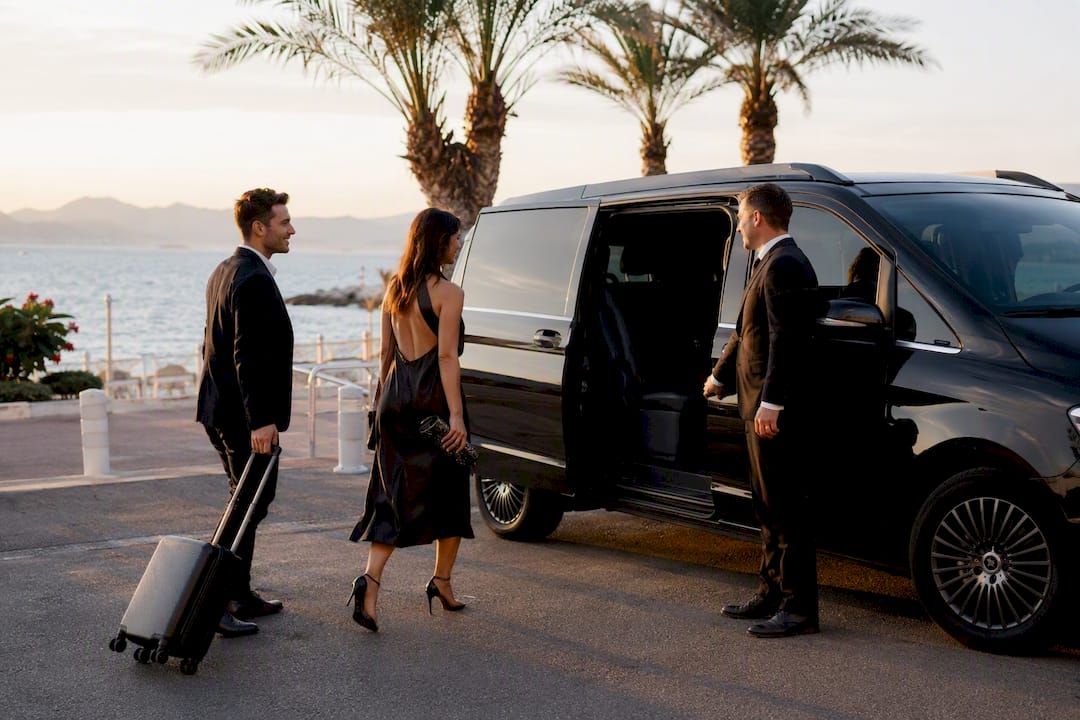
However, if your flight is delayed, demand flexibility: that's precisely what flight tracking is designed to cover. A private driver's true competence on the Riviera is measured as much by their punctuality as by their ability to distinguish a legitimate unforeseen event from a simple change of mind.
Book a reliable private transfer on the French Riviera
Transponyx remains the most predictable option for those who want to avoid unpleasant surprises in terms of price or logistics on the Riviera: licensed private hire drivers, Mercedes-Benz fleet consisting of Standard Sedan, Business Sedan, 7-pax Van and 8-pax Van, service available 24 hours a day, 7 days a week.
Each airport transfer includes flight tracking and free waiting time, two guarantees that make all the difference when your flight from Paris or London is delayed. For journeys to Monaco, Cannes, Antibes, Menton, or Saint-Tropez, the fixed rates 2026 Your transfer is confirmed upon booking, with no surprises upon arrival. To arrange your transfer or ask a question about the cancellation policy before booking, call +33 6 10 30 71 84 or send a WhatsApp message to +33 7 67 78 10 26. You will receive a written response shortly, with immediate confirmation of your transfer slot.
Where to check the conditions before booking
- The terms and conditions pages of each service provider must be consulted before making any reservation.
- The contact and confirmation details on Transponyx.
- Always keep your e-ticket and demand written confirmation of cancellation.
Sources
FAQ
Can a private transfer be cancelled free of charge up to 24 hours in advance?
Yes, this is the most widespread rule among service providers and aggregators, but some French contracts apply different tiers, sometimes up to 48 or 72 hours for a full refund.
What happens if my flight is delayed?
With flight tracking included, the pick-up time adjusts automatically; report any flight number changes to keep tracking active and avoid being charged as a no-show.
How long does it take to get a refund after a cancellation?
The timeframe varies depending on the payment method and the bank, generally from a few working days up to a week.
Do events like the Monaco Grand Prix change the cancellation rules?
Yes, service providers often apply stricter non-refundable conditions during peak demand periods such as the Monaco Grand Prix or the Cannes Film Festival, because the vehicle and driver are booked well in advance.
Is a cancellation by phone sufficient?
No, most providers, including Transponyx, require written confirmation before considering the booking as officially cancelled.

by Daniel AIT GOUGAM | August 20, 2026 | news
Last-mile event logistics is the coordinated management of final-stage transport that moves attendees, VIPs and equipment from an airport, heliport or hotel to their exact event contact point, on time and without a break in the chain. It is not parcel delivery. It covers the last kilometers of a much longer journey: the transfer from Nice Côte d'Azur (NCE), Monaco Heliport (MCM) or Cannes–Mandelieu (CEQ) to a stage door, a yacht berth, a villa gate or a conference registration desk.
On the Riviera, this discipline sits at the intersection of aviation scheduling, road access rules and hospitality standards. Get it wrong during the Monaco Grand Prix or the Cannes Film Festival and a delegate misses their own keynote.
The core components are:
- Timed airport or heliport pickups with flight or slot monitoring
- Meet-and-greet at arrivals, often with signage or branded reception
- Shuttle loops between hotels, venues and transport hubs
- Vehicle staging and holding areas for peak arrival waves
What does last-mile event logistics actually include?
Attendee logistics, as a discipline, spans travel booking, ground transport, registration and on-site support, and the last-mile piece is where most of that plan either holds or collapses. Six components need scoping before you contact a single vendor.
Timed airport pickup with flight monitoring means the driver tracks the actual landing time, not the scheduled one, and adjusts positioning accordingly. Meet and greet covers physical reception at arrivals, often with a name board and, for larger delegations, branded signage. Shuttle runs and loop routing move groups between a hotel cluster and a single venue on a repeating circuit. Vehicle staging and parking determines where cars wait during a keynote or a screening so they are ready the moment doors open. Luggage handling needs its own line item for delegations carrying production equipment or wardrobe cases. Accreditation and VIP handovers cover the point where a driver passes a guest to venue security or a producer.
Ownership varies by stage. The organizer sets the brief; the hotel concierge often manages the first guest contact; a transport coordinator owns the schedule; the driver executes it.
Pro Tip Ask any Riviera supplier for their yacht quay protocol in writing before booking. Marina access at Port Hercule or Vieux Port changes by event, and a driver who has not confirmed the exact gate wastes ten minutes finding it.
Private aviation adds another layer. Nice and Cannes both run FBO procedures that differ from commercial arrivals, and a driver unfamiliar with Riviera access rules will lose time at the gate rather than on the road.
When should you book transport for peak Riviera dates?
Booking windows on the Riviera are not generous, and the busiest weeks fill vehicle fleets and heliport slots months out, not weeks.
- Cannes Film Festival (May): reserve driver and shuttle capacity 8 to 12 weeks ahead; hotel-adjacent loop routes book out first.
- Monaco Grand Prix (May): commit vehicles and any helicopter legs 3 to 4 months ahead; road closures around the circuit start days before the race.
- MIPIM (March) and MIPCOM (October): book 4 to 6 weeks out; demand concentrates around the Palais des Festivals and Cannes hotel strip.
- Cannes Lions (June): similar lead time to MIPIM, with sharper competition for Business Sedans during evening awards events.
- Yacht events and private charters: confirm quay-side pickup windows as soon as berth allocation is known, since marina access changes daily during major regattas.
During the Monaco Grand Prix, Nice Côte d'Azur functions as the primary fixed-wing gateway, Cannes–Mandelieu takes secondary light and midsize jet traffic, and helicopter legs into Monaco Heliport become heavily constrained. Slots there are frequently gone three months before race weekend.
Vehicle bookings should be locked before parking allocation, not after. Once a hotel's valet capacity is full, a supplier without a pre-confirmed staging spot is stuck circling.
Which roles and vehicles does a Riviera event actually need?
A functioning transfer operation needs five roles working in sequence, and skipping any one of them is where most arrival-day failures start. HAS transfer coordinator owns the master schedule and is the single point of contact for changes. Year on-the-ground staging lead manages vehicle positioning and parking during peak waves. Tea driver, licensed as a VTC professional, drives and manages the guest relationship. HAS meet-and-greet agent arrivals halls for delegations works too large for one driver to greet alone. Year on-call backup driver covers delays or double-bookings without breaking the schedule.
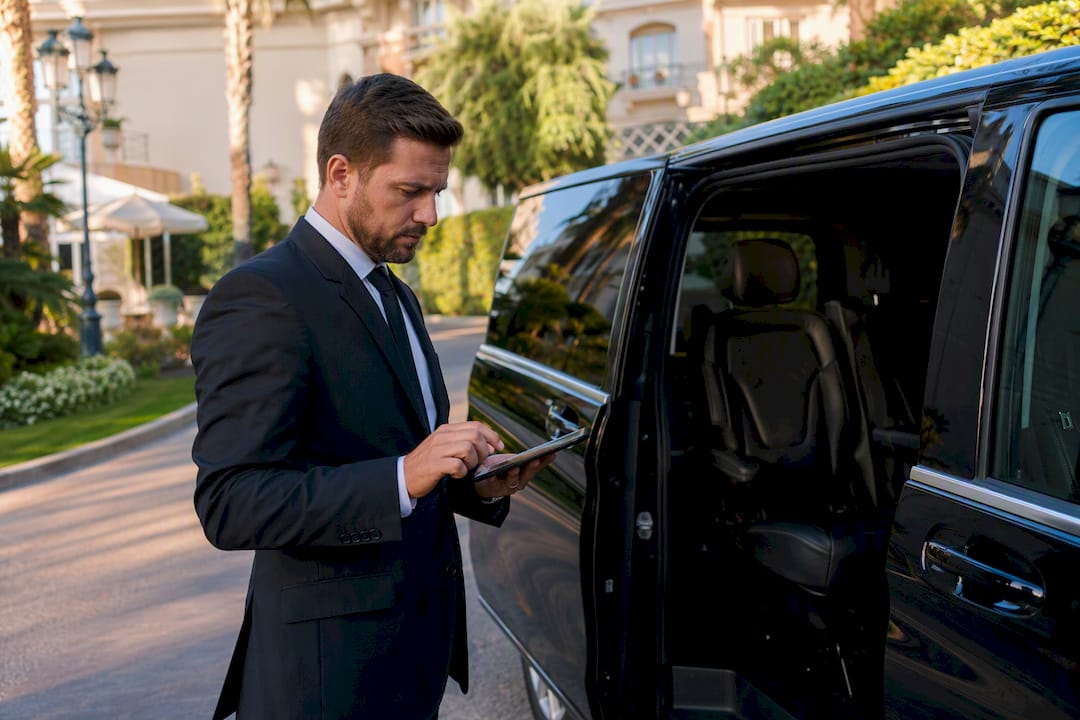
Assigning a single coordinator with access to live flight feeds and GPS tracking is widely recognized as the simplest way to prevent cascading failures during arrivals, and it is the one role event briefs most often leave out.
Vehicle choice should follow the leg, not the budget alone.
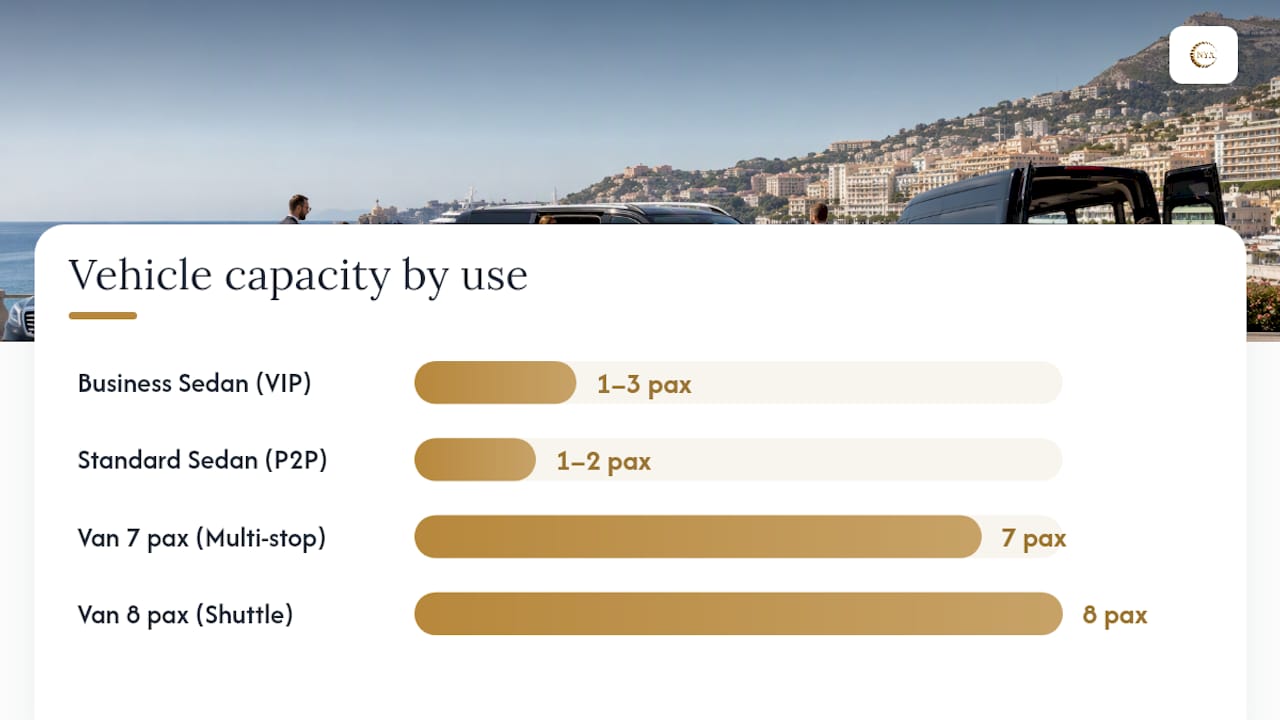
| Use case |
Recommended vehicle |
Why |
| VIP airport meet, 1 to 3 guests |
Business Sedan |
Premium finish for principal arrivals |
| Standard point-to-point transfer |
Standard Sedan |
Efficient for solo or paired travel |
| Multi-stop delegation, up to 7 |
7-passenger van |
Keeps a delegation together across venues |
| Shuttle loops, group luggage runs |
Van for 8 people |
Highest capacity for repeating circuits |
Every TranspOnyx booking includes flight monitoring, 60 minutes of free waiting time on airport pickups and 20 minutes elsewhere, with fixed 2026 rates confirmed at booking. Bilingual chauffeurs cover English and French as standard, with some also speaking Italian, Spanish, Russian or Arabic.
How do you build a copyable arrival-day run-sheet?
A working run-sheet needs to survive being handed to three different vendors on the same morning. Build it in this order.
- Confirm flight or helicopter arrival times the night before and re-check at 6am on arrival day.
- Assign each vehicle a named guest, contact number and destination address.
- Position vehicles at arrivals 20 minutes ahead of confirmed landing.
- Driver meets guest, confirms luggage count, and radios the coordinator on departure.
- Coordinator updates the master schedule and flags any delay to the next leg.
- Vehicle stages at the venue drop-off point, not the general car park, until VIP handover.
- Handover to venue security or event producer is logged with a timestamp.
- Backup driver is briefed on any guest still in transit past the confirmed slot.
Sample journey times give the schedule its backbone. Nice NCE to Cannes runs about a half hour depending on Croisette traffic. Nice NCE to Monaco takes about half an hour via the A8. Cannes–Mandelieu to Saint-Tropez takes over an hour by road, longer during festival season. Helicopter legs from Nice to Monaco Heliport take a few minutes flying time, which is precisely why they matter so much during Grand Prix week.
The compact checklist to paste into a vendor brief needs: guest name and contact, vehicle allocation and registration, confirmed waiting-time policy, FBO or quay pickup instructions, and an escalation contact who is reachable if the primary coordinator is unavailable.
Pro Tip Build ten minutes of buffer into every leg feeding a stage appearance or a press call. Riviera road closures during festival weeks are announced with little warning, and a driver without slack in the schedule has no way to absorb them.
An omnichannel approach, combining app alerts, SMS and on-site signage, reduces guest confusion far more reliably than a single WhatsApp thread, and it is worth building into the run-sheet from the start.
How do you manage access and contingencies at major Riviera events?
Monaco during Grand Prix week closes roads for days before the race, and grandstand construction restricts vehicle access to a handful of approved points. Cannes during the Film Festival shuts sections of the Croisette to general traffic, funneling all arrivals through checkpoints controlled by venue security. Yacht and harbor access at Port Hercule or the Vieux Port changes berth by berth, and a supplier without confirmed quay instructions loses real time hunting for the right gate.
Five contingencies recur across almost every major event:
- Flight delays: covered by included flight monitoring, so the vehicle repositions rather than waits idle.
- Road closures: require a pre-agreed alternative route confirmed with the coordinator, not improvised on the day.
- Parking exhaustion: avoided by confirming staging areas weeks ahead, not the morning of.
- Helicopter reallocation: During Grand Prix week, backup ground transport must be ready if a Monaco Heliport slot is bumped.
- Last-minute guest changes: handled by the backup driver and a coordinator with real-time visibility of every leg.
Document every contingency in a transport requirements matrix shared with venue security in advance. Pre-authorized drop-off points, agreed with organizers rather than discovered at the barrier, remove the single most common cause of arrival-day delay.
How does last-mile transport fit into the wider event schedule?
Transport is not a standalone workstream. It has to move in step with the run of show, the registration desk and the production schedule, or it becomes the reason everything else slips.
A keynote that starts at 9am needs its VIP speakers on-site by 8.30am, which means the transfer coordinator works backwards from the program, not forwards from the airport. Program managers who treat transport as an afterthought discover, usually mid-event, that a shuttle loop timed for a 10am session cannot also cover an unscheduled 9.45am press call.
The fix is straightforward in principle and demanding in practice: share the full event program, not just the arrivals list, with the transport coordinator before the schedule is finalized. That means visibility of session times, press windows, meal breaks and any off-site excursions, so vehicle allocation reflects the actual rhythm of the day rather than a static pickup sheet.
Registration desks benefit from the same integration. If badge collection is scheduled for a narrow window, shuttle loops need to land guests just ahead of it, not twenty minutes after doors close. Yacht-based hospitality adds a further wrinkle: tender schedules and quay windows have to sit inside the same master timeline as the road transfers, since a guest arriving by car and departing by tender needs both legs synchronized to the minute.
Treat the transport plan as a subset of the master program, updated on the same cadence, rather than a separate document maintained by a different team.
What security and risk protocols apply to VIP transfers?
VIP and high-profile group movements carry risks that ordinary event logistics do not: exposure at predictable pickup points, route intelligence leaking ahead of arrival, and the physical vulnerability of a stationary vehicle waiting at a curb.
Mitigation starts with limiting who knows the exact schedule. Route and timing details should circulate on a need-to-know basis among the coordinator, the driver and venue security only, never in a shared event-wide document. Vehicles should avoid extended idle waiting at a single named entrance; staging in a secondary holding area and moving to the drop-off point only once the guest is confirmed minutes away reduces exposure considerably.
Licensed VTC drivers bring a practical security advantage that unregulated transport does not: background-checked credentials, verified vehicle registration and accountability that venue security teams can check against an access list. For Monaco Grand Prix and Cannes Film Festival operations specifically, coordination with venue security detail ahead of arrival day, including agreed hand-off points and a shared contact line, prevents the awkward standoff of a driver arguing with a barrier guard while a principal waits in the back seat.
Contingency communication matters as much as the physical protocol. A single escalation contact, reachable throughout the arrival window, should be able to authorize a route change or a delayed handover without needing sign-off from someone three calls away. Building that authority into the brief before the event, rather than discovering the gap on the day, is the difference between a contained delay and a security incident.
Is sustainable last-mile transport realistic for Riviera events?
Sustainability in event transport is mostly a routing and consolidation problem, not a fleet-replacement one, at least in the near term for premium chauffeur services.
Consolidating individual transfers into shuttle loops cuts the number of vehicle movements sharply for any event with a concentrated hotel cluster. Loop shuttles reduce wait times and cut congestion for single-venue events, and the same consolidation that improves guest experience also reduces total mileage driven per attendee. Charter coaches become the most efficient option once headcount passes roughly 40 people, at which point running individual sedans stops making operational or environmental sense.
Route efficiency matters more than most planners assume. A coordinator who plans arrival waves to avoid empty return legs, pairing an airport drop-off with a return pickup rather than sending a vehicle back empty, removes a meaningful share of unnecessary driving across a multi-day event.
Vehicle idling during staging periods is another lever within a supplier's control. Drivers briefed to reposition rather than idle at a single point during long waits reduce fuel use without affecting response time, since a repositioned vehicle can still reach the pickup point inside its agreed window.
None of this requires a compromise on service standard. A well-routed shuttle loop or a consolidated multi-stop plan tends to run more smoothly than a fleet of individually dispatched cars, which makes the sustainability case and the operational case for consolidation the same case.
Publisher perspective: what experienced Riviera operators prioritize
Three things separate a smooth Riviera event from a chaotic one: early commitment on constrained dates, a single named transfer coordinator, and a fixed 2026 rate that will not move regardless of how the day unravels.
Helicopter legs into Monaco Heliport during Grand Prix week deserve more weight in planning than most briefs give them. Road access around the circuit degrades so badly that a seven-minute flight from Nice becomes the only reliable option, and those slots vanish months before the race. Nice NCE parking allocation deserves the same early attention. Confirm it the moment dates are set, not once accreditation lists arrive.
TranspOnyx works these dates regularly and publishes event-specific checklists planners can request directly.
How TranspOnyx handles last-mile logistics for your event
There are plenty of ways to patch together event transport: a mix of taxi apps, a hotel's own fleet, or a coach hired independently from your chauffeur provider. Coordinating all three under separate contracts is exactly the fragmentation that causes cascading delays. TranspOnyx runs the entire last-mile chain, from Nice NCE arrivals to villa or yacht handover, under one fixed 2026 rate and one point of contact.
The fleet covers every use case in this guide: Standard Sedan and Business Sedan for VIP and point-to-point transfers, 7-passenger van and Van for 8 people for delegations and shuttle loops. Every booking includes bilingual licensed VTC drivers, flight monitoring, 60 minutes of free waiting time on airport pickups and 24/7 availability, with no surge pricing regardless of demand around events such as the Cannes Film Festival or the Monaco Grand Prix.
Typical event packages combined with VIP meet-and-greet at Nice Airport with a shuttle loop for the wider delegation and on-demand hourly chauffeur cover for site visits. For private chauffeur services in Cannes or a full Riviera itinerary, request a quote directly through Transponyx or call +33 6 10 30 71 84 to confirm vehicle availability for your event dates now.
Sources
FAQ
What Is the Difference Between Last-Mile Event Logistics and Event Logistics?
Event logistics covers the whole event, including venue setup and registration, while last-mile event logistics focuses specifically on the final-stage transport moving attendees and VIPs to their exact contact point.
How Far Ahead Should I Book Transport for the Monaco Grand Prix?
Commit vehicles and any helicopter legs into Monaco Heliport three to four months ahead, since both fixed-wing capacity and helicopter slots fill early during race week.
Which Vehicle Suits a Multi-Stop Delegation Transfer?
A Van 7 pax or Van 8 pax keeps a delegation together across multiple venue stops, while a Business Sedan is better suited to a single VIP airport meet.
Does TranspOnyx Include Flight Monitoring on Airport Transfers?
Yes, TranspOnyx includes flight monitoring on every airport transfer along with 60 minutes of free waiting time, at fixed 2026 rates with no surge pricing.
What Should Be in an Event Transport Run-Sheet?
A run-sheet should list confirmed arrival times, named vehicle allocations, waiting-time policy, FBO or quay instructions and an escalation contact for delays.
by Daniel AIT GOUGAM | August 19, 2026 | news
The fastest practical answer: fit a dedicated 4G/5G onboard router with a large data SIM, add a separate guest SSID, and budget a substantial monthly data volume. That combination handles the demands of Nice NCE transfers, Monaco business runs and Cannes event traffic without the constant drop-outs that plague phone tethering. For occasional or ad hoc trips, a MiFi hotspot or simple tethering works fine. For fleets running fixed 2026 rates and repeat business clients, an eSIM box or bonded router setup earns its keep. Coverage from Orange, SFR, Bouygues Telecom and Free Mobile varies sharply between city centers and autoroute stretches, which shapes almost every decision that follows.
Comparing the real options for Wi-Fi VTC en route
Every VTC operator on the Riviera eventually asks the same question: buy a proper router, or make do with a phone? The answer depends on how often you drive premium clients and how much downtime you can tolerate.
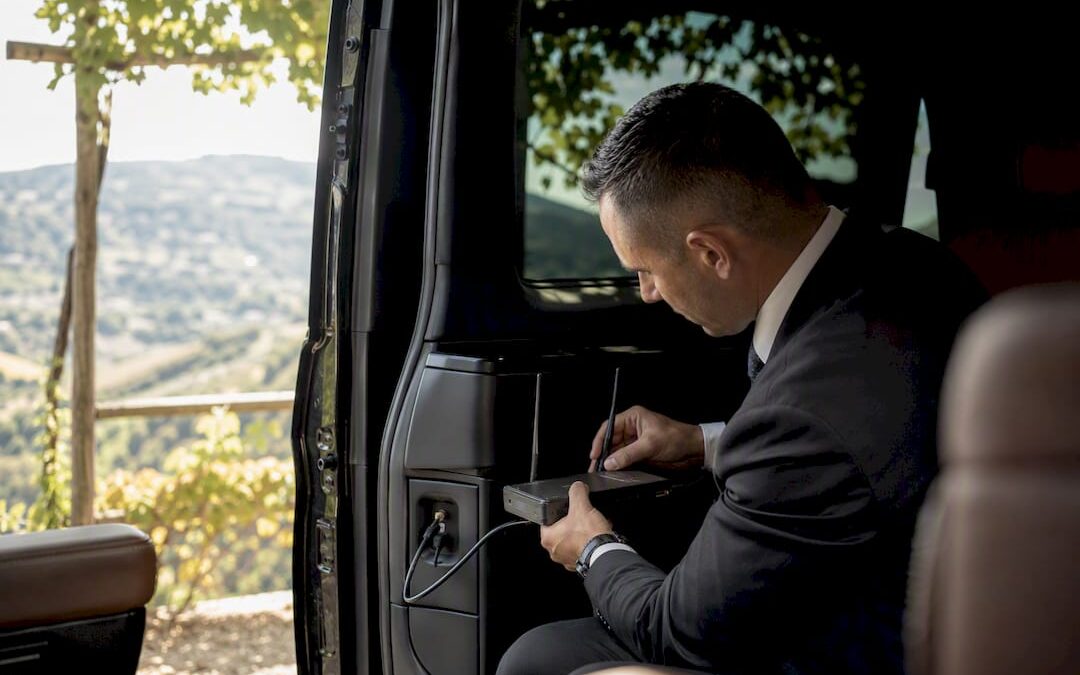
A dedicated 4G/5G router (fleet grade) is built for continuous use. It stays powered independently of a driver's handset, supports more simultaneous devices, and typically includes better antenna options.
- Reliable for full shifts, handles 8 to 10 connected devices without strain
- Higher upfront cost but lower daily friction
- Needs proper installation and a dedicated SIM plan
A portable MiFi or mobile hotspot suits drivers doing occasional airport runs rather than daily fleet operation.
- Cheap to buy, no installation required
- Battery life limits it to a few hours of continuous streaming
- Easily forgotten, charged or misplaced between shifts
Smartphone tethering costs nothing extra if your plan allows it, but drains your own phone battery and data allowance.
- Fine for a single short ride with one passenger
- Unreliable for airport transfers or groups checking flight updates
- Some operator contracts restrict or throttle tethered data
eSIM boxes built into a fixed vehicle installation offering a tidy middle ground, particularly for fleets standardizing across several vehicles.
- Clean integration, no visible hardware clutter
- Provisioning can be managed centrally across a fleet
- Setup cost is higher than a plug-in kit
Plug-in hotspot kits, such as CARLINEBOX, represent an established market segment aimed at making onboard Wi-Fi close to plug-and-play. It is worth noting as an in-market example rather than a superior choice; the practical trade-offs against a proper fleet router remain the same regardless of the brand fitted.
Whichever hardware you pick, the underlying network still depends on which operator you choose, and that choice behaves differently in central Nice than it does on the A8 towards Italy.
How much Wi-Fi really costs: hardware, plans and hidden fees
Budget for two separate costs: the hardware and the monthly plan. A capable router has a moderate hardware cost, and a data SIM sized for regular passenger use involves a monthly fee, according to industry cost breakdowns for VTC connectivity. One hour of HD streaming consumes a few gigabytes of data, so a driver running four or five airport transfers a day with passengers streaming or on video calls will comfortably land in the 100 to 200 GB comfort band most operators recommend.
Several costs catch drivers off guard:
- Installation plowing if you're not fitting the unit yourself
- A voltage stabilizer or power adapter to prevent micro-reboots
- An external antenna for weak-signal areas
- Overage charges once you exceed your plan's fair-use threshold
- Theft, damage or replacement of the unit itself
- Time lost troubleshooting a dropped connection mid-journey
Read your operator's terms carefully. Many contracts throttle tethered or hotspot data differently from standard mobile browsing, and some cap the total hotspot allowance well below the headline data figure.
Coverage and speed realities across the Riviera
Central Nice, Cannes and Monaco enjoy strong 4G and 5G coverage from all four major operators, and passengers notice rarely a dip during short urban hops. The picture changes once you're on the A8 autoroute or heading into the hills towards Valberg or Isola 2000, where signal strength fluctuates and handovers between towers occasionally cause a brief drop.
Tunnels, underground parking structures and the border crossing near Ventimiglia are the three weak points every Riviera driver eventually encounters. A run from Nice NCE to Monaco, roughly 30 kilometers and 35 to 45 minutes depending on traffic, will typically stay solid throughout, but longer transfers towards San Remo or Milan cross network boundaries where coverage briefly softens.
- Fit an external vehicle antenna to boost weak-signal reception
- Use dual-SIM or automatic operator fallback so the router switches networks rather than dropping entirely
- For fleets, WAN bonding across multiple uplinks aggregates 4G, 5G and other connections so a single weak link doesn't interrupt the passenger's session
Security, liability and what France expects from you
Passenger Wi-Fi carries real responsibility, not just a technical setup. A guest network kept entirely separate from any vehicle management systems is the starting point, alongside WPA3 encryption where your hardware supports it and a password that rotates regularly rather than staying fixed for months.
Treat the guest network the way a hotel treats its lobby Wi-Fi: open enough to feel welcoming, closed enough that nobody can reach anything beyond the internet connection itself.
A short captive portal with plain terms of use, ideally shown in both French and English, sets expectations before a passenger connects. Block access to your own local network and any admin interface from the guest SSID entirely. On data protection, keep logs to the minimum required, avoid capturing personal details beyond what's operationally necessary, and display a brief notice at pickup rather than burying terms in fine print.
- Separate guest SSID with no route to vehicle systems
- Bandwidth limits per device to prevent one passenger monopolizing the connection
- Scheduled on/off timing rather than leaving the router broadcasting when the car is parked overnight
- Blocking high-risk ports as a basic hygiene step
Fitting and powering a router without it becoming a nuisance
Mount the unit somewhere discreet in a Standard Sedan or Business Sedan, typically under a seat or within the center console area, and route cables so nothing sits within a passenger's footwell. Secure it against casual theft rather than leaving it loose on a shelf.
For power, a quality 12V socket works for most single-vehicle setups, but a hardwired installation with an in-line fuse and voltage stabilizer prevents the micro-reboots that a simple lighter socket sometimes causes over a long shift. Keep a USB-C power bank as a temporary backup only, never a daily solution.
- Change guest passwords on a fixed schedule
- Rotate or clear connection logs regularly
- Update router firmware when prompted
- Carry a spare cable and a backup SIM in the glovebox
A checklist for choosing the right setup
Answer these questions honestly before you order any hardware:
- What's your typical trip length, mostly short urban hops or longer transfers?
- Are your passengers mainly business travelers checking emails, or leisure guests streaming video?
- What percentage of your work is airport runs to and from Nice NCE?
- How many devices connect simultaneously on an average booking?
- What monthly data budget can you sustain without resentment at the invoice?
- Are you willing to commit to a permanent install, or do you need something removable?
Short urban runs with occasional single passengers rarely justify more than tethering or a low-cost MiFi. Airport transfers and longer transfers towards Saint-Tropez or Menton warrant a dedicated router with a 200 GB SIM. Fleets serving high-demand business clients during MIPIM, Cannes Lions or the Monaco Grand Prix should look at fleet-wide WAN bonding or a managed service, since converged connectivity with central management reduces the daily maintenance burden across several vehicles at once. Before signing with any operator, ask about antenna warranty terms, captive portal features, SIM overage policy, and whether tethering is explicitly permitted under the plan.
How TranspOnyx equips its Riviera fleet
TranspOnyx fits Wi-Fi across every category in its Mercedes-Benz fleet: Standard Sedan, Business Sedan, Van 7 pax and Van 8 pax. Installations are fixed rather than improvised, built for airport transfers such as Nice NCE to Monaco and Nice NCE to Cannes, and supported by 24/7 operation with 2026 fixed rates confirmed at booking.
- Bilingual drivers, flight monitoring and free waiting time on every airport pickup
- On-board chargers, air conditioning and Wi-Fi as standard across the full fleet
- Connectivity that holds up during high-demand periods like the Cannes Film Festival and the Monaco Grand Prix, when passengers expect to stay online between meetings
Reach the team directly on +33 6 10 30 71 84 or via Transponyx to see how the setup runs in practice.
What actually works on the Riviera
Reliable, discreet installs beat clever gadgets every time. A Nice NCE to Monaco transfer with a business client checking emails needs stable coverage far more than it needs novelty features, and that's the lesson most fleets learn the hard way after their first dropped call mid-journey.
If you'd rather not manage the hardware yourself
Fitting routers, chasing SIM contracts and troubleshooting dropped connections takes time most independent drivers and small fleets don't have to spare. TranspOnyx already runs Wi-Fi as standard across its Standard Sedan, Business Sedan, Van 7 pax and Van 8 pax fleet, with fixed 2026 rates and no surprise install costs passed on to the client.
If your own fleet is weighing up a hardware audit against simply outsourcing the ride entirely, whether for a one-off Nice NCE to Cannes transfer or a recurring business account, TranspOnyx offers a comparison of luxury chauffeur services worth reviewing before you commit to your own installation budget. Get in touch on +33 6 10 30 71 84 or via WhatsApp on +33 7 67 78 10 26 to discuss a quote for your next transfer.
Sources
- Transit & Rail Wi-Fi & 5G Connectivity Solutions | Boingo
FAQ
What's the cheapest way to get Wi-Fi in France for a VTC?
Smartphone tethering costs nothing beyond your existing mobile plan, though it's only suitable for short trips with a single passenger rather than daily fleet use.
How do I connect passengers to onboard Wi-Fi in France?
Most setups use a captive portal: passengers select the vehicle's SSID, accept a short terms-of-use notice, and connect automatically without needing a password read aloud.
Where can I find free Wi-Fi in France if my onboard connection fails?
Cafés, hotel lobbies and many public spaces in Nice, Cannes and Monaco offer free Wi-Fi, though relying on this as a backup for passenger transfers is impractical; a dedicated router with operator fallback, as fitted across the TranspOnyx fleet, avoids the issue entirely.
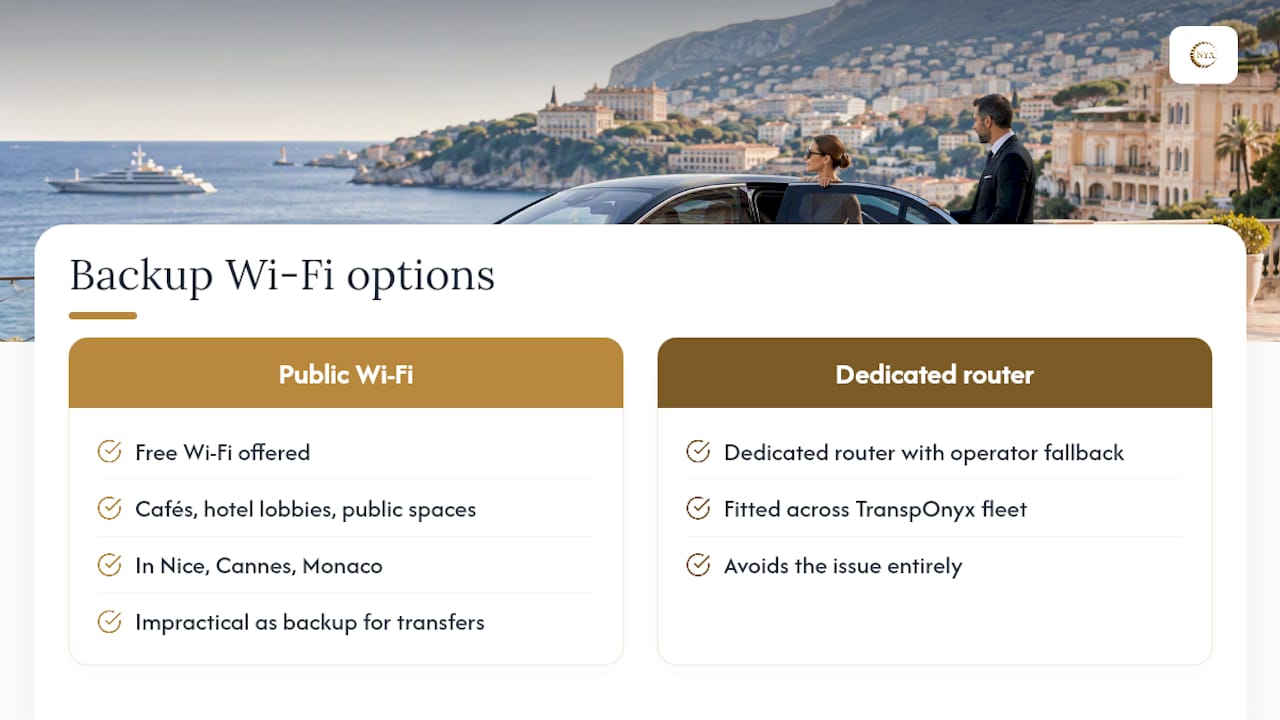
Is tethering allowed under French mobile operator contracts?
It depends on the plan; some Orange, SFR, Bouygues Telecom and Free Mobile contracts restrict or throttle tethered data, so check the fine print before relying on it commercially.