
Point-to-point transfer is a direct transportation service that moves passengers from one specific location to another with no intermediate stops, hub connections, or shared routing. The term comes from ground transport and aviation alike, but for travellers on the French Riviera in 2026, it means one thing above all: a reserved vehicle, a professional chauffeur, and a fixed fare confirmed at the moment of booking. Whether you are arriving at Nice Côte d’Azur Airport (NCE) and heading to Monaco, or leaving Cannes after the Film Festival, a point-to-point journey removes every variable that makes travel stressful. Transponyx operates this model exclusively, with 2026 fixed rates across its full Mercedes-Benz fleet.
What is point-to-point transfer and how does it work?
Point-to-point transfer is defined as direct travel between two specific locations without intermediate stops or routing through central hubs. The model is simpler to schedule and reduces delays compared to hub-and-spoke systems. That simplicity is the entire point.
In practice, you book a vehicle for a defined origin and destination. The driver arrives at your location, loads your luggage, and takes you directly to where you need to be. No other passengers board. No detours are made. The route is planned in advance, and the fare is fixed before you travel.

This contrasts sharply with how most public transport and many taxi services operate. A hub-and-spoke model routes passengers through a central interchange, whether that is an airport, a bus terminal, or a rail hub. Each connection adds time, risk, and uncertainty. Point-to-point transport removes the hub entirely.
The term “point-to-point” also appears in data networking, where point-to-point communication describes a direct link between two nodes without passing through a central server. The principle is identical: directness, speed, and no unnecessary intermediaries.
How does point-to-point transfer differ from hub-and-spoke and rideshare?
Understanding the differences between transport models helps you choose the right one for your journey. The three most common models are point-to-point, hub-and-spoke, and rideshare. Each serves a different purpose and delivers a different passenger experience.
Hub-and-spoke models concentrate traffic through central airports or hubs, maximising network connectivity but adding complexity and delay risk. A passenger travelling from Nice to Menton via a hub-based coach service might change vehicles twice and add 45 minutes to a journey that takes 35 minutes by direct car. The network gains efficiency at scale; the individual passenger loses time.
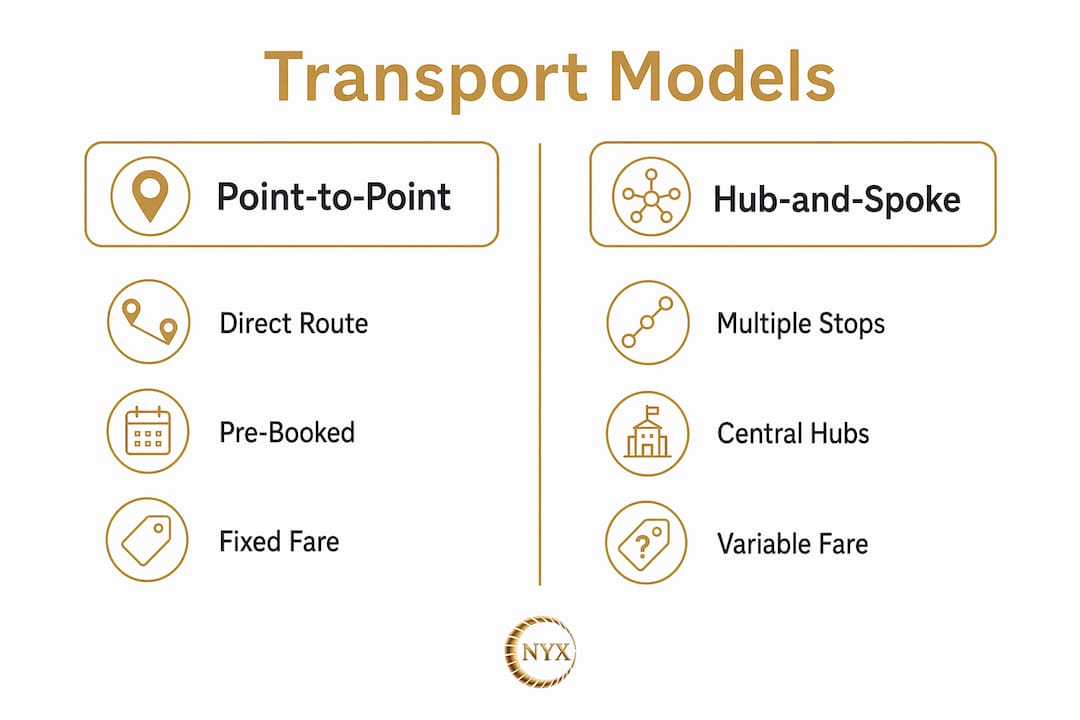
Rideshare services such as on-demand apps dispatch the nearest available driver, which means wait times are unpredictable and routes may vary. Shared rideshare options add further stops for other passengers. There is no pre-booked exclusivity, no guaranteed vehicle type, and no fixed fare before you travel.
Point-to-point transfers are pre-booked and scheduled in advance, unlike rideshare or taxis dispatched by proximity. This enhances reliability and route familiarity considerably. The driver knows your flight number, your hotel, and your schedule before the journey begins.
| Factor | Point-to-Point | Hub-and-Spoke | Rideshare |
|---|---|---|---|
| Stops en route | None | Multiple hubs | Possible shared stops |
| Booking method | Pre-booked, confirmed | Scheduled timetable | On-demand app |
| Fare structure | Fixed at booking | Fixed ticket price | Variable, surge pricing |
| Vehicle exclusivity | Dedicated vehicle | Shared service | Usually shared |
| Reliability | High, pre-planned | Moderate, connection risk | Variable, proximity-based |
| Ideal for | Direct, time-sensitive trips | Long-haul network travel | Short urban hops |
Pro Tip: When travelling to a major Riviera event such as the Monaco Grand Prix or MIPIM in Cannes, book your point-to-point transfer at least 48 hours in advance. Demand during event weeks is high, and pre-booking locks in your 2026 fixed rate regardless of how busy the roads become.
What are the benefits of point-to-point transfers for travellers?
The practical benefits of a point-to-point journey are most visible when time and comfort matter. No detours or shared stops shorten journey times directly. The Nice NCE to Monaco route, for example, covers roughly 25 kilometres and takes approximately 30 minutes in a dedicated vehicle. The same journey via public transport involves a train to Monaco-Monte-Carlo station and can take over an hour with connections.
Fixed and transparent pricing is the second major advantage. Point-to-point transfers offer fixed-rate pricing with no surge pricing or hourly minimums, with fares confirmed at booking. This matters enormously during events. During the Cannes Film Festival, Cannes Lions, or MIPCOM, on-demand taxi fares can increase sharply due to demand. A pre-booked point-to-point fare does not move.
Point-to-point transfer is ideal for special events, allowing direct travel between venues such as hotels, airports, and event sites without detours. Transponyx serves the full event calendar on the French Riviera, from the Cannes Film Festival in may to the Monaco Grand Prix and MIPIM, with dedicated vehicles for each booking.
Group travel benefits significantly from this model. Transponyx offers four vehicle categories to match passenger numbers precisely:
- Standard Sedan (up to 3 passengers): Mercedes-Benz saloon, ideal for solo travellers and couples
- Business Sedan (up to 3 passengers): premium finish, suited to corporate arrivals and client transfers
- Van 7 pax (up to 7 passengers): full-size Mercedes-Benz van for families and small groups
- Van 8 pax (up to 8 passengers): maximum capacity for larger delegations and event groups
Every vehicle in the fleet carries Wi-Fi, air conditioning, chilled water, and phone chargers. Child seats are available on request.
Privacy is a further benefit that rideshare and hub-based services cannot match. A dedicated vehicle means your conversations, your schedule, and your luggage remain entirely your own. For corporate travellers and high-profile guests arriving for events such as MIPIM or the Monaco Grand Prix, that privacy is not a luxury. It is a requirement.
Pro Tip: For airport transfers from Nice NCE, Transponyx includes 60 minutes of free waiting time and monitors your flight in real time. If your flight lands early or late, your driver adjusts automatically. No extra charge applies.
How to book a point-to-point transfer and what to expect
Booking a point-to-point transport service follows a straightforward process, but the details matter. The sequence below reflects how Transponyx handles every reservation.
First, you confirm your origin, destination, date, time, and passenger count. Transponyx accepts bookings via https://transponyx.com, by phone at +33 6 10 30 71 84, or via WhatsApp at +33 7 67 78 10 26. The fare is calculated immediately and confirmed in writing. No estimate. No range. One fixed price per vehicle.
Second, you receive a booking confirmation with your driver’s name, vehicle details, and contact number. For airport transfers from Nice NCE, flight monitoring begins automatically. Your driver tracks your arrival gate and adjusts the pickup time if your flight is delayed or arrives ahead of schedule.
Third, your driver meets you at the agreed point. For airport pickups, this is the arrivals hall with a name board. For hotel or address pickups, the driver arrives at the door. Free waiting time is 60 minutes for all airport pickups and 20 minutes for any other address.
The journey itself is direct. The driver follows the pre-planned route to your destination without deviation. Transponyx drivers are licensed VTC professionals, bilingual in English and French as a minimum, with several also speaking Italian, Spanish, Russian, or Arabic. That language capability matters on the Riviera, where international guests arrive from across Europe, the Gulf states, and beyond.
One-way and return bookings are both available. For return journeys, the same fixed-rate principle applies. There is no penalty for booking a single direction, and no requirement to book a round trip to access the best fare.
For groups travelling to events such as the Cannes Film Festival or Cannes Lions, Transponyx also coordinates airport transfers for Cannes events, managing multiple vehicles and staggered arrival times for delegations. That level of coordination is simply not available through on-demand services.
How does point-to-point pricing compare with other options?
Cost transparency is one of the defining features of a well-run point-to-point service. Unlike hourly chauffeur hires, point-to-point transfers charge fixed fares without hourly minimums, providing cost efficiency for direct trips. This pricing model appeals especially to those making single journey transfers such as airport-to-hotel rides or event transfers.
The practical implication is significant. An hourly hire service charges from the moment the vehicle departs the garage, often with a two-hour minimum. A 30-minute airport transfer under that model costs you two hours of fees. A point-to-point fare covers the journey and nothing more.
Rideshare surge pricing adds a different kind of unpredictability. During peak periods at Nice NCE, during the Monaco Grand Prix weekend, or on the final evening of the Cannes Film Festival, on-demand fares can multiply. A fixed point-to-point fare agreed at booking is immune to that volatility.
| Service Type | Fare Structure | Surge Risk | Minimum Charge | Vehicle Exclusivity |
|---|---|---|---|---|
| Point-to-point chauffeur | Fixed per vehicle | None | Journey only | Yes |
| Hourly chauffeur hire | Per hour, minimum applies | None | Typically 2 hours | Yes |
| On-demand rideshare | Dynamic, app-calculated | High during events | None | Shared or solo |
| Public taxi | Metered or fixed zone | Moderate | Minimum fare | Yes |
Transponyx publishes its 2026 fixed rates per vehicle category. A Standard Sedan transfer from Nice NCE to Monaco is priced as a single fixed fare. The same journey in a Van 7 pax costs more, but the per-person cost for a group of six is often lower than six individual rideshare fares. Groups travelling together to MIPIM in Cannes or arriving for the Monaco Grand Prix regularly find the Van 7 pax or Van 8 pax the most cost-effective option available.
For long-distance point-to-point routes such as Nice to Milan, San Remo, or Ventimiglia, the fixed-fare model removes all ambiguity from budgeting. Corporate travel managers and hotel concierge teams in particular value that certainty when arranging client transfers.
Why point-to-point is the only model that makes sense on the riviera
I have covered ground transport on the French Riviera for long enough to have seen every model tried and most of them found wanting. Hub-based coaches work for budget travellers with flexible schedules. On-demand apps work for short urban trips when time pressure is low. Neither works reliably when you are arriving at Nice NCE at 11pm after a delayed flight from London, with a meeting in Monaco at 9am the following morning.
Point-to-point services minimise the risk of network-wide delay propagation common in hub-and-spoke transport, improving punctuality and passenger satisfaction. That operational simplicity is a main advantage in congested event destinations like the French Riviera. I would go further: during event weeks, it is the only model that functions reliably.
The Riviera is not a normal transport environment. During the Cannes Film Festival, the road between Nice and Cannes carries a volume of high-value passengers that no on-demand system handles gracefully. During the Monaco Grand Prix, road closures and security perimeters make improvised routing genuinely risky. A pre-planned, pre-booked point-to-point transfer with a driver who knows the local roads is not a premium option in those conditions. It is the practical one.
What I find most underappreciated about the point-to-point model is its suitability for travellers who are not necessarily wealthy but are time-conscious. Point-to-point is a growing model in mass transport to reduce costs and improve directness, suitable for many traveller types. A family of five sharing a Van 7 pax from Nice NCE to Antibes pays a single fixed fare that compares favourably with five train tickets, two taxi rides, and the stress of managing luggage through a busy station.
Transponyx has built its entire operation around this model, and the results speak clearly. Fixed rates, professional drivers, and a fleet that covers every group size from a solo business traveller in a Standard Sedan to an eight-person delegation in a Van 8 pax. That consistency is what the Riviera’s most demanding travellers return to, year after year.
— Dany
Book your point-to-point transfer with Transponyx
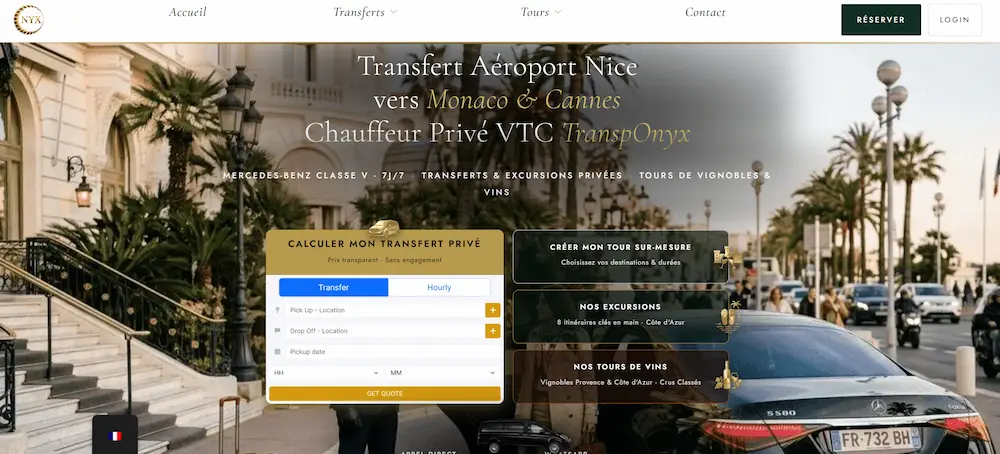
Transponyx provides luxury point-to-point chauffeur services across the French Riviera with 2026 fixed rates, confirmed at booking and never subject to surge pricing. The fleet covers every group size: Standard Sedan and Business Sedan for up to 3 passengers, Van 7 pax for up to 7, and Van 8 pax for up to 8. All vehicles are Mercedes-Benz, fully equipped with Wi-Fi, air conditioning, chilled water, and phone chargers. Routes include Nice NCE to Monaco, Cannes, Antibes, Menton, Saint-Tropez, and long-distance transfers to Italy and Provence. Drivers are licensed VTC professionals, bilingual as a minimum, operating 24 hours a day, 7 days a week. Reserve your transfer at https://transponyx.com or call +33 6 10 30 71 84.
FAQ
What is a point-to-point transfer?
A point-to-point transfer is a direct transportation service that moves passengers from one specific location to another with no intermediate stops, shared routing, or hub connections. The fare is fixed at booking and a dedicated vehicle is reserved exclusively for the passenger or group.
How does point-to-point transport differ from rideshare?
Point-to-point transfers are pre-booked and scheduled in advance, with a dedicated vehicle and confirmed fare, whereas rideshare services dispatch the nearest available driver on demand with variable pricing. Point-to-point services offer no surge pricing and no shared stops.
Is point-to-point transfer more expensive than a taxi?
Point-to-point transfers charge fixed fares without hourly minimums, which makes them cost-competitive with taxis for direct journeys, particularly for groups sharing a vehicle. During high-demand periods such as the Cannes Film Festival or Monaco Grand Prix, fixed fares are typically lower than surged taxi or rideshare rates.
What vehicles are used for point-to-point transfers on the french riviera?
Transponyx operates an exclusive Mercedes-Benz fleet in four categories: Standard Sedan (up to 3 passengers), Business Sedan (up to 3 passengers, premium finish), Van 7 pax (up to 7 passengers), and Van 8 pax (up to 8 passengers). All vehicles include Wi-Fi, air conditioning, chilled water, and phone chargers.
How far in advance should i book a point-to-point transfer?
Booking at least 24 hours in advance is recommended for standard routes such as Nice NCE to Monaco or Cannes. During major events including the Cannes Film Festival, MIPIM, or the Monaco Grand Prix, booking 48–72 hours ahead secures your preferred vehicle and locks in the 2026 fixed rate.


0 commentaires