
A VIP transfer is defined as a tailored, chauffeur-driven ground transport service designed to meet the precise requirements of discerning travellers, executives, and event guests. Knowing how to arrange VIP transfers correctly is the difference between a dignified, punctual arrival and a costly logistical failure. On the French Riviera, where the Cannes Film Festival, Monaco Grand Prix, Cannes Lions, and MIPCOM compress thousands of high-profile movements into narrow windows, the margin for error is effectively zero. Transponyx operates as a licensed VTC provider from Nice Côte d’Azur Airport (NCE), covering Monaco, Cannes, Antibes, Menton, and Saint-Tropez with fixed 2026 rates and no surge pricing.
How to arrange VIP transfers: what you need before you book
The most common planning error is treating vehicle selection as the first decision. Service design precedes vehicle choice to avoid wasted budget and mismatched logistics, particularly in congested urban settings like Monaco or the Croisette in Cannes. Define the service first. The vehicle follows.
Before contacting any operator, gather the following information:
- Passenger count and roles. A solo executive requires different protocols from a family of five or a delegation of eight. Vehicle categories differ accordingly: a Standard Sedan accommodates up to 3 passengers, a Business Sedan offers the same capacity with premium finish, while a Van 7 pax or Van 8 pax handles larger groups.
- Arrival type. Confirm whether the pickup is from a commercial terminal such as Nice NCE, a private fixed-base operator (FBO) facility, a helipad, or a hotel address. Each location carries different access protocols and timing requirements.
- Luggage volume. Ski equipment for Isola 2000, multiple suitcases for a two-week Riviera stay, and a carry-on for a Monaco day trip each demand a different vehicle configuration.
- Special requests. Child seats, specific language-speaking chauffeurs, chilled water, or security team coordination must be flagged at the outset, not after confirmation.
- Flight or itinerary reference. No professional operator can build a reliable schedule without a confirmed flight number or departure time. This is the baseline for every subsequent decision.
On timing, book luxury transfers 1 to 3 days in advance as a minimum, and significantly earlier during peak Riviera events. During the Monaco Grand Prix or Cannes Film Festival, availability in premium vehicle categories tightens days before the event opens.
Pro Tip: Prepare a one-page traveller brief before calling any operator. Include passenger names, flight references, pickup addresses, drop-off addresses, and any special requirements. This single document eliminates back-and-forth and ensures the operator quotes accurately from the first contact.
What does the booking process for private transfers actually involve?
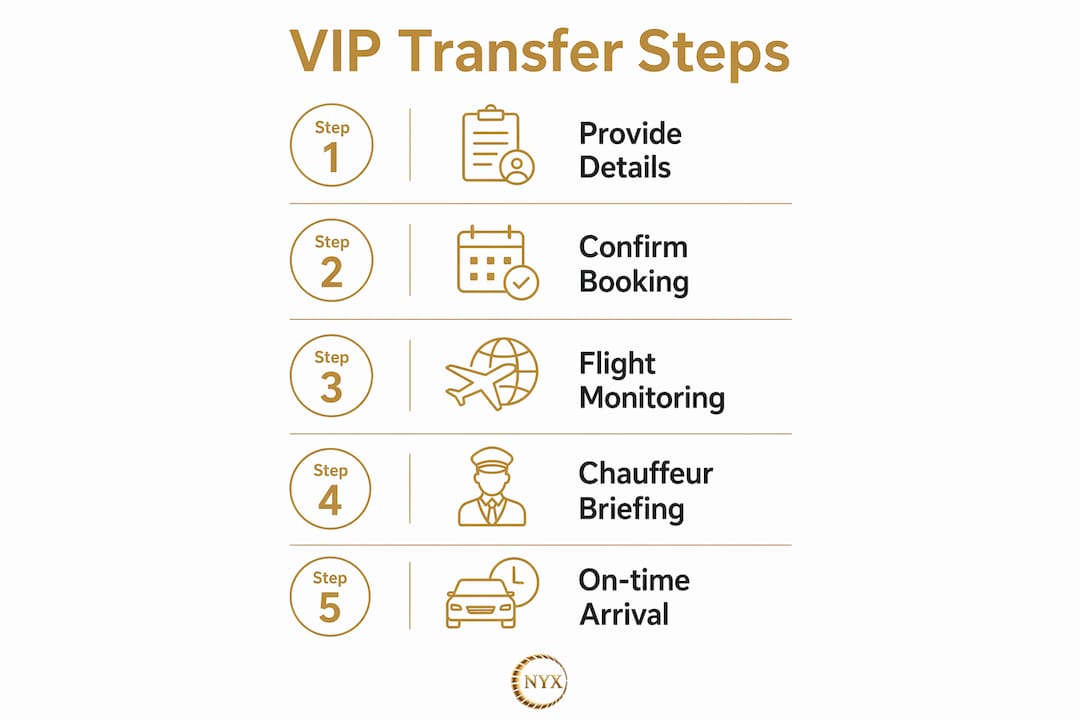
A structured booking workflow prevents the fragmented communications that cause delays and misunderstandings. The process has a clear sequence, and skipping steps creates compounding problems.
- Submit a comprehensive brief. Provide the operator with all traveller details in a single message or call. Include pickup and drop-off addresses with private access points where relevant, such as a hotel service entrance or a yacht marina gate.
- Define the service pattern. Specify whether you need a one-way transfer, a return journey with standby, a multi-stop itinerary, or hourly hire. Each pattern is priced and managed differently.
- Request written confirmation of all operational details. This means the chauffeur’s name, the vehicle category (Standard Sedan, Business Sedan, Van 7 pax, or Van 8 pax), the confirmed pickup time, and the agreed itinerary.
- Clarify waiting time and fee structures. Transponyx includes 60 minutes of free waiting time on all airport pickups and 20 minutes for any other address. Understand what applies before you confirm.
- Establish a single communication channel. One clear communication channel reduces coordination errors and eliminates the confusion that arises when multiple people contact the operator independently.
- Designate an authorised contact for amendments. Identify one person who can approve itinerary changes after hours. This is particularly critical during multi-day event programmes where schedules shift without notice.
- Confirm contingency protocols. Ask the operator directly: what happens if the flight diverts, if a guest is delayed at customs, or if a meeting overruns? A professional operator has a defined answer.
Pro Tip: Always request confirmation in writing, even if the initial booking is made by phone. A written record protects both parties and gives the chauffeur a precise reference document on the day.
The table below summarises the key details to confirm before any VIP transfer is finalised.
| Detail to confirm | Why it matters |
|---|---|
| Chauffeur name and contact number | Allows direct communication on arrival day |
| Vehicle category and registration | Confirms capacity and helps guests identify the vehicle |
| Pickup time and buffer allowance | Prevents confusion between scheduled and actual departure |
| Waiting time policy | Clarifies cost exposure if the guest is delayed |
| Flight monitoring inclusion | Confirms the operator adjusts automatically to delays |
| Fixed rate confirmation | Eliminates surprise charges after the journey |
How does real-time coordination ensure a flawless VIP arrival?
The visible part of a VIP transfer is the chauffeur holding a name board at arrivals. The invisible part is what separates a professional operator from a basic booking service.
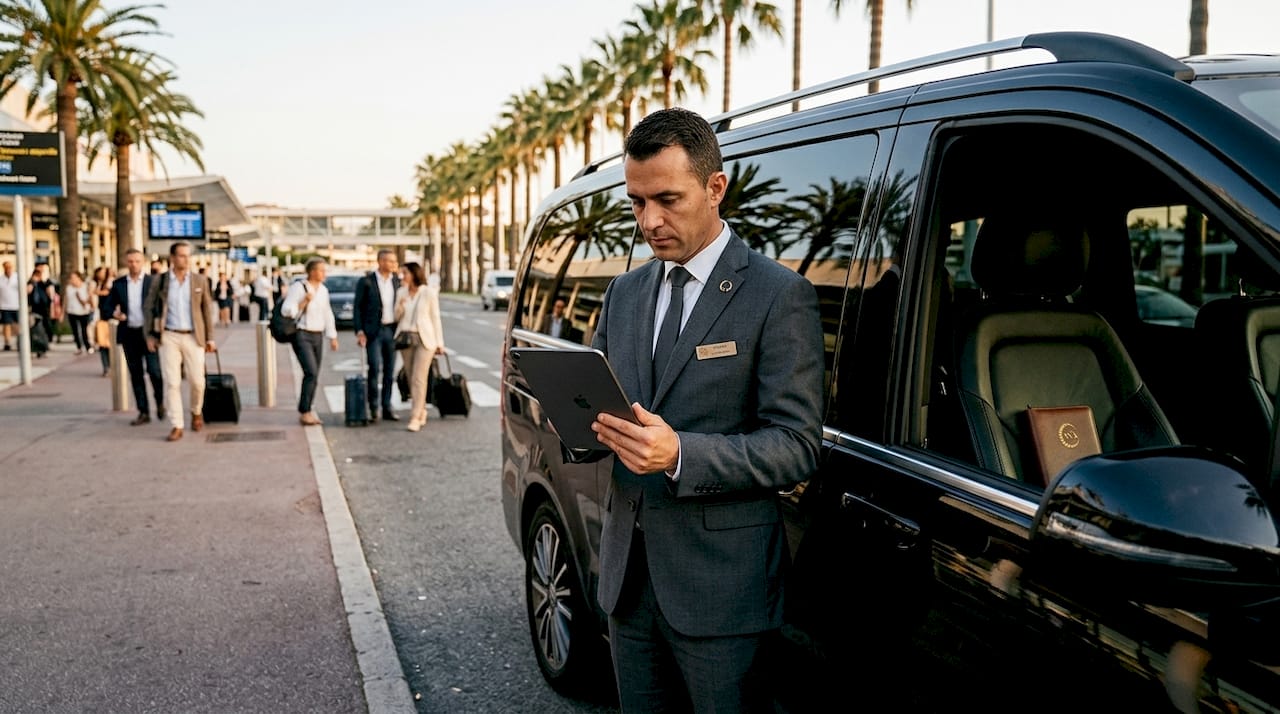
Flight tracking is the foundation of reliable airport transfers. Transponyx monitors every inbound flight on airport pickups, adjusting the chauffeur’s dispatch time automatically when a flight lands early or late. This means guests arriving at Nice NCE from London, Paris, or Milan are met without delay regardless of schedule changes. Integrated flight tracking eliminates tarmac dwell time and prevents the frustrating scenario of a guest waiting alone at arrivals.
For private aviation, the coordination requirement is more demanding. FBO coordination 24 hours in advance minimises tarmac dwell time and prevents security friction. Private jet arrivals at Nice NCE’s FBO facilities follow different access procedures from commercial terminals. The chauffeur must be cleared, positioned, and briefed before the aircraft doors open.
Buffer management with hard and soft deadlines allows real-time route adjustments without disrupting the traveller. A hard deadline is a fixed departure time, such as a Monaco Grand Prix hospitality event with a defined start. A soft deadline allows flexibility, such as a hotel check-in with no strict window. Treating every transfer as a hard deadline wastes resources and creates unnecessary pressure. Distinguishing between the two allows the operator to absorb minor delays without escalation.
“Operational silence is the hallmark of a well-run VIP transfer programme. When the event organiser receives no calls from the transport team, the logistics are working exactly as designed.”
Driver briefing protocols matter as much as route planning. A well-briefed chauffeur knows the client’s preferred greeting style, whether to initiate conversation or maintain discretion, the confirmed route, and any security considerations. On the French Riviera, where reliable luxury transport is expected as standard by high-profile guests, these details define the quality of the experience.
What are the most common mistakes when organising luxury transfers?
Errors in VIP transfer planning cluster around the same recurring failures. Recognising them in advance is the most direct way to avoid them.
- Booking without confirmed traveller details. Arranging a vehicle before knowing the passenger count, luggage volume, or arrival time produces a transfer that fits no one’s actual needs.
- Mismatching vehicle type to group size. A Business Sedan booked for four passengers creates an immediate problem at pickup. A Van 7 pax booked for two passengers wastes budget. Vehicle selection must follow a confirmed headcount.
- Ignoring private aviation access requirements. Commercial terminal pickups and FBO pickups are operationally distinct. Sending a chauffeur to the wrong zone at Nice NCE causes delays that compound quickly, particularly when the client has a connecting commitment in Monaco or Cannes.
- Failing to coordinate with security teams. For high-profile guests, the protection team’s requirements affect vehicle positioning, route selection, and timing. These details must be integrated into the brief from the outset, not added as an afterthought.
- Mediating every minor change personally. Avoiding micromanagement of every amendment and establishing a clear delegation protocol produces smoother execution. When an executive assistant tries to relay every small change personally, response times slow and errors multiply.
- Underestimating buffer time during peak periods. The A8 motorway between Nice and Cannes during the Cannes Film Festival or Cannes Lions can add 40 minutes to a journey that normally takes 25 minutes. Transfers planned without traffic buffers fail predictably.
- Neglecting to confirm the meeting point protocol. A chauffeur waiting at the wrong exit of Nice NCE arrivals hall, or holding a name board with an incorrect spelling, creates an avoidable first impression. Confirm the exact meeting point, signage format, and chauffeur contact number before the day.
Reputable operators demonstrate a 99.8% on-time execution rate for complex VIP ground transport programmes. That figure is achieved through systematic planning, not luck.
How do group and event transfers differ from standard VIP arrangements?
Group transfers introduce a layer of logistical complexity that individual bookings do not carry. The core challenge is coordinating multiple passengers with varying schedules, luggage volumes, and drop-off points, while maintaining the quality standard expected of a VIP service.
The financial case for group booking is clear. Booking group transport for 10 or more passengers saves approximately 20% compared to individual rideshares or taxis, while reducing coordination delays. That saving is meaningful across a multi-day event programme such as MIPCOM in Cannes or a corporate incentive trip across the Riviera.
Vehicle mix is the first operational decision. A group of 14 arriving at Nice NCE might require two Van 8 pax vehicles, or one Van 8 pax and two Business Sedans for senior delegates who require separation from the wider group. The right mix depends on the group’s internal hierarchy, luggage volume, and whether the event transport programme requires simultaneous or staggered departures.
Pro Tip: For groups of six or more, prepare a passenger manifest before the transfer day. Include each person’s name, flight number, and mobile number. Share it with the operator 24 hours in advance. This single document allows the chauffeur team to manage arrivals independently without requiring constant contact from the organiser.
Pre-arrival manifest management also covers luggage handling. Large groups travelling with ski equipment for Auron or Valberg, or with exhibition materials for MIPIM, require advance notice so the operator can confirm boot capacity and, if necessary, arrange a separate luggage vehicle.
On-site coordination during festivals like Cannes Lions or the Monaco Grand Prix requires a dedicated transport manager or a designated tour leader within the group. This person holds the operator’s direct contact, approves schedule changes, and communicates updates to the chauffeur team. Without this single point of contact, group transfers fragment into individual requests that overwhelm the operator and delay departures.
The table below illustrates how vehicle selection aligns with group size for Riviera event transfers.
| Group size | Recommended vehicle mix | Notes |
|---|---|---|
| 1–3 passengers | Standard Sedan or Business Sedan | Ideal for executive arrivals at Nice NCE |
| 4–7 passengers | Van 7 pax | Single vehicle, efficient for hotel transfers |
| 8 passengers | Van 8 pax | Maximum single-vehicle capacity |
| 9–16 passengers | Two Van 8 pax vehicles | Allows simultaneous arrival and departure |
| Mixed delegation | Business Sedan plus Van 7 pax | Separates senior delegates from wider group |
What I have learned from arranging VIP transfers on the French Riviera
Client expectations in 2026 have shifted in one clear direction: guests want complete operational transparency before the day, and complete operational silence on the day itself. They want to know the chauffeur’s name, the vehicle registration, and the confirmed pickup time in advance. Then they want to hear nothing until the car arrives.
What surprises many first-time organisers is how much the Riviera’s event calendar compresses the available window for quality operators. During the Monaco Grand Prix in may, or the Cannes Film Festival in the same month, the gap between a well-planned transfer and a last-minute booking is not just a matter of price. It is a matter of whether a suitable vehicle exists at all. I have seen corporate travel managers attempt to book Business Sedans for executive arrivals at Nice NCE two days before the Grand Prix, only to find the entire category committed weeks earlier.
The other misunderstanding I encounter regularly is the assumption that all licensed VTC operators on the Riviera offer equivalent service. They do not. The difference lies in the operational infrastructure behind the booking: flight monitoring, FBO coordination, driver briefing protocols, and the ability to absorb schedule changes without escalating to the client. These are not visible at the point of booking. They become visible at 23:00 when a flight from London diverts to Marseille and the client needs a solution within the hour.
Transponyx operates 24 hours a day, 7 days a week, with bilingual chauffeurs and fixed 2026 rates across all routes from Nice NCE to Monaco, Cannes, Antibes, Menton, and Saint-Tropez. That operational depth is what makes the difference between a transfer that works and one that requires managing. For anyone planning VIP transport around a major Riviera event, the planning conversation should start weeks before the event, not days.
— Dany
Transponyx: VIP chauffeur services for the French Riviera in 2026
Transponyx provides licensed VTC chauffeur services across the French Riviera, operating from Nice Côte d’Azur Airport (NCE) to Monaco, Cannes, Antibes, Menton, Saint-Tropez, and the Alpine ski resorts of Isola 2000, Auron, and Valberg. All 2026 rates are fixed per vehicle and confirmed at booking, with no surge pricing and no hidden charges.
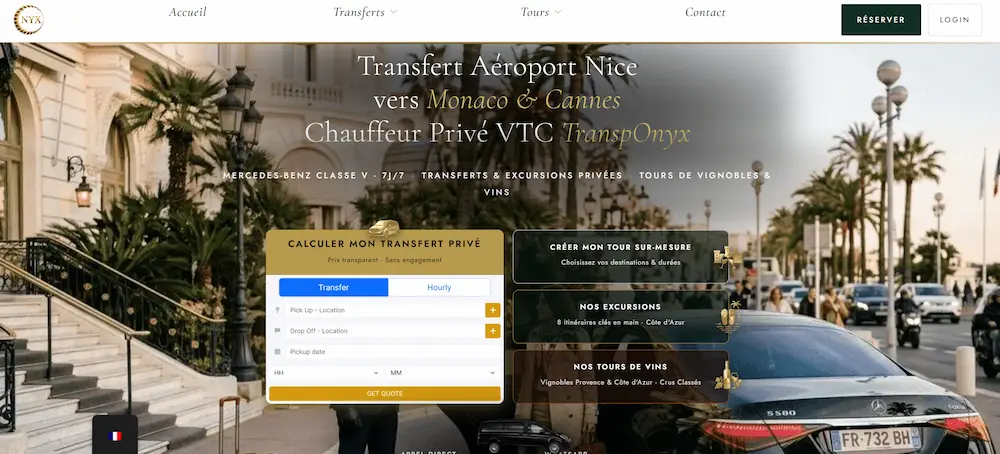
The fleet covers every group size: Standard Sedan, Business Sedan, Van 7 pax, and Van 8 pax. All vehicles are Mercedes-Benz, equipped with Wi-Fi, air conditioning, chilled water, and phone chargers. Flight monitoring is included on every airport pickup, with 60 minutes of free waiting time. For a full comparison of luxury chauffeur options on the Riviera, or to book directly, contact Transponyx at +33 6 10 30 71 84 or visit https://transponyx.com.
FAQ
What is a VIP transfer?
A VIP transfer is a pre-booked, chauffeur-driven ground transport service tailored to the specific requirements of the traveller, including vehicle type, pickup location, waiting time, and personalised service protocols.
How far in advance should I book a VIP airport transfer?
Book at least 1 to 3 days in advance for standard periods, and several weeks ahead during major events such as the Cannes Film Festival or Monaco Grand Prix, when premium vehicle availability is severely limited.
What information do I need to arrange a private transfer?
You need the passenger count, flight number or confirmed arrival time, pickup and drop-off addresses, luggage details, and any special requests such as child seats or language preferences. Providing this in a single brief produces the most accurate quote and confirmation.
How does flight monitoring work on VIP airport transfers?
The operator tracks the inbound flight in real time and adjusts the chauffeur’s dispatch time automatically. Transponyx includes flight monitoring on every airport pickup, ensuring the chauffeur is present regardless of early or late arrivals at Nice NCE.
Is group booking more cost-effective than individual VIP transfers?
Group transport for 10 or more passengers saves approximately 20% compared to individual rideshares or taxis, while reducing coordination complexity across multi-stop or multi-day event programmes.
0 commentaires