
Corporate travel recommendations are strategic guidelines that improve efficiency, safety, and cost-effectiveness for professionals travelling on company time. The difference between a productive trip and a costly one often comes down to planning discipline, policy compliance, and the quality of ground transport at your destination. On the French Riviera, where events such as the Cannes Film Festival, Monaco Grand Prix, and Cannes Lions compress demand into short windows, those decisions carry real financial and reputational weight. This guide delivers the most current business travel tips for 2026, grounded in industry standards and regional expertise.
1. What are the best business travel recommendations for planning and booking?
Book flights 21–30 days in advance to secure the best corporate fares. Early booking reduces costs by 20–30% and improves itinerary reliability, which matters when your schedule is built around client meetings or conference keynotes.
Planning windows vary by trip complexity. Domestic trips with simple itineraries require one to two weeks of lead time. Long-haul international trips need four to eight weeks. Visa-dependent travel demands six to twelve weeks of preparation. Compressing these windows creates avoidable risk.
Corporate travel policy compliance should be treated as a baseline, not a target. Any exception requires documented executive approval. AI-powered booking platforms now enforce policy rules in real time, pushing compliance rates above 95% and flagging out-of-policy selections before purchase. That automation removes the burden from individual travellers and keeps finance teams in control.
Centralised booking systems deliver a second benefit beyond cost. They create a single record of every itinerary, which is the foundation of any credible duty of care programme. When an incident occurs, your travel manager needs to locate affected colleagues within minutes, not hours.
- Book flights 21–30 days ahead for optimal fares
- Allow 4–8 weeks for international trips, 6–12 weeks for visa-dependent travel
- Use AI booking platforms to enforce policy compliance automatically
- Route all bookings through a centralised system for duty of care visibility
- Require executive sign-off for any out-of-policy exception
Pro Tip: Set calendar reminders for your booking windows at the start of each quarter. Treating the booking deadline as a hard project milestone prevents last-minute fare spikes.
2. How can travellers maintain wellness and productivity on the road?
Travel-related burnout costs companies around £2,500 per affected employee. That figure covers lost productivity, increased sick leave, and the downstream effect on client relationships. Wellness is not a soft benefit; it is a measurable cost line.
Jet lag management starts before departure. Shifting sleep patterns two days before a long-haul flight reduces the adjustment period significantly. Hydration during the flight matters more than most travellers acknowledge. Cabin air at cruising altitude has humidity levels below 20%, which accelerates fatigue and impairs concentration.
Mental health applications such as Calm or Headspace provide structured breathing and sleep exercises that translate well to hotel rooms and airport lounges. Scheduling at least one buffer day between arrival and your first major meeting gives your body time to recalibrate. Extended trips benefit from a weekly scheduled rest period built into the travel itinerary for business.
Ergonomic hotel room upgrades, specifically a firm mattress and a proper desk chair, make a measurable difference on trips longer than three nights. Meal choices matter too. Protein-heavy breakfasts sustain energy through morning sessions better than pastry-led continental options. Regular communication with your home team, structured rather than reactive, prevents the cognitive overload that compounds travel fatigue.
- Shift sleep patterns two days before long-haul departures
- Hydrate consistently during flights; avoid alcohol on overnight routes
- Use a mental health app for structured wind-down routines in hotel rooms
- Build one buffer day into every international itinerary
- Choose ergonomic room upgrades on trips exceeding three nights
Pro Tip: Request a quiet room away from the lift and ice machine when you check in. Poor sleep quality is the single biggest driver of next-day performance loss on business trips.
3. What are best practices for ground transport on the French Riviera?
Pre-booked ground transportation aligned to travel policy improves time management and expense visibility. Ad-hoc transport at unfamiliar destinations increases logistical risk substantially. On the French Riviera, where road congestion during major events can be severe, that risk is amplified.
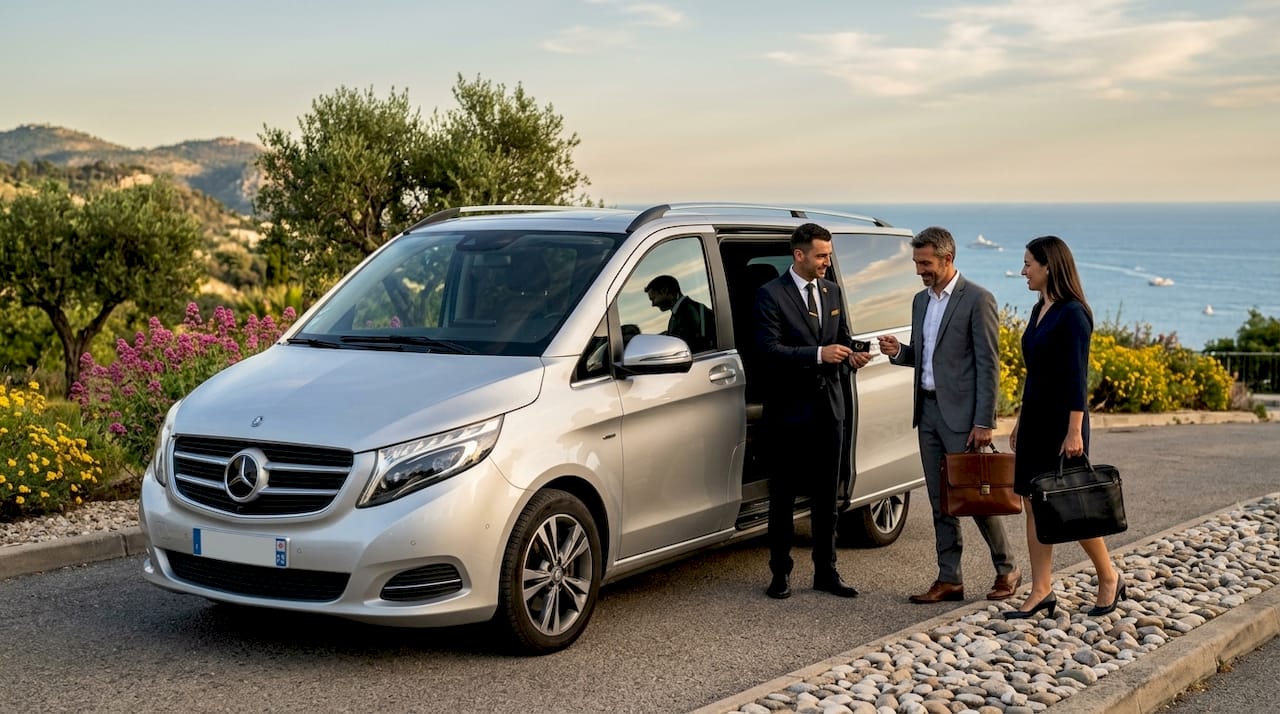
The standard fleet categories for luxury corporate ground transport are the Standard Sedan (up to 3 passengers), Business Sedan (up to 3 passengers, premium finish), Van 7 pax (up to 7 passengers), and Van 8 pax (up to 8 passengers). Each category serves a different delegation size and budget tier. Choosing the right vehicle at the booking stage prevents last-minute upgrades that fall outside policy.
Journey times between key Riviera destinations vary considerably depending on traffic and season. The table below reflects typical durations from Nice Côte d’Azur Airport (NCE) under normal conditions.
| Route | Typical journey time | Notes |
|---|---|---|
| Nice NCE to Monaco | 30–45 minutes | Longer during Monaco Grand Prix |
| Nice NCE to Cannes | 30–40 minutes | Peak demand during Cannes Lions, MIPIM, MIPCOM |
| Nice NCE to Antibes | 20–30 minutes | Consistent year-round |
| Nice NCE to Menton | 45–60 minutes | Border proximity adds variable time |
| Nice NCE to Saint-Tropez | 90–120 minutes | Road-only; no motorway direct route |
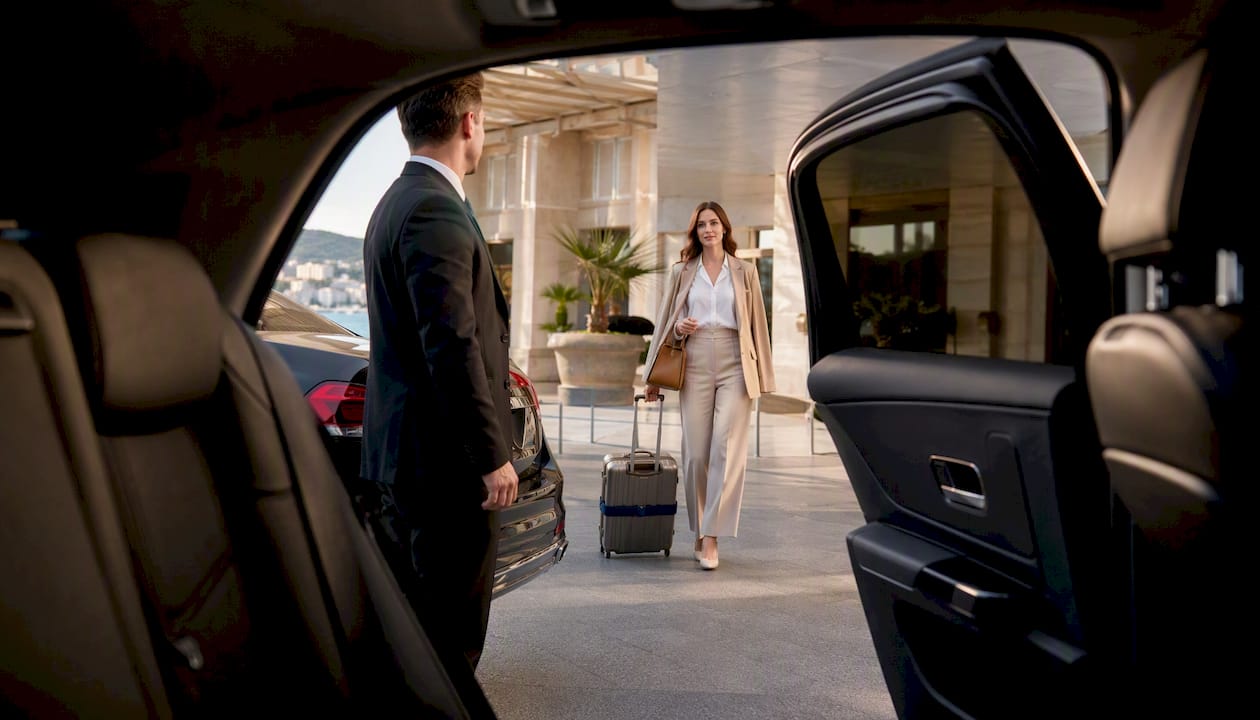
Private chauffeur services remove the productivity dead time that public or ad-hoc transport creates. A licensed VTC driver handles navigation, parking, and waiting, which frees the traveller to review briefing documents, take calls, or decompress between meetings. That is a material advantage when your schedule runs from an 08:00 airport arrival to a 19:00 dinner in Monaco.
Transponyx operates 24 hours a day, 7 days a week across the French Riviera, with fixed 2026 rates confirmed at booking and no surge pricing. Flight monitoring is included on every airport transfer, and drivers allow 60 minutes of free waiting time on all airport pickups. The fleet consists exclusively of Mercedes-Benz vehicles, all equipped with Wi-Fi, air conditioning, chilled water, and phone chargers.
- Pre-book ground transport at the same time as flights, not on arrival
- Match vehicle category to delegation size: Standard Sedan, Business Sedan, Van 7 pax, or Van 8 pax
- Confirm fixed rates in writing before travel to avoid expense disputes
- Account for event-driven congestion when setting departure times
- Use a provider with flight monitoring to absorb arrival delays automatically
Pro Tip: For Cannes Lions or MIPCOM, book your chauffeur in Cannes at least four weeks ahead. Vehicle availability tightens sharply as the event date approaches, and fixed-rate providers fill their calendars faster than surge-priced alternatives.
4. How do corporate travel policies and technology integrate to improve business trips?
AI-powered booking platforms now enforce travel policy in real time, blocking out-of-policy selections before purchase rather than flagging them after the fact. That shift from reactive to preventive compliance is the defining change in corporate travel management in 2026. Finance teams report fewer policy breach investigations and faster month-end reconciliation as a direct result.
Duty of care obligations require more than a contact list. Real-time traveller tracking combining passenger name records (PNR), GPS check-ins, and live flight data allows travel managers to locate any traveller within 30 minutes. That 30-minute response window is the industry standard for incident escalation. SMS remains the primary communication channel for emergency alerts, given its delivery reliability across international networks.
Cybersecurity is a practical concern, not a theoretical one. Business travellers using public Wi-Fi in airports and hotels expose corporate credentials to interception. A VPN is the minimum standard. Sensitive documents should be accessed through corporate cloud systems with multifactor authentication, not downloaded to local devices before travel.
Expense reporting carries its own compliance requirements. Submitting digital expense reports with scanned receipts within five business days of returning is the industry-standard practice. Missing that window creates audit flags and delays reimbursement. Centralised booking platforms that auto-populate expense fields from booking data reduce the manual burden and the error rate simultaneously.
- Adopt an AI booking platform that enforces policy at the point of purchase
- Integrate PNR, GPS, and flight data into a single traveller tracking dashboard
- Mandate VPN use on all devices during travel
- Set a five-business-day expense submission deadline as a non-negotiable policy rule
- Use centralised booking data to auto-populate expense reports and reduce manual entry
Centralised booking is the primary lever for balancing cost control, compliance, and traveller safety. Organisations that fragment booking across multiple channels lose visibility, increase policy breach rates, and complicate duty of care responses.
5. What sustainable and hybrid travel trends should business travellers consider in 2026?
Business and leisure hybrid trips, known in the industry as bleisure travel, have increased by 47% in 2026. Companies are responding with formal bleisure policies that define allowable extensions, expense boundaries, and insurance coverage for the personal portion of a trip. Travellers who extend a Cannes conference trip into a weekend on the Côte d’Azur represent the norm, not the exception.
Corporate sustainability programmes now target a 30% reduction in emissions from 2019 levels by the end of 2026. That target is driving adoption of carbon tracking tools integrated into booking platforms, which assign a carbon cost to each itinerary alongside the financial cost. Travellers and managers can then make informed trade-offs between flight options, rail alternatives, and virtual meeting formats.
Eco-certified hotels are gaining ground in corporate travel programmes. Properties with ISO 14001 certification or Green Key accreditation meet independently verified environmental standards. Specifying eco-certified accommodation in your travel policy signals commitment without requiring travellers to research options individually.
Rail versus short-haul flight is a live debate on the French Riviera. The TGV from Paris to Nice takes approximately five and a half hours, with a lower carbon footprint than a direct flight and no airport processing time at the Paris end. For trips originating within France, rail is the more productive and lower-emission option for many routes.
Digital-first meetings reduce non-essential travel without sacrificing relationship quality when used selectively. The key word is selectively. Relationship-building meetings, contract signings, and site visits still benefit from physical presence. Routine status updates and internal reviews do not.
- Establish a formal bleisure policy covering expense limits and insurance for personal extensions
- Integrate carbon tracking into your booking platform to make emissions visible at the point of purchase
- Specify eco-certified accommodation in your corporate travel policy
- Default to rail over short-haul flights where journey times are comparable
- Reserve in-person travel for meetings where physical presence adds measurable value
What I have learned about business travel on the French Riviera
The most common mistake I see from business professionals arriving on the French Riviera is treating ground transport as an afterthought. Flights get booked weeks in advance. Hotels get compared and confirmed. Then, on the morning of arrival, someone is scrambling for a taxi outside Nice NCE while their first meeting starts in Monaco in 45 minutes.
That is not a minor inconvenience. During the Monaco Grand Prix or Cannes Film Festival, ad-hoc transport from the airport can take 90 minutes to arrange and cost three times the equivalent pre-booked rate. The stress that arrives with it does not disappear by the time you walk into a client meeting.
The wellness recommendations in this guide are not aspirational. They are operational. I have watched colleagues arrive at MIPIM in Cannes after red-eye flights, skip the buffer day, and deliver presentations at 60% of their usual standard. The cost of that underperformance is invisible on an expense report but very visible to the client across the table.
The integration of travel policy and technology is where most organisations still have work to do. Knowing where your travellers are within 30 minutes of an incident is not a luxury feature. It is a legal and ethical obligation in most jurisdictions. If your booking system cannot answer that question, it is not fit for purpose in 2026.
Private chauffeur services on the French Riviera, particularly for airport transfers and inter-city journeys during major events, are one of the few travel expenses that pay for themselves in recovered time and reduced stress. The fixed rate, the flight monitoring, the Wi-Fi in the vehicle: these are not extras. They are the conditions that allow a business traveller to arrive at a meeting ready to perform.
— Dany
Transponyx: premium ground transport for business travellers on the Riviera
Business professionals arriving at Nice Côte d’Azur Airport need ground transport that matches the standard of the meetings they are travelling to attend.
Transponyx provides luxury airport transfers and private chauffeur services across the French Riviera, with 2026 fixed rates confirmed at booking and no surge pricing. The fleet covers every delegation size: Standard Sedan, Business Sedan, Van 7 pax, and Van 8 pax, all Mercedes-Benz vehicles with Wi-Fi, air conditioning, chilled water, and phone chargers. Routes cover Nice NCE to Monaco, Cannes, Antibes, Menton, Saint-Tropez, and long-distance transfers to Italy and Provence. For groups, the private driver French Riviera service handles multi-stop itineraries with the same fixed-rate transparency. Contact Transponyx at +33 6 10 30 71 84 or visit https://transponyx.com to confirm your booking.
FAQ
What is the ideal booking window for business travel?
Book flights 21–30 days in advance for optimal corporate fares. International trips with visa requirements need six to twelve weeks of lead time.
How much does travel-related burnout cost companies?
Travel burnout costs approximately £2,500 per affected employee in lost productivity and absence. Structured wellness practices and buffer days in the itinerary reduce that cost materially.
Why should ground transport be pre-booked for business trips?
Pre-booking ground transport aligned to travel policy improves punctuality and expense visibility. Ad-hoc transport at high-demand destinations such as Nice or Cannes during major events carries significant logistical and financial risk.
What is bleisure travel and how should companies manage it?
Bleisure travel combines a business trip with a personal leisure extension. It has increased by 47% in 2026, and companies should address it with a formal policy covering expense boundaries, insurance, and approved extension durations.
How quickly must expense reports be submitted after a business trip?
Industry standard practice requires submitting digital expense reports with scanned receipts within five business days of returning. Missing that window creates audit flags and delays reimbursement.

0 commentaires