
The most reliable way to move a dog or cat from Nice Côte d’Azur Airport (NCE) to Monaco, Cannes, Antibes or Menton is a private transfer that you book in advance and arrange around the animal. In France a driver is entitled to turn away a passenger with a pet, so a street taxi is a gamble at the arrivals kerb. With TranspOnyx, a Mercedes-Benz chauffeur service based in Nice, the vehicle, the route and the fixed 2026 rate are agreed before you fly, which leaves you free to look after your animal instead of negotiating. This guide covers what French rules say, how to restrain a pet safely, what the Italian border requires, and what to settle before you book.
What French rules say about pets in a chauffeur car
There is no national right to travel with a pet in a taxi or chauffeur-driven car in France. The European Consumer Centre’s guidance on taxis and chauffeur-driven cars states that drivers may refuse passengers accompanied by an animal, with one exception: guide dogs must be accepted.
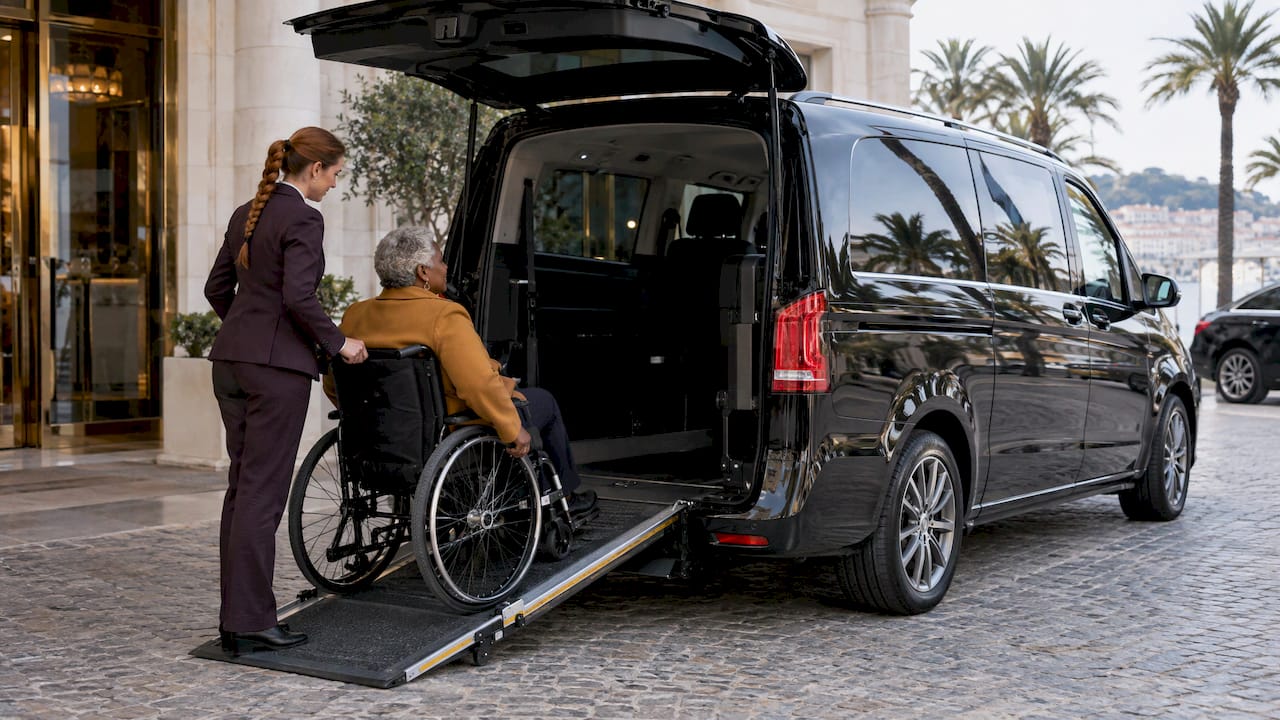
That exception is worth knowing in detail. A ministry leaflet republished by the city of Nice explains that guide and assistance dogs accompanying eligible disabled people or their trainers may use transport without a muzzle and without an extra charge. If you travel with an assistance dog, you are in a different position from the owner of a pet, and you should still tell the company at booking so the seating is planned properly.
For everyone else, acceptance is at the discretion of the operator, and it varies by company, by vehicle and often by the size of the animal. That is why the sensible order of events is to ask first and book second. A pet that is welcome in writing before arrival is a pet that will not be left on the pavement at 23:40 after a delayed flight.
The practical conclusion is simple. If an animal is part of your journey, treat it as a booking detail, like luggage or a child seat, and not as a surprise for the driver.
Why a pre-booked transfer works better than a street taxi
A rank taxi at an airport serves whoever is next in the queue. The driver has no idea what is waiting in the terminal, how large your dog is, or whether a cat in a carrier is in play. A refusal costs you twenty minutes and a second walk to the rank, with a stressed animal in your arms.
A private transfer reverses the order. You declare the animal, the number of people and the luggage, and the company chooses the vehicle. At TranspOnyx the fleet is exclusively Mercedes-Benz, in four categories: Standard Sedan and Business Sedan, each for up to 3 passengers, plus Van 7 pax and Van 8 pax. Every vehicle has air conditioning, chilled water, Wi-Fi and phone chargers, and the rate is fixed per vehicle at the time of booking, with no surge pricing.
Two more details matter to anyone with an animal. Flight monitoring is included on every airport transfer, so a late arrival does not break the arrangement. And free waiting time covers 60 minutes on airport pickups, which absorbs the slow part of arriving with a pet: passport control, baggage reclaim, a quick walk on a lead if the terminal allows it. For any other address, 20 minutes of waiting is included.
Air conditioning deserves a word of its own. On the coast in July and August, a closed car is the single greatest hazard to a dog. A chauffeur car that is already cooled when you step in, with water on board, is a better starting point than a vehicle that has stood in the sun on a rank.
Restraining your pet: carrier, harness and rest stops
A loose animal in a moving cabin is a danger to itself, to you and to the driver. I-CAD, the French national register for pet identification, advises a suitably sized carrier, or a harness fixed with a dedicated seat-belt connector, and states that an animal must not roam free in the passenger compartment.
In practice, the choice depends on the animal.
A cat belongs in a rigid or semi-rigid carrier, placed on the rear seat or the floor behind the front seat and held steady by the seat belt. Cats are more sensitive than dogs to unfamiliar movement, so a blanket carrying a familiar scent helps. Small dogs travel well in a carrier of the same kind, provided they can stand up and turn around inside it.
Medium and large dogs are normally harnessed. A collar is not a restraint: in a sudden stop it loads the neck. Use a harness with a proper connector, and fit it before the journey, not in the car park. If your dog has never worn one, a few short practice sessions in the days before the flight save a great deal of trouble.
On a longer run, such as Nice to Saint-Tropez, I-CAD also recommends regular stops to give water and let a dog out on a lead, with extra care for cats, which should never be released near a road. Dogs prone to motion sickness are best discussed with a vet before travel. Avoid a heavy meal in the hours before the transfer, and keep a towel and a small bowl in your hand luggage.
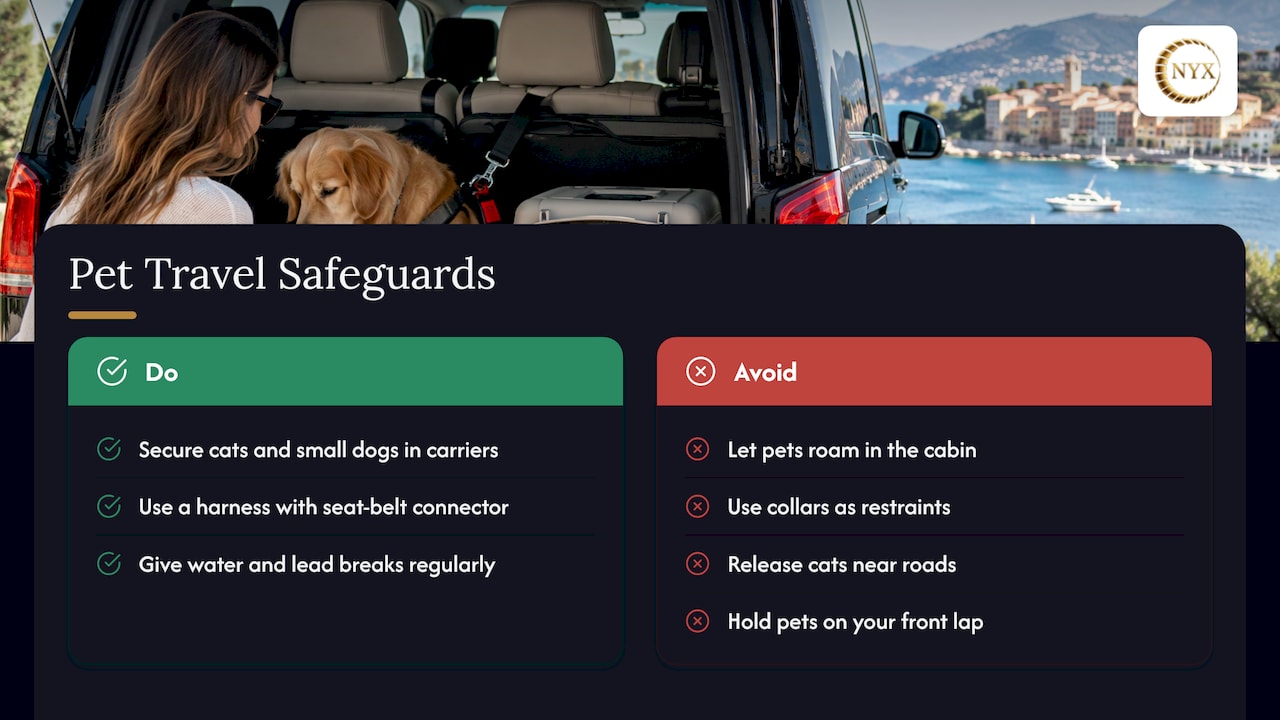
One point on ground rules inside the car: keep the animal off the driver’s side, never let it near the pedals or the gear lever, and do not hold it on your lap in the front. These are common sense, but they are also the reasons a professional driver will ask you how you intend to seat the animal before agreeing to the booking.
Arriving at Nice Côte d’Azur: planning the first hour
NCE is the second busiest airport in France after the Paris airports, and its two terminals can be long walks with a tired animal. The most useful thing you can do is decide in advance where the animal will be when you walk out.
For a dog, a short relief break before you leave the terminal area makes the drive calmer. For a cat, keep the carrier closed until you are inside the car. In both cases, tell your chauffeur which terminal you land at and, if you can, how you will travel through the terminal: carrier on a trolley, harnessed dog beside you, or both.
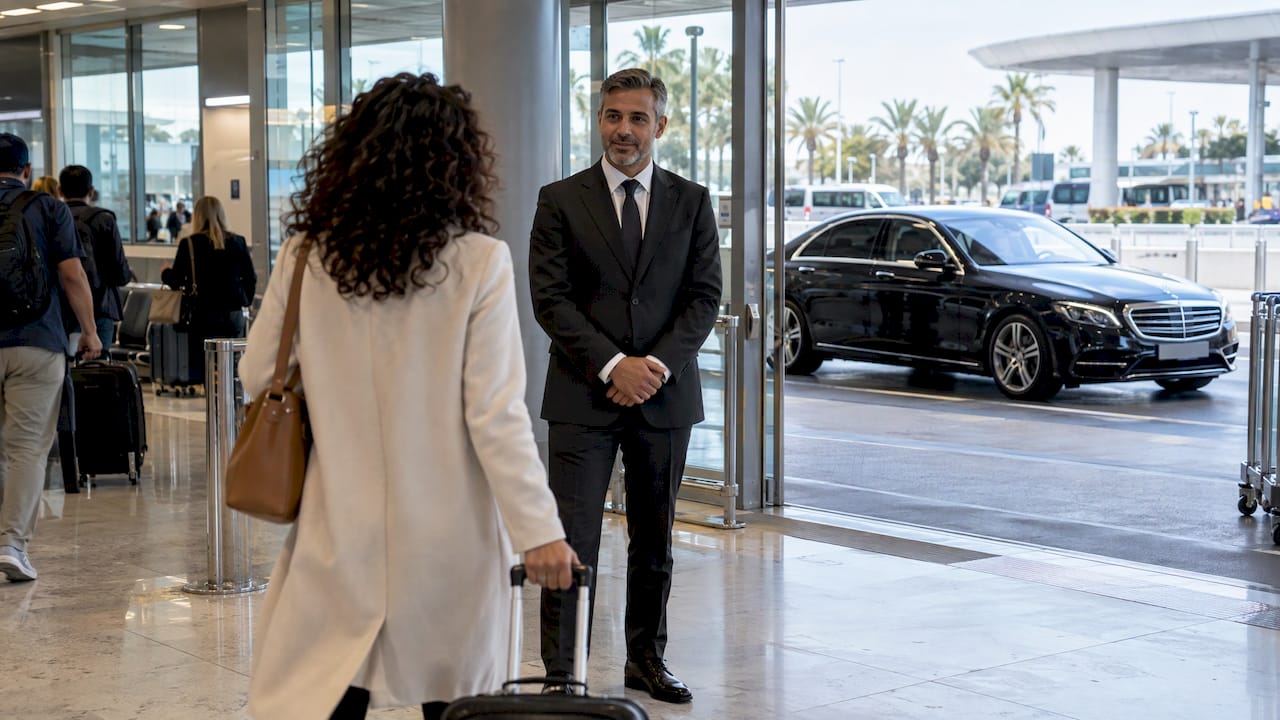
The free 60 minutes of waiting on airport pickups is designed for exactly this kind of arrival, and because flights are monitored, the driver is there when you actually land and not when the timetable said you would. If you want the wider picture on arrival planning, our premium airport transfer tips for the Riviera cover meeting points and luggage in more detail.
When you book, give the chauffeur four facts: species, approximate weight, whether the animal is in a carrier or a harness, and the name of the hotel or villa you are heading to. That takes thirty seconds on the phone and it answers nearly every question a driver would otherwise ask at the kerb.
Journey times and 2026 fixed rates from Nice airport
Distance and time matter more with an animal than with a briefcase. A pet that is comfortable for 30 minutes may be unhappy at 90, and the rest-stop question changes at once. These are the main routes from NCE with our 2026 fixed rates, which are per vehicle and confirmed at booking. The journey times are indicative for normal traffic, and they lengthen sharply on event days.
| Route from Nice airport | Approx. distance | Typical journey time | 2026 fixed rate per vehicle |
|---|---|---|---|
| Antibes, Juan-les-Pins | about 20 km | 25 to 35 minutes | €68 to €110 |
| Monaco, Monte-Carlo | about 30 km | 35 to 45 minutes | €90 to €140 |
| Cannes | about 30 km | 35 to 50 minutes | €90 to €150 |
| Menton, Beausoleil | about 35 km | 45 to 60 minutes | €108 to €158 |
| Isola 2000, Auron, Valberg | mountain roads | 1 hr 30 to 2 hr 15 | €240 to €350 |
| Saint-Tropez, Ramatuelle | about 110 km | 1 hr 45 to 2 hr 30 | €260 to €400 |
The full list of airport routes and rates is on our VTC airport transfer page. For a city-to-city run, a chauffeur from Nice to Cannes is listed at €75 to €110 per trip on the Nice to Cannes chauffeur page.
Because the price is per vehicle and not per passenger, a family with two adults, a child and a labrador pays the same rate as a single traveller in the same car. The only variable is the category you need: a Standard Sedan or Business Sedan seats up to 3, a Van 7 pax or Van 8 pax gives a large dog, luggage and a larger party real space.
The Saint-Tropez run is the one to plan most carefully. On the coast road in summer the time can stretch well beyond the figure above, so a rest stop for the dog is part of the plan, not an interruption to it. Event weeks have a similar effect around Cannes: during the Cannes Film Festival, MIPIM, MIPCOM and Cannes Lions, and on Monaco Grand Prix weekend, roads that take 40 minutes on a quiet Tuesday can take well over an hour. Book earlier, allow more time, and bring more water.
Crossing into Italy with a pet
The Italian border at Menton and Ventimiglia is a short drive from Nice, and day trips to San Remo or longer runs to Milan are routine for travellers on the Riviera. Within the EU, pets move freely as long as the paperwork is in order. The European Commission explains that an EU pet passport records the microchip, the rabies vaccination and the issuing vet, and that an up-to-date rabies vaccination is the key requirement. Any authorised vet can issue the passport for a dog, cat or ferret.
Carry the original passport in your hand luggage, not in the suitcase in the boot. If your animal is microchipped after its vaccination, or the vaccination is recent, speak to your vet well before the trip: the order of microchip and vaccine, and the waiting period after a first rabies vaccination, can decide whether the animal is cleared to travel. I-CAD advises checking the destination’s requirements with a vet or the embassy before any trip abroad, and that is the right order of questions for a visitor who lives outside France.
For a day on the Italian side, our private San Remo excursion with fixed 2026 rates shows how a cross-border day is priced and organised. The same logic applies: tell us about the animal when you book, and agree the plan for stops and for time spent out of the car before the day starts.
Restaurants and beaches on both sides of the border have their own rules about dogs, and those rules change by season and by municipality. A chauffeur can wait with the car, but the animal should not be left inside it on a warm day, so plan stops where the whole party can go in or sit outside together.
Hotels, villas and events
Most luxury hotels on the Riviera accept dogs in some form, many with a daily supplement and a size limit, and villa owners often set their own conditions. This is information you collect before you land, not while you are standing in the lobby. Ask the hotel for the exact entrance a dog is expected to use, because some properties route animals through a side door.
For events, think about the departure as much as the arrival. A dog that has spent the day at a wedding in the hills behind Cannes, or in a villa after a yacht lunch, wants a calm ride home. If you arrive in Antibes or Juan-les-Pins for a party, our guide to private party transfers in Antibes explains how pickup times and venues are coordinated.
Two things protect the animal at any event. First, fix the pickup time with some margin so the animal is not waiting in the heat. Second, keep a nominated person with the animal, ideally someone who is not also responsible for the seating plan.
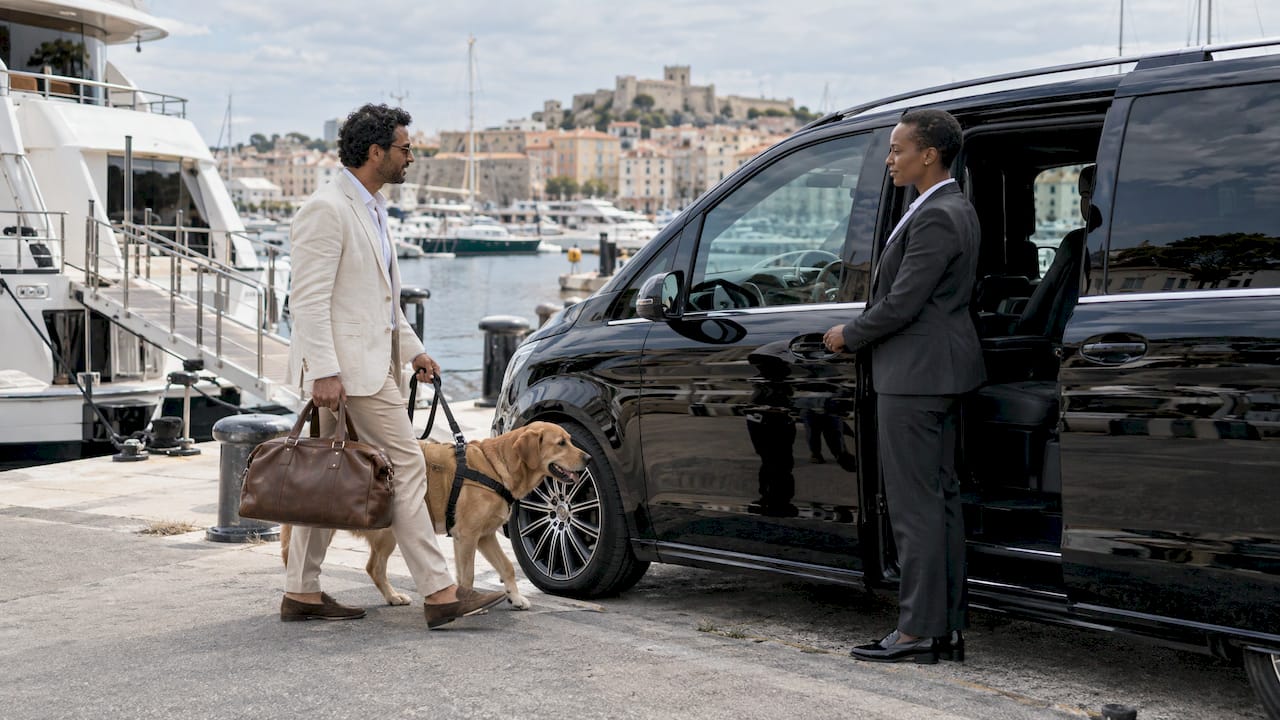
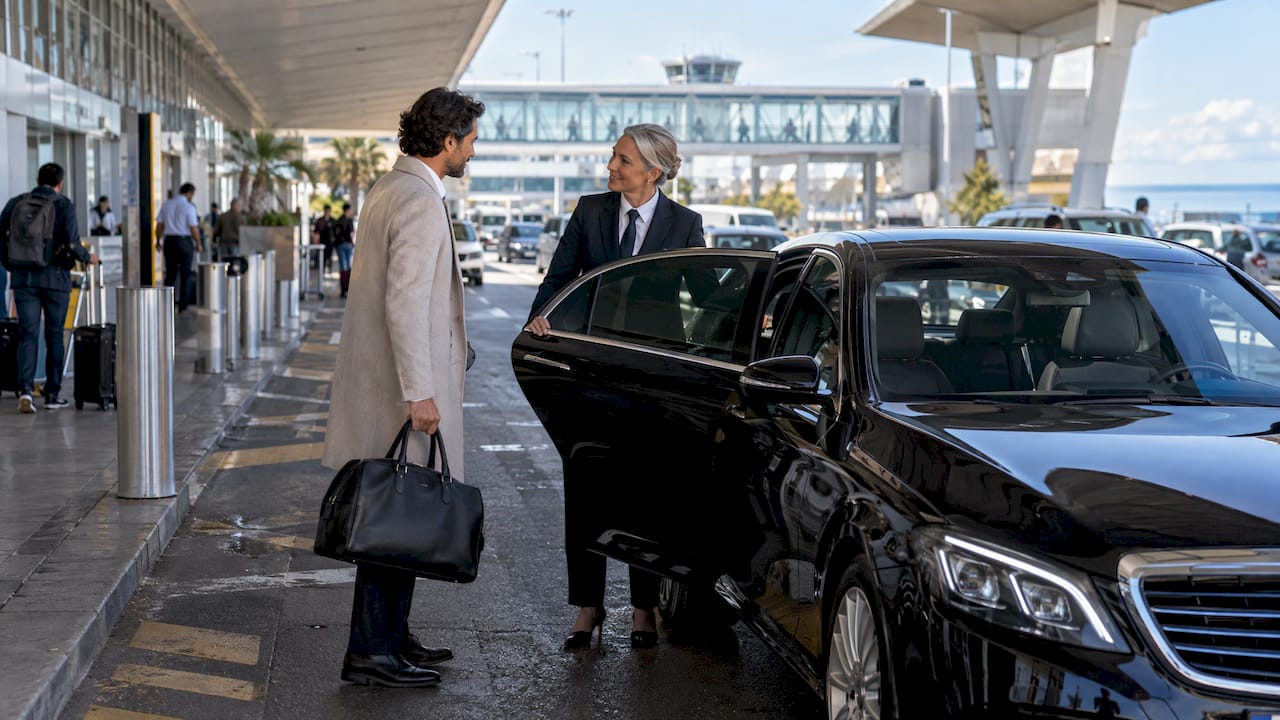
For a yacht transfer, the animal’s position on the quay matters. Gangways and pontoons are slippery, and a harness with a short lead is safer than a carrier carried on one arm with luggage in the other. Brief the chauffeur so the car stops as close to the berth as access allows.
Groups, luggage and more than one animal
A pet changes the arithmetic of a group transfer. A couple with two suitcases fits into a Standard Sedan or Business Sedan. Add a large dog and a travel crate and the same couple may need a Van 7 pax, simply because the crate cannot be balanced on the rear seat with a passenger beside it.
A useful rule is to count the animal as a passenger when choosing the category. A medium dog in a harness takes up a seat position. A crate takes a seat and a half. Two dogs of any size, plus a family, usually point to the Van 7 pax or Van 8 pax, where the rear space is not shared with a person.
With several people and several animals, it often works better to take two vehicles than to cram everyone into one. Because our rates are per vehicle and fixed, the cost of a second car is clear in advance. Multi-vehicle coordination is something we handle for weddings, corporate hospitality and larger arrivals, so a family party and a separate luggage car can leave the airport together.
Finally, think about the order of loading. Luggage goes in first, the animal’s equipment last and within reach: water bowl, towel, spare bags and any medication. Nobody wants to unload a boot at a motorway rest area to find a leash.
Cleaning, extra charges and what to settle first
This is the question that deserves a direct answer before you pay, because policies for animals vary from one operator to another. Some charge a supplement, some ask for a carrier or a seat cover, and some apply a cleaning fee if the vehicle needs attention afterwards. We have no published pet supplement to quote, so ask for the full cost in writing when you enquire, and ask for it in the same message that describes the animal.
Three questions cover it: is there any supplement for the animal, what must the animal travel in, and what is expected of you if the animal is unwell on the road. That last point is easy to forget. A prepared owner has a towel, a spare bag and a water bottle, and the journey recovers in minutes.
If plans change, for instance when a vet advises against travel the day before, it helps to know the cancellation terms. Our guide to private transfer cancellation delays, fees and your rights in 2026 sets them out in plain terms.
At booking, a fixed rate per vehicle with no surge pricing means the figure you are given is the figure you pay for the journey, whether you land at midday or at 02:00. Where an animal-specific condition exists, it should be stated at the same time, not added afterwards.
Our perspective
A pet is a passenger with the same right to a calm, cool and punctual journey as everyone else in the car. We think the best preparation is a booking that treats the animal as part of the plan from the first message, not as a complication at the airport.
Our work is built on details that a nervous animal notices: a cooled cabin, chilled water on board, a driver who has been told in advance what is arriving and has monitored the flight so he is there when you land. The 60 minutes of free waiting on airport pickups give an owner time to walk out of the terminal at the animal’s pace.
The Riviera is a place of short distances and long traffic jams. A journey that is 35 minutes on paper can double during the Cannes Film Festival or Monaco Grand Prix week. Our advice is to pick the vehicle category with room to spare, a Van 7 pax or Van 8 pax when a large dog or a crate is involved, and to tell us everything at booking so we can give you a fixed rate and a clear plan.
Our drivers are licensed VTC professionals, bilingual in English and French as a minimum, so the conversation about your animal does not get lost in translation.
Dany
Arranging your pet transfer with TranspOnyx
TranspOnyx runs airport transfers, point-to-point journeys and by-the-hour hire across the French Riviera and into Italy, 24 hours a day, seven days a week. Rates are fixed per vehicle and confirmed at booking. Use the Nice airport transfer page to see your route and category, then tell us about your animal when you book.
You can reach the reservations team on +33 6 10 30 71 84, by WhatsApp on +33 7 67 78 10 26, or through transponyx.com. Give us your flight number, the number of passengers, the type and size of your animal, and whether it travels in a carrier or a harness. For a longer day out, from a half-day tour to a full day across the coast, hire by the hour is listed at €60 to €90 per hour on our airport and hire page, which suits owners who want stops built into the plan.
Frequently asked questions
Can I take my dog or cat in a private transfer in France?
It depends on the operator, because French rules let a driver refuse an animal, except a guide dog. Ask before you book, describe the animal and agree the arrangements in writing. A confirmed booking removes the risk of a refusal at the kerb.
How should my pet travel in the car?
Cats and small dogs belong in a carrier of the right size, and larger dogs in a harness with a seat-belt connector. I-CAD advises that an animal must never move freely in the cabin. For longer journeys, plan stops for water and a supervised walk on a lead.
Do I need a pet passport to go from Nice to Italy?
Yes, for a dog, cat or ferret you need an EU pet passport with a valid rabies vaccination and identification by microchip. Any authorised vet can issue one. Check the timing of the first vaccination with your vet well before you travel.
Which vehicle should I choose with a large dog?
Count the dog as a passenger. A Standard Sedan or Business Sedan seats up to 3 people, so a large dog with luggage often calls for a Van 7 pax or Van 8 pax. The rate is fixed per vehicle, so the choice is clear before you commit.
Is there an extra charge for a pet?
Operators differ, and some apply a supplement or a cleaning condition. Ask for the full figure in writing when you describe the animal. Our rates are fixed per vehicle and confirmed at booking, with no surge pricing.
0 commentaires