
A wheelchair accessible transfer is settled before you land, not at the kerb. In France, a vehicle that carries a passenger seated in a wheelchair must be specially homologated, fitted with a ramp or lift and with tie-downs, and the details of your chair must be matched to that vehicle in advance. For a journey from Nice Côte d’Azur Airport (NCE) to Monaco, Cannes, Antibes, Menton or Saint-Tropez, that means three things: the right vehicle, the right information given early, and a driver who is waiting when the assistance team hands you over. TranspOnyx works on fixed 2026 rates per vehicle, with 60 minutes of free waiting on airport pickups and flight monitoring on every airport transfer. Call us on +33 6 10 30 71 84 with your requirements and we will talk them through before anything is confirmed.
What “wheelchair accessible” means in France
The phrase is used loosely. A saloon with a boot large enough for a folded manual chair is convenient for some travellers, but it is not what French regulation means by an accessible vehicle. For a passenger who stays in the chair, or who cannot transfer to a car seat without a ramp or lift, the vehicle has to meet a defined standard.
The French Ministry of Ecological Transition sets this out in its 2025 guide to travelling by car with a wheelchair. A vehicle equipped to carry a wheelchair user must comply with the Code de la route and the amended arrêté of 23 August 2013, and it must be homologated and registered as a specialised vehicle with HANDICAP bodywork, shown on the registration certificate. The wheelchair space needs anchor points for a tie-down and occupant-restraint system, including a validated three-point belt. The same guide advises leaving at least 5 cm of clearance above the passenger’s head and inspecting the straps and belt.
The technical detail is stricter still. The arrêté of 29 December 2020, applicable from 1 March 2021, requires a free passage width of 700 mm to the wheelchair space and a boarding device, ramp or lift platform, operable from outside by a third party. Lift platforms must measure at least 730 mm wide and 1,200 mm long, with a lifting capacity of at least 300 kg. Such vehicles must also hold a fit-out certificate before they go into circulation.
You do not need to memorise these figures. What matters is that they explain why a general enquiry such as “do you have something accessible?” never settles the matter. Ramp or lift, headroom, restraint points and the dimensions of your own chair all interact, and the CEREMH technical guide on this type of vehicle makes the same point: the chair must be lashed to the vehicle, and the occupant needs a three- or four-point belt.
The details to give before you book
A good transfer begins with a precise description of the passenger. Whoever arranges the journey will want to know whether the chair is manual or electric, and whether it folds. They will want its length, width and height, and its weight with the user seated in it, because the ramp or lift has a rated capacity and the vehicle floor has a fixed height. Mention anything that projects: anti-tip bars, powered leg rests, a tall headrest or a backrest that raises the overall height. The ministry’s guide recommends matching the chair’s traction and motorisation to the ramp and flooring, so it is worth saying whether the chair is rear-wheel or front-wheel drive and how much ground clearance it has.
Then comes everything that travels with the chair. Count the companions, because every seat in the vehicle is spoken for once the wheelchair space is allocated. List the suitcases, and mention any oxygen equipment, folding walking aids or a second, spare chair. Luggage is the point most often forgotten, and it decides between a larger vehicle and two vehicles. Our guide to baggage assistance for travellers explains how bags are handled between the arrivals hall and the car, which is useful when a companion is also pushing a chair.
Finally, give the practical facts of the journey: flight number and arrival terminal, the exact hotel or villa address, and whether the final approach has steps, a steep drive or a gravel path. A hillside villa above Èze or a hotel on a pedestrianised street in old Antibes can leave a driver unable to stop at the door, and that is better known on Tuesday than on arrival at midnight.
How early should all this be arranged? Treat 48 hours as the floor for the airport side, and allow longer for the ground transfer, particularly in event weeks when specialist vehicles are in demand. The same logic applies abroad too: advance booking of an airport shuttle works best when the passenger’s needs and the arrival time are stated at the outset rather than on the day.
Arriving at Nice Côte d’Azur: assistance and the handover
Airport assistance and your onward transfer are two separate services, and the transition between them is where journeys go wrong.
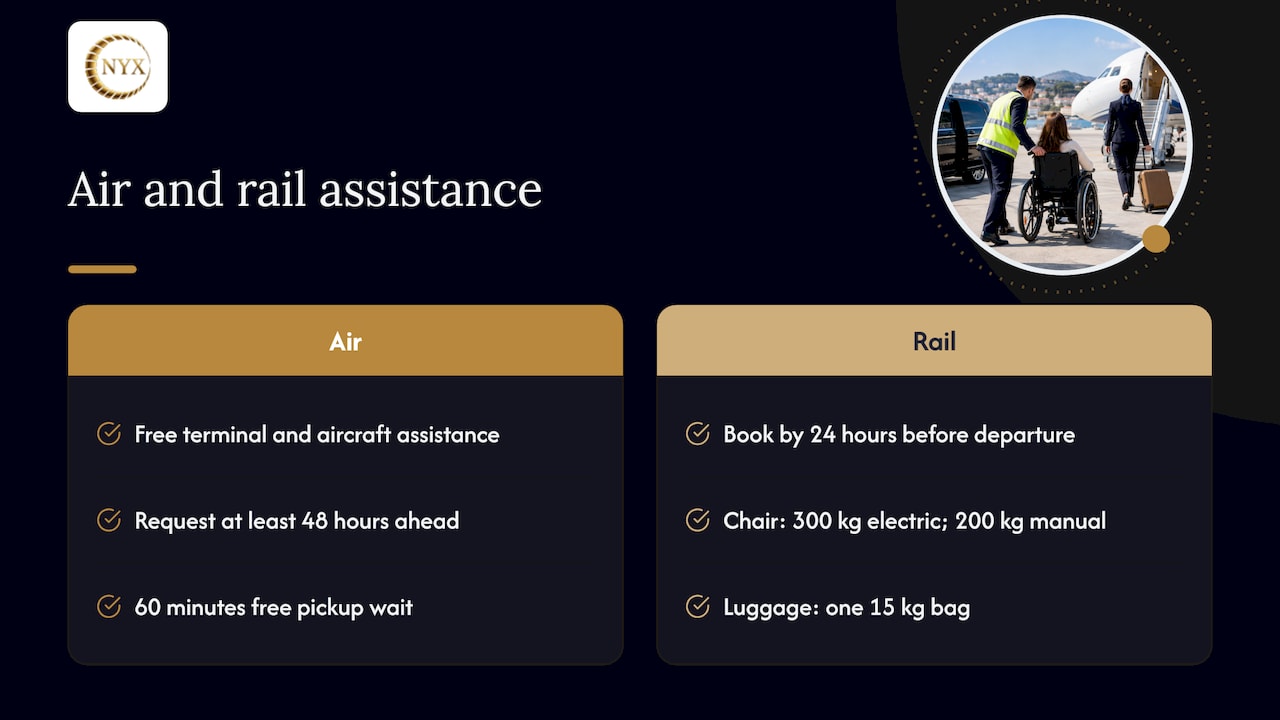
Under European Regulation 1107/2006, airport managing bodies at commercial airports in the EU, Norway, Iceland and Switzerland must provide free assistance to passengers with reduced mobility, in the terminal and when boarding and leaving the aircraft. The French ministry explains that an airline must carry up to two mobility aids per passenger free of charge, provided it receives at least 48 hours’ notice. No medical proof of disability is required to ask for assistance. Responsibility passes from the airport to the airline once the passenger is installed in the aircraft, so the request goes through your airline, travel agent or tour operator, not through your chauffeur.
Nice airport says the same in its own guide for passengers with reduced mobility: tell your airline or travel agent when you book, and at least 48 hours before departure, to benefit from the assistance service. The airport also notes that hidden disabilities are hard to detect, and that its teams aim to establish the passenger’s real needs from the moment of handover, adapt to their pace and avoid long queues and noisy, crowded areas. Say plainly what you need: that is what the system is designed to hear.
Here is where the transfer fits. Assistance gets you from the aircraft door through border control and baggage reclaim to the arrivals area, at a pace that depends on the aircraft, the queue and the time of day. Your driver cannot predict that to the minute, which is why waiting time matters more for a passenger using assistance than for anyone else. Our airport pickups include 60 minutes of free waiting, and flight monitoring on every airport transfer means the pickup follows the actual landing time rather than the timetable. That margin is designed to absorb a slow disembarkation without a surcharge appearing on the bill.
Arriving by rail instead? The national station service, Assist’enGare, has replaced the separate booking centres since 10 January 2024. It should be booked when you buy the ticket and no later than 24 hours before departure. SNCF’s conditions limit a wheelchair to 700 mm wide, 1,200 mm long and 1,450 mm high, with a 1,500 mm turning diameter, and a combined weight of wheelchair and occupant of 300 kg for an electric chair or 200 kg for a manual one. The assistance runs from the assistance point to the seat, and from the seat to the station exit or taxi rank. It does not include carrying luggage beyond one 15 kg bag, so a chauffeur meeting you at the station exit, with your cases dealt with, completes the arrival.
Planning the journey to your destination
The Riviera is a narrow strip of coast with a single main axis, and every destination except the ski resorts lies along it. Nice airport sits on the western edge of the city, right on the Baie des Anges. Monaco is roughly 20 km east, around 25 to 35 minutes in light traffic. Menton, on the Italian border, is a little further. Cannes is roughly 30 km west, and Antibes sits between the airport and Cannes. Saint-Tropez is a much longer run across the Var, and the road is notorious for slow traffic in July and August.
Traffic is the variable that matters most for a passenger in a wheelchair, because seating, restraint and unloading take time at each end. Plan the arrival at your hotel rather than the departure from the airport. Allow for the loading time at the kerb, for the fact that a main-road stop may not be possible, and for any step-free entrance that lies around the side of the building.
Our 2026 fixed rates are per vehicle, confirmed at booking, with no surge pricing. For airport transfers the published ranges are as follows.
| Route from Nice airport (NCE) | 2026 fixed rate per vehicle, one way |
|---|---|
| Antibes and Juan-les-Pins | €68 to €110 |
| Monaco and Monte-Carlo | €90 to €140 |
| Cannes | €90 to €150 |
| Menton and Beausoleil | €108 to €158 |
| Isola 2000, Auron and Valberg | €240 to €350 |
| Saint-Tropez and Ramatuelle | €260 to €400 |
A chauffeur journey from Nice to Cannes is €75 to €110, and hourly hire is €60 to €90 per hour. The full list is on our airport transfer pages. Because the price belongs to the vehicle and not the seat, a family of four with a companion and luggage pays the same fixed figure as a single traveller, and the quote is the final figure. The range within each route reflects the vehicle category and the booking, and we confirm the exact sum before you commit.
Our fleet is Mercedes-Benz only, in four categories: Standard Sedan and Business Sedan, each for up to three passengers, and Van 7 pax and Van 8 pax for larger parties. All carry Wi-Fi, air conditioning, chilled water and phone chargers, and child seats are available on request. Drivers are licensed VTC professionals, bilingual in English and French at a minimum, and some also speak Italian, Spanish, Russian or Arabic, which helps when a family is travelling with a carer or interpreter from another country. We take reservations 24 hours a day, seven days a week, on +33 6 10 30 71 84 or by WhatsApp on +33 7 67 78 10 26.
If your trip includes a cruise, our guide to the cruise port transfer at Villefranche covers the practicalities of tender landings and meeting points, which are worth settling beforehand when mobility is a concern.
Events, weddings and groups
The Riviera calendar creates its own pressure. The Cannes Film Festival, MIPIM, MIPCOM, Cannes Lions, ILTM and the Monaco Grand Prix fill hotels and roads for days at a time, and the vehicles and drivers who are free on an ordinary Wednesday are not free on the opening day of any of them. A group that includes a wheelchair user should arrange transport as soon as the accommodation is confirmed, not when the badge arrives.
Groups raise questions that an individual booking does not. How many people need a seat, and how many need the wheelchair space? Does everyone arrive on the same flight, or do arrivals spread across a morning? Do the luggage and the equipment, such as presentation materials or a second chair, travel with the passenger or separately? For larger parties, our Van 7 pax and Van 8 pax categories keep a group together, while a mix of vehicles can be planned when arrivals are staggered. Our rates remain fixed per vehicle, so the cost of a multi-vehicle plan is known at booking, which matters for an event organiser managing a budget.
For the day itself, name one contact for the whole party. Hotels, concierges and DMCs often handle this for their guests, and we work with them directly. The same discipline applies to weddings, where the bride’s family, the venue and the photographer all need to know where the cars stop and how far the walk from the kerb to the ceremony is. Our guides to the role of a chauffeur at a private villa party and to wedding transport on the Riviera set out how drop-off points and timings are planned around a venue.
A last point on rules. French law now treats accessibility as an obligation on transport services, not a courtesy. Article L1112-1 of the Code des transports states that collective transport services must be accessible to disabled or reduced-mobility persons, and specific requirements for passenger transport services apply to services provided after 28 June 2025. Organisers should expect more questions on this subject from attendees, not fewer.
How we arrange your transfer
We start from the details, not the brochure. When you call or message us, we ask for the flight, the destination, the number of passengers and the luggage, and we ask you to tell us what your journey requires so that we can confirm what is possible before the booking is made. The airport pickup then follows the flight, with 60 minutes of free waiting included, and for any other address the free waiting time is 20 minutes. The rate you are quoted is the rate you pay.
For an airport arrival, see our Nice airport transfer service or go straight to the airport transfer rates and booking page. If you are attending hospital or clinic appointments on the coast, our page on chauffeur service for medical appointments is the place to start. You can also reach us on WhatsApp at +33 7 67 78 10 26, or through transponyx.com.
Our view on accessible travel on the Riviera
Most of the difficulty with an accessible journey lies in the hours before it, not in the drive. A passenger who has told the airline, described the chair accurately and agreed a single pickup point has already solved three-quarters of the problem.
What we try to give is certainty on the parts we control. The rate is fixed per vehicle, so nobody is calculating a surcharge at the kerb. Waiting is built in, 60 minutes at the airport, because assistance never runs to the minute. Flight monitoring is included on every airport transfer, so a late landing does not undo the arrangement.
Our drivers are licensed VTC professionals who speak English and French at a minimum, and a clear conversation with the person at the wheel is part of safe travel. We would rather spend ten minutes on the phone beforehand than discover on the pavement that the details do not match. Call or message us and we will go through your journey with you before you commit.
Dany
Frequently asked questions
How far ahead should I arrange a wheelchair accessible transfer?
Request airport assistance through your airline at least 48 hours before departure, as the French ministry and Nice airport both advise. For the ground transfer, contact us as soon as your flight is booked, and earlier during major events such as MIPIM or the Cannes Film Festival, so the details can be confirmed in good time.
What should I tell the chauffeur company about my wheelchair?
Give the type, whether it folds, its length, width, height and weight with the user seated, and any projecting parts such as anti-tip bars or leg rests. Add the number of companions and the luggage. With those details, we can confirm the journey before booking.
Do I need a medical certificate to request assistance at the airport?
No. Under Regulation 1107/2006, the French ministry confirms that no medical proof of disability is needed to request assistance. An airline may assess fitness to fly only where there is reasonable doubt about safety.
Is the price different for a passenger who uses a wheelchair?
Our rates are fixed per vehicle and confirmed at booking, with no surge pricing. The range for each route, for example €90 to €140 from Nice airport to Monaco in 2026, depends on the vehicle and the journey, and we give you the exact figure before you commit.
Sources
- Voyager en voiture avec un fauteuil roulant, 2025 guide, French Ministry of Ecological Transition
- Arrêté du 29 décembre 2020, Légifrance
- CEREMH guide on TPMR vehicles
- Aviation: rights of disabled persons and persons with reduced mobility, French Ministry of Ecological Transition
- Passagers à mobilité réduite, Nice Côte d’Azur Airport
- Assist’enGare, Mon Parcours Handicap
- Article L1112-1 du Code des transports, Légifrance

0 commentaires