
Twenty-four-hour availability is not a premium add-on for luxury clients. It is the minimum condition under which high-net-worth clients choose to trust a provider with their time. For premium ground transport operators, the role of 24-hour availability for luxury clients is straightforward: it converts a single booking into a long-term relationship, supports higher fixed pricing, and captures the spontaneous, high-value demand that competitors without genuine overnight capacity simply cannot reach.
Three claims underpin everything that follows:
- Retention and pricing: Customers who can reach you at 2 AM on the night before the Monaco Grand Prix do not shop around. Consistent accessibility supports premium rate integrity and reduces churn.
- On-demand expectations: The booking window for ultra-high-net-worth (UHNW) travelers has collapsed. Operators who confirm within hours, not days, win the business.
- Hybrid delivery: Full in-house night rosters are rarely necessary. A well-designed hybrid of AI triage, on-call bilingual specialists, and real-time flight monitoring delivers genuine 24/7 resolution at a fraction of the cost.
The sections that follow cover what luxury clients actually expect, how to staff and govern 24/7 operations, which channels and tools to use, how to price the capability, and how to measure whether it is working.
Why round-the-clock availability matters for luxury clients and the bottom line
The commercial case for 24/7 luxury client availability remains on three converging pressures: global time zones, compressed booking windows, and the psychology of exclusivity.
A client flying into Nice Côte d'Azur Airport from New York or Singapore is not operating on Central European Time. When they decide, at midnight their time, that they need a Business Sedan for a 6 AM arrival at NCE, they need confirmation immediately. A provider who responds at 9 AM the following morning has already lost the booking to whoever answered first. Hype Luxury's analysis of UHNW booking behavior describes this as the “96-hour window”: the operative reality in which spontaneous, high-value bookings are confirmed within hours, not days. Operators who cannot match that pace are structurally excluded from a significant share of the most lucrative demand.
BCG research finds that 62% of luxury participants worry that AI may erode the human touch in premium service — a figure that underlines why availability must be engineered around human augmentation, not human replacement.
The retention argument is equally concrete. A client who calls at an unusual hour and receives a prompt, personal response from a bilingual professional is not simply satisfied; they are reassured that the relationship is real. That reassurance is what supports retainer models, corporate account renewals, and the word-of-mouth referrals that drive UHNW acquisition. Availability, in this sense, is not a cost center. Zendesk's benchmark commentary makes the point directly: 24/7 support, when bundled with premium tiers and retainer products, can be repositioned as a profit generator rather than an overhead.
The pricing dimension is often underestimated. Fixed-rate operators who guarantee overnight response can defend their rates against surge-pricing competitors precisely because the guarantee has value. A client who knows their transfer from Nice NCE to Monaco is confirmed at a fixed price, regardless of the hour they book, is paying for certainty as much as comfort.
What luxury clients actually expect from a 24-hour service
“Always available” means different things at different third-party clients. The expectations below reflect what genuinely high-end clients consider acceptable, not what a standard customer service team would find reasonable.
Response and resolution targets by third-party client
| Third-party client | First response target | Resolution target | Preferred channel |
|---|---|---|---|
| VVIP / UHNW | In under 5 minutes | In under 15 minutes | Dedicated WhatsApp line or direct phone |
| VIP corporate account | In under 15 minutes | In under 30 minutes | WhatsApp, phone, or concierge app |
| Premium leisure | In under 30 minutes | In under 60 minutes | WhatsApp or booking platform |
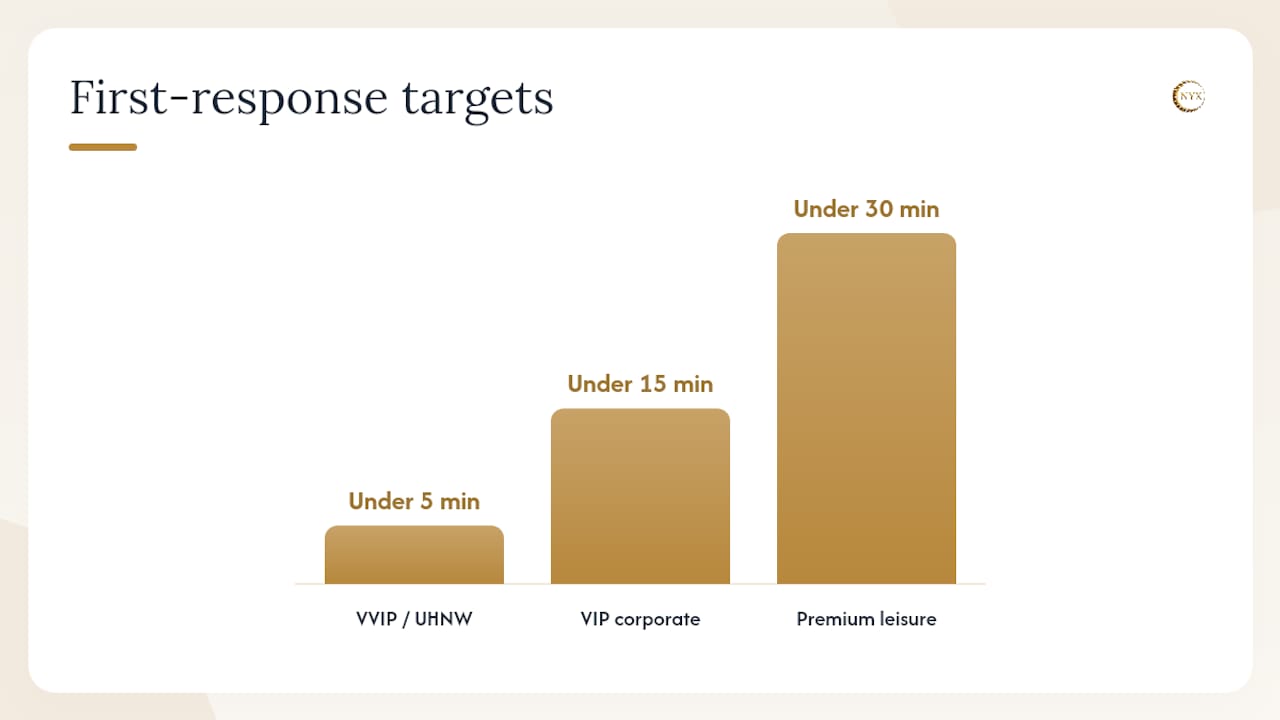
These are not aspirational figures. They reflect the service levels that prevent attrition at the top of the market. A UHNW client who waits 45 minutes for a response to an airport transfer request at 3 AM will not complain; they will simply not rebook.
Beyond speed, luxury clients expect:
- Multilingual capability. A client communicating in Russian, Arabic, or Italian expects a response in the same language, not a translated template.
- Proactive monitoring. Flight delays should trigger automatic updates before the client asks. A driver who is already adjusted to a revised arrival time, without the client having to chase, is the standard.
- Discretion. Channel choice matters. A VVIP client does not want their transfer details passing through a generic ticketing queue. Dedicated lines, encrypted messaging, and named account managers are not optional extras.
- Memory. Clienteling platforms such as BSPK demonstrate how CRM-backed advisors can reference a client's vehicle preference, preferred pickup point, and dietary requirements without asking again.
For airport transfer requests, the expectation is confirmation within minutes and a driver update within 30 minutes of any flight change. For itinerary changes, the expectation is a single point of contact who can resolve the matter without the client being passed between departments.
How premium operators deliver 24/7 without burning out teams
Three delivery models are in practical use among premium ground transport operators. Each has a different cost profile and a different failure mode.
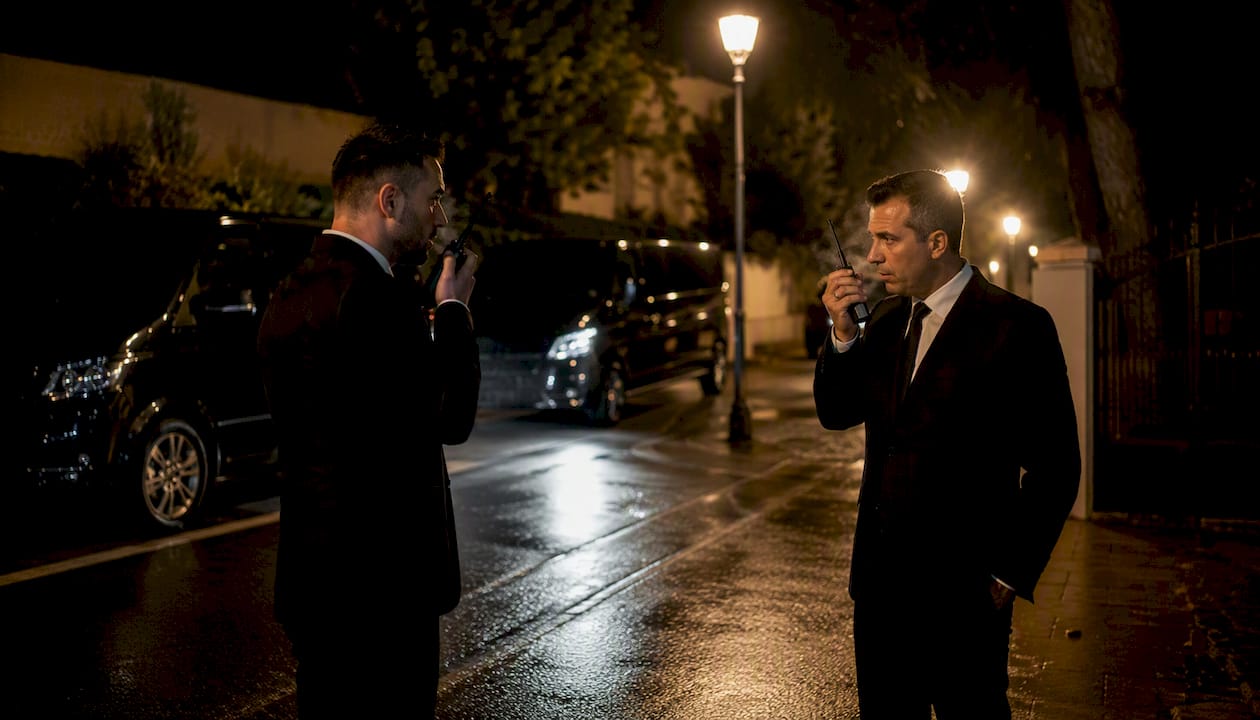
In-house 24/7
A dedicated overnight team, fully employed and trained to the same standard as the day operation. The advantage is consistency: every interaction is handled by someone who knows the brand, the clients, and the fleet. The disadvantage is cost. Decagon's analysis of 24/7 support models notes that in-house overnight seats are expensive and prone to burnout, particularly when overnight volume is low but the requirement for immediate, high-quality response is constant. For a Riviera operator running 20 vehicles, a full in-house night team is rarely justified outside peak event periods.
Hybrid: AI triage with on-call specialists
The most practical model for mid-sized luxury operators. An AI layer handles Tier 0 requests: booking confirmations, status updates, flight monitoring alerts, and standard itinerary queries. When a request requires judgment, language nuance, or client-specific discretion, it escalates immediately to a bilingual on-call specialist. Zendesk's hybrid model guidance confirms that this structure delivers genuine 24/7 resolution without requiring full night rosters. The critical design requirement is that the escalation is invisible: the client should never feel they have been transferred.
BPO overflow
A business process outsourcing partner handles overnight volume when in-house and AI capacity is exceeded. Useful during major Riviera events, when demand spikes sharply. The risk is brand consistency: a BPO agent who does not know that a particular client always requests a Van 7 pax for the Cannes Film Festival, or that a corporate account has a standing instruction for NCE arrivals, will deliver a generic response that damages the relationship. BPO overflow works only when the CRM handoff is complete and the briefing is thorough.
Shift pattern principles for a Riviera fleet
During the Cannes Film Festival (May), Monaco Grand Prix (May), Cannes Lions (June), and MIPCOM (October), overnight demand is genuine and sustained. A practical shift pattern for these periods runs a senior bilingual specialist from 10 PM to 6 AM, supported by AI triage for routine queries, with a BPO escalation path for language combinations outside the in-house team's capability. Outside event periods, a single on-call specialist with AI support is sufficient for most operators.
Pro Tip Design your escalation triggers before you go live. Define exactly which request types move from AI to human: any request involving a named VIP, any itinerary change within four hours of departure, any complaint, and any request in a language the AI cannot handle with full fluency. Write these as rules, not guidelines.
Which channels and tools support 24/7 without losing the human feel
The channel stack for a luxury 24/7 operation is not complicated, but the integration between channels is where most operators fail.
- WhatsApp for immediate, personal communication. A dedicated WhatsApp line, separate from the general inquiry number, signals to the client that they have direct access. Transponyx operates a dedicated WhatsApp line at +33 7 67 78 10 26 for exactly this purpose. The key discipline is response time: a WhatsApp message that goes unanswered for 20 minutes at 11 PM is a broken promise.
- Phone for urgent resolutions. Some situations require a voice. A client whose driver has not appeared at Nice NCE after a long-haul flight does not want to type. A direct phone line to a bilingual specialist, answered within three rings, resolves the situation and preserves the relationship.
- Concierge app or booking platform for pre-planned itineraries and corporate accounts. These channels handle the administrative layer: booking confirmations, receipts, itinerary management. They free the WhatsApp and phone lines for genuine urgency.
- CRM with omnichannel clienteling for memory and personalization. Every interaction, regardless of channel, should update a single client record. When a client calls at 2 AM, the answering specialist should be able to see the client's vehicle preference, their last five journeys, and any standing instructions, without asking.
BCG's research on AI in luxury argues that AI expands the means of engagement and is essential to scale white-glove service, but only when it augments human advisors rather than replacing them.
Zendesk is a practical choice for ticketing and escalation management in a hybrid model, providing audit trails and shift handoff notes that keep overnight context visible to the morning team. For encrypted messaging and client data protection, platforms with end-to-end encryption are preferable to standard SMS or unencrypted email for VVIP communications.
Tea Luxury Roundtable's design guidance sets out the governing principle clearly: AI when the client wants efficiency, human when they need reassurance, with permissions and audit trails as the controls that keep the system trustworthy.
How to price and package 24/7 availability for luxury clients
The pricing question is not whether to charge for 24/7 availability, but how to frame the value so that clients perceive it as a natural feature of the tier they have chosen.
Three structures work in practice. For corporate accounts and hotel partnerships, 24/7 availability is most effectively bundled as a standard feature of the account agreement. The client pays a fixed annual or monthly retainer that includes guaranteed response times, a named account manager, and priority fleet access during peak events. The retainer model converts overnight cost into predictable revenue and removes the per-booking friction that erodes relationships.
For premium leisure clients, a per-booking premium is cleaner. A fixed surcharge for confirmed overnight bookings, stated transparently at the time of reservation, is accepted readily when the value proposition is clear: a fixed 2026 rate, no surge pricing, and a bilingual driver who is already tracking the flight. The overhead does not need to be large; it needs to be honest.
For event-specific demand, event overloads are standard practice. During the Cannes Film Festival, Monaco Grand Prix, or Cannes Lions, operators who can guarantee availability order a premium that reflects genuine scarcity. A Van 7 pax confirmed for a film festival transfer at 1 AM is worth considerably more than the same vehicle at 10 AM on a quiet Tuesday.
Pro Tip When communicating 24/7 availability to corporate accounts, frame it as a guarantee, not a feature. “Your account includes confirmed response within 15 minutes, at any hour, with a named specialist who knows your preferences” is a stronger proposition than “we are available 24/7.”
The marginal cost of overnight coverage, once a hybrid model is in place, is lower than most operators assume. The AI layer handles the majority of overnight volume at negligible cost; the on-call specialist is a fixed cost regardless of volume. Pricing should reflect the value of the guarantee, not the cost of delivery.
The governance, privacy and discretion rules luxury clients expect
Luxury clients do not read privacy policies. They do, however, notice when their data is handled carefully, when a driver knows something they did not share directly, or when a message appears on a channel they did not authorize. Governance in a 24/7 luxury operation is not a compliance exercise; it is a trust architecture.
The non-negotiable elements under UK GDPR and the Data Protection Act 2018 are:
- Lawful basis for processing. For a 24/7 service that acts on a client's behalf, legitimate interest or explicit consent must be documented before any automated action is taken. A client who asks a chauffeur service to monitor their flight and adjust the pickup time has implicitly consented to that processing; the consent should be captured explicitly at onboarding.
- Storage limitation. Client preferences, itinerary data, and communication records should be retained only as long as necessary. A retention schedule, reviewed annually, prevents data accumulating beyond its useful life.
- Encrypted messaging. Any channel carrying client identity, travel itinerary, or financial data should use end-to-end encryption. Standard SMS and unencrypted email do not meet this standard for VVIP communications.
- Audit trail for every intervention. When a specialist acts on a client's behalf, such as amending a booking, confirming a vehicle upgrade, or communicating with a hotel, the action must be logged with a timestamp, the specialist's identity, and the authorization basis.
- Permissions for acting on behalf of clients. A standing instruction from a corporate account to confirm bookings without prior approval for each journey must be documented, signed, and stored. Acting without documented authority, even helpfully, creates liability.
“Service is the moat in luxury. AI must be governed by permissions, approvals and audit trails so humans can deliver the memorable moments.” Luxury Roundtable, January 2026
The practical implication for operators is a short permissions document, signed at account opening, that specifies which actions the service may take autonomously and which require client confirmation. This document protects both parties and removes the ambiguity that causes overnight errors.
How to remain exclusive while offering continuous availability
The paradox of 24/7 luxury service is that constant availability can feel like abundance, and abundance erodes rarity. The solution is not to restrict availability but to restrict access to it.
Invite-only channels are the most effective design pattern. A dedicated WhatsApp line or a direct phone number shared only with confirmed clients signals that access is earned, not open. The client who has that number knows they are not in a queue. Hype Luxury's research on UHNW operators notes that operators on the French Riviera who overcome the exclusivity-availability paradox do so through curated, invitation-only channels and genuine fleet inventory, not through artificial scarcity.
Capacity rules matter during peak events. A fleet of 20 vehicles cannot serve 40 simultaneous requests during the Monaco Grand Prix without compromising quality. The answer is not to accept all 40 bookings; it is to allocate capacity to the highest-value accounts first, with a clear policy communicated in advance. Clients who know their account tier includes priority allocation during events do not feel excluded; they feel protected.
BCG's luxury AI research confirms that 62% of luxury clients worry about losing the human touch. Exclusivity, in this context, is not about limiting hours; it is about limiting who has direct access to the human layer.
Staged capacity release, in which a proportion of event-period inventory is held back for confirmed account holders and released to new inquiries only when confirmed accounts are satisfied, is a practical governance tool. It prevents the situation where a long-standing corporate client finds their preferred vehicle unavailable because it was confirmed to a one-time booking.
KPIs and SLAs to prove 24/7 is working and when to pause or scale it
Measurement is where most luxury operators are weakest. The instinct is to treat 24/7 availability as a qualitative commitment rather than a measurable service standard. That instinct is expensive.
| KPI | Suggested threshold | Review cadence |
|---|---|---|
| First response time (overnight) | Under 10 minutes for VVIP; under 20 minutes for VIP | Weekly |
| Resolution time | Under 30 minutes for urgent requests | Weekly |
| Net Promoter Score (NPS) | Minimum 70 for account clients | Quarterly |
| Customer retention rate | Above 60% for luxury participants | Quarterly |
| Revenue per customer (account tier) | Year-on-year growth target set at account opening | Annually |
Microsoft Dynamics' global customer service research documents response time disparities between day and night operations as a common attrition driver. The implication for luxury operators is that overnight SLAs must be measured separately from daytime performance; a strong daytime average can mask a failing overnight service.
Decision thresholds are as important as the metrics themselves. If overnight first response time consistently exceeds 15 minutes, the hybrid model needs recalibration: either the AI triage is not escalating quickly enough, or the on-call specialist is covering too wide a time window. If NPS for overnight interactions falls below 65, the issue is usually channel or language, not availability per se.
The analytics requirement is modest: a weekly report separating overnight volume by request type (urgent versus non-urgent), response time by tier, and resolution rate. Most CRM and ticketing platforms, including Zendesk, generate this automatically. The discipline is reviewing it.
- Separate urgent from non-urgent overnight volume before drawing conclusions about staffing needs.
- Track NPS specifically for overnight interactions, not just overall account NPS.
- Review retention data by account tier quarterly; a corporate account that reduces booking frequency is an early warning signal.
What automation should do and what must remain human in a luxury 24/7 service
The automation matrix for a luxury 24/7 operation has three tiers, and the boundaries between them are not negotiable.
Tier 0: fully automated. Booking confirmations, payment receipts, flight status updates, standard itinerary reminders, and FAQ responses. These tasks have no relationship value and high volume. Automating them frees human capacity for the interactions that matter.
Tier 1: AI-assisted with human oversight. Itinerary queries that require checking real-time fleet availability, standard change requests within pre-approved parameters, and multilingual template responses reviewed by a specialist before sending. The AI drafts; the human approves.
Tier 2: bilingual human specialists only. Any request involving a named VIP, any complaint, any request that deviates from standing instructions, any communication requiring cultural nuance, and any situation where the client's tone suggests dissatisfaction. These interactions cannot be templated.
The “bot vibe” failure mode is well documented. It occurs when an AI response uses generic phrasing, fails to reference the client's history, or takes longer than a human would to respond. Governance mitigates this: every AI response in Tier 1 should be reviewed against the client's CRM record before sending, and any response that does not reference at least one client-specific detail should be escalated to Tier 2.
BCG's research is direct on this point: AI expands the means of engagement and is essential to scale white-glove service, but the strategy must be AI-assisted rather than AI-only.
Pro Tip Audit your AI responses monthly. Pull a random sample of 20 overnight AI-handled interactions and ask a senior specialist to rate them against the brand standard. If more than two feel generic or impersonal, the escalation triggers need tightening.
How Transponyx operates 24/7 for high-net-worth travelers
Transponyx is a working example of the operational model described in this guide. The service operates 24 hours a day, seven days a week, from Nice on the French Riviera, with a fleet of Mercedes-Benz vehicles across four categories: Standard Sedan, Business Sedan, Van 7 pax, and Van 8 pax. All 2026 rates are fixed per vehicle and confirmed at booking, with no surge pricing regardless of the hour.
Flight monitoring is included on every airport transfer. When a flight into Nice Côte d'Azur Airport is delayed, the driver's schedule adjusts automatically; the client does not need to call. Free waiting time of 60 minutes is included on all airport pickups, 20 minutes for any other address. These are not policies that require a client to negotiate; they are standard.
Journey times on primary routes give a sense of the operational reality. Nice NCE to Monaco runs approximately 30 minutes in normal traffic; Nice NCE to Cannes is approximately 35 minutes. During the Cannes Film Festival or Monaco Grand Prix, when road conditions are unpredictable, a bilingual driver who knows the Riviera's secondary routes is not a luxury; it is the service standard. Transponyx drivers are licensed VTC professionals, bilingual in English and French as a minimum, with several also fluent in Italian, Spanish, Russian, or Arabic.
“The 96-hour window is the operative reality for UHNW mobility. Operators who maintain genuine fleet inventory and can confirm within hours, not days, win the spontaneous, high-value business.” Hype Luxury Blog
For superyacht transfers and last-minute berthing schedules, the 24/7 model is not a convenience; it is a prerequisite. A yacht arriving at Antibes at 11 PM needs a confirmed Van 7 pax for a group of six within the hour. Transponyx handles these requests through its dedicated WhatsApp line at +33 7 67 78 10 26 and reservations phone at +33 6 10 30 71 84. Full service details and booking are available at Transponyx.
A 90-day pilot plan for UK luxury operators launching 24/7 service
A structured pilot reduces the risk of launching 24/7 availability before the governance and staffing model is ready.
Days 1 to 30: analytics and preparation. Review six months of overnight inquiry data to separate urgent from non-urgent volume. Identify the client tier that generates the most overnight requests. Draft consent scripts and a permissions document for the pilot cohort. Confirm encryption on all client-facing channels.
Days 31 to 60: channel pilot. Launch WhatsApp and phone coverage for a pilot cohort of 10 to 20 VIP or corporate account clients. Use AI triage for Tier 0 requests and a single on-call bilingual specialist for escalations. Log every interaction in the CRM with response time and resolution outcome.
Days 61 to 90: measurement and go/no-go. Review first response time, resolution rate, and NPS for the pilot cohort against the thresholds in the KPI table above. If overnight first response is consistently under 15 minutes and NPS is above 70, the model is ready to scale. If either metric is failing, identify the root cause before expanding.
Immediate GDPR actions before launch:
- Consent scripts capturing lawful basis for overnight processing, reviewed by a data protection adviser.
- Retention schedule for client communication records, with a maximum period appropriate to the service relationship.
- Encryption confirmed on WhatsApp, CRM, and any other channel carrying client identity or itinerary data.
- Audit trail configured in the ticketing system to log every overnight intervention with timestamp and authorization basis.
Pro Tip Choose your pilot cohort from clients who already communicate with you outside business hours. Their existing behavior tells you where the demand is real, and their familiarity with your service means they will give you honest feedback rather than simply churning silently if the pilot underperforms.
Zendesk's research confirms that Many customers consider 24/7 support a crucial part of good customer service. For luxury operators, the figure is almost certainly higher among UHNW clients, for whom time is the scarcest resource.
UK legal and compliance considerations beyond GDPR
GDPR is the floor, not the ceiling, for a UK luxury service operating around the clock. Several additional frameworks apply and are frequently overlooked.
Consumer Rights Act 2015. Services must be performed with reasonable care and skill, within a reasonable time, and at a reasonable price where no price was agreed in advance. For a 24/7 luxury operator, this means that a confirmed overnight booking carries the same legal weight as a daytime booking. A failure to provide the confirmed vehicle, without a suitable alternative, is a breach of contract regardless of the hour.
Consumer Contracts Regulations 2013. Where bookings are made online or by phone, clients have cancellation rights unless the service is for a specific date or period. Luxury transport operators should ensure their terms clearly address the cancellation framework for time-specific bookings, particularly for event transfers where the date is fixed.
Advertising Standards Authority (ASA) and the CAP Code. Any claim made in marketing about 24/7 availability, response times, or service guarantees must be substantiated and not misleading. Stating “guaranteed response within 15 minutes” in advertising requires that the operator can demonstrate consistent delivery of that standard. The ASA has taken action against service businesses that advertised availability guarantees they could not reliably meet.
Working Time Regulations 1998. For UK-based operators with employed overnight staff, the 48-hour average working week limit and mandatory rest periods apply. Night workers are entitled to free health assessments. These obligations are not suspended by client demand during peak events; they require careful shift design and documented rest periods.
Financial Conduct Authority (FCA) considerations. Where a luxury service operator holds client funds in advance, such as retainer payments or pre-paid account balances, the handling of those funds may attract regulatory scrutiny depending on the structure. Legal advice is appropriate before launching a retainer model that involves holding significant client deposits.
This article provides general information only. Operators should confirm current obligations with a qualified legal adviser before launching or modifying a 24/7 service offering.
The real trade-off between service ambition and brand rarity
The conventional wisdom in luxury service is that availability and exclusivity are in tension: the more accessible you are, the less rare you feel. That framing is wrong, and it leads operators to under-invest in overnight coverage for the wrong reasons.
The clients who value exclusivity most are not measuring it by how hard you are to reach. They are measuring it by how well you know them, how reliably you perform, and how little they have to think about logistics. A UHNW traveler who can send a WhatsApp at midnight and receive a confirmed Business Sedan for a 5 AM departure from Nice NCE does not feel that the service has become common. They feel that it has become indispensable.
The risk of abundant rarity is real, but it comes from poor channel design and undifferentiated access, not from genuine availability. An operator who gives every inquirer the same WhatsApp number, the same response time, and the same vehicle options has commoditized the service. An operator who reserves direct overnight access for confirmed account holders, maintains genuine fleet inventory, and responds with a named specialist who references the client's history has done the opposite.
The Riviera context sharpens this. During the Monaco Grand Prix or the Cannes Film Festival, the operators who protect their best clients' access while managing overflow demand are the ones who retain those clients the following year. Transponyx's model, with fixed 2026 rates, genuine fleet ownership, and bilingual drivers available around the clock, is a working demonstration that the exclusivity-availability paradox is a design problem, not an inherent constraint.
Transponyx: 24/7 private chauffeur service on the French Riviera
For high-net-worth travelers, event organizers, and corporate accounts requiring guaranteed overnight availability on the Côte d'Azur, Transponyx delivers what this guide describes: fixed 2026 rates confirmed at booking, a bilingual driver fleet available around the clock, and flight monitoring included on every airport transfer from Nice NCE.
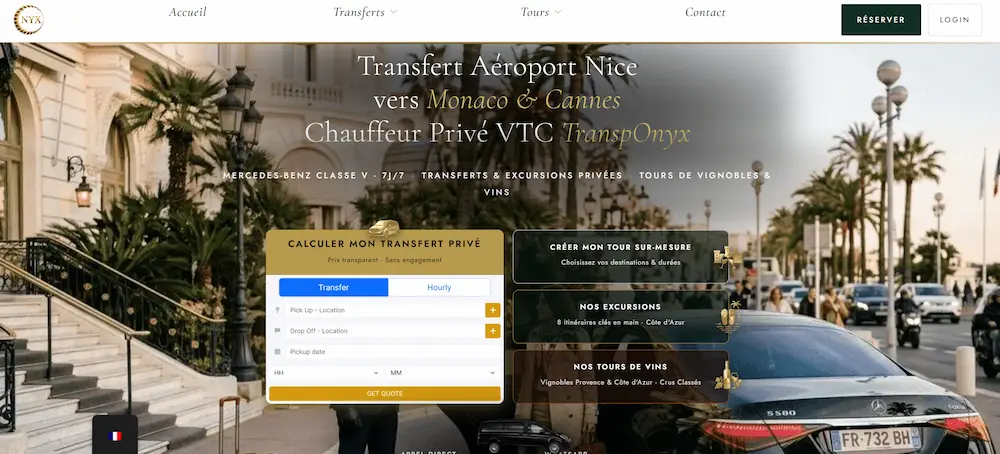
The fleet covers every group size, from a Standard Sedan for a solo business traveler to a Van 8 pax for a delegation arriving for MIPCOM or the Cannes Film Festival. Routes extend from Nice NCE to Monaco, Cannes, Antibes, Menton, and Saint-Tropez, with long-distance transfers to Milan, San Remo, and Ventimiglia available on request. There are no surge prices, no ambiguous terms, and no generic ticketing queues: direct access via WhatsApp at +33 7 67 78 10 26 or phone at +33 6 10 30 71 84.
To review the full fleet and compare 2026 third-party service, visit Transponyx or contact the reservations team directly to discuss a corporate account or event package.
Sources
- Why The Luxury Experience Needs an AI Moment | BCG
- How to offer 24/7 support with AI and hybrid models | Zendesk
- The 96‑hour window: how last‑minute luxury is becoming the new UHNW norm | Hype Luxury Blog
- Crafting AI for luxury (January 15 2026) | Luxury Round Table
- 24/7 customer support benefits and best practices for lean teams | Decagon
FAQ
Why does 24-hour availability matter for luxury clients specifically?
Luxury clients operate across time zones and make high-value decisions spontaneously. A provider who cannot confirm a booking or resolve a request outside business hours loses the relationship to one who can, often permanently.
What response time should a luxury service guarantee overnight?
VVIP clients expect a first response within five minutes and resolution within 15 minutes. VIP corporate accounts should receive a response within 15 minutes and resolution within 30 minutes, regardless of the hour.
How do you maintain quality during busy periods without burning out staff?
A hybrid model combining AI triage for routine requests with on-call bilingual specialists for escalations delivers consistent quality without requiring full overnight rosters. The key is designing escalation triggers before launch, not after the first failure.
How does Transponyx handle overnight airport transfers at Nice NCE?
Transponyx operates 24/7 with flight monitoring included on every transfer. If a flight is delayed, the driver's schedule adjusts automatically. Free waiting time of 60 minutes is included on all airport pickups, and fixed 2026 rates are confirmed at booking with no overnight surcharge.
What UK legal obligations apply to a 24/7 luxury service beyond GDPR?
The Consumer Rights Act 2015, Consumer Contracts Regulations 2013, ASA advertising standards, and Working Time Regulations 1998 all apply. Operators should confirm current obligations with a qualified legal advisor before launching overnight service coverage.
0 Comments