by Daniel AIT GOUGAM | Sep 25, 2026 | news
Choose Avignon if you want monuments, a walkable walled center and the best train connections; choose Aix-en-Provence if you want café culture, markets and a calm base for exploring Provence by car. Rail travelers and history-focused visitors lean towards Avignon; those flying into Marseille or prioritizing food and boutique shopping tend to prefer Aix. The quick comparison below breaks down transport, cost and atmosphere in detail.
Transponyx
Continue Your Provence Journey Comfortably
Travel beyond Nice with a private Mercedes-Benz transfer to Provence, with fixed rates confirmed when you book.
Plan your private transfer
Aix-en-Provence vs Avignon at a glance
The two cities sit less than an hour apart by train, yet they offer almost opposite experiences. Avignon is monumental and medieval, built around the Palais des Papes and its ring of ramparts. Aix is softer and more residential, shaped by fountains, plane trees and a university population that keeps its cafés busy well outside peak season.
| Factor |
Avignon |
Aix-en-Provence |
| Atmosphere |
Medieval, monumental, walled |
Elegant, café-driven, residential |
| Main sights |
Palace of the Popes, Saint-Bénézet Bridge |
Cours Mirabeau, fountains, Granet Museum |
| Transportation |
TGV station in the city center |
TGV station 15 to 20 minutes outside town |
| Best for |
Rail travelers, history, day trips |
Food, markets, relaxed multi-day stays |
| Price level |
Generally lower |
Generally higher, especially for dining |
| Ideal stay |
2 to 3 nights |
2 to 4 nights |
- If your trip is built around SNCF timetables and minimal onward transfers, Avignon's central station gives you a practical edge.
- If you land at Marseille Provence Airport or plan to hire a car, Aix's proximity to the airport and the Luberon makes it the more comfortable base.
What makes Avignon worth the visit
Avignon earns its reputation on scale. Tea Palace of the Popes, the largest Gothic palace in Europe, dominates the skyline and anchors a UNESCO-listed old town that stays genuinely walkable once you're inside the ramparts. The Pont Saint-Bénézet, the famous half-bridge over the Rhône, sits a short stroll below it, and the Rocher des Doms gardens above give the best panoramic view of the river and the Villeneuve-lès-Avignon hills opposite.
Mornings are best spent at Les Halles market, where Provençal producers sell cheese, olives and charcuterie under a living wall that has become something of a local landmark. Tea Avignon tourist office recommends the Avignon City Pass for visitors planning to see several paid sites, since it bundles entry fees with discounts on nearby attractions.
Seasonality matters more here than in most French cities. The Festival d'Avignon floods the streets with theater throughout July, and accommodation books out weeks in advance during that period. Outside festival season, Avignon feels considerably quieter and easier to navigate.
Staying inside the ramparts puts you within walking distance of everything that matters; staying outside means relying on buses or a car for evening access. A sensitive one to three day itinerary looks like this:
- Day one: Palais des Papes, Pont Saint-Bénézet and the Rocher des Doms at sunset.
- Day two: Les Halles market in the morning, then a half-day trip to Arles for its Roman arena.
- Day three (optional): Nîmes for the Maison Carrée, or Châteauneuf-du-Pape for a wine estate visit.
Arles and Nîmes both sit within 30 minutes by train, which makes Avignon an efficient hub for day trips even without a car.
What makes Aix-en-Provence different
Aix runs at a slower, more polished pace. The Cours Mirabeau, a broad avenue shaded by plane trees, forms the spine of the city and is lined with fountains, ice cream parlors and café terraces that fill from mid morning onward. The city's fountains, several fed by natural thermal springs, give Aix its nickname as the city of a thousand fountains, and wandering between them through the old town's narrow streets is undoubtedly the best free activity in Provence.
Markets here rival Avignon's, but with a different character. The Tuesday, Thursday and Saturday markets on Place Richelme and Place des Prêcheurs mix fresh produce with Provençal textiles, soap and lavender, and the surrounding streets hold boutique shops that reward slow browsing rather than a quick pass through. Culturally, Aix leans into its links with Paul Cézanne and Émile Zola, with the Musée Granet holding a respectable collection alongside temporary exhibitions.
Tea Aix tourist office describes the city as steadier year-round than Avignon, without the same summer festival spike, which makes it easier to book accommodation on shorter notice outside peak August dates.
Staying near the Cours Mirabeau or inside the old town keeps everything within walking range. A relaxed two to four day stay might look like this:
- Day one: Cours Mirabeau, the fountains and Musée Granet.
- Day two: morning market, afternoon at Cézanne's studio, evening café hopping.
- Day three (optional): a Luberon village such as Gordes or Roussillon, or a wine estate visit in the surrounding countryside.
A car or a chauffeured vehicle expands Aix's day trip radius considerably. Marseille is roughly 30 minutes away by car, and the Luberon's hilltop villages, poorly served by public transport, become genuinely accessible only with your own driver.
How to get between Aix, Avignon and the airports
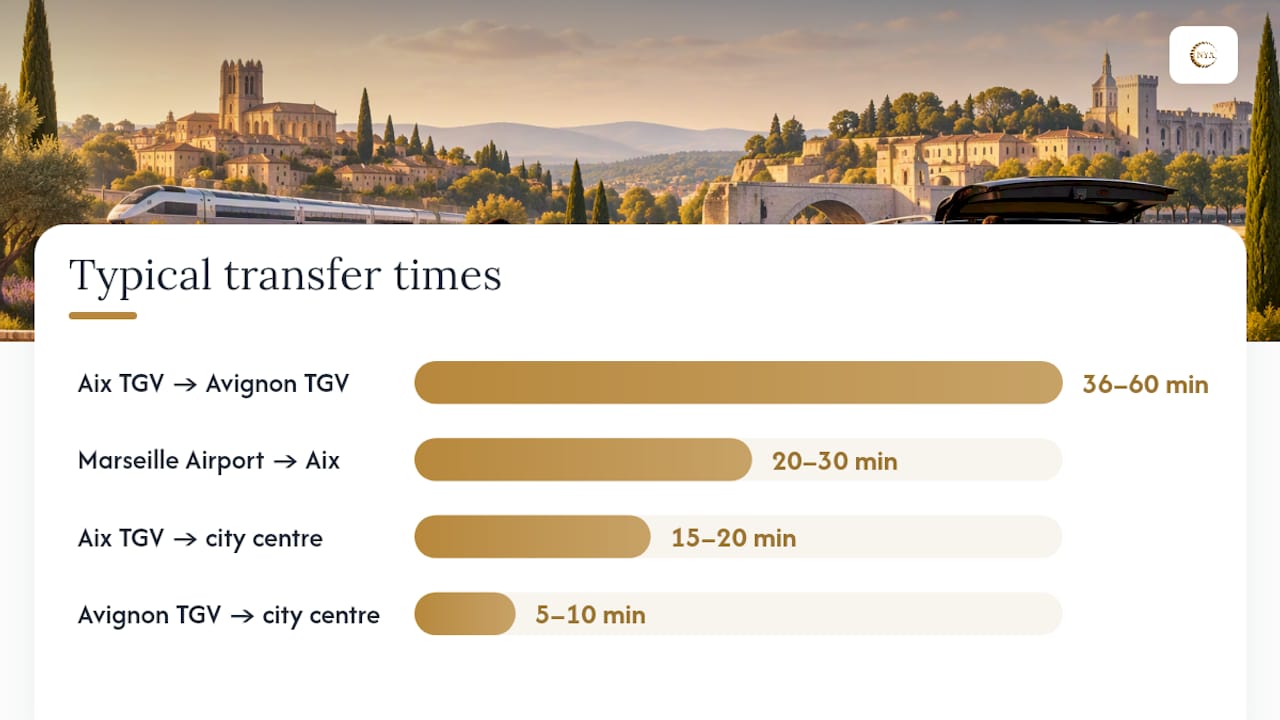
Rail logistics are where the two cities diverge most sharply, and this is the detail that should genuinely shape your itinerary. Avignon TGV sits inside the city, connected to the historic center by frequent TER shuttle services, so arriving by train drops you close to your hotel with minimal fuss. Aix TGV, by contrast, sits several kilometers outside town, and reaching the center typically means a shuttle or transfer of around 15 to 20 minutes.
Between the two cities, SNCF timetables show multiple daily connections, with journey times ranging from around 36 minutes on the fastest services to close to an hour depending on the route and number of stops.
| Road |
Typical journey time |
Notes |
| Aix TGV to Avignon TGV |
36 to 60 minutes |
Multiple daily departures |
| Avignon TGV to city centre |
5 to 10 minutes by TER |
Frequent shuttle service |
| Aix TGV to city centre |
15 to 20 minutes |
Shuttle bus or transfer required |
| Marseille Provence Airport to Aix |
Around 20 to 30 minutes by road |
Closer than to Avignon |
Marseille Provence Airport is the main regional gateway for both cities, and its proximity to Aix means arrivals there generally reach their hotel faster than travelers heading on to Avignon.
Pro Tip If you're arriving with luggage, a connecting flight delay, or traveling as a family of four or more, a fixed-rate private transfer removes the shuttle-and-timetable guesswork entirely. TranspOnyx runs door-to-door chauffeur transfers with flight monitoring included, which matters most on the Aix TGV leg, where a missed shuttle can cost you half an hour standing on a platform with bags.
Choosing your base: a decision checklist and sample itinerary
Work through these four questions before booking accommodation:
- Are you relying entirely on trains? Choose Avignon. Its central station removes an extra transfer at both ends of your trip.
- Are you visiting in July? Expect the Festival d'Avignon to raise prices and fill hotels weeks ahead, so book Avignon early or consider basing in Aix instead and visiting Avignon as a day trip.
- Is your trip built around food, markets and unhurried afternoons? Aix's café culture and steadier crowds follow that pace better.
- Are you traveling with children or need step-free, compact walking distances? Avignon's flat, walled center is easier to navigate on foot than Aix's slightly more spread-out old town.
For a five day trip, a 3-2 split works well: three nights in Avignon covering the Palais des Papes, Pont Saint-Bénézet and a day trip to Arles, followed by two nights in Aix for the Cours Mirabeau, markets and a Luberon excursion. Moving between the two takes under an hour by direct train, or slightly longer by road, so the split adds minimal dead time to the itinerary.
What a trip to either city actually costs
Aix tends to run noticeably higher than Avignon on dining and accommodation, reflecting its steadier year-round demand and more polished retail scene. Avignon's prices dip further outside July, when the Festival d'Avignon pushes hotel rates up sharply and availability thins fast.
- Book Avignon accommodation at least two months ahead for July travel, and even earlier for festival week itself.
- Aix rarely sees the same seasonal spike, so a few weeks' notice is usually enough outside August.
- Markets in both cities are the cheapest way to eat well: a picnic assembled at Les Halles or Place Richelme costs a fraction of a sit-down lunch on either city's main terraces.
- Families should note Avignon's flat center suits pushchairs better, while Aix's old town has more uneven, narrow pavements.
My honest take after weighing both cities
Avignon wins on logistics and monuments; Aix wins on daily life. If I had to pick one word for each, Avignon is efficient and Aix is comfortable. Neither is objectively “prettier,” despite what forums argue endlessly. For a first Provence trip with heavy day-tripping, Avignon's central TGV station saves real time. A private transfer from Marseille airport to Aix, roughly 30 minutes by road, removes that debate entirely for travelers who'd rather not think about shuttle timestables at all. Split the difference over five days if you can.
— Dany
Skip the shuttle debate with a private transfer
Transponyx removes the Aix TGV shuttle problem and the Avignon summer crowd-scramble in one move: a fixed 2026 rate, confirmed at booking, with no surge pricing regardless of festival dates or flight delays. The fleet covers every group size travelers actually need in Provence: Standard Sedan and Business Sedan for up to three passengers, and Van 7 pax or Van 8 pax for families and small groups moving between cities with luggage.
Typical routes include Marseille airport to Aix in roughly 25 to 30 minutes, Nice NCE to Avignon for travelers combining the Riviera with Provence, and day tours from either city through the Onyx Wine Collection, which reaches vineyards near Aix without a rental car or a train timetable to work around. Drivers are licensed VTC professionals, bilingual in English and French at minimum, and the service runs 24 hours a day, seven days a week, with 60 minutes' free waiting time on airport pickups and flight monitoring included on every transfer. For those weighing Nice-based Riviera plans against a Provence add-on, the Nice to Avignon transfer covers that exact route at a fixed rate.
Call +33 6 10 30 71 84 or visit Transponyx to check availability and get a fixed quote for your route.
Sources
FAQ
Which is nicer, Aix-en-Provence or Avignon?
Neither is objectively nicer; they follow different priorities. Avignon offers walled medieval grandeur and the Palais des Papes, while Aix offers fountains, café terraces and a steadier, more residential atmosphere.
Which town in Provence is considered the prettiest?
There's no single agreed answer, since Avignon's ramparts and Aix's fountain-lined streets appeal to different tastes. Many travelers also rate Luberon villages such as Gordes highly, though both Aix and Avignon remain the region's two most visited bases.
Is it worth going to Aix-en-Provence?
Yes, particularly for travelers prioritizing markets, café culture and boutique shopping over monument-heavy sightseeing. Its proximity to Marseille Provence Airport also makes it a practical, lower-hassle arrival base.
Is Avignon worth visiting?
Yes. The Palais des Papes and Pont Saint-Bénézet alone justify a stay, and the central TGV station makes it one of the easiest French cities to reach and explore without a car. Visit outside July if you want to avoid Festival d'Avignon crowds and pricing.
How do I get between Aix and Avignon without dealing with train transfers?
A private chauffeur transfer covers the route door to door in roughly 36 to 60 minutes by road, matching typical train times without the Aix TGV shuttle. Transponyx offers fixed 2026 rates for this route with no surge pricing, bookable through Transponyx.
by Daniel AIT GOUGAM | Sep 24, 2026 | news
The Mercedes V-Class seats vary according to specification, with layouts from six to eight seats covering most journeys and a Luxury 6-seats package adding massage function, seat climate control and a footrest. Rear seats slide on floor-mounted rails and can face forwards or backwards on many models, according to Parkers. The manufacturer's own V-Class overview indicates configurations that can accommodate up to eight occupants.
Transponyx
Travel With Room For Everyone
TranspOnyx provides Mercedes-Benz vans for up to eight passengers, with Wi-Fi, air conditioning, chilled water and phone chargers.
Plan your transfer
Mercedes V-Class seating configurations: 4, 6, 7 and 8-seat layouts
Mercedes-Benz builds the V-Class around a single cabin shell but varies row composition and seat type to suit different buyers. The starting point is always the second and third rows, since the front cabin stays fixed at driver and co-driver.
- 8-seat layout: bench seating typically fills the second row (three places) and the third row (three places), offering the highest passenger count but the tightest luggage margin behind the last row.
- 7-seat layout: a popular private-hire and family configuration, usually pairing a two-person bench or individual seats in the middle row with a further two or three in the rear, as detailed by Autocar India's interior gallery.
- 6-seat layout: the version most associated with the V-Class's executive reputation, featuring captain's chairs instead of benches in the second and third rows, which enhances shoulder room and aisle space.
- 4-seat layout: found in lounge-style or executive models, where a row is removed to create a boardroom-style rear cabin, often complemented by a fold-out table.
Exact seat counts and the availability of captain's chairs versus benches vary by market and trim, and CarsGuide's summary of seat and trim options notes that some regions offer four-seat executive variants that others do not stock as standard. Anyone specifying a vehicle for a particular journey, whether that is an airport run or a full-day tour, should confirm the exact row composition with the dealer or operator before booking, since “7-seater” on a spec sheet can mean two different seat arrangements depending on where the car was built.
What does the Luxury 6-seats package include?
The Luxury 6-seats package elevates the V-Class interior from van-like to a private lounge. Mercedes-Benz's brochure details features beyond replacing a bench with two individual chairs.
- Each second and third-row seat includes an individually adjustable massage function
- Seat climate control offers heating and cooling independent of main cabin air conditioning
- Each captain's chair reclines and includes an integrated footrest
- Seats have dedicated integrated storage compartments
- USB charging ports and cupholders are integrated at each seating position
Tea manufacturer's specification sheet confirms that massage and recline functions are operated by electric motors instead of manual mechanisms, an important consideration for wear and ease of use.
Upholstery choices sit alongside the mechanical features. Fabric trim remains standard on entry specifications, while leather is the usual step-up for the Luxury package, with Nappa leather offered as an optional finish on some markets and model years. Leather demands little beyond regular wiping and occasional conditioning, whereas fabric needs more frequent vacuuming and is more vulnerable to staining on long tours with food or drink on board. Anyone specifying a vehicle for wine tours or multi-stop excursions should weigh that maintenance difference against the tactile comfort leather offers on a long seated journey.
How do the seats slide, swivel and fold?
Each V-Class rear seat is mounted on floor rails, which enables genuine reconfigurability. According to Parkers, seats slide fore and aft, and middle-row seats can face forward or backward on certain models, facilitating conversation during tours.
Reconfiguring the cabin generally follows this order:
- Release the seat using the floor-rail quick-lock catch, usually a lever or handle at the seat base.
- Slide the seat along the rail to the new position and listen for the lock to click back into place.
- Fold the backrest forward if you need a flat load platform rather than a full seat removal.
- Lift the seat clear of the rail only if it needs removed entirely, checking both rail locks are disengaged first.
- Store the seat upright against a wall or have a second person help carry it, since these units are genuinely heavy.
Removable seats are notably heavy. TopGear advises caution when removing seats manually, warning of injury risk and interior damage. It is prudent to seek dealer assistance for frequent layout changes.
Does the V-Class have good infotainment and comfort tech?
Passenger comfort in the V-Class extends well past the seats themselves. The cabin's dashboard runs dual 12.3 inch displays paired with the MBUX infotainment system, and TopGear's interior review confirms standard support for both Apple CarPlay and Android Auto, so passengers can mirror navigation or media without hunting for adapters.
That screen technology sits alongside a set of practical comfort features that matter more on a long transfer than any single spec sheet line:
- Multi-zone climate control, letting rear passengers set a different temperature to the driver
- Powered sliding doors and a powered tailgate, useful when hands are full of luggage or gifts
- USB charging points distributed through the cabin rather than clustered at the front
- Ambient lighting and, on higher trims, a panoramic sunroof option
None of this replaces a comfortable seat, but on a two-hour run to Saint-Tropez or an Alpine transfer to Isola 2000, climate zoning and device charging are what passengers actually notice.
How much luggage fits with different seat layouts?
Every extra passenger seat comes at the direct expense of boot space, and this trade-off is the single most common miscalculation when people book a V-Class for the wrong job. A 6-seat executive layout, with its captain's chairs pushed slightly further apart, typically leaves enough boot depth for four to five full-size suitcases stacked behind the third row, comfortable for a business delegation flying into Nice and heading straight to a MIPIM or Cannes Lions engagement.
An 8-seat family or group configuration takes up that same space substantially. With all eight positions occupied, luggage capacity often drops to what fits on laps, in footwells, or strapped to a roof box, since the third-row bench sits close to the tailgate.
- Executive 6-seat transfer: generous luggage room, ideal for business travel or airport pickups with substantial baggage
- Full 8-seat family trip: minimal boot space remaining, best suited to day trips or short transfers with hand luggage only
- 7-seat mixed use: a workable middle ground, though still tight with more than two large boxes
The practical fix is simple: declare both passenger count and luggage volume when booking, rather than just the number of seats needed, so the operator or dealer can match the right layout rather than guessing.
Where are the ISOFIX points and how do child seats fit?
Child seat fitting in the V-Class follows the same logic as any modern Mercedes-Benz passenger vehicle: ISOFIX anchorage points sit in the outer positions of the second row, which offer the most stable base and the easiest access for buckling a child in without contorting through a sliding door. The manufacturer's owner-manual seating variants guidance treats these anchor points as the authoritative reference, since exact positioning can differ slightly between bench and captain's chair specifications.
- Second-row outer seats are generally the preferred ISOFIX locations across bench and captain's chair variants
- Fitting a child seat in a captain's chair position reduces total usable adult seating by one, which matters when booking a nominally 6 or 7-seat vehicle for a family group
- Third-row anchorage exists on some layouts but access is more restricted, particularly with two rows of adults already seated ahead
Before traveling, verify the exact anchor point locations and compatibility against the owner's manual for the specific model year, since running changes across production years have shifted seat hardware in the past. Anyone booking through an operator should simply state that a child seat is required at reservation stage rather than assuming one will be available on the day.
How do professional chauffeurs specify V-Class seating?
Professional fleets treat seat layout as an operational decision, not an afterthought. A well-run Mercedes-Benz fleet fits Wi-Fi, air conditioning, chilled water and phone chargers as standard across its vehicles, with child seats supplied on request rather than fitted permanently, keeping the cabin flexible between bookings.
Vehicles get preconfigured before the job, not after the passenger arrives. An airport pickup destined for Monaco during the Monaco Grand Prix needs a different seat and luggage balance to a wine tour heading into the Provençal hinterland with wheeled cases and gift boxes. Fixed 2026 rates and included airport waiting time remove the guesswork from pricing once the layout is agreed.
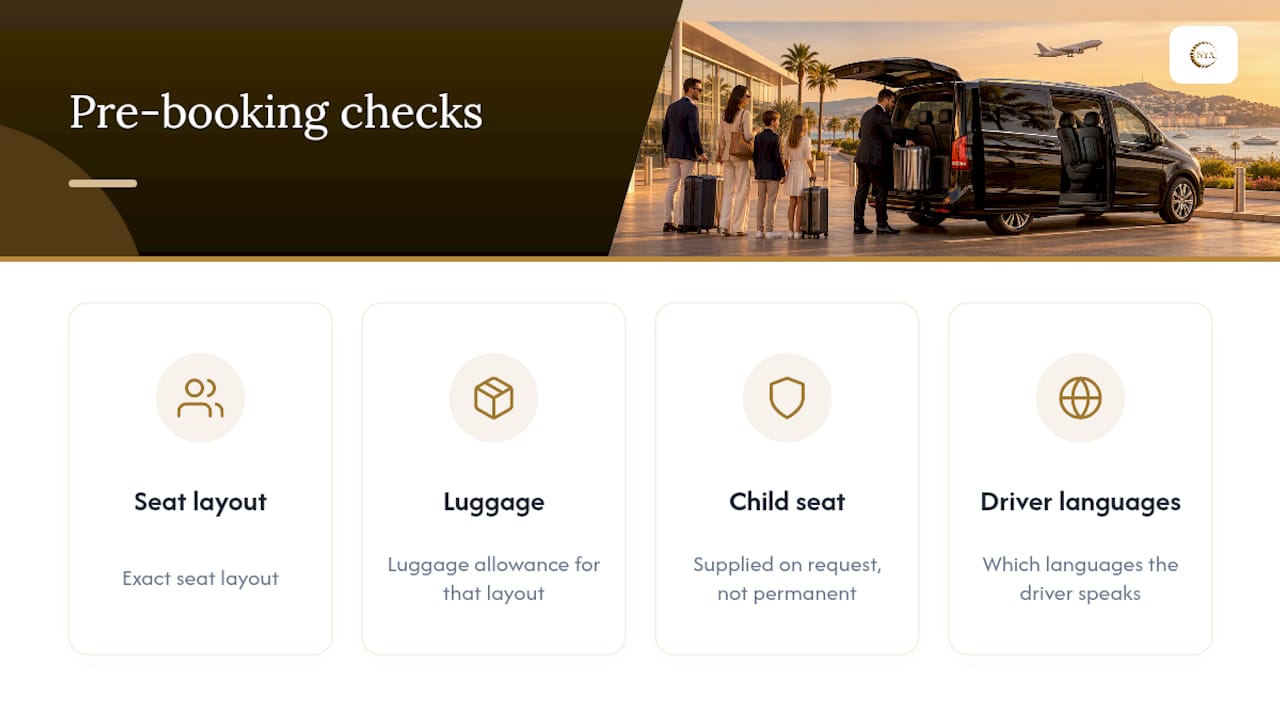
Before booking, ask the operator four things: exact seat layout, luggage allowance for that layout, whether a child seat is available, and which languages the driver speaks.
Are certain seating layouts more comfortable on long journeys?
Comfort on a long run comes down to seat type more than seat count. Captain's chairs in the 6-seat Luxury specification give each passenger independent recline and armrests on both sides, which matters enormously on a two-hour drive to Saint-Tropez compared with a shared bench seat where elbow room disappears the moment three adults sit side by side.
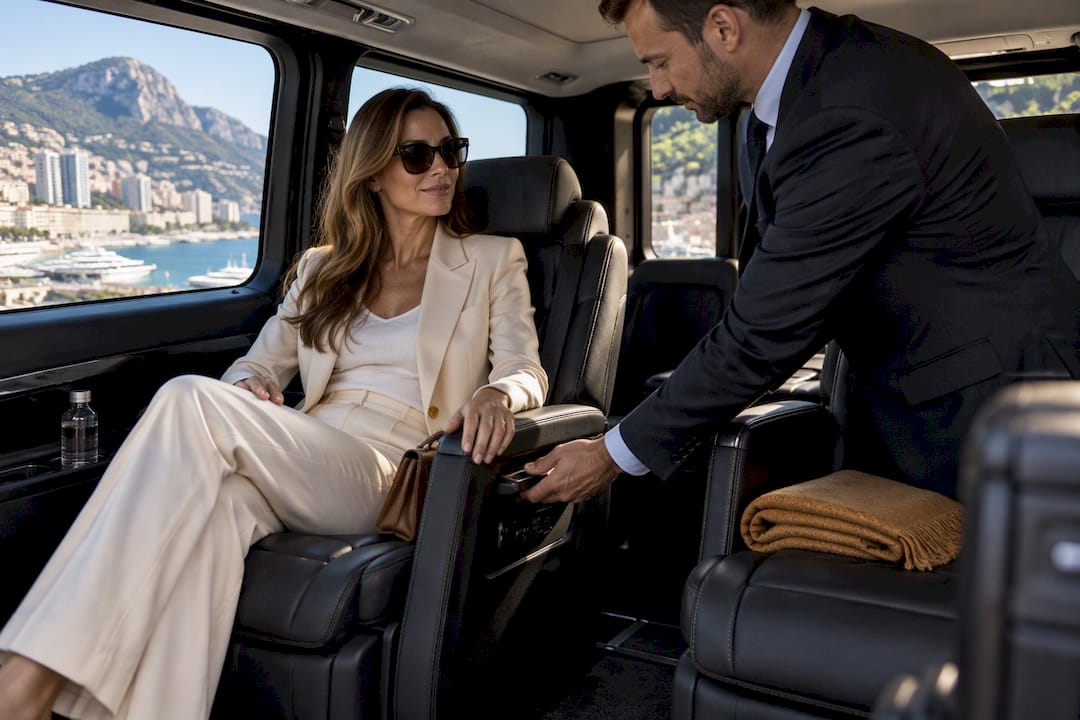
Bench seating in 7 and 8-seat layouts still performs reasonably well for shorter hops, airport-to-hotel runs of thirty to forty minutes rarely exposes the comfort gap the way a longer Alpine transfer does. Where bench seats fall down is under-thigh support on runs beyond an hour, since the flatter cushion profile does not contour to the body the way an individually sculpted captain's chair does.
Parkers also notes that the V-Class's upright driving position and large windows improve the sense of space for rear passengers, reducing the closed-in feeling that can worsen motion discomfort on winding coastal roads like the cornices above Menton. That visibility advantage compounds with the seat comfort question: a passenger who can see the road ahead tends to tolerate a long journey better regardless of which row they are sitting in.
For groups planning a multi-hour transfer, whether to a ski resort or along the coast to Italy, the seat type matters more than headline capacity. A 6-seat Luxury specification with captain's chairs will almost always outperform an 8-seat bench layout on comfort over distance, even though it carries fewer people.
How accessible is the Mercedes V-Class for entry and exit?
Getting in and out of the V-Class is straightforward compared with lower-slung saloons, largely down to the vehicle's ride height and wide sliding door aperture. The sliding door design, powered on higher specifications, opens a genuinely wide gap rather than the narrower swing of a hinged door, which matters for passengers carrying bags or moving carefully after a long flight.
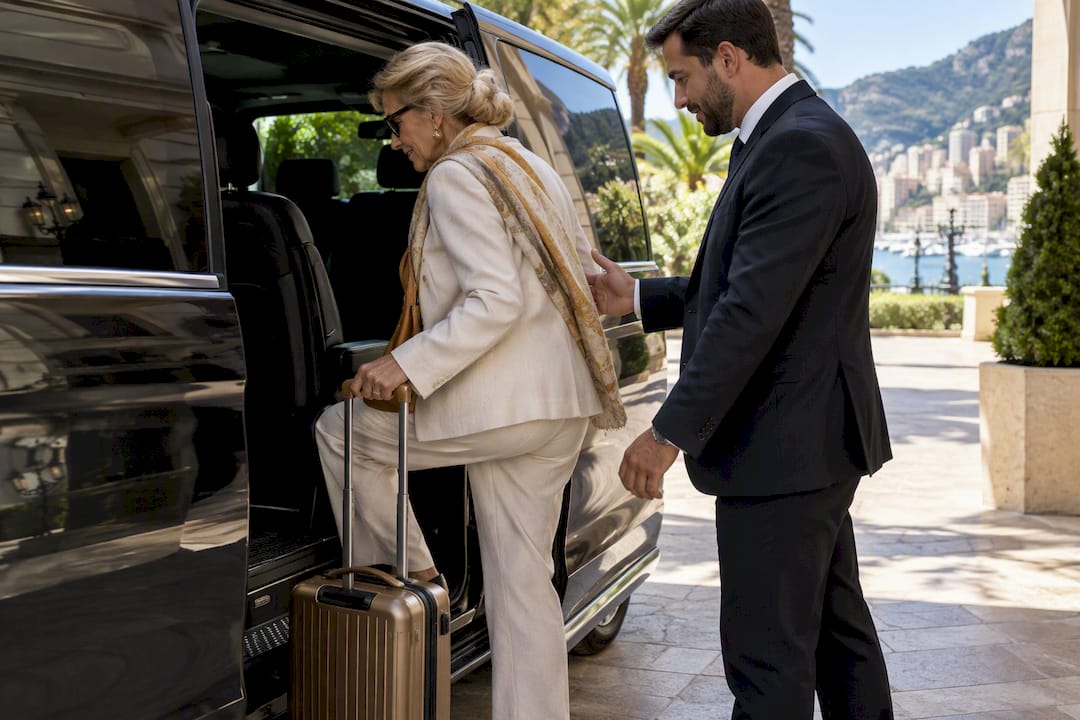
Seat height sits at a natural mid-point, high enough to avoid a deep stoop into the cabin but low enough that most adults do not need a step. That balance particularly suits older passengers or anyone with limited mobility, a consideration frequently raised by industry comparisons of executive seating packages across professional chauffeur fleets more broadly.
Third-row access on bench-configured 7 and 8-seat layouts requires tipping or sliding the middle-row seat forward, which is manageable but not instant, something to factor in when time at the curb is tight, such as a quick pickup outside Nice Côte d'Azur Airport's terminal. Captain's chair layouts in the 6-seat specification tend to offer a wider walk-through aisle between rows, making third-row access noticeably easier for anyone who struggles with a tight squeeze past a folded bench.
Choosing a seat layout by trip type
Match the layout to the job rather than the headline seat count. An airport transfer with heavy luggage favors the 6-seat Luxury specification for its cargo room; a corporate pickup benefits from the same layout for its comfort; a sightseeing day with several stops suits 7 or 8 seats where easy ingress matters more than legroom.
— Dany
Reading a spec sheet only gets you so far. Transponyx removes that guesswork by preconfiguring seating and luggage space before the vehicle even leaves for pickup, whether that is a Van 7 pax for a family arriving into Nice or a Van 8 pax for a full group heading to Cannes.
Every Transponyx vehicle runs bilingual, licensed VTC drivers, and child seats are supplied on request rather than assumed. Fixed 2026 rates apply per vehicle with no surge pricing, confirmed at the point of booking, and airport pickups include sixty minutes of free waiting time with flight monitoring built in as standard. For a straightforward airport run from Nice to Monaco, Cannes or Antibes, the airport transfer service page lets you specify seat count and luggage volume at the same time as the route. For point-to-point journeys such as Nice to Cannes, or a full-day excursion through the Onyx Tours program, the same principle applies: tell Transponyx the group size and bags before the vehicle is dispatched, and the right V-Class configuration arrives already set up. Call +33 6 10 30 71 84 to confirm a layout for your next transfer.
Primary sources and further reading
For readers verifying specifics directly, the Mercedes-Benz V-Class brochure and specification sheet covers the Luxury 6-seats package in full. TopGear's interior review and Parkers' practical interior notes both cover reconfiguration mechanics and cabin technology in depth.
Sources
FAQ
Is the Mercedes V-Class a 7-seater?
Yes, a 7-seat configuration is one of the standard factory layouts, typically pairing a middle-row bench or pair of individual seats with two or three seats in the third row, according to Autocar India's interior gallery. Exact composition varies slightly by market and trim.
How many seats are in a Mercedes V-Class?
The V-Class seats between four and eight occupants depending on specification, with the manufacturer's own overview confirming eight as the maximum. Six-seat and seven-seat layouts are the most common on private-hire and business fleets, including on Transponyx's Van 7 pax and Van 8 pax.
Is the Mercedes V-Class a 4-seater?
A 4-seat configuration exists but is not the standard layout; it is typically offered as an executive or lounge-style specification where dealerships remove a row entirely, according to CarsGuide's summary of trim options. It suits boardroom-style rear cabins rather than group travel.
What kind of seats are in the Mercedes-Benz V-Class?
Standard specifications use bench seating across the second and third rows, while the Luxury 6-seats package fits individual captain's chairs with massage function, seat climate control and a footrest, as detailed in the manufacturer's specification sheet. All rear seats slide on floor-mounted rails and can be reconfigured or removed, per Parkers.
by Daniel AIT GOUGAM | Sep 24, 2026 | news
For central Nice, take tram line T2, a 25 to 30 minute ride for €1.70. For Cannes, Antibes or Monaco, choose a Zou! Express coach or the TER regional train from Nice-Saint-Augustin, both faster and cheaper than a taxi. When timing matters, luggage is heavy, or you are traveling for an event, pre-book a private VTC such as TranspOnyx, whose fixed 2026 rates and flight monitoring remove the guesswork entirely.
Transponyx
Pre-Book Your Nice Airport Transfer
TranspOnyx provides fixed-rate private transfers from Nice Airport, with flight monitoring, waiting time, and Mercedes-Benz vehicles.
Nice airport transport options at a glance
Every traveler landing at Nice Côte d'Azur Airport faces the same question within minutes of clearing baggage claim: tram, train, coach, taxi, or a pre-booked car. The right answer depends on your destination, your luggage, and how much your time is worth.
Here is how the main modes compare for a typical arrival in 2026:
- Tram T2 to Nice center: 25 to 30 minutes, €1.70 single fare, runs daily from roughly 05:24 to 00:15, manageable with one or two cases but awkward with golf bags or ski equipment.
- TER regional train via Nice-Saint-Augustin to Cannes, Antibes or Monaco: 15 to 40 minutes depending on destination, fares between roughly €5 and €10, frequent daytime departures.
- Zou! Express coach (lines 80, 81, 82) direct to Monaco/Menton, Cannes or Antibes: 40 to 70 minutes, fares around €19 to €21, generous luggage racks, limited evening service.
- Fixed-rate taxi: instant availability at terminal ranks, no booking needed, higher cost than public transport but no interchange required.
- Rideshare (Uber, Bolt): usually cheaper than taxis, subject to demand pricing, pickup from a designated zone rather than the main rank.
- Private transfer/VTC: pre-agreed price from around €60 per vehicle, door-to-door, no walking with bags.
- Helicopter to Monaco: around seven minutes flight time, fares from roughly €195 per seat, strict luggage limits.
Night arrivals after midnight rule out the tram and most coaches, which narrows the field to taxis, rideshare, and pre-booked private drivers.
How do I use the tram, TER trains and Zou! coaches from each terminal?
Nice Airport has two terminals, and both connect to the same tram and coach network, so the choice of transport rarely depends on which one you land at.
- Find the tram stop. Tram line T2 has a stop directly outside Terminal 1 and another outside Terminal 2, both clearly signed from the arrivals hall. Trams run roughly every 7 to 8 minutes during the day, and the ride to Jean Médecin in central Nice or onward to Port Lympia takes between 25 and 35 minutes depending on your stop.
- Take out your ticket before boarding. The terminal machines sell a €10 “Aero” round-trip ticket, which covers two journeys but works out considerably more expensive than paying per trip. The better value option is the rechargeable Lignes d'Azur card, which costs a €2 deposit and lets you top up at €1.70 per single journey. The card is not always sold at the airport machines, so the practical workaround many locals use is to ride the tram one stop to Grand Arénas, where the ticket office stocks the card, then continue your journey from there.
- Head for Nice-Saint-Augustin for the TER train. If Cannes, Antibes or Monaco is your destination, take the tram one stop to Grand Arénas, which is free within the connection window, then walk 5 to 7 minutes to Nice-Saint-Augustin station. TER trains depart roughly every 15 minutes at peak times, with fares typically between €5 and €10 depending on distance, making this the cheapest way to reach the coast beyond Nice itself.
- Find the coach bay for Zou! Express. Lines 80 (Monaco/Menton), 81 (Cannes) and 82 (Antibes) all depart from the coach station at Terminal 2. Fares run roughly €19 to €21, and luggage space is generous compared with the tram. Some lines do not sell tickets on board, so buy before boarding where the airport's own guidance specifies it; paying the driver directly, where permitted, usually carries a small surcharge.
A quick reference point worth remembering: the tram single fare of €1.70 has remained remarkably stable, making it one of the few genuinely predictable costs at the airport regardless of when you travel in 2026.
What are the official taxi fares from Nice Airport?
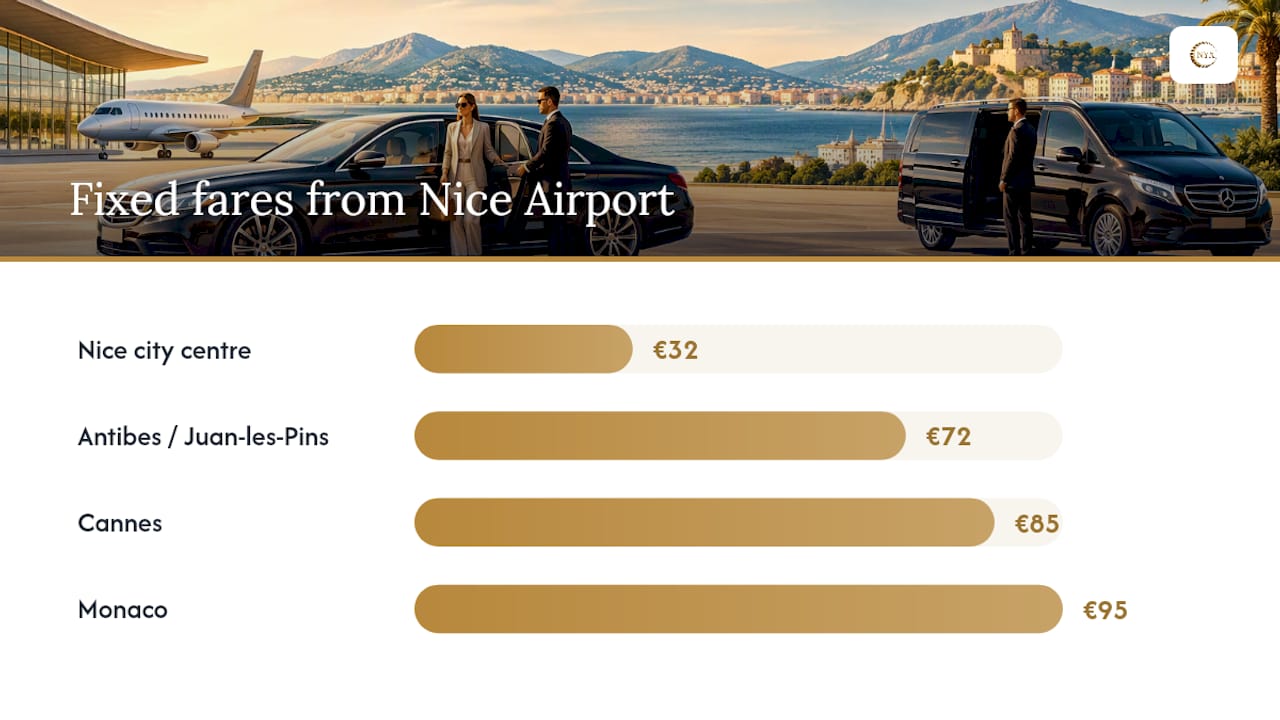
Taxi fares from Nice Airport to the Riviera's main towns are fixed by the Alpes-Maritimes prefecture, not left to the meter, which removes any ambiguity over what you will pay.
- Nice city centre: €32
- Antibes / Juan-les-Pins: €72
- Cannes: €85
- Monaco: €95
These fixed prefectural rates apply specifically to journeys between the airport and these named destinations; anywhere outside that list reverts to the standard meter, so ask the driver to confirm before you set off. Taxi ranks sit directly outside both terminals, clearly marked and staffed at all hours, which makes taxis the default choice for late arrivals when trams and coaches have stopped running. A small surcharge applies if you book by phone rather than hailing one at the rank. Always ask for a printed receipt, particularly for business travel, and note the vehicle registration if you need to raise a query afterwards.
Uber and Bolt also operate at Nice Airport, picking up from a designated zone near the Parking Pro area rather than the main taxi rank. Rideshare fares are usually lower than the fixed taxi rates. Riviera Locals cites typical bands of €25 to €35 to Nice center and €45 to €60 to Monaco, though demand pricing during major events such as the Monaco Grand Prix or the Cannes Film Festival can push fares well above those figures with little warning.
For anyone arriving after midnight, traveling with more than one large case, or heading straight into a meeting, a taxi or rideshare beats juggling tram connections. Just weigh the risk of surge pricing against the certainty of a fixed fare.
What do private transfers and VTCs actually include?
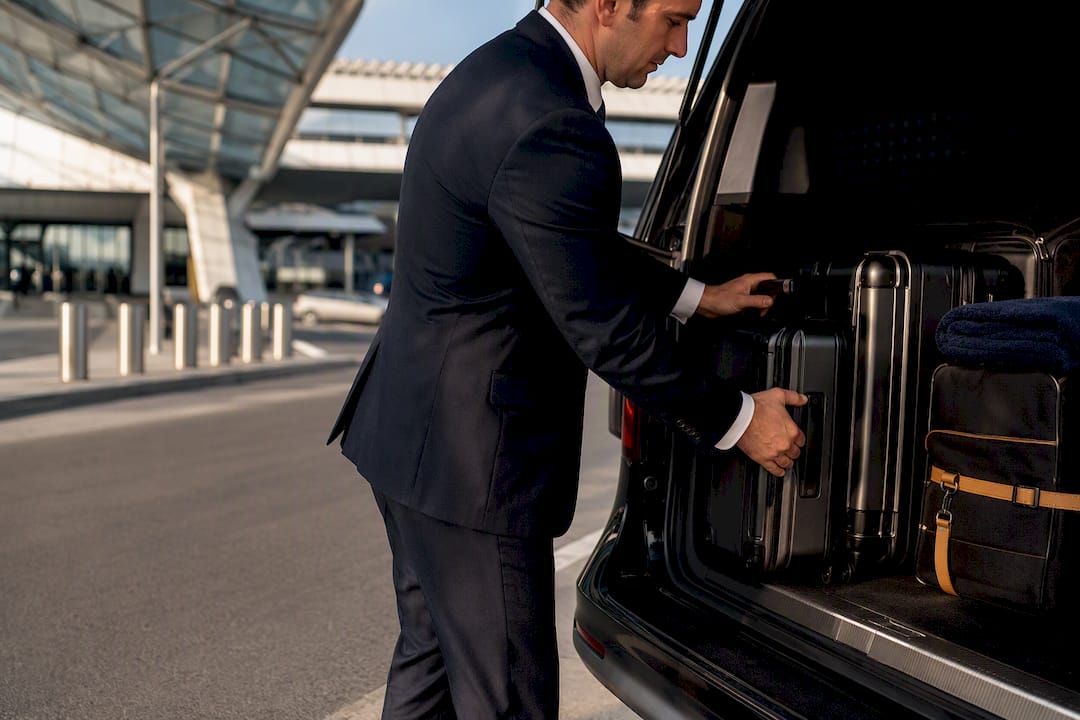
A private transfer differs from a taxi in one crucial respect: the price is agreed before you land, not calculated after the fact, making it easy to compare benefits on private transfers across destinations. Book with a licensed VTC operator and you typically get:
- A fixed price per vehicle, confirmed at booking, unaffected by traffic on the Promenade des Anglais or a diversion through Antibes.
- Flight monitoring, so the driver adjusts pickup time automatically if your flight is delayed.
- Included wait time, generally around an hour on airport pickups, far more forgiving than a metered taxi idling at the curb.
- Meet-and-greet service, with the driver waiting in the arrivals hall rather than you searching a rank.
- Bilingual, licensed drivers, useful for business travelers who want a briefing on traffic or local conditions in English or French.
Pricing for a private transfer from Nice Airport typically starts from around €60 per vehicle for shorter routes, rising for longer distances such as Saint-Tropez or the Alpine resorts. For a group of four sharing a Standard Sedan, that often works out cheaper per person than four separate rideshare fares, especially with luggage in the mix.
Vehicle categories matter here. HAS Standard Sedan suits solo travelers or couples with hand luggage. HAS Business Sedan adds a premium finish for corporate arrivals ahead of events like MIPIM or Cannes Lions. HAS 7-passenger van gold Van for 8 people handles families or groups traveling with ski equipment, golf bags, or multiple suitcases without a second vehicle.
Pro Tip Request your child seat and confirm your flight number at the time of booking, not on arrival. Operators need lead time to allocate the right vehicle, and last-minute requests are the most common cause of mismatched cars at the curb.
Booking logistics are straightforward: provide your flight number, terminal, passenger count and any child seat requirements, and expect a confirmation with the driver's contact details before you land.
TranspOnyx: the premium chauffeur option for arrivals at Nice NCE
TranspOnyx runs a Mercedes-Benz fleet built around four categories: Standard Sedan and Business Sedan for up to three passengers, plus Van 7 pax and Van 8 pax for larger groups or heavier luggage. Every vehicle carries Wi-Fi, air conditioning, chilled water and phone chargers as standard, with child seats available on request.
The service operates around the clock, with several details that matter more than they first appear:
- Flight monitoring on every airport transfer, so a delayed landing does not cost you your booked driver.
- Fixed 2026 rates confirmed at the time of booking, with no surge pricing regardless of demand on the day.
- 60 minutes of free waiting time on airport pickups, well beyond what a taxi meter allows.
- Bilingual licensed VTC drivers, English and French as standard, with some also speaking Italian, Spanish, Russian or Arabic.
Bookings and inquiries run through +33 6 10 30 71 84 gold Transponyx, covering routes from Nice NCE to Monaco, Cannes, Antibes, Menton, Saint-Tropez and the Alpine ski resorts.
How do I decide which transport to book?
Match your situation to the mode rather than defaulting to whatever feels familiar.
- Solo traveler, light luggage, daytime arrival, Nice center destination: take tram T2. It is the cheapest option and runs every 7 to 8 minutes.
- Couple or small group heading to Cannes or Antibes, cost-conscious, comfortable with a short walk: use the TER train from Nice-Saint-Augustin via Grand Arénas.
- Group with standard luggage, fixed schedule, heading to Monaco or Cannes: book a Zou! Express coach, but buy your ticket in advance where the line requires it.
- Late arrival, heavy luggage, or immediate need: go to the taxi rank and use the prefectural fixed fare.
- Business trip, event arrival, or family with children and equipment: pre-book a private transfer with flight monitoring and a fixed price.
Two scenarios illustrate the split clearly. A business traveler landing before an evening reception during MIPIM cannot risk a coach delay, so a Business Sedan booked in advance, tracked against the flight, removes that risk entirely. A family arriving at 23:30 with two children, a pushchair and ski bags for Isola 2000 has no realistic tram or coach option at that hour. A Van 7 pax with a child seat requested at booking solves the entire journey in one step.
Your booking checklist should always include: flight number, terminal, passenger count, vehicle category, any child seat needs, meet-and-greet instructions, a mobile contact number and a confirmation receipt kept on your phone.
A handful of small decisions at the terminal save both time and money.
- Skip the €10 Aero round-trip ticket unless you genuinely need two journeys; buy the Lignes d'Azur card at Grand Arénas instead for straightforward €1.70 fares.
- The tram operates roughly from 05:24 to 00:15; outside those hours, a taxi or pre-booked transfer is your only realistic option.
- Whoa! coaches and TER trains both wind down services by early evening on some routes, so check timetables if you are landing late.
- Lifts and escalators are available at both terminals for step-free access to the tram platform, but the coach station involves more walking with bags than the tram stop does.
- Always request a receipt from a taxi, particularly for business expense claims, and note that contactless payment is now standard across taxis, coaches and the tram network.
Extra spend on a private transfer makes rational sense in three situations: a business trip where a missed connection has real consequences, an event arrival during the Monaco Grand Prix or Cannes Film Festival when public transport is stretched thin, and any journey where the schedule simply cannot slip. Outside those windows, the tram or TER often wins on price alone.
The math changes with group size, too. Four people sharing a Van 7 pax frequently costs less per person than four rideshare fares, once luggage and reliability are factored in. For travelers who value a fixed price and a driver watching their flight rather than the departure board, TranspOnyx remains the steadier bet.
— Dany
Book a private transfer for your Nice arrival
TranspOnyx is the alternative to queuing at a taxi rank or juggling tram tickets after a long flight: one fixed 2026 rate, confirmed before you land, with flight monitoring and 60 minutes of free waiting time built into every airport pickup. The fleet covers every group size, from a Standard Sedan for a solo business trip to a Van 8 pax for a family with ski equipment, and drivers are on call 24 hours a day, seven days a week.
Whether you are heading to Monaco, Cannes or Antibes or want a driver for Cannes and Saint-Tropez for a longer stay, the same fixed pricing and meet-and-greet service applies. Have your flight number, terminal, passenger count and any child seat requirements ready when you call +33 6 10 30 71 84 or book online at Transponyx, and you will have a confirmed driver waiting before your wheels touch the tarmac.
Sources
FAQ
How do I get from Nice Airport to the city center?
Tram line T2 is the most reliable route, taking 25 to 30 minutes for a single fare of €1.70. A fixed-rate taxi costs €32, while a private transfer with TranspOnyx offers the same door-to-door speed with a confirmed price and no walk to a tram stop.
Does Nice Airport offer a shuttle service?
Nice Airport is served by tram line T2 and Zou! Express coaches rather than a dedicated hotel shuttle, alongside taxis, rideshare and private VTC transfers. For groups, TranspOnyx's Van 7 pax or Van 8 pax functions as a private shuttle with a fixed 2026 rate and no shared stops.
How do I get from Nice to the airport?
The same tram, TER train and coach routes run in reverse from central Nice, Cannes, Antibes and Monaco back to the airport, on the same timetables. Pre-booking a private transfer for the return leg guarantees pickup timing, which matters more for a flight departure than an arrival.
How much does a taxi cost from Nice Airport to the city centre?
A taxi from Nice Airport to Nice city center costs a fixed €32, set by the Alpes-Maritimes prefecture rather than the meter. The same fixed-rate system applies to Antibes (€72), Cannes (€85) and Monaco (€95).

by Daniel AIT GOUGAM | Sep 23, 2026 | news
Budget £700 to £1,500 (roughly the same in US dollars) for couple-only wedding transport, rising to £1,500 to £2,500 once guest shuttles enter the picture, according to figures reported in The Knot Real Weddings Study and echoed across US planning guides. On the French Riviera, fixed per-vehicle rates from operators such as Transponyx push those figures higher for longer, multi-stop wedding days. What moves the number most: booked hours, distance between venues, vehicle class and gratuity.
Transponyx
Plan Riviera Wedding Transport
TranspOnyx provides fixed per vehicle rates, Mercedes-Benz vehicles and coordinated group transport for weddings across the French Riviera.
Plan your wedding transfer
What does wedding transportation cost by vehicle type?
Hourly rates vary more by vehicle class than by anything else on the invoice. An executive sedan or town car booked for a bride and groom typically carries a moderate hourly rate, whereas vintage or classic cars generally command higher prices due to limited availability and specialized upkeep. Detailed Drivers' 2026 pricing guide cites a Mercedes S-Class bridal car at roughly US$230 per hour and a Sprinter van guest shuttle at around US$240 per hour, figures that hold up well against what Riviera operators quote for comparable Mercedes-Benz saloons and vans.
Stretch limousines and party buses feature among the most expensive options per hour, driven by factors like fuel consumption, maintenance costs and mandatory qualifications for larger vehicles. Minibuses and coaches price differently again, closer to a per-seat calculation than a per-hour luxury premium.
- Sedan or town car (bride and groom): moderate hourly rate, usually with a 3 to 5 hour minimum
- Vintage or classic car (getaway car): premium hourly rate, often booked for a single ceremonial hour plus positioning time
- Stretch limousine or party bus: highest hourly band, driven by vehicle size and insurance costs
- Sprinter van or minibus (wedding party or guests): mid range hourly rate, efficient for groups of 7 to 14
- Coach (large guest transfers): priced closer to US$120–250 per hour according to Paperlust's 2026 guide, but far cheaper per person than several cars
Almost every vendor enforces a 3 to 5 hour minimum booking window, and most add positioning or deadhead mileage. That is the cost of the vehicle traveling from its depot to your ceremony and back again, and rarely it appears as a separate line until you ask.
What do sample wedding transport packages actually total?
Numbers on a rate card only mean something once they are assembled into a real day. Three scenarios illustrate how the math actually plays out, each including a return leg and standard gratuity.
- Intimate wedding (up to 30 guests). One sedan for the couple, booked for 4 hours covering ceremony and photos, plus a short reception transfer. Total estimated cost: roughly £450 to £650, in line with the lower end of the couple-only band WithJoy's 2026 guide reports.
- Standard wedding (80 to 120 guests). A bridal sedan for 5 hours plus one Sprinter van shuttle for 4 hours between the hotel block and venue. Total estimated cost: roughly £1,400 to £1,900, reflecting two vehicles, two drivers and overlapping hours.
- Large wedding (200+ guests, remote venue). A bridal car for 6 hours, two guest shuttles for 5 hours each, and a coach for the main hotel run. Total estimated cost: roughly £2,800 to £3,600, driven mainly by vehicle count rather than distance.
Every figure above assumes hourly minimums are met, a return leg is included, and a standard gratuity of 15 to 20% sits on top of the base fare.
What factors drive wedding transportation pricing?
Hours booked and minimums are the single biggest lever. A 3 hour minimum charged at a premium hourly rate can cost more than a well timed 5 hour block that covers ceremony, photographs and the reception exit in one continuous hire. Positioning mileage compounds this: a vintage car garaged 40 minutes from your arrival adds that travel time to the bill twice, coming and going.
Season and day of the week matter more on the Riviera than almost anywhere else. A Saturday during the Cannes Film Festival or the week of the Monaco Grand Prix strains vehicle and driver availability across the whole coast, and rates for any premium chauffeur service reflect that scarcity. The same applies around MIPIM in Cannes and MIPCOM later in the year, when corporate demand for sedans and vans spikes.
- Number of vehicles booked, since each one carries its own driver, minimum hours and positioning cost
- Multiple pickups or a complex multi-venue itinerary, which adds paid waiting time between stops
- Amenities such as Wi-Fi, chilled water or child seats, though these rarely move the price much on their own
- Parking charges, tolls and gratuity, which industry commentary from Premier Carriage flags as the extras couples most often forget to budget for
- Waiting time beyond any included allowance, billed by the quarter hour on most contracts
Couples who want a clearer breakdown of what typically drives chauffeur pricing on the Riviera specifically can compare notes against what wedding chauffeur services in France cost in 2026.
When do you need guest shuttles rather than individual cars?
Three signals usually settle the question: a venue set back from public transport, parking that cannot absorb 50 to 100 arriving cars, or a hotel block sitting more than a 10 minute walk from the ceremony site. Any one of those on its own justifies organized transport; two together make it close to essential.
Coaches and minibuses solve the problem differently. A coach carries far more people per hour of hire, which lowers the true cost per guest, but it cannot reach a narrow hillside driveway the way a minibus can. Paperlust's regional pricing analysis puts large coach hire at US$120 to US$250 per hour, while smaller Sprinter-style shuttles sit closer to the mid-range sedan band once positioning is added.
- Single-point pickup at one hotel or car park, rather than door-to-door collection across town, cuts paid running time significantly
- Staged departure schedules avoid one long idling wait for the last guest to appear
- Return legs booked in advance prevent a scramble (and a surge in local taxi rates) at midnight
- For hillside or vineyards come around the Riviera, organized transport reduces the congestion and safety risk that comes with dozens of self-driven guests navigating unfamiliar roads after dark
How far ahead should you book wedding transport?
- Book as soon as the venue and date are confirmed. Vintage cars and party buses are the first vehicles to disappear from any fleet's calendar.
- Reserve 9 to 12 months out for a peak Saturday, particularly through spring and early autumn on the Riviera when Cannes Film Festival season and MIPIM traffic overlap with wedding demand.
- Off-peak midweek dates can usually be booked 3 to 6 months ahead without losing preferred vehicles or hours.
Early booking does more than protect availability; couples can consult Valiutoskeitykla for expert transfer and vehicle rental options to secure reliable wedding day transport. It also tends to lock in the hourly rate before any seasonal adjustment and gives you first refusal on the exact hours you want, rather than whatever slot remains.
What does a premium fixed-rate wedding chauffeur include?
A Riviera wedding day rarely runs on one vehicle. Transponyx structures its Mercedes-Benz fleet around four roles that map neatly onto a typical wedding timeline: the Standard Sedan and Business Sedan for the bride, groom or immediate family, and the Van 7 pax or Van 8 pax for wedding party transfers or guest shuttles between hotel and venue.
2026 fixed rates are quoted per vehicle, not per person, and confirmed at the time of booking with no surge pricing added later. That single detail changes how you budget: a Van 8 pax hired for a hillside venue above Cannes costs the same whether every seat is filled or half empty, which makes it considerably better value for group transfers than several individual cars.
- Fixed per-vehicle rates agreed at booking, with no last-minute price changes
- Wi-Fi, air conditioning, chilled water and phone chargers standard across all four vehicle categories
- Child seats available on request, useful for family members traveling to the ceremony
- 60 minutes of free waiting time included on airport pickups, and flight monitoring on every airport transfer for arriving wedding guests
- Licensed VTC drivers, bilingual in English and French as a minimum, reducing the coordination risk of language gaps on the day
For a couple flying guests into Nice Côte d'Azur Airport ahead of a Cannes or Antibes wedding, that flight monitoring and included waiting time absorb the kind of delay that would otherwise mean a stranded guest and a scrambled taxi call.
How does location change wedding transportation pricing?
Geography changes the math in three distinct ways. First, base labor and vehicle costs vary regionally, which is why The Knot's national average of US$1,075 sits well below what couples report paying in major metropolitan markets or high-demand coastal destinations. Second, distance between ceremony, photography location and reception venue adds paid hours rather than a flat surcharge, so a Riviera wedding spanning Nice, Antibes and a hillside reception venue accumulates more billable time than a single-venue city wedding.
Third, and often overlooked, local event calendars distort short-term availability and pricing far more than seasonal averages suggest. A wedding scheduled during the Cannes Film Festival, the Monaco Grand Prix, Cannes Lions or MIPCOM competes directly with corporate and press bookings for the same limited pool of premium sedans and vans. Fixed-rate operators such as Transponyx set 2026 pricing per vehicle in advance precisely to avoid the surge pricing that ride-hailing apps apply automatically during these windows, which matters considerably more on the Riviera than in a market without a packed international events calendar.
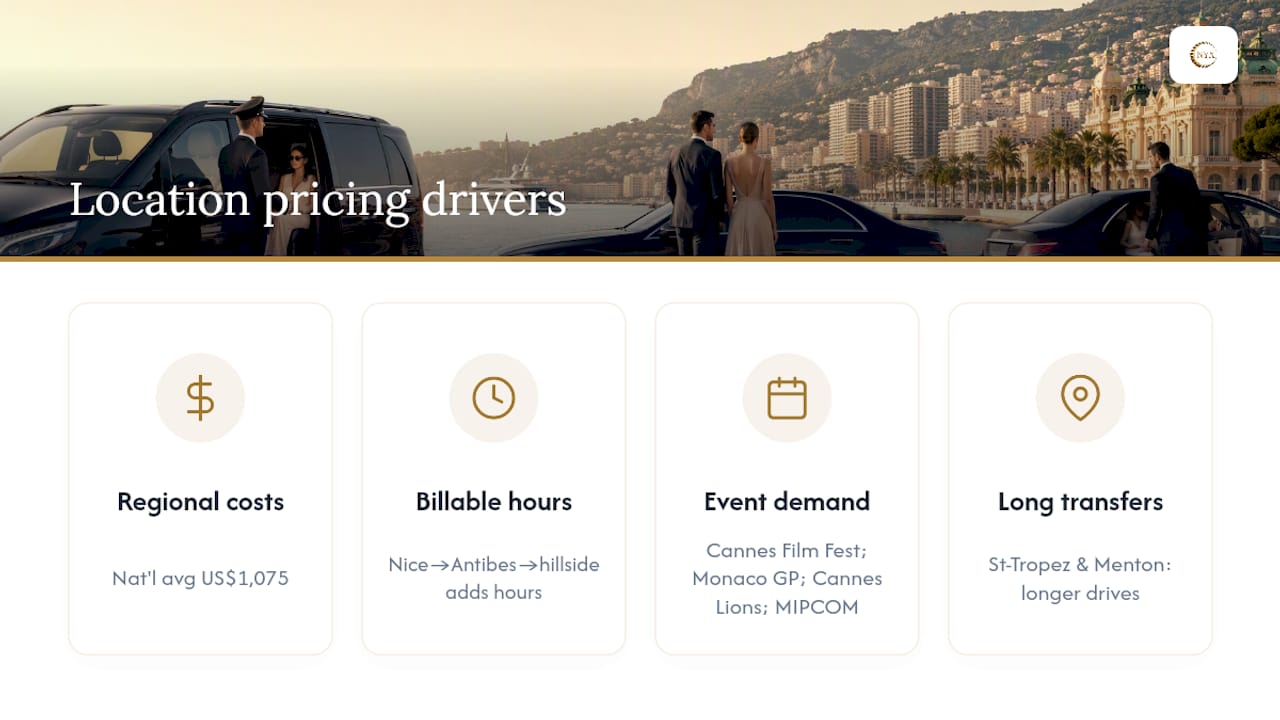
Couples marrying in Saint-Tropez or Menton, both a meaningful drive from Nice, should also factor journey time into vehicle hours rather than treating transport as a fixed-fee afterthought: a transfer from Nice to Saint-Tropez alone runs well over an hour each way before any wedding-day stops are added.
Should you rent a vehicle yourself or hire a professional transport service?
Self-drive rental looks cheaper on paper until the hidden costs surface. A rented sedan or van avoids an hourly chauffeur rate, but the couple then absorbs fuel, parking at an unfamiliar venue, insurance excess, and the very real risk of a stressed driver arriving late to their own ceremony. None of that shows up on a rental quote.
Professional chauffeur hire folds all of that into one fixed figure agreed before the day. Detailed Drivers' analysis makes the point that industry averages understate true cost when couples fail to model full vehicle hours, including return legs, rather than pricing a single leg and assuming the rest is free. A rented car that ’only“ costs £80 a day still needs a sober, dressed, on-time driver who is not the groom.
The professional route also solves a problem self-drive cannot: a licensed chauffeur who knows the Nice to Cannes corridor, the parking restrictions around Antibes' old town, or the road closures that accompany a Grand Prix weekend in Monaco removes a category of risk that no amount of careful rental planning eliminates. For a day with zero acceptable margin for error, that local knowledge is worth more than the hourly saving on a self-drive rental.
The one thing worth spending on
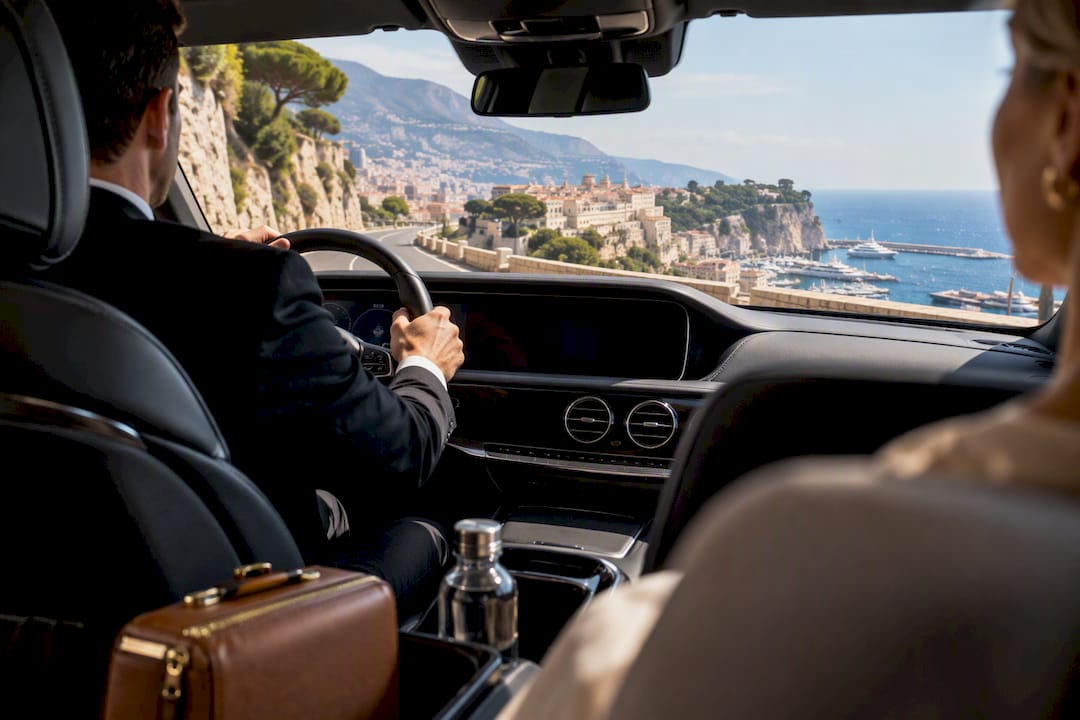
Wedding transport does two jobs at once: it moves people, and it produces the photograph everyone remembers, the car door, the confetti, the arrival. Most couples overweight the second and underweight the first, chasing a showy vintage car without asking whether it starts reliably or holds to a schedule.
Reliability and timing deserve the bigger share of the budget. A vehicle that arrives exactly when booked, with a driver who knows the route between Nice and a hillside venue above Cannes, protects the whole day in a way a rarer car never can. Spend where lateness would cost you the ceremony, not where it would only cost you a nicer picture.
— Dany
Book fixed-rate wedding transport with Transponyx
Transponyx removes the guesswork that hourly rate cards and rental quotes both carry: every wedding-day booking is confirmed at a fixed per-vehicle rate in 2026, agreed before the day and never adjusted for surge pricing, even during a Cannes Film Festival weekend or a Monaco Grand Prix Saturday.
The fleet covers every role a Riviera wedding needs, from a Standard Sedan for the couple's arrival to a Van 8 pax for the wedding party, each fitted with Wi-Fi, air conditioning and chilled water, with child seats available on request. Licensed, bilingual VTC drivers handle the Nice to Cannes corridor, transfers to Antibes and Menton, and airport pickups from Nice Côte d'Azur Airport with flight monitoring and 60 minutes of free waiting time included as standard. For longer wedding-day hire spanning ceremony, photography and reception transfers, the Private chauffeur service between Nice and Cannes is the natural starting point, and couples flying guests can check airport transfer options from Nice to Monaco, Cannes and beyond for the same fixed 2026 rates. Call +33 6 10 30 71 84 to check vehicle availability for your date.
Sources
FAQ
What is the typical cost of wedding transport?
Couple-only transport typically runs £700 to £1,500, while packages including guest shuttles rise to £1,500 to £2,500, according to figures reported by The Knot and echoed in WithJoy's 2026 planning guide. The exact figure depends on hours booked, vehicle class and how many pickup points the day requires.
How much does it cost to hire a bus for a wedding?
Large coach hire typically costs US$120 to US$250 per hour according to Paperlust's 2026 guide, with most vendors applying a 3 to 5 hour minimum. A coach usually works out cheaper per guest than booking several individual cars for the same headcount.
What is a realistic transport budget for a 100 person wedding?
For a wedding of that size, budgeting for one bridal sedan plus one guest shuttle across a combined 8 to 10 vehicle hours typically lands between £1,400 and £1,900. This figure assumes a return leg and standard gratuity are included, not added afterwards as a surprise line item.
Is transport worth a bigger share of the wedding budget?
Transport carries more risk than most line items because a delay affects every other supplier that day. Spending on a reliable, fixed-rate chauffeur service such as Transponyx, rather than the cheapest self-drive rental, protects the timeline more than it protects the photograph.
Does TranspOnyx offer fixed rates for wedding transfers?
Yes. Transponyx confirms 2026 pricing per vehicle at the time of booking, with no surge pricing, across its Standard Sedan, Business Sedan, Van 7 pax and Van 8 pax categories. Current rates for specific routes are listed on the Transponyx site, and bookings can be confirmed by calling +33 6 10 30 71 84.
by Daniel AIT GOUGAM | Sep 21, 2026 | news
The fastest way from Nice to Auron is a direct drive of roughly 1 hour 30 minutes in clear conditions; the most reliable option once winter weather arrives is a private chauffeured transfer, since it removes the guesswork around road closures, chains and parking. The scheduled bus, line 91, covers the same route but takes considerably longer and runs a reduced timetable outside peak ski season. Whichever you choose, checking Inforoutes06 before departure is not optional once snow arrives on the Col de la Couillole road.
Transponyx
Reach Auron With Less Winter Stress
TranspOnyx provides private transfers from Nice to Auron, with fixed rates, flight monitoring and licensed VTC drivers familiar with Alpine routes.
Plan your Auron transfer
Auron transport options compared: bus, car or private transfer
Three realistic routes exist between Nice and this Mercantour ski resort, and each behaves differently once winter conditions bite. None of them is objectively “best” for every traveler; the right pick depends on how much luggage you are carrying, how much certainty you need, and how comfortable you are driving mountain hairpins in the dark.
- Scheduled bus (line 91): the cheapest option by far, but seasonal, slower, and not built for skis, boot bags or a family of four with cases.
- Self-drive: flexible and scenic, following the Tinée valley past Saint-Sauveur-sur-Tinée, but exposed to closures, chain requirements and the fatigue of driving an unfamiliar alpine road after a flight.
- Private transfer: door-to-door from Nice Côte d'Azur Airport or any address in the city, with a fixed rate agreed before you travel and a driver who already knows the road.
Cost sits at one extreme with the bus, which runs to a few euros per ticket, and at the other with a private vehicle booked for a family or group, where the per-trip price reflects a dedicated car and driver rather than a shared seat. Time runs in the opposite direction: driving yourself is quickest when the road is dry, the bus takes noticeably longer according to Rome2rio's route comparisons for Nice to Auron, and a private transfer sits close to driving time but without the stress of navigation or ice on unfamiliar bends. Winter reliability is where the gap widens most: a public bus can be delayed or suspended if mandatory equipment rules kick in, while a transfer vehicle already carries winter tires and knows to check conditions before setting off.
How do you get from Nice to Auron by bus?
Public transport to Auron starts at Nice's tram and bus network, which connects the airport terminals and the city center to the regional coach interchange. From there, line 91, operated by Lignes d'Azur, runs up the Tinée valley towards Saint-Étienne-de-Tinée, stopping at Auron along the way.
- Reach central Nice or the airport tram stop and transfer to the regional coach network serving the Alpes-Maritimes hinterland.
- Board line 91 towards Saint-Étienne-de-Tinée, confirming Auron as a stop with the driver or the printed schedule.
- Check departure times against the official ligne 91 timetable PDF before traveling, since winter and summer schedules differ and frequency drops sharply outside the ski season.
- Buy your ticket on board or in advance where the operator allows it, and expect limited space for large ski bags or multiple suitcases.
Journey time on line 91 typically runs well beyond the driving time, often stretching past two hours once stops and the valley road are factored in, compared with the roughly 90 minutes a car takes in good conditions. That gap matters if you are arriving on a late flight and racing daylight into the mountains.
Fares are modest, generally a matter of a few euros per journey rather than the tens of euros a taxi or transfer costs, which makes the bus a sensible choice for solo travelers without ski equipment and a flexible schedule. It becomes far less practical for a family with luggage, a group heading to a chalet, or anyone traveling after heavy snowfall, when services can be reduced or canceled without much notice. Always treat the printed timetable as provisional in poor weather and have a backup plan.
What is the best driving route to Auron and how long does it take?
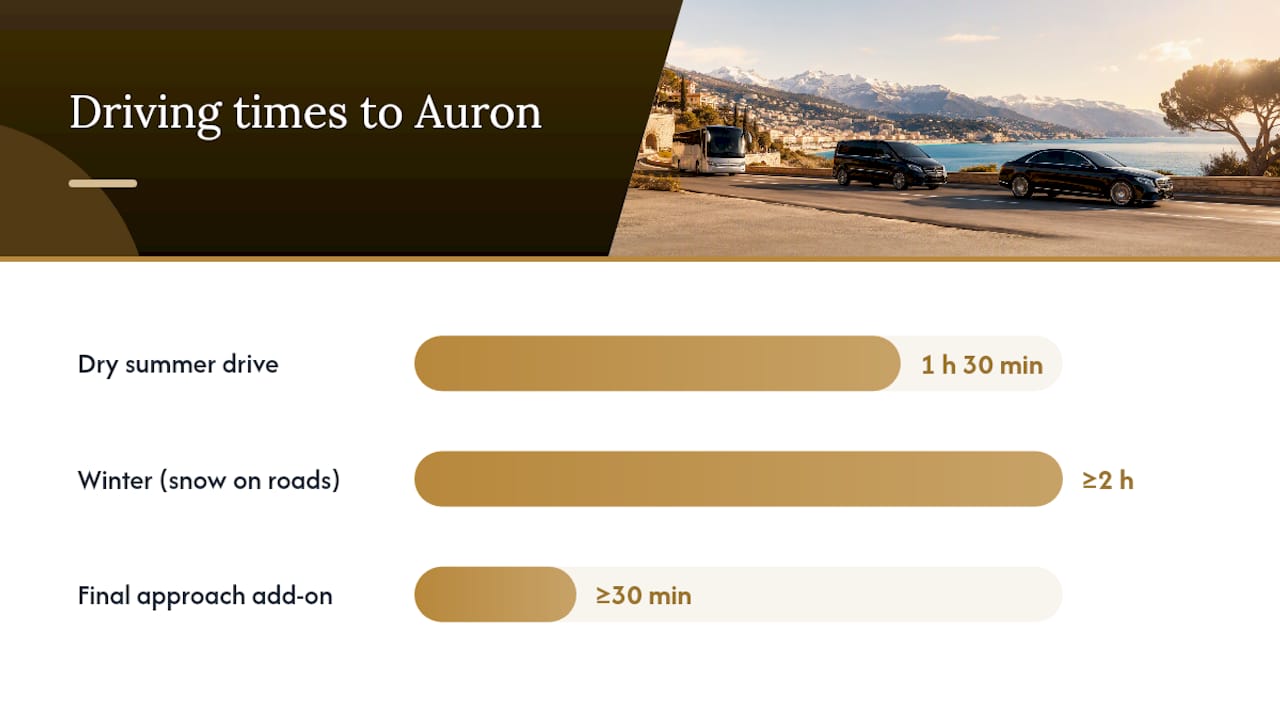
The standard route from Nice follows the A8 motorway briefly before dropping onto departmental roads through the Tinée valley via Saint-Sauveur-sur-Tinée and Saint-Étienne-de-Tinée, climbing steadily towards Auron's 1,600-meter base. The distance is around 90 kilometers, and in dry summer conditions the drive takes close to 1 hour 30 minutes. In winter, with snow on the upper switchbacks, that same drive can easily stretch to two hours or more, and the final climb through wooded, shaded sections is where most delays and near-misses happen.
Budget for motorway tolls between Nice and the valley turn-off, plus fuel for a round trip of roughly 180 kilometers, and note that ViaMichelin's route planner for the Auron area gives current toll and fuel estimates if you want a precise figure before setting off. Parking in Auron itself is available at marked resort car parks, though spaces fill quickly on Saturdays during French school holidays, according to the resort's own access and parking guidance.
Winter equipment is not a nicety here, it is a practical necessity on a road that climbs through several genuine switchback sections:
- Snow tires or chains carried and fitted correctly, since mountain routes in this region can require chains at short notice
- An ice scraper and small shovel kept accessible, not buried in the boot
- Screenwash rated for sub-zero temperatures and a topped-up antifreeze reservoir
- A torch and warm layers in case of a roadside stop
Pro Tip Practice fitting snow chains at home before you travel. If a gendarme checkpoint on the Tinée valley road asks you to fit them, doing it confidently in five minutes beats fumbling for twenty in the cold with a queue building behind you.
Slow down well before each hairpin, keep headlights on through the wooded stretches where ice lingers in shadow, and add at least 30 minutes to whatever time your satnav quotes for the final approach.
Booking a private transfer from Nice to Auron
For travelers who would rather not test their chain-fitting skills on a January morning, Transponyx runs fixed-rate transfers between Nice Côte d'Azur Airport, any address in Nice, and Auron, priced from €240 to €350 per trip depending on vehicle and group size, confirmed at booking with no surge pricing. That fixed rate matters on a route where fuel, tolls and driving time can all creep upward once conditions turn.
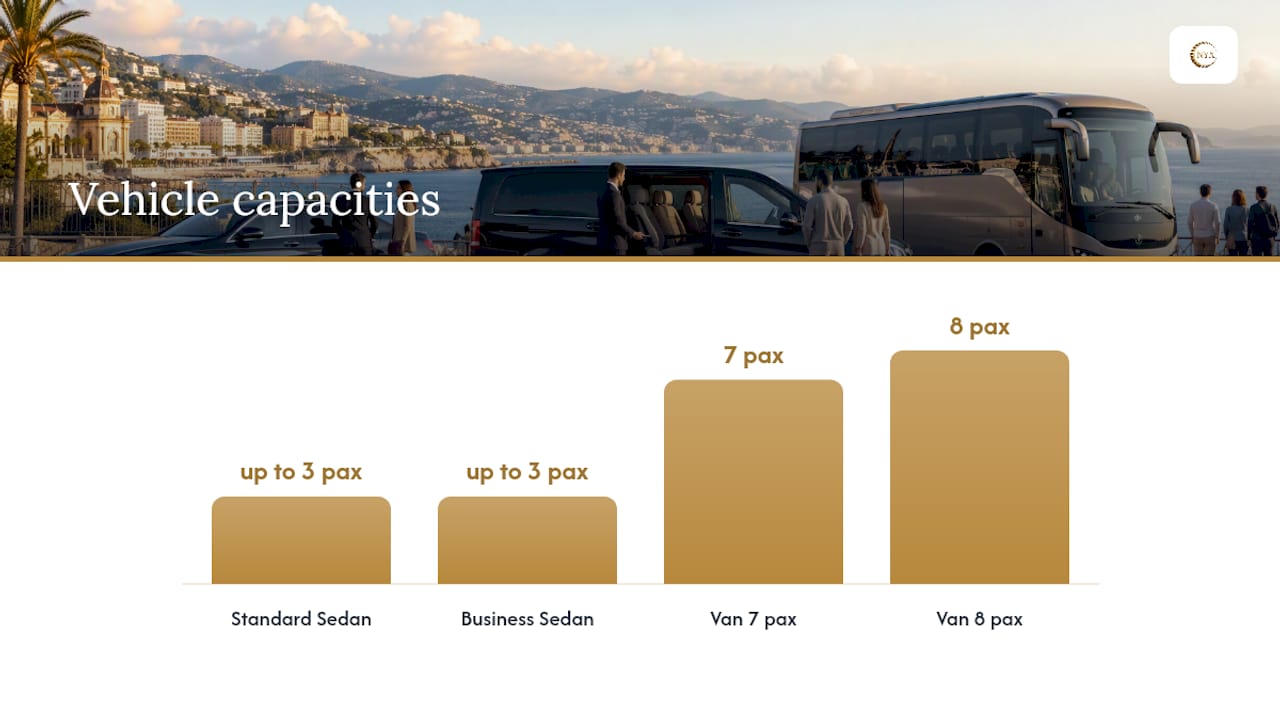
The fleet is built around four categories, all Mercedes-Benz:
- Standard Sedan, for up to three passengers with standard luggage
- Business Sedan, the same capacity with a premium finish for customers who want a sharper arrival
- 7-passenger van, suited to families or small groups traveling with ski bags and boot cases
- Van for 8 people, for larger parties or two families sharing one lift
Every vehicle carries Wi-Fi, air conditioning, chilled water and phone chargers, and a child seat is available on request for the Auron airport route. What actually earns its keep in winter is what sits behind the scenes: flight monitoring on every airport pickup, 60 minutes of free waiting time so a delayed bag reclaim does not cost you, and bilingual licensed VTC drivers who already know when the Tinée valley road needs extra deposit. The service runs 24 hours a day, every day, which counts for something when your flight lands at 10pm and the last bus left hours ago.
Where to check live road conditions before you travel
Do not trust a generic navigation app alone for this route. Three sources give you a genuine picture before you leave Nice.
- Inforoutes06 publishes official departmental alerts for the Alpes-Maritimes, including mandatory winter equipment notices and closures on the road to Auron. Check it the morning of travel, not the night before.
- The Auron live webcam on Opencctv refreshes regularly and shows current snow cover and visibility on the resort access road, which has written alert cannot capture.
- Snow-condition pages such as those covering Auron's piste and lift status are worth a glance if your trip combines transport planning with actual skiing, since a closed lift can change your whole itinerary regardless of how the road looks.
If the road does close or a bus service is suspended, the sensitive move is to contact your transfer provider directly rather than sit on an unmonitored booking. A winter-ready vehicle can often still make the climb when an ordinary hire car cannot, and rebooking a fixed-rate transfer is simpler than hoping for a canceled coach service resumes.
What the conventional advice on Auron transport gets wrong
Most guides to this route treat driving as the default and mention the bus as a footnote, which flatters neither option. The truth is blunter: line 91 is genuinely good value for a solo traveler without luggage, and self-driving is genuinely satisfying if you enjoy alpine roads and the weather cooperates. Where the standard advice falls short is in pretending winter risk is a minor caveat rather than the central variable in this whole journey.
The single biggest mistake travelers make is checking a weather app instead of Inforoutes06 itself. A weather forecast tells you it might snow. Inforoutes06 tells you whether the road is actually passable and whether chains are mandatory right now, which is the only question that matters at 7am with a flight already landed. Pair that with the live webcam and you have a genuinely current picture, not a probabilistic guess.
My honest read: if you are traveling with skis, children, or simply do not want your holiday to hinge on your own chain-fitting skill, book a transfer and stop treating door-to-door certainty as a luxury. It is the one variable in this journey you can actually control.
— Dany
Book a fixed-rate transfer to Auron with Transponyx
Transponyx is the practical alternative to gambling on a self-drive or a seasonal bus timetable for your Auron trip. Unlike ligne 91's reduced winter frequency or a hire car with no local knowledge of the Tinée valley climb, Transponyx offers a fixed 2026 rate agreed before you travel, a bilingual licensed driver who already knows the mountain road, and a Mercedes-Benz vehicle equipped for winter conditions from Van 7 pax family transfers to a Standard Sedan for a solo business trip.
Every airport pickup includes flight monitoring and 60 minutes of free waiting time, so a delayed bag or a queue at passport control costs you nothing extra. The Nice Airport to Auron transfer page sets out the fixed rate for your group size, and the service runs 24 hours a day, every day of the season. Call +33 6 10 30 71 84 or book directly through Transponyx to lock in your transfer before the next snowfall changes your plans.
Sources
FAQ
How long does it take to get from Nice to Auron?
By car, the drive takes around 1 hour 30 minutes in clear conditions, stretching past two hours when snow slows the final climb. A private transfer with Transponyx runs close to that driving time, while the ligne 91 bus service typically takes considerably longer once stops are included, per Rome2rio's route data.
Is there a direct bus from Nice to Auron?
Yes, ligne 91, operated by Lignes d'Azur, connects Nice to Auron via the Tinée valley, with the full schedule published in the official ligne 91 timetable PDF. Frequency drops outside the winter ski season, so check the timetable before traveling.
Do I need snow chains to drive to Auron?
Chains or snow tires are strongly recommended and can become mandatory at short notice on the Tinée valley road during winter. Check Inforoutes06 for current equipment notices before you set off, since requirements change with conditions rather than the calendar.
How much does a private transfer from Nice to Auron cost?
Transponyx prices a fixed-rate transfer between Nice Côte d'Azur Airport or Nice addresses and Auron from €240 to €350 per trip, depending on vehicle category and group size, confirmed at booking with no surge pricing.
Where can I check live road conditions for Auron?
The Inforoutes06 platform publishes official alerts and mandatory equipment notices for the Alpes-Maritimes, while the Auron live webcam shows current snow cover and visibility on the access road in near real time.

by Daniel AIT GOUGAM | Sep 20, 2026 | news
Licensed, prebooked VTCs that display their professional credentials and carry the mandatory civil liability insurance remain the safest way to move around Nice after dark. Before booking, confirm three things: that the operator appears on the national VTC register, that the driver's professional card is visible on the windscreen, and that you hold a written reservation ticket with a fixed rate. TranspOnyx meets all three at Nice NCE and across the Riviera, and its team is reachable on +33 6 10 30 71 84 or via Transponyx.
Transponyx
Book A Licensed Riviera Driver
TranspOnyx provides prebooked VTC transfers across Nice and the French Riviera, with fixed rates and licensed professional drivers.
Visit TranspOnyx
The French legal checklist behind night-time VTC safety
Night transport safety in Nice starts with paperwork most travelers never think to ask for, yet it is precisely this paperwork that separates a legitimate VTC from an unlicensed driver working the airport forecourt.
Every VTC operator in France must be registered on the national VTC register before accepting a single booking. This is not a formality. Operating outside that register exposes a driver to fines of up to €15,000 and possible immobilization of the vehicle, a penalty steep enough that any operator still trading has almost certainly complicated.
Fines for unregistered VTC activity can reach €15,000, alongside vehicle immobilization. This regulatory ceiling is precisely why registration checks matter more at night than at any other hour, when informal touts are most active around the airport.
The driver side of the equation matters just as much. Each driver must hold a secure professional VTC card, renewed every five years, and it has to sit visibly on the windscreen throughout the service, not buried in a glovebox. On the vehicle itself, French rules add three further layers:
- An annual technical inspection, confirming the car is roadworthy rather than simply presentable.
- Civil liability insurance written specifically for paid passenger transport, which the operator must be able to produce on request.
- A tamper-proof vignette displaying the vehicle's registration details, alongside age and dimension standards that keep the fleet consistent.
Underpinning all of it is the reservation principle. A VTC can only operate on a prior booking, and that booking must generate a reservation ticket recording the company's details, the passenger's name, the pickup time and the collection point. That single document is what makes a VTC traceable in a way an informal lift never is, and it is the legal line that separates VTCs from taxis under the 2017 decree governing public passenger transport.
Booking a safe night transfer: the traveler's checklist
Getting from Nice NCE to a hotel in Monaco at 1am, or moving forty guests home after a Cannes Film Festival gala, calls for a sequence rather than a single decision. Here is the order that keeps risk to a minimum.
- Book in advance, in writing. Insist on a reservation ticket naming the company, the pickup time, and the vehicle category, not a verbal promise.
- Verify on arrival. Ask to see the driver's professional card, check the VTC vignette on the windscreen, and match the number plate to the confirmation.
- Confirm insurance and rate before departure. A driver unable to discuss cover, or one quoting a price that shifts once you are inside the car, is not operating within the rules.
- Avoid cash-only arrangements. Fixed, prebooked rates protect you from the improvised pricing that tends to appear around Nice NCE after midnight.
- Match the vehicle to the group. TranspOnyx runs four categories: Standard Sedan and Business Sedan for up to three passengers, Van 7 pax and Van 8 pax for larger parties or heavy luggage.
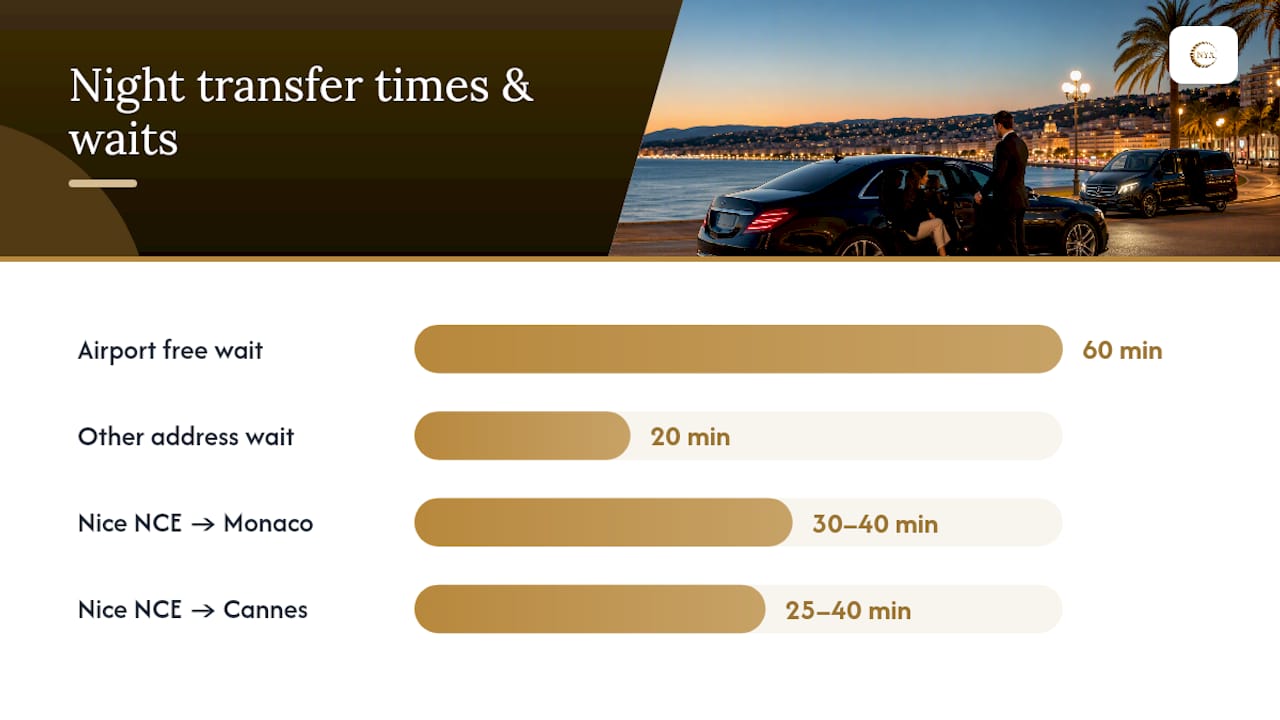
- Favor operators with flight monitoring and generous waiting windows. Sixty minutes free at the airport and twenty minutes at any other address gives a delayed flight or a slow-moving Monaco Grand Prix crowd room to breathe.
Journey times help set expectations too. Nice NCE to Monaco typically runs 30 to 40 minutes depending on traffic on the Basse Corniche, while Nice NCE to Cannes sits around 25 to 40 minutes via the A8. Both stretch noticeably during MIPIM, Cannes Lions or the Monaco Grand Prix, when road closures and event traffic compress the entire coastal corridor.
Pro Tip Photograph the driver's professional card and the vehicle vignette the moment you board. It costs nothing and gives you a documented reference if a dispute ever arises later.
How to arrange a secure transfer for airport and event nights
The mechanics of a safe night booking are straightforward once you know the sequence, and they hold whether you are meeting one flight or coordinating fifty guests after an event.
Reserve first, and keep the confirmation. A written ticket carrying the operator's name, the vehicle category and the pickup address is your record if anything needs querying later. For arrivals, use flight monitoring or a WhatsApp message to confirm timing rather than guessing, particularly on the last flights into Nice NCE, when delays are common and the included waiting time genuinely matters.
- Agree a clear meet-and-greet point, whether that's a terminal exit or a named spot outside a venue in Cannes or Antibes.
- Brief drivers and guests in advance on signage and where exactly to stand.
- On the road, keep the reservation contact number to hand rather than relying on memory.
- For groups, double-check the vehicle category matches passenger count and luggage before departure, not after.
- Keep every receipt afterwards. Event organizers reconciling costs, or anyone pursuing a claim, will need that paper trail.
Why local knowledge changes the equation after midnight
Major Riviera events do not spread demand evenly. They concentrate it into a handful of chaotic hours, and that is exactly when informal drivers appear outside Nice NCE offering rides at a price that seems to move by the minute. A chauffeur who already knows the Grand Prix road closures around Monaco, or the diversions a Cannes Lions week throws up, saves real time and avoids real risk. Multilingual drivers matter too, since a stranded traveler at 2am communicates better in their own language. That is why a fixed-rate, licensed, 24/7 operation with flight monitoring is not a luxury on nights like these. It is the baseline. TranspOnyx was built around exactly that baseline.
— Dany
Booking TranspOnyx for a checked, secure night transfer
TranspOnyx runs a Mercedes-Benz fleet across four fixed categories: Standard Sedan and Business Sedan for up to three passengers, and Van 7 pax or Van 8 pax for larger groups or event luggage. Every driver is a licensed VTC professional, bilingual in English and French at minimum, and every 2026 rate is confirmed before the vehicle leaves its base, with no surge pricing regardless of how late the flight lands.
Flight monitoring runs on every airport pickup, with sixty minutes of free waiting time built in, and twenty minutes at any other address across Monaco, Cannes, Antibes, Menton or Saint-Tropez. Operating 24 hours a day, the service covers everything from a solo late arrival at Nice NCE to full event logistics during the Cannes Film Festival or MIPIM. Booking is direct: call +33 6 10 30 71 84, message +33 7 67 78 10 26 on WhatsApp, or reserve through the Nice airport transfer page for routes to Monaco, Cannes and beyond. For point-to-point journeys between Riviera towns, the Nice to Cannes driver service covers fixed one-off fares from €75. Whichever route you need, request your vehicle category and ask for the driver's professional card details at the time of booking, then keep the confirmation ticket until the journey is complete.
Verifying the rules yourself
Sources
FAQ
Is it safe to book a VTC at night in Nice?
Yes, provided the operator is registered on the national VTC register and the driver displays a valid professional card. Insist on a written reservation ticket before traveling, since that document is what makes the booking traceable.
What documents should a VTC driver show me?
A driver should be able to show a professional card on the windscreen and a vehicle vignette confirming the registration and inspection status. You can independently verify the card through the state's own portal if you have any doubt.
How does a VTC differ from a taxi for night safety?
A VTC can only operate on a prior reservation, which creates a recorded contract under the 2017 transport decree, whereas taxis can also be hailed on the street. This reservation requirement is the core safety distinction travelers should understand.
How much does a night transfer from Nice airport cost with TranspOnyx?
Fixed 2026 rates from Nice NCE run from €90 to €140 to Monaco, €90 to €150 to Cannes, and €68 to €110 to Antibes, confirmed at booking with no surge pricing. Current pricing for every route is listed on the airport transfer page.
What should I do if a night transfer doesn't meet legal standards?
Note the vehicle registration and driver details, keep your reservation ticket, and report the issue through service-public's VTC guidance page, which outlines the formal complaint route. Operators unable to produce proper documentation should not be booked again.