by Daniel AIT GOUGAM | October 2, 2026 | news
Yes, you can drive from Nice to Milan in a single day. Two routes serve the journey well: the coastal A8 through Monaco and Ventimiglia for speed and predictability, or the inland Fréjus route when alpine scenery or coastal congestion make it the smarter choice. Expect somewhere between 3 hours 20 minutes and 4 hours under normal traffic, depending on which road you take.
Transponyx
Travel Between Nice and Milan
TranspOnyx provides fixed-rate, private chauffeur journeys between the French Riviera and Milan in Mercedes-Benz vehicles.
Coastal A8 versus inland Fréjus: which route suits your trip
The coastal A8 runs from Nice through Monaco, across the Italian border at Ventimiglia, then via Sanremo and Imperia towards Genoa before turning north to Milan. It follows the sea for much of its length, offers consistent motorway conditions, and avoids the separate Fréjus Tunnel toll, a point highlighted consistently in route planning guides.
The inland option threads through the Fréjus Tunnel onto the French A43 and Italian A32, joining the A4 near Turin before the final run into Milan. Although it can be slightly longer in distance, the route offers alpine scenery and is a practical alternative when coastal congestion peaks near Riviera events such as Cannes or Monaco.
- Choose the coastal A8 for reliability and sea views, especially peak outside season.
- Choose the inland Fréjus route when the Riviera coast road is congested or when alpine scenery matters more than tunnel fees.
- Check live conditions before committing, since snow, landslides or roadworks can flip the calculation either way.
How far is it and how long does the drive take
Route choice changes both distance and duration meaningfully, and knowing the numbers before you leave helps you set a realistic departure time rather than guessing at journey length once you are already on the road.
| Road |
Distance |
Typical drive time |
| Coastal A8 (via Monaco, Ventimiglia, Sanremo) |
Approximately 315 to 320 kilometers |
Roughly 3 hours 20 minutes |
| Inland Fréjus (A43, A32, A4) |
Approximately 340 kilometers |
Around 4 hours |
These figures assume ordinary traffic. Rush hour around Genoa, event weekends in Cannes or Monaco, and scheduled motorway maintenance can all stretch the drive time and distance estimates noticeably, so checking Autostrade per l'Italia's live bulletins before departure is worth the two minutes it takes.
What tolls and fuel will realistically cost you
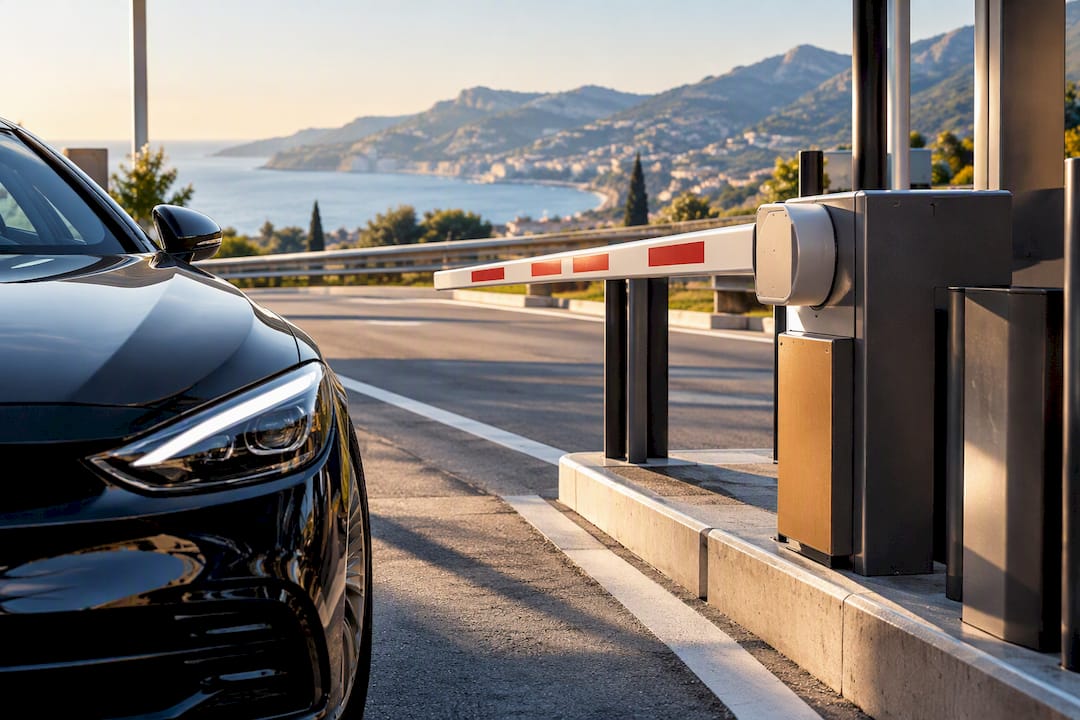
French and Italian autostrade both operate distance-based tolls, collected at barriers by card, cash or an electronic toll badge fixed to the windscreen. The badge lets you glide through dedicated lanes without stopping, which matters on a route crossing two countries' toll networks in one day.
The Fréjus Tunnel charges a separate one-way fee of €55.50 for a standard car in 2026, distinct from the ordinary autostrada tolls, and it only applies to drivers taking the inland route through the tunnel itself.
- Budget separately for standard motorway tolls and, if relevant, the Fréjus Tunnel charge.
- Card payment is accepted almost everywhere, though carrying some cash covers smaller or older toll plazas.
- A electronic toll transponder, hired with the car or borrowed from a rental company, speeds up every barrier crossing.
- Fuel costs vary with the vehicle, but a mid-size car over 315 to 340 kilometers will typically need one full tank.
Documents and vehicle checks before you cross into Italy
Crossing from France into Italy by road involves no passport control under the Schengen arrangement, but you still need the paperwork that proves the car and its driver are legitimate. Carry your driving license, the vehicle's registration document, and proof of insurance valid for Italy. A green card is worth keeping in the glovebox even where not strictly demanded, since it settles any roadside query quickly.
Hired or leased vehicles need particular attention: not every rental agreement permits cross-border travel, and some insurers exclude Italy or the Fréjus Tunnel specifically, so read the contract before you leave the depot.
- Driving license, vehicle registration and valid insurance documents, kept together and accessible.
- A green card or equivalent proof of Italian coverage, even when not routinely checked.
- A basic safety kit: warning triangle, high-visibility vest, and a spare bulb kit for older vehicles.
- Winter tires or snow chains between mid-autumn and spring if taking the inland alpine route.
Check your vehicle's emissions class on the Motorist Portal before you leave home, to ensure compliance before entering Milan's low emission zones.
Milan's Area B and ZTL rules for visiting drivers
Milan restricts a large portion of its municipal area under Area B, an electronically enforced low-emission zone covering most of the city within the ring road. Since 1 October 2025, Area B has excluded certain older petrol vehicles rated Euro 3, a change that catches out visitors driving older cars from outside Italy.
Milan enforces Area B through numerous camera-monitored gates called varchi; being unaware of your vehicle's emissions classification is the main cause of fines for foreign drivers.
- Check your vehicle's Euro class against Area B rules before entering the city, not after.
- Consult the municipal map of varchi to identify which entry points sit inside the restricted zone.
- Non-resident vehicles that qualify for temporary access can sometimes use the MoVe-In box scheme, though allowances are limited and must be arranged in advance.
- Parking outside the ring road and using public transport for the final stretch avoids the question entirely.
Staying safe and on schedule between the two cities
Ligurian motorways schedule night-time maintenance on the A10 and A7 corridors with some regularity, and these closures can force an unexpected detour if you are driving after dark. Checking Autostrade per l'Italia's viability notices before you set off, rather than relying on memory of a previous trip, remains the most reliable habit for any Riviera to Lombardy run.
- Check Autostrade's live updates and the Liguria regional bulletins the morning you travel.
- Build in one rest stop roughly every two hours, useful for fuel, coffee and a change of driver.
- Fit a electronic toll badge before departure if your rental allows it, saving time at every barrier.
- Treat the alpine Fréjus route with extra caution in winter, and expect coastal congestion near Cannes or Monaco during major events.
Recommended stops and two ready-made itineraries
Whichever route you take, a handful of stops turn a transit drive into something more memorable without adding much time.
- Chin, just before the Italian border, rewards a twenty-minute wander through its old town and lemon-scented streets.
- Monaco offers a quick detour to the harbor or the Casino Square, best kept brief given its notorious parking.
- Sanremo, on the Italian coastal stretch, suits a proper lunch stop with its seafront promenade.
- Inland travelers can pause in the Maurienne valley before the Fréjus Tunnel, where mountain views justify fifteen minutes out of the car.
For a fast transfer, leave Nice by 8am, take the coastal A8, and expect arrival in Milan by early afternoon after one short fuel stop. For a scenic day, leave by 7am, take the inland Fréjus route, stop for a mountain coffee near Modane, then lunch in Turin before the final leg to Milan.
Anyone travelling around the Cannes Film Festival, Monaco Grand Prix, MIPIM gold Cannes Lions should add at least an hour to coastal timings and consider leaving well before the morning rush.
When a self-drive plan gives way to a chauffeured transfer
Self-driving suits travelers with time and a taste for the open road, but certain situations tip the balance, making a concierge private driver a preferable option to navigate Italy's ZTL zones and VIP travel needs (Avoid ZTL Fines: Concierge Private Drivers in Italy for VIP Travelers). Group travel with heavy luggage, a fixed arrival deadline during MIPCOM or the Grand Prix, or simple reluctance to gamble on Area B eligibility all favor a professional driver who manages route changes, paperwork and local rules without your involvement. TranspOnyx operates exactly this kind of long-distance transfer from the Riviera into Italy.
— Dany
Booking a TranspOnyx transfer from Nice to Milan
Travelers who would rather arrive rested than navigate tolls and Area B rules themselves have a direct alternative. TranspOnyx runs point-to-point long-distance transfers from Nice to Italy, including Milan, under fixed 2026 rates confirmed at the time of booking, with no surprises added en route.
The fleet covers four Mercedes-Benz categories: Standard Sedan and Business Sedan for up to three passengers, and Van 7 pax or Van 8 pax for larger groups or extra luggage. Every vehicle carries Wi-Fi, air conditioning, chilled water and phone chargers, and drivers are licensed VTC professionals fluent in at least English and French. TranspOnyx operates 24 hours a day, seven days a week, with free waiting time included on airport pickups.
- Fixed 2026 rates per vehicle, agreed before you travel, with no surge pricing.
- Bilingual licensed drivers who handle Italian border and Area B considerations directly.
- Booking by phone on +33 6 10 30 71 84, by WhatsApp, or via the TranspOnyx website.
For travelers already comparing chauffeur options for Riviera legs, the Nice to Marseille transfer service shows how the same fixed-rate, point-to-point model works on other long-distance routes.
Where to check live conditions before you leave
Confirm motorway status with Autostrade per l'Italia, whose bulletins cover closures and scheduled works on the A10 and A7. Verify Milan access rules through the Area B guidance and the Portale dell'Automobilista. For distance, timing and toll estimates, ViaMichelin's route planner remains a dependent reference, alongside TyreMap's toll breakdown.
Sources
FAQ
How can I get from Nice to Milan by car?
Take either the coastal A8 through Monaco and Ventimiglia or the inland route via the Fréjus Tunnel onto the A32 and A4. Both are manageable in a single day, with the coastal option generally favored for reliability and the inland option for shorter distance on paper, as detailed in the route comparison above.
What is the best route to drive from France to Italy?
There is no single best route for every trip. The coastal A8 suits drivers who want predictable motorway conditions and avoid the separate Fréjus Tunnel charge, while the inland Fréjus road suits those prioritizing alpine scenery or dodging coastal congestion near Cannes or Monaco.
What is the best way to travel from Nice to Milan?
Self-driving works well for travelers who enjoy the flexibility of stopping at Menton, Monaco or Sanremo along the way. Those preferring not to manage tolls, borders and Milan's Area B rules often choose a chauffeured transfer instead, arranged directly with a provider such as TranspOnyx.
Is it possible to drive from France to Italy?
Yes, driving between France and Italy is routine and requires no passport control under the Schengen arrangement. You do need your driving license, vehicle registration and valid insurance documents, plus awareness of Milan's Area B emissions rules if your final destination lies within the city.
by Daniel AIT GOUGAM | October 1, 2026 | news
The fastest realistic option from Nice to Turin is a direct coach at around 4 hours 15 minutes, while the cheapest advance rail tickets start from roughly £23 according to Trainline. Both modes carry a real disruption risk on the Ligurian coastal corridor and the A10 motorway, so travelers with fixed schedules, such as those heading to a conference or a flight, often choose a private chauffeur through TranspOnyx (+33 6 10 30 71 84, transponyx.com) for door to door certainty.
Transponyx
Travel Between Nice And Turin With Ease
TranspOnyx provides private chauffeur journeys from Nice to Italy, with fixed rates, professional drivers and Mercedes-Benz vehicles.
Contact TranspOnyx
Train travel: routing via Ventimiglia and Savona, durations and fares
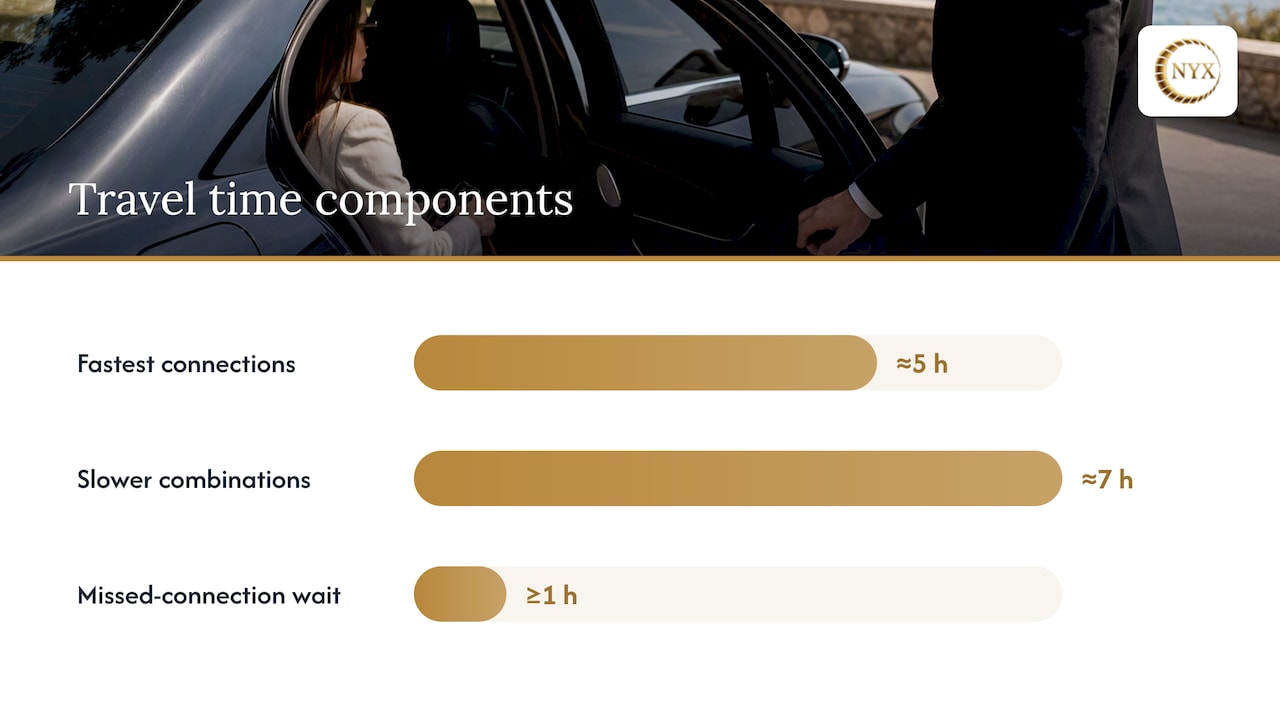
There is no direct train between Nice and Turin. Every rail itinerary requires at least one change, most commonly at Ventimiglia, Savona, or both, and the practical journey time runs from about five hours on the fastest connections to seven hours on slower combinations, according to Trainline. The straight-line distance is roughly 156 kilometers, so the extra hours come entirely from the changeover and the winding coastal alignment through Liguria rather than from raw distance.
Fares reward early planning far more than most short European rail hops. Trainline lists advance tickets from around £23, and a comparable advance floor of roughly £23 to £30 appears on the operator's own Nice Ville route listing. Prices climb sharply closer to departure, so booking three to six months ahead is the surest way to lock in the lower end of that range.
Trainline's advance fares for Nice to Turin start from around £23, a floor that typically only holds for tickets bought well before the travel date, according to Trainline.
Arrivals land at either Torino Porta Nuova or Torino Porta Susa, both central and well connected to onward transport, but travelers should confirm which station their booking uses before arranging a pickup. SNCF Connect publishes current timetable combinations for the route and is worth checking on the day, since routing and change patterns shift with engineering works.
Rail travelers should build a buffer into any connection along this line, for three reasons:
- Changes at Ventimiglia and Savona typically allow only a narrow window before the next departure.
- Maintenance work on the coastal line between Savona and Finale Ligure has triggered bus replacement services, as flagged in Trenitalia's service bulletins.
- A missed connection at either junction usually means a wait of an hour or more for the next service.
Bus and coach: fastest coach options and typical fares
Coach services, mainly FlixBus, offer the quickest single-ticket route between the two cities, with a typical journey of about 4 hours 15 minutes and fares generally between €18 and €30, as aggregated by Rome2Rio. That duration beats most rail combinations outright because it avoids the Ventimiglia and Savona changeovers entirely, running instead on a more direct inland corridor.
Frequency is the trade-off. Services do not run every hour, and some weeks offer only a handful of departures, so travelers with fixed arrival deadlines should check the live schedule rather than assume a coach will be waiting.
A few practical points worth confirming before booking:
- Luggage allowances vary by operator and fare class, so check the limit before you pack.
- Boarding usually closes a set number of minutes before departure, and coach stops can be less central than train stations.
- Single-ticket simplicity makes coach a sound choice for solo or budget travelers who value one booking over the fastest possible arrival.
Driving: distance, route choices and where closures bite
Driving from Nice to Turin covers roughly 156 kilometers and takes between 3 hours 15 minutes and 4 hours depending on traffic, mostly via the A10 motorway through Liguria before joining the Italian autostrada network. It is the most flexible option for anyone carrying luggage for several passengers or traveling outside train and coach timestables.
The catch is that the A10 Genova to Savona stretch is prone to scheduled maintenance and night closures, and Autostrade's own bulletins confirm these are a regular feature of the corridor rather than a rare exception. Drivers should check the notice board for the travel date before setting off, particularly for evening departures.
- The coastal SS1 (Via Aurelia) is a workable alternative when the A10 is closed, though it adds time through town centers and coastal bends.
- Tolls apply on both the French and Italian motorway sections, and fuel and city-center parking in Turin are additional costs to budget for.
- Schengen travelers face no routine border formalities crossing from France into Italy, though a passport or identity card should still be carried.
Rideshare and mixed itineraries: combining modes for speed or savings
Rideshare can undercut both rail and coach fares for groups traveling together, but availability on this particular route is patchier than on shorter Riviera hops, and luggage space is rarely guaranteed in advance.
A mixed itinerary sometimes beats a single mode outright. One workable pattern is a short rail or private transfer to Ventimiglia followed by a connecting service or private car into Italy, which sidesteps some of the coastal line's least reliable segments.
- Mixed journeys depend on tight timed connections, so a delay on the first leg can cascade through the rest of the trip.
- Border checks are minimal for Schengen travelers but can still add a few minutes at busy times.
- Groups with heavy luggage generally find mixed itineraries more stressful than a single continuous journey.
How to choose: a decision framework for speed, cost, comfort and reliability
Four factors decide the right mode: speed, cost, comfort and reliability, and they rarely all point the same way. A solo traveler on a loose schedule can absorb a slow connection that would ruin a business trip with a fixed meeting time.
- Budget solo traveller: the coach at around €18 to €30 and 4 hours 15 minutes, per Rome2Rio, usually offers the best balance of low cost and a single ticket.
- Family with luggage: driving gives control over stops and space, provided you check Autostrade's advisories before departure.
- Business traveler with a fixed schedule: a private driver removes the single points of failure baked into rail changeovers and motorway closures.
- Advance planner chasing the lowest fare: rail booked three to six months out, checked against SNCF Connect's timetables, captures the cheapest seats before they disappear.
Pro Tip Whichever mode you choose, check the relevant advisory page on the morning of travel rather than the night before, since both rail replacement buses and motorway closures are sometimes announced with very little notice.
Private chauffeur option with TranspOnyx: what it includes and when it makes sense
For travelers who cannot afford a missed connection, TranspOnyx operates a private chauffeur service across the French Riviera and into Italy, with fixed 2026 rates confirmed at the time of booking. The fleet runs exclusively on Mercedes-Benz vehicles across four categories: Standard Sedan, Business Sedan, Van 7 pax and Van 8 pax, each fitted with Wi-Fi, air conditioning, chilled water and phone chargers, with child seats available on request.
Drivers are licensed professionals, bilingual in English and French at minimum, and the service runs 24 hours a day, seven days a week. A private chauffeur suits three situations particularly well:
- A tight schedule where a missed train connection at Ventimiglia would cause real damage, such as a flight or a meeting.
- Travel during major Riviera events, when demand on shared transport spikes.
- A preference for one continuous, monitored journey rather than several changes.
Reach the reservations team on +33 6 10 30 71 84 or at Transponyx.
Choosing reliability over price around Riviera events
Demand on Riviera transport spikes sharply during the Cannes Film Festival and the Monaco Grand Prix, and that pressure spills onto rail and motorway capacity heading towards Italy too. Anyone traveling near those dates should add a buffer to any train connection or drive, and treat schedule certainty as worth paying for rather than an afterthought. A private transfer removes the guesswork precisely when shared transport is least predictable.
— Dany
Booking TranspOnyx: fixed 2026 rates and how to reserve
TranspOnyx prices every vehicle at a fixed 2026 rate confirmed when you book, with free waiting time on airport pickups and no surge pricing regardless of demand around Riviera events. For a Nice to Turin route, that means no last-minute fare spikes and no dependence on a single train connection holding up.
Call +33 6 10 30 71 84 or book directly at Transponyx.
Sources
FAQ
Can you get a train from Nice to Turin?
Yes, though there is no direct service. Every journey requires at least one change, usually at Ventimiglia or Savona, with typical journey times of five to seven hours according to Trainline.
How can I travel from Nice, France to Italy?
The main options are rail via Ventimiglia and Savona, a direct coach service of around 4 hours 15 minutes, driving via the A10 motorway or the coastal SS1, and private chauffeur transfer. Each mode suits a different priority, whether that is lowest cost, fastest journey or schedule certainty.
How far is Turin from the French border?
The border crossing near Ventimiglia sits well over 100 kilometers from Turin, with the full Nice to Turin distance running to roughly 156 kilometers according to Trainline. Driving from the border typically takes between two and a half and three hours depending on the route and traffic.
What is the closest Italian town to Nice, France?
Ventimiglia is the nearest Italian town to Nice, sitting just across the border and serving as the standard changeover point for rail travelers heading into Italy. Many mixed itineraries, including private transfers offered by TranspOnyx, use Ventimiglia as the handover point between French and Italian legs of the journey.

by Daniel AIT GOUGAM | Sep 29, 2026 | news
The strongest day trips from Nice are Eze, Villefranche-sur-Mer, Monaco, Menton, Antibes and Juan-les-Pins, Cannes, Grasse, Saint-Paul-de-Vence and Cap Ferrat, with Ventimiglia and the Lérins islands as worthwhile additions when time allows. Most are reachable within 10 to 60 minutes by TER train or local bus, while a private chauffeur such as TranspOnyx offers 2026 fixed-rate, door-to-door travel for those who want to cover several stops in one day. Start early and pick one or two highlights per destination rather than rushing the full list.
Transponyx
Make More of Your Côte d'Azur Day
Travel between Nice, Monaco, Cannes and other destinations in a Mercedes-Benz vehicle with fixed rates and door-to-door service.
1. Choosing among the top day trips from Nice
Each of these towns rewards a different kind of traveler, and matching the destination to your pace and interests makes far more difference than trying to squeeze in extra stops.
-
Eze village. This medieval hilltop settlement clings to a rocky outcrop above the coast, its narrow lanes leading up to the Jardin Exotique and views that stretch to Cap Ferrat on a clear day. The Nietzsche path connects the village to the seafront below at Eze-sur-Mer, a steep but manageable walk for anyone with reasonable fitness. Bus 82 from Nice or a short train ride followed by the uphill climb both work, and the trip takes roughly 30 to 40 minutes each way. It suits travelers after photographs, a short hike and a genuine sense of medieval Provence rather than a packed itinerary.
-
Villefranche-sur-Mer. A sheltered bay with pastel houses stacked above the water, the Citadelle Saint-Elme and a beach that stays calm even when the open coast gets choppy. Trains from Nice-Ville take just 7 to 10 minutes, among the fastest connections on this list according to the TER Sud Provence-Alpes-Côte d'Azur schedule, which makes it an easy half-day trip for anyone wanting a relaxed seaside break without much planning.
-
Monaco and Monte Carlo. The Prince's Palace, the Oceanographic Museum and the casino quarter pack a lot into a small principality, and frequent TER services from Nice make it one of the simplest excursions on this list, typically 20 to 30 minutes depending on the train. Explore Nice Côte d'Azur lists Monaco among the region's most visited short trips, though it also notes that festival and race dates change the picture entirely, since the Monaco Grand Prix fills the principality with crowds and road closures for days either side of the event.
-
Chin. Known for its lemons, its Belle Époque architecture and a genuinely different, more Italian-leaning atmosphere than the rest of the coast, Menton sits around 40 minutes from Nice by TER. Travelers with extra time often continue on to Ventimiglia, just across the Italian border, for its Friday market.
-
Antibes and Juan-les-Pins. The Picasso Museum sits inside the old town's ramparts, the covered market runs daily, and the marina holds some of the largest private yachts on the coast. TER trains from Nice take around 20 to 25 minutes, making it one of the quicker options for a morning of culture followed by an afternoon at the beach in Juan-les-Pins.
-
Cannes. La Croisette, the film festival's red carpet steps and a busy old quarter known as Le Suquet make Cannes a natural day trip, reachable in 30 to 40 minutes by TER. Timing matters here more than almost anywhere else on this list: during the Cannes Film Festival in May, hotel prices spike and the town center becomes difficult to navigate, so a straightforward sightseeing day works better outside festival weeks.
-
Grasse. The perfume capital of France, home to historic houses including Fragonard, Galimard and Molinard, sits inland and slightly apart from the coastal rail line. The train station lies some distance from the old town, with an uphill walk at the end, and the journey from Nice by train or the 650 bus can run 60 to 90 minutes depending on connections. Grasse rewards patience and works far better with a car or a chauffeur than with a rushed train transfer.
-
Saint-Paul-de-Vence and Saint-Jean-Cap-Ferrat. These two could not be more different: one a perched art village looped by ramparts, the other a wooded peninsula with the Villa Ephrussi de Rothschild and its gardens. Both require a combination of bus and sometimes tram connections from Nice, with journey times that vary considerably depending on traffic and transfers. Saint-Paul-de-Vence's steep, cobbled streets are not kind to anyone with mobility difficulties, and Cap Ferrat's distances between sights mean a fair amount of walking regardless of how you arrive.
- Ventimiglia's cross-border market makes a good half-day extension from Menton, roughly an hour by train from Nice.
- The Lérins islands, Sainte-Marguerite and Saint-Honorat, are reached by boat from Cannes and follow travelers who want to add a maritime detour to a Cannes day trip.
2. Trains, buses, boats or a private driver: what actually works
The Nice-Ville to Ventimiglia corridor, running through Monaco and Menton, and the Nice to Antibes and Cannes line to the west cover most of the destinations on this list with frequent TER services. Drivers on these routes commonly check tickets during the journey, so buying before boarding avoids any complications.
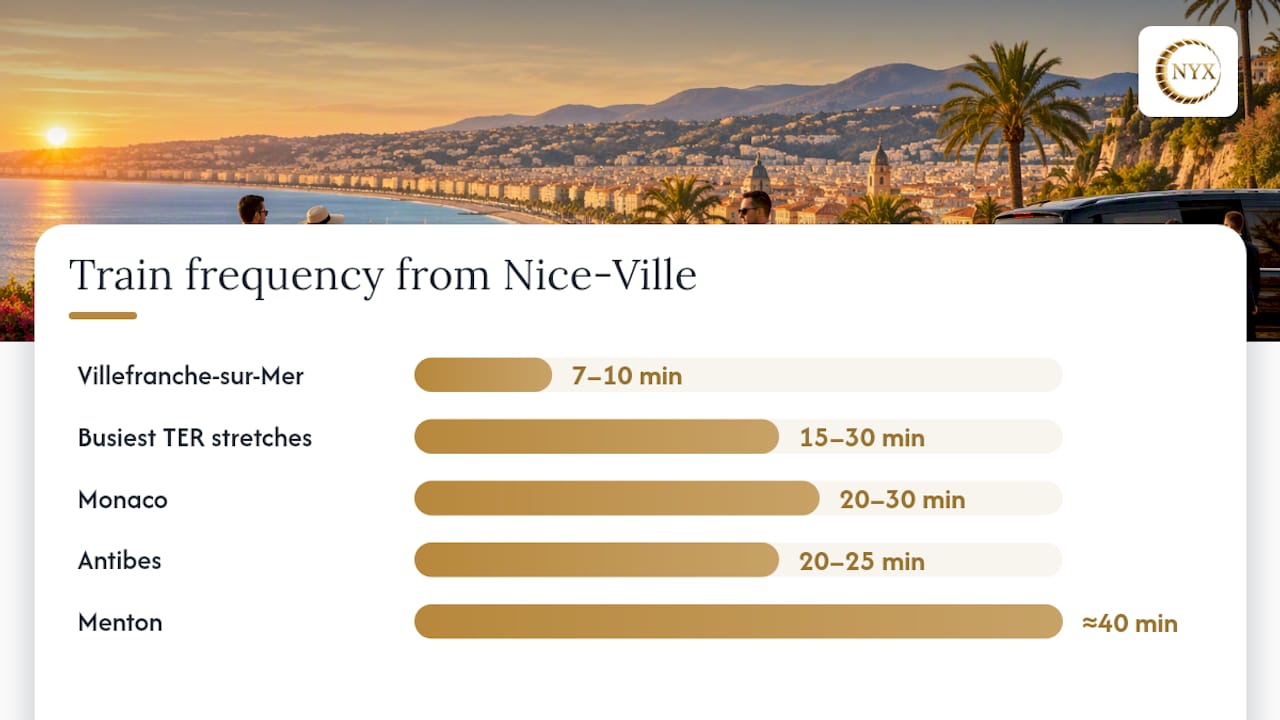
- TER trains run every 15 to 30 minutes on the busiest stretches, with Villefranche-sur-Mer at 7 to 10 minutes, Monaco at 20 to 30 minutes, Antibes at 20 to 25 minutes and Menton at around 40 minutes from Nice-Ville, according to the TER Sud Provence-Alpes-Côte d'Azur network, which lists these towns among its principal direct destinations.
- Local buses depart from hubs including Vauban and the Gare Routière, with tram connections feeding into both; Lignes d'Azur runs the network across Nice and much of the surrounding coast.
- Boat services, notably Trans Côte d'Azur, run seasonal routes along the coast and out to the Lérins islands, with a typical crossing from Cannes to Île Sainte-Marguerite taking well under an hour, per the practical tourism guidance published for the region.
- Private chauffeur transfers suit travelers making multiple stops in a day, starting before public transport is fully running, or traveling in a group where taxi queues and train platforms become a hassle.
A single bus ride in the Lignes d’Azur network costs €1.70, according to fare notes summarized in regional travel guides, though passes covering wider zones exist and some destinations such as Monaco or Menton fall outside the standard urban fare structure. That single figure sets the baseline for comparing the cost of public transport against a fixed-rate chauffeur booking.
TranspOnyx operates a fleet of Standard Sedan, Business Sedan, Van 7 pax and Van 8 pax Mercedes-Benz vehicles with bilingual licensed VTC drivers, running 24 hours a day on 2026 fixed rates with no surge pricing. Tickets and passes for trains and buses are best bought through the TER website or app, at Lignes d'Azur ticket machines at major stops, or at station kiosks before traveling.
3. Timing, crowds and packing for a smooth day out
The hour you arrive matters almost as much as the destination itself. Eze and Saint-Paul-de-Vence fill with coach groups by mid-morning, so an early train or bus buys you empty lanes and better light for photographs. Monaco and Cannes, by contrast, run on frequent services throughout the day, so arrival time matters less than checking the return schedule before you set off, particularly on Sundays when frequencies drop.
Hilltop villages demand a level of fitness that seaside towns simply do not. Eze's approach involves genuine gradient, and Saint-Paul-de-Vence's cobbled streets are uneven underfoot, while Villefranche-sur-Mer and Antibes remain largely flat and manageable for anyone.
- Buy a single ticket for a one-off trip; a pass only pays off once you are combining several rides in a day.
- Keep a ticket validated and ready to show, since TER drivers check regularly and an unvalidated ticket can mean a fine on the spot.
- Check festival calendars before booking a Cannes or Monaco day, since the Cannes Film Festival and the Monaco Grand Prix both disrupt normal transport and hotel availability for the surrounding week.
- Boat timestables to the Lérins islands run a reduced winter schedule, so confirm sailing times directly with the operator outside the summer months.
- Pack comfortable shoes, sun protection, water and some small change, since bus drivers on Lignes d'Azur routes often expect exact fare.
Anyone weighing up a hilltop village against a flatter coastal town should treat the walking distance as the deciding factor, not the headline sights, since a stunning viewpoint reached by exhausted legs rarely lands the way it should.
4. When a chauffeur beats the train for a Nice day trip
A licensed VTC driver removes the two biggest frictions of a self-organized day trip: timetable anxiety and the walk from station to sight. TranspOnyx runs a Mercedes-Benz fleet across four categories, Standard Sedan, Business Sedan, Van 7 pax and Van 8 pax, with Wi-Fi, air conditioning, chilled water and phone chargers as standard, and child seats available on request.
- Drivers are bilingual in English and French at minimum, with some also speaking Italian, Spanish, Russian or Arabic.
- The service runs 24 hours a day, seven days a week, with 2026 fixed rates confirmed at the point of booking and no surge pricing.
- Free waiting time applies: 60 minutes on airport pickups and 20 minutes at any other address, with flight monitoring included on every airport transfer.
A transfer from Nice NCE to Monaco takes roughly the same 20 to 30 minutes as the TER, but arrives directly at the hotel or sight rather than the station, which matters most for early Grand Prix mornings or heavy luggage. A trip out to Saint-Paul-de-Vence, which involves changing buses and a final uphill stretch on public transport, becomes a single direct journey by chauffeur, useful for groups, festival days or anyone with limited mobility. Book through +33 6 10 30 71 84 or via Transponyx.
5. What a day trip from Nice actually costs
A single TER ticket from Nice to Villefranche-sur-Mer or Monaco costs only a few euros, while longer legs such as Nice to Menton or Cannes cost somewhat more, and buying online through the TER website in advance avoids queuing at the station. Lignes d'Azur city buses run on a flat single-ride fare of €1.70, though this excludes certain longer-distance routes and destinations outside the immediate urban zone, including parts of the journey to Monaco or Menton.
Regional passes exist for travelers combining several trips or several modes in one day, and SudAzur-branded options can work out cheaper than buying single tickets for each leg, though they only pay for themselves once you are making more than two or three journeys. Boat fares to the Lérins islands or along the coast with Trans Côte d'Azur vary by season and route, and prices are best checked directly with the operator before traveling, since summer sailings differ from the reduced winter timetable noted in the regional practical guide. For a comparison against a fixed daily rate, a chauffeured full day with TranspOnyx sits in a different bracket entirely, but it removes ticket-buying, timetable-checking and walking to and from stations altogether.
6. Where to eat on each Riviera day trip
Menton's lemon defines much of its table, appearing in tarts, syrups and the region's own citrus liqueurs, and the town's covered market is the best place to taste it fresh rather than in a restaurant setting. Antibes runs a daily produce market inside the old walls, ideal for assembling a simple lunch of socca, the chickpea flour flatbread found across the Niçois coast, alongside olives and cheese.
Grasse's old town has small family-run restaurants serving Provençal dishes such as daube and pistou soup, a fitting contrast to the perfume houses that draw most visitors there. Villefranche-sur-Mer's waterfront restaurants specialize in fresh fish, given the bay's long fishing history, while Cannes offers everything from beachfront brasseries on La Croisette to quieter bistros a few streets back that avoid festival-week pricing.
Eze village, for all its charm, tends towards tourist-priced dining near the main lanes, so a packed lunch eaten on the Nietzsche path or at the belvedere often beats anything on the menu. Monaco's dining runs from casual creperies to some of the most expensive tables on the coast, and a modest budget stretches further with a takeaway lunch near the port than a sit-down meal near the casino.
7. Weather and seasonal changes worth planning around
Summer on the Riviera means long daylight hours and reliable boat services, but also the busiest crowds at Eze, Monaco and Cannes, and midday heat that makes the uphill walk to Saint-Paul-de-Vence or Eze considerably harder. Spring and autumn bring milder temperatures and thinner crowds, and remain the best balance for anyone doing the hillier villages on foot.
Winter changes the picture for boat trips in particular: the practical tourism guide for the region notes that coastal cruises and island crossings run on a reduced schedule outside the summer months, so a winter Lérins islands trip needs checking in advance rather than assuming a sailing will be available. Mistral winds occasionally disrupt smaller boat services along this stretch of coast, another reason to confirm sailings on the day rather than relying on a printed timetable.
Rain rarely lasts long on the Riviera, but when it falls it turns Eze's cobbles and Saint-Paul-de-Vence's steep lanes slippery, so a wet forecast is a reasonable trigger to swap a hilltop village for a flatter coastal alternative such as Villefranche-sur-Mer or Antibes.
8. Combining two or three destinations in a single day
Eze and Monaco pair naturally, since both sit on the same rail corridor and a morning in the hilltop village followed by an afternoon at the Oceanographic Museum makes for a full but manageable day. Menton and Ventimiglia work as a similar pairing, with the Italian border town's Friday market adding a cross-border flavor to an otherwise French itinerary.
Antibes and Juan-les-Pins are close enough to treat as a single stop, culture in the morning and beach in the afternoon, while Cannes and a Lérins islands crossing suit anyone wanting to add a maritime element without a second train journey. Saint-Paul-de-Vence and Cap Ferrat are harder to combine by public transport in one day given the bus and tram connections required between them, which is exactly the kind of itinerary where a chauffeured day, moving directly from one to the other without a station in between, saves the most time.
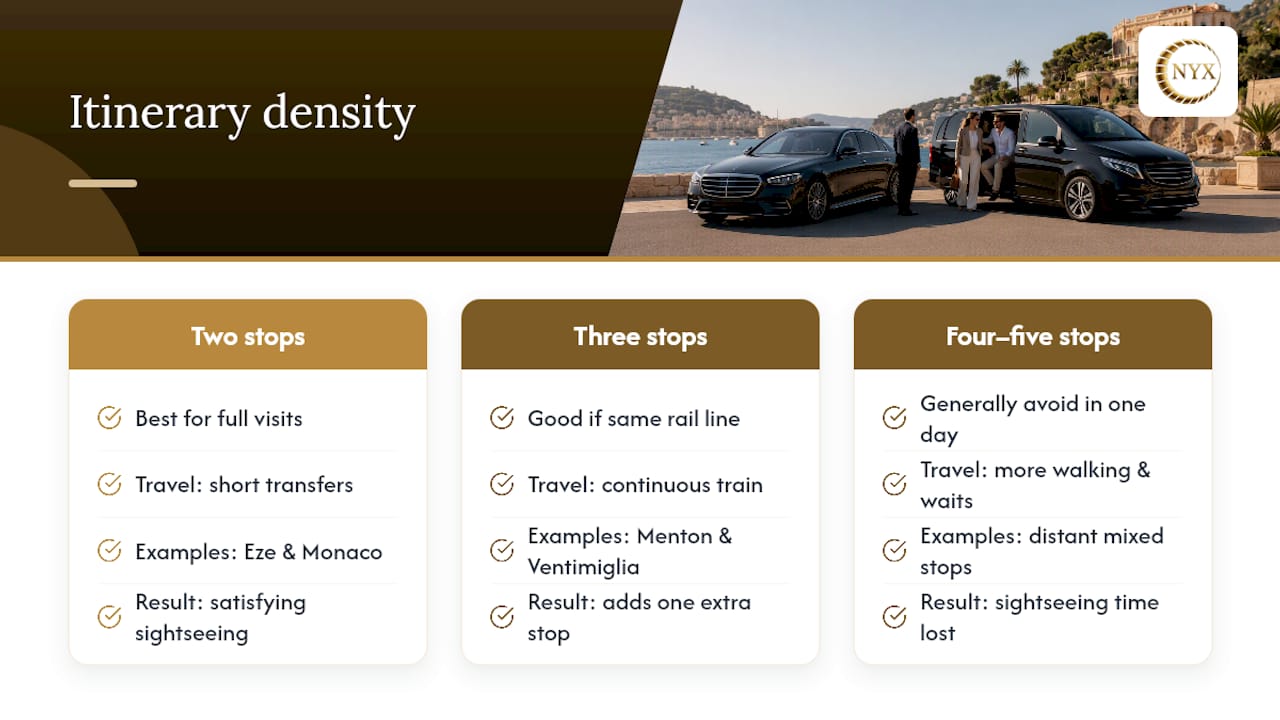
Trying to fit four or five stops into a single day generally backfires, since the walking and waiting between each one eats into the time meant for actually seeing anything. Two well-chosen destinations, or three if they sit on the same train line, make for a far more satisfying day than a checklist rushed through at speed.
9. Staying safe and respecting local customs
The Riviera is a low-risk destination for visitors, though the usual precautions around bag-watching apply on crowded trains and at busy markets in Antibes and Menton. Beaches this along coast are generally safe, but swimming outside designated areas or ignoring flag warnings is worth avoiding, particularly around Villefranche-sur-Mer's more exposed stretches.
Dress codes matter more here than in many parts of France: swimwear is expected to stay on the beach rather than in town, and a degree of smart-casual dress helps in Monaco's casino quarter or at a formal restaurant in Cannes. Meal times run later than in much of northern Europe, with lunch service often starting around midday and running at 2:00 PM, and dinner rarely served much before 7:30 PM.
Tipping in France is not obligatory since a service charge is usually included, though rounding up or leaving small change is common and appreciated. A polite “bonjour” on entering a shop, market stall or taxi is expected rather than optional, and skipping it is one of the more noticeable faux pas a visitor can make on this coast.
What most day-trip advice gets wrong about Nice
Most guides to day trips from Nice treat train timetables as the whole story, listing journey minutes as if the trip ends the moment you step off the platform. It rarely does. The real cost of a day trip is the walk from Grasse's station to its old town, the bus change needed to reach Saint-Paul-de-Vence, or the queue for a return train out of Cannes on a Sunday evening.
The practical truth is that public transport handles the coastal towns well and the inland or perched villages poorly. Eze, Grasse and Saint-Paul-de-Vence all sit some distance from their nearest station or require a change that eats into the day. Readers planning a single coastal stop should trust the train. Readers trying to link two or three places, or heading somewhere hillier, get more value from comparing the total door-to-door time rather than the train time alone, since that is where a chauffeured transfer earns its cost.
— Dany
Booking a driver for your Nice day trip
Readers who want the flexibility of visiting Eze and Monaco in one morning, or reaching Saint-Paul-de-Vence without a bus change and an uphill walk, get more out of a fixed-rate chauffeur than a string of separate tickets. TranspOnyx runs Private driver Nice → Cannes for coastal day trips, along with airport and point-to-point transfers on the Nice, Monaco, Cannes and Antibes route page, and bespoke excursions through Onyx Tours, including the Half-day and Full-day formats for a curated full day.
- A Half-day à la carte tour runs between 350 EUR and 500 EUR for a five-hour private tour, while the Full day covers nine hours at rates ranging from 630 EUR to 900 EUR, both booked as a fixed one-off rate for the vehicle rather than per person.
- All rides run on 2026 fixed rates confirmed at booking, with free waiting time of 60 minutes on airport pickups and 20 minutes elsewhere.
Booking is straightforward: call +33 6 10 30 71 84, message on WhatsApp at +33 7 67 78 10 26, or reserve directly through Transponyx. The extra cost over a train ticket can be worthwhile for groups, families traveling with luggage, multi-stop days, or anyone visiting during a festival week when timestables and taxi availability both come under strain.
For live train times and any service disruptions on the Nice to Monaco, Menton or Cannes lines, the TER Sud Provence-Alpes-Côte d'Azur site is the authoritative source. Official tourist information, including event dates and local advice for towns such as Villefranche-sur-Mer and Saint-Jean-Cap-Ferrat, comes from Explore Nice Côte d'Azur.
- For boat operators, seasonal excursion contacts and route examples across the region, see the practical tourism guide published for Nice and its surroundings.
Sources
FAQ
What are some beautiful towns to visit near Nice?
Eze, Villefranche-sur-Mer, Menton and Saint-Paul-de-Vence are among the most visually striking towns near Nice, each offering a distinct setting from hilltop ramparts to a sheltered fishing bay. Monaco and Cap Ferrat add a more polished, upscale character to the same stretch of coast.
Where can I go from Nice by train?
TER trains from Nice-Ville run direct to Monaco, Menton, Antibes, Cannes and Villefranche-sur-Mer, with Villefranche-sur-Mer reachable in as little as 7 to 10 minutes according to the TER Sud Provence-Alpes-Côte d'Azur network. Menton and Ventimiglia extend the same line further towards the Italian border.
What are some hidden gems in Nice or the French Riviera?
Saint-Jean-Cap-Ferrat's quieter coastal paths and the Villa Ephrussi gardens see far fewer visitors than Monaco or Cannes despite being closed by. The Lérins islands off Cannes, reached by a short boat crossing, offer a genuinely quiet alternative to the mainland's busier towns.
Do I need a car to visit Grasse or Saint-Paul-de-Vence?
A car is not strictly necessary, but both towns sit awkwardly for public transport: Grasse's station requires an uphill walk into the old town, and Saint-Paul-de-Vence often needs a bus change from Nice. A private chauffeur removes both problems with a direct door-to-door transfer.
Is a private chauffeur worth it for a Nice day trip?
It depends on the itinerary: a single coastal stop such as Monaco or Antibes is simple and cheap by train, while a chauffeur earns its cost on multi-stop days, festival weeks or trips to harder-to-reach villages like Saint-Paul-de-Vence. TranspOnyx offers 2026 fixed rates with free waiting time for exactly this kind of flexible day out.
by Daniel AIT GOUGAM | Sep 28, 2026 | news
A day trip to Saint-Tropez from Nice is worth doing, and the smoothest way to manage it is a private chauffeur or the seasonal ferry, since both remove the parking search that ruins so many self-drive visits. The day divides neatly into three blocks: a harbor and old-town morning, a midday choice between the Musée de l'Annonciade and the coast, and a Citadelle or golden-hour finish back at the Vieux Port.
Transponyx
Make Saint-Tropez Your Day's Highlight
Travel from Nice in a Mercedes-Benz vehicle with a licensed chauffeur, fixed rates, and routes planned around your itinerary.
Plan your Saint-Tropez journey
Quick itinerary at a glance
A satisfying visit runs comfortably inside 6 to 9 hours on the ground, which follows both a ferry stopover window and a driver-driven day. Tea suggested ordering of activities places the port and old village first, a single concentrated midday activity second, and an elevated finale last, and that sequence works which ever transport you choose.
- 09:00 to 10:30: arrive and settle into the Vieux Port, browse La Ponche's lanes, get oriented before the crowds thicken.
- 10:30 to 12:00: walk to Place des Lices if it is market morning, or head straight into the old town's shaded streets.
- 12:00 to 13:30: lunch near the port or just off it, away from the most photographed tables.
- 13:30 to 15:30: choose one midday anchor, either the Annonciade museum or a beach stretch, rather than trying both.
- 15:30 to 17:00: climb to the Citadelle for the view and the last-entry window, or walk the coastal path towards Les Graniers.
- 17:00 onwards: return to the port for golden hour before departure.
Arriving by ferry compresses everything into the boat's fixed stopover, so the museum-or-beach choice in step four becomes non-negotiable rather than optional. Arriving by car or chauffeur gives more slack, letting you swap step five for Pampelonne if beach time matters more than the Citadelle. A driver-driven day also allows a later start and later return, which matters in July and August when midday heat slows everything down.
How to get to Saint-Tropez from Nice: four practical options
Saint-Tropez has no train station, so every visitor arrives by road or by water, and that single fact shapes the whole planning exercise. Practical visitor accounts confirm that driving, seasonal ferry, bus connections and organized transfers from Nice are the only realistic approaches, and each comes with its own timing logic.
Tea seasonal ferry run by operators such as Trans Côte d'Azur is the most scenic option and effectively sets your itinerary clock for you. A typical Nice departure leaves around 09:00, with an on-site window of roughly 11:30 to 16:30, giving you about five hours ashore before the return crossing. That window is generous enough for the port, old town and one midday activity, but it leaves no room for detours, so treat the boat's schedule as the frame everything else fits inside.
Driving yourself takes anywhere from 1.5 to 2.5 hours depending on the route and the time of day, with the coastal roads through Sainte-Maxime often slower than the inland option via the A8 and D25 in high season. Parking is the real constraint: the town's central car parks fill by mid-morning in July and August, and rates at the main paid lots typically run into double figures for a full day. Arriving before 09:30 or choosing a car park slightly outside the historic core saves both time and stress.
Train plus bus works for budget-conscious travelers with a flexible day. You take the train to Saint-Raphaël, then transfer to a bus into Saint-Tropez, a combination that stretches total journey time well beyond the drive or ferry and follows those without a car which are not pressed for time.
A private chauffeur removes every one of these frictions at once. There is no parking search, no ferry timetable to build the day around, and no bus connection to time carefully. TranspOnyx runs this route from Nice with a Mercedes-Benz fleet across four categories:
- Standard Sedan, seating up to three, for straightforward point-to-point transfers.
- Business Sedan, seating up to three, with a more premium finish for customers who want the extra polish.
- 7-passenger van, for families or small groups traveling together.
- Van for 8 people, for larger parties who still want one vehicle rather than two.
All rates are fixed and confirmed at booking under TranspOnyx’'s 2026 pricing, with free waiting time built in, and bookings run 24 hours a day on +33 6 10 30 71 84. For a Nice to Saint-Tropez day trip, the value is less about speed and more about certainty: you know your pickup time, your driver knows the route, and nobody is circling a car park at 4pm hunting for a space.
Morning in Saint-Tropez: the Vieux Port, La Ponche and the market
Start at the Old Port. The morning light on the pastel facades and the fishing boats moored alongside the superyachts is the classic Saint-Tropez image, and it photographs best before 10am, when the crowds and the heat are both still manageable.
From there, walk into The Ponche, the old fishing quarter tucked behind the port. This is where Saint-Tropez still feels like a village rather than a stage set.
- Tea Church of Our Lady of the Assumption, with its distinctive bell tower, anchors the quarter and is worth a five-minute break.
- The narrow lanes running down to Ponche Beach give you a quieter stretch of shoreline right in the center.
- Look out for the fishermen's cottages that give the neighborhood its name and its character.
If your visit coincides with a Tuesday or Saturday morning, head to Place des Lices for the market. Stalls sell Provençal linens, olive oils, cheeses and produce, and it is as much a social occasion for locals as a shopping stop for visitors. Buying a few items here for an impromptu picnic later works well if your midday plan includes a beach rather than the museum.
Wherever you end up between 10:30 and 11:30, build in a stop for coffee and a slice of Tropezienne tart, the cream-filled brioche that originated here and that every good pastry in town sells. It is a small ritual, but it is the one memory of the morning that you actually consume, and it gives you a natural pause before deciding on the midday block.
Midday choice: the Annonciade museum or the coast
This is the decision point that shapes the rest of your day, and the azurselect itinerary framework is right to treat it as a single choice rather than a menu. Trying to do both the museum and a proper beach session in one afternoon usually means rushing both.
Tea Annunciation Museum, housed in a former chapel by the port, holds a compact collection of Pointillist and Fauvist works connected to the artists who put Saint-Tropez on the map in the early twentieth century. A visit runs about an hour, sometimes 90 minutes for anyone lingering over the Signac and Matisse pieces, and it suits travelers whose day trip is as much about culture as coastline.
If the beach wins out, your options split by distance:
- Town beaches such as Plage des Graniers sit a short walk from the center, ideal if your afternoon window is tight.
- Pampelonne delivers the classic Riviera beach experience but adds 20 to 30 minutes of travel each way, which eats into a ferry-timed schedule fast.
- A short stretch of the coastal path towards Les Graniers gives walkers sea views without committing to a full swim stop.
Whichever you choose, keep an eye on the Citadel if it features in your late afternoon. The site enforces date-specific opening hours and a strict last-entry rule, including a 17:00 closing on 17 and 18 July 2026, so a museum or beach block that overruns can cost you the view entirely.
Pro tip: Check the Citadelle's official schedule for your travel date before you leave Nice, since last-entry times shift with the season and a five-minute delay can mean missing it altogether.
Beaches explained: Pampelonne, Graniers and Bouillabaisse
Saint-Tropez's beaches differ enough in character and distance that the right choice depends entirely on what your day trip needs at that hour.
Pampelonne is the famous arc of sand stretching towards Ramatuelle, split between exclusive beach clubs and public stretches where you can lay a towel for free. It delivers the postcard version of the Riviera coast, but reaching it from the center adds real travel time, whether by taxi, chauffeur or the seasonal beach shuttle, so it suits travelers with a flexible schedule rather than a ferry-timed one.

Graniers Beach, just beyond La Ponche, is the closest sand to the old town and the easiest fit for a tight midday window. It is small and can fill quickly in peak season, but its proximity makes it the practical choice when time is the binding constraint.
Bouillabaisse Beach, on the other side of the port near the marina, offers a gentle slope into the water and calm conditions. For families with younger children, visitor guidance points to Bouillabaisse or Graniers over Pampelonne precisely because they avoid the extra travel and the more exposed conditions further along the coast.
A few practical notes apply across all three:
- Sunbeds and parasols are available to rent at the beach club sections of Pampelonne, but the town beaches are largely unequipped, so bring your own towel and shade.
- Lifeguard cover is seasonal and concentrated on the busier stretches, so check flags before swimming outside peak months.
- Crowds build fastest between midday and 3pm in July and August, so an early or late session avoids the worst of both the heat and the density.
Practical tips: parking, timing, packing and costs
Getting the logistics right matters more in Saint-Tropez than in most Riviera towns, largely because the road network into the center is narrow and the parking supply limited.
Park at one of the paid lots on the edge of the historic center rather than circling for street parking, and arrive before 09:30 in July and August if you are self-driving. Seasonal advice points to late spring, specifically May and June, and again September and October, as the best months for a day trip, since crowds thin and the light stays flattering without the peak-summer heat. July and August remain the busiest and hottest months, which is when a driver or ferry arrangement pays off most.
Pack light but deliberately: sun protection, comfortable shoes for the Citadelle's cobbled ramps, a reusable water bottle, and cash or card for market stalls that do not always take contactless payment.
Accessibility deserves a mention too. The old town's lanes are largely flat, but the Citadelle involves a steady climb and internal steps, which makes it a poor fit for visitors with limited mobility. A chauffeur can at least remove the walk from the car park to the old town, which for many travelers is the most tiring part of the day.
Three sample day-trip schedules you can copy
Each of these respects the timing constraints already covered, whether that is a ferry stopover, a Citadelle last-entry rule, or simply a family's shorter attention span.
-
Ferry-anchored schedule. Departure Nice around 09:00 by boat, arriving with an on-site window of roughly 11:30 to 16:30. Walk the port and La Ponche first, choose the Annonciade museum over a beach given the tight window, then head straight up to the Citadelle by 3:30 p.m., checking the day's last-entry time beforehand. Return to the port for the boat with time to spare rather than sprinting for it.
-
Driver-flexible schedule. With a private chauffeur, leave Nice around 08:30 and arrive by roughly 10 o'clock depending on traffic. Spend the morning at the port and Place des Lices market if the date allows, take a leisurely lunch, then use the extra flexibility to reach Pampelonne for two hours before finishing at the Citadelle in late afternoon. A chauffeur waiting on call means the return leg starts whenever you are ready, not when a timetable dictates.
-
Family-friendly schedule. Aim for a mid-morning arrival to avoid the worst heat with young children. Keep the walking short: port, a gentle stroll through La Ponche, then straight to Plage de la Bouillabaisse or Plage des Graniers for a swim rather than attempting Pampelonne's longer transfer. Skip the Citadel's steps if mobility or patience is limited, and instead finish with an early dinner near the port before the journey home.
Each of these can be built around a chauffeur booking through TranspOnyx's private transfer service, which removes the guesswork from both the outbound and return legs.
Should you stay a day or a night in Saint-Tropez?
A single day is enough if your priority is the port, the old town and one midday anchor, whether that is the Annonciade or a beach session. It stops being enough the moment you want Pampelonne properly, a late dinner in town, or a slower pace through the Citadelle without watching the clock. Ramatuelle's beach clubs and the town's evening atmosphere reward an overnight stay far more than a rushed final hour ever will.
What changes the calculation is transport. A chauffeur-driven day, rather than a self-drive or ferry-timed one, buys back the hours most travelers lose to parking searches and fixed departure windows. That extra flexibility can turn a cramped six-hour visit into a genuinely relaxed nine-hour one, which for many travelers closes the gap between a day trip and an overnight stay almost entirely. I would still choose to stay overnight in high summer, when the midday heat eats into whatever time you have gained.
— Dany
How TranspOnyx makes a Saint-Tropez day trip easier
A day trip to Saint-Tropez runs more smoothly when the transport is fixed before you leave Nice, and that is precisely what TranspOnyx is built for. The company operates a private chauffeur and VTC service from Nice across the whole Riviera, with a Mercedes-Benz fleet and 2026 fixed rates confirmed at booking, so there are no surprises when the invoice arrives.
For this specific route, the relevant services are straightforward:
- A direct Nice to Saint-Tropez private transfer, priced between 260 and 400 EUR per vehicle depending on the exact pickup and drop-off points.
- Provision, by-the-hour hire from 60 to 90 EUR per hour, useful if you want the driver to wait through the museum or beach block and continue afterwards.
- A full-day bespoke itinerary through Onyx Tours, running from 630 to 900 EUR for a complete nine-hour day, which suits travelers who want the whole schedule planned around them rather than around a ferry timetable.
Every vehicle, whether a Standard Sedan, a Business Sedan, a Van 7 pax or a Van 8 pax, comes with Wi-Fi, air conditioning, chilled water and phone chargers, and drivers are bilingual licensed VTC professionals. Free waiting time is included on the relevant pickups, and flight monitoring covers anyone connecting through Nice Côte d'Azur Airport before heading straight to Saint-Tropez.
The practical case for a driver on this specific route is the Citadelle's last-entry rule and the parking shortage in the historic center. Neither problem exists when someone else is driving and waiting. Book through TranspOnyx directly or call +33 6 10 30 71 84 to confirm a fixed rate for your travel date.
Authoritative pages to check before you go
A few official sources are worth checking directly rather than relying on secondhand summaries.
- Tea Citadelle's official page lists date-specific opening hours, seasonal closures and the exact last-entry cutoff for your visit date.
- Ferry operators such as Trans Côte d'Azur publish current departure times and stopover windows, which shift slightly between seasons.
- Municipal notices on parking availability and market days are worth a quick check the week before travel, since both can change with local events.
Sources
FAQ
What to do in Saint-Tropez for one day?
Focus on three blocks: the Vieux Port and La Ponche in the morning, one midday anchor (the Annonciade museum or a beach), and the Citadelle or a return to the port for golden hour. This sequence, drawn from the standard day-trip framework, fits comfortably into 6 to 9 hours.
Is Saint-Tropez worth visiting on a day trip?
Yes, provided you accept that one day means choosing rather than seeing everything. The port, old town and one further activity give a genuine sense of the place without the pressure of an overnight stay.
How much does a Saint-Tropez day trip cost?
Costs vary by transport choice: a seasonal ferry ticket, edge-of-town parking, and lunch near the port sit at moderate levels, while a private chauffeur transfer from Nice runs from 260 to 400 EUR per vehicle with TranspOnyx. A full bespoke day tour through Onyx Tours runs from 630 to 900 EUR for the vehicle and driver.
What are some hidden gems to visit in Saint-Tropez?
Plage de la Bouillabaisse, near the marina, offers a quieter and gentler alternative to Pampelonne for a short swim. The lanes of La Ponche beyond the main port also reward a slow walk, since most day visitors head straight for Place des Lices or the Citadelle and skip the fishing quarter entirely.

by Daniel AIT GOUGAM | Sep 27, 2026 | news
Yes, a Provence lavender tour from Nice is entirely practical, and for most travelers the best option is a private full-day chauffeur trip rather than a shared coach. Valensole, the region's main lavender plateau, sits roughly two and a half hours from Nice, well within range of a single day out. Book a private driver or a small-group tour, aim for the mid-June to mid-July bloom, and confirm bloom status with the local tourist office before you set off.
Transponyx
transponyx.com
Make Provence Part of Your Journey
Onyx Tours offers private guided excursions and wine tours across Provence and the Côte d'Azur, with Mercedes-Benz vehicles and professional drivers.
Explore private tours
The format you choose shapes the entire day more than any other decision. A shared coach and a private chauffeur can visit the same plateau and deliver completely different experiences.
Private chauffeur day trips give you door-to-door service from your Nice hotel or apartment, with a driver who waits while you shoot photographs, stretch the visit past the standard hour, or detour to a village that catches your eye. This matters more than it sounds: lavender photography lives and dies by light, and a private schedule lets you chase the golden hour instead of a fixed departure slot. Groups of families or small parties of friends tend to find this the most comfortable option, since there's no shared itinerary to negotiate.
Small-group tours run with eight to sixteen passengers, a fixed departure time, and a guide who narrates the drive. They cost less per person than a private hire and suit solo travelers or couples who want structure without spending the day managing logistics themselves. The tradeoff is a set schedule: if the group wants to leave a field after twenty minutes, you leave with them.
Shared coach excursions carry larger numbers, sometimes forty or more passengers, and represent the cheapest way to see Valensole from the coast. Expect less flexibility, shorter stops, and an itinerary built around efficient loading and unloading rather than lingering among the rows.
Combined itineraries pair lavender viewing with the Gorges du Verdon or a perched village such as Moustiers-Sainte-Marie. These make for a spectacular but long day, often ten to twelve hours door to door, and work best for visitors who won't return to Provence and want maximum scenery in one trip.
- Private chauffeur: flexible timing, personalized stops, higher cost
- Small-group tour: fixed schedule, guided commentary, moderate cost
- Shared coach: lowest cost, minimal flexibility, larger crowds
- Combined lavender and gorge itineraries: longest day, most variety, less time per stop
When and where to see lavender in Provence
Valensole is the plateau to prioritize if you only have one day. Its fields are dense, extensive and reachable from Nice without an overnight stay, and the area combines vast open rows with a working Lavender Museum and local producer stalls south of the village.
Bloom timing runs mid-June to mid-July in a typical year, though flowering depends heavily on weather and the exact window shifts from one season to the next. In 2026, early observations pointed to blooming from early June, with harvest beginning around 29 June and continuing gradually over roughly fifteen days. That fifteen-day harvest window is worth building into your planning: once cutting starts in a given field, its color fades within days, so a trip booked for early July can land on rows already reduced to stubble if the season runs early.
Beyond Valensole, the Sault plateau and the Luberon offer alternative landscapes at slightly different elevations, which sometimes shifts their flowering by a week or two either side of Valensole's window. Sault sits higher and tends to bloom a little later into July; the Luberon's smaller fields and stone villages suit travelers who want lavender combined with hilltop architecture rather than open plateau.
Festivals shape both crowds and access. Valensole traditionally holds local festivities around the third Sunday in July, while Sault runs a larger lavender festival close to 15 August. Visiting a few days either side of these dates tends to mean calm fields and easier photography, since festival weekends draw the heaviest coach traffic of the season.
Getting there: distance, drive time and sample schedules
The road math is straightforward. Nice to Valensole covers approximately 163.6 km, with an estimated driving time of around 2 hours 29 minutes, though that figure can stretch during peak summer traffic on the A8 and through the Durance valley approach.
You have four realistic ways to make the journey:
- Self-drive car hire: cheapest for a solo traveler with a license, but you sacrifice the ability to enjoy the scenery and arrive tired for the return leg.
- Private chauffeur: door-to-door pickup, a driver who handles navigation and parking, and the freedom to adjust the day's timing as the light and your energy dictate.
- Organised coach tour: no driving responsibility, but a compressed schedule dictated by the operator's return time.
- Small-group minibus tour: a middle path between coach and private hire, with a fixed but usually generous field allowance.
A private nine-hour day built around a 07:30 departure gives you roughly three to four hours on the plateau itself, plus time for a village stop in Valensole or Riez and a proper lunch, before heading back to Nice by early evening. A typical coach day, by contrast, often allocates closer to ninety minutes at the fields once loading, comfort breaks and the drive itself are accounted for.
Photographers should note that Valensole's rows run largely north to south, which means the best light for classic wide shots falls in the early morning, roughly 07:00 to 09:00, before haze builds over the plateau. Parking near the busiest fields fills quickly by mid-morning in peak season, another reason an early private departure beats a mid-morning coach slot.
How to choose and book the right lavender tour
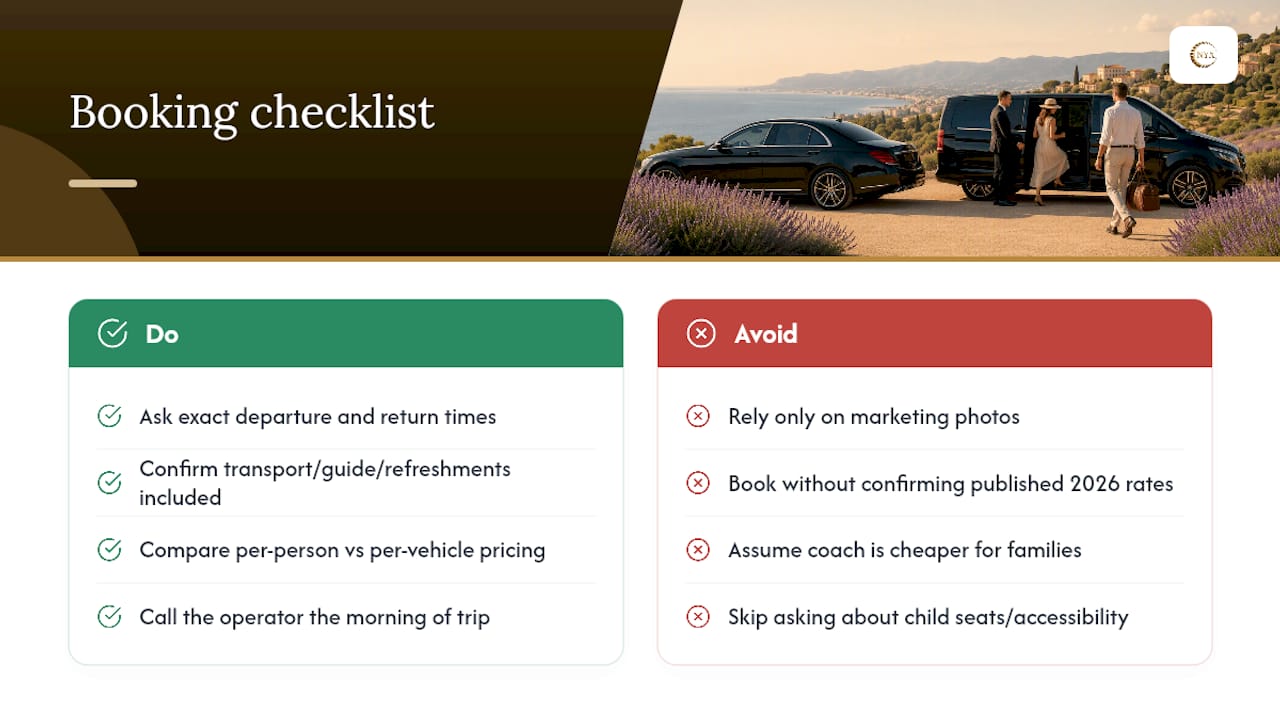
Before you commit to any operator, run through a short set of practical questions. What time does the tour actually leave Nice, and what time does it return? Is transport, a guide, or refreshments included in the quoted price, or are these extras? What's the group size, and are child seats or step-free access available if you need them?
Pricing structures differ by format. Coach and small-group tours quote per person, which can look cheap on paper but adds up quickly for a family of four. A private chauffeur quotes a fixed rate per vehicle rather than per head, which often works out comparably or better for groups of three or four once everyone is accounted for. Confirm that any operator you contact is working from a published 2026 rate rather than a quote that can shift after booking.
Ask operators directly about flexibility to stop for photographs, the policy on comfort breaks, cancellation terms if weather or a flight delay disrupts your plans, and whether the driver speaks English fluently. These are the details that separate a smooth day from a frustrating one, and few brochures answer them upfront.
Pro Tip Call the operator the morning of your trip, not just the week before. Bloom conditions and harvest activity on the Valensole plateau can change within days during the cutting season, and a quick call to the operator or the Valensole tourist office can save you from arriving at freshly cut rows.
Book through the operator's own site where possible, or through your hotel concierge if you want a vetted recommendation. Check recent reviews and cross-reference bloom guidance against the official regional tourism pages rather than relying solely on a tour company's marketing photos, which are often shot at peak bloom and don't reflect current conditions.
Field label and what to pack
Valensole's lavender rows are working farmland, not public gardens, and the single most important rule is straightforward: never enter or pick from a private field without permission. Most farmers tolerate photography from field margins and designated access points, but wandering deep into a row to cut a bouquet is both discourteous and, in some cases, a trespass on someone's livelihood.
For photography, arrive early. Soft morning light between roughly 07:00 and 09:00 flatters the purple tones far better than the harsh midday sun, and a simple polarizing filter cuts glare off the waxy foliage if you're shooting with a dedicated camera rather than a phone.
Practical packing matters more than most visitors expect:
- Sturdy shoes, since the tracks between rows are uneven, dusty and occasionally muddy after rain
- Sun protection and a hat, as the plateau offers almost no shade
- Insect repellent, particularly in the warmer weeks of July
- Water, since roadside facilities near the fields are limited
Buying lavender oil, soap or dried bunches directly from producer stalls near Valensole, or from the Lavender Museum's shop, supports the growers whose land you're photographing and gives you a far more authentic souvenir than anything sold in a coastal gift shop.
Why a private chauffeur from Nice suits a lavender day trip
A lavender day trip has three enemies: unpredictable timing, poor light management and rigid schedules. A private chauffeur addresses all three directly. TranspOnyx runs an all Mercedes-Benz fleet across four categories, Standard Sedan, Business Sedan, Van 7 pax and Van 8 pax, which covers everything from a couple traveling light to a family or small group needing extra luggage space for a full day out.
Every driver is a licensed VTC professional, bilingual in English and French at minimum, and 2026 fixed rates are confirmed at the time of booking, so there's no surge pricing if your day runs long. Waiting time and flight monitoring services may be offered for airport pickups from Nice Côte d'Azur Airport.
For a nine-hour lavender day, this translates into real practical benefits: predictable timing that respects your morning photography window, the freedom to add a stop in Riez or Moustiers, child seats available on request, and a service that operates 24 hours a day, seven days a week. Reach the team directly on +33 6 10 30 71 84 or through Onyx Tours at transponyx.com to check availability for a private day trip.
Accessibility for travelers with mobility issues
Lavender fields are not designed with step-free access in mind, and that reality shapes what's realistic for travelers using a wheelchair, a walking frame, or who simply struggle with uneven terrain. Valensole's plateau consists of dirt and gravel tracks between rows, often rutted and occasionally soft underfoot after rain, which makes independent wheelchair access difficult across most of the working farmland.
That said, several practical workarounds exist. Roadside viewpoints along the D8 near Valensole allow visitors to see and photograph expansive lavender rows without leaving a vehicle or walking far from a parking area. A private chauffeur service offers a genuine advantage here: the driver can identify the flattest, most accessible field margins and position the vehicle close to a viewing spot, something a fixed-stop coach itinerary simply cannot accommodate.

If mobility is a serious concern, discuss it directly with your chosen operator before booking rather than on the day. Ask specifically about the terrain at planned stops, the distance from parking to the nearest viewable rows, and whether the itinerary can be adjusted to prioritize more accessible locations, such as the roadside plateau views over the deeper working fields near Puimichel or Entrevennes. A tourist office in Valensole or Manosque can also advise on which specific access points follows reduced mobility that season, since conditions change as harvest progresses through the fields.
My honest recommendation for planning this trip
If photography or flexibility matters to you, book a private chauffeur and leave Nice early. That single decision does more for the quality of your day than any amount of research into which field looks best on Instagram. An early departure, ideally around 07:30, gets you to Valensole by roughly 10:00, ahead of the midday haze and the coach parties that arrive from 10:30 onward.
A sensible shape for the day looks like this: depart Nice at 07:30, arrive Valensole around 10:00, spend three to four hours on the plateau and around the village, take a proper lunch in Riez or Valensole itself, then head back to Nice by early evening. Budget travelers who don't need that flexibility should look at a reputable small-group tour instead, which still offers a fixed but generous field allowance without the cost of a private vehicle.
Whichever you choose, confirm bloom timing with the Valensole tourist office in the fortnight before you travel, and check the festival calendar so you know whether you're arriving into a quiet plateau or a packed one.
— Dany
Booking your private lavender day trip with TranspOnyx
TranspOnyx is the practical alternative to a generic coach excursion for a lavender day trip from Nice: instead of a fixed group schedule, you get a fixed vehicle price confirmed at booking, with the freedom to build the day around your own timing. A full-day private tour option is available, priced according to current rates, offering about nine hours from Nice to Valensole and back, with the itinerary shaped around your priorities rather than a coach operator's turnaround time.
Every booking runs through the same fleet of Standard Sedan, Business Sedan, Van 7 pax and Van 8 pax vehicles, so a couple, a family or a small group of friends can all be matched to the right car. Drivers are licensed VTC professionals, bilingual in English and French as standard, and 2026 rates are fixed at the time of booking, so a longer stop at the fields or an extra village visit doesn't trigger a surge charge. Pickups from Nice Côte d'Azur Airport may include flight monitoring and waiting time as part of the service.
To check availability for your dates, visit Onyx Tours or call +33 6 10 30 71 84 directly to confirm your nine-hour Valensole itinerary.
Where to verify bloom dates and plan your route
Bloom conditions shift year to year, so cross-check the official sources before locking in a date.
Sources
FAQ
What are some good lavender tours in Provence from Nice?
The main formats are private chauffeur day trips, small-group guided tours, and shared coach excursions, each covering the Valensole plateau in roughly nine to eleven hours from Nice. A private chauffeur, such as the Onyx Tours full-day option, gives the most flexibility for photography and personalized stops.
What is the best month to see lavender in Provence?
Lavender in Provence typically flowers from mid-June to mid-July, with the exact peak shifting each year depending on weather. Harvest on the Valensole plateau in 2026 began around 29 June and continued gradually for about a fortnight, so late June to early July generally offers the fullest fields.
Where are the best lavender fields to visit in France?
Valensole in the Alpes-de-Haute-Provence is the most extensive and reliable single site, easily reached in a day from Nice. Sault and the Luberon offer alternative landscapes with slightly different bloom timing, useful if you're extending your trip beyond a single day.
Is Provence a day trip from Nice?
Yes. Valensole sits about 163.6 km from Nice, roughly a 2 hour 29 minute drive, comfortably manageable within a nine-hour round trip by private chauffeur or organized tour. Departing by 07:30 leaves three to four hours on the plateau before the return journey.

by Daniel AIT GOUGAM | Sep 26, 2026 | news
The best window to see lavender in full bloom across Provence runs from mid-June to mid-July, though this shifts depending on where you stand. Lower plateaus such as Valensole tend to peak first, while higher ground around Sault and Forcalquier can stay in flower into late July. In hot, dry years, harvest can begin as early as the last week of June, stripping color from fields faster than the calendar suggests.
Transponyx
Explore Provence Beyond The Fields
Onyx Tours offers private guided excursions and wine tours across Provence, with Mercedes-Benz vehicles and professional bilingual drivers.
Provence lavender season 2026: area-by-area timing
Provence has no single lavender season. It has several, staggered by altitude and running roughly six weeks from first color to last cut. Understanding this gradient is the difference between a trip that catches the plateau at its most saturated and one that arrives to find rows already shorn to stubble.
Here is how the main zones typically line up:
- Valensole plateau (400 to 600 meters): flowering has historically fallen between 15 June and 15 July, and in 2026 the region reported color appearing as early as 10 June, with harvest starting on 29 June and running for roughly a fortnight, according to Provence-Alpes-Côte d'Azur Tourism.
- Luberon (300 to 500 meters): follows Valensole closely, generally peaking through the last two weeks of June into early July, with pockets lingering slightly longer near Sénanque Abbey.
- Sault Plateau (700 to 800 meters): later than the low plateaus, with distilleries and botanical trails opening for visits from the end of June and fields often holding color into late July.
- Drôme Provençale: broadly similar timing to Sault, with a scattering of smaller, quieter parcels that bloom slightly later than Valensole thanks to a cooler, more northerly climate.
- Forcalquier and its surrounding hills: a mid-altitude zone that bridges Valensole's early peak and Sault's later one, often good for a second visit in the same trip.
Harvest is the detail most first-time visitors underestimate. Cutting does not happen everywhere at once. Farmers work plot by plot, often over two to three weeks, so a field photographed in full purple on one Tuesday can be cut by the following Monday while its neighbor remains untouched. Heat accelerates this. Extreme drought and sustained high temperatures have been shown to push flowering and harvest forward by several weeks in affected years, which is why checking conditions in the fortnight before departure matters more than trusting a fixed date on a calendar.
A quick reference for 2026 planning: if your trip window is fixed and cannot flex, aim for the last week of June through the second week of July. That period offers the broadest overlap across Valensole, the Luberon, and the lower slopes of Sault, before the earliest harvests begin clearing plots and before the higher plateau has necessarily caught up.
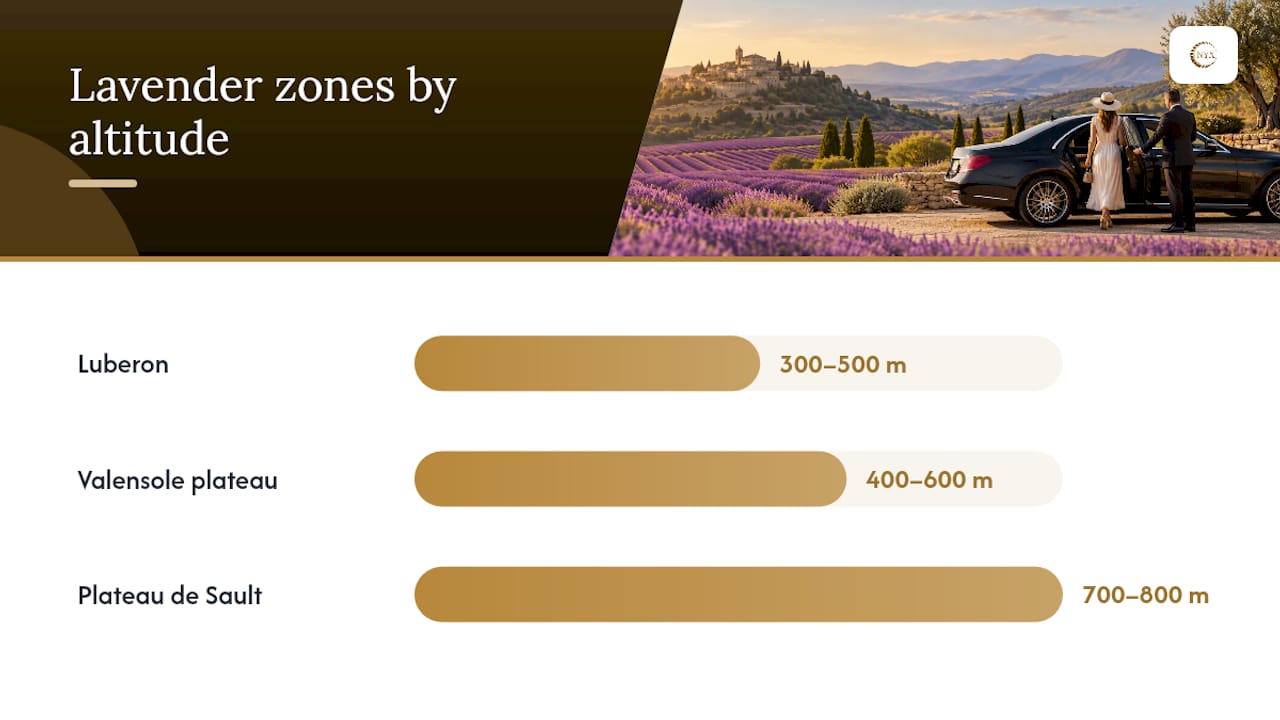
Where to see the best lavender fields in Provence
Each of Provence's main lavender zones rewards a different kind of visitor, and choosing the right one matters more than chasing the perfect date.
Valensole plateau is the postcard image most people carry into the trip: flat, vast fields running to the horizon, often photographed with a solitary tree or old stone shed in the middle distance. Flowering here generally runs from mid-June to mid-July, and the plateau's scale makes it the easiest place to find a quiet row even when the village itself is busy. The Lavender Museum in Valensole sits just south of the town and offers a useful primer on distillation and history, worth twenty minutes if the fields themselves are between peak and harvest.
Sault Plateau sits higher, at roughly 700 to 800 meters, and that altitude buys extra weeks. Known locally as the cradle of lavender in Haute-Provence, it carries the Appellation d'Origine Protégée for the region's essential oil and hosts a concentration of working distilleries. Botanical trails and distillation visits typically open from the end of June, giving a more agricultural, less manicured feel than Valensole.
The Luberon and Sénanque Abbey offer something neither plateau does: a frame. The twelfth-century abbey near Gordes, ringed by narrow lavender rows against pale stone, is one of the most photographed religious sites in France precisely because the composition does the work for you. Combine it with a stop in Roussillon or Gordes and the day becomes as much about perched villages as about the flowers.
Drôme Provençale and Forcalquier are the answer for travelers who have already done Valensole and want fewer coach parties. Both regions carry similar bloom biology to Sault but see a fraction of the visitor numbers, and Forcalquier's rolling hills make a sensitive second stop if your itinerary allows two lavender days rather than one.
The lavender route maintained by regional tourism bodies links many of these zones with waymarked stops, and it is worth following at least a section of it rather than driving directly between two headline villages.
Why lavender bloom dates shift from year to year
Two different plants share the same purple reputation, and mixing them up explains most of the confusion around bloom timing. Fine lavender (Lavandula angustifolia) is the true, wild-origin species, typically grown at higher altitude, with a fine scent and an earlier flowering habit that can still extend into late July or early August once you climb above 700 meters. Lavandin (Lavandula x intermedia), a hybrid of true lavender and spike lavender, dominates the vast commercial rows at Valensole and flowers slightly later, though it is usually harvested in bulk for its higher oil yield.
Altitude is the single biggest lever on timing. As a rough rule, every 100 to 200 meters of elevation gain delays flowering by several days to a couple of weeks, which is why Sault at 700 meters trails Valensole at 500 meters by roughly two to three weeks in a normal year.
Weather then overrides all of it. A hot, dry spring and early summer push both species forward and can advance harvest by several weeks, a pattern that has become more frequent in recent seasons. A cool, wet spring does the opposite, delaying flowering and occasionally compressing the entire regional bloom into a shorter, more intense window. This is precisely why regional reports, rather than fixed dates, are the only reliable guide once you are within a month of travel.
Planning a lavender day: routes, timing, and etiquette
Light is everything in these fields, and the difference between a flat midday shot and a glowing early one is not subtle. Arrive at Valensole or Sault between 6.30 and 8.30 in the morning and you get low, warm light, cooler air, and roads that have not yet filled with tour coaches. The same fields at 1pm in July can sit under a harsh white sun with car parks overflowing.
A realistic day plan for Valensole runs like this:
- Departure before sunrise to reach the plateau for first light, roughly 6.30am in late June.
- Photograph and walk the marked field edges for ninety minutes while temperatures remain manageable.
- Move on to Valensole village for coffee and the Lavender Museum once the light has flattered.
- Continue toward Moustiers-Sainte-Marie or the Verdon Gorge for the afternoon, returning to fields for a second, golden-hour pass around 7pm.
Parking at Valensole's busiest roadside fields fills quickly by mid-morning in July, and unofficial yards near the most photographed rows are routinely blocked by June. Sault and the Luberon are gentler, with more formal car parks near Sénanque Abbey and in Gordes itself.
Distillery visits are worth building into the plan rather than treating as an afterthought. Traditional operations such as the Vallon des Lavandes distillery near Sault run visitor programs across much of the year, with the fullest schedule in July and August, and group bookings available on request. If timing lines up, Sault's Lavender Festival, held annually on 15 August, brings markets, distillation demonstrations and a communal harvest meal, though it marks the end of the season rather than its floral peak, so do not expect fields still in full color that day.
Pro Tip Never step into a working field for a photographer. Farmers rely on those rows for their annual oil yield, and trampled plants show for the rest of the season. Regional guidance is explicit on this: stick to marked paths and roadside edges, and treat every fence or hand-painted sign as a boundary, not a suggestion.

Where to stay and how to route your lavender trip
Base yourself in Aix-en-Provence or a village on the Luberon's western edge if lavender is the priority, since both put Valensole, Gordes, and Sénanque Abbey within a manageable radius. Aix works particularly well as a hub because it also sits close to the region's vineyards, so a lavender morning can pair naturally with an afternoon wine stop, an itinerary detailed in this guide to Provence wine touring.
Travelers staying on the coast face a longer but entirely workable route. From Nice or Cannes, the drive into Valensole or the Luberon takes roughly two to two and a half hours, which argues for an overnight stop rather than a single exhausting day trip, particularly if you want the early light. Those splitting time between the Riviera and Provence sometimes anchor a few nights in Cannes before heading inland, and practical local guidance such as this Cannes travel guide is useful for sorting accommodation before the Provence leg begins.
For a slower route, drive via Grasse and take in the perfumeries before continuing north, since the town's perfume houses share the same lavender supply chain as the fields you are about to see in bloom.
How to photograph Provence's lavender fields
The best light at Valensole and Sault falls in the hour after sunrise and the hour before sunset, when the sun sits low enough to rake across the rows and pick out texture in the flower heads. Midday sun flattens color and casts hard shadows across the furrows, which is the single most common reason holiday photos of lavender fields disappoint.
Shoot from a low angle where possible, crouching so the rows recede toward the horizon rather than photographing straight down into them. A single tree, stone hut, or distant church spire gives the eye somewhere to land and lifts an otherwise repetitive pattern into a proper landscape shot. At Sénanque, position yourself on the slope opposite the abbey rather than at field level, since the elevated view is what makes that particular composition famous.
Overcast days are underrated. Soft, diffused light removes the harsh contrast of full sun and often renders the purple more accurately than a cloudless sky does, particularly on a camera phone. Arrive on a weekend morning if you can. Valensole's roadside pull offs are genuinely difficult to use after 9am in peak season, and having the field edge to yourself changes the quality of every frame you take.
Climate change and the shifting lavender calendar
Provence's growers have reported earlier flowering and earlier harvest in successive warm years, a pattern regional bodies now track closely. Heatwaves and drought have been shown to advance both flowering and harvest by several weeks compared with a typical season, with some plots cut as early as mid-June in the most affected years.
This has two practical consequences. First, the safe mid-June to mid-July window is compressing at the early end, meaning travelers who once treated the first week of July as a safe midpoint now sometimes arrive to find lower-altitude fields already harvested. Second, quality can suffer alongside timing. Drought-stressed plants tend to produce shorter stems and paler color, which affects both the visual spectacle and the oil yield distilleries depend on. Higher-altitude zones such as Sault and Forcalquier are increasingly the more reliable bet for travelers who want insurance against an early, hot spring, since their extra elevation continues to buy extra weeks even as the baseline calendar shifts earlier. None of this makes any single year predictable, which is exactly why checking conditions close to departure remains more useful than relying on last year's dates.
A chauffeur's view of timing a Provence lavender trip
From Nice Côte d'Azur Airport, Valensole sits roughly two hours fifteen minutes away by road, while Aix-en-Provence to the same plateau takes closer to an hour and a half. Catching the fields at their best light means leaving before dawn, and that only works reliably with a driver who already knows the route and can adjust departure time the night before if a heatwave has pulled harvest forward. A private chauffeur also removes the parking scramble at Valensole's busiest turnoffs, dropping you at the field edge and returning at a time you set, not a coach timetable's. For bookings or route advice, TranspOnyx can be reached on +33 6 10 30 71 84 or via Transponyx.
— Dany
Book a private lavender day with TranspOnyx
A fixed-price chauffeur service can replace the rental car and road atlas approach to lavender season, offering local route knowledge to avoid traffic and early departures if harvest shifts due to weather. Rates are typically fixed per vehicle and confirmed at booking, allowing flexible planning once live bloom reports are consulted.
For a single lavender day from the coast, the Onyx Tours half-day or full nine-hour tour covers Valensole and a village stop such as Moustiers-Sainte-Marie in a Business Sedan, or a 7-passenger van gold Van for 8 people for groups and families, with a bilingual driver handling navigation while you focus on the light. Those basing themselves on the coast can also arrange a straightforward point-to-point transfer through the Nice airport and regional transfer network before picking up a private Provence day from Aix or Cannes. To lock in a sunrise departure or check availability for a specific week in June or July 2026, call +33 6 10 30 71 84 or book directly at Transponyx.
FAQ
Which French city is famous for lavender fields?
No single city claims the title, but Valensole in the Alpes-de-Haute-Provence is the name most associated with lavender tourism thanks to its vast, easily accessible plateau in flower from mid-June to mid-July, according to regional tourism data. Sault, higher in the Vaucluse, runs a close second for travelers who want a later, quieter alternative.
What is the difference between Provence lavender and French lavender?
“French lavender” is a loose, often imprecise term used outside France, while Provence actually grows two distinct plants: lavande fine (Lavandula angustifolia), the true species prized for perfume, and lavandin, a hybrid that fills most of the vast commercial fields tourists photograph. Lavandin flowers slightly later than lavande fine and dominates plateaus like Valensole.
Where are the most beautiful lavender fields in Provence?
Valensole offers the classic vast, flat vista, while the Luberon's Sénanque Abbey provides the most photographed single composition, with lavender rows framing a twelfth-century abbey. The Plateau de Sault, home to many working distilleries, rewards visitors who want a later bloom and a quieter, more agricultural atmosphere.
Does Provence lavender come back every year?
Yes. Lavender is a perennial shrub, and established fields flower again each summer without replanting, though individual plants are typically replaced every eight to ten years as yields decline. Bloom timing shifts annually with weather, and drought or heatwaves can push flowering and harvest several weeks earlier than a typical season.
How much does a private day trip to Valensole cost with TranspOnyx?
Onyx Tours prices a half-day, five-hour excursion at €350 to €500 and a full nine-hour day at €630 to €900, both fixed per vehicle for 2026 and confirmed at booking. Full details and current availability are listed at Transponyx.