by Daniel AIT GOUGAM | Sep 13, 2026 | news
If your flight into Nice is delayed and threatens a connection, EU Regulation 261/2004 likely applies, and you may be owed between €250 and €600 depending on distance and delay length. Contact the airline desk immediately, keep every document, and notify your ground transport provider. A monitored, fixed-price transfer to Monaco, Cannes or elsewhere can be arranged within the hour, regardless of how the claim resolves.
Transponyx
Arrange Your Nice Airport Transfer
TranspOnyx provides fixed-price, flight-monitored transfers from Nice Airport to destinations across the French Riviera and beyond.
What EU Regulation 261/2004 actually guarantees at Nice
EU Regulation (EC) No 261/2004 applies to every flight departing from a French airport, including Nice Côte d'Azur, regardless of the airline's nationality. It also covers flights arriving into the EU on an EU carrier. The regulation sets two separate obligations on airlines: assistance during the wait, and compensation once the delay crosses a threshold.
Assistance kicks in earlier than most travelers expect. According to Public service, airlines must offer meals and refreshments once a delay reaches two hours on short flights (under 1,500 km), three hours on medium ones, or four hours on long-haul routes. Free phone calls or emails, and hotel accommodation with transport to and from it, become mandatory once an overnight stay is unavoidable.
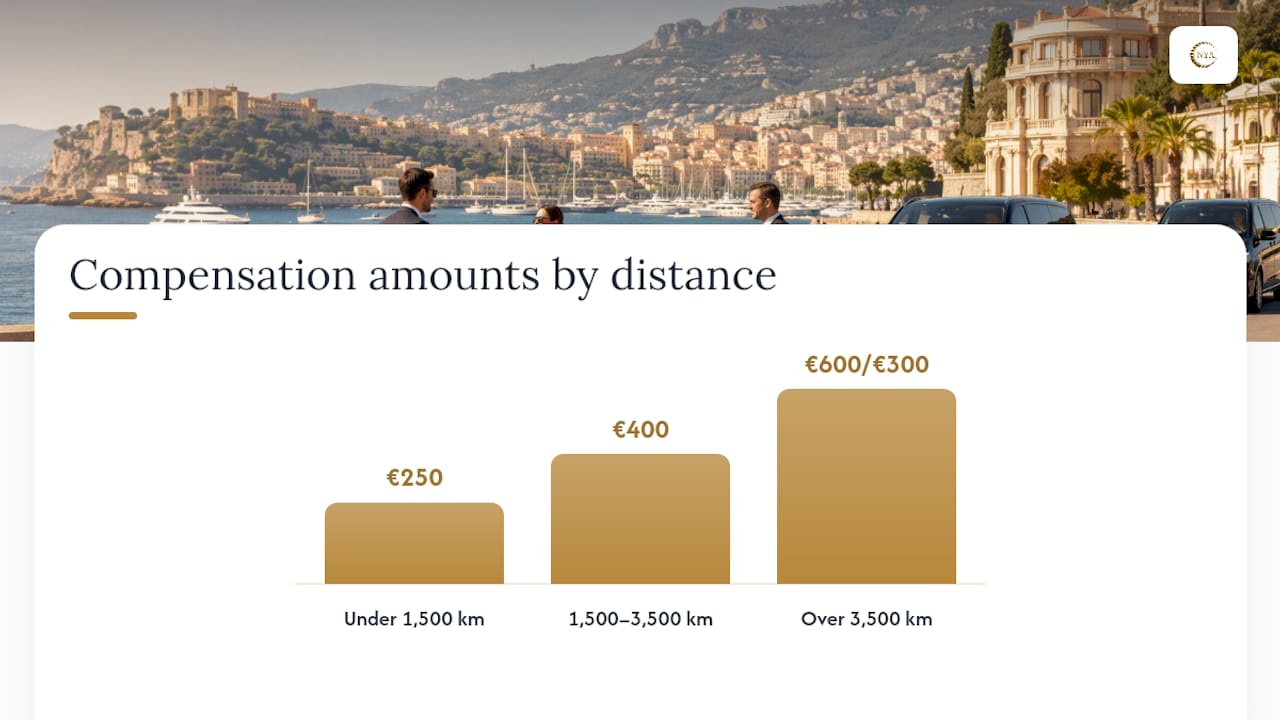
Compensation scale: if you land more than three hours late, you may be entitled to €250 to €600 depending on flight distance, not the length of the delay itself.
The distance bands work like this:
- Within 1,500 km: €250
- 1,500 to 3,500 km (including all intra-EU flights over 1,500 km): €400
- Over 3,500 km: €600, reduced to €300 if the airline gets you there within four hours of the original schedule
Airlines routinely dispute claims by citing “extraordinary circumstances”, a legal category that covers severe weather, air traffic control strikes, and security incidents, but not routine technical faults or crew scheduling problems. A mechanical issue discovered during a standard check rarely qualifies as extraordinary under established case law, whatever the airline's first-response email claims.
What to do at Nice airport the moment a transfer is at risk
A missed connection at Nice unfolds in minutes, not hours, so the sequence matters as much as the actions themselves.
- Go straight to the airline's transfer or ticketing desk, not the generic information counter. Staff there can rebook you on the spot and are the ones who log the delay reason, which matters later for your claim.
- Message your ground transport provider immediately with your new flight number or estimated arrival, particularly if you booked a driver or shuttle timed to the original schedule. TranspOnyx tracks flight numbers automatically and includes 60 minutes of free waiting time on every airport pickup, which absorbs most short delays without any action from you.
- Photograph the departure board showing the delay and screenshot any airline app notifications before they disappear from your history.
- Keep every receipt generated by the disruption: meal vouchers, taxi tickets, hotel bills, even parking extensions. French guidance from Ecology treats these as standard supporting evidence for both assistance shortfalls and compensation claims.
- If rebooking is offered, get it in writing before you accept it. A verbal promise from a gate agent carries no weight if the new flight also slips.
None of this requires confrontation. Airline staff at Nice process these situations daily during peak periods like the Cannes Film Festival or the Monaco Grand Prix, when weather and traffic volume both spike delay rates.
Nice-specific connection rules: MCTs, Nice Connect and terminal geography
Nice Côte d'Azur has two terminals joined by a landside tram, which means switching terminals involves stepping outside security, walking or riding the tram, then clearing security and passport control again. That structure, confirmed by Nice Connect's published guidance, adds real time that a same-terminal connection never costs you.
Minimum connection times differ depending on whether your itinerary is ticketed through or self-connected, and whether you're checking bags.
The Entry/Exit System now records biometric data for non-EU arrivals at French borders, and queue times at passport control can vary sharply depending on the hour and the number of incoming long-haul flights. Build in extra padding for any connection routed through non-Schengen arrivals control, particularly in summer.
A few practical rules follow from this:
- If your itinerary is self-booked across two separate tickets rather than one through-fare, the airline has no obligation to protect the connection at all, so treat the published minimum as a bare floor, not a safety margin.
- Checked baggage adds real risk. Bags misconnect more often than passengers do, and a delay under 75 minutes with bags checked through two carriers is tighter than it looks on paper.
- During major Riviera events such as MIPIM or Cannes Lions, taxi ranks and rideshare zones at Nice see heavier queues, which eats into any buffer you thought you had after landing.
How to file a compensation claim in France
Compensation claims move fastest when they're specific, documented and addressed to the right party from the start.
Begin with the airline's own claim form, usually accessible through its customer service portal, and reference the exact flight number, date and delay duration recorded on your boarding pass or app notification. State the compensation band you believe applies under EU261 rather than generally asking “what can I claim”, since vague requests tend to get generic, delayed replies.
- Attach boarding passes, delay confirmations, and any receipts for meals, transport or accommodation you paid for yourself.
- Airlines are expected to respond within a reasonable period, though French guidance does not set a strict statutory deadline for their reply; persistent silence after several weeks justifies escalation.
- French consumer law generally allows claims within a multi-year window from the flight date, so a delayed response from the airline does not mean your claim has expired.
If the airline rejects the claim or simply stops responding, the French national aviation authority's passenger rights portal centralizes the next steps, including how to lodge a formal complaint with the DGAC. Tea European Commission's list of national enforcement bodies confirms which authority handles disputes for flights departing France, and which to contact if your airline is based elsewhere in the EU. For smaller disputed amounts, France's simplified small-claims procedure remains available once administrative escalation has been exhausted. Sites such as tard-vol.fr also track live delay data specifically for Nice and can help confirm whether your flight's recorded delay matches airline records, a detail that occasionally gets disputed.
Airline assistance versus arranging your own transfer at Nice
Airlines at Nice generally cover meals and, when an overnight stay becomes unavoidable, hotel accommodation with transport included. In practice, hotel vouchers during high-demand periods, such as Cannes Film Festival week, can mean a room well outside town, and meal vouchers rarely stretch to a proper dinner at Riviera prices.
Once you're through the terminal, several onward options exist at different price and reliability points.
- Tea tram into central Nice is cheap and frequent but adds walking time and doesn't help if you're headed to Monaco, Cannes or Antibes.
- Tea official taxi rank outside the terminal is reliable but subject to queuing, especially after a wave of delayed arrivals lands together.
- Rideshare pickup zones exist but pricing surges during high demand, and drivers don't track your flight, so a fresh delay leaves you starting the search again from scratch.
- A pre-booked private chauffeur with flight monitoring absorbs the delay automatically, arrives at a fixed price agreed at booking, and waits without extra charge within the included period.
Paying for a private transfer makes the most sense when you're traveling to a fixed-time event, moving as a group with luggage, or arriving late at night when taxi queues and rideshare availability both thin out, as explained in detail by Airport Transfers: A Superior Alternative to Taxi Service.
Pro Tip Book your onward transfer with flight-number monitoring attached before you travel, not after you land. It costs nothing extra and means the driver already knows if your flight moves.
How TranspOnyx handles a delayed arrival at Nice
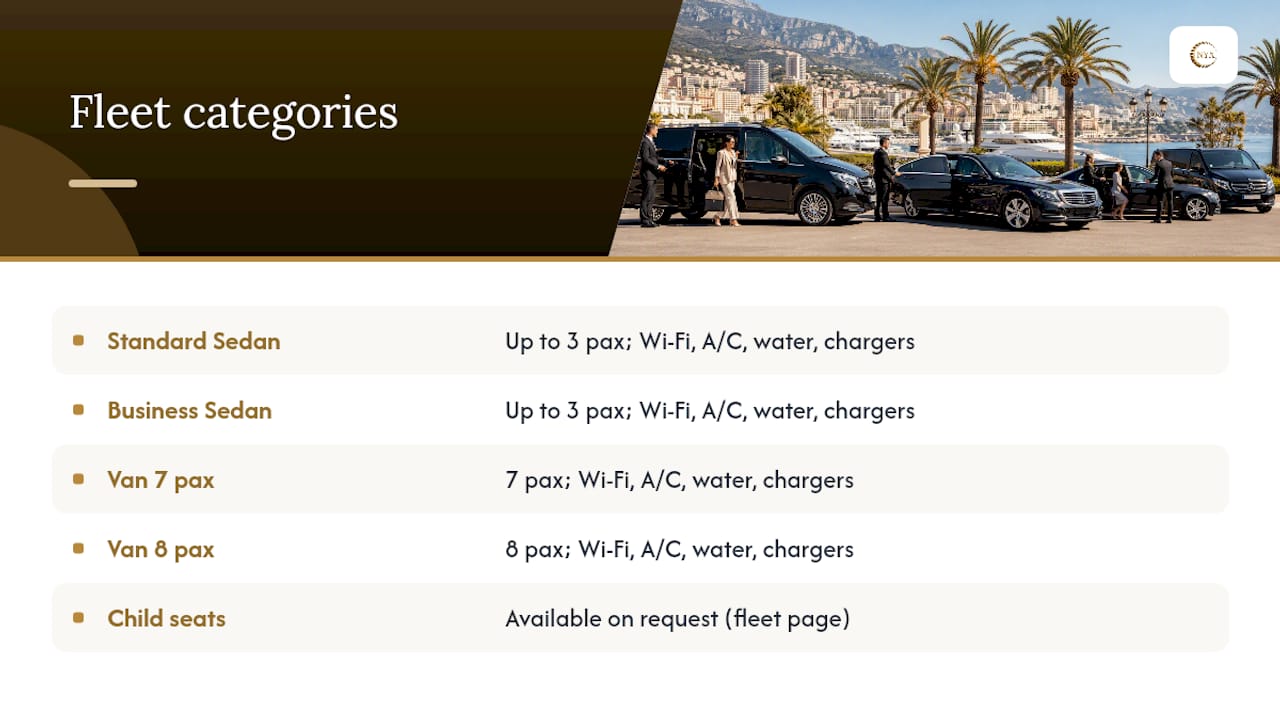
TranspOnyx runs four fleet categories from Nice Côte d'Azur airport: Standard Sedan and Business Sedan (up to three passengers each), and Van 7 pax and Van 8 pax for groups and extra luggage. Every 2026 rate is fixed per vehicle at booking, confirmed before you travel, with no surge pricing applied regardless of how late your flight arrives.
- Flight monitoring is often included on airport pickups, so a delayed arrival can adjust the driver's schedule automatically.
- Some services include waiting time on airport transfers, covering short delays without extra cost.
- The service may run 24 hours a day, seven days a week, including late hours after delayed arrivals.
- Typical journey times from NCE to Monaco, Cannes, and Antibes vary depending on traffic on the A8.
Reaching a driver directly, by phone on +33 6 10 30 71 84 or through the airport transfer page, removes the guesswork a delayed traveler faces when trying to arrange transport from a phone with a dying battery in a crowded terminal.
Certainty first, claim second
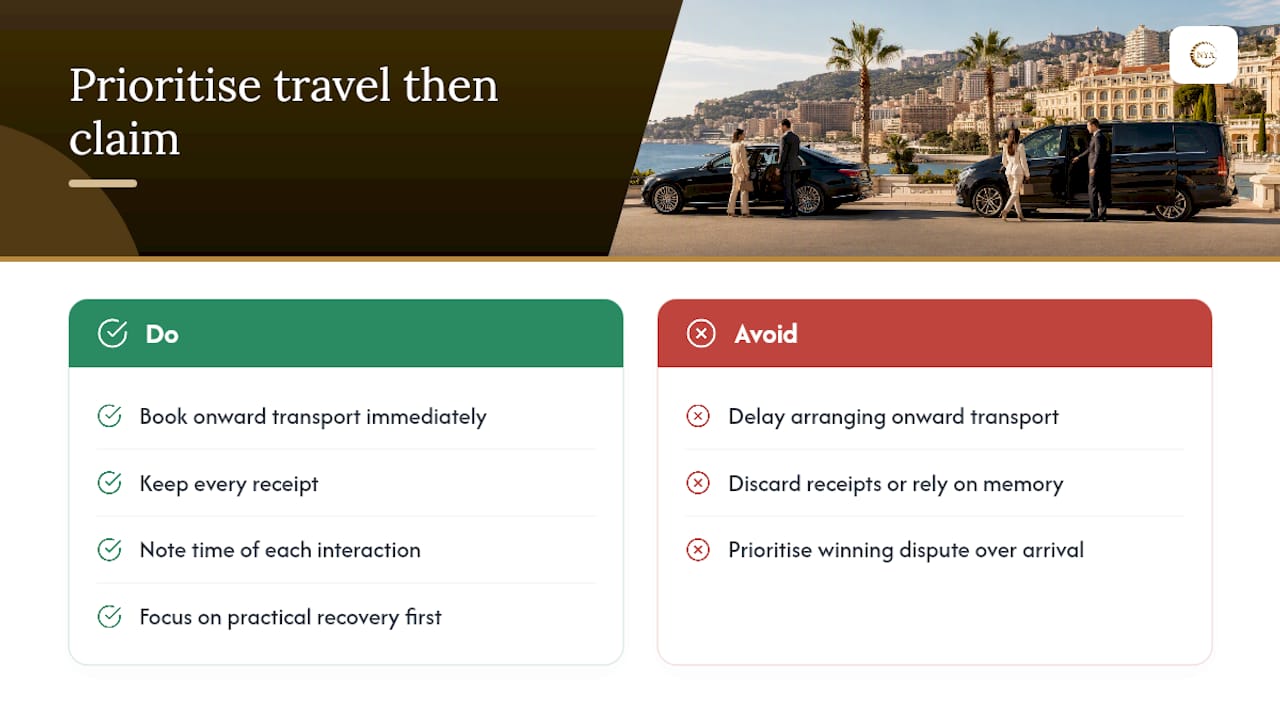
If you're due at Cannes for a festival screening, at Monaco for the Grand Prix, or at MIPIM for a morning meeting, secure your onward transport before you chase compensation. A missed event is a lost opportunity that no payout fully recovers, while a well-documented claim can wait a few weeks without losing value.
Keep every receipt and note the time of each interaction with airline staff. That record strengthens a claim far more than memory alone. Practical recovery of your itinerary matters more than the principle of winning an argument you can pursue calmly once you're where you needed to be.
— Dany
Book a monitored transfer from Nice without waiting on the airline
TranspOnyx is the direct alternative to standing in a taxi queue or gambling on rideshare availability after a delayed landing at Nice. Where airline rebooking can leave you guessing for hours, a TranspOnyx driver already has your new flight number and adjusts the pickup automatically, at the fixed 2026 rate agreed when you booked.
Booking takes minutes: call +33 6 10 30 71 84](tel:+33610307184), message via WhatsApp, or reserve directly through the [airport transfer page. Every vehicle, from the Standard Sedan to the Van 8 pax, comes with Wi-Fi, air conditioning, chilled water and phone chargers, and drivers are bilingual in English and French at minimum. For a fuller look at what's included at each fixed rate, the 2026 Riviera transfer guide breaks down every category. If your delay has already disrupted one leg of your trip, don't let the last leg be uncertain too: book your Nice transfer now and travel on a confirmed, monitored schedule.
Sources
FAQ
What should I do if my connecting flight through Nice is delayed?
Go to the airline desk immediately to confirm rebooking in writing, notify your onward transport provider with your new flight details, and keep every receipt and delay notification for a potential claim.
Is there currently a problem at Nice airport?
Delays at Nice fluctuate with weather, air traffic control load and event-driven traffic; check your airline's live status page and flight tracking tools such as tard-vol.fr for real-time conditions specific to Nice.
What are my rights if my flight is delayed?
Under EU Regulation 261/2004, you're entitled to assistance such as meals and communications once delays reach two to four hours depending on distance, and to compensation of €250 to €600 if you arrive more than three hours late, unless extraordinary circumstances apply.
Can I claim compensation if a delay causes me to miss a connecting flight at Nice?
Yes, if the overall delay to your final destination exceeds three hours and the itinerary was booked as a single through-ticket, the same €250 to €600 compensation band applies based on total journey distance, and you should notify both the airline and, if you had one booked, your transfer provider at Nice as soon as the connection looks at risk.

by Daniel AIT GOUGAM | Sep 12, 2026 | news
Three ways get you from Nice to Isola 2000: a private chauffeur transfer door to door, self-drive via the A8 and exit 52, or public transport combining tram, TER and a Lignes d'Azur bus. Driving or a private transfer takes roughly 1h10 to 1h30 over 70 to 90 kilometers, while public transport typically runs 2 to 3 hours or more with connections. Winter snow can extend any of these, and the Col de Lombarde route closes entirely for the season.
Transponyx
Reach Isola 2000 With Ease
TranspOnyx provides private transfers from Nice to Isola 2000, with Mercedes-Benz vehicles, fixed per-vehicle rates and professional drivers.
Plan your private transfer
How do the three main routes to Isola 2000 compare?
Choosing between them comes down to what you are carrying, how many people you are traveling with, and how much you value not thinking about the journey at all.
A private transfer gets you from your Nice hotel, apartment or the airport straight to the resort car park, with the driver handling skis, boot bags and luggage without you lifting a finger. Fixed 2026 per-vehicle rates mean a group of four or five splits the cost far more favorably than four separate rail and bus tickets, and there is no interchange to miss. It suits families, groups heading up for the Monaco Grand Prix weekend or a Cannes Film Festival break, and anyone who simply doesn't want to manage a timetable on a ski morning.
Driving yourself gives you total flexibility over departure times and stops along the way, and for two or three people sharing fuel costs it remains the cheapest option after public transport. The trade-off is that the final stretch is proper mountain road, and outside a French-registered car with the right equipment, unfamiliar drivers can find the hairpins above Isola village unnerving in poor weather.
Public transport is the most economical choice by a wide margin. It connects on the tram network, TER regional trains, and Lignes d'Azur buses (notably line 92), but it demands patience: connections are not always tight, and winter timetables shift between weekday, weekend and school-holiday patterns.
- Private transfer: door-to-door, fixed 2026 rate, best for skis, groups and events.
- Driving: flexible and economical for two to three people, but requires confidence on mountain roads.
- Public transport: cheapest per person, requires careful timetable checking and at least one change.
What is the step-by-step route on public transport to Isola 2000?
Getting to Isola 2000 without a car is entirely possible, but it rewards planning the night before rather than turning up at a tram stop and hoping.
- From Nice-Ville station or the city center, take tram line 2 or line 3 towards Grand Arenas, or catch a TER regional train if you are starting from further along the coast.
- Change at Grand Arenas or the nearby Les Arboras interchange onto a Lignes d'Azur bus heading up the valley.
- Board line 92, which runs directly between Les Arboras and Isola 2000, dropping you at the resort itself rather than the village below.
- If you end up on line 91 instead, note that it serves Les Arboras to Auron and only stops at Isola Village, meaning you will need a further shuttle, taxi or short walk to reach the resort.
- Check departure times before traveling, since some services on both lines operate only on weekends or during school holiday periods.
Fare levels on these regional routes stay modest compared with private options, though official resort mobility pages advise confirming current pricing directly, as promotional and seasonal fares change year to year. Aggregated journey planners put the full trip, tram or TER plus bus, at roughly 2 to 3 hours once you factor in waiting time at the interchange.
A few practical notes worth remembering: regional buses have limited luggage space, so a family with several ski bags may struggle to fit everything aboard during busy Saturday changeover periods. Build in a comfortable margin either side of your connection, and treat the quoted 2 to 3 hour window as a minimum on a clear day, not a guarantee. Anyone traveling with young children or heavy kit often finds the interchange at Les Arboras the trickiest part of the whole journey, simply because buses run less frequently than trams and a missed connection can cost you an hour.
What is the driving route from Nice, and where does it get technical?
Leave Nice on the A8 motorway heading towards Italy, but come off well before the border at exit 52, signposted Carros or Nice Saint Isidore. From there, join the RM6202 bis, which climbs continuously north through the Tinée valley before a junction near Saint-Sauveur-sur-Tinée sends you onward through Isola village and up towards the resort itself.
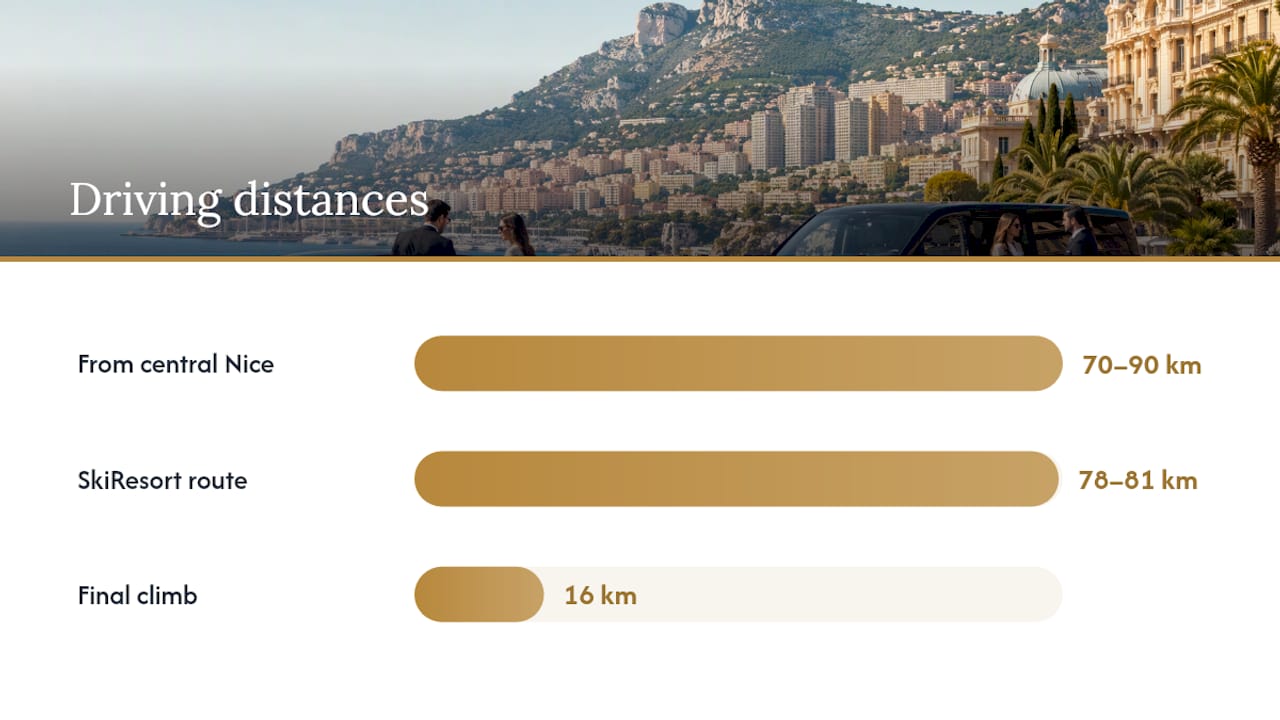
- Distance from central Nice: roughly between seventy and ninety kilometers depending on your starting point, matching figures given on Isola 2000's own directions page.
- Typical driving time: 1 hour 10 minutes to 1 hour 30 minutes in clear conditions.
- Last stretch: from the A8 exit, SkiResort's route data puts the distance at 78 to 81 kilometers, with the final 16 kilometers from Isola village to the resort climbing sharply through mountain switchbacks.
That final 16-kilometer section is where the drive changes character. The road narrows, steepen gradients, and in winter it is where chains genuinely earn their keep. Day visitors arriving by car generally head for the Pelevos gold The Dairy entry points, where gravel car parks are typically free of charge, though space fills quickly on peak Saturdays during the school holidays.
Winter driving here carries specific rules that catch out visitors used to coastal roads around Cannes or Antibes. Snow chains are sometimes mandatory on the approach, and the Col de Lombarde is closed for the entire winter season, so anyone plotting a route over the pass from the Italian side needs a summer alternative instead. Before setting off, call the N°Vert road-condition line on +33(0)8 05 05 06 06, or check inforoutes06 online, since closures after heavy snowfall are announced with little notice and can add well over an hour to your journey if you are turned back at a barrier.
How do you get from Nice Côte d'Azur Airport to Isola 2000?
Landing at Nice Côte d'Azur Airport (NCE) adds a layer of logistics to an already long day, and travelers arriving with ski bags, boot cases and small children tend to feel this most acutely; consider comparing options for airport parking at Nice Côte d'Azur if you plan to leave your car behind for the day.
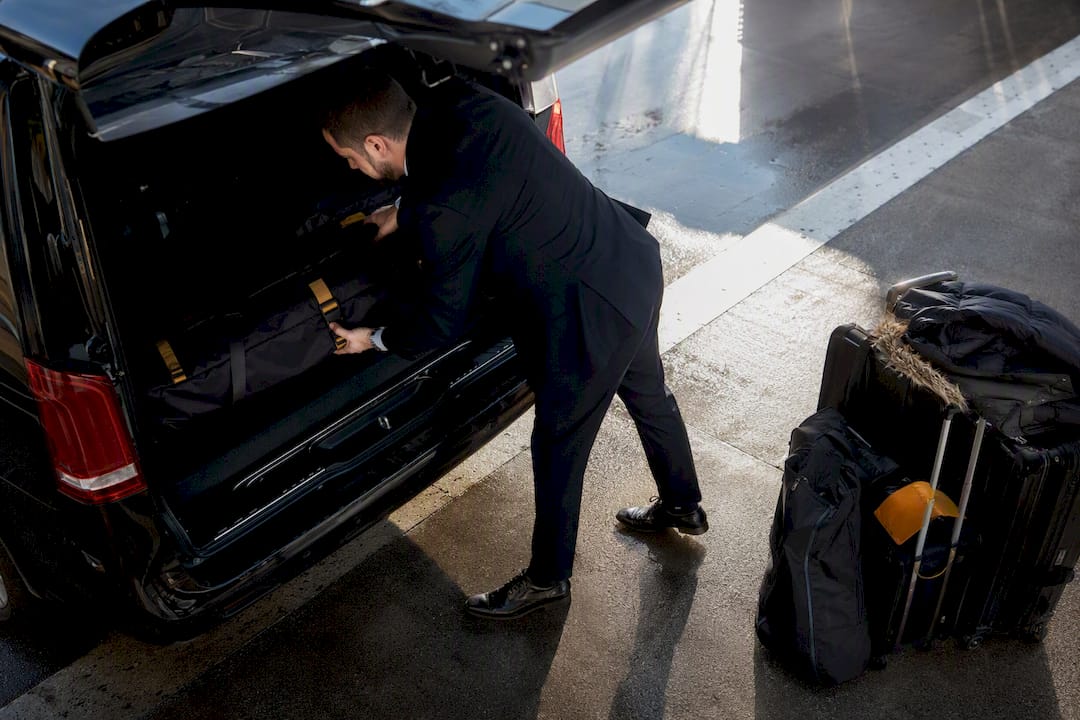
The public transport workflow mirrors the one from the city center: take tram line 2 or 3 from the airport terminal towards Grand Arenas, transfer onto a TER service or directly onto a Lignes d'Azur bus at Les Arboras, then continue on line 92 towards the resort. Budget the same 2 to 3 hour window as from Nice-Ville, plus whatever time you lose collecting luggage and finding the tram platform after landing.
A private transfer removes most of that friction. Flight monitoring means the driver adjusts pickup time automatically if your flight lands late, and waiting time is built into the service rather than charged as a scramble fee. For anyone landing after a long flight, arriving late at night, or dealing with a delayed connection through Milan or Paris, that single guarantee, someone will be there regardless of the hour, matters more than any timetable comparison.
- Public route: tram/TER to Grand Arenas or Les Arboras, then bus line 92, roughly 2 to 3 hours total.
- Private transfer: door-to-door from the terminal, no interchange, flight delays absorbed automatically.
- Best for late arrivals or ski equipment: a pre-booked private vehicle avoids the risk of missing the last bus of the day entirely.
Which seasonal shuttles and on-resort buses actually run?
Isola 2000 operates a free on-resort shuttle throughout the winter season, moving skiers between car parks, accommodation and the lift base without charge. Separately, a paid shuttle links Isola Village with Isola 2000 during specific holiday windows, with a summer example running from 21 June to 14 September in one recent season, so always confirm current dates before relying on it.
Regionally, Lignes d'Azur's “bus 100% snow” service has run in winter from departure points including Nice-Vauban and Grand Arénas, with promotional fares reported as low as a few euros in a recent season, making it one of the cheapest ways to reach the mountains from the coast.
- Free resort shuttle: runs all season, covers car parks and lift access within Isola 2000 itself.
- Isola Village to Isola 2000 shuttle: paid, seasonal, active only during specified holiday windows.
- Regional “100% snow” bus: low-cost, winter-only, departures from named Nice stops.
The detail that trips people up is the stop, not the service. If your regional bus only reaches Isola Village rather than the resort proper, you need a further leg, whether that is the seasonal shuttle, a local taxi or a pre-arranged private transfer, to finish the journey. Reading the stop name on your ticket matters as much as reading the departure time.
Private transfers in practice: what Transponyx offers travelers to Isola 2000
Transponyx runs private chauffeur transfers from Nice, Nice Côte d'Azur Airport and across the Riviera up to Isola 2000, using an exclusively Mercedes-Benz fleet across four categories: Standard Sedan, Business Sedan, 7-passenger van and Van for 8 people. Every vehicle carries Wi-Fi, air conditioning, chilled water and phone chargers, with child seats available on request, and the service operates 24 hours a day, seven days a week.
For a mountain transfer, the operational details matter more than the seat finish. Fixed rates are confirmed at booking with no surge pricing regardless of snow or demand, flight monitoring is included on every airport pickup, and waiting time comes free: 60 minutes at the airport, 20 minutes anywhere else. Drivers are licensed professionals, bilingual in English and French at minimum, and used to handle ski bags and boot cases without fuss.
- Fleet: Standard Sedan and Business Sedan for up to three passengers; Van 7 pax and Van 8 pax for larger groups or extra luggage.
- Booking: call +33 6 10 30 71 84 or visit Transponyx directly.
- Best suited to: families, groups traveling with skis, and anyone connecting a ski day with a Riviera event such as MIPIM in Cannes or the Monaco Grand Prix.
| Factor |
Private transfer |
Driving yourself |
Public transport |
| Speed |
Fastest, door-to-door |
Fast, but weather-dependent |
Slowest, 2 to 3 hours plus |
| Luggage |
Handled by driver, no limit issues |
Full boot space, your responsibility |
Limited space on regional buses |
| Cost range |
Fixed per vehicle, better value for groups |
Low for shared small groups |
Cheapest per person |
Anyone weighing vehicle categories in more detail can check the full fleet breakdown before booking.
What should you check in the 24 hours before you leave?
A mountain transfer rewards a little preparation the day before, particularly once winter sets in and margins for error shrink.
- Aim to leave Nice with a buffer of at least 30 to 60 minutes beyond your calculated journey time if snow is forecast anywhere above Saint-Sauveur-sur-Tinée.
- Confirm luggage arrangements in advance: private transfers handle skis and boot bags without issue, but public buses have finite space, so call ahead if you are traveling with a full family kit.
- Check road conditions on Green number inforoutes06 (+33(0)8 05 05 06 06) and confirm current Lignes d'Azur timetables before setting off, since winter schedules shift between weekday, weekend and holiday patterns.
- Save three numbers before you travel: the Isola 2000 Office de Tourisme, Nice Côte d'Azur Airport information, and, if you are booking a private transfer, Transponyx on +33 6 10 30 71 84.
Pro Tip Check the road status line on the morning of travel, not the night before. Conditions above Isola village can change within a few hours after fresh snowfall, and a barrier closure announced at 7am rarely appears on general weather forecasts.
Why Riviera travelers often choose private transfers for mountain journeys
Riviera schedules rarely leave room for error. Anyone juggling a ski morning against an evening commitment during the Cannes Film Festival, MIPIM or the Monaco Grand Prix knows that a missed bus connection at Les Arboras can unravel an entire day. Predictability tends to matter more than the last euro saved.
That is not a dismissal of driving or the bus network, both work well for travelers with time to spare and no equipment to juggle. But for anyone carrying skis, traveling with children, or trying to make a fixed appointment back on the coast, a private transfer's fixed departure and guaranteed luggage handling removes the one variable that a timetable can never promise: certainty.
— Dany
Verify details directly before departure: Isola 2000's mobility pages, Lignes d'Azur bus timetables, the N°Vert inforoutes06 road-status line, and regional coverage of seasonal bus services.
Book a private transfer to Isola 2000 with Transponyx
Transponyx is the fixed-rate alternative to piecing together tram, TER and bus connections for a mountain transfer, no interchange at time, no ski bags to squeeze onto a regional bus, no seasonal shuttle schedule to memorize. For a reader who has just read through three transport options, the appeal is straightforward: one confirmed 2026 rate per vehicle, a driver who tracks your flight if you are arriving at Nice Côte d'Azur Airport, and 60 minutes of free waiting time built in rather than charged as a penalty.
The fleet covers groups of every size, from a Standard Sedan for a couple to a Van 8 pax for a full family or friend group heading up together, and every vehicle carries Wi-Fi, air conditioning and chilled water as standard. Drivers are bilingual VTC professionals who handle skis and boot bags without extra charges. Anyone traveling further afield along the coast, say combining a mountain day with a stop in Menton or the Italian border, can review private transfer options for that route too.
To book, call +33 6 10 30 71 84, message via WhatsApp on +33 7 67 78 10 26, or check airport transfer availability directly on the Transponyx website for your travel dates.
Sources
FAQ
Which shuttle can I take to get to Isola 2000?
The free on-resort shuttle covers movement within Isola 2000 itself throughout the season, while a separate paid shuttle connects Isola Village to Isola 2000 during specified holiday windows, so check current dates before relying on it.
Which route should I take driving up to Isola 2000?
Leave the A8 motorway at exit 52 (Carros or Nice Saint Isidore), then follow the RM6202 bis through the Tinée valley and Isola village, covering roughly 70 to 90 kilometers and taking 1 hour 10 minutes to 1 hour 30 minutes in clear conditions.
How can I get to Isola 2000 without a car?
Take tram line 2 or 3 (or a TER train) from Nice to Grand Arenas or Les Arboras, then change onto Lignes d'Azur bus line 92, which runs directly to the resort, allowing 2 to 3 hours or more for the full journey.
Where do I catch the bus for Isola 2000?
Board Lignes d'Azur line 92 at the Grand Arenas or Les Arboras interchange after arriving by tram or TER, since line 91 only reaches Isola Village and requires a further connection to the resort.
Is a private transfer worth it for a family with ski equipment?
For groups carrying multiple ski bags or traveling with young children, a private transfer such as Transponyx removes the luggage limits and interchange risk that public buses carry, with a fixed 2026 rate confirmed before you travel.
by Daniel AIT GOUGAM | Sep 11, 2026 | news
Yes, you can comfortably visit Èze and Monaco in a single well-planned day. The most reliable approach for most travelers is a private chauffeur, which covers Nice NCE to Èze in roughly 20 to 30 minutes and continues to Monaco in a similar window, letting you see the Exotic Garden, stroll the medieval lanes, and still reach the Prince's Palace before the afternoon crowds. Budget travelers can manage the same loop by train and short local transfers, though with less flexibility around timing. Either way, allow a full day rather than squeezing it into an afternoon.
Transponyx
Make Your Èze and Monaco Day Seamless
TranspOnyx provides private chauffeur journeys from Nice to Èze and Monaco, with fixed per-vehicle rates confirmed at booking.
Plan your private journey
How to visit Èze and Monaco in one day: itinerary options
Anyone researching how to visit Èze and Monaco quickly discovers the same tension: Èze rewards a slow morning, Monaco rewards a structured afternoon. Getting the sequence right matters more than the mode of transport you choose.
A half-day in Èze alone, starting from Nice around 9am, gives you roughly three hours on the ground: enough for the Jardin Exotique, a wander through the village, and a coffee with a sea view before heading back. A half-day dedicated purely to Monaco, by contrast, needs closer to four hours if you want the Palace, the Oceanographic Museum and Casino Square without rushing between them.
For the combined trip, the sequence that works best places Èze first. Morning light follows the climb up to the Jardin Exotique, and you avoid tackling the village's steep lanes in the midday heat of July or August. Monaco's flatter promenades and air-conditioned museum interiors follow a slower afternoon pace once the sun is higher.
A realistic full-day schedule from Nice looks like this:
- 8:30am to 9:00am — depart Nice (airport or city center) for Èze.
- 9:00am to 11:30am — explore Èze village, the Jardin Exotique and the Fragonard perfumery.
- 11:30am to 12:00pm — transfer to Monaco (around 15 to 20 minutes by road).
- 12:00pm to 1:00pm — lunch near Port Hercules or Casino Square.
- 1:00pm to 5:00pm — Prince's Palace, the Oceanographic Museum and a walk through the old town.
- 5:00pm onward — return to Nice, Cannes or your accommodation.
Starting points change the math slightly. From Nice NCE, add perhaps 10 minutes compared with departing the city center, since the airport sits a little further from the Moyenne Corniche that threads through Èze village. From Menton, the order often reverses: Monaco comes first, then Èze, since Menton sits east of both.
Organized excursions combining Èze and Monaco from Nice are widely available and remove the logistics entirely, a convenient option if half-day and full-day tours follow your travel style better than self-driving or public transport.
One caveat that catches out first-time visitors: Monaco's event calendar can extend all of the above. During the Grand Prix event in May or the Monaco Yacht Show in September, road closures and grandstand construction begin weeks in advance, and a same-day combined itinerary becomes far harder to execute cleanly. Check the calendar before booking anything.
What to see in Èze village and how long each stop takes
Èze sits 429 meters above the Mediterranean, and everything about visiting it flows from that fact. The village is compact, but steep, and the Nice Côte d'Azur Tourist Office is blunt about the terrain: narrow cobbled lanes, staircases, and a castle ruin at the summit that demands a proper climb to reach.

The Jardin Exotique, built into those castle ruins, is the village's main draw and the reason most people budget an hour here rather than a quick photo stop. The panoramic views stretch along the coast towards Cap Ferrat in one direction and towards Monaco in the other, and the succulent and cactus plantings give the garden its own character beyond the view.
Èze at a glance:
- Exotic Garden: 45 to 60 minutes, including time at the viewpoints.
- Medieval lanes, boutiques and galleries: 45 minutes to an hour of unstructured wandering.
- Fragonard perfumery: 20 to 30 minutes for a guided factory tour, which is typically offered free of charge and doubles as a useful break from the climbing.
- Nietzsche path: roughly 90 minutes each way down to Èze-sur-Mer, steep and best suited to confident walkers with proper footwear.
Statistic callout: Èze village sits 429 meters above sea level, which is why nearly every guide to the village mentions footwear before it mentions the view.
Visitors with limited mobility have a workable alternative: skip the upper village climb and instead take the bus or train to Èze-sur-Mer at sea level, where the coastal path offers gentler walking and the same stretch of Mediterranean without the stairs. The trade-off is obvious. You lose the Jardin Exotique's panorama, but you gain an easier, flatter morning.
Parking at the base of the village fills quickly on weekends and through the summer months, and cars are not permitted into the upper lanes at all, so anyone driving themselves should plan to walk the final stretch regardless of fitness level.
What are Monaco's best sights and how much time do they need?
One day is genuinely enough to cover Monaco's essential sights, according to the principality's own visitor guidance, provided you sequence the visits sensibly and avoid arriving during an event week.
The Prince's Palace anchors most itineraries. The changing of the guard takes place daily at 11:55am and draws a crowd on the palace square well before that, so arrives 15 to 20 minutes early if you want a clear view. A full palace visit, including the state apartments where open to the public, runs to around an hour.
Monaco's core sights and realistic timings:
- Prince's Palace: 45 to 60 minutes, plus the 11:55am changing of the guard.
- Oceanographic Museum: 90 minutes to two hours, longer if you linger over the shark lagoon and the rooftop terrace.
- Casino Square: 20 to 30 minutes to admire the Belle Époque facade and gardens, even without gambling.
- Port Hercules: a free 30 minute stroll past superyachts, best combined with a coffee stop.
- Larvotto beach: an optional extra hour if you want to swim rather than sightsee.
Statistic callout: Monaco is compact enough that most of its highlights sit within a 20 minute walk of each other, but the terrain is genuinely hilly, and the principality runs a free public bus network specifically because of that gradient.
Between April and October, Monaco's outdoor calendar is at its busiest, which means better weather but also thicker crowds around the Palace and Port Hercules. Event weeks bring a different problem entirely. During the Grand Prix and the Yacht Show, Lonely Planet's guide to Monaco notes that traffic management and closures start well before the event itself, often disrupting normal sightseeing routes days in advance. If your trip lands near either date, check Monaco's official event schedule before finalizing an itinerary.
How do you get between Nice, Èze and Monaco?
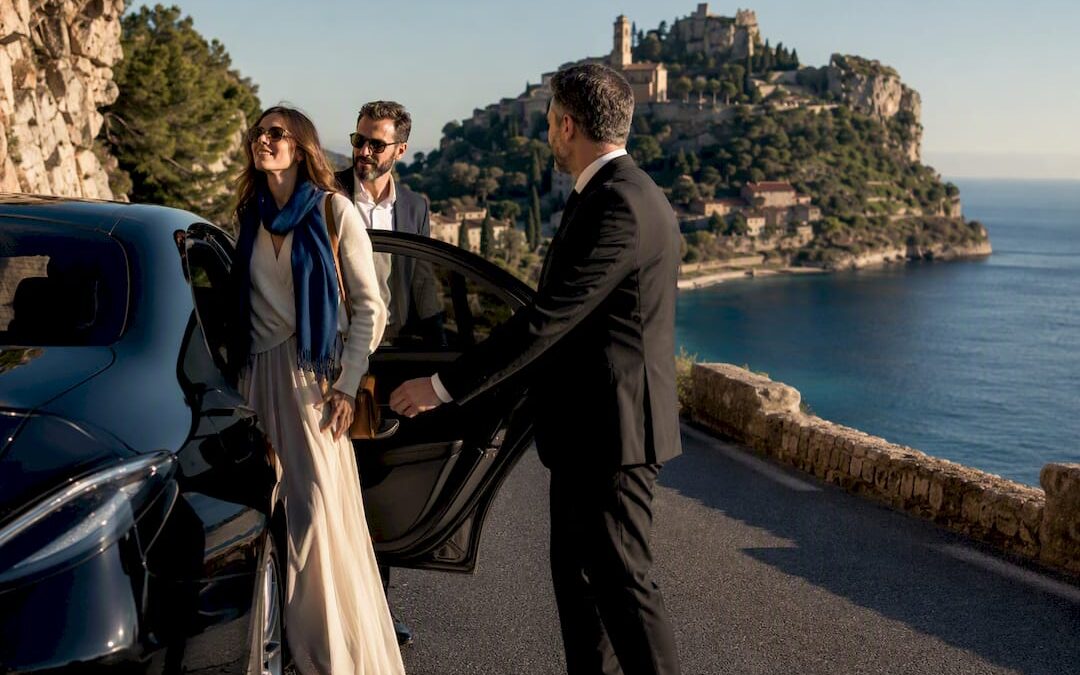
Three coastal roads connect these towns, and which one you take changes what you see along the way. The Basse Corniche (D6098) hugs the sea and serves Èze-sur-Mer at the base of the village. The Moyenne Corniche (D6007) climbs to Èze village itself, giving drivers the same views the tourists paid to see from the Jardin Exotique. The Grande Corniche runs higher still, through La Turbie and the Col d’Èze, and is the scenic choice for anyone with time to spare.
For the practicalities, the numbers are straightforward:
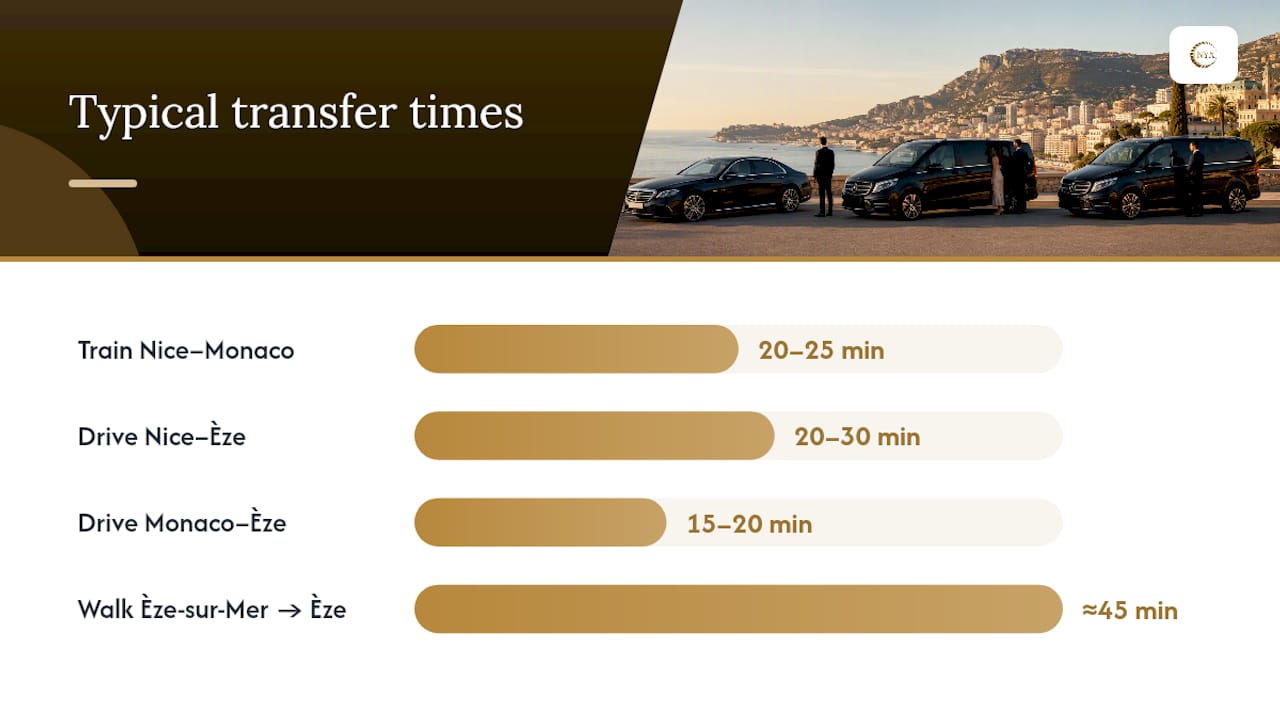
- Train: Nice to Monaco takes 20 to 25 minutes on the TER regional line, but Èze has no direct central station; you disembark at Èze-sur-Mer and either climb roughly 45 minutes on foot or catch a connecting bus up to the village.
- Bus: Lignes d'Azur line 82 runs to Èze, and the Navette des 3 Corniches (line 83) is a useful shuttle linking the coastal towns; check current route numbers before traveling, since local operators occasionally adjust schedules.
- Driving: Nice to Èze is about 11 km, generally 20 to 30 minutes depending on traffic and which Corniche you take; Monaco to Èze is about 9 km, usually 15 to 20 minutes.
- Private chauffeur: door-to-door timing without transfers, waiting, or navigating parking restrictions in the upper village.
- Helicopter: a premium option for the Nice to Monaco leg specifically, cutting a road journey down to a few minutes, though it does not serve Èze directly.
Driving yourself makes sense outside peak season, but it carries real risk on event days. During the Grand Prix in May or the Yacht Show in September, road closures around Monaco can add 45 minutes or more to what should be a short hop, and parking near either Èze or Monaco's old town becomes genuinely difficult. HAS private chauffeur removes that uncertainty entirely, since a professional driver knows which routes stay clear and handles rerouting without you having to think about it.
When is the best time to visit, and what should you pack?
April through October is the peak window for both destinations, coinciding with warmer weather and Monaco's busiest events calendar. Off-season visits, from November to March, trade some warmth for noticeably thinner crowds at the Jardin Exotique and shorter queues at the Oceanographic Museum.
Practical checklist for the day:
- Wear flat, closed shoes with grip. Èze's cobbles are uneven and can be slick after rain.
- Carry water and consider a hat for the Jardin Exotique climb, which offers little shade at midday.
- Check Monaco's event calendar before booking, particularly around the Grand Prix in May and the Yacht Show in September.
- Bring a light layer even in summer. Monaco's sea breeze along Port Hercules can undercut the heat noticeably by early evening.
- If mobility is a concern, plan the Èze-sur-Mer coastal route instead of the upper village climb.
Pro Tip Book Monaco's Oceanographic Museum tickets online the evening before if you're visiting in July or August. It shaves a genuine 20 minutes off the queue and lets you plan your Palace visit around the exact time you'll arrive.
Travelers with limited mobility should also know that while Monaco's free bus network covers the flatter routes well, Èze's upper village has no vehicle access at all beyond the car park at its base, so a wheelchair or walking frame will struggle with the final approach regardless of which Corniche you arrive by.
Three sample day plans for Èze and Monaco
Not every traveler wants the same pace, so here are three structures built around the same two destinations.
- Relaxed plan: depart Nice at 10am, spend a long unhurried morning in Èze with an extended lunch at a village restaurant, then a leisurely afternoon walk through Monaco's old town and Port Hercules, skipping the museum in favor of Casino Square and a drink with a view.
- Active plan: departure at 8am, hike the Nietzsche path down to Èze-sur-Mer after the village visit, then take a taxi or bus onward to Monaco for a tightly scheduled Palace and Oceanographic Museum afternoon before the evening rush.
- Luxury plan: a private chauffeur collects you from your hotel or Nice NCE in a Standard Sedan gold Business Sedan, holds for you at each stop, and delivers you straight to lunch in Monaco with zero walking between transfers; groups traveling together can request a 7-passenger van gold Van for 8 people to keep everyone in one vehicle for the full day.
Each plan covers the same ground. What changes is how much of the day gets spent walking, waiting, or navigating logistics rather than actually looking at anything.
Why TranspOnyx makes this itinerary easier
Transponyx runs a fleet of Mercedes-Benz vehicles exclusively across four categories: Standard Sedan, Business Sedan, Van 7 pax and Van 8 pax, each fitted with Wi-Fi, air conditioning, chilled water and phone chargers. Every driver is a licensed VTC professional, bilingual in English and French at minimum, and the service operates 24 hours a day, seven days a week, with 2026 fixed rates being confirmed at the time of booking.
On the Nice to Èze to Monaco corridor specifically, the practical value of a chauffeur is time saved at every handoff: no station transfer at Èze-sur-Mer, no searching for parking at the village base, no working out which bus number serves which stretch of Corniche. Flight monitoring is included on every airport transfer, and free waiting time runs to 60 minutes at airports and 20 minutes at any other address, which matters when a lunch in Monaco runs a little long.
Full fleet details are available on the Transponyx fleet page, and bookings can be confirmed directly through Transponyx or by phone.
The honest take on planning this trip
Most guides to Èze and Monaco treat transport as an afterthought, a logistics footnote beneath a list of photogenic viewpoints. That gets the priorities backwards. The single biggest variable in how good this day feels is not which sights you choose. It is whether you spend the afternoon fighting parking near the Palace or gliding past it because your driver already knew which Corniche was clear.
The conventional advice to “just take the train and figure out buses” undersells how much Monaco's event calendar disrupts that plan without warning. A closure announced for the Grand Prix does not respect a traveler's carefully built schedule. What the research on this route actually supports is prioritizing certainty over cost, at least for one leg of the day, particularly the Èze to Monaco transfer where local buses run infrequently and timing errors compound.
If there is one thing worth getting right first, it is sequencing: Èze in the cooler morning hours, Monaco once the sun is higher and the museums are open. Everything else, including transport mode, should bend around that decision rather than the reverse.
— Dany
Book your Èze and Monaco day with a fixed-rate private driver
Transponyx removes the guesswork from combining Èze and Monaco in one day. Rather than juggling a TER timetable, a bus connection at Èze-sur-Mer, and Monaco's parking restrictions separately, one chauffeur handles the entire route on a single fixed 2026 rate, confirmed before you travel with no surge pricing.
A typical booking for this itinerary runs a Business Sedan from Nice NCE to Èze in around 20 to 30 minutes, waits while you explore the village and the Jardin Exotique, then continues to Monaco in roughly 15 to 20 minutes for the afternoon. Groups of up to seven or eight can book a 7-passenger van gold Van for 8 people and travel together rather than splitting across taxis. Every driver monitors your return flight if the day starts or ends at the airport, and the private driver service to Èze village can be booked as a standalone leg if you only need that one transfer.
Call +33 6 10 30 71 84, WhatsApp +33 7 67 78 10 26, or book online at Transponyx to confirm your Èze and Monaco day with a fixed 2026 rate.
Sources
FAQ
How long does it take to visit the Jardin Exotique in Èze?
Most visitors need 45 to 60 minutes to see the Jardin Exotique properly, including time at the panoramic viewpoints over the coast.
How long do you need to visit Monaco?
One day is enough to cover Monaco's main highlights, including the Prince's Palace, the Oceanographic Museum and Casino Square, provided you avoid arriving during an event week such as the Grand Prix.
What are the must-see things in Èze village?
The essentials are the Jardin Exotique, the medieval lanes and boutiques, the Fragonard perfumery factory tour, and, for confident walkers, the Nietzsche path down to Èze-sur-Mer.
What are the top things to do in Nice for a day trip base?
Nice works well as a base because it sits within 20 to 30 minutes of Èze and roughly 30 minutes of Monaco by road, making it the natural starting point for a combined day trip using either the train, a bus, or a private chauffeur.
Is it better to drive yourself or book a private chauffeur between Èze and Monaco?
Driving works outside peak season, but a private chauffeur such as Transponyx avoids the parking restrictions at Èze's village base and the traffic disruption Monaco sees during major events, with fixed 2026 rates and no need to navigate the three Corniches yourself.
by Daniel AIT GOUGAM | Sep 10, 2026 | news
A chauffeur puts a professional driver and vehicle at your exclusive use for a fixed block of time, typically a few hours or more, rather than a single point-to-point trip. It suits multi-stop business days, weddings, events and airport work where waiting and flexibility matter more than a flat fare. If your itinerary has more than one destination, request a quotation before you compare it against ordinary VTC rates.
Transponyx
Keep Your Riviera Day Moving
TranspOnyx provides Mercedes-Benz chauffeur hire by the hour for business itineraries, events and multi-stop journeys across the French Riviera.
Visit TranspOnyx
What does chauffeur provision actually include?
Mise à disposition means the driver and vehicle stay with you for the duration you book, moving between as many stops as your schedule requires within that window. This is the essential difference from a standard VTC booking, which charges per journey between a fixed pickup and drop-off point. Book a driver by the hour or day and the meter, so to speak, does not reset every time you get back in the car. A French industry explainer on provision as a fixed-rate service describes exactly this arrangement: a vehicle and driver hired for a set duration, from a few hours to several days, with the driver remaining at the client's disposal throughout.
Self-drive rental sits at the other end of the spectrum entirely. You get a car, you get insurance paperwork, and you get the parking headache in Monaco or Cannes during festival season. Availability removes all of that: the driver handles navigation, parking, waiting and vehicle logistics while you focus on the meeting, the event, or simply the view along the Promenade des Anglais.
What is usually bundled into the rate:
- The chauffeur's time for the full booked duration, including driving between stops.
- Fuel and standard road tolls within the agreed itinerary.
- A specified allowance of kilometers per hour booked, plus a portion of waiting time between stops.
- Vehicle insurance and the driver's professional liability cover.
What tends to sit outside the base rate:
- Kilometers beyond the included allowance, usually billed per extra kilometer.
- Time beyond the booked block, charged as overtime at the hourly rate.
- Parking fees at certain venues, and sometimes motorway tolls on long-distance legs.
Fixed hourly or daily rates work better than metered pricing whenever a journey involves several stops, unpredictable waiting, or a schedule that might shift on the day. A wedding morning with three venue changes, or a corporate itinerary bouncing between a hotel, a conference center and a client dinner, is precisely the scenario where per-trip VTC pricing becomes unpredictable and provision becomes the sensitive option. Some providers also frame this as a flexible alternative for firms managing occasional transport needs without running their own vehicle fleet, which is worth noting if you are a travel manager weighing options.
When do people actually book a chauffeur by the hour on the Riviera?
Private clients reach for provision most often around events with a fixed structure but an unpredictable timeline. A wedding party moving from a villa in the hills above Cannes to a ceremony in Antibes, then on to a reception venue, needs a driver who waits rather than one who drops off and leaves. Shopping trips along the Croisette, villa guest transfers for a weekend party, and open-ended sightseeing around Cannes and Antibes all follow the same logic: the itinerary is fluid, so the pricing needs to be too.

Business use tends to cluster around the Riviera's calendar of major events. During the Cannes Film Festival, delegates often need a car and driver held for an entire day, shuttling between screenings, the Palais des Festivals and evening receptions with little advance notice of timing changes. MIPIM in Cannes and MIPCOM later in the year bring the same pattern for property and media executives moving between conference halls and client meetings. The Monaco Grand Prix compresses transport demand into a few frantic days, when road closures around the harbor make a chauffeur who knows the diversions far more valuable than a self-driven hire car. Cannes Lions adds a further layer of agencies and marketing teams needing reliable multi-stop transport between venues along the bay.
Typical scenarios worth booking made available for:
- Multi-venue business meetings across Nice, Cannes or Monaco in a single day.
- Wedding and private event logistics with several pickup points.
- Festival and conference attendance where schedules shift hour to hour.
- Combined airport arrival plus a half-day of sightseeing or client visits.
Airport and intercity work also benefits from the same held-driver model, particularly on the Nice NCE to Monaco corridor, Nice to Cannes, or transfers out to Menton near the Italian border. Booking a chauffeur for a half-day around a flight, rather than a single transfer, lets you fold in a stop at a hotel or a first meeting without a second booking. Providers that build in free waiting time and flight monitoring, standard on airport pickups, cut the risk of a delayed landing turning into a missed connection. For a broader look at how event transport is arranged around the Riviera calendar, see why chauffeur service suits Riviera events.
How much does a chauffeur by the hour cost in France?
Expect hourly rates to scale with vehicle category, and daily rates to offer a meaningful discount over booking the same hours individually. French VTC operators typically publish sample price tables for both hourly and full-day provision, and many calculate the kilometer allowance based on hours reserved, with Île-de-France examples commonly including around 20 kilometers per hour booked. On the Riviera, where distances between Nice, Cannes and Monaco are shorter than in Paris, that allowance tends to cover a normal multi-stop day comfortably.
Sample pricing structure — Several French chauffeur operators publish fixed price examples for 6-hour and 12-hour blocks, explicitly to help clients compare offers before booking. This transparency matters more in provision than in single-trip VTC, because the range of possible inclusions is wider.
Sedan-class vehicles sit at the lower end of the pricing scale, business-class saloons cost more per hour for the added finish and space, and vans for group transport are priced by seating capacity and vehicle size. HAS fixed 6-hour or 12-hour rate is common practice among French operators, and asking for that structure upfront, rather than an open hourly meter, is the single easiest way to avoid an inflated final bill. For 2026, Transponyx confirms all rates per vehicle at the point of booking, with no surge pricing applied regardless of demand around events such as the Monaco Grand Prix or the Cannes Film Festival.
What a reliable quote should specify in writing:
- The vehicle category and confirmed passenger capacity.
- Kilometers included per hour or per day, and the rate for kilometers beyond that allowance.
- Waiting time included, and how any excess waiting is charged.
- The overtime rate if your day runs past the booked block.
- Whether fuel, tolls and parking are bundled or billed separately.
Most disputes over a provision bill trace back to two things: kilometers and overtime. Providers commonly bill extra kilometers per unit beyond the included allowance, and overtime at a simple multiple of the hourly rate, but the practical checklist worth confirming before booking includes included kilometers, waiting allowances and overtime rates explicitly, in writing, not verbally at pickup. Treat the kilometer allowance as the number that matters more than the headline hourly rate. A cheaper hourly price with a thin kilometer allowance can end up costing more once a driver crosses from Nice to Saint-Tropez, roughly two hours each way, than a slightly higher rate with generous mileage built in.
How do you book a chauffeur and what happens on the day?
Booking a chauffeur runs more smoothly when you have the full itinerary ready before you call, rather than trying to build it during the conversation. A precise quotation depends on the same handful of details every time.
- Confirm the date, start time and total duration you need the vehicle held for.
- List every stop, or at least the general area, so the driver can plan routing and estimate kilometers.
- Specify the vehicle category needed, based on passenger count and luggage.
- Provide flight numbers for any airport leg, so monitoring can be activated against delays.
- Ask for the quote in writing, covering kilometers included, waiting allowance and overtime rate.
Lead time matters more than most first-time bookers expect. During the Cannes Film Festival, MIPIM or the Monaco Grand Prix, demand for vans and business-class vehicles rises sharply across the entire Riviera. Last-minute requests often mean settling for a smaller vehicle than planned. Booking weeks ahead of these dates, rather than days, secures both the vehicle category you want and the driver continuity that makes a multi-stop day run smoothly. Guidance on securing reliable transport during peak Riviera periods covers this timing question in more detail.
Once confirmed, expect a booking reference, the driver's contact details, and confirmation of pickup location ahead of the day itself. If your schedule slips, most operators allow the block to extend on the spot, billed at the pre-agreed overtime rate rather than renegotiated on the roadside. Before signing off on any quote, check the cancellation window stated in the terms: shorter notice periods close to major events typically carry stricter refund conditions than routine bookings.
Pro Tip Ask specifically whether the quoted kilometer allowance is per hour or fixed for the whole booking. A per-hour allowance on a 12-hour day adds up fast, but a flat allowance on the same booking can run short if your stops are spread between Cannes and Saint-Tropez.
How does TranspOnyx structure its provision service?
Transponyx runs its by-the-hour and by-the-day hire exclusively on a Mercedes-Benz fleet across four categories: Standard Sedan and Business Sedan, each seating up to three passengers, plus Van 7 pax and Van 8 pax for group transport. Every vehicle carries Wi-Fi, air conditioning, chilled water and phone chargers as standard, with child seats available on request, details also set out on the fleet page.
Primary routes cover the corridor most Riviera visitors and business travelers actually need: Nice Côte d'Azur Airport to Monaco takes roughly 25 to 35 minutes depending on traffic through the Moyenne Corniche, Nice to Cannes runs 35 to 55 minutes, and Cannes to Antibes is a short 25-minute hop. Menton, near the Italian border, and Saint-Tropez further west are both served as standard routes, alongside long-distance transfers into Italy toward Ventimiglia, San Remo and Milan, and up into the Alps for ski transfers to Isola 2000, Auron and Valberg.
All 2026 rates at Transponyx are fixed per vehicle and confirmed at the point of booking, with no surge pricing applied during high-demand periods such as the Monaco Grand Prix or the Cannes Film Festival. Free waiting time is built into every booking: 60 minutes on airport pickups and 20 minutes at any other address, with flight monitoring included automatically on every airport transfer.
Drivers hold VTC professional licensing and are bilingual in English and French at minimum, with some also speaking Italian, Spanish, Russian or Arabic depending on the booking. The service operates 24 hours a day, seven days a week, which matters for early morning festival departures or late arrivals from long-haul connections at Nice airport.
Booking channels are straightforward: call Transponyx directly on +33 6 10 30 71 84, message via WhatsApp on +33 7 67 78 10 26, or book through Transponyx. For sightseeing-style provision around Cannes and Antibes specifically, the private sightseeing tours page sets out how the same held-driver model applies to leisure days rather than business ones.
Why do so many first-time bookers overpay without realizing it?
The mistake most people make with mise à disposition is comparing headline hourly rates without asking what kilometer allowance sits behind them. A lower rate with a thin allowance almost always ends up costing more once a real itinerary, say a morning meeting in Nice followed by an afternoon in Monaco, eats through the included distance and tips into per-kilometer overage charges.
Conventional advice tells readers to “get several quotes and compare.” This is incomplete. The number worth comparing is not the hourly figure at all. It is the combination of kilometers included, waiting allowance and overtime rate, because those three variables determine what a genuinely busy day actually costs. A festival week itinerary bouncing between the Palais des Festivals and three separate receptions will expose a stingy allowance within hours.
Readers should prioritize getting a written quote covering all three variables before comparing price at all. Anyone treating hourly rate as the only decision point is pricing the wrong thing.
— Dany
Book a chauffeur service with fixed 2026 rates
Transponyx gives you exactly what the checklist in this guide asks for: a written quote with kilometers, waiting allowance and overtime rate fixed before you travel, not negotiated at the roadside. Every 2026 rate is confirmed per vehicle at booking, with no surge pricing during the Cannes Film Festival, MIPIM or the Monaco Grand Prix, when other operators quietly raise theirs.
The Mercedes-Benz fleet, Standard Sedan, Business Sedan, Van 7 pax and Van 8 pax, covers everything from a solo business day between Nice and Monaco to a full wedding party moving between Antibes and Cannes. Bilingual VTC drivers, 60 minutes of free waiting on airport pickups, and flight monitoring on every transfer mean the details that usually cause disputes are settled before you get in the car. For corporate travel buyers weighing options against managing an internal fleet, the case for a held chauffeur is set out fully on the corporate account page, and the practical case for convenience in business travel more broadly is explored in this look at business travel priorities.
Call +33 6 10 30 71 84, WhatsApp message on +33 7 67 78 10 26, or request a fixed 2026 quotation directly through the airport transfer booking page for your next multi-stop day on the Riviera.
Sources
FAQ
What does “mise à disposition conducteur routier” mean?
It refers to a professional driver being placed at a client's disposal for a set period rather than a single trip, the same principle behind chauffeur-by-the-hour hire, whether for freight, logistics or passenger transport.
What are the rules for provision of a company vehicle?
Regulations vary by context, but for passenger chauffeur services the vehicle, driver licensing and insurance remain the operator's responsibility throughout the booked period, and the terms of kilometers, waiting time and overtime should be set out in the written quote before travel.
What counts as “availability” in road transport?
Availability describes the period during which a driver and vehicle are held ready for the client's use, including time spent waiting between stops rather than only time spent actively driving, which is exactly the basis on which availability is priced.
What is a vehicle provision contract?
It is the written agreement confirming the vehicle category, duration, included kilometers, waiting allowance and overtime rate for a chauffeur-driven hire, and providers such as Transponyx confirm these terms per vehicle before the booking is finalized.
What is the minimum booking duration for a driver by the hour?
Minimums commonly range from two to three hours among French operators, with any time booked beyond that block charged at the standard hourly overtime rate.

by Daniel AIT GOUGAM | Sep 9, 2026 | news
The TER train from Nice-Ville reaches Ventimiglia in roughly 45 to 50 minutes and remains the least stressful option for solo travelers or couples heading to the Friday market. Anyone shopping in numbers, carrying luggage, or simply short on patience should book a private chauffeur, since a fixed-rate transfer removes the border and parking guesswork entirely. Driving yourself is the one choice to avoid on a Friday, when the seafront is pedestrianized and every car park within walking distance fills before mid-morning.
Transponyx
Make Ventimiglia Simple From Nice
Travel door to door with a fixed-rate Mercedes-Benz vehicle, bilingual VTC driver, and space for passengers, luggage, or market purchases.
Plan your transfer
Train, car, bus or driver: which suits your market day?
Every mode gets you to the same stalls, but the experience differs wildly once you factor in a Friday crowd of thousands. Your priorities, cost, comfort, or how much you plan to buy, should decide the mode, not habit.
- Train (TER): around 45–50 minutes from Nice-Ville, running frequently through the day, with tickets bought via SNCF or at the station counter. No parking to find, but carriages get packed on Friday mornings and the walk into the market adds another 5 to 15 minutes.
- Because: driving time varies from 40 minutes to well over an hour once Friday border queues build up. Tolls apply on the A8, and parking near the market is scarce by 9am. Only sensitive for larger groups traveling outside Friday, or when you plan to park well outside town.
- Bus or organised excursion: fixed departure points in Nice, a set price, and a guided drop-off close to the market. A sound choice if you would rather not think about tickets, timestables, or where to leave a car.
- Private chauffeur: a fixed-rate, door-to-door journey with a bilingual driver who handles luggage and timing. This is the option that best suits families, groups with heavy purchases, or anyone who wants a fixed 2026 rate agreed before departure rather than a surprise at the border.
There is no universally “best” mode here. A retired couple traveling light will be perfectly served by the train. A family of six returning with leather goods, olive oil, and market crates will find a 7-passenger van gold Van for 8 people transfer considerably less painful than juggling suitcases on a platform.
How do you actually get to Ventimiglia from Nice?
Each mode has its own logistics, and knowing them in advance saves real time on the day.
- By train: Buy your TER ticket through SNCF Connect or at the counter at Nice-Ville station. Journey time to Ventimiglia runs around 45 to 50 minutes, and departures are frequent enough that you rarely wait more than half an hour between trains. On arrival, the station sits a short walk, roughly 5 to 15 minutes depending on your entry point, from the main market zones.
- By car: Take the A8 towards Menton, then continue on the SS1 across the border. Budget extra time on Fridays specifically for queuing at the border. If you know the market will be busy, park in one of Menton's public car parks and finish the journey by train rather than fighting for a Ventimiglia space that likely will not exist.
- By bus or excursion: Several operators run day excursions from central Nice with fixed departure points and set return times. These suit travelers who want a guided structure and zero parking stress, though timings are less flexible than traveling independently.
- By private chauffeur: A fixed-rate transfer eliminates every variable above. TranspOnyx runs this route with a Mercedes-Benz fleet across four categories, Standard Sedan, Business Sedan, 7-passenger van, and Van for 8 people, all with bilingual licensed VTC drivers who monitor timing and handle luggage. Full route details and 2026 fixed rates are listed on the private transfer from Nice to Ventimiglia page.
Pro Tip If you are traveling with more than three people, compare the combined cost of individual train tickets against a Van 7 pax transfer before deciding. Once you factor in the walk from the station and the return trip with shopping bags, the price gap narrows quickly.
When does the Ventimiglia market open, and where should you go first?
The Friday market runs from roughly 07:00 to 17:00, and it is the largest outdoor market on the Riviera, spreading along the waterfront and deep into the town center. The covered market, Mercato Coperto on Via della Repubblica, operates Monday to Saturday for fresh food, a useful fallback if you visit on a day other than Friday or the weather turns.
Three zones matter most:
- Lungomare (seafront): leather goods, fashion, sunglasses and accessories, the stretch most visitors associate with “the Ventimiglia market.”
- Centre and Roya district: textiles, homeware, fabrics and household goods, generally calmer than the seafront.
- Covered market: cheese, cured meats, olives and produce, best visited with an appetite and a cool bag.
Arrive close to opening for the calmest browsing and the widest stock selection. Mid-morning brings the real atmosphere, and the crowds to match. By mid-afternoon, vendors often drop prices to clear stock before packing down, which suits bargain hunters more than first-time browsers. Visitor estimates put Friday footfall in the thousands, so budgeting a proper half-day rather than a quick drop-in country off.
What should French visitors know about the border, parking and cash?
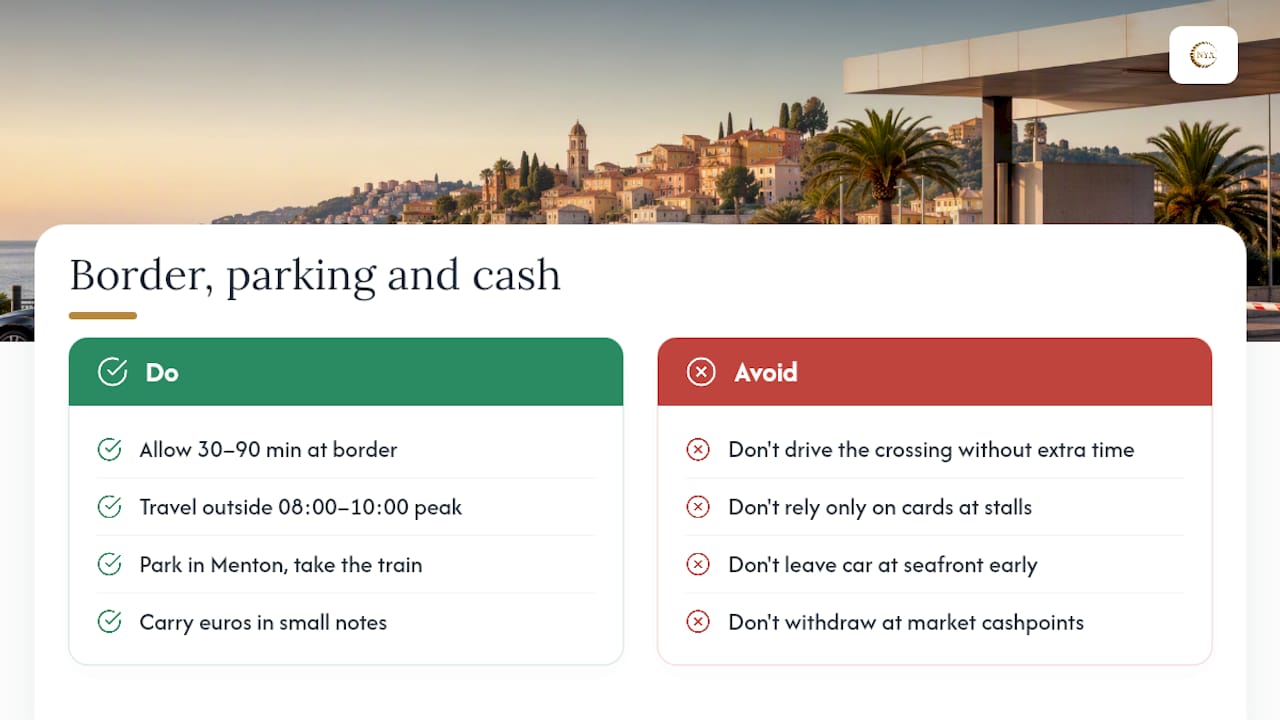
Friday border traffic can add 30 to 90 minutes at peak times, particularly between 08:00 and 10:00 when both shoppers and commercial traffic converge at the crossing. Anyone driving should build that margin into their schedule rather than discover it at the frontier.
Parking is the other pressure point. The seafront is pedestrianized for the market, so the closest public car parks fill early and enforcement is active. Leaving the car in Menton and covering the last stretch by train, a journey of only a few minutes, avoids both the fine risk and the search for a space that quietly eats an hour of your day.
Cash still rules most stalls. Vendors generally prefer euros in small denominations, and card readers are far from universal. Cashpoints exist near the market but queue heavily on Friday mornings, so withdrawing euros before you leave Nice is the sensible move. For anything above modest souvenir spending, keep your receipt: it makes returning with goods across the border far less complicated if questions arise.
TranspOnyx: the private chauffeur alternative for a stress-free market day
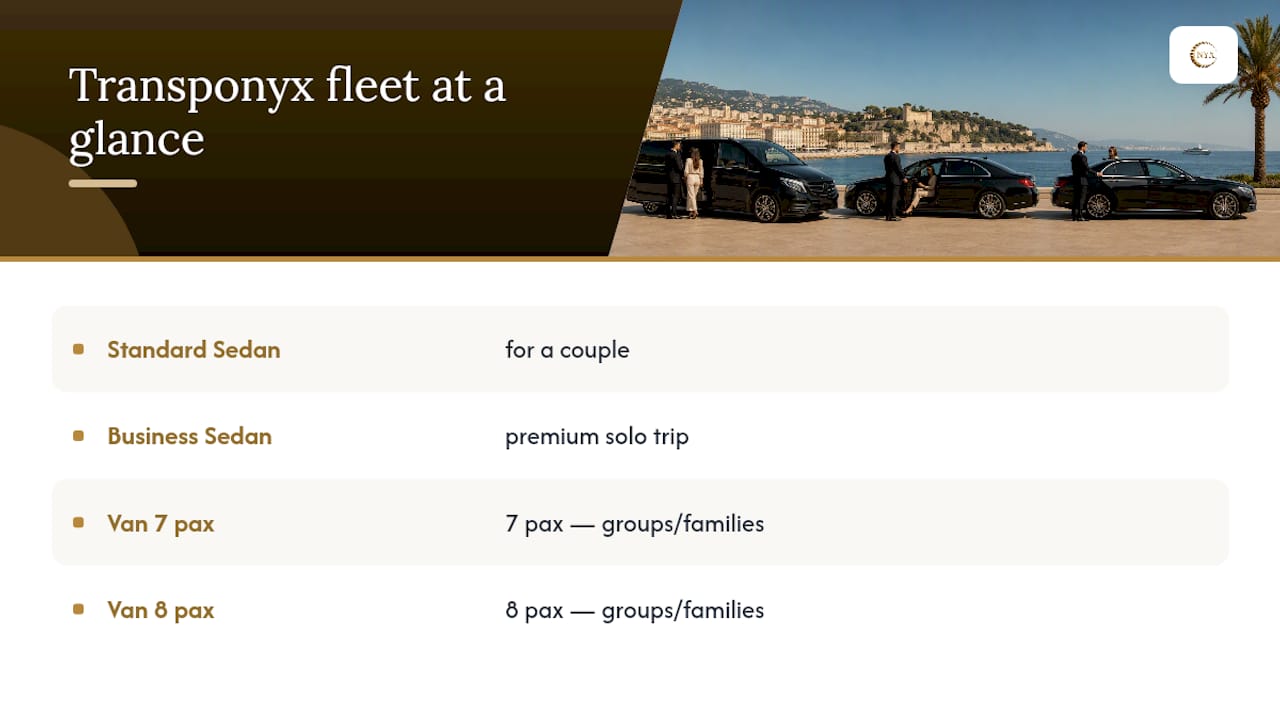
Transponyx is the alternative to driving yourself into Ventimiglia's Friday chaos: a fixed-rate private transfer that removes the border queue, the parking hunt and the ticket logistics in one booking. The fleet covers every group size, from a Standard Sedan for a couple, through the Business Sedan for a premium solo trip, up to the 7-passenger van gold Van for 8 people for families and groups returning with market hauls.
A typical booking looks like this: pick-up from Nice-Ville or Nice Côte d'Azur Airport (Nice NCE) around 07:30, door-to-door arrival at Ventimiglia within the hour, and a return collection timed to whenever your shopping wraps up. Drivers include 20 minutes of free waiting on non-airport pickups, and flight monitoring is built in for anyone landing at Nice NCE before heading straight to the market. Every vehicle carries Wi-Fi, air conditioning, chilled water and phone chargers, and child seats are available on request.
Rates for 2026 are fixed per vehicle and confirmed at the time of booking, with no surge pricing regardless of Friday demand. To arrange a transfer, call +33 6 10 30 71 84 or visit the Nice to Ventimiglia private transfer page on Transponyx directly, and compare the fleet against other Riviera options via the luxury chauffeur services comparison.
A working itinerary for the market, and two variants
Departure Nice-Ville by TER around 07:30 to 08:00, or by chauffeur slightly earlier if you want to beat the crowds entirely. Spend the first half hour walking the full market once without buying, a habit seasoned visitors swear by, then return to the stalls that caught your eye. Lunch in Ventimiglia's old town around 12:30 breaks the day well, leaving a final hour for last purchases before heading back mid-afternoon.
Two variants work for different visitors. Heavy shoppers should book a Van 7 pax transfer and let the driver hold purchases in the boot rather than carrying them all day. Slower explorers should arrive at opening, cover the market thoroughly, then extend the day with a visit to the Hanbury Gardens just across the border. My own reading of how this route works, as someone who covers Riviera ground transport for a living, is that the train suits impulse trips and the chauffeur suits planned ones. Neither is wrong; they simply solve different problems.
— Dany
Sources
Check the official Ventimiglia market page for municipal notices and confirmed hours before traveling. For border logistics via Menton, the private transfer to Menton and the Italian border page covers the park-and-ride approach in more detail.
FAQ
Which day is the main Ventimiglia market?
Friday is the main market day, running from roughly 07:00 to 17:00 along the Lungomare and into the town center. The covered market for fresh food operates Monday to Saturday as a separate, smaller alternative.
What's the best time to visit Ventimiglia market?
Arrive close to the 07:00 opening for calm browsing and full stock, since visitor numbers run into the thousands by mid-morning. Late afternoon suits bargain hunters as vendors start clearing stock before packing down.
Is the trip to Ventimiglia market actually worth it?
Yes, for most visitors from Nice, particularly given the 45 to 50 minute train journey and the scale of the market itself. A private chauffeur through TranspOnyx makes the trip worthwhile even for shoppers who dislike public transport or carry heavy purchases.
Where exactly does the market take place?
The market spreads along the seafront Lungomare for leather and fashion, through the center and Roya district for textiles and homeware, and into the covered Mercato Coperto for food, as confirmed on the municipal market page.
How long should I allow for the visit?
Budget at least half a day, ideally four to five hours, to browse properly, eat locally, and avoid rushing the return journey during Friday peak border traffic.
by Daniel AIT GOUGAM | Sep 8, 2026 | news
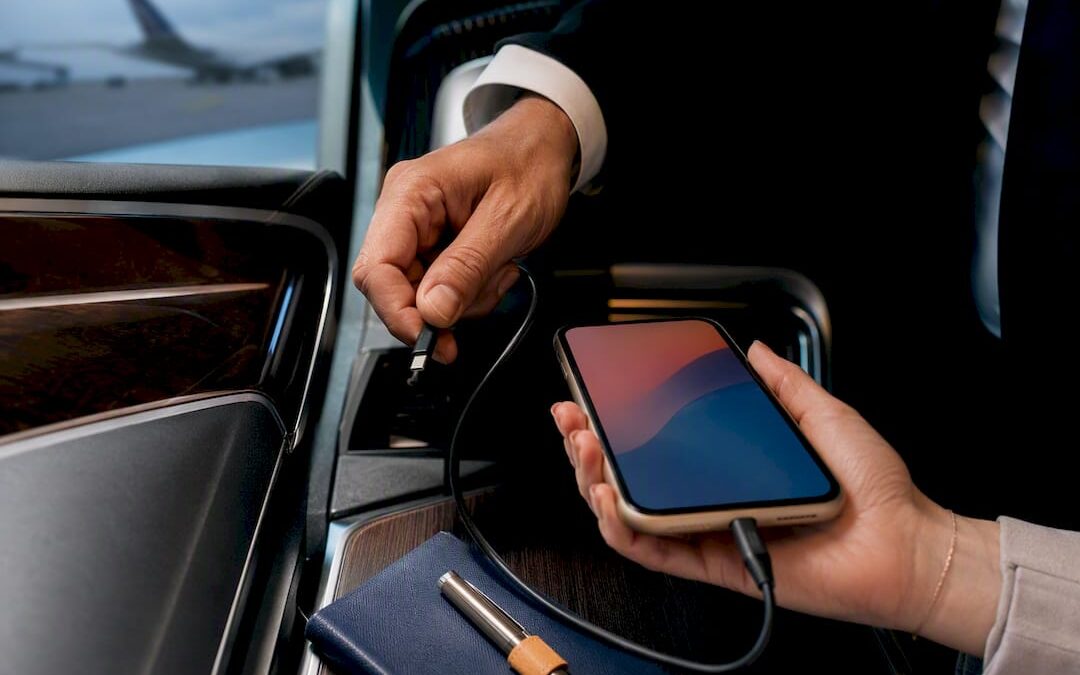
Most VTC providers in Nice now advertise phone chargers as standard, but availability still varies by fleet and vehicle class. TranspOnyx fits every vehicle in its fleet, from the Standard Sedan to the Van 8 pax, with onboard phone chargers as a fixed feature, not an optional extra. If you want the full shortlist and a booking checklist to confirm the charger type before you travel, both follow below.
Transponyx
Keep Your Phone Charged
Every TranspOnyx vehicle includes phone chargers, Wi-Fi, air conditioning and chilled water for journeys from Nice Côte d'Azur Airport.
Nice ride-hailing phone chargers: the shortlist compared
Confirming a charger before you book saves an awkward conversation kerbside at Terminal 1. The comparison below sets out vehicle categories, charger policy, and price implications across the options a Nice traveler is likely to encounter.
| Vehicle category |
Charger availability |
Charger type provided |
Price impact / fixed-rate note |
Best for |
| TranspOnyx — Standard Sedan, Business Sedan, Van 7 pax and Van 8 pax |
Always, fleet-wide |
USB ports, cables carried, Wi‑Fi and chilled water alongside |
Included in fixed 2026 rate, no surcharge |
Airport transfers and Riviera point-to-point journeys with guaranteed amenities |
| Local VTC provider (amenity-focused) |
Advertised, confirmed at booking |
USB, unspecified cable types |
Fixed or metered depending on booking channel |
Passengers booking by phone who want explicit amenity confirmation |
| Local VTC provider (fixed-rate budget) |
On request |
Basic USB, cable not guaranteed |
Fixed fare, amenities not itemized |
Travelers prioritizing predictable pricing over guaranteed comfort features |
TranspOnyx leads this list on a simple basis: every vehicle carries a charger as standard, not as a line item you have to chase up. The company's own service statement confirms that its fleet is equipped with phone chargers, Wi‑Fi, air conditioning and chilled water across all four categories, and that transfers run on fixed 2026 rates with no surge pricing. A Nice NCE to Monaco run takes around 20 to 30 minutes depending on the Basse Corniche traffic, and a Nice NCE to Cannes transfer usually takes around half an hour to 40 minutes via the A8; both are quoted per vehicle rather than per passenger, so the charger comes at no extra cost regardless of party size.
Other local operators take a looser approach. One Nice-based VTC service explicitly lists a mobile phone charger among its onboard amenities, alongside Wi‑Fi and bottled water, which shows the amenity is genuinely part of the local market rather than a rarity. Several regional listings for Nice VTC operators mention chargers as a routine inclusion in airport and hotel pickup packages, reinforcing that the amenity has become an expected baseline rather than a premium extra. Budget-focused fixed-rate services tend to mention chargers more vaguely, often as “on request”, which is where a clear booking note becomes essential.
What to say when booking if you need a phone charger
Getting a charger confirmed is less about luck and more about the wording you use when you book. A vague “does the car have a charge?” invites a vague answer. Specific phrasing gets specific confirmation.
- State the exact charger type you need: “Please confirm a USB‑C charger in the vehicle” or, for older devices, “Please confirm a USB‑A port is available.”
- If you plan to use your own cable, say so directly: “I will bring my own cable, please confirm a USB port is accessible from the rear seats.”
- Ask for the confirmation in writing, not just verbally over the phone, so there is a record if anything goes wrong on the day.
- Request the note be added to your reservation file, particularly if you book through a third party such as a hotel concierge or travel agent.
- For group bookings in a Van 7 pax or Van 8 pax, ask whether multiple ports are fitted, since a single charger becomes a queue with six or seven passengers.
Pro Tip Screenshot your booking confirmation the moment it arrives. If a charger request was agreed by SMS or WhatsApp, that screenshot is your evidence at the curb, not a memory of what was promised.
On timing, a charger request should never affect your pickup. Fixed-rate operators build waiting time into the booking itself; TranspOnyx includes 60 minutes of free waiting on airport pickups and 20 minutes at any other address, regardless of any amenity requests you have made. If a provider tells you a charger request will delay your car or add a fee, treat that as a signal to book elsewhere.
USB‑A, USB‑C, Lightning or wireless: what to actually request
The charger type printed on a VTC's amenities page rarely tells you how fast it will actually charge your phone. Knowing the difference means you ask for the right one.
- USB‑C is the current standard for most Android phones and recent iPhones, and it generally supports faster charging speeds than older ports.
- USB‑A is the older, rectangular port found in aging vehicle fleets. It works, but charging is noticeably slower, particularly on newer handsets.
- Lightning is Apple's proprietary connector, fitted only on older iPhone models; fewer vehicles carry a Lightning cable as standard, so bringing your own is sensitive.
- Fixed cables built into the console are convenient but limit you to whichever connector the vehicle carries; loose cables offer more flexibility but raise a fair question about how often they are cleaned or replaced.
- Wireless charging pads exist in some premium vehicles but tend to charge more slowly than a cable and only work if the phone sits precisely on the pad, which is difficult on a winding coastal road.
If speed genuinely matters, USB‑C with your own cable is the safest request. If you only need a modest top-up before a business meeting in Monaco, any working port will do.
Amenities by vehicle class: what is normal and what is not
Amenity lists on VTC websites can blur together, so it helps to know what each vehicle class typically carries. Across TranspOnyx's four categories, phone chargers, Wi‑Fi, air conditioning and chilled water are standard, not tiered by class.
- The Standard Sedan, seating up to three passengers, carries the same charger and Wi‑Fi provision as the Business Sedan, with the difference lying in interior finish rather than amenity count.
- The Business Sedan adds a premium cabin finish, useful for MIPIM delegates or Cannes Lions attendees needing a polished arrival, while keeping the same charging setup.
- The Van 7 pax and Van 8 pax extend the same amenities across a larger cabin, which matters for families or small delegations traveling together to Antibes or Menton.
- Flight monitoring and included waiting time apply across all four categories, so a delayed arrival at Nice NCE does not put your fixed rate or your charger access at risk.
A transfer from Nice NCE to Antibes takes about half an hour; to Menton, allow up to around three quarters of an hour given the coastal road east of Monaco. Both routes are quoted at fixed 2026 rates regardless of which sedan or van category you choose.
Charging safely without risking your device or your data
A charging port in an unfamiliar vehicle is not automatically a risk, but a little deposit costs nothing. Damaged cables and unknown data connections are the two things worth watching.
- Avoid visibly frayed or damaged cables; a cracked connector can damage your phone's charging port over repeated use.
- Where possible, use your own cable rather than one supplied loose in the vehicle, which reduces any theoretical data-transfer risk from an unfamiliar USB connection.
- If your phone runs hot while charging in a warm cabin, remove any case and reduce screen brightness rather than letting it charge at full speed in direct sun through the window.
- If you need a genuinely rapid top-up before a meeting, ask specifically for a fast-charge USB‑C port, bring your own regional adapter if traveling from outside the EU, and ask whether a portable power bank is carried as a backup.
None of this is unique to Nice. It is the same common sense that applies to charging in any hired vehicle, anywhere.
TranspOnyx: fleet, routes and what you can verify before booking
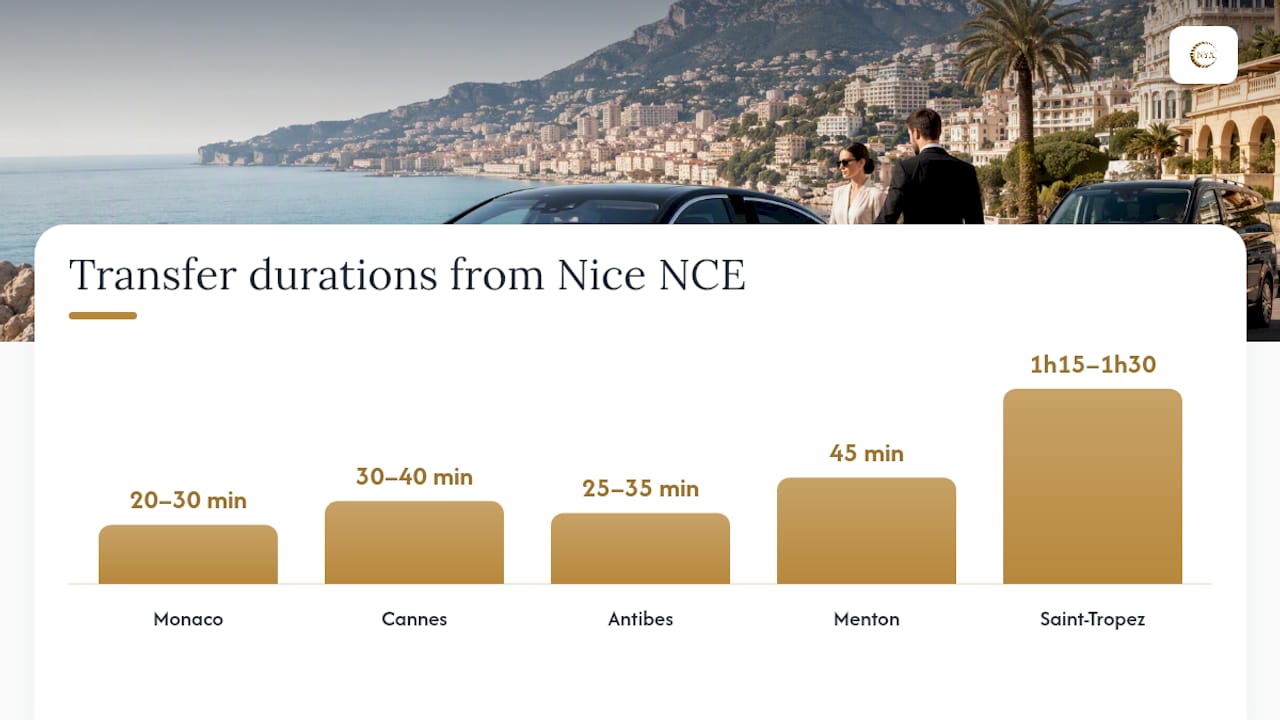
TranspOnyx operates four vehicle categories across the Riviera: Standard Sedan and Business Sedan (each up to three passengers), Van 7 pax, and Van 8 pax. Every vehicle is fitted with phone chargers, Wi‑Fi, air conditioning and chilled water as standard, confirmed directly on the company's fleet listing.
Core routes include:
- Nice NCE to Monaco, roughly 20 to 30 minutes, useful for Monaco Grand Prix arrivals and business travel.
- Nice NCE to Cannes, roughly 30 to 40 minutes, relevant during the Cannes Film Festival and Cannes Lions.
- Nice NCE to Antibes, roughly 25 to 35 minutes.
- Nice NCE to Menton, roughly 45 minutes.
- Nice NCE to Saint‑Tropez, a longer transfer of around 1 hour 15 minutes to 1 hour 30 minutes depending on season.
All journeys run on fixed 2026 per-vehicle rates with no surge pricing, 60 minutes of free waiting time on airport pickups, and flight monitoring included as standard. Drivers hold professional VTC licenses and are bilingual in English and French at minimum. Bookings run 24 hours a day on +33 6 10 30 71 84 or via Transponyx.
Why the charger question matters more than most travelers assume
Most guides to Nice transport treat phone chargers as a footnote, a nice-to-have buried under fleet photos and pricing tables. That undersells the point. A dead phone at Nice NCE means no boarding pass, no hotel confirmation, and no way to reach your driver if plans change, so this amenity sits closer to essential infrastructure than decoration.
The conventional advice, simply asking “does your car have a charger”, is too weak. It invites a yes without specifying charger type, cable condition, or whether the promise survives a driver swap on a busy Grand Prix weekend. Precise language, confirmed in writing, is what actually protects you.
My view, based on how these fleets are actually built rather than how they are marketed, is that fleet-wide provision beats a policy of chargers “on request” every time. A charger fitted as standard, not requested as a favour, tells you something about how the whole vehicle is equipped and maintained. That is the detail worth prioritizing before price, before vehicle class, before anything else on the booking form.
— Dany
Book a Nice transfer with a guaranteed charger
TranspOnyx solves the exact problem this guide has been walking through: instead of asking a dispatcher to confirm a charger and hoping the note survives to pickup, every vehicle in the fleet, Standard Sedan through Van 8 pax, carries phone chargers as standard equipment, alongside Wi‑Fi, air conditioning and chilled water, all locked into a fixed 2026 rate with no surge pricing.
Whether you are landing at Nice NCE for a Monaco Grand Prix weekend or heading to Cannes for MIPCOM, your reservation includes flight monitoring, 60 minutes of free airport waiting time, and a licensed, bilingual driver, without needing to negotiate the charger question at all. Book directly via the Nice airport transfer page, call +33 6 10 30 71 84, or message via WhatsApp on +33 7 67 78 10 26 to confirm your vehicle and fixed rate ahead of arrival.
Sources
FAQ
Do all VTCs in Nice provide phone chargers?
Many advertise chargers as standard, but provision varies. TranspOnyx fits chargers across its entire fleet, while some local providers list chargers as available on request rather than guaranteed.
What is the salary of a VTC driver in Nice?
VTC driver earnings vary significantly by hours worked, vehicle category and client volume, and no single figure applies across the Riviera market. Rates depend heavily on whether a driver works independently or for a fleet operator like TranspOnyx.
How much does a VTC license (macaron) cost in 2026?
License and registration costs for VTC operators vary by prefecture and vehicle type, and change periodically, so drivers should confirm current figures directly with their local transport authority rather than relying on older published estimates.
Where can I get a VTC badge for Nice airport?
Airport-specific VTC access badges are issued through the relevant transport authority governing Nice Côte d'Azur Airport; drivers should confirm current application procedures via the airport's official site.
Should I bring my own charging cable into a Nice VTC?
Bringing your own USB‑C or Lightning cable is sensitive, since it guarantees compatibility with your device and avoids relying on a cable of unknown condition in the vehicle.