by Daniel AIT GOUGAM | Sep 7, 2026 | news
A private excursion from San Remo gets you into Dolceacqua, Ventimiglia's market, Menton's gardens or Monaco's harbor in a single day, on your own schedule, without a coach group in sight. The main trip types split into inland villages, coastal border towns and scenic drives along the Corniche. Booking works on a fixed per-vehicle rate, so the next step is simple: call a licensed French Riviera chauffeur, confirm the itinerary and the price, and go.
Transponyx
Plan Your French Riviera Excursion
TranspOnyx provides private chauffeur journeys between San Remo, Provence and the Côte d'Azur, with fixed rates confirmed at booking.
Explore private journeys
Curated shortlist: best private day excursions from or including San Remo
San Remo sits at the hinge between Liguria and the French border, which means a private excursion can head inland to medieval villages or west along the coast into France within the same afternoon. The choice depends on what you actually want from the day: wine and stone alleys, market stalls, formal gardens, or the theater of Monaco's harbour.
Dolceacqua rewards travelers who want atmosphere over ticking boxes. The village's arched stone bridge, the one Claude Monet painted in 1884, spans the Nervia river beneath a ruined castle, and the surrounding hills produce Rossese di Dolceacqua, a dry red wine rarely exported outside Italy. It is a near-constant feature on private itineraries departing San Remo, and for good reason.
Ventimiglia's Friday market draws French day trippers from across the border for leather goods, linens and Ligurian produce at prices that still undercut French retail. A private driver lets you arrive before the 9am crush and leave before the afternoon coach parties clog the old town's narrow streets.
Menton and the string of border towns offer a different register entirely: the Jardin Serre de la Madone, pastel Belle Époque facades, and a harborside that feels more restrained than Monaco's. It suits travelers who want beauty without spectacle.
Monaco, by contrast, is built for spectacle. A half-day stop covers the harbour, the Casino Square and a walk through the old town in roughly two to three hours, enough to feel the principality's density without needing an overnight stay.
The coastal Corniche drive between San Remo and the French border is worth building into any itinerary purely for the photo stops: cliffside curves, fishing villages clinging to the rock, and views back towards San Remo's skyline that no coach tour will pause long enough to let you capture.
- Dolceacqua: medieval alleys, Monet's bridge, Rossese wine tastings
- Ventimiglia: Friday market, leather and produce stalls, border-town energy
- Menton: gardens, pastel architecture, quieter pace
- Monaco: harbour, Casino Square, compact half-day glamor
- Corniche drive: cliff roads, fishing villages, photo stops
Sample itineraries by duration with timings and distance estimates
Matching a private excursion to the time you actually have avoided the single most common planning mistake: trying to fit a full-day route into four hours.
- Half-day (4 to 5 hours): pickup from San Remo between 8:30am and 9am, drive time of roughly 20 to 30 minutes to either Ventimiglia's market or Dolceacqua, two to three hours on foot, return by early afternoon. This follows a Friday market visit or a focused wine and village stop without disrupting the rest of the day.
- Full-day (6 to 8 hours): a morning walk along San Remo's Corso Imperatrice promenade, a drive inland to Dolceacqua for lunch and wine tasting, then the Corniche back towards the border with photo stops. Full-day private tours combining San Remo and Dolceacqua commonly run to this length, with total driving kept under two hours across the whole route.
- Two-day suggestion: spend the first evening in San Remo itself, since two to three days is the recommended visit length for seeing the old town properly rather than rushing it. The second day can shift to a cycling loop along the former railway path or a deeper winery focus around Dolceacqua, with no need to retrace the same roads.
Build in a 30-minute buffer either side of any itinerary that crosses race weekends or festival dates on the French side. Traffic around Monaco during the Grand Prix, or along the Croisette during the Cannes Film Festival, can add significant delay to journeys that would otherwise take twenty minutes.
Practical planning: border notes, market days, seasonality and crowd tips
Timing an excursion around market days changes the entire character of the trip. Ventimiglia's main market runs on Fridays, while San Remo's own markets operate on Tuesdays and Saturdays, so a Friday departure gives you both a lively Ventimiglia and a quieter San Remo, and a Tuesday or Saturday flips that balance.
Marketplace pricing pattern: Private Riviera excursions booked through tour marketplaces commonly show per-vehicle pricing with free cancellation up to 24 hours before departure, a structure worth checking against any quote you receive.
For travelers based in France, the border itself is straightforward: a valid passport or national ID card covers short Schengen-zone visits, and no visa is required. The friction is logistical rather than administrative.
- Carry ID even for short hops, since spot checks do happen at the Ventimiglia crossing
- Expect steep, narrow parking in Dolceacqua; most private drivers drop passengers at the village entrance rather than attempting the upper streets
- Reserve May to early June or September if you want manageable crowds and swimmable sea temperatures
- Expect July and August to bring peak pricing and the thickest crowds along the whole coast
How to customize and book: vehicle selection, inclusions, price shape and questions to ask
Getting the right vehicle matters more than most travelers expect, particularly on routes with tight village streets or steep parking.
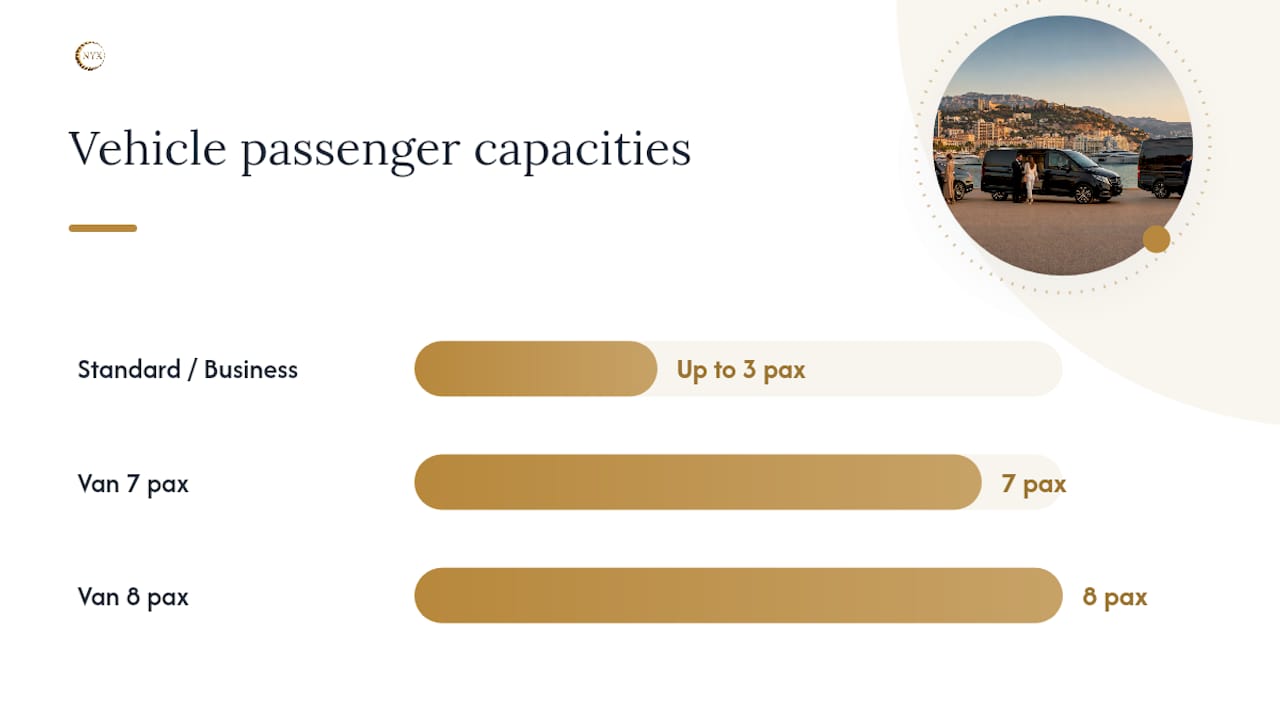
- Match the vehicle to your party: a Standard Sedan gold Business Sedan suits up to three passengers with luggage, while a 7-passenger van gold Van for 8 people covers families or small groups who want to travel together rather than split across two cars.
- Confirm the 2026 fixed rate covers driver time, fuel and standard waiting time, since these are the usual inclusions on a private per-vehicle booking, matching the pattern seen across marketplace excursion listings.
- Ask directly what is excluded. Meals, wine tasting fees and museum entry are almost never bundled into the vehicle rate.
- Confirm pickup and drop-off points, cancellation terms, whether a bilingual driver is guaranteed, and whether child seats are available before you pay a deposit.
Pro Tip Ask for the total confirmed price in writing before departure day. A quote that only states a per-hour rate without a clear cap is the single most common source of billing disputes on cross-border excursions.
Treat vague total pricing, or any suggestion of surge pricing during a busy weekend, as a warning sign. A licensed operator confirms one figure at booking and holds it.
How a professional French-Riviera chauffeur runs the day
A well-run private excursion follows a predictable rhythm long before the car arrives. Transponyx builds each 2026 fixed rate around a bilingual, licensed VTC driver and a Mercedes-Benz vehicle fitted with Wi-Fi, chilled water and phone chargers, details that matter more on a six-hour day than they might on a short transfer.
- Pickup window confirmed the evening before, with a traffic buffer built in for border crossings
- Guided stops at each village or market, with the driver available to help with restaurant or tasting reservations on request
- A single confirmed price for the vehicle, agreed before departure, with no additional charges added mid-route
Inquiries go through +33 6 10 30 71 84 or Transponyx, with details confirmed before the day of travel.
Tips for dietary or accessibility requirements when booking private excursions
Private excursions solve dietary and accessibility problems that coach tours simply cannot accommodate, because the itinerary bends around the traveler rather than the reverse.
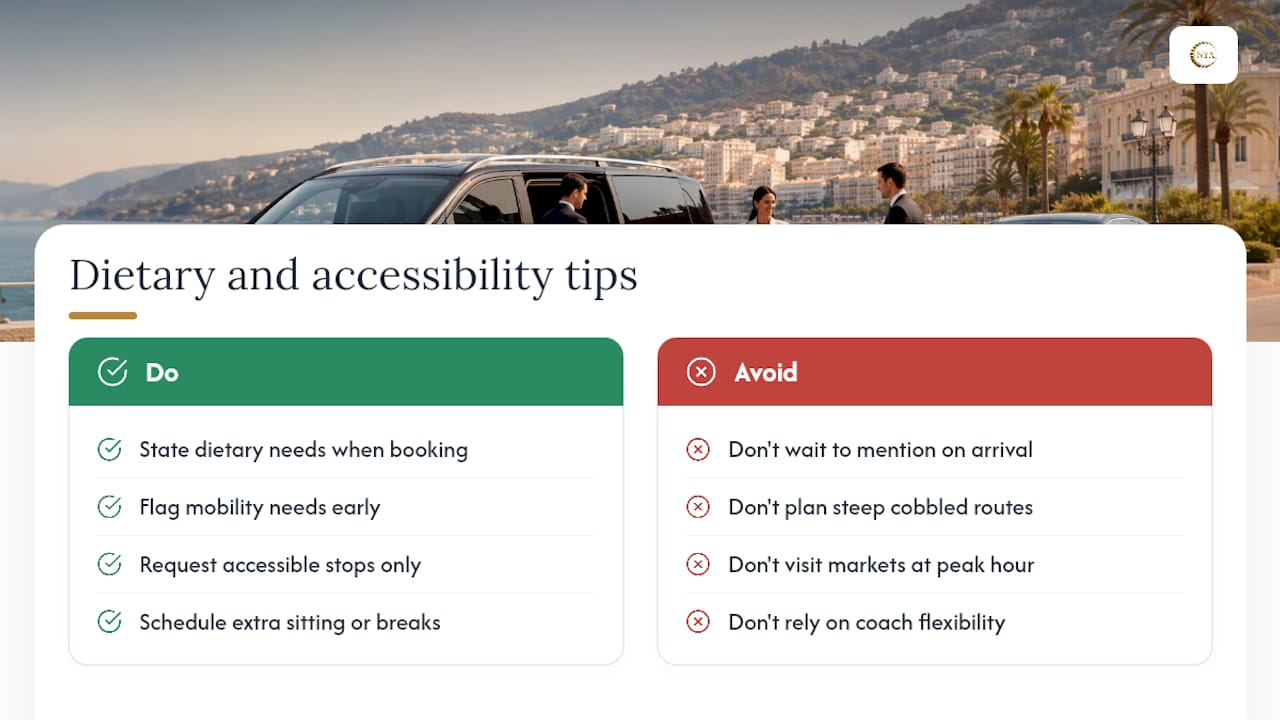
If you follow a specific diet, whether gluten-free, vegetarian or an allergy that needs careful handling, mention it when booking rather than on arrival. A private driver can route lunch towards a restaurant in Dolceacqua or Ventimiglia that already caters to the requirement, saving the awkwardness of scanning a menu at the table with no backup plan.
Mobility needs deserve the same early flagging. Dolceacqua's upper village involves steep cobbled lanes that are genuinely difficult for wheelchairs or unsteady footing, while San Remo's seafront promenade and Menton's lower old town are flatter and far more forgiving. A private itinerary can favor the accessible stops and simply shorten or skip the ones that are not, something a fixed coach route cannot do.
Sensory or fatigue considerations matter too on a long day. Ask your driver to build in extra sitting time or to skip the busiest hour of a market visit if crowds are a concern. Because the vehicle and schedule belong entirely to your party, none of this needs justifying to fellow passengers, unlike a shared group tour where changing the plan means changing it for everyone.
Local dining or refreshment options integrated into the itineraries
Food is where a private excursion earns its price difference over a scripted coach tour, because the stops can follow appetite rather than a fixed schedule.
Dolceacqua's small trattorias serve Ligurian staples, testaroli, torta verde, and Rossese by the glass, in settings that rarely seat more than thirty people, so arriving with a group of six or eight already booked avoids the disappointment of a full room. Ventimiglia's market morning pairs naturally with a focaccia or farinata bought straight from a stall, eaten standing up between purchases, which suits the half-day itinerary better than a sit-down lunch would.
On the full-day route, San Remo itself offers the widest choice: seafront restaurants along Corso Imperatrice for a relaxed lunch before heading inland, or a coffee stop on the return leg to break up the Corniche drive. Menton's harborside cafés work well as a late-afternoon pause on itineraries that push towards the French border, particularly during citrus season when lemon-based pastries appear on nearly every counter.
A private driver who knows the route can also flag which spots get overrun at peak times, steering lunch fifteen minutes earlier or later to avoid a queue that would otherwise eat into the afternoon's schedule.
When a private chauffeur trip is the best choice
For most French travelers, a private excursion beats self-drive the moment a group exceeds two people or the day includes an inland village with limited parking, as explained in this private chauffeur meaning overview. The per-vehicle rate structure also tends to undercut group tours once three or more people share the cost. Self-drive or the train still makes sense for a solo traveler heading straight to Ventimiglia's market and nowhere else.
— Dany
Booking a private excursion with Transponyx
Transponyx runs private, France based chauffeur services into San Remo and the surrounding Riviera, at fixed 2026 rates confirmed before you travel, with no surge pricing added on busy weekends. The fleet covers every party size: a Standard Sedan gold Business Sedan for up to three passengers, and a 7-passenger van gold Van for 8 people for families and groups who want to stay together for the day.
A quote takes minutes to arrange. Call +33 6 10 30 71 84, message via WhatsApp, or visit Transponyx to describe your route and passenger count. Two pages worth checking before you inquire: the private driver Nice to San Remo service page for direct border crossings, and the Sunset Wine Experience for travelers who want a Bellet vineyard tour built into the same trip. Every booking confirms a single vehicle price, a bilingual licensed driver and the pickup window in advance, so there is nothing left to negotiate on the day itself.
Sources
FAQ
How much does a sun lounger cost in San Remo?
Beach club sunbed rentals in San Remo vary by season and location along the seafront, with prices rising sharply during July and August; check directly with the beach establishment (stabilimento) you plan to visit, since rates are not centrally fixed.
What is the prettiest village near San Remo?
Dolceacqua is widely considered the standout, thanks to its medieval stone bridge painted by Monet, a ruined hilltop castle and Rossese wine tastings in the village itself.
Which market is better, Ventimiglia or San Remo?
Ventimiglia's Friday market is larger and more geared towards bargain shopping and produce, while San Remo's Tuesday and Saturday markets feel smaller and more local; choose Ventimiglia for volume, San Remo for atmosphere.
What can you see between Ventimiglia and San Remo?
The coastal Corniche between the two towns offers cliffside photo stops and fishing villages, while a short inland detour reaches Dolceacqua and the Nervia Valley for medieval architecture and wine tasting.
Is a private excursion worth it for a small group?
For three or more travelers, a fixed per-vehicle rate from an operator such as Transponyx typically works out competitively against per-person group tours, while also giving full control over timing and stops.
by Daniel AIT GOUGAM | Sep 6, 2026 | news
Walking from Gare de Cannes is fastest for anyone arriving light, since the Palais des Festivals et des Congrès sits at 1 Boulevard de la Croisette, 06400 Cannes, barely six minutes on foot from the station concourse. Airport arrivals should pre-book a transfer rather than gamble on a taxi rank, particularly from Nice Côte d'Azur Airport taxi options. During major festivals, street closures around the venue typically begin from about 2:00 p.m., so anyone traveling that afternoon needs a confirmed pick-up, not a plan to find one on the day.
Quick directions to the Palais des Festivals by starting point
Which route works best depends entirely on where the journey begins and what you are carrying.
- From Cannes train station: walk. It takes roughly six minutes across the forecourt to the Croisette, and no vehicle will beat that on a festival afternoon.
- From Nice NCE: book a private transfer in advance. Road traffic on the Cannes approach becomes unpredictable once the red carpet events start.
- From Cannes-Mandelieu Airport: a short taxi or pre-arranged car works well given the shorter distance.
- Driving yourself: fine outside festival dates, but plan your drop-off point carefully once the Croisette pedestrianises.
- Staying locally in Cannes: walking or a short taxi hop is usually quicker than driving into the restricted zone.
Anyone with heavy luggage, a wheelchair, or an evening dress code should default to a booked car. On festival days, a pre-booked transfer beats an ad-hoc taxi almost every time, simply because taxis queue in the same traffic everyone else does.
How far is Gare de Cannes from the Palais des Festivals?
Gare de Cannes sits a short walk from the Palais, according to the official access page, and the route is about as simple as station-to-venue walks get. Exit through the main forecourt, cross toward the sea, and follow the Rue Jean Jaurès down to the Croisette, where the Palais becomes visible almost immediately.
Travelers with cases or mobility needs should use the station's lift access rather than the stairs near the main hall, since the platform-to-street route avoids several steps. If you are arriving for an evening screening or gala and carrying formalwear, a short taxi from the station rank or a pre-booked transfer removes the walk entirely and keeps shoes and hemlines intact. It rarely costs much time either way; the distance is short enough that both options land you at the venue within minutes of each other.
What is the transfer time from Nice and Cannes airports?
Nice Côte d'Azur Airport is the main gateway for Cannes, and the road transfer runs around 45 minutes by car to the Croisette under normal traffic. Cannes-Mandelieu Airport, used mostly for private and executive flights, sits closer, at a short drive by road.
Shuttle buses exist from Nice NCE, but their schedules thin out at the exact hours festival flights tend to land, and they were never designed around red-carpet timetables. Taxi ranks at both airports work well outside event periods, though queues lengthen sharply during the Cannes Film Festival, MIPIM, and the Monaco Grand Prix, when demand across the whole Riviera spikes at once. A private chauffeur transfer, booked ahead, includes flight monitoring so the driver adjusts to delays automatically, plus a waiting allowance that a metered taxi simply does not offer.
Driving to the Palais: motorway exits, drop-off rules and parking
Drivers approaching from the A8 should take the Cannes exits feeding onto the D6098, which runs along the coast directly past the Palais. It is the clearest route into town and avoids the confusing back-street diversions that trip up first-time visitors.
Official drop-off points sit along Boulevard de la Croisette itself, though several sections pedestrianize during major events, so a drop-off that worked in April may be closed by May. Checking current restrictions before committing to a route saves a frustrating U-turn in heavy traffic.
- Parking: P01 – Palais Parking is the municipal car park directly serving the venue, with details and contact information listed on the Cannes municipal site.
- Best approach: A8 to the Cannes exits, then the D6098 seafront route rather than cutting through the town centre.
- Festival caution: confirm your drop-off zone is still open before setting a route, since pedestrianization shifts by event day.
Which Palm Bus lines serve the Palais and how reliable are they?
Several Palm Bus lines pass close to the Palais under normal conditions, but festival periods bring frequent rerouting and stop suspensions in the immediate vicinity, a pattern well documented during the Cannes Film Festival's traffic restrictions. Stops nearest the Croisette are the first to be suspended once pedestrianization takes hold.
Palm Bus does add reinforced night services during major events to handle the crowds leaving late screenings, though buses run fuller and slower than usual. Anyone relying on public transport that week should check live timetables on the Palm Bus site before setting out, and build in extra time rather than cutting it fine.
Can you walk to the Palais from the Croisette or the Suquet?
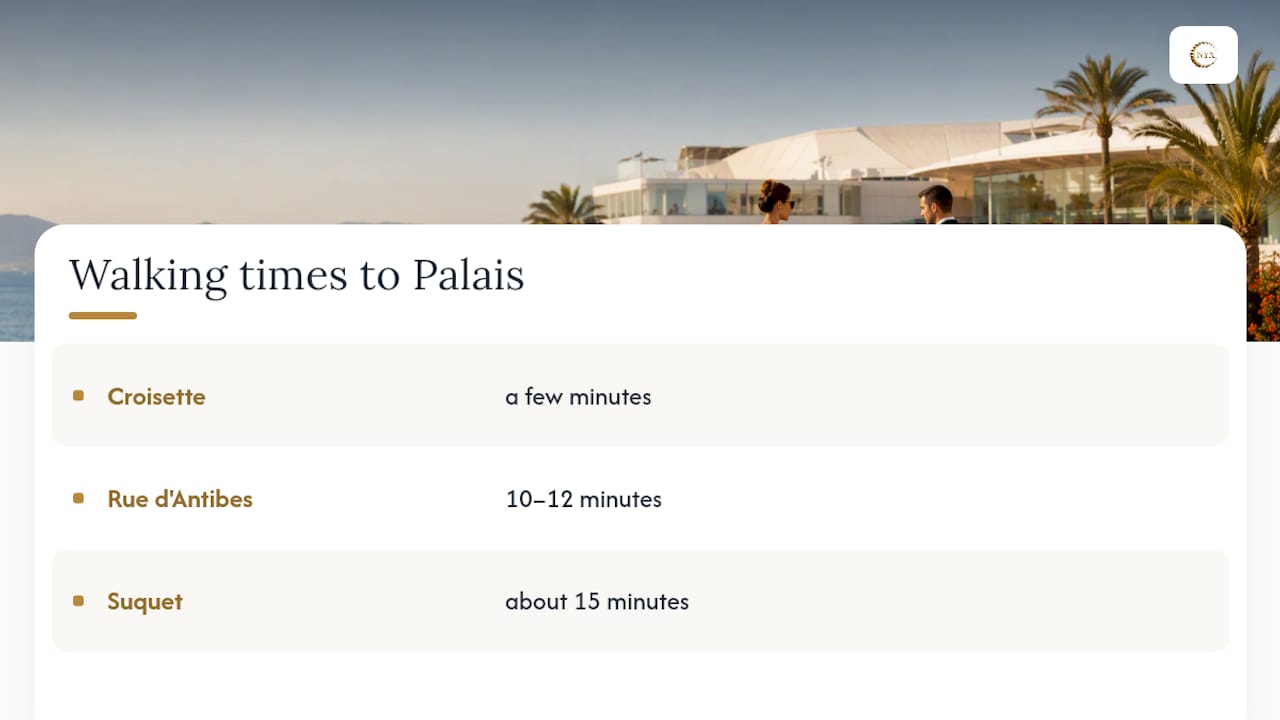
Walking is the most underrated option in Cannes, and the Palais' position at the start of the Croisette makes it genuinely walkable from most central points. From the Croisette promenade itself, expect only a few minutes regardless of where you start. From Rue d'Antibes, the parallel shopping street one block back, allow around 10 to 12 minutes. From the Suquet, the old town on the hill above the port, budget closer to 15 minutes given the gradient.
Landmarks make navigation simple: head toward the Grand Auditorium's distinctive frontage, follow signs for the Palais beach, or orient from the Vieux Port if arriving from the western side of town. Walking suits light luggage and good weather; it suits nobody in heels carrying a suitcase.
Is the Palais des Festivals accessible for reduced mobility visitors?
Yes. The Palais holds a “Tourisme & Handicap” designation and provides accessible seating and induction loop systems in its main halls. Dedicated lifts and marked entrance levels serve the Grand Auditorium and Théâtre Debussy separately, and the venue's official PMR access plan sets out exactly which entrances and lift routes apply to each theater, since the two spaces do not share the same access point.
Anyone requiring assistance should call +33 4 92 99 26 24 ahead of arrival to confirm the correct entrance for their specific event, rather than assuming one access point serves the whole building.
What happens to Cannes traffic during festival days?
Municipal traffic plans during major events prioritize pedestrian flow over vehicle access, which is why the hyper-centre closes to cars from around 2:00 p.m. onward on key festival dates, a pattern confirmed by regional press coverage of past Cannes Film Festival closures. Several Croisette-side buses stop operating entirely for the day, and detours push traffic onto already congested side streets.
Three habits keep arrivals stress-free on these dates. Arrive earlier than you think you need to, since the closure window narrows options fast once it starts. Pre-book a transfer rather than relying on a taxi hailed from the street because pre-arranged chauffeur services can plan around the restrictions rather than get caught by them. Use a pick-up point outside the pedestrianized strip, then walk the final stretch, since drivers unfamiliar with event routing often get rerouted or fined for entering closed sections.

Why local driver knowledge matters on festival days
Cannes during the Film Festival, MIPIM or the Monaco Grand Prix is not the same city it is in October. TranspOnyx's own observations from years of Riviera festival transfers confirm that transport becomes genuinely scarce once the closures start, and pre-booking is what separates a calm arrival from a stranded one.
Booking properly means giving your flight number so the driver can track delays, requesting the free waiting time built into every airport pickup, and choosing the right vehicle for your group: Standard Sedan or Business Sedan for up to three passengers, Van 7 pax or Van 8 pax for larger parties or extra luggage. TranspOnyx can be reached on +33 6 10 30 71 84 or via Transponyx to arrange this ahead of any event date.
Author's note: two actions that make arrival stress-free
Book your transfer before you fly, not after you land. That single decision solves most of the chaos travelers describe during the Cannes Film Festival or MIPIM week, when every taxi on the Croisette is already taken. Second, if reduced mobility is a factor, call the Palais' access line days ahead, not on arrival morning. A route worked out in advance from Nice NCE or Cannes-Mandelieu is worth more than any shortcut discovered on the day.
— Dany
Book a reliable private transfer to the Palais
Transponyx removes the single biggest risk of a Cannes arrival: not knowing whether a car will actually be there when you land. Where taxi ranks empty out fast during festival weeks and shuttle timestables ignore delayed flights, a Transponyx booking locks in your vehicle, your driver, and your route at 2026 fixed rates agreed before you travel, with no surge pricing if traffic runs long.
Have your flight number, arrival time and exact pick-up or drop-off address ready when you call, and the driver will already be tracking your flight before you land. Every airport pickup includes 60 minutes of free waiting time, and every other address includes 20 minutes, so a delayed bag or a late connection does not cost you the booking. Choose between the Standard Sedan, Business Sedan, Van 7 pax or Van 8 pax depending on your party size, and read more about what a hotel-to-Palace transfer includes before your trip. To secure a car for the Cannes Film Festival, MIPIM or any 2026 date, call +33 6 10 30 71 84 or book directly online.
Sources
FAQ
Can you visit the Palais des Festivals without an event ticket?
Public areas and the exterior, including the famous steps and Croisette-facing frontage, are accessible without a ticket, though the main auditoriums are generally open only during scheduled events or accredited festivals.
How do you get to the Palais des Festivals in Cannes?
Walk if you are near Gare de Cannes, since it is roughly six minutes away, or book a private transfer for airport arrivals from Nice NCE (around 45 minutes by road) or Cannes-Mandelieu (about 15 minutes).
Can anyone attend the Cannes Film Festival?
Most screenings and the red carpet are reserved for accredited professionals and invited guests, though the town itself, including the Croisette and beach areas near the Palais, stays open to the public throughout.
Can you walk on the steps of the Palais des Festivals?
The famous red-carpet steps are generally reserved for accredited attendees during festival screenings, though visitors can view and photograph the entrance area at other times of year.
What is the fastest way to reach the Palais during a festival week?
A pre-booked chauffeur transfer with flight monitoring, arranged through a service such as Transponyx, is generally more reliable than a taxi once afternoon street closures begin around 2:00 p.m.
by Daniel AIT GOUGAM | Sep 5, 2026 | news
The fastest way to reach the Italian Riviera from Nice is the regional train to Ventimiglia, roughly 40 to 50 minutes from Nice Ville. The most flexible way to see it properly is a private chauffeur, and the most scenic is a boat excursion from Genoa to Portofino. Train suits solo travelers on a budget; a chauffeur suits families, groups and anyone who wants San Remo, Dolceacqua and Bordighera in one loop without watching a timetable. Fixed rates for 2026 are available for exactly this kind of day trip.
What are the best ways to plan an Italian Riviera day trip?
Choosing a format for an Italian Riviera day trip comes down to three questions: how many people are traveling, how much luggage or mobility flexibility you need, and whether you want to cover one town or several. Get those three answers right and the rest of the planning falls into place.
Train travel is the default choice for solo travelers and couples who want Ventimiglia or San Remo without spending money on a rental car. It is cheap, frequent, and needs no booking in advance for most departures. The downside is rigidity: you are tied to the timetable, and a market morning in Ventimiglia can turn into a scramble to catch the last convenient train back if you linger over lunch.
Private chauffeur service changes the math entirely. Instead of one town, you can string together San Remo's old quarter, Bordighera's palm-lined seafront, and Dolceacqua's medieval bridge in a single day, with the driver waiting rather than you waiting for a platform announcement. Luggage, shopping bags from the Ventimiglia market and pushchairs all travel in the boot rather than on your lap through three station changes.
Self-drive appeals to travelers who already have a hire car in Nice, but the Italian side of the border brings its own friction: narrow village streets never built for modern cars, limited and often paid parking in San Remo and Ventimiglia, and Italian autostrada tolls that catch out drivers used to France's toll-free A8 stretches near the border.
Small-group and market tours work well for solo travelers or couples who want company and a set itinerary without driving themselves. Tours from Nice commonly combine a market visit at San Remo or Bordighera with an inland detour to a village such as Dolceacqua, typically in minivans capped around eight passengers with an early hotel pickup.
Boat excursions from Genoa deliver the postcard view of Portofino's harbor that no road trip matches, but the trade-off is time. HAS boat leg from Genoa to Camogli runs about 50 minutes each way, and the loop is seasonal, reliable from April to October and patchy outside that window.
- Train: cheapest, fastest to Ventimiglia, rigid timetable
- Private chauffeur: most flexible, best for multi-town days and groups
- Self-drive: convenient if you already have a car, but parking and tolls bite
- Small-group tour: sociable, structured, good for solo travelers
- Boat from Genoa: unbeatable scenery, seasonal, longest total travel time
How do you actually get from Nice to the Italian Riviera?
The mechanics of the crossing matter more than most guides admit, because a wrong assumption about journey time can cost you an hour of daylight you never get back.
By train to Ventimiglia. Regional TER trains from Nice Ville reach Ventimiglia in roughly 40 to 50 minutes, with services running frequently through the day and tickets cheap enough that advance booking is rarely necessary. The station sits a short walk from the town center and the covered market, which makes this the lowest-friction Italian Riviera day trip Nice residents can attempt on a weekday morning.
By train or car to San Remo. San Remo has no direct train from Nice; the practical route is train to Ventimiglia and a connecting Italian regional service onward, adding roughly 30 to 40 minutes to the journey, or driving via the A10 autostrada from the border. Total door-to-door time by car runs close to an hour from central Nice depending on border traffic.
Journey time snapshot: Nice Ville to Ventimiglia by regional train takes approximately 40 to 50 minutes. A chauffeured car from central Nice to San Remo typically covers similar ground in under an hour, without a station change.
By private chauffeur. This is where the calculation shifts from “how do I get there” to “what can I do into the day.” TranspOnyx quotes door-to-door journeys from Nice NCE or central Nice to Ventimiglia, San Remo, or the access points for a Portofino day, in a Standard Sedan gold Business Sedan for parties up to three, or a 7-passenger van gold Van for 8 people for larger groups and families with luggage. Every 2026 fixed rate is confirmed at booking, so there is no metered surprise waiting at the Italian border. Reservations run through +33 6 10 30 71 84 or via Transponyx, with WhatsApp available for last-minute confirmations.
By self-drive. The A8 motorway from Nice crosses into Italy near Ventimiglia in around 30 minutes of driving, tolls included on the French side. Beyond the border, autostrada tolls apply on the Italian A10, and parking in San Remo's old town or Ventimiglia's center on market day is genuinely difficult; expect to circle for a space or pay for a controlled zone.
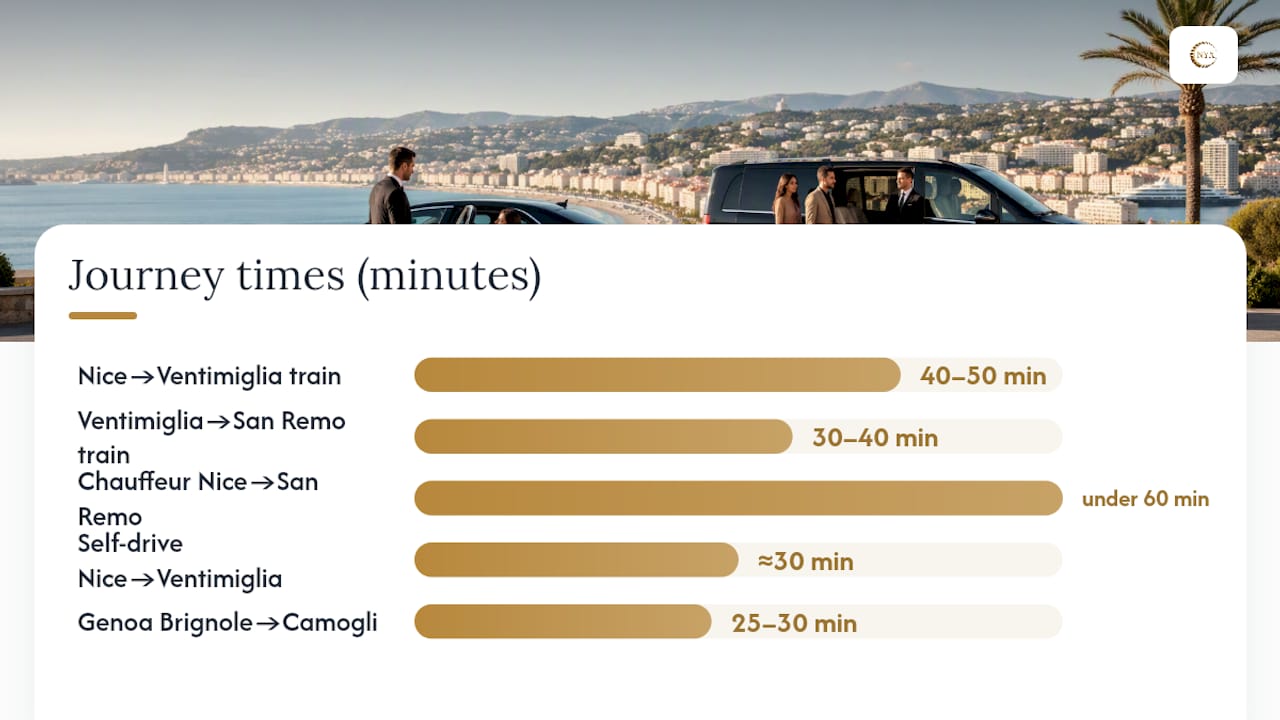
Reaching Genoa for the boat excursions. This is the longest leg of any Italian Riviera day trip from Nice. There is no fast direct rail link; travelers typically combine a train or drive to the Ligurian coast with onward connections. Once at Genoa Brignole, regional trains reach Camogli in about 25 to 30 minutes for around €3 to €4, which is where the Golfo Paradiso ferry service begins its seasonal loop to San Fruttuoso and Portofino.
Practical steps for the day:
- Buy Nice to Ventimiglia train tickets at the station or via SNCF regional ticket machines; no advance purchase required in most cases.
- For San Remo or Dolceacqua by car, cross the border at Ventimiglia and follow the A10 signage.
- For chauffeured travel, confirm pickup time and vehicle class with TranspOnyx at least 24 hours ahead in high season.
- For the Genoa boat loop, arrive at the departure point well before the first sailing, since operators often begin around 09:00.
What are the best sample itineraries for a day trip?
Five itineraries cover the realistic range of what a single day allows, from a quick market morning to a full luxury loop through three towns.
1. Ventimiglia market morning by train. Take an early train from Nice Ville, arriving in Ventimiglia by mid-morning to catch the weekly market at its best, before the midday crowds thicken. Allow two to three hours browsing the covered market and the stalls along the seafront promenade, then lunch in town before catching an afternoon train back to Nice. Total elapsed time: around six hours door to door, with roughly three hours actually spent in Ventimiglia.
2. San Remo and Dolceacqua in one day. This pairing needs a car or a chauffeur, because there is no direct rail link between the two. Depart Nice by mid-morning, spend an hour and a half in San Remo's old town and covered market, then head inland to Dolceacqua for lunch near the medieval bridge that once inspired Monet. Return to Nice by early evening. A private driver makes this loop workable in under seven hours total; attempting it by train and local bus stretches the same plan closer to nine or ten hours, most of it spent waiting for connections.
3. Portofino, Camogli and San Fruttuoso via Genoa. This is the most ambitious single-day plan and it demands an early start, ideally at 07:00 departure from Nice. Reach Genoa, then Camogli by regional train, and join the Golfo Paradiso ferry loop. A full loop covering Camogli, San Fruttuoso and Portofino runs about €18 to €20 per person, with the boat leg from Genoa to Camogli itself taking roughly 50 minutes. Expect to allocate around two hours at each stop, which leaves little slack if trains run late. Travelers who want a gentler pace should consider overnighting near Genoa rather than compressing everything into one day, or booking a private transfer to Portofino directly to cut out one leg of the journey.
4. Bordighera or Menton for a late start. For anyone who prefers a lie-in over an early alarm, Bordighera's old town and seafront make an easy half-day trip, reachable by train via Ventimiglia or by a short chauffeured hop across the border. Departure Nice around midday, allow two hours strolling the palm-fringed promenade and lunching on fresh seafood, and be back in Nice by early evening. This is the lowest-effort Italian Riviera day trip on this list, and the one best suited to a spontaneous half-day rather than a full itinerary.
5. The flexible luxury day with a private chauffeur. For parties of one to four, a Business Sedan picked up around 08:30 from a central Nice hotel or Nice NCE allows a loop through San Remo's market, a stop in Bordighera for coffee, and a detour to Dolceacqua, all before an evening return. For groups of five to eight, the 7-passenger van gold Van for 8 people handles the same route with room for shopping and luggage. Unlike train connections, the driver waits at each stop rather than the traveler waiting for the next departure, and the itinerary can be adjusted mid-morning if a market runs long or the weather changes plans.
What should you budget in time and money?
Costs on an Italian Riviera day trip split into three categories: transport, on-site spending, and time, and none of the three behave the way first-time visitors expect.
Train fares stay low. A Nice to Ventimiglia return sits in the inexpensive bracket typical of French regional TER pricing, and the Genoa Brignole to Camogli leg costs around €3 to €4 each way.
Ferry pricing on the Golfo Paradiso route runs Camogli to San Fruttuoso at around €8 and Camogli to Portofino at around €12, with the full loop landing around €18 to €20 as of 2026. Service is reliable April to October and thins out considerably in winter.
On-site spending in Portofino runs noticeably higher than in neighboring towns: coffee at €4 to €6, an aperitivo at €15 to €20, and a main course at €25 to €40 are typical prices once you are past the harbour. Budget accordingly if Portofino is a stop rather than the whole day.
Private chauffeur pricing for 2026 works on fixed, per-vehicle rates confirmed at booking rather than a metered fare, which means the final price depends on distance, waiting time beyond the included allowance, and vehicle class rather than traffic or time of day. A Standard Sedan for a short border hop costs less than a Van 8 pax booked for a full day looping through three towns, but both are quoted in advance with no surprises on arrival.
Self-drive costs add up in less obvious ways: Italian autostrada tolls, paid parking zones in San Remo and Ventimiglia, and the French A8 toll on the way out. A day trip by hire car rarely undercuts the train once tolls and parking are totalled.
Small-group tours from Nice are typically priced per person with hotel pickup, market visits and a village stop included, sitting between the cost of solo train travel and a private chauffeur for a full group.
- Train return, Nice to Ventimiglia: budget category, low cost
- Genoa to Camogli train: around €3 to €4 each way
- Golfo Paradiso ferry loop: around €18 to €20 per person
- Portofino aperitivo: around €15 to €20
- Private chauffeur: fixed 2026 rate per vehicle, not per person
What do you need to know about borders, markets and seasons?
Crossing from France into Italy at Ventimiglia sits inside the Schengen Area, so there is no routine passport check for most travelers, though carrying valid photo identification is standard practice and non-EU visitors should always travel with a passport in case of a spot check. France-based residents should treat this the same way they would any Schengen internal crossing: identification in hand, no visa required, no customs declaration for personal luggage.
Market timing shapes the whole day. Ventimiglia's weekly market is the single biggest draw for day-trippers, and arriving before the late-morning peak means better prices and first pick of stalls before the crowds from Nice and Menton arrive. San Remo's market runs on a similar rhythm, best tackled early.
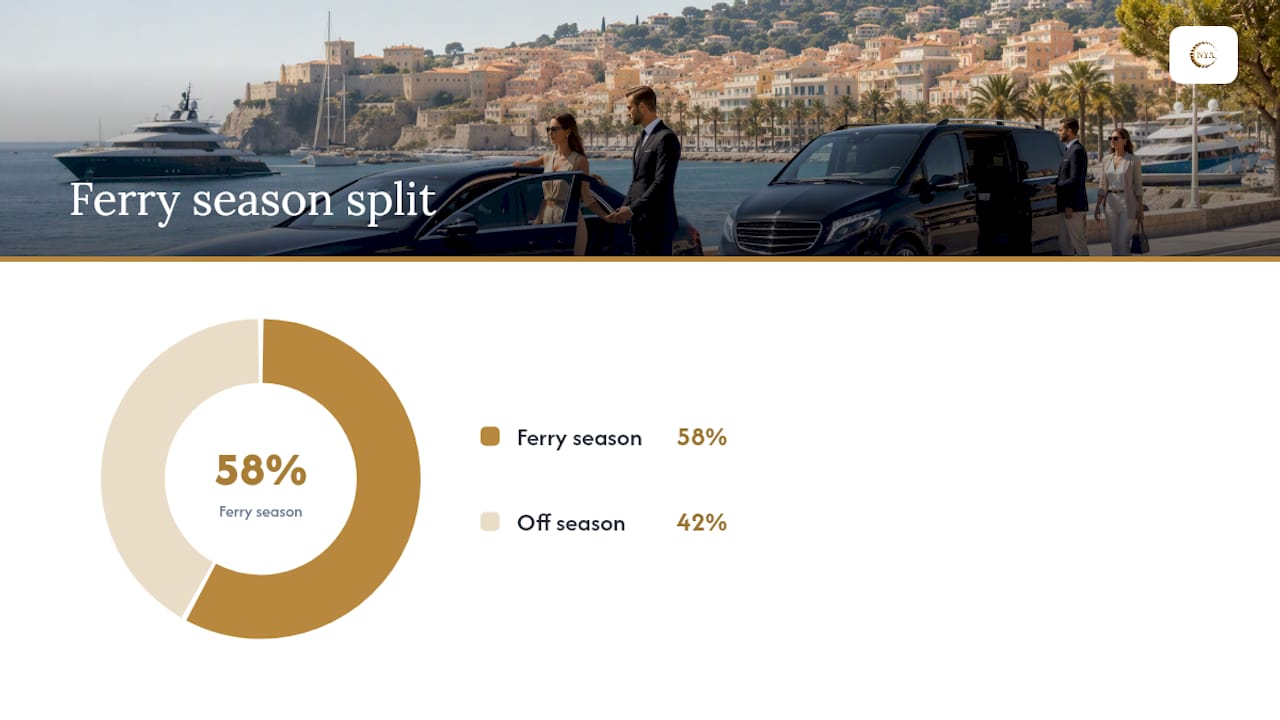
Ferry seasonality is not a footnote, it is the deciding factor for anyone planning the Portofino loop. Golfo Paradiso services run reliably from April through October; outside that window, sailings reduce sharply or stop altogether, and travelers should default to train or private car instead. Even in high season, operators typically begin around 09:00 and the last sailings back can run full, so arriving early at the departure point matters more than most itineraries suggest.
Mobility is a genuine concern in medieval hill towns. Dolceacqua's cobbled lanes and San Remo's old quarter were never built for wheelchairs or pushchairs, and a private chauffeur who can drop passengers close to the entrance and collect them at an agreed time solves a problem that train travel simply cannot.
- Carry photo identification for the Schengen crossing; a passport if traveling as a non-EU visitor
- Ventimiglia and San Remo markets peak mid-morning; arrives early for the best selection
- Golfo Paradiso ferries run April to October; plan road or rail alternatives outside that window
- Cash remains useful in Italian markets, though cards are widely accepted in shops and restaurants
- French residents shopping in Italy can claim VAT refunds on qualifying purchases above the relevant threshold, subject to standard EU tax-free shopping rules
Why a private chauffeur changes the math for a Riviera day trip
The gap between a train timetable and an actual day out becomes obvious the moment a market visit runs long or a ferry queue backs up. TranspOnyx has built its 2026 fixed-rate structure around exactly that gap, quoting a Standard Sedan gold Business Sedan for parts of up to three, and a 7-passenger van gold Van for 8 people for families and groups, each fitted with Wi-Fi, air conditioning, chilled water and phone chargers as standard.
Every driver is a licensed VTC professional, bilingual in English and French at minimum, and the fleet is dispatched around the clock, seven days a week, through +33 6 10 30 71 84 or the WhatsApp line at +33 7 67 78 10 26. Flight monitoring applies to airport pickups from Nice NCE, and free waiting time, 60 minutes at the airport and 20 minutes at any other address, absorbs the kind of delay that a fixed train departure never forgives.
The difference between a train-based Italian Riviera day trip and a chauffeured one is rarely about speed. It is about what happens when the market runs long, the ferry queue backs up, or the group wants one more hour in Dolceacqua. A private car waits. A train does not.
For a family heading to San Remo with pushchairs and shopping, or a group of eight wanting to see three towns rather than one, a private chauffeur removes the single biggest constraint on a day trip: the fixed departure time. Compared with self-drive, it also removes the need to find parking in a village built five centuries before the combustion engine. Full fleet details, including amenities and child seat availability on request, sit on the TranspOnyx fleet page, and route-specific timing for the San Remo run is covered in the operator's 2026 Nice to San Remo guide.
The itinerary that most guides get wrong
Most day-trip guides treat the Italian Riviera as a single destination and hand you one itinerary, usually Ventimiglia's market, and stop there. That undersells the coast badly. San Remo, Bordighera and Dolceacqua sit close enough together that a single well-planned day can cover two or three of them, and the only real obstacle is transport rigidity, not distance.
The conventional advice, take the train, save money, keeps travelers boxed into one town because the timetable dictates the day rather than the traveler. What the research on this route actually supports is that the format matters more than the destination: a solo traveler on a budget should absolutely take the train to Ventimiglia, but a family or a group of friends wanting San Remo, Bordighera and Dolceacqua in one loop needs a vehicle that waits rather than one that leaves on schedule.
My honest read is that most people underrate how much a fixed, pre-agreed rate removes the anxiety of an unfamiliar border crossing. Knowing the price before you leave Nice, rather than negotiating a fare in a language you might not speak, is worth more to most travelers than the extra euros saved on a train ticket. Prioritize flexibility first, budget second, and the right format for your Italian Riviera day trip becomes obvious.
— Dany
Book a private chauffeur for your Italian Riviera day trip
Compared with a train timetable that dictates when you leave Ventimiglia or a hire car hunting for parking in San Remo, TranspOnyx offers a fixed 2026 rate agreed before you leave Nice, so the price never changes regardless of border queues, market crowds or a longer lunch than planned.
For solo travelers or couples heading to Ventimiglia or Bordighera, the Standard Sedan gold Business Sedan covers the journey comfortably, while families or groups bound for a San Remo, Bordighera and Dolceacqua loop should book the 7-passenger van gold Van for 8 people for room and luggage space. Onyx Tours, the private guided excursion arm of the same operation, can also build a bespoke itinerary across the Riviera and into Provence for travelers who want a curated day rather than a self-planned one. Booking at least 24 hours ahead is advisable in high season, particularly around events such as the Monaco Grand Prix or the Cannes Film Festival when demand across the coast rises sharply. Reserve by phone on +33 6 10 30 71 84, via WhatsApp on +33 7 67 78 10 26, or compare vehicle classes and fixed rates directly through the luxury chauffeur benefits guide for Nice travelers before confirming your day trip.
Sources
FAQ
Which Italian city is closest to the French Riviera?
Ventimiglia is the closest Italian town to the French Riviera, roughly 40 to 50 minutes from Nice Ville by regional train and around 30 minutes by car from central Nice.
Is the Italian Riviera better than the French Riviera?
Neither outranks the other; the French Riviera offers Monaco, Cannes and Antibes with polished infrastructure, while the Italian Riviera delivers Ventimiglia's market energy and Portofino's harbor views, and most Nice-based travelers get the best of both by treating Italy as a day trip rather than a rival destination.
What is the prettiest town on the French Riviera?
Menton is frequently named the prettiest town for its pastel architecture and lemon groves, though Antibes and Saint-Tropez each have strong claims depending on whether you prefer a working port or a glamorous destination.
What is the Italian equivalent of the French Riviera?
The Italian Riviera, the Ligurian coast running from Ventimiglia through San Remo to Genoa and Portofino, is the direct Italian counterpart to the French Riviera, sharing the same coastline but with its own distinct market towns and cuisine.
How far is Portofino from Nice for a day trip?
Portofino has no direct route from Nice; the practical journey combines travel to Genoa, then a regional train to Camogli in about 25 to 30 minutes, followed by a ferry leg of roughly 50 minutes, making it the longest single-day option on the Italian Riviera from Nice.

by Daniel AIT GOUGAM | Sep 3, 2026 | news
For most travelers, the train wins on value and Nice to Genoa travel becomes a straightforward half-day trip covering roughly 190 to 200 kilometers. Budget a few hours for the train journey, including a change at Ventimiglia. Business travelers, event delegates and groups with luggage should book a private chauffeur through TranspOnyx (+33 6 10 30 71 84, transponyx.com) for guaranteed timing regardless of traffic or strikes.
How do train, bus, car and driver compare for Nice to Genoa travel?
Four realistic options exist for getting from the French Riviera to Liguria's capital, and each suits a different kind of traveler. Speed alone rarely tells the whole story; reliability, especially around major Riviera events, matters just as much.
- Train: 3 to 4.5 hours, roughly €18 to €30 one way, several departures daily via Ventimiglia. Best for solo travelers and anyone who wants city-centre-to-city-centre convenience without driving.
- Bus: around 2 hours 50 minutes to 3 hours 25 minutes at the fast end, fares from roughly €12 to €23, a handful of daily departures. Best for budget travellers who can tolerate a fixed schedule and less flexibility on luggage.
- Drive: theoretically 2 to 2.5 hours over 190 to 200 km on the A8/A10, but realistically 4 to 5 hours once you add fuel stops, tolls and any event traffic. Best for small groups touring the coast who want total control over stops.
- Private chauffeur: journey time close to the driving estimate but with none of the logistics, fixed 2026 rates confirmed at booking, and flight or event monitoring built in. Best for business travelers, wedding parties and anyone attending the Monaco Grand Prix, Cannes Film Festival or MIPIM who cannot afford a missed connection.
Scenic value tips heavily towards the drive and, to a lesser extent, the coastal rail line, both of which trace cliffside stretches near San Remo. Congestion around major events can double any of these journey times without warning, which is precisely where a pre-booked, fixed-rate chauffeur earns its premium.
Which trains run from Nice to Genoa and what do tickets cost?
Rail remains the default recommendation for most travelers weighing up Nice to Genoa train options, largely because it avoids tolls, parking and the mental load of driving on unfamiliar Italian autostrada exits. Departures run from Nice-Ville station, with most itineraries requiring a change at Ventimiglia just across the Italian border, before continuing to either Genova Piazza Principe or Genova Brignole.
- Fastest journeys: aggregator data shows the quickest connections at around three hours, though this depends on how tightly the Ventimiglia connection is timed.
- Average journeys: allow for 3 to 4.5 hours end to end, since regional trains on the Italian side stop frequently along the Ligurian coast.
- Fares: advance tickets on some services start from around €22.78, though walk-up regional fares can run higher depending on the day.
- Frequency: several departures run daily, dense enough that same-day travel rarely requires more than an hour's wait for a workable connection.
Regional trains generally don't require seat reservations, which is useful if your Ventimiglia connection is tight, but it also means no guaranteed seat during peak summer weekends. Luggage racks on Italian regional stock are modest, so a single large case per person is the practical ceiling. If sea views matter to you, the Ligurian stretch past Bordighera and Imperia rivals any coastal route in Europe, though the trade-off is a slower average speed than the equivalent bus or drive.
Is the bus a good option for Nice to Genoa travel?
Coach travel is the cheapest way to cover this route, and for many budget-focused travelers, that single fact settles the decision. Fares commonly sit in the €12 to €23 range, noticeably below typical train pricing, and journey times can beat the train on a good day.
- Fastest recorded durations run from roughly 2 hours 40 minutes to 3 hours 25 minutes, depending on the operator and border traffic at Ventimiglia.
- Average journeys tend to take a few hours, similar to the quicker end of the rail options.
- Coaches typically depart from central bus stations in Nice and arrive at stops near Genova Piazza Principe, putting you within walking distance of the old port and city center.
- Frequency is lower than rail, often just a few services per day, so this option demands more advance planning than turning up at a train station.
- Legroom and luggage space vary by operator, but most long-distance coaches allow one large case in the hold plus hand luggage, which suits travelers packing lighter than a full holiday load.
Choose the bus when price is your main constraint and your schedule has flexibility built in. Avoid it if you're traveling during Cannes Film Festival week or the Monaco Grand Prix, when regional road congestion can push already tight schedules well past their advertised arrival times.
Should you drive from Nice to Genoa?
Driving gives you total control over the itinerary, and the coastal route rewards that flexibility with some of the best scenery in the Mediterranean. The distance runs roughly 190 to 200 km via the A8 and A10, with theoretical driving time between two and two and a half hours. In practice, plan for four to five hours once you account for toll stops, fuel breaks and traffic near the border.
- Tolls on the A10 stretch typically run to moderate amounts for a standard car, so budget accordingly on top of fuel.
- Fill up on the French side before crossing; fuel prices are generally lower there than in Italy, and EV drivers should identify fast-charging points along the route in advance rather than relying on finding one mid-journey.
- The route runs through numerous tunnels, including the Galleria San Lorenzo and Galleria Imperia; keep headlights on, maintain distance, and expect sudden speed changes as traffic bunches at tunnel entrances.
- Good rest stops include Sanremo, Ventimiglia and Finale Ligure, each offering a genuine break from tunnel driving and a chance to see the coastline properly.
- Driving suits travelers who want to explore Menton, Monaco or Antibes en route, or who are continuing beyond Genoa into Liguria. It's a poor choice during the Monaco Grand Prix or Cannes Film Festival, when the coastal corridor slows to a crawl for days at a time.
What does a private chauffeur transfer include, and why does it matter?
A chauffeured transfer solves the one problem none of the self-drive or public options can: certainty. TranspOnyx runs an exclusively Mercedes-Benz fleet across four categories, Standard Sedan, Business Sedan, Van 7 pax and Van 8 pax, so a solo executive and a family of eight are both covered without compromise. Every vehicle comes with Wi-Fi, air conditioning, chilled water and phone chargers, and child seats are available on request.
The operational detail is where this option earns its keep on a route as unpredictable as Nice to Genoa. TranspOnyx confirms fixed rates per vehicle at the point of booking under its 2026 pricing structure, so a delayed flight or a diversion around an accident on the A10 never turns into a surprise invoice. Flight monitoring is included on every airport pickup, and waiting time is built in as standard: 60 minutes free on airport collections, 20 minutes on any other address.
- Bilingual drivers as a baseline, French and English, with some also fluent in Italian, Spanish, Russian or Arabic, useful given this route crosses directly into Italian territory.
- Service runs 24 hours a day, seven days a week, which matters for early flights out of Nice Côte d'Azur Airport (NCE) or late arrivals into Genoa.
- Routes served include Nice NCE to Monaco, Cannes, Antibes, Menton and Saint-Tropez, plus long-distance transfers into Italy covering Ventimiglia, San Remo and beyond.
- Bookings go through +33 6 10 30 71 84 or Transponyx, with vehicle category confirmed before departure.
During peak congestion windows such as the Monaco Grand Prix or MIPIM, a confirmed private transfer with real-time flight tracking is often the only way to guarantee a fixed arrival time, since public transport frequency and road capacity simply cannot absorb the extra demand.
How do you choose the right option before you book?
Run through three questions before committing to any mode. First, how much time do you actually have, both for the journey and for any delay it might absorb without wrecking your schedule? Second, what's your real budget ceiling, factoring in tolls, fuel or fares plus any incidental costs like taxis to and from stations? Third, how much tolerance do you have for transfers, whether that's changing trains at Ventimiglia or navigating an unfamiliar Italian bus terminal with luggage?
- If time is tight and budget is flexible, match to a private chauffeur with a confirmed pickup slot.
- If budget dominates and your schedule has slack, the coach is the rational pick.
- If you want the coastal views and don't mind one change, the train balances both.
- If you're touring rather than transiting, driving lets you stop at Sanremo or Finale Ligure along the way.
Whichever mode you choose, ask direct questions before paying: is the fare refundable or flexible if plans shift, what's the luggage allowance, where exactly is the pickup or meeting point, and can you reach the driver or operator directly on the day. For any private transfer, confirm the rate is fixed and inclusive of tolls before you hand over a card number.
Pro Tip If you're traveling during a major Riviera event, treat “fixed rate confirmed at booking” as a non-negotiable filter. Surge pricing on ad hoc bookings during the Cannes Film Festival or Monaco Grand Prix can multiply costs several times over.
When should you book, and how do events change the plan?
Advance train and coach tickets on this corridor tend to get noticeably cheaper the earlier you buy, particularly for weekend travel. Booking seven to fourteen days ahead usually secures better fares than walking up on the day, especially on the busier coach services.
- Around Cannes Film Festival, Monaco Grand Prix, MIPIM, Cannes Lions and MIPCOM, both road and rail capacity tighten sharply. Pre-book a private transfer weeks ahead if your schedule cannot absorb delay.
- Check live rail status directly with the operator on travel day, since Ventimiglia connections are the single most common point of disruption.
- For coaches, confirm the departure stop the morning of travel; terminals occasionally shift during roadworks or closures events in central Nice.
When does a chauffeur make more sense than saving a few euros?
I'd argue the calculation most guides skip is opportunity cost, not ticket price. A €20 train fare looks unbeatable until a missed Ventimiglia connection costs you a client meeting or a festival credential collection slot. For business travel, weddings, or any group hauling proper luggage, the reliability of a fixed-rate booking with flight monitoring, the kind TranspOnyx runs as standard, is worth far more than the saving on paper. If that's your situation, the booking snapshot below is the sensible next step.
— Dany
Book a fixed-rate transfer from Nice to Genoa with TranspOnyx
Transponyx is the alternative to gambling on train connections or event traffic for Nice to Genoa travel: one confirmed vehicle, one fixed price, no surprises if the A10 backs up near Ventimiglia. The fleet covers every group size, Standard Sedan and Business Sedan for up to three passengers, Van 7 pax and Van 8 pax for larger parties, all fitted with Wi-Fi, air conditioning and chilled water as standard.
Every 2026 rate is fixed per vehicle and confirmed at the time of booking, with flight monitoring included on airport pickups and 60 minutes of free waiting time built in. Drivers are licensed VTC professionals, bilingual in French and English at minimum, so the language barrier at the Italian border is never your problem to solve. Read the full breakdown of how private transfers work on the Riviera, then call +33 6 10 30 71 84 or visit Transponyx to confirm your Nice to Genoa transfer today.
For up-to-the-minute schedules and route mapping, check Trainline for rail times, Rome2Rio for combined bus and train options, and ViaMichelin for driving routes and tolls. Standards for premium ground transport are also outlined by Riga Global Travel.
Sources
FAQ
How can I travel from Nice, France to Genoa, Italy?
You can take a train via Ventimiglia (3 to 4.5 hours), a direct coach (around 3 hours), drive the A8/A10 (190 to 200 km, 2 to 5 hours depending on traffic), or book a private chauffeur with TranspOnyx for a fixed-rate, monitored transfer.
Is the Nice to Genoa train scenic?
Yes, the Ligurian coastal stretch past Bordighera and Imperia offers sustained sea views, making the train journey one of the most visually rewarding rail routes on this coastline.
What is the closest Italian town to Nice, France?
Ventimiglia is the closest Italian town to Nice, roughly 30 minutes away by car or train, and it's the standard connection point for rail journeys continuing on to Genoa.
Is there a high speed train from Nice to Genoa, Italy?
No dedicated high-speed line runs this route directly. Journeys use regional and intercity services with a change at Ventimiglia, giving fastest times of around three hours rather than true high-speed running.
What's the fastest way to get from Nice to Genoa?
Driving offers the fastest theoretical time at 2 to 2.5 hours, but a private chauffeur transfer through TranspOnyx delivers comparable speed with guaranteed punctuality, which matters most during Riviera events like the Monaco Grand Prix or Cannes Film Festival.
by Daniel AIT GOUGAM | Sep 1, 2026 | news
The fastest way from Nice to Monaco is the train, with SNCF's TER service covering the route in as little as 22 minutes, averaging closer to 24. Driving takes 20 to 40 minutes or more depending on traffic across the 21.4 kilometer road route, against a straight-line distance of roughly 13 kilometers. A taxi or private chauffeur runs on the same road timings as any car, so congestion on the A8 or A500 affects them identically. Major events and night works can add significant delay to any of these.
How does the Nice Monaco journey time compare across train, car and bus?
Pick your mode based on what matters most: raw speed, door-to-door convenience, or guaranteed timing regardless of what the road is doing that day.
- Train: fastest 22 minutes, typical 24 minutes, tickets from a few euros when booked ahead, best for solo travelers without heavy luggage.
- Car (self-drive): 20 to 40 minutes depending on traffic, essentially free beyond fuel and parking, best when you already have a hire car and flexible timing.
- Taxi: similar road time to a car, fares climbing quickly with distance and traffic, best for short-notice single trips.
- Private chauffeur / VTC: fixed 2026 rate regardless of traffic delay, flight monitoring on airport pickups, best for events, groups or anyone who cannot afford to be late.
- Bus: usually 40 to 55 minutes on local coastal services, cheapest option, best for travelers with no time pressure.
Trains between Nice Ville and Monaco–Monte-Carlo run at a frequency of roughly 55 to 60 direct services a day, so there is rarely a long wait. Anyone starting from Nice Côte d'Azur Airport should add transfer time to the station or a direct road transfer before comparing these figures against a hotel-to-hotel journey.
How long does the train take from Nice to Monaco?
SNCF's own timetable data puts the fastest Nice Ville to Monaco–Monte-Carlo journey at around 22 minutes, with the average trip closer to 24 minutes once intermediate stops are factored in. That consistency is the train's real selling point on this stretch of coast: unlike the road, rail timing barely shifts between a quiet Tuesday morning and the Friday before a long weekend.
The numbers: SNCF lists between 55 and 60 direct TER services daily between the two stations, with the first departures around 05:53 and the last services running past 21:30 to 22:30 depending on the day of the week.
That frequency means most travelers can simply turn up at Nice Ville station without pre-booking a specific slot, though advance purchase through SNCF Connect still secures the lowest fares. Prices vary by how far ahead you book, but the route sits firmly in the budget bracket compared with taxi or chauffeur fares.
A few practicalities worth knowing before you plan around the train:
- Monaco–Monte-Carlo station sits underground; walking to street level and onward to hotels near the port or the Casino district adds a further five to ten minutes on foot.
- Nice Ville is not the airport. Travelers arriving at Nice NCE need to add the transfer to the station itself, plus time to navigate baggage and platforms.
- Peak-season crowding on the coastal line can mean standing room only on the busiest midday and early-evening services, particularly around the Cannes Film Festival and Monaco Grand Prix weekends.
For a traveler landing at Nice NCE with luggage, the realistic door-to-door time by rail typically runs well beyond the quoted 22 to 24 minute train segment once the airport-to-station leg and walking time at both ends are added. That is the detail most journey planners leave out, and it is the single biggest reason business travelers often skip the train entirely for airport connections.
What is the driving time and distance from Nice to Monaco?
The road distance between Nice and Monaco is approximately 21.4 kilometers, against a straight-line distance of around 12 to 13 kilometers. That gap between the two figures tells you something useful on its own: the coastline forces a longer, curving route rather than a direct line, and traffic conditions on that curve are what actually decides your journey time.
On a clear day, expect 20 to 25 minutes via the A8 motorway. Add roadworks, a Friday evening exodus towards Monaco, or an accident, and that figure climbs quickly to 30, 45, even 60 minutes or more. Mappy's route data shows driving times ranging from 27 to 35 minutes depending on which of several viable routes you take, with distances varying between 18.1 and 22.0 kilometers across those alternatives.
Two corridors dominate this stretch:
- A8 motorway via the A500 spur: the fastest option in normal conditions, running through the Monaco tunnel directly into the principality.
- Middle Corniche (D6007): slower but scenic, and the standard detour whenever the A500 tunnel closes for maintenance.
A quick reality check on cost: toll exposure on this stretch is generally modest compared with longer Riviera runs, and fuel for a 21 kilometer trip is a minor line item next to parking. Monaco's on-street and garage parking fees, particularly near the port and Casino Square, often cost more than the fuel itself, and finding a space during peak season adds its own delay before you even reach your destination.
Self-driving suits travelers with their own hire car and no fixed appointment time. Anyone with a flight to catch, a business meeting, or tickets to an event should weigh the unpredictability against a fixed-rate alternative, since a delayed self-drive has no safety net.
Are the bus, taxi or VTC options better for this route?
Local bus services between Nice and Monaco typically take 40 to 55 minutes, longer than the train and often longer than a clear-road car journey, because of intermediate stops along the coast through Villefranche-sur-Mer and Eze. They remain the cheapest option on the corridor, which makes them worth considering for travelers with no time constraints and a preference for saving money over saving minutes.
Taxis run on the same road timings as any private car, so a quiet-traffic taxi from central Nice to Monaco takes roughly 20 to 30 minutes, while a congested one can stretch past 45. Fares climb with both distance and time stuck in traffic, since Nice taxis meter on a combination of the two, which makes the final cost harder to predict than a fixed booking.
- Bus: cheapest, slowest, best for no-rush travel.
- Taxi: metered, unpredictable pricing under traffic, best for spontaneous single trips.
- Private driver: fixed price agreed at booking, flight monitoring on airport routes, generous waiting-time allowances, best when punctuality genuinely matters.
For anyone connecting to a flight, a wedding, or a business meeting in Monaco, the appeal of a private chauffeur is simple: the price and pickup time are locked in before you leave, regardless of what the A8 is doing that morning.
How much do events and roadworks affect journey times?
Riviera traffic can turn a typical short drive into a much longer crawl, and the causes are rarely mysterious once you know what to watch for.
- Unplanned incidents: VINCI Autoroutes Radio reported a heavy-vehicle fire that closed the A8 near Nice Est, producing tailbacks of more than five kilometers and delays lasting hours before normal flow resumed.
- Scheduled maintenance: Nice-Matin reported planned night closures of the Monaco A500 tunnel for maintenance, typically between 20:30 and 05:30, forcing drivers onto the Moyenne corniche detour.
- Major events: the Monaco Grand Prix, the Cannes Film Festival, Cannes Lions, MIPIM and MIPCOM all draw heavy traffic onto the coastal corridor. Road times during peak arrival and departure windows regularly double.
During Grand Prix weekend or the Cannes Film Festival, a journey that normally takes 25 minutes by road can stretch past an hour, and even the train can see standing-room crowding on the busiest departures.
The practical response is straightforward: favor the train when road disruption is likely, check Coyote's live traffic data before setting off, and book a chauffeur in advance for any date tied to a fixed schedule.
Getting the timing right for Nice Airport to Monaco transfers
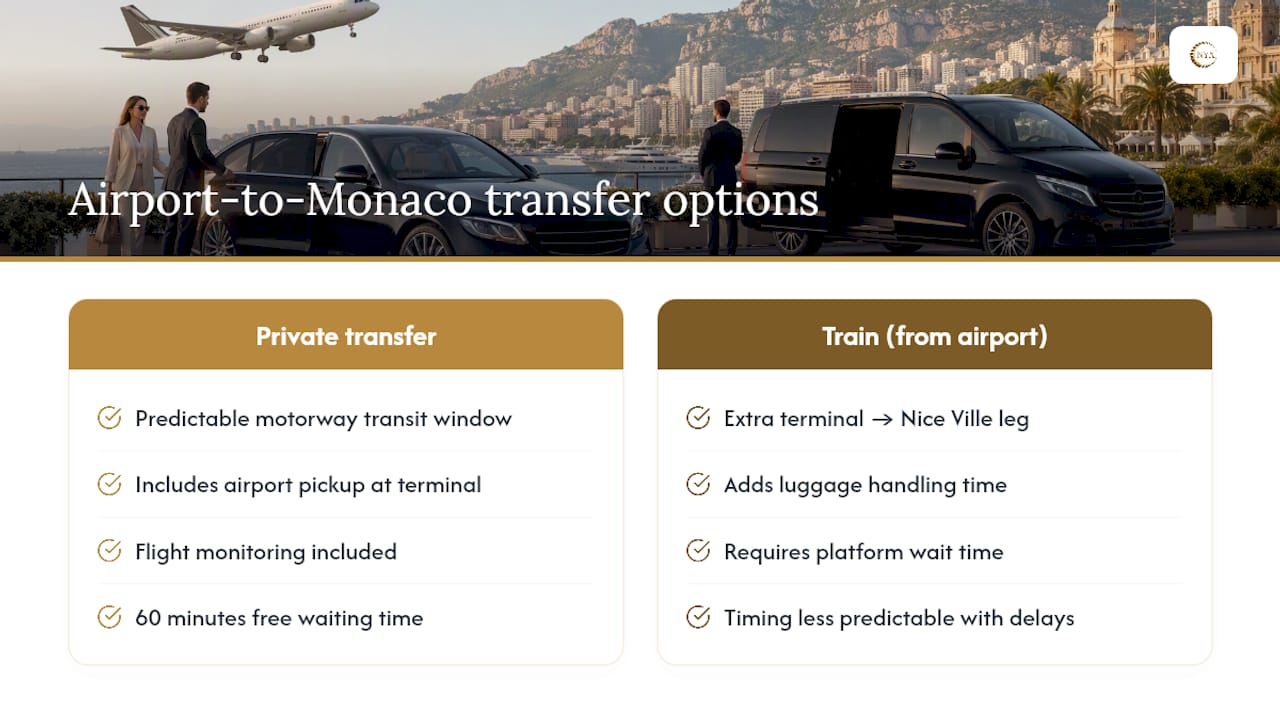
Travelers landing at Nice Côte d'Azur Airport face a different calculation than those already based in central Nice. Collection point matters: a well-timed private transfer typically covers the airport-to-Monaco run inclusive of motorway transit within a predictable window, while relying on the train adds the extra leg from the terminal to Nice Ville station, plus luggage handling and platform time.
Transponyx runs fixed-rate 2026 transfers on this exact corridor, with every airport pickup including flight monitoring and 60 minutes of free waiting time, removing the guesswork that comes with a delayed landing or a slow baggage carousel. The fleet covers a Standard Sedan and Business Sedan for up to three passengers, plus a Van 7 pax and Van 8 pax for groups or extra luggage heading to Monaco Grand Prix week, a Cannes Film Festival stay, or a Cannes Lions delegation. Call +33 6 10 30 71 84 or visit Transponyx to confirm a fixed rate before you fly.
Before setting off, three sources cover almost everything worth knowing. SNCF Connect publishes the current Nice to Monaco timetable, including first and last departures for any given day. ViaMichelin and Mappy both offer route planners with live distance, time and toll estimates for the drive. For incident and roadworks alerts, Radio VINCI Autoroutes and Nice-Matin's transport section carry the most reliable local reporting, and travelers heading to a yacht berth near Monaco's port may also find dedicated port transfer guidance useful for coordinating pickup with a vessel's arrival window.
Most guides to the Nice Monaco journey recite a single average time and leave it there, which flatters the train and misleads anyone driving during a Riviera event weekend. The real story is variance: rail timing barely moves, road timing moves constantly, and the gap between the two widens sharply the moment a major event, an A8 incident, or scheduled A500 works enters the picture.
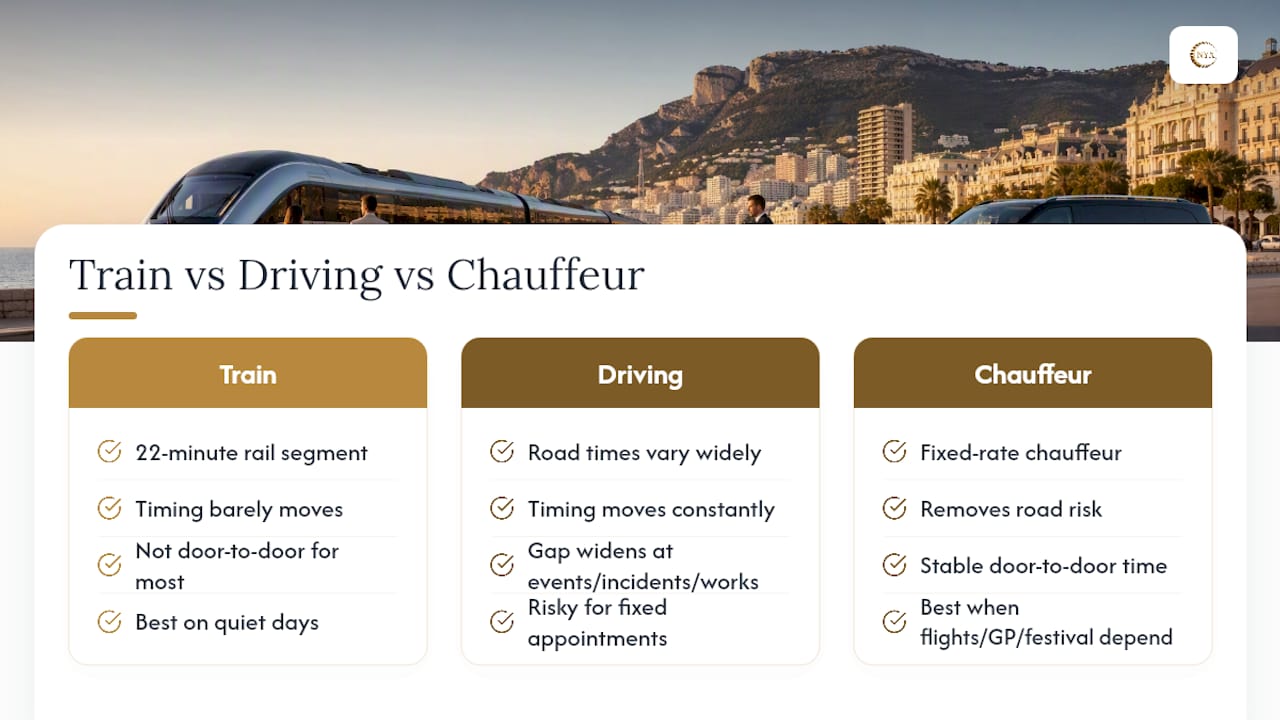
The conventional advice, simply “take the train, it's fastest,” ignores that most travelers are not leaving from Nice Ville station. They are landing at Nice NCE with luggage, arriving for a fixed appointment, or moving as a group. In those cases the meaningful metric is not the 22 minute rail segment but the full door-to-door time, and that is where a fixed-rate chauffeur earns its premium: not by beating the train on a quiet Tuesday, but by removing the risk on the days when nothing on the Riviera runs to schedule.
Prioritize certainty over the fastest theoretical number whenever a flight, a Grand Prix credential, or a festival screening depends on your arrival time.
— Dany
Sources
FAQ
What Is the Distance Between Nice and Monaco Along the Coast?
The road distance following the coastal corridor is approximately 21.4 kilometers, while the straight-line distance is roughly twelve to thirteen kilometers.
What Is the Overall Distance Between Nice and Monaco?
By road it runs to about 21.4 kilometers, though some route alternatives measured by Mappy range between 18.1 and 22.0 kilometers depending on the path chosen.
How Much Does the Toll Cost Between Nice and Monaco?
Toll exposure on this specific stretch is modest compared with longer Riviera motorway journeys, and ViaMichelin's route planner gives an up-to-date estimate for the exact route selected on the day.
How Much Does a Taxi Cost Between Nice and Monaco?
Taxi fares are metered on distance and time, so the final cost varies with traffic conditions along the roughly 21.4 kilometer route; a fixed-rate chauffeur booking with Transponyx removes that pricing uncertainty entirely.
How Long Does the Train Really Take From Nice to Monaco?
SNCF timetable data lists the fastest Nice Ville to Monaco–Monte-Carlo service at around 22 minutes, with the average trip closer to 24 minutes across the roughly 55 to 60 direct services running daily.

by Daniel AIT GOUGAM | August 31, 2026 | news
An airport meet and greet places a dedicated greeter or chauffeur at the aircraft door or arrivals curb, escorting you through immigration, baggage and security so you never navigate an unfamiliar terminal alone. Nice Côte d'Azur Airport publishes example pricing for exactly this service, and TranspOnyx offers a chauffeur-led version across the Riviera. It suits business travelers, families and anyone with a tight connection, and most operators want 48 hours' notice, though last-minute bookings are sometimes possible.
What does an airport meet and greet service actually include?
The core promise is simple: someone meets you before you have to work anything out for yourself. What varies enormously is how far that support extends, and this is where reading the fine print of any package matters.
At its most basic, a greeter meets you at the gate, jetbridge or arrivals hall holding a name board, then walks you to baggage reclaim or your transfer point. Global concierge providers typically build outward from that foundation, adding escort through passport control and security, provide assistance with luggage trolleys, and coordination with a waiting driver. Airports label these services inconsistently, sometimes as meet and greet, sometimes meet and assist, sometimes VIP escort, but the operational content is largely the same.
A fuller package typically covers:
- Arrival escort from the aircraft door or jetbridge, not just the terminal exit
- Gate-to-gate support for connecting flights, useful when a transfer window is under 90 minutes
- Escort through security and immigration formalities, including priority or fast-track lanes where the airport permits them
- Baggage assistance and porter service from reclaim to vehicle
- Buggy or electric cart transfers for long terminal walks or reduced-mobility passengers
- Lounge access and direct chauffeur handover as optional add-ons
Tiered branding such as Silver, Gold, Family or Elite is common among larger operators, and these tiers scale from a simple escort up to a fully personalized VIP arrival with lounge time and a private car waiting outside. Understanding which tier you are actually buying, rather than assuming “meet and greet” always means the full package, is the single biggest source of traveler disappointment with this service.
How much does airport meet and greet cost?
Expect a starting price in the low hundreds for a single arrival or departure escort, rising sharply once you add passengers, luggage volume, night hours or aircraft parked away from the terminal.
Nice Côte d'Azur Airport lists arrival meet and greet from €175 excluding VAT, with separate departure pricing and clearly flagged night-time surcharges. That published figure is useful precisely because it is one of the few concrete, airport-verified numbers in an industry where quotes often arrive vaguely worded.
Nice Airport meet and greet: what typically pushes the price up
Several factors commonly separate a quoted headline rate from the total you actually pay:
- Number of passengers, since several operators cap how many people one greeter handles at once
- Luggage count, particularly oversized items requiring extra porter time
- After-hours or night overloads, applied outside standard daytime operating windows
- Aircraft offstand or airtrack transfers, charged when the plane parks away from the gate and passengers are bussed in
- Lounge access or a chauffeur handover added as extras rather than included in the base fee
Air France's own Meet & Greet terms set a limit of nine passengers per booking, a detail worth checking before you assume a large family or group party fits under one reservation. Prices are frequently quoted excluding VAT, then shown “ATI” (all taxes included) at checkout, so the number you see first is rarely the number you pay. Confirm the total, taxes included, before you commit to any booking.
How do you book meet and greet and what happens on arrival?
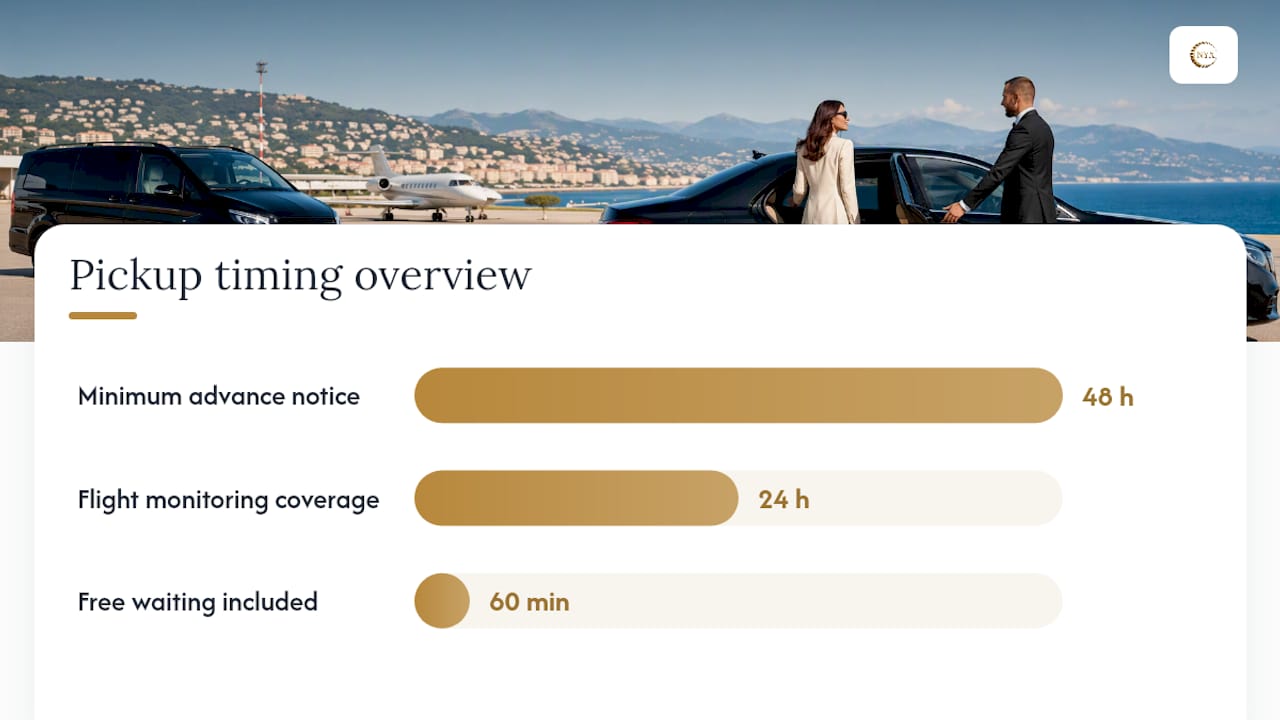
Book at least 48 hours ahead for a guaranteed, dedicated greeter; most operators, including ComfortPass, state this as their standard minimum lead time, though some accommodate last-minute requests depending on airport permissions and staff availability.
- Submit your flight number, passenger names and a mobile contact number. Operators use the flight number to track your arrival in real time, so accuracy here matters more than almost any other detail on the form.
- Flag any specific assistance needs at booking stage. Wheelchair access, an infant seat, or a large equipment case are all things a greeter needs to plan for in advance, not discover on the day.
- Receive confirmation of your meeting point and the greeter's contact details. This is usually a named arrivals point or gate area, agreed and communicated before you fly.
- On landing, the greeter meets you as agreed, checks identification, then escorts you through immigration, security or fast-track formalities as included in your package, coordinating baggage retrieval along the way.
- Handover to a waiting driver or transfer vehicle happens directly outside, if that service is part of your booking, closing the loop between plane and car without a single unaccompanied step.
Flight monitoring underpins the whole system. Airport operators maintain round-the-clock coverage precisely because delays and diversions happen constantly, and a greeter who is tracking your actual landing time, not your scheduled one, absorbs that disruption without you having to phone anyone.
Pro Tip If your flight is delayed or re-routed, do not contact the operator yourself in a panic. A properly monitored meet and greet service, including TranspOnyx's own airport pickup process, adjusts the greeter's timing automatically and will already be waiting when you land.
Who benefits most from booking a meet & greet service?
Time-pressed travelers gain the most, but the exact value shifts depending on why you are flying.
During peak Riviera weeks, the case becomes overwhelming. Events like the Cannes Film Festival, other major business and entertainment conventions, MIPIM, Cannes Lions, and MIPCOM compress tens of thousands of arrivals into a handful of days, and Nice NCE's terminals slow to a crawl accordingly. A pre-booked escort through that congestion is worth considerably more than its price tag to anyone with a schedule to keep.
- Business travellers heading straight into meetings gain a guaranteed, unhurried exit from the terminal
- Families and passengers needing mobility assistance benefit from buggy transfers and dedicated luggage handling, particularly with young children or reduced mobility
- Short connections are safest with a transit-specific meet and greet, where a greeter walks you gate to gate rather than leaving you to find your own way
- Fast-track or lounge-only passes, by contrast, solve queuing but offer no personal escort. Meet and greet solves both problems at once
TranspOnyx executive meet and greet: what you actually get
TranspOnyx runs its meet and greet as a chauffeur-led arrival rather than a standalone escort, meaning the greeter who meets you is also the driver who takes you onward. The service operates 24 hours a day, seven days a week, with flight monitoring included on every booking and free waiting time of 60 minutes on all airport pickups.
Every 2026 rate is fixed per vehicle, confirmed at the point of booking, with no surge pricing regardless of flight delays or peak-week demand.
Drivers are licensed VTC professionals, bilingual in English and French at minimum, with some also speaking Italian, Spanish, Russian or Arabic. Sample journey times from Nice NCE illustrates the ground covered:
- Monaco: roughly 30 to 40 minutes depending on traffic
- Cannes: roughly 30 to 45 minutes
- Antibes: roughly 20 to 25 minutes
- Menton: roughly 45 minutes
- Saint-Tropez: roughly 1 hour 15 minutes to 1 hour 30 minutes
Full service details sit on the Executive Meet & Greet page, and reservations run through +33 6 10 30 71 84 or Transponyx.
What are the cancellation and refund terms?
Policies vary meaningfully between operators, and this is exactly the section of any booking confirmation worth reading before you pay, not after something goes wrong.
Air France's published Meet & Greet terms set out specific conditions covering purchase, refunds and the circumstances under which a booking can be amended or canceled. These terms typically distinguish between cancellations made well ahead of the travel date, which are usually refundable in full or in part, and same-day cancellations, which are frequently non-refundable given the staffing already committed.
Most reputable providers follow a broadly similar structure: a free cancellation window closing somewhere between 24 and 48 hours before the scheduled service, followed by a reduced or zero refund inside that window. Flight cancellations and major delays are usually treated more leniently than a simple change of plan, since operators are monitoring your flight anyway and can reschedule around genuine disruption rather than penalizing you for it.
Always confirm three things before booking: the exact cancellation deadline, whether a refund is full or partial inside that deadline, and whether flight delays are handled automatically or require you to notify the operator. A provider that cannot answer these three questions clearly at booking stage is not one to trust with a time-sensitive arrival.
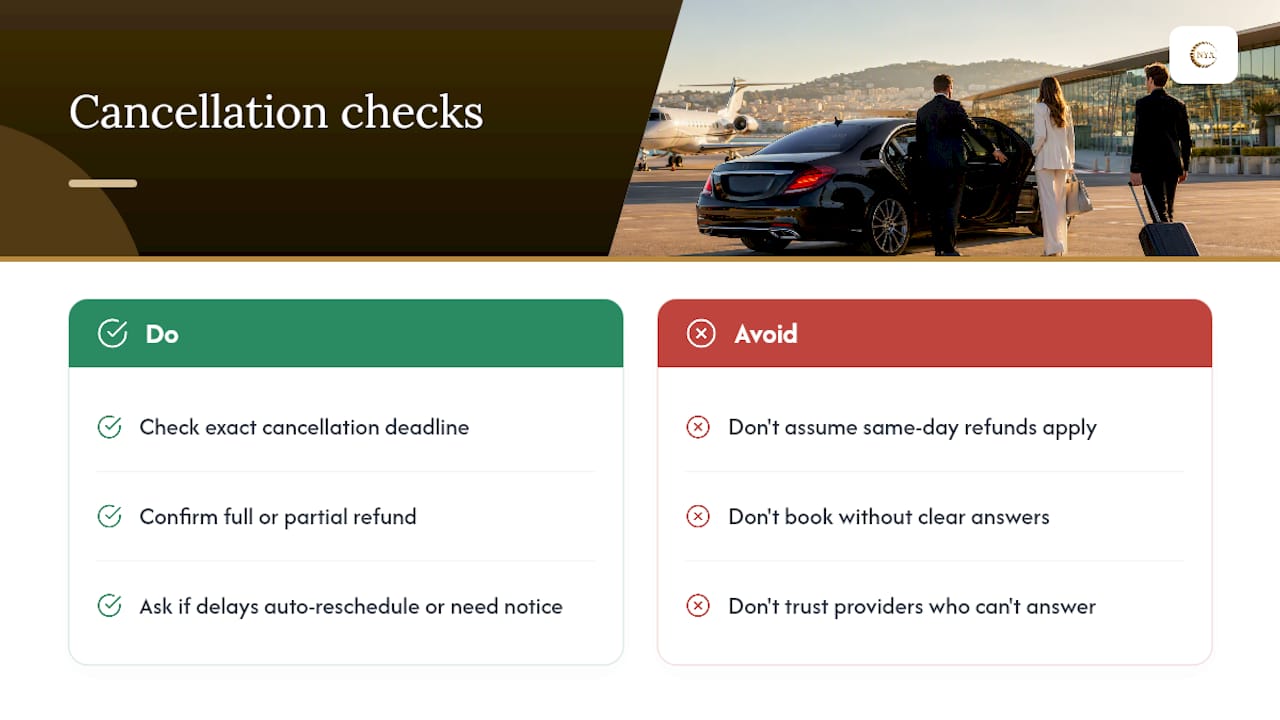
How do you compare meet and greet providers properly?
Price is the easiest thing to compare and the least reliable indicator of quality. A genuinely useful comparison looks at inclusions, accountability and transparency instead.
Start with what is actually included at the quoted price rather than what the marketing implies. A €175 headline figure, such as the one Nice Airport publishes for arrivals, might exclude VAT, night surcharges or airtrack fees entirely, so the real cost only becomes clear once you ask directly. Any operator unwilling to confirm a total, taxes included, before you book is a red flag worth taking seriously.
Check who the greeter actually is. Some providers subcontract to third-party agencies with variable staff quality, while others, including chauffeur-led services like TranspOnyx, use their own licensed drivers as the point of contact from arrival through to onward transfer. That continuity matters more than it sounds: a single accountable person from plane door to car door removes the handover risk that comes with passing you between two separate teams.
Look for explicit flight monitoring, a stated response time if your flight changes, and clear contact details you can reach directly rather than a generic booking inbox. Genuine 24/7 availability should be stated plainly, not implied. Finally, read any passenger cap into your group size calculation before you book, since several operators, Air France among them, limit numbers per greeter and will otherwise split larger parties across separate reservations and separate charges.
When should you book meet and greet, and can you customize it?
Booking timing matters almost as much as the operator you choose. Reserve as early as your travel plans allow, ideally the moment your flight is confirmed, and treat 48 hours before arrival as an absolute minimum rather than a comfortable buffer.
Around major Riviera events, that margin shrinks fast. During the Cannes Film Festival and Monaco Grand Prix, greeter availability at Nice NCE tightens noticeably in the days before hand, and last-minute requests that would normally be accommodated often cannot be during those peak weeks. If your travel dates overlap with a known event, book weeks ahead rather than days.
Customization is where most travelers underuse the service. Beyond the basic escort, you can typically specify a preferred vehicle class, request a child seat, ask for a specific language for your greeter or driver, and add lounge access or a chauffeur handover as a single combined booking rather than separate purchases. Providing your full itinerary, including any connecting flight, luggage volume and mobility needs, at the point of booking rather than on the day lets an operator plan properly instead of improvising once you land. The more specific your request, the more precisely a good operator can match a greeter, vehicle and route to it.
Is the premium of chauffeur-led meet & greet worth paying?
Chauffeur-led meet and greet earns its premium when your time actually has a price attached to it: a boardroom in Monaco waiting on you, a wedding party running to schedule, or a connection with no margin for error. Around fixed dates like the Cannes Film Festival or MIPIM, pre-booking stops being a luxury and becomes the only realistic way to guarantee an on-time arrival. For a relaxed holiday with hours to spare, it is a comfort rather than a necessity. Book it when the clock matters; skip it when it does not.
— Dany
Book your TranspOnyx executive meet and greet
TranspOnyx replaces the usual patchwork of a separate greeter, a separate taxi and a separate wait for luggage with one driver who covers all three, at a fixed 2026 rate agreed before you fly. That single point of accountability, rather than a handover between strangers, is the real advantage over a standalone airport meet and greet booking.
Choosing a vehicle is straightforward. Solo travelers and couples typically book the Standard Sedan or the premium-finish Business Sedan, while families and small groups take the Van 7 pax, and larger parties or corporate teams use the Van 8 pax, which seats up to eight. Every booking includes 60 minutes of free waiting time on airport pickups and flight monitoring as standard, so a delayed landing never costs extra. Full route and pricing details for the Nice corridor sit on the Nice airport transfer page, and the luxury chauffeur benefits guide covers the wider service if you are still comparing options.
Reserve directly by calling +33 6 10 30 71 84, messaging on WhatsApp, or booking online at Transponyx. Confirmation is immediate, with your driver's details and fixed fare sent well ahead of your flight.
Sources
FAQ
What is airport meet and greet exactly?
It is a service where a greeter or chauffeur meets you at the aircraft, gate or curb and escorts you through security, immigration and baggage collection, often continuing to a waiting car.
How much does meet and greet cost at the airport?
Prices start in the low hundreds for a basic arrival escort. Nice Côte d'Azur Airport lists arrivals from €175 excluding VAT, with night surcharges and airtrack fees added on top depending on circumstances.
How far ahead should I book a meet and greet service?
Book at least 48 hours before your flight for a guaranteed dedicated greeter. Last-minute requests are sometimes possible but depend entirely on operator and airport availability.
Does TranspOnyx offer airport meet and greet?
Yes. TranspOnyx runs a chauffeur-led Executive Meet & Greet from Nice NCE with 24/7 availability, fixed 2026 rates, flight monitoring and 60 minutes of free waiting time, bookable directly at Transponyx or by phone on +33 6 10 30 71 84.
Can I cancel or get a refund on a meet and greet booking?
Most providers, including Air France under its published terms, offer full or partial refunds if you cancel well ahead of your travel date, with reduced or no refund for same-day cancellations.
Is meet and greet worth it for a short connection?
Yes, particularly with under 90 minutes between flights. A gate-to-gate escort removes the risk of missing a connection in an unfamiliar terminal.