
Baggage assistance is a dedicated service that manages luggage handling and logistics on a traveler's behalf, from the moment they arrive at an airport through to their final destination. The term covers a broad spectrum: at its most basic, it means a porter carrying bags from the curbside to the check-in desk; at its most advanced, it means end-to-end luggage logistics with GPS tracking, airline check-in integration, and door-to-door collection. Most travelers encounter the service without fully understanding who provides it, what it costs, or what rights apply when something goes wrong. This guide answers all of that clearly.
What is baggage assistance and how does it work at airports?
Baggage assistance is the organized support system that moves luggage through airport zones so travelers do not have to. The industry term for the broader category is baggage handling services, though travelers often use the phrases interchangeably. The service sits at the intersection of airport infrastructure, airline ground operations, and specialist logistics providers.
The traditional porter model
The most familiar form of airport baggage support is the porter service. A porter meets a traveler at the curb, collects the bags, and escorts them through check-in, security, and sometimes customs. Traditional airport porters typically charge a flat fee of $3.00 USD per item for luggage transport between the curbside and terminal areas. This figure reflects a straightforward, labor-based service with no technology component.
Porters use trolleys and coordinated processes to reduce physical strain and logistical friction for travelers moving through security, customs, and check-in. The value is not just physical. A good porter knows the airport layout, the fastest queues, and the correct counters. That local knowledge saves time in ways a trolley alone cannot.
Who actually controls your bags?
This is the point most travelers misunderstand. Airports provide the infrastructure, but baggage management authority rests with airlines and their contracted ground handling agents. Companies such as Swissport and Menzies Aviation operate behind the scenes, loading, sorting, and transferring bags between flights. Airport information desks cannot access baggage systems and cannot resolve handling issues directly.
When a bag is delayed or damaged, the correct first contact is the airline's specific ground handling agent, not the airport's general help desk. Going to the wrong desk wastes time and risks missing critical reporting windows.
Pro Tip At any airport, ask the airline desk to confirm which ground handling agent manages your flight. Note the agent's name and contact before you leave the terminal. This single step removes the most common source of delay when making a baggage claim.
Legal responsibilities and reporting windows
Travelers have defined rights when luggage is delayed, lost, or damaged. US DOT regulations require passengers to report baggage issues promptly; for domestic flights, the reporting window is typically within six hours of receiving the bags. Six hours sounds generous. In practice, many travelers collect their bags, travel to their hotel, unpack, and only then notice damage. By that point, the window has often closed.
Airlines must reimburse passengers for reasonable incidental costs caused by baggage delays, but only when the traveler can provide verifiable expense records and has reported the issue on time. The liability framework rewards those who act immediately at the airport, not those who wait.
What types of baggage assistance are available?
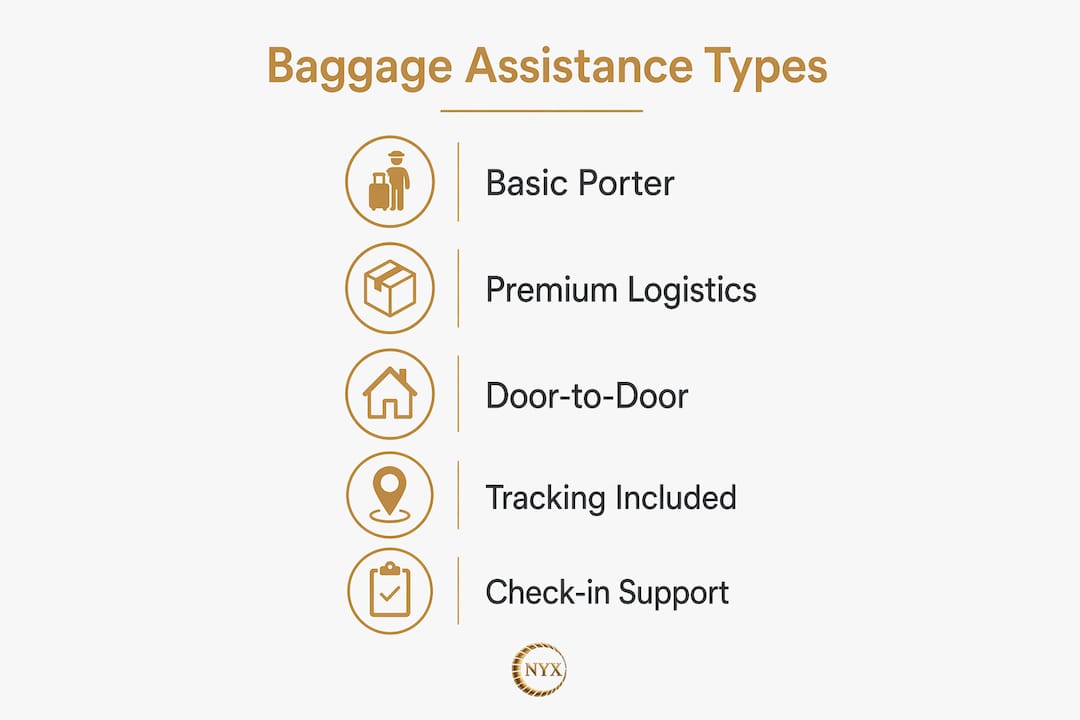
The range of luggage assistance services in 2026 spans from simple porter help to fully managed logistics operations. Understanding the differences helps travelers choose the right level of support for their journey.
Basic Porter Services
Basic porter services are available at most major international airports. A porter collects bags at the curb or check-in zone, transports them using airport-approved trolleys, and hands them over at the designated point. The service is booked on arrival, often through a uniformed desk near the terminal entrance. Costs are typically per item, with no advance reservation required.
This level suits travelers with heavy bags, reduced mobility, or tight connection times. It does not include tracking, insurance beyond standard airline liability, or any coordination with the airline's check-in system.
Premium door-to-door baggage logistics
Premium baggage logistics services operate at a fundamentally different level. Leading premium providers achieve a 99.9% arrival success rate by integrating directly with airline check-in systems. This figure reflects a service built on chain-of-custody tracking, not just physical transport.
These services collect bags from a traveler's home or hotel, check them in remotely, and deliver them to the destination address. The traveler passes through the airport with no luggage at all. GPS monitoring tracks each item throughout the journey. For business travelers attending events such as the Cannes Film Festival or the Monaco Grand Prix, this level of service removes an entire layer of logistical complexity from an already demanding schedule.
Service level comparison
| Service level | Collection point | Check-in integration | GPS tracking | Typical cost basis |
|---|---|---|---|---|
| Basic porter | Airport kerb or terminal | None | None | Per item (flat fee) |
| Premium airport assist | Airport terminal | Partial | Limited | Per journey or package |
| Door-to-door logistics | Home or hotel | Full airline integration | Real-time GPS | Per bag or subscription |
The table above uses generic service categories. Individual providers vary in scope, and travelers should confirm exactly which features are included before booking.
Key features that distinguish premium services
True end-to-end baggage assistance integrates with airline systems for early check-in and customs clearance, offering higher security and efficiency than standard porter services. This matters most on international routes where customs documentation must accompany the bags. A premium provider handles that paperwork as part of the service. A basic porter does not.
For travelers arriving at Nice Côte d'Azur Airport (NCE) and continuing to Monaco, Cannes, or Antibes, the combination of premium bag logistics and a pre-arranged private transfer eliminates every friction point between the aircraft door and the hotel lobby.
How to use baggage assistance services effectively
Knowing that baggage assistance exists is one thing. Using it well requires a few deliberate steps before and during travel.
Booking and preparation
-
Check your airline's website before departure. Some carriers partner with premium baggage logistics providers and offer the service at a discounted rate during the booking process. Others list approved porter services on their airport information pages.
-
Contact the airport directly for porter availability. Not every airport offers a formal porter program. Calling ahead confirms availability, hours of operation, and the correct meeting point.
-
Book premium door-to-door services at least 48 hours in advance. Most providers require advance notice to arrange collection, coordinate with the airline's check-in system, and assign a dedicated handler.
-
Photograph your bags and their contents before traveling. This takes two minutes and provides the evidence base needed for any damage or loss claim. Without photographs, claims are harder to substantiate.
-
Carry a copy of your baggage receipt. Airlines issue a baggage claim tag at check-in. Keep it until you have physically inspected your bags at the destination. The tag number is the reference for any claim.
Pro Tip If you are traveling with fragile or high-value items, declare them at check-in and ask for a fragile sticker. This does not guarantee careful handling, but it creates a documented record that the airline was informed of the bag's contents before departure.
What to expect on the day
A porter or baggage assistance agent will typically meet you at a designated point, confirm your name and flight details, and issue a receipt for each item collected. Keep that receipt. At premium service level, you will receive a tracking reference by SMS or email within minutes of handover.
At the destination, bags are delivered to the agreed address or collection point. If anything is missing or damaged, report it before leaving the airport. Time sensitivity is critical for baggage claims. Many travelers forfeit their rights by delayed reporting or damaged bags after leaving the airport, often missing the six-hour domestic reporting window entirely.
Reporting a problem
Contact the airline's ground handling agent at the airport immediately. Do not go to the general airport information desk. Ask for a Property Irregularity Report (PIR), which is the standard industry document for recording baggage mishandling. The PIR number is your reference for all subsequent correspondence. Keep all receipts for expenses incurred because of the delay, as airlines are legally required to reimburse reasonable costs when the claim is properly documented.
Common questions about baggage assistance answered
Travelers new to these services share a consistent set of questions. The answers below address the most frequent ones directly.
-
Is baggage assistance included with my airline ticket? Standard tickets do not include porter or premium baggage logistics services. Some premium cabin fares and certain airline loyalty programs include airport meet-and-assist services, which may cover porter help. Check your fare conditions before assuming inclusion.
-
Are there additional costs beyond the per-item fee? Basic porter services charge per item, with gratuity expected but not always mandatory. Premium door-to-door services charge per bag or per journey, and may include insurance as part of the package. Always confirm the full cost at the time of booking.
-
Can baggage assistance help with connecting flights? Basic porters operate within a single terminal or airport zone. Premium providers can coordinate inter-terminal transfers and, in some cases, manage bags across connecting flights on the same booking. Confirm this capability explicitly before booking if you have a connection.
-
What liability covers damaged or lost baggage? Airline liability under international conventions covers a defined maximum per kilogram or per bag. Passengers should contact their airline's ground handling agent directly for baggage problems, not the airport desk. Premium baggage logistics providers often carry additional insurance, which is worth confirming before travel.
-
Does baggage assistance cover customs clearance? Basic porter services do not include customs support. Premium end-to-end providers may assist with documentation for international routes, but customs clearance remains the traveler's legal responsibility. The provider facilitates; the traveler is accountable.
Why baggage assistance matters more than most travelers realize
I have watched hundreds of travelers arrive at Nice Côte d'Azur Airport looking composed, only to unravel at the baggage carousel. The bags are late. The ground handler desk is on the other side of the terminal. The taxi is waiting outside. The Cannes Lions conference starts in three hours. Every one of those problems was avoidable.
The real value of professional baggage assistance is not the physical act of carrying a bag. It is the removal of uncertainty. When you know your bags are tracked, checked in, and confirmed on your flight, your attention is free for everything else. That mental clarity is what seamless travel in 2026 actually means. It is not a luxury concept. It is a practical one.
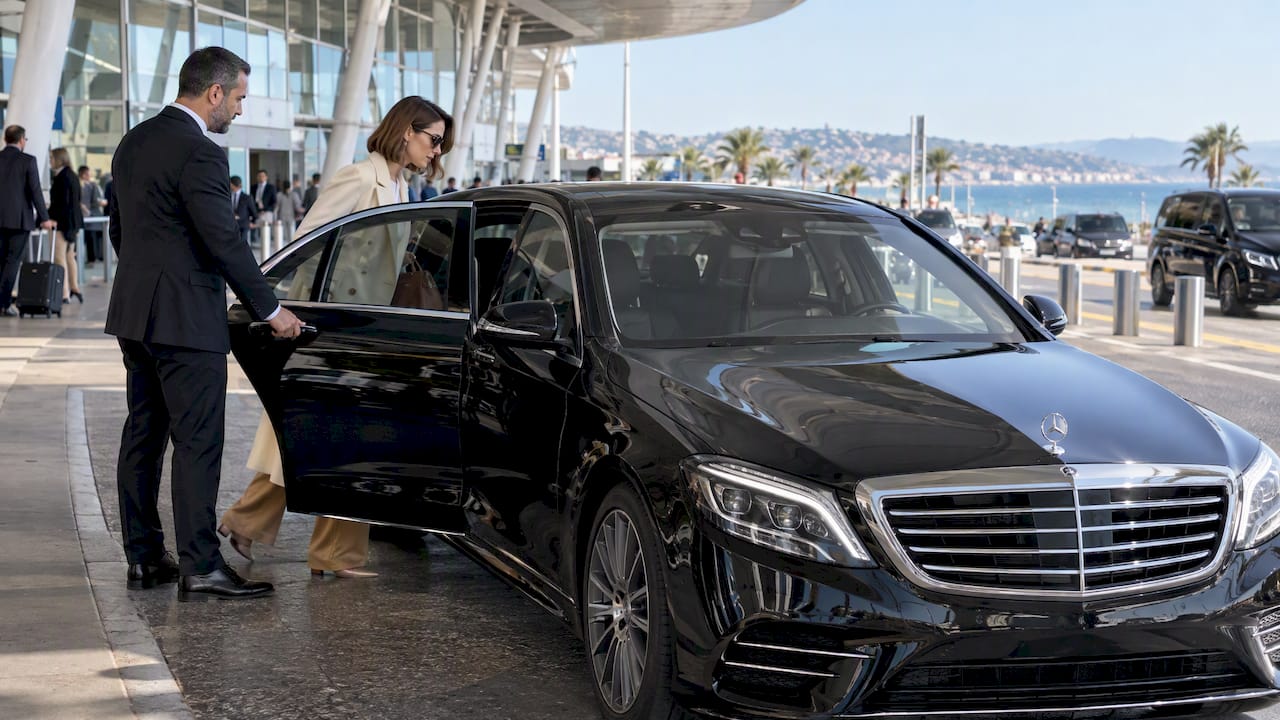
What I have also noticed is that travelers who invest in good baggage assistance and then arrange their own ground transport are solving only half the problem. The bag arrives smoothly, but the transfer from the airport is chaotic. A private driver who monitors your flight, waits the full 60 minutes if you are delayed, and loads your bags into a Mercedes-Benz without you lifting a finger is the other half of that equation. On the French Riviera, where distances between Nice NCE, Monaco, and Cannes are short but traffic during events like MIPIM or the Monaco Grand Prix is not, that coordination is the difference between arriving calm and arriving frazzled.
The travelers I see getting this right are not necessarily the wealthiest. They are the most organized. They book the bag service. They book the transfer. They confirmed both the night before. They are coming.
— Dany
Transponyx: luxury transfers that complete the picture
Professional baggage assistance gets your luggage to the right place. Transponyx gets you there in the same condition.

Transponyx operates premium airport transfers from Nice Côte d'Azur Airport (NCE) to Monaco, Cannes, Antibes, Menton, and Saint-Tropez, with fixed 2026 rates confirmed at booking and no surge pricing. The fleet covers every group size: Standard Sedan and Business Sedan for up to three passengers, Van 7 pax and Van 8 pax for larger parties. Every vehicle carries Wi-Fi, air conditioning, chilled water, and phone chargers. Flight monitoring is included on every airport pickup, with 60 minutes of free waiting time. For groups attending the Cannes Film Festival, MIPCOM, or the Monaco Grand Prix, Transponyx also offers luxury chauffeur services by the hour. Book via https://transponyx.com or call +33 6 10 30 71 84.
FAQ
What is baggage assistance at an airport?
Baggage assistance is a service that manages luggage handling on a traveler's behalf, ranging from porter support at the curb to full door-to-door logistics with GPS tracking and airline check-in integration.
How much does airport porter service cost?
Traditional airport porter services typically charge a flat fee of $3.00 USD per item for transport between the curbside and terminal areas, with gratuity often expected in addition.
Who should I contact if my bag is lost or damaged?
Contact your airline's specific ground handling agent at the airport immediately and request a Property Irregularity Report. Do not use the general airport information desk, as airport staff do not have access to airline baggage systems.
How long do I have to report a damaged bag?
For domestic US flights, the reporting window is typically within six hours of receiving the bag. Waiting until you reach your hotel frequently means missing the deadline and forfeiting compensation rights.
Is premium baggage assistance worth the cost?
For travelers with tight connections, high-value luggage, or demanding schedules such as attending major events on the French Riviera, premium door-to-door baggage logistics removes significant logistical risk and pairs naturally with a pre-arranged private transfer for a fully managed arrival experience.


0 Comments