
Elite athletes arriving in Nice for the Ironman 70.3 World Championship face a transport challenge that most travel guides overlook entirely. How to select business travel vehicles that can accommodate a triathlon bike, a gear bag, a wetsuit box, a coach, and a nutritionist, all in a single transfer from Nice Côte d’Azur Airport to a villa in Antibes, requires a level of planning that goes well beyond typing “car hire” into a search engine. Get it wrong, and your race preparation starts under stress. Get it right, and you arrive composed, organised, and on schedule.
How to select business travel vehicles for Ironman events
The starting point for any serious business travel transport selection is an honest assessment of what you are actually transporting. Not just the people, but everything that travels with them. For elite triathletes, that list is longer and bulkier than most corporate travellers ever encounter.
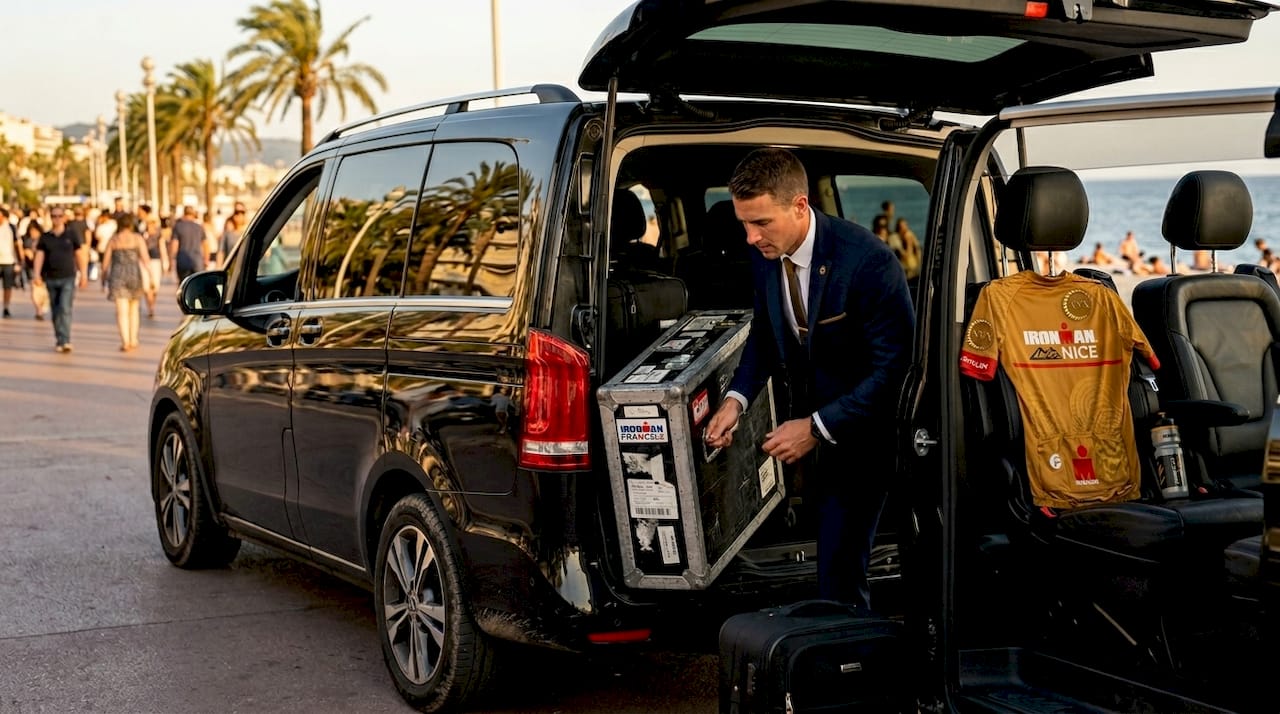
A typical Ironman competitor arriving internationally at Nice NCE will be travelling with a bike box (roughly 130 x 90 x 30 cm and weighing between 12 and 20 kg), a large check-in bag, a carry-on, a race wheel bag in some cases, and possibly a separate nutrition or medical kit. A coach accompanying two or three athletes multiplies that luggage instantly. Support staff, physiotherapists, and family members attending the event add further passenger count and baggage volume.
Corporate-rental guidance for 2026 is clear on this point: compact cars suit solo city trips, SUVs manage three to four standard bags, but larger groups with specialist cargo require vans. For an Ironman team, that means the conversation starts at Van 7 pax or Van 8 pax territory before a single passenger has been counted.
Passenger configurations and vehicle capacity
The table below illustrates how different group types map to the Transponyx fleet on the French Riviera.
| Group type | Typical passenger count | Luggage profile | Recommended vehicle |
|---|---|---|---|
| Solo athlete with coach | 2 passengers | 2 bike boxes, 3 bags | Van 7 pax |
| Athlete with family (3) | 4 passengers | 1 bike box, 4 large bags | Van 7 pax |
| Team of 3 athletes | 3 passengers | 3 bike boxes, 4 bags | Van 8 pax |
| Full team with staff (6) | 6 passengers | 2 bike boxes, 6 bags | Van 8 pax |
| Individual executive traveller | 1 passenger | Standard luggage | Business Sedan |
| Corporate pair | 2 passengers | 2 carry-ons | Standard Sedan |
The cargo space criteria that apply to standard corporate trips, fuel economy, style, comfort, and luggage volume, apply here too. The difference is that underestimating cargo in an Ironman context is not merely inconvenient. It may mean a bike box is left at the airport, a replacement is impossible to source before race morning, and a season of preparation collapses.
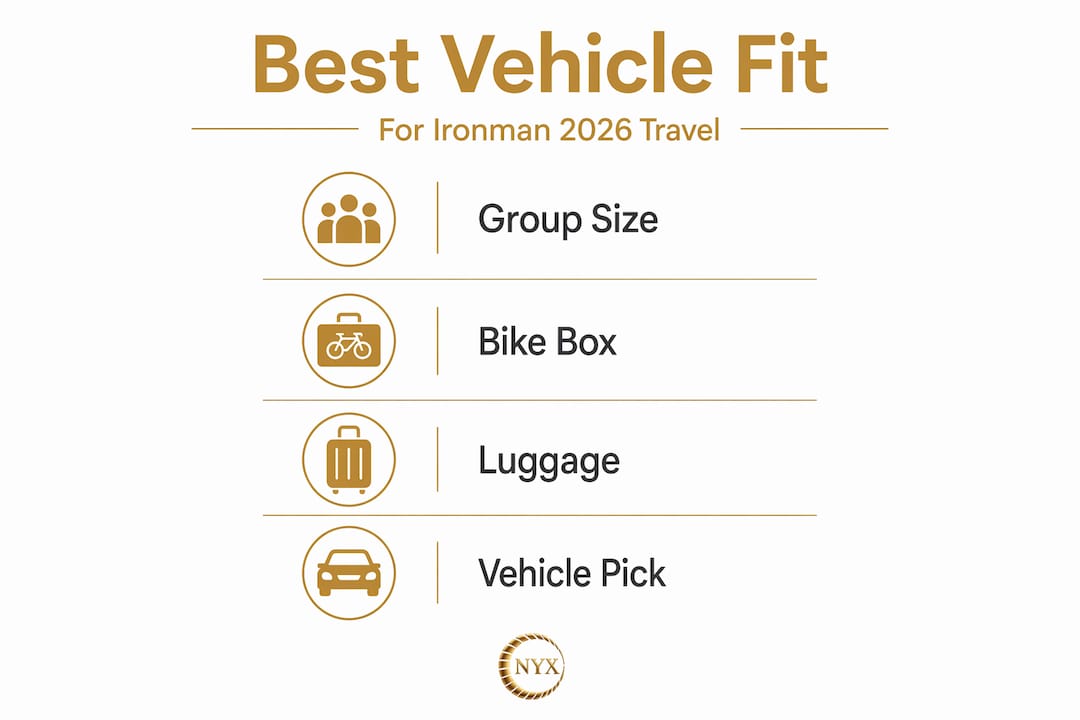
A further consideration is timing. Race day in Nice begins before 6:00 am. Athletes require transfers that allow warm-up time, equipment drop-off at transition zones, and absolutely zero uncertainty about arrival. Finish-line pickups demand a vehicle with sufficient interior space for a physically exhausted athlete, a wet trisuit, equipment bags, and often a companion. The Van 7 pax and Van 8 pax configurations in the Transponyx fleet handle all of these phases with the necessary space and professional preparation.
Matching vehicle to journey phase
Choosing vehicles for business trips of this nature is not a single decision. It is a sequence of decisions mapped to each distinct phase of the event, and each phase has different priorities.
-
International arrivals at Nice NCE. Athletes flying in from the United States, Australia, Germany, or Brazil typically arrive on long-haul connections, often with oversized luggage. The priority here is a vehicle large enough to load without compromise, a driver who monitors the flight and adjusts pickup time accordingly, and a fixed rate that was agreed at booking with no surge pricing.
-
Hotel and villa check-in transfers. The journey from Nice Airport to Antibes takes approximately 20 to 25 minutes, Monaco around 35 minutes, and Cannes 30 to 40 minutes depending on traffic. These are not complicated journeys by distance, but during periods of high event concentration, including the Cannes Film Festival in May or the Monaco Grand Prix, the Riviera road network tightens considerably.
-
Race-day morning transfers. This is the most pressure-sensitive transfer of the entire event. Departure times as early as 4:30 am are common. The vehicle must be on time to the minute, climate-controlled, and quiet. Athletes do not want conversation. They want a professional driver who understands the schedule, knows the access points around the race course, and will not add a single unnecessary variable to the morning.
-
Finish-line pickups. After crossing the finish line, recovery is the priority. An athlete returning to a villa in Saint-Tropez or an apartment in Menton needs a vehicle they can load without effort, with cool water on board and space to lie back. The Van 7 pax and Van 8 pax are the natural choices here. Tailoring vehicle choice to passenger number, luggage, occasion, and journey duration reduces operational risk and improves the traveller experience throughout.
-
Group transfers and team logistics mid-event. For teams managing multiple athletes across several days of the race programme, standardising on three to five fleet configurations limits logistical complexity when multiple VIP arrivals and departures occur simultaneously. A corporate account with Transponyx achieves exactly this, with a consistent vehicle standard and predictable fixed pricing across the entire booking.
-
Cross-border and long-distance transfers. Teams based in Monaco or those collecting athletes from connections in Milan need providers with confirmed cross-border competence. Transponyx covers transfers to Ventimiglia, San Remo, and Milan on request. Cross-border vehicle operations carry regulatory compliance obligations that only licenced professionals can satisfy. VTC-licenced chauffeurs, as operated by Transponyx, are the correct category for this.
Booking private chauffeur services in 2026
The most common error elite sports teams make with vehicle options for business travel is booking too late. During race week for the Ironman 70.3 World Championship in Nice, van availability across the Riviera tightens rapidly. The same applies during the Cannes Film Festival in May, MIPIM in March, and the Monaco Grand Prix in late May. Booking at least four to six weeks in advance is the minimum. For multi-vehicle corporate accounts managing six or more athletes and staff, confirming arrangements ten to twelve weeks out is advisable.
- Confirm luggage capacity in writing. Not all vans are configured identically. The Transponyx Van 7 pax and Van 8 pax both accommodate oversized sports equipment, but confirming bike box dimensions at booking avoids any ambiguity.
- Verify that flight monitoring is included. Transponyx monitors every incoming flight on airport transfers and adjusts pickup time without any action required from the client. Free waiting time of 60 minutes is included on all airport pickups as standard in 2026.
- Ask for fixed rates, confirmed at booking. A 2026 corporate chauffeur guide notes that flagship saloons cost 30 to 50% more than standard vehicles, and advises that spend should reflect occasion, not default booking habit. Fixed rates mean there is no post-journey invoice surprise regardless of traffic conditions or waiting time.
- Check driver language capability. Transponyx drivers are licensed VTC professionals, bilingual in English and French at minimum, with several also fluent in Italian, Spanish, Russian, or Arabic. For international athlete groups, this is not a minor detail. It is the difference between a smooth, reassuring transfer and a frustrating one.
Pro Tip: When booking vehicles for a multi-day event programme, request a dedicated driver for the race morning transfer specifically. Continuity matters when an athlete is mentally preparing for competition.
Professional private chauffeur services offer something that self-drive rental cars simply cannot: local knowledge applied in real time. A driver who knows that the Promenade des Anglais closes to private traffic during race morning, who has navigated team logistics during the Cannes Lions conference and the Monaco Grand Prix in the same calendar month, and who can reach a finish-line pickup point without GPS guesswork, adds genuine operational value. Reviewing airport transfer logistics before finalising bookings helps clarify which services cover the full scope of what a competitive event demands.
Cost, efficiency, and sustainability considerations
Understanding the cost structure of business travel vehicle recommendations on the French Riviera in 2026 requires looking at the total picture, not just the per-journey rate.
| Vehicle | Capacity | Approx. 2026 fixed rate (NCE to Antibes) | Best use case |
|---|---|---|---|
| Standard Sedan | Up to 3 passengers | From €75 | Executive solo or pair, standard luggage |
| Business Sedan | Up to 3 passengers | From €90 | Corporate client, premium occasion |
| Van 7 pax | Up to 7 passengers | From €120 | Athlete team, multiple bike boxes |
| Van 8 pax | Up to 8 passengers | From €135 | Full team with equipment and support staff |
Rates are per vehicle, fixed at booking, with no surge pricing regardless of demand. This is a significant operational advantage during major Riviera events, when conventional ride-hailing pricing can increase by 200 to 300 percent.
On the question of vehicle hire versus vehicle rental, the calculation for short-term elite event travel consistently favours professional chauffeur hire. Paying for a larger vehicle group than necessary is a documented error in business travel. But the inverse, under-hiring to save money and then finding that bikes do not fit, is considerably more expensive in time, stress, and logistical recovery.
From an environmental perspective, the French Riviera’s charging infrastructure is improving steadily, but EV suitability for event logistics depends on route length and depot charging availability. Fleet procurement specialists recommend a 20 to 30% range buffer to avoid schedule risk during tight event timelines. For routes from Nice to Saint-Tropez (approximately 100 km) or to Milan (approximately 300 km), petrol Mercedes-Benz vehicles remain the more reliable operational choice in 2026 until charging infrastructure along these corridors reaches sufficient density.
The other sustainability argument worth making is this: one Van 8 pax carrying a full team produces a fraction of the emissions of four individual rental cars making the same journey. Professional group transport is the operationally and environmentally rational choice for coordinated event teams, and the Transponyx fleet is structured precisely to support it.
What I have learned from Riviera event transport
In my experience working with business travellers and elite sports clients on the French Riviera, the biggest mistake is not a poor vehicle choice. It is a late vehicle choice. Teams that finalise transport arrangements in the final two weeks before the Ironman 70.3 World Championship in Nice consistently face the same problems: van availability is reduced, preferred time slots are taken, and any contingency planning becomes reactive rather than prepared.
The second lesson is one I have come back to many times. Athletes and corporate clients often conflate “large vehicle” with “appropriate vehicle.” I have seen groups of four attempt to manage three bike boxes in a saloon because they assumed capacity would be sufficient. It never is. The standard executive saloon seats three adults with luggage comfortably, and anything beyond that requires an MPV at minimum.
What I find genuinely reliable, particularly during the compressed calendar of a Nice race week, is a fixed-rate model. Knowing the exact cost before the journey begins removes a decision variable at exactly the moment when an athlete’s mental bandwidth should be directed entirely towards race preparation, not managing transport invoices. The 2026 fixed rates that Transponyx confirms at booking are one of the clearest expressions of that principle in practice on the Riviera.
There is also something to be said for the cumulative effect of professional service. A driver who is on time, calm, and knowledgeable about race-day logistics contributes to the athlete’s composure in ways that are difficult to quantify but impossible to ignore. I have spoken with coaches who book the same chauffeur service year after year, not because it is the cheapest option, but because it is the one that has never introduced an unnecessary complication.
— Dany
Transponyx: race-ready chauffeur services for Ironman 2026
For elite athletes and their teams attending the Ironman 70.3 World Championship in Nice this September, the vehicle question resolves clearly once the requirements are on paper.
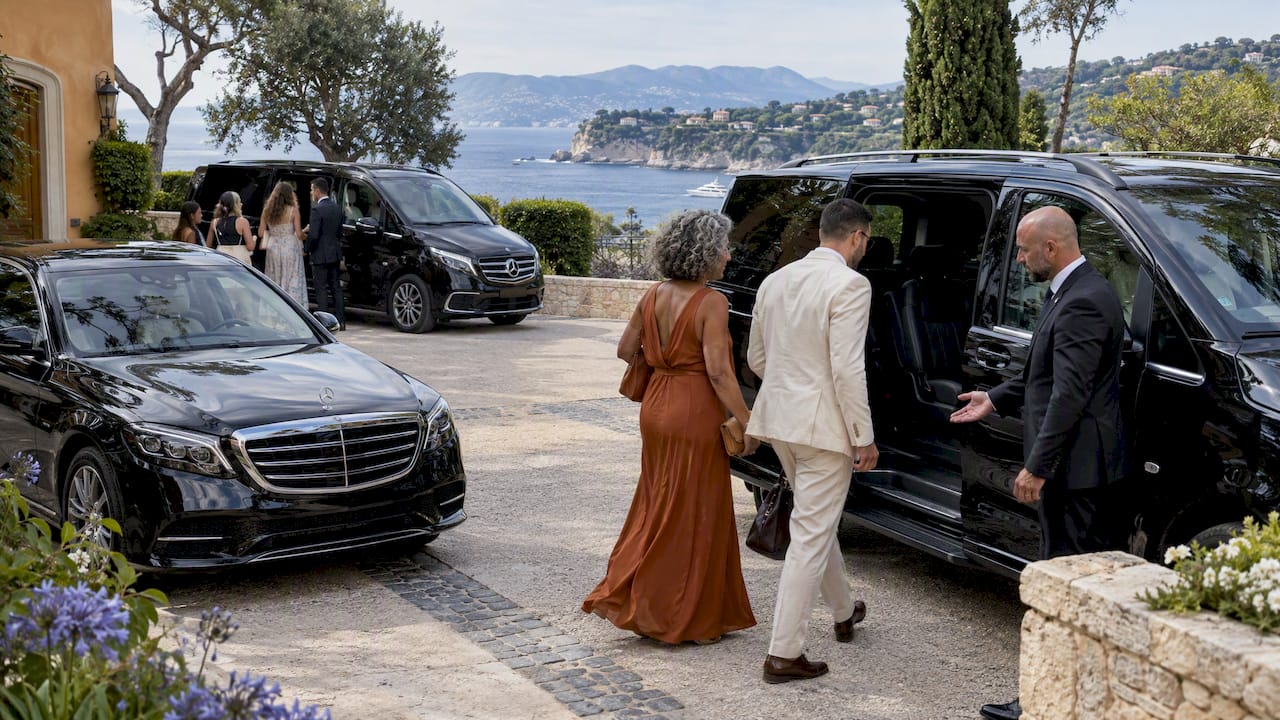
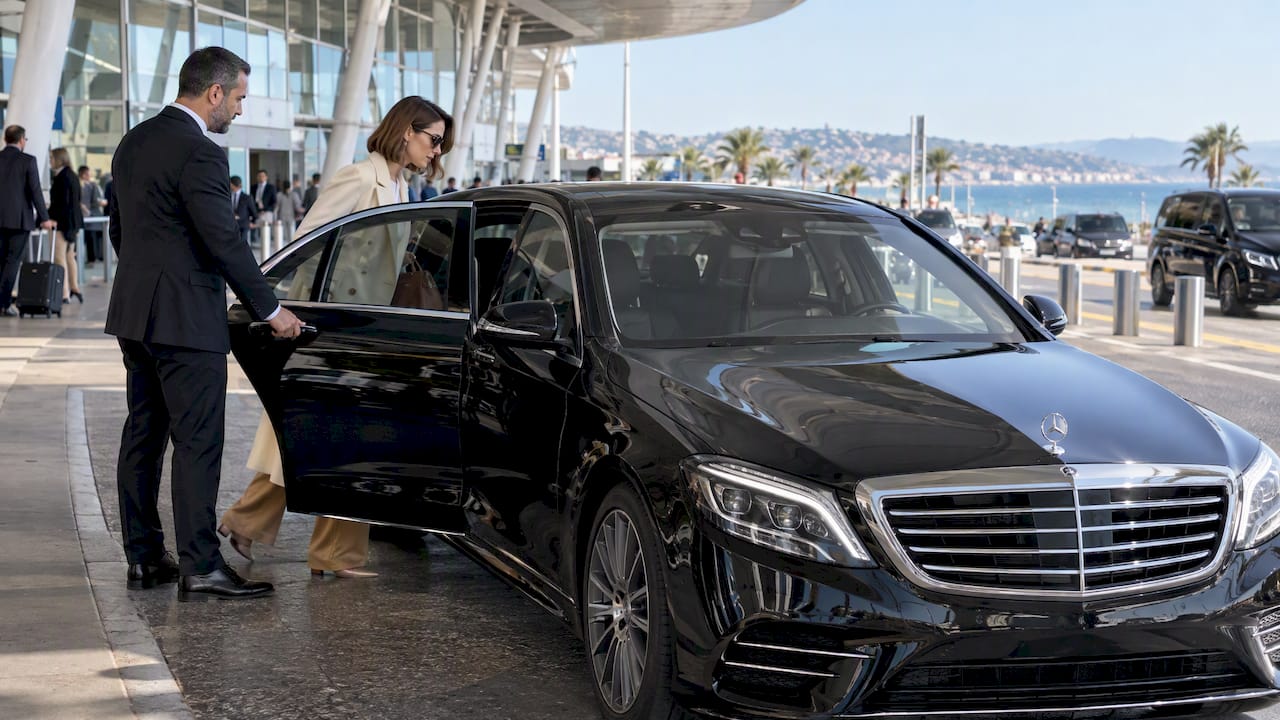
Transponyx operates exclusively from the French Riviera with a Mercedes-Benz fleet structured for exactly this kind of demand. The Van 7 pax and Van 8 pax handle bike boxes, equipment, and full team configurations with ease. The Business Sedan serves individual competitors or corporate delegates attending associated Riviera events. Every transfer includes Wi-Fi, air conditioning, chilled water, and phone charging. All 2026 rates are fixed and confirmed at booking with no surge pricing, making team budget management straightforward. For groups arriving at Nice NCE and transferring to Monaco, Antibes, Cannes, or Saint-Tropez, the service operates 24 hours a day, seven days a week.
Book a private driver on the French Riviera directly via https://transponyx.com, call +33 6 10 30 71 84, or message on WhatsApp +33 7 67 78 10 26. For transfers from Nice Airport to Antibes and the race corridor, visit the dedicated Antibes chauffeur service for 2026 fixed rates.
Common questions
What size vehicle fits a triathlon bike box?
A Van 7 pax or Van 8 pax is the appropriate vehicle for transporting triathlon bike boxes alongside passengers and additional luggage. Standard sedans do not have the cargo space required.
How far in advance should I book transport for Ironman Nice?
Book at least four to six weeks before the event. During Ironman race week in September 2026, van availability on the French Riviera reduces quickly, particularly for early morning race-day slots.
Are fixed-rate chauffeur services available for airport transfers in Nice?
Yes. Transponyx confirms all rates at booking with no surge pricing, including a 60-minute free waiting period on all Nice Airport pickups and full flight monitoring as standard.
Which vehicle is best for a race-day morning transfer?
For athlete groups with equipment, the Van 7 pax or Van 8 pax is the correct choice. For individual competitors, a Business Sedan provides the quiet, climate-controlled environment suited to pre-race preparation.
Can chauffeur services cover transfers to Monaco or Cannes from Nice Airport?
Yes. Transponyx covers all major Riviera destinations including Monaco (approximately 35 minutes from Nice NCE), Cannes (30 to 40 minutes), and Antibes (20 to 25 minutes), with fixed 2026 rates per vehicle.
0 commentaires