
Arriving at Nice Côte d’Azur Airport with a tri-bike case, a support team of six, and a race-day schedule that starts at 5:30 in the morning is not the moment to discover your transfer has not shown up. Yet this is precisely the situation many athletes and event support teams face when ground transport has been arranged as an afterthought. Ironman France Nice 2026 draws competitors and crew from across the globe, and the logistics surrounding their arrival, daily movement, and post-race pickup demand the same level of precision as the race itself. This guide gives you a clear, step-by-step workflow to plan every transfer in advance and execute it without a single missed connection.
Key Takeaways
| Point | Details |
|---|---|
| Advance planning is vital | Begin your VIP transport workflow at least 28-60 days before the event for a seamless experience. |
| Integrate and verify your team | Assign clear roles and document a full manifest to prevent missed connections or delays. |
| Choose local specialists | Prioritise Riviera chauffeur services with event and route expertise for Ironman France Nice. |
| Build in redundancy | Have backup drivers and vehicles ready to manage race day changes without stress. |
| Single vendor accountability works | A single luxury supplier avoids the risks of fragmented bookings and boosts overall control. |
What makes VIP event transport logistics unique?
Standard transfer services are built for simplicity: one passenger, one address, one destination, minimal luggage. Ironman France Nice 2026 is the opposite of that. You are coordinating athletes, coaches, nutritionists, media personnel, and equipment across multiple days and venues, all of which operate against fixed, non-negotiable timings. The margin for error is practically zero.
The seamless transport in Nice challenge during a major triathlon event goes well beyond booking a few cars. Consider what a typical support team manages simultaneously:
- Multiple athletes with different arrival times spread across two or three days at Nice Côte d’Azur Airport (NCE)
- Large format luggage including tri-bike cases, wetsuit bags, nutrition crates, and medical kit
- Daily shuttles between hotels along the Promenade des Anglais, the transition zone, and the race village
- Pre-dawn race-day transfers starting as early as 05:00, well before public transport is reliably available
- Post-race pickups along a live course corridor with road closures and restricted access zones
- Last-minute schedule changes triggered by athlete performance, weather, or organisational decisions
Each of these pressure points requires a supplier who understands not just how to drive, but how events of this scale actually work. VIP transport planning for sports travellers begins a minimum of 28 to 60 days before the event, covering manifest creation, route analysis, permit applications, and the clear assignment of roles across your team. That level of advance preparation is what separates professional logistics from improvised chaos.
Pro Tip: Assign a dedicated Transport Lead from within your team at the very start of planning. This person owns the manifest, communicates directly with your chauffeur supplier, and is the single point of contact on race day. Without this role, instructions become fragmented and errors multiply rapidly.
When fragmented vendors are used, accountability disappears the moment something goes wrong. One provider handles the airport arrivals, a separate firm manages race-day shuttles, and a third is booked for the gala dinner. Nobody has a full picture of your schedule. Nobody has the incentive to solve problems that sit at the boundary between their contracted service and someone else’s. Integrated, accountable chauffeur solutions are not a luxury preference for events like Ironman France Nice. They are an operational necessity.
Step-by-step workflow: from manifest to movement
With those distinct challenges in mind, here is a step-by-step plan any VIP transport team can follow to guarantee reliable flow during Ironman France Nice 2026.
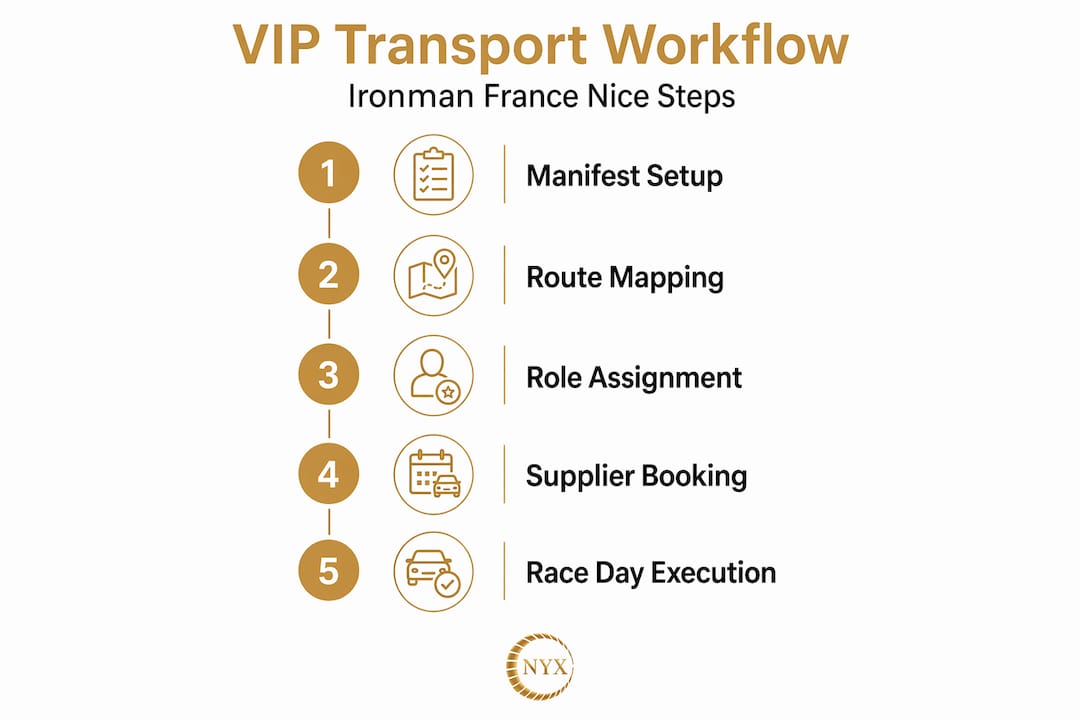
The 2026 Ironman 70.3 World Championship confirms that the primary arrival airport is Nice Côte d’Azur (NCE), with services covering round-trip transfers, daily local transport, and race-day functions. Many event packages also stipulate five-night hotel minimums, which means your transfer provider needs to be contracted for the full duration of the stay, not just the arrival and departure days.
Phase 1: 28 to 60 days before the event
- Build your ground transport manifest. List every person travelling, their arrival flight details, departure schedule, hotel address, and daily movement requirements. Include bike case dimensions and weight for each athlete. This document is your operational bible.
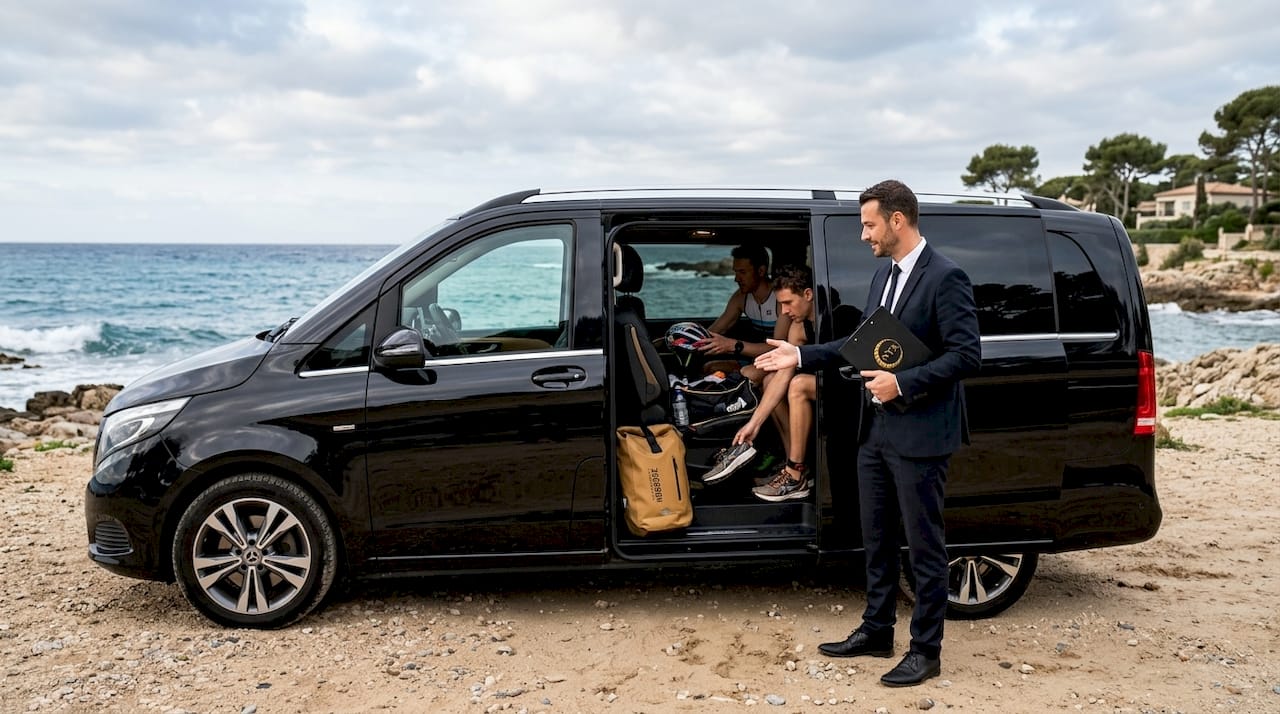
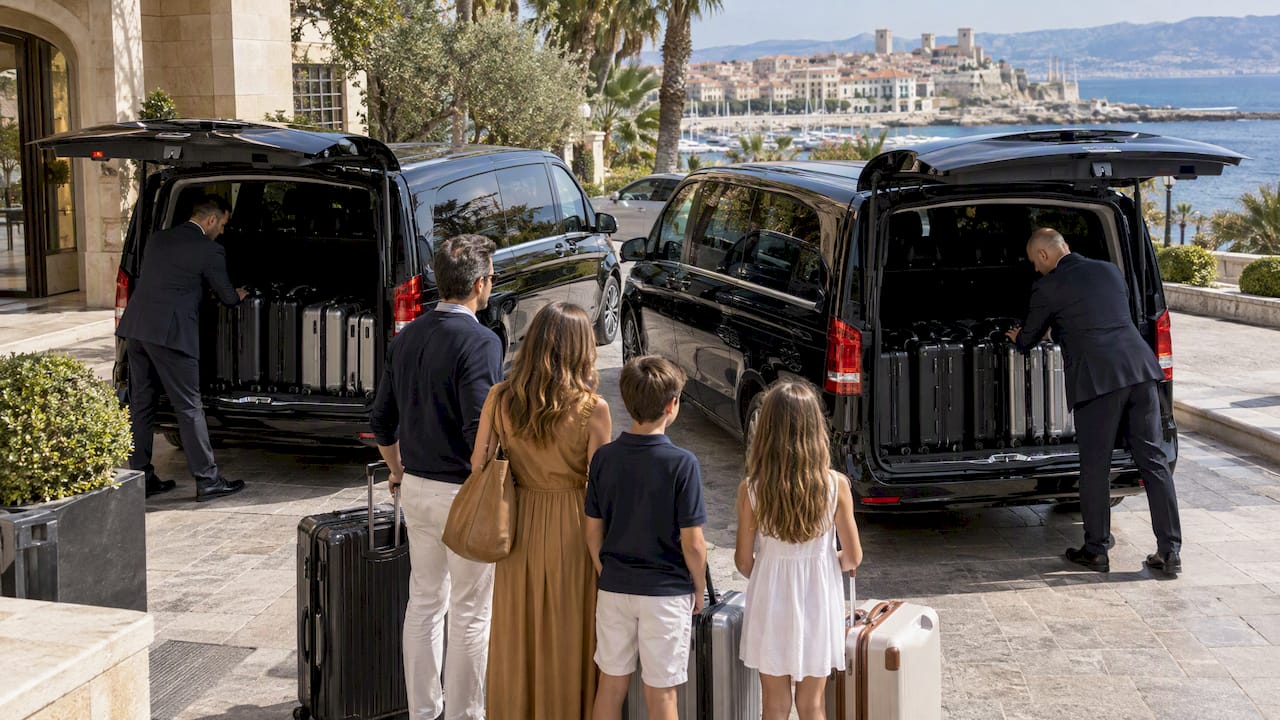
- Identify vehicle categories needed. For teams carrying tri-bikes and full kit, the Van 7 pax or Van 8 pax categories are the correct choice. Mercedes-Benz vans with generous load space handle tri-bike cases without the indignity of roof racks or trailer hitches.
- Map race-day routes and access zones. The route along the Promenade des Anglais and surrounding streets in central Nice will have restricted access zones during race hours. Confirm which approach roads remain open and which require event permits.
- Submit permit applications. Work with your chauffeur supplier to identify whether any special access permits are needed for transition zone drop-offs or course-adjacent pickups.
- Assign internal roles. As noted in professional event transport planning, you need at minimum an Event Ops Director, a Transport Lead, and a Security Lead. Each must know their responsibilities before the first vehicle moves.
- Contract your primary chauffeur provider. Confirm fixed rates, vehicle categories, waiting time policy, and flight monitoring cover for all airport pickups.
Phase 2: 7 to 14 days before the event
- Circulate the finalised manifest to your chauffeur provider and all internal team leads. Any changes after this point must be communicated through a single channel to avoid duplication or missed updates.
- Conduct a route rehearsal for the most time-critical transfers. For race day, this means physically checking the drop-off point at the transition zone and the collection point for post-race pickups near the Promenade des Anglais finish area.
- Pre-confirm all bookings and receive written confirmation with vehicle type, driver name where possible, pickup time, and pickup location for every single transfer in the manifest.
- Review your contingency plan. What happens if a flight is delayed by four hours? What happens if an athlete drops out of the race and the post-race logistics change entirely? Document the answers.
Pro Tip: Use the airport transfer checklist to verify that every NCE arrival has confirmed flight monitoring, confirmed waiting time, and a named driver contact. Print and distribute this to all athletes before they board their outbound flights.
Phase 3: Race day execution
- Brief all drivers the evening before with the full schedule, key contact numbers, and any known route restrictions.
- Activate your communication loop. The Transport Lead should have direct messaging contact with every driver on duty.
- Stage vehicles at transition zones 60 minutes before athletes are scheduled to arrive for post-race collection.
- Run real-time check-ins every 30 minutes during active transfer windows.
The event attendees transport options in Nice range from public trams to private vans, but only fixed-rate private chauffeur services offer the certainty of a confirmed vehicle, confirmed timing, and a driver who is already monitoring your flight before you land.
| Phase | Key actions | Timeline |
|---|---|---|
| Manifest and planning | Build manifest, map routes, assign roles | 28 to 60 days out |
| Permits and contracting | Submit permits, confirm rates, select vehicles | 21 to 28 days out |
| Final confirmation | Distribute manifest, route rehearsal, pre-confirm all bookings | 7 to 14 days out |
| Race day briefing | Brief drivers, activate comms loop, stage vehicles | 12 to 24 hours before |
| Live execution | Real-time check-ins, contingency activation if needed | Race day |
Choosing the best chauffeur and vehicle suppliers
Having documented your workflow, the next step is selecting the right partners to make your plan a reality.
Not every chauffeur service operating in Nice has genuine experience with Ironman-scale logistics. Many firms are excellent for one-off airport runs but lack the fleet depth, the local route knowledge, or the internal systems to manage 15 separate transfers over five consecutive days. For Ironman France Nice, NCE specialists with Riviera knowledge are the correct starting point, because local expertise directly affects your contingency resilience.
When evaluating any supplier, verify the following as a minimum:
- VTC professional licence confirmed for all drivers. In France, VTC (Voiture de Tourisme avec Chauffeur) licensing is mandatory. Any unlicensed provider creates legal and insurance exposure for your team.
- Comprehensive commercial insurance covering passengers, luggage including specialist sports equipment, and third-party liability.
- Fleet quality and vehicle condition. For an event attended by international athletes and media, a fleet of well-maintained Mercedes-Benz vehicles reflects the professionalism your team expects. Vans should have adequate loading space for tri-bike cases without modification.
- Flight monitoring as standard. Every airport pickup must include active flight tracking so the driver adjusts automatically to early or late arrivals.
- Fixed pricing confirmed at booking. Surge pricing during high-demand event windows is a real risk with unvetted providers. Confirm that the rate quoted is the rate charged, regardless of race-day traffic or demand.
- Multilingual drivers. For international athlete groups, English and French are the minimum. Spanish, Italian, and other languages are a meaningful advantage.
The best chauffeur services in Nice for this type of event are those who treat every booking as part of a larger programme rather than a standalone transaction. As expert logistics analysis confirms, treating event transport as a mini-programme with built-in redundancy, rather than a series of isolated bookings, is the defining factor between smooth execution and operational failure.
| Feature | Integrated premium provider | Fragmented vendors |
|---|---|---|
| Single point of accountability | Yes | No |
| Fixed rates confirmed at booking | Yes | Variable |
| Flight monitoring on all arrivals | Yes | Often unavailable |
| Fleet with bike-friendly loading capacity | Yes | Inconsistent |
| Route knowledge for Nice event zones | Deep | Variable |
| Contingency vehicle availability | Built-in | Not guaranteed |
| Multilingual drivers | Standard | Not guaranteed |
The pitfalls of using multiple small suppliers are well documented. Premium event transportation planning consistently shows that fragmented vendor lists create gaps in accountability. When a driver is 40 minutes late and belongs to a different firm from the one managing the race-day shuttles, nobody takes responsibility quickly enough. The athlete is left waiting. The morning schedule collapses. And the damage to your team’s confidence in the overall logistics plan is difficult to recover.
Troubleshooting and success verification for event-day logistics
Once suppliers and plans are set, you need practical steps to ensure flawless execution as race day unfolds.
The most common pain points during Ironman France Nice and comparable large-scale events follow a predictable pattern. Knowing what they are in advance means you can prepare the right responses before they become crises.
Traffic and road closures along the Promenade des Anglais and surrounding streets create the most significant real-time challenge. Approach roads that are clear at 05:00 on race morning may be completely inaccessible by 09:00. Your drivers must know the secondary access routes before race day, not discover them during it.
Lost or delayed athletes arriving from different countries and connecting through multiple airports create manifest gaps. A flight delayed in Amsterdam means your NCE pickup window shifts entirely. Without an airport chauffeur service that includes flight monitoring as standard, your driver is simply waiting at a fixed time with no awareness that the aircraft has not landed.
Communication breakdowns between drivers, the Transport Lead, and athletes are the third most frequent failure point. A driver waiting at the north exit of NCE while an athlete is waiting at the south exit is a simple problem with an expensive consequence.
“The most preventable failures in event-day transport are the ones nobody planned for in advance. A contingency protocol is not pessimism. It is the single most professional thing your team can produce.”
Here are the essential checks to verify on race day itself:
- Confirm driver deployment by 22:00 the evening before. Every driver on the schedule should have confirmed their availability and received the final brief.
- Verify vehicle condition and loading capacity by 06:00. For pre-dawn transfers, check that vans have the correct space for athlete equipment before the first pickup.
- Check road access for transition zone approaches and confirm which routes are open with your local chauffeur provider no later than 05:30.
- Activate real-time communication. All drivers, the Transport Lead, and the Event Ops Director should be live on a shared messaging channel from the first vehicle departure.
- Monitor flight arrivals continuously for the duration of your airport transfer window and update the manifest immediately when delays are confirmed.
- Stage post-race collection vehicles at confirmed pickup points along the Promenade des Anglais at least 45 minutes before the first expected finisher.
- Conduct a post-event debrief within 48 hours. Capture every deviation from the manifest, every delay, and every resolution. This becomes the baseline for improvement at the next event.
VIP transport planning at this level requires formal role assignments to ensure accountability. Without a named Transport Lead and a clear escalation path, problems that should be solved in minutes stretch into hours. Success verification is not just about what went right. It is about documenting what did not go to plan and why, so the next event runs with greater precision.
Why most VIP event transport failures start with workflow gaps
Here is the uncomfortable reality that most teams discover too late: the vehicle is rarely the problem. The drivers are rarely the problem. The failure almost always traces back to a workflow gap that was visible weeks before the event and simply not addressed.
The most common gap is manifesting. Teams spend significant time and budget on hotel bookings, race registrations, and athlete nutrition, but the ground transport manifest is built the week before the event from a WhatsApp thread and a shared spreadsheet that three people have edited simultaneously. Critical information, such as bike case dimensions, dietary requirements for in-vehicle refreshments, and confirmed hotel addresses, is missing. The manifest is the foundation of the entire logistics operation. If it is incomplete, every transfer built on top of it is fragile.
The second gap is role clarity. Event transport programmes with genuine redundancy and accountability assign named individuals to named responsibilities before a single booking is made. When everyone is vaguely responsible for transport, nobody is actually responsible when something fails.
The third gap is vendor fragmentation. It feels cost-effective to book the cheapest available option for each individual transfer. In practice, using four different suppliers across five days means four different communication styles, four different response times, and four separate accountability chains that all break simultaneously when race-day pressure peaks.
We have seen this pattern repeat across multiple major events on the Côte d’Azur. The teams that execute without incident are not necessarily the ones with the largest budgets. They are the ones who treated premium transport planning as a programme, not a procurement task. They contracted a single accountable provider, built a detailed manifest 30 days out, assigned clear internal roles, and rehearsed the most time-critical routes before race day.
The hard-learned truth is this: improvisation at the event level feels efficient in the planning phase because it requires less effort upfront. It costs far more in time, reputation, and athlete experience on the day itself. Systematic planning with a single, experienced provider is not bureaucracy. It is the only approach that consistently works.
Elevate your Ironman experience with premium chauffeur service
The workflow we have described above delivers its full value only when the chauffeur partner you choose is genuinely capable of executing it. A detailed manifest and a well-assigned team cannot compensate for a supplier who lacks local route knowledge, fleet depth, or flight monitoring capability.
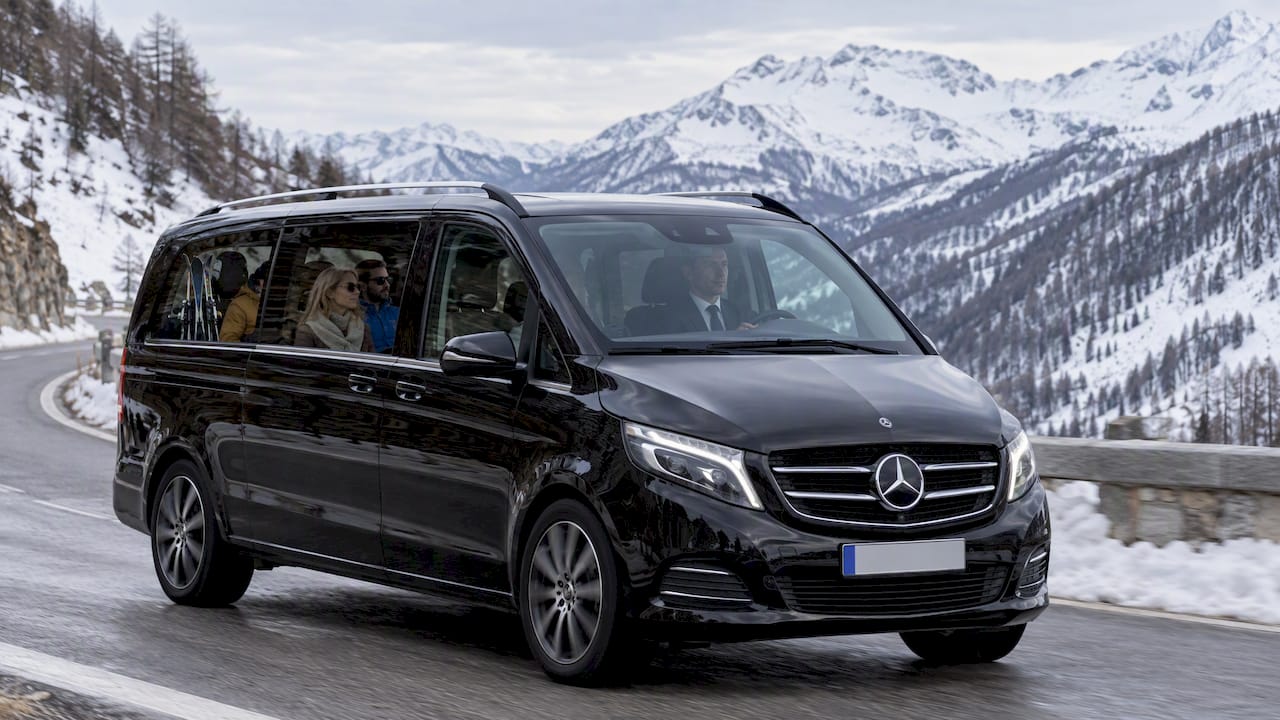
TranspOnyx is a luxury VTC company based in Nice, built specifically for the standards that athletes and event teams require on the Côte d’Azur. Our fleet of Mercedes-Benz vehicles, including Van 7 pax and Van 8 pax categories equipped with Wi-Fi, air conditioning, and phone chargers, is ideally suited for airport arrivals with tri-bikes and full race kit. Fixed 2026 rates are confirmed at booking with no surge pricing, and every NCE airport pickup includes 60 minutes of complimentary waiting time with active flight monitoring. Discover the benefits of luxury chauffeurs for Ironman France Nice, or compare Nice chauffeur services to find the right fit for your team. Reach us on WhatsApp at +33 7 67 78 10 26 or call +33 6 10 30 71 84 to discuss your 2026 event requirements.
Frequently asked questions
How early should I start planning VIP transport for Ironman France Nice?
Begin your transport workflow 28 to 60 days before the event, as advance planning at this stage covers manifest creation, route analysis, permit applications, and role assignments. Starting earlier reduces risk and ensures vehicle availability during peak event demand.
Do all chauffeur suppliers near Nice have Ironman event experience?
No, and the difference is significant. NCE specialists with Riviera knowledge understand race-day route restrictions, transition zone access, and athlete equipment handling in a way that general transfer firms simply do not.
What is the biggest risk on race day for private transport?
Last-minute changes, including altered road access, delayed athletes, and revised pickup locations, are the primary risks. Expert event transport guidance is clear: redundancy planning and a single accountable provider are the most reliable defences against race-day disruption.
Is it better to book a single luxury transport provider or multiple?
A single accountable provider consistently outperforms fragmented vendors for events of this complexity. Integrated event transport with built-in redundancy, flight monitoring, and a unified communication chain eliminates the accountability gaps that appear when multiple small suppliers are used simultaneously.

0 commentaires