
Four sources answer nearly every question about a flight at Nice Côte d’Azur Airport. Check the Nice airport arrivals page or departures page first for terminal, gate and baggage belt data. Use the airline’s own app for boarding changes, rebooking and delay compensation. Turn to Flightradar24 or FlightAware when you want to see exactly where the aircraft is in the sky. If you have a chauffeur transfer booked, Transponyx tracks the flight independently and adjusts the pickup time without you lifting a finger.
Each source does a different job:
- Nice airport site and app — gate, terminal, baggage belt, official status
- Airline app — boarding calls, rebooking, delay and cancellation rights
- Flightradar24 / FlightAware — live airborne position, radar-based ETA
- Transponyx — flight monitoring built into every airport transfer, with 60 minutes of free waiting on pickups
Knowing which one to open first saves you standing at the wrong end of Terminal 2 wondering why nobody has landed yet.
How to track a flight on the official Nice airport site and app
Start with the source that actually controls the gates. The Nice airport arrivals and departures pages show scheduled and estimated times, current status and the baggage belt number, and this data comes directly from airport operations rather than a third-party feed. For departing passengers, the equivalent departures page lists check-in desks and boarding gates as they’re assigned.
The companion app goes further. It can scan your boarding pass and populate your specific flight automatically, which beats scrolling through a departure board searching for your number.
To set it up properly:
- Download the official Nice Côte d’Azur Airport app and open the flight search tool.
- Scan your boarding pass or enter the flight number and date manually.
- Enable push notifications in the app settings so status changes reach you without opening the app again.
- Add a second traveller’s flight if you’re coordinating a pickup for someone else.
The app’s push notifications cover boarding calls, delays and baggage updates, which means once it’s configured, you can put your phone away and trust it to alert you.
Terminal assignment is the field most worth double-checking. Nice operates two terminals roughly two kilometres apart, and turning up at the wrong one with luggage in tow costs you a shuttle ride and some extra time you didn’t budget for.
When Flightradar24 or FlightAware tell you more than the airport does
Radar trackers earn their keep once the aircraft is actually airborne. Flightradar24 uses ADS-B signals broadcast by the aircraft itself to plot its exact position, altitude and speed, and its estimated arrival time is calculated from that live track rather than from a static schedule. FlightAware runs on the same principle, offering an independent live feed for Nice (LFMN) covering arrivals, departures and aircraft still en route.
This matters most in three situations:
- A flight is running long over the Alps due to headwinds, and the radar-derived ETA shifts before the airport page updates.
- An aircraft enters a holding pattern off the coast waiting for a runway slot, visible on the tracker’s live map long before any status change appears elsewhere.
- A flight diverts to Marseille or Lyon because of weather or an operational issue at Nice, something you’ll spot on a tracker’s route map well before an announcement.
What these tools won’t tell you is which belt your suitcase is heading to or which gate has just changed. For that, you still need the airport’s own feed. Treat Flightradar24 and FlightAware as your window on the sky, and the Nice airport pages as your window on the ground.
Why the airline app still matters for boarding and rebooking
Nobody rebooks you except the airline. If a flight is cancelled or you’ve missed a connection, the airline’s own app or website is the only channel that can issue a new boarding pass, process compensation, or confirm your baggage has been rerouted. Airport pages and radar trackers are informational, not operational.
Watch for code-share confusion. A flight sold as an Air France number might actually be operated by a partner carrier, and trackers display the operating flight number, not the marketing one. If your booking reference doesn’t match what you see on Flightradar24 or the Nice arrivals board, search using the operating carrier’s number instead.
As a rule of thumb: contact the airline for anything involving your ticket, seat or rebooking, and check the airport for anything involving where to physically be. Mixing the two up wastes time on hold when a glance at the departures page would have answered the question already.
Finding a specific flight fast, whichever tool you use
Speed matters most when you’re already in the car heading to pick someone up. The fastest route to the right flight varies slightly by platform, but the logic holds everywhere.
- Search by flight number and date first. This is the quickest match on the Nice airport site, the airline app and both trackers.
- If you don’t know the flight number, search by route and approximate time instead. Both airport pages and Flightradar24 allow filtering by origin airport.
- On the Nice airport app, scan the boarding pass barcode directly. It auto-fills the flight number, date and passenger name in one step.
- For code-shared flights, always use the operating carrier’s number rather than the one printed on a connecting ticket, since trackers index by operating flight.
Pro Tip: Save the flight number to your phone’s notes app the moment you book, not the morning of travel. Code-share numbers get buried in itinerary emails, and hunting for them at the arrivals hall with a data signal that keeps dropping is a bad way to start a pickup.
What “delayed”, “landed” and other flight statuses actually mean
Status labels look simple until two sources disagree, which happens more often at Nice than travellers expect given how close the airport sits to the Mediterranean and how quickly Mistral winds can shift approach patterns.
| Status | Meaning | Where it typically appears first |
|---|---|---|
| Expected / scheduled | Flight is on its planned timetable, no live update yet | Airport site |
| Approach | Aircraft is descending towards Nice, visible on radar | Flightradar24 / FlightAware |
| Landed | Wheels down on the runway | Radar trackers, seconds before airport site |
| Arrived / on stand | Aircraft has reached the gate; passengers can disembark | Nice airport site |
| Delayed | Departure or arrival pushed past scheduled time | Airline app, then airport site |
| Diverted | Aircraft redirected to another airport | Radar trackers first |
| Cancelled | Flight will not operate | Airline app |
The gap between “landed” and “arrived” catches people out most. A flight can land and still take ten to fifteen minutes taxiing to the stand, especially during peak MIPIM or Cannes Film Festival traffic when apron congestion is heavier than usual. If you’re timing a pickup, wait for “arrived” or the baggage belt number to appear before assuming your passenger is walking through the doors.
What to do when a flight is delayed, cancelled or diverted
A delay at 35,000 feet is not a crisis. A delay nobody tells your driver about is. The sequence that actually resolves things fastest:
- Confirm the official status on the Nice airport arrivals page rather than relying on a single tracker.
- Contact the airline directly if you need rebooking, compensation or baggage tracing.
- Check the new baggage belt assignment once the flight shows as arrived, since delays sometimes shift belt numbers.
- Update your transfer provider immediately if pickup timing has changed by more than a few minutes.
That last point is where Transponyx does the work for you. Every airport transfer booked with Transponyx includes flight monitoring as standard, so a delay on your route is picked up automatically rather than left for you to report.
Transponyx operates 24 hours a day, seven days a week from Nice, with fixed 2026 rates confirmed at the time of booking and 60 minutes of free waiting time on every airport pickup. Drivers are notified of schedule changes directly, so a two-hour delay into Terminal 1 doesn’t mean a driver circling the forecourt or a client standing outside with no car in sight.
If a diversion or lengthy delay pushes your arrival well past the free waiting allowance, call Transponyx on +33 6 10 30 71 84 to adjust pickup timing or request a different driver slot. Genuine schedule changes are accommodated rather than charged as a missed pickup, which is worth knowing before you land rather than after.
Accessibility options for tracking flights at Nice
Not every traveller checks a flight status the same way, and Nice’s official channels account for that reasonably well. The airport app supports screen readers on both iOS and Android, and the arrivals and departures pages on the Nice Côte d’Azur website are built with standard web accessibility markup that works with assistive browsing tools.
For travellers who find small departure boards hard to read in the terminal, the app’s larger on-screen text and boarding pass scanner remove the need to squint at a physical display altogether. Push notifications also help anyone who struggles to monitor a screen continuously, since the alert arrives regardless of whether the app is open.
Voice-based options exist too, though indirectly. Both Flightradar24 and FlightAware integrate with third-party voice assistants in some regions, letting a traveller ask for a flight’s status verbally rather than reading it. Coverage and accuracy of these integrations vary by device and are worth testing before relying on them for a time-sensitive pickup.
For anyone travelling with a companion or carer who needs to coordinate a meeting point, sharing the flight number through the Nice airport app means both parties see identical status updates rather than relaying information secondhand. That single shared source removes a common point of confusion, particularly at Terminal 2, where the arrivals hall serves several long-haul and charter services simultaneously during peak summer weeks.
When to head to the terminal and how to handle a sudden gate change
Timing your arrival at Nice comes down to one habit: check the status again shortly before you leave, not just the night before. Schedules shift, and a flight showing “on time” at breakfast can slip by twenty minutes before lunch, particularly during Mistral wind conditions that affect approach paths into Nice more than most French airports.

For departing passengers, arrive at the terminal with enough margin for security and, during high-traffic periods like a busy weekend or a major event weekend, allow extra time for taxi and drop-off congestion outside both terminals. Gate numbers at Nice are often only confirmed 30 to 45 minutes before boarding, so it’s not unusual to see “gate to be announced” until relatively late.
If a gate change is announced, the fastest confirmation comes from the departure board or the airport app rather than word of mouth in the terminal. Terminal 1 and Terminal 2 are separate buildings, so a gate change that also involves a terminal switch needs a shuttle bus, and that alone can eat fifteen minutes you weren’t expecting.
For those meeting arriving passengers, resist the urge to head to the terminal the moment a flight shows “landed”. Taxiing, disembarkation and passport control at Nice typically add fifteen to twenty-five minutes beyond that point. Watching for the baggage belt number is a more reliable cue than the landed status alone, especially on flights arriving during a busy event or MIPCOM when arrivals volume runs high and processing takes longer.
Getting help from Nice airport’s information desks
Sometimes an app doesn’t answer the question you actually have, and that’s what the information desks are for. Nice Côte d’Azur Airport staffs help points in both terminals, positioned near the main arrivals and departures halls, and they can confirm live flight status, terminal assignments and baggage handling issues that occasionally lag behind the digital feed during high-volume periods.
The desks are particularly useful for two scenarios the app can’t fully resolve: a baggage discrepancy after a flight has already been marked “arrived”, and confirming which exit or meeting point to use when a terminal has multiple arrival halls active simultaneously, as Terminal 2 does during peak summer and major event periods.
Phone contact is also available for general flight information enquiries, listed on the airport’s official site alongside the arrivals and departures pages. For anything involving a ticket change, refund or missed connection, airport staff will still direct you to the airline, since only the operating carrier holds the authority to rebook or compensate a passenger. The information desk’s role is logistical, not contractual.
If you’re coordinating a chauffeur pickup and a discrepancy arises between what the app shows and what’s happening at the gate, contacting Transponyx directly on +33 6 10 30 71 84 resolves it faster than waiting in an airport queue, since the flight monitoring built into your transfer already has the corrected data.
Arrivals versus departures: what actually differs in the tracking
Tracking an arrival and tracking a departure at Nice aren’t quite the same exercise, even though both run through the same airport systems. Arrivals tracking centres on three checkpoints: landing time, taxi to stand, and baggage belt assignment. Departures tracking centres on check-in desk, security wait and gate assignment, which tends to firm up much later in the process than an arrival’s belt number does.
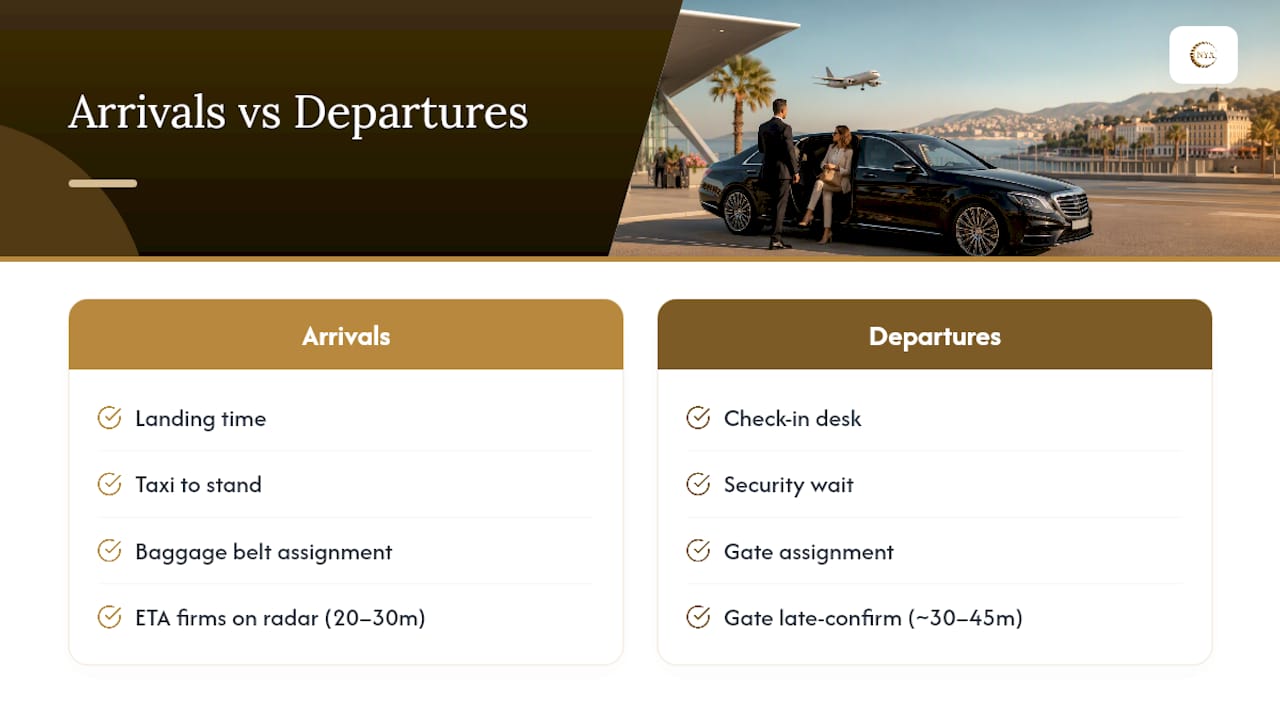
The practical difference shows up in how early useful information appears. A departing passenger often knows their check-in desk hours in advance, but the gate number can remain unconfirmed until 30 to 45 minutes before boarding. An arriving passenger’s flight status becomes far more precise once the aircraft is on radar, typically 20 to 30 minutes before landing, because Flightradar24 and FlightAware can then extrapolate a firm ETA from the aircraft’s actual descent path rather than a scheduled estimate.
Baggage information only exists on the arrivals side, and belt numbers at Nice are sometimes reassigned mid-process if a delayed flight’s original slot gets reused by another arrival. Departures never carry this ambiguity since check-in and gate data doesn’t get reassigned the way baggage belts occasionally are.
For anyone organising a pickup, this asymmetry is exactly why the Nice airport arrivals page deserves more attention than the departures side. It’s the version of the site that changes right up until the last useful minute, and it’s the one Transponyx drivers monitor for every scheduled collection.
Why chasing every tracker at once misses the point
The instinct with flight tracking is to open four tabs and cross-reference everything, and that instinct is mostly wrong. Most delays and gate changes at Nice resolve through a single authoritative source, the airport’s own arrivals or departures feed, and the value of Flightradar24 or FlightAware lies in a narrow, specific window: the twenty minutes before landing when radar data genuinely outpaces the airport’s own estimate.
Conventional advice treats all four channels as roughly interchangeable, which undersells how differently they behave. An airline app is built for compensation and rebooking, not live position. A radar tracker is built for position, not baggage belts. Conflating the two leads to travellers refreshing Flightradar24 for gate information it was never designed to show.
What actually matters is sequencing: check the airport first for anything ground related, layer in a radar tracker only when you specifically need airborne ETA precision, and treat the airline as your last resort for anything involving your ticket. For anyone with a transfer already booked, that sequencing problem largely disappears, because flight monitoring built into the booking does the cross-referencing before you’d even think to open an app. That’s the detail conventional guides tend to skip, because it’s a logistics point rather than a technology one, and logistics is where most pickups actually go wrong.
— Dany
Sources
- Suivi & Infos vols à l’arrivée — Nice Aéroport
- Flightradar24 — Nice Cote d’Azur Airport (NCE)
- FlightAware — Nice (LFMN) live airport
FAQ
How can I track an Air France flight’s route in real time?
Search the flight number on Flightradar24 or FlightAware to see its live position, or check the Air France app for boarding and status updates; if it’s a code-share, use the operating carrier’s flight number for the tracker search.
How do I track my flight live once it’s in the air?
Enter the flight number and date into Flightradar24 or FlightAware to see its current altitude, speed and position on a live map, alongside a radar-derived estimated arrival time.
Is there a problem at Nice airport today?
Check the official Nice airport departures and arrivals pages for current status alerts, since disruptions from weather, strikes or runway issues are posted there first, ahead of third-party trackers.
If you’re arranging a pickup and want the flight watched for you, Transponyx builds monitoring into every airport transfer at no extra cost, alongside 60 minutes of free waiting time. Call +33 6 10 30 71 84 or visit Transponyx to arrange a chauffeur for your next arrival into Nice.



0 commentaires