
A chauffeur backup plan for groups is a pre-defined operational protocol that guarantees replacement vehicles, driver cover, and clear escalation steps so that a group transfer proceeds without disruption, regardless of what goes wrong. For corporate travel planners and event coordinators, it is the difference between a conference that opens on time and one that begins with forty delegates stranded on the A8 outside Nice.
Before vetting any operator, apply this three-point checklist immediately:
- Backup vehicle availability: confirm in writing that a spare vehicle of equivalent or greater capacity is staged close to the primary pick-up point to allow swift response.
- Single point of contact: one named coordinator must remain accountable from departure to delivery, not a call-centre queue.
- Automatic flight and itinerary monitoring: the operator’s system must track flight status in real time and adjust vehicle staging proactively without waiting for the organiser to call.
Premium operators publish an on-time arrival rate of 99% or higher, defining “on time” as arriving 15 to 20 minutes before the scheduled pick-up to ensure punctuality. Planners should insist on driver assignment confirmed at least 24 hours before departure and automatic backup dispatch triggered within 15 minutes of a verified disruption.
What must every complete group backup plan contain?
A contingency plan for chauffeur services is only as strong as its weakest component. The following building blocks are non-negotiable for any high-stakes group transfer, whether that is a Monaco Grand Prix hospitality run or a 50-delegate airport shuttle from Nice NCE to Cannes.
- Fleet redundancy: at least one spare vehicle of matching or greater capacity is reserved and staged, not merely “available on request.” For VIP and event transfers, this is the single item that separates professional operators from ad-hoc providers.
- Driver cover: standby drivers are rostered and confirmed before the event, not sourced reactively when a primary driver calls in sick.
- Route alternatives: primary, secondary, and safe-pause routes are mapped in advance, with defined trigger points that force an automatic switch.
- Real-time monitoring: flight feeds, live traffic data, and GPS tracking are active throughout the transfer window, not checked manually at departure.
- Communications protocol: a pre-agreed messaging chain tells organisers, chauffeurs, and passengers what has happened and what happens next, within a defined time window.
- Escalation procedures: written steps for breakdowns, accidents, health emergencies, and large-scale disruptions, with named authority at each level.
- SLAs and insurance: contractual guarantees with measurable definitions, service credits for failures, and verified operator insurance limits.
For airport runs and VIP event transfers, fleet redundancy, driver cover, and real-time monitoring are the three components that cannot be traded away. A plan that omits any one of them is a plan that will fail at the worst possible moment.

How do operators stage backup vehicles for group transfers?

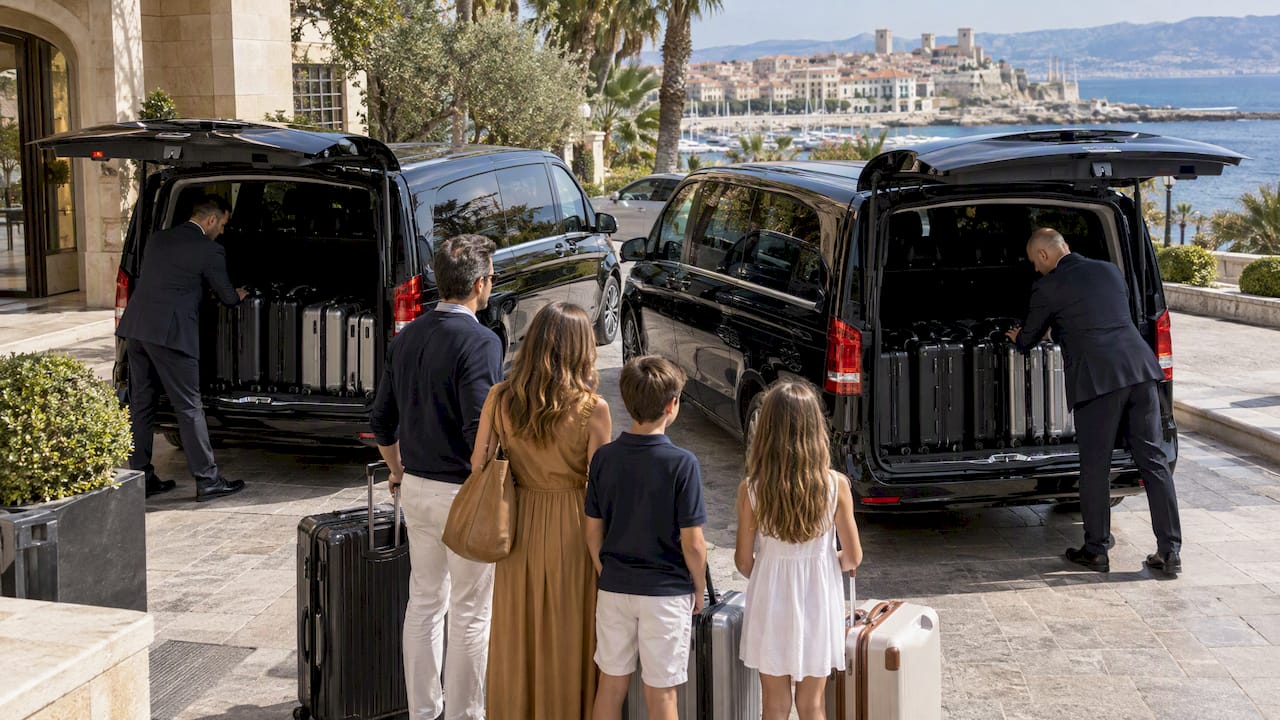
Staging is not simply parking a spare vehicle nearby. It requires deliberate placement at pre-authorised locations, sized correctly for the group, and ready to move within a defined lead time. Designated staging points at hotel entrances and private lobbies keep itineraries fluid and allow replacement vehicles to hold without disrupting guest flow.
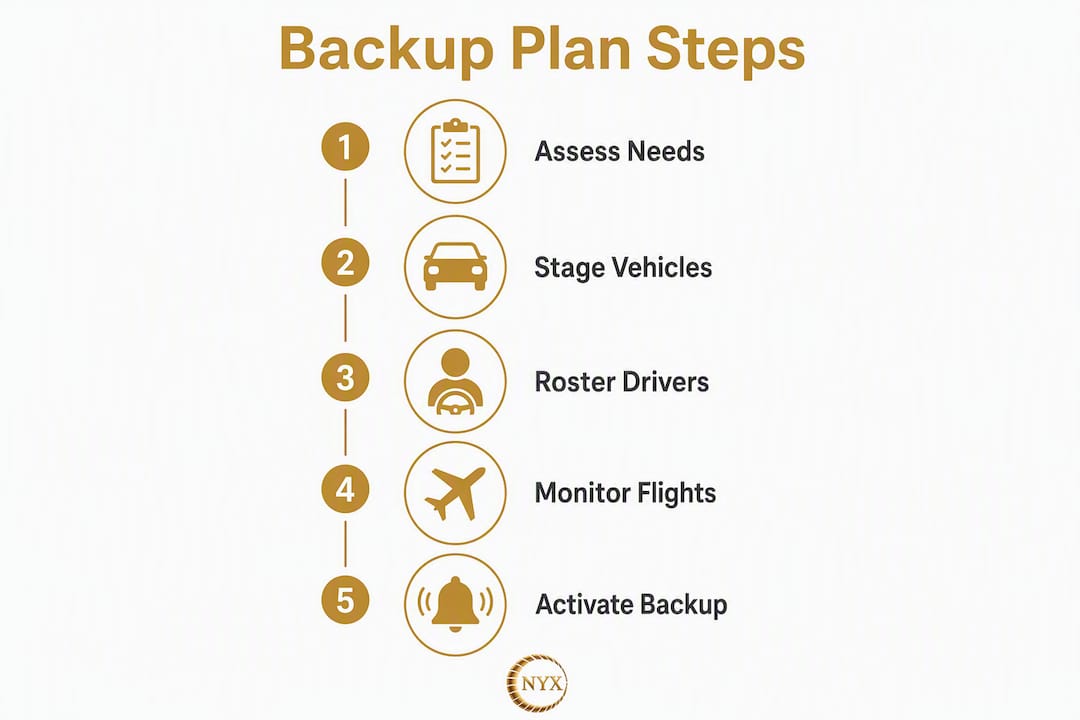
Rules of thumb for spare vehicle ratios
For short-haul transfers, operators typically stage a spare vehicle for every few primary vehicles. On longer or more complex schedules, the ratio increases to provide closer coverage.
Vehicle mix examples by group size
| Group size | Primary vehicles | Recommended spare | Notes |
|---|---|---|---|
| Up to small groups | A small number of suitable vans or sedans | At least one spare vehicle is recommended | Spares cover potential vehicle failure |
| Medium groups | Multiple vans sized appropriately | Several spare vehicles are staged | Allows coverage for multi-wave transfers |
| Large groups | A mix of vans and sedans suited to group composition | Multiple spare vehicles staged at key locations | Spares handle complex event logistics |
For groups of mixed seniority, a Business Sedan staged alongside Van 7 pax vehicles ensures that a VIP passenger is never placed in a utility vehicle during a swap.
Staging locations and lead times
The most effective staging locations are covered hotel entrances, private event loading bays, and secure layover areas within 500 metres of the primary pick-up point. A vehicle staged at a prime location near the event can be repositioned to key points in a matter of minutes, whereas a vehicle staged further away may require significantly longer travel time due to traffic conditions. That gap is the difference between a seamless swap and a visible failure.
- Pre-authorise staging points with the venue or hotel at least 48 hours before the event.
- Confirm that the staging area accommodates the vehicle’s dimensions (Van 8 pax requires a standard coach bay).
- Brief the standby driver on the exact pick-up point, not just the venue name.
How should you roster drivers to guarantee cover for group shifts?
Driver redundancy is the component most often underestimated in group transportation backup plans. A spare vehicle without a qualified driver is useless. The following approach gives organisers a defensible rostering structure for multi-vehicle group movements.
A sample shift plan for standby cover
- Primary driver assigned: confirmed by name and vehicle registration at least 24 hours before departure.
- Standby driver on call: rostered for the same time window, briefed on the route, staging points, and passenger manifest.
- Shift overlap built in: for transfers exceeding four hours, a relief driver is scheduled to arrive 30 minutes before the primary driver’s maximum permitted driving time is reached.
- Handover script completed: the outgoing driver verbally confirms passenger count, luggage status, next destination, and any special requirements to the incoming driver, who acknowledges in writing (or via the dispatch app).
- Dispatcher notified: the control room logs the handover time, driver names, and vehicle registration at the moment of transfer.
Handover script template
The handover should take no more than two minutes and cover five points: passenger count confirmed, luggage accounted for, next destination and ETA, any passenger with special requirements, and vehicle fuel or charge level. The incoming driver signs or taps acceptance in the dispatch system before the outgoing driver leaves the vehicle.
Fatigue and rest compliance for UK operations
Under UK working time rules applicable to private hire and chauffeur operations, drivers must not exceed 10 hours of driving in a single day, and a minimum 11-hour rest period must follow each working day. For multi-day events such as MIPCOM in Cannes or the Monaco Grand Prix, operators must roster at least two drivers per vehicle across the event window. Planners should request the driver rota as part of the pre-event documentation pack, not as an afterthought.
How do you design alternate routes for events and road closures?
Route planning for group transfers is not a single line on a map. It is a hierarchy of options, each with a defined trigger that forces an automatic switch. A dynamic backup plan requires defined trigger points for activation, such as sustained low traffic speeds or monitored flight delays, allowing automatic reassignment before passengers notice disruption.
Mapping a route hierarchy
For a transfer from Nice NCE to Monaco during the Monaco Grand Prix, the primary route via the A8 motorway and the Moyenne Corniche is typically closed or severely restricted in the final 48 hours before race day. A well-prepared operator maps three layers:
- Primary route: A8 to Monaco, fastest under normal conditions, approximately 25 minutes.
- Secondary route: Grande Corniche via La Turbie, adds 10 to 15 minutes but bypasses the circuit perimeter.
- Safe-pause route: divert to a pre-authorised staging point at a hotel in Beausoleil or Cap-d’Ail, hold the group, and await a confirmed window before the final approach.
The same logic applies to Cannes during the Cannes Film Festival, where the Boulevard de la Croisette is closed to non-credentialled vehicles for significant periods. Operators who have not mapped a secondary approach via the Rue d’Antibes corridor will find themselves improvising in real time, which is precisely what a backup plan is designed to prevent.
Trigger points that force a route switch
Traffic speeds sustained below 15 kilometres per hour for more than 15 minutes on the primary corridor should trigger an automatic switch to the secondary route. A confirmed road closure or police diversion triggers an immediate switch, with the dispatcher notifying the organiser within five minutes.
Pro Tip: Pre-authorise at least two staging anchor points with the venue or hotel before any major event transfer. A chauffeur who knows exactly where to hold the group, and has the venue contact’s mobile number, can absorb a 30-minute delay without passengers ever perceiving a problem.
What does a flight monitoring workflow look like for airport pick-ups?
Flight monitoring is not a courtesy feature. For airport transfers, it is the operational backbone that prevents missed connections and wasted vehicle time. Premium operator standards include real-time flight tracking and secondary vehicle staging as standard operating procedures for corporate accounts.
The monitoring workflow, step by step
- Automated flight feed activated: at booking confirmation, the flight number is entered into the operator’s tracking system, which monitors departure and arrival status continuously.
- Dispatcher alert triggered: if the flight is delayed by more than 20 minutes, the dispatcher receives an automatic alert and reviews vehicle staging.
- Chauffeur notified: the driver receives an updated ETA and, if necessary, a revised staging instruction (hold at the terminal, relocate to the overflow bay, or stand down and return at a new time).
- Passenger message sent: the organiser or lead passenger receives a brief SMS or WhatsApp message confirming the updated pick-up time and the driver’s name and vehicle registration.
- Escalation triggered: if the flight is delayed by more than 30 minutes and a connection is at risk, a standby vehicle is dispatched to the alternative terminal or a reassignment is initiated.
SLA escalation triggers planners must require
- Flight delayed more than 30 minutes: standby vehicle confirmed and staged within 15 minutes of the alert.
- Flight diverted to an alternative airport: full reassignment initiated within 20 minutes, with a new ETA communicated to the organiser.
- Missed connection confirmed: escalation to the coordinator, who sources the next available vehicle and briefs the passenger directly.
At Nice NCE, where international arrivals from London, Frankfurt, and Dubai land within minutes of each other during peak conference periods, a monitoring system that relies on manual checks will inevitably miss a delay. Automatic feeds are the only reliable standard.
How should communications and escalation work on the day?
The single most critical, and most often overlooked, element of any group travel emergency solution is a pre-defined communication chain with explicit authority to approve reroutes or emergency dispatch. Informal multi-step phone chains fail under pressure. A written escalation tree does not.
The single point of contact model
For groups of more than eight passengers, one named coordinator must hold all authority for the transfer. That person approves route changes, authorises additional vehicles, and communicates directly with the organiser. Passengers do not contact drivers directly; drivers do not contact the organiser directly. Every message flows through the coordinator.
The communications tree
- T minus 2 hours: coordinator confirms vehicle assignments, driver names, and staging points with the organiser.
- T minus 30 minutes: chauffeur sends a “vehicle in position” message to the coordinator, who relays to the organiser.
- Disruption detected: coordinator notifies organiser within five minutes, states the nature of the disruption, the action being taken, and the revised ETA.
- Arrival contact: the venue or hotel contact is notified of any ETA change at least 15 minutes before the revised arrival time.
Short message templates for common scenarios
- Delayed flight: “Your flight [number] is now showing an arrival of [time]. Your chauffeur [name] will be at [meeting point] at [revised time]. No action needed.”
- Vehicle breakdown: “We have a vehicle issue on your transfer. A replacement [vehicle type] is en route and will reach you by [time]. [Coordinator name] is managing this directly.”
- Reroute: “Due to [closure/event restriction], your driver is taking an alternative route. Your arrival time is now [time]. No action needed.”
What is the step-by-step procedure for breakdowns and emergencies?
When a mechanical failure, accident, or health emergency occurs during a group transfer, the response must be immediate, structured, and fully documented. Improvisation at this point is a liability.
- Chauffeur activates hazard lights and moves the vehicle to a safe position, off the carriageway where possible, and confirms passenger safety before contacting the dispatcher.
- Dispatcher is notified within two minutes of the incident, with the vehicle location (GPS coordinates or nearest landmark), nature of the incident, and passenger count.
- Emergency services are called if there is any injury, medical episode, or road safety risk. The chauffeur remains with passengers until emergency services arrive or the group is safely transferred.
- Replacement vehicle is dispatched by the coordinator immediately upon notification. A vetted operator network can mobilise replacement vehicles within roughly one hour for large group disruptions, and for luxury operators with pre-staged spares, the window is considerably shorter.
- Organiser is notified within five minutes of the incident, with a confirmed replacement ETA.
- Passengers are briefed by the chauffeur: the situation, the action being taken, and the expected wait time. Clear, calm communication prevents panic.
- Post-incident report completed within 24 hours, covering: incident time and location, nature of the failure, response actions taken, replacement vehicle details, passenger impact, and any insurance or regulatory notifications required.
Organisers should require this report as a contractual deliverable, not a courtesy. It is the evidence base for any service credit claim and for improving future planning.
How do you calculate vehicle mixes and transfer waves for groups?
Translating a headcount into a vehicle plan requires three inputs: passenger count, luggage volume per person, and the acceptable transfer window. Get any one of these wrong and the plan unravels at the loading bay.
Capacity examples by group size
| Group size | Vehicle mix | Luggage assumption | Transfer waves |
|---|---|---|---|
| 8 passengers | 1 × Van 8 pax | 1 bag per person | Single wave |
| 20 passengers | 3 × Van 7 pax | 1 bag per person | Single wave |
| 50 passengers | 5 × Van 8 pax + 2 × Van 7 pax | 1 bag per person | Two waves if venue access is restricted |
| — | 15 × Van 8 pax | Mixed (1–2 bags per person) | Three to four waves, staggered by 15 minutes |
For conference delegates arriving at Nice NCE from multiple flights, luggage volume is the variable most likely to force a vehicle upgrade. A delegate with two large cases and carry-on luggage effectively occupies the space of two passengers in a Van 7 pax. Build a 15% luggage buffer into every vehicle calculation.
When staging transfers in waves, the first wave should carry the highest-priority passengers (speakers, VIPs, executives) and the final wave should include the organiser or a designated deputy who can confirm all passengers have departed. Staggering waves by 15 minutes at the venue arrival point prevents a bottleneck at the entrance and allows the venue team to manage arrivals without congestion.
For groups exceeding 50, high-specification group transfers commonly include fixed pricing, enhanced vehicle fit-outs, and bespoke wait-time allowances to reduce on-day friction. Planners should request these terms explicitly rather than accepting a standard rate card.
What contract clauses and SLA language should you require?
A verbal assurance of reliability is worth nothing when a group of 30 delegates misses the opening session of MIPIM. The protection lives in the contract. Top corporate car services define “on time” as arriving 15 to 20 minutes before the scheduled pick-up, and publish backup vehicle dispatch protocols as part of their SLA.
The following clauses should appear in any operator agreement for group transfers:
- On-time definition: “On time” means the vehicle is at the confirmed pick-up point no later than 15 minutes before the scheduled departure time.
- Backup dispatch guarantee: a replacement vehicle is confirmed and en route within 15 minutes of a verified disruption, at no additional cost to the client.
- Service credits: late arrival of 15 to 30 minutes verified by GPS log attracts a 25% credit on the affected vehicle booking; late arrival exceeding 30 minutes attracts a 50% credit; failure to deliver the group attracts a 100% refund of the affected booking.
- Driver assignment: the primary driver’s name, licence number, and vehicle registration are confirmed to the organiser at least 24 hours before departure.
- Fleet reservation: the specific vehicles allocated to the event are confirmed and not reassigned without the organiser’s written consent.
- Staging point confirmation: the operator confirms pre-authorised staging locations in writing before the event.
- Incident reporting: a written post-incident report is delivered within 24 hours of any disruption.
Red flags to refuse in any bid:
- “On time” defined as arriving at the scheduled pick-up time, with no early buffer.
- No written backup protocol, or backup described as “available on request.”
- No named coordinator; only a general dispatch number.
- No service credit mechanism; only a vague “goodwill” commitment.
- No confirmation of driver assignment before the event day.
A corporate chauffeur account with a reputable operator should include all of the above as standard terms, not as negotiated additions.
How does redundancy change the cost of a group transfer?
Redundancy is not free, but the cost of not having it is almost always higher. Analysts note that the cost of unplanned disruption in executive travel exceeds the cost of planned redundancy, and top providers build redundancy into assignments rather than treating it as emergency cover.
Budget scenarios for a 20-delegate airport transfer
| Scenario | Base cost | Redundancy premium | Total | Risk exposure if no backup |
|---|---|---|---|---|
| Standard (no backup) | — | — | — | Rebooking, hotel night, reputational cost |
| With standby vehicle | — | — | — | Minimal |
| With standby vehicle and driver | — | — | — | Minimal |
| Full event rate (blended) | — | Included | — | Minimal |
Note: figures are illustrative budget scenarios. Request fixed 2026 rates from your operator.
A missed flight for a single delegate typically costs £300 to £800 in rebooking fees alone, before accounting for the reputational and productivity impact. A standby vehicle that prevents that outcome costs a fraction of that figure. The business case for redundancy is straightforward.
Billing structures to consider
Operators typically offer several pricing models, including flat standby fees, hourly hold fees for additional vehicles, and blended event rates that incorporate redundancy into a single fixed price for the event, providing options for procurement teams. For events such as the Cannes Film Festival or Cannes Lions, where the risk of disruption is high and the reputational stakes are higher, the blended event rate is the most defensible choice.
The 72-hour to on-the-day organiser timeline
A reliable group transportation backup plan does not materialise on the morning of the event. It is built over the preceding 72 hours through a series of confirmed milestones.
72 to 48 hours before departure
- Confirm vehicle assignments, driver names, and vehicle registrations in writing with the operator.
- Confirm staging points with the venue or hotel and obtain the venue contact’s direct mobile number.
- Share the final passenger manifest and luggage estimate with the operator.
- Confirm the flight monitoring system is active for all arriving flights.
- Distribute the communications tree to all relevant parties: organiser, dispatcher, venue contact, and lead passenger.
24 hours before departure
- Receive written confirmation of standby vehicle and driver assignment.
- Confirm the route plan, including secondary and safe-pause routes, with the operator.
- Brief the lead passenger on the single point of contact and the messaging protocol.
- Confirm that the operator holds the organiser’s direct mobile number and WhatsApp contact.
2 to 4 hours before departure
- Receive “vehicle in position” confirmation from the primary chauffeur.
- Confirm standby vehicle is staged and driver is on call.
- Check flight status for all arriving passengers and confirm no alerts are active.
On the day
- Organiser remains reachable on a single number throughout the transfer window.
- Coordinator sends a status update every 30 minutes during active transfers.
- Any disruption is communicated to the organiser within five minutes of detection.
- Post-transfer confirmation sent once all passengers have arrived at the destination.
Printable checklist for the run sheet:
- [ ] Vehicle assignments confirmed in writing
- [ ] Driver names and registrations received
- [ ] Staging points pre-authorised
- [ ] Flight monitoring active
- [ ] Communications tree distributed
- [ ] Standby vehicle and driver confirmed
- [ ] Route plan (primary, secondary, safe-pause) agreed
- [ ] Venue contact briefed
- [ ] Post-transfer report requested
What licences and insurance must you verify for UK group transfers?
For transfers originating or terminating in the United Kingdom, organisers carry a duty of care to verify that the operator meets minimum legal and insurance standards. The following audit checklist covers the items that reduce organisational risk.
- PHV operator licence: confirm the operator holds a valid Private Hire Vehicle operator licence issued by the relevant licensing authority (Transport for London for London operations; the local council for operations elsewhere in England and Wales).
- Driver PHV licence: each driver must hold a valid PHV driver’s licence for the area in which they operate.
- Operator insurance: the operator’s policy must cover public liability and passenger liability to a minimum of £5 million per incident. Request the certificate of insurance, not a verbal assurance.
- Vehicle MOT and service records: all vehicles must hold a valid MOT certificate. For luxury operators, request the most recent service record to confirm the vehicle is maintained to manufacturer standards.
- DBS checks: for transfers involving vulnerable adults or minors, request evidence that all drivers hold a current enhanced DBS (Disclosure and Barring Service) certificate.
- Operator’s licence conditions: confirm the operator’s licence has no conditions or restrictions that would affect the planned transfer (some licences restrict operating areas or vehicle types).
Documents to request and retain:
- Copy of the PHV operator licence
- Copy of each driver’s PHV licence
- Certificate of insurance (current policy year)
- MOT certificates for all vehicles allocated to the event
- DBS certificate references for drivers (enhanced, where required)
Red flags requiring further enquiry:
- Operator cannot produce a PHV licence on request.
- Insurance certificate shows a policy limit below £5 million.
- Driver’s licence is for a different licensing area than the transfer location.
- MOT certificate is expired or the operator cannot confirm the vehicle’s last service date.
For transfers on the French Riviera, the equivalent requirement is the VTC (Voiture de Tourisme avec Chauffeur) licence issued under French law, along with the operator’s professional liability insurance. Organisers arranging cross-border transfers between the UK and France should verify both sets of credentials.
How a luxury operator builds redundancy for a major event transfer
The following is drawn from the operational approach used by luxury chauffeur operators for high-profile Riviera events, illustrating how the principles above translate into practice.
During the Monaco Yacht Show, a luxury operator managing transfers for a hospitality group of 40 guests across three days faced a scenario familiar to any event planner: two primary vehicles were delayed by unexpected road closures near Port Hercule, and a third driver reported a mechanical fault 90 minutes before the evening transfer.
The operator’s response followed a pre-built protocol. The coordinator activated two pre-staged Van 8 pax vehicles held at a hotel in Fontvieille, 1.2 kilometres from the primary pick-up point. The mechanical fault vehicle was replaced within 18 minutes. All 40 guests departed within 12 minutes of the original schedule. The organiser received a single status update at the moment of activation and a post-event report within 24 hours.
The items organisers should request from any operator claiming this capability:
- Confirmed staging points and their distance from the primary pick-up location
- Standby vehicle ratio for the event (minimum one spare per three primary vehicles)
- Named coordinator with direct mobile number, active throughout the event window
- On-time arrival rate of 99% or higher for the previous 12 months of comparable event transfers
- Sample post-incident report from a previous event
For Monaco Yacht Show group logistics, the combination of pre-staged vehicles, a dedicated coordinator, and real-time GPS tracking is what separates operators who can genuinely absorb disruption from those who can only describe how they would.
Why redundancy is the only procurement decision that actually protects you
The conventional wisdom in corporate travel procurement is that redundancy is a premium add-on, something to negotiate away when budgets tighten. That framing is wrong, and the evidence from high-stakes event transfers makes it clear why.
Redundancy built into the assignment phase, before the event, costs a fraction of what reactive emergency cover costs when something goes wrong. An operator who stages a spare Van 8 pax at the Hôtel Majestic in Cannes during the Cannes Film Festival is not charging you for a luxury. They are charging you for the certainty that 40 delegates will reach the Palais des Festivals on time, regardless of what the Boulevard de la Croisette looks like at 8:30 in the morning.
The planners who consistently deliver flawless group transfers are not the ones with the largest budgets. They are the ones who treat the SLA as a working document, not a formality. They insist on named drivers 24 hours out. They pre-authorise staging points. They read the post-incident report and use it to improve the next event. The checklists and SLA language in this guide are designed to be copied directly into tender documents and operator briefings. Use them.
For high-risk corridors such as Nice NCE to Monaco during the Grand Prix, or Cannes during the Lions festival, the question is not whether to build redundancy into the plan. The question is how many layers of redundancy the event warrants and whether the operator you are considering can prove, with documentation, that they have delivered it before. Top corporate chauffeur services report an on-time arrival rate of 99% or higher for these corridors as of the last 12 months, with arrival buffers of 15–20 minutes before scheduled pick-up.
Transponyx: group transfer planning with built-in redundancy for the French Riviera
For corporate travel planners and event coordinators organising group transfers across the French Riviera, Transponyx offers a fixed-rate, fully documented service built around the redundancy principles this guide describes.
The fleet covers every group configuration: Standard Sedan and Business Sedan for executive pairs and VIPs, Van 7 pax and Van 8 pax for larger delegations. All 2026 rates are fixed per vehicle at booking, with no surge pricing during the Cannes Film Festival, Monaco Grand Prix, MIPIM, or MIPCOM. Flight monitoring is included on every airport transfer from Nice NCE, with 60 minutes of free waiting time on all arrivals. A dedicated coordinator manages staging, driver rostering, and real-time communications for event transfers, and a post-event report is available on request.
To request a bespoke redundancy proposal for your next group transfer, contact Transponyx directly on +33 6 10 30 71 84 or via WhatsApp on +33 7 67 78 10 26. For an overview of luxury chauffeur service options and 2026 fixed rates, visit transponyx.com and request a tailored quote for your event.
Useful sources for procurement and operations
The following sources support the claims and SLA language in this guide and are worth consulting when drafting tender documents or operator briefings.
-
Corporate Ground Transportation SLAs: What a 99%+ On-Time Rate Really Means (Detailed Drivers): the most detailed publicly available breakdown of SLA language for corporate chauffeur accounts, including on-time definitions, backup dispatch protocols, and service credit structures. Use this when drafting or reviewing operator agreements.
-
Disruption Response Transport (Groupbus): explains the coordinator model for large-scale group disruptions, including mobilisation timelines and the accountability structure that keeps a single point of contact responsible through delivery. Useful for procurement teams specifying coordinator requirements.
-
When Highways Fail: Building a Chauffeured Travel Plan (Limousine.live): covers trigger-point methodology for route switching and the staging anchor-point approach in detail. The most operationally specific source on dynamic backup planning for chauffeur services.
-
Private Driver Support for Executive Travel (Ego Swiss): makes the business case for embedding redundancy in the assignment phase rather than treating it as emergency cover, with analysis of cost trade-offs relevant to procurement decisions.
-
Group Transportation Planning Guide (Charter a Coach): a practical planning framework covering written itineraries, vehicle selection, and contingency planning for multi-vehicle group movements. Useful as a cross-reference when building run sheets.
Organisers are encouraged to request the primary SLA language from any operator under consideration and compare it directly with the sample clauses in this guide before signing.
FAQ
What is a chauffeur backup plan for groups?
A chauffeur backup plan for groups is a pre-defined operational protocol that guarantees replacement vehicles, standby drivers, and a clear escalation chain so that a group transfer continues without disruption if the primary vehicle or driver is unavailable.
What should a group transportation SLA include?
A group transportation SLA should define “on time” as arriving 15 to 20 minutes before the scheduled pick-up, guarantee backup vehicle dispatch within 15 minutes of a verified disruption, and include service credits of 25% to 100% for verified late arrivals.
What happens if a chauffeur cancels on the day of a group transfer?
If a chauffeur cancels, the operator’s coordinator should immediately activate a pre-rostered standby driver and a staged replacement vehicle, notifying the organiser within five minutes and confirming a revised ETA. A well-structured plan makes this invisible to passengers.
What is the purpose of a dedicated coordinator for group transfers?
A dedicated coordinator holds sole authority to approve reroutes, activate backup vehicles, and communicate with the organiser, preventing the confusion that arises when multiple people attempt to manage a disruption simultaneously.
How much does redundancy add to the cost of a group chauffeur transfer?
A standby vehicle and driver typically adds 15% to 25% to the base transfer cost. For a 20-delegate airport transfer, that premium is considerably less than the cost of a single missed flight or a delayed conference opening.


0 commentaires