
For most families and small groups of five to six travellers with up to five large suitcases, the Van 7 pax is the right call. Groups of seven, anyone needing wheelchair access, or parties checking six or more large suitcases should book the Van 8 pax. When in doubt, especially on mobility needs or luggage volume, we always recommend going up a size rather than risking a day-of change.
Passenger and luggage capacity: the numbers that matter
The decision rarely comes down to seat count alone. Luggage volume and accessibility needs to decide more bookings than headcount does, and getting this wrong causes the majority of day-of vehicle swaps at airports and ports.
A typical 7-seater carries five large suitcases and suits groups of five to six comfortably, while an 8-seater configuration carries six large suitcases and is the size class most commonly available with wheelchair accessible (WAT) fittings. That single fact, WAT availability sitting almost exclusively with the larger van, is what separates the two categories operationally rather than cosmetically.
On a standard Riviera airport run, a group of six with five large suitcases and two carry-ons fits the Van 7 pax without compromise; add a sixth suitcase or a folding wheelchair and the Van 8 pax becomes the only sensible booking.
A few practical points for anyone taking the booking:
- Large suitcases (the 70 to 90 litre checked kind) are the limiting factor long before passenger count is, particularly on airport and cruise transfers.
- Carry-on bags and soft holdalls rarely cause problems in either vehicle, but they should still be mentioned if the group is travelling with golf bags, instrument cases or ski equipment.
- Wheelchair accessible layouts are normally only available in the Van 8 pax, so any mobility aid, folding or otherwise, should trigger that booking by default.
- A buffer of one spare seat or one spare suitcase slot is worth building in for events, when bags tend to multiply.
Concierges briefing a client should always ask for both numbers, passengers and suitcases, rather than one or the other. Industry booking guidance consistently flags that omitting luggage detail at the point of booking is the single most common cause of under-sized vehicle requests, and it is just as true for Riviera airport transfers as for any other maxi vehicle market.
How to choose: a short decision checklist for bookers
Choosing correctly the first time comes down to four questions, asked in this order, every single time:
- How many passengers are travelling, including children and infants in laps or seats?
- How many large suitcases need to go in the boot, not counting hand luggage?
- Does anyone require a wheelchair, walker or other mobility aid that needs ramp or lift access?
- Are there child seats, golf bags, instrument cases or other oversized items to plan around?
Three upgrade triggers make the Van 8 pax the correct answer almost automatically: a seventh passenger joining the party, six or more large suitcases, or any mobility aid in the group. None of these are judgement calls once the four questions above have been answered honestly.
Cost framing is simple under the 2026 fixed-rate model: the vehicle is priced per trip, not per passenger, so a single Van 8 pax booking for a group of seven is typically more economical and far less stressful than splitting the same party across two smaller cars and two separate fares.
Pro Tip: Ask the luggage question before the passenger question. Groups almost always know their headcount but underestimate suitcase volume until they are standing at the carousel.
Booking checklist and scripts for concierges and travel agents
A booking note that captures the right fields the first time removes almost all day-of friction. We ask for the same core details on every transfer:
- Passenger count, including children travelling in their own seat.
- Number of large suitcases, separate from hand luggage or carry-ons.
- Flight number and arrival terminal, so the driver can track the flight and adjust timing automatically.
- Any mobility aid, with a note on whether it folds or needs a ramp.
- Child seats required, and for which age group.
- Event name, if the transfer coincides with something like the Cannes Film Festival or the Monaco Grand Prix, since both routes and pickup zones shift during those weeks.
On the operational side, every airport pickup includes 60 minutes of free waiting time, and every other pickup address carries 20 minutes, with flight monitoring built into the service rather than offered as an extra. That policy alone resolves most of the disputes that arise when flights are delayed.
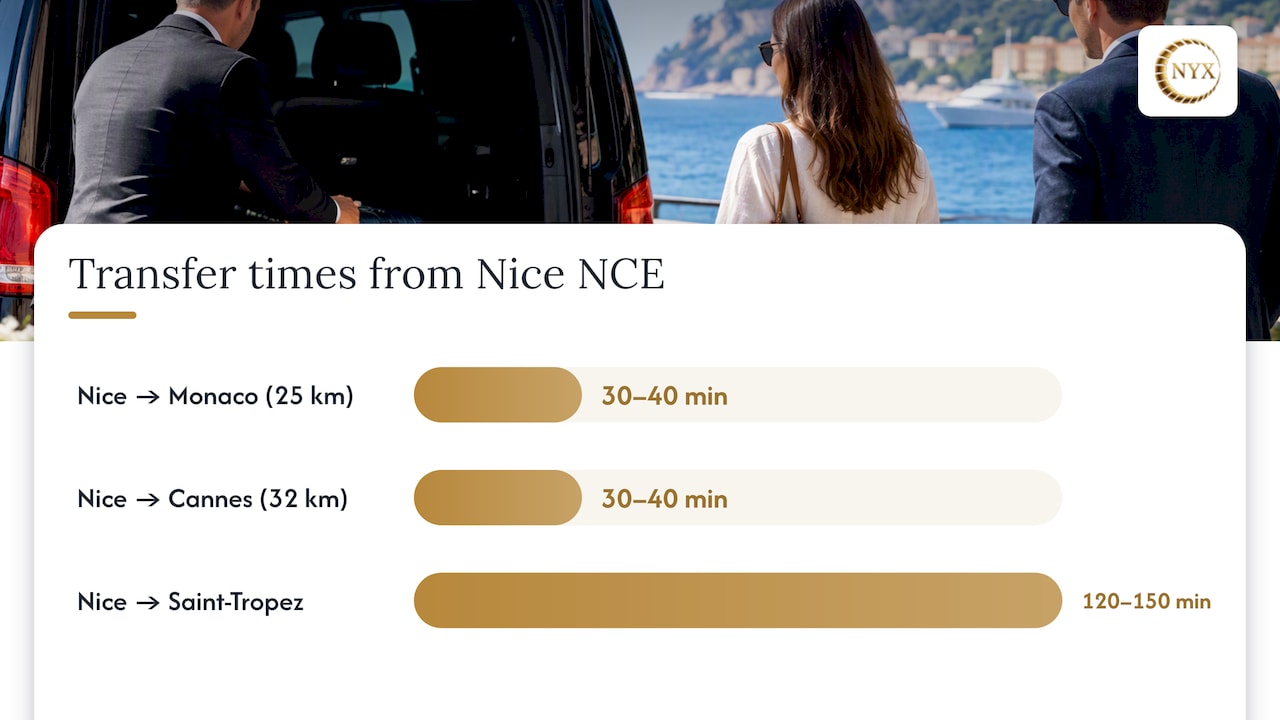
For journey planning, Nice NCE to Monaco runs roughly 30 to 40 minutes over 25 kilometres, Nice NCE to Cannes is a similar 30 to 40 minutes across 32 kilometres, and Nice NCE to Saint-Tropez typically takes 120 to 150 minutes depending on the route taken. During major events, we advise building in extra contingency time on all three routes, since traffic patterns around Monaco and Cannes change considerably during festival weeks. A fixed-rate chauffeur service also removes the metered uncertainty that complicates last-minute itinerary changes for agents managing client expectations.
TranspOnyx: fleet, service rules and why the right van matters
Our fleet runs across four categories: Standard Sedan and Business Sedan, both seating up to three passengers, and Van 7 pax and Van 8 pax for larger groups. Every vehicle, regardless of size, comes with Wi-Fi, air conditioning, chilled water and phone chargers, so the amenities are consistent whether a client books a sedan or the larger van.
Rates are fixed per vehicle for 2026, confirmed at the time of booking with no surge pricing applied regardless of flight delays or event-week demand. Drivers are licensed VTC professionals, bilingual in English and French at minimum, and flight monitoring is included on every airport transfer rather than sold as an add-on. Free waiting time runs to 60 minutes for airport pickups and 20 minutes elsewhere, and the service operates 24 hours a day, every day of the year. Child seats are available on request for either van category, though we recommend confirming this at booking rather than on the day.
In practice, this plays out across routes concierges book often: a family of six flying into Nice NCE for a week in Antibes fits the Van 7 pax comfortably, while a corporate group of eight heading to a conference venue in Cannes, or a party that includes a guest using a wheelchair, moves straight to the Van 8 pax. The same logic applies to transfers toward Menton or onward into the Alpine resorts, where luggage volume tends to climb with ski equipment.
Dimensions and interior space beyond passenger count
Passenger count tells only part of the story. The 8-seater body shell in this vehicle class is typically built on a longer wheelbase than the 7-seater, which translates directly into a deeper boot well rather than just one extra seat squeezed into the same footprint.
That longer wheelbase also means a flatter, more usable load floor. Where a 7-seater often requires folding or removing a third-row seat to free up boot space for extra luggage, the 8-seater’s boot is designed from the outset to hold luggage and passengers simultaneously, without the fold-down compromise. Headroom and legroom in the rearmost row also tend to be marginally more generous in the 8-seater, since the body extension that adds the eighth seat usually adds proportional cabin length rather than simply narrowing the existing rows.
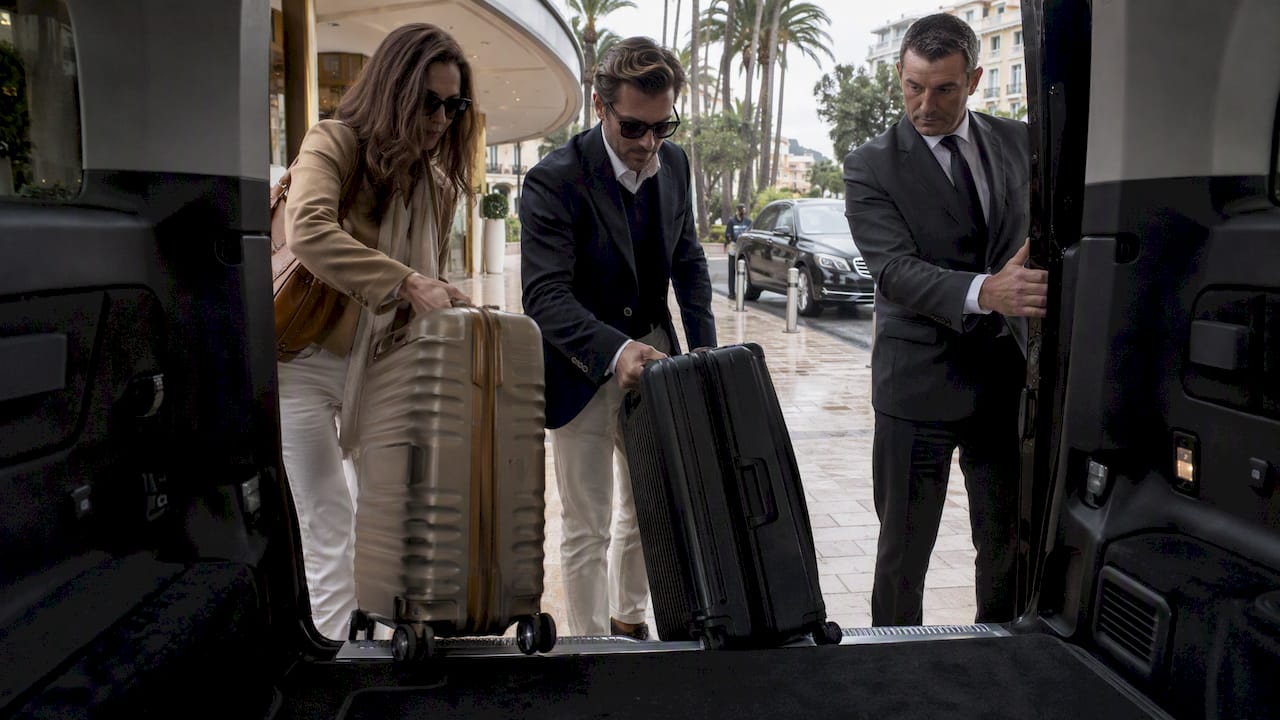
Sliding side doors are common on 8-seater vans and make loading passengers and bags considerably easier at a kerbside pickup, particularly during a busy airport exit or a hotel departure with several parties waiting. Interior width matters too: shoulder room across the middle and rear benches is what separates a cramped five-hour drive to Saint-Tropez from a comfortable one, and it is consistently one of the first things repeat clients mention when comparing vehicle categories.
Fuel efficiency: what changes with the extra seat
The extra body length, weight and frontal area that come with an 8-seater configuration mean it typically consumes somewhat more fuel per kilometre than the equivalent 7-seater on the same chassis platform. The difference is rarely dramatic on a single transfer, but it compounds across longer routes such as Nice NCE to Saint-Tropez or transfers into the Alpine resorts, where the extra distance magnifies any gap in consumption.
For most private transfer bookings, though, fuel efficiency is the wrong lens entirely. A single 8-seater carrying seven passengers and their luggage is almost always more fuel-efficient per passenger than splitting the same group across two 7-seaters or sedans, simply because one larger engine working for seven people beats two engines working for three or four each. The efficiency conversation only matters when a booker is choosing between sizing up unnecessarily or sizing correctly, not when comparing a single large vehicle against multiple smaller ones for the same group.
In practice, this means the fuel question should rarely drive the booking decision on its own. Passenger count, luggage volume and accessibility needs settle which vehicle is correct, and the fuel efficiency difference between the two van categories is a secondary consideration once the right size has already been established for the group’s actual requirements.
Price difference and cost implications of hiring the right van
Fixed-rate pricing in 2026 is set per vehicle, not per seat, which changes how the price difference between a Van 7 pax and a Van 8 pax should be read. A larger van with more structure, a longer wheelbase and higher load capacity naturally carries a modestly higher fixed rate than the smaller category, but that difference is rarely proportional to the extra seat alone.
The more useful comparison for concierges and agents is not Van 7 pax against Van 8 pax in isolation, but one larger van against the alternative of booking two smaller vehicles for the same group. A party of seven or eight travelling together in one Van 8 pax, on one fixed fare, is typically more economical than splitting the group across a sedan and a van, or across two separate vans, each carrying its own fixed rate and its own waiting time allowance.
There is also a hidden cost in getting the size wrong: a vehicle swap requested on the day, whether because a sixth suitcase would not fit or because a guest’s wheelchair needed ramp access that was not booked in advance, almost always costs more in delay and stress than simply booking one size up from the outset. For group travel specifically, the practical advice is to price the trip as a single party rather than as individual seats, and to let luggage and accessibility needs, not a strict seat count, decide whether the booking moves from the smaller van to the larger one.
Driving and parking considerations for larger vans
A longer, wider vehicle changes how a journey plays out well before anyone reaches the destination. Narrow lanes through the old quarters of towns like Antibes or Menton, tight hotel driveways, and the switchback approach roads into Alpine resorts such as Isola 2000 all demand more from a driver handling an 8-seater than a 7-seater or sedan.
This is one of the clearest arguments for a professional chauffeur rather than a self-drive hire in this vehicle class. A licensed VTC driver who works these roads daily already knows which hotel forecourts in Cannes or Monaco can accommodate a longer wheelbase and which require a short walk from a nearby drop point, knowledge that a visiting driver simply does not have.
Parking in central Nice, Cannes or Monaco is already tight for a standard sedan; an 8-seater van multiplies that difficulty, particularly during event weeks when temporary road closures around venues for the Cannes Film Festival or the Monaco Grand Prix reroute traffic with little notice. A chauffeured transfer removes this problem entirely, since the vehicle drops passengers at the kerb and moves on, rather than needing to find and hold a parking space nearby.
For anyone weighing a self-drive rental against a chauffeured option for a larger group, the parking and manoeuvring difference alone is often reason enough to book a driver, independent of any comfort or cost argument.
Safety features relevant to the number of seats
Seat count itself does not determine a vehicle’s safety rating, but the practical safety considerations shift as a vehicle carries more passengers and more weight. An 8-seater, fully loaded with passengers and luggage, handles differently under braking and in corners than the same vehicle carrying four people, which is one reason professional drivers adjust following distance and cornering speed when a van is at or near capacity.
Third-row and rearmost seating, present in both 7-seater and 8-seater configurations, typically sits further from the vehicle’s front crumple zones, which is a structural reality of this vehicle class rather than a flaw specific to either size. Properly fitted child seats matter more in these rear positions, which is why we always recommend booking them in advance rather than assuming one can be fitted correctly on arrival.
Weight distribution is the other practical factor: a van carrying eight passengers and six large suitcases is working closer to its rated capacity than one carrying five passengers and three bags, and a well-maintained, professionally driven vehicle manages that load far more predictably than a self-drive hire where the driver has no prior experience with the vehicle’s loaded handling characteristics. This is a quiet but genuine advantage of booking a chauffeur-driven van over a rental for a full group.
Typical seating configurations for each van category
A Van 7 pax is most commonly arranged across three rows: a driver and front passenger, a middle row of three, and a rearmost row of two, with a boot area sized for roughly five large suitcases. Some configurations swap the rearmost two-seat bench for a slightly larger middle row, but the three-row, 2-3-2 layout including the driver is the standard pattern for this category.
A Van 8 pax typically extends that layout to a 2-3-3 pattern, adding one seat to the rearmost row or occasionally running a 2-2-2-2 four-row arrangement that is more common in the longer wheelbase vans used for wheelchair accessible configurations. The extra row or extra seat is also where the boot gains the capacity for a sixth large suitcase, since the structural extension that adds the seat usually adds load floor as well.
Wheelchair accessible configurations tend to depart from both standard layouts, with one or more rear seats replaced by a securement point and ramp access, which is why WAT fittings are normally only available in the 8-seater category rather than retrofitted into a 7-seater. For bookers, the practical takeaway is simple: if the group’s accessibility needs are known in advance, say so at booking, since the seating configuration itself changes to accommodate it.
When extra luggage room beats one more seat
Event weeks on the Riviera complicate what would otherwise be a simple headcount decision. During the Cannes Film Festival, MIPIM or the Monaco Grand Prix, groups often travel with garment bags, equipment cases and extra luggage that a straightforward passenger count would never predict.
My own view, watching how these bookings play out year after year, is that concierges consistently underweight luggage and overweight seats. A party of five with seven pieces of luggage for a festival week needs the larger van far more urgently than a party of seven travelling light for a single city hop.
The operational rule I would set is this: for airport and yacht transfers, let luggage and accessibility decide the vehicle. For short city transfers between hotels or venues, seat count is usually the simpler and sufficient measure.
— Dany
How TranspOnyx handles group transfers of any size
We run both the Van 7 pax and Van 8 pax on fixed 2026 rates, alongside Standard Sedan and Business Sedan options, for airport transfers, point-to-point journeys and by-the-hour hire across the Riviera. Under Onyx Tours, we also run private guided excursions and wine tours for groups who want a chauffeured day out rather than a straight transfer.
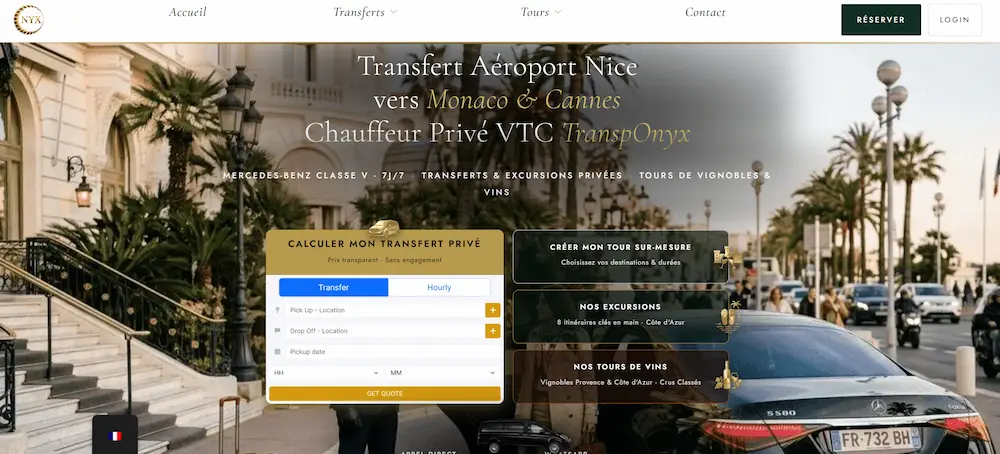
Booking the right vehicle starts with telling us the same four things we ask every client: passenger count, large suitcase count, any mobility aid, and whether child seats are needed. We confirm the fare and the vehicle category before the day of travel, with no surge pricing applied.
- Call us on +33 6 10 30 71 84 or message us on WhatsApp at +33 7 67 78 10 26 for a same-day quote.
- Hotels, concierge desks and travel agencies can set up a standing B2B account for repeat group bookings.
- Visit our Chauffeur Privé Nice to Cannes page to check fixed rates and confirm a Van 7 pax or Van 8 pax for your next group transfer.
FAQ
What is the main difference between a 7 seater and an 8 seater transfer van?
The main difference is practical capacity rather than just one extra seat: a 7-seater typically handles five large suitcases and groups of five to six, while an 8-seater handles six large suitcases and is the size most commonly fitted for wheelchair access. Passenger count matters less than luggage volume and accessibility needs when choosing between them.
How many suitcases fit in a Van 7 pax compared with a Van 8 pax?
A Van 7 pax typically carries around five large suitcases, while a Van 8 pax typically carries six, according to standard maxi vehicle guidance. Carry-on bags rarely affect this limit, but oversized items like golf bags or ski equipment should be mentioned when booking.
Is wheelchair access available on both van sizes?
Wheelchair accessible (WAT) configurations are normally only available on the larger 8-seater category, not the 7-seater. Any mobility aid in the group should default the booking to the Van 8 pax to ensure ramp or lift access is available.
What information should I give when booking a group transfer?
We ask for passenger count, number of large suitcases, flight number and terminal, any mobility needs, and whether child seats are required. Mentioning an event name, such as the Monaco Grand Prix or the Cannes Film Festival, also helps us plan for route and timing changes.
How much free waiting time is included on an airport pickup?
Airport pickups include 60 minutes of free waiting time, while pickups at any other address include 20 minutes, with flight monitoring built into every airport transfer. This policy is designed to absorb normal flight delays without any extra charge.
0 commentaires