
A reliable event transport plan sets vehicle capacity, confirmed timings, staged pick-up and drop-off points and contingency cover before permits are even sought. It succeeds or fails on four pillars: capacity, timing, staging and safety, and contingency. Tools such as flight monitoring and frameworks like DPS, Zone Ex and PRM accessibility guidance turn these pillars into a workable plan rather than a wish list.
Building the transport plan: a step-by-step workflow
A transport plan that holds up on the day starts weeks earlier, with scoping rather than bookings. Arrival profiles vary wildly between a corporate conference and a festival weekend, so the first task is mapping who arrives when, by what mode, and in what numbers.
- Scope attendee arrival profiles: flight waves, train arrivals, self-drive numbers and VIP movements requiring separate handling.
- Convert that scoping into firm vehicle bookings and a manifest listing names, contact numbers and special requirements.
- Assign a named owner for each decision: vehicle sourcing, staging liaison, medical coordination and on-day control.
- Set a timeline working backwards from the event date for permit applications, driver briefings and final manifest locks.
Permit lead times and venue access windows often dictate the whole schedule, so they belong at the top of the plan rather than an afterthought bolted on once vehicles are booked. A conference bringing 300 delegates through Nice NCE on a single Thursday morning needs this sequence finished at least four weeks out, since airport transfer capacity and coach parking permits both tighten closer to major fixtures such as MIPIM.
Choosing the right vehicle mix and building accurate manifests
Vehicle sizing follows arrival waves, not headcount totals. A single large coach sitting half empty wastes budget, while undersized sedans stranded guests queuing at a terminal damage the day’s first impression.
- Use sedans for VIPs, speakers or small executive groups who need privacy and flexibility.
- Use 7 or 8 passenger vans when groups travel together and luggage volume is moderate.
- Reserve coaches for arrival waves exceeding 20 people within a tight window, typically festival accreditation days or trade show opening mornings.
- Flag mobility needs, child seats and excess luggage on the manifest before vehicles are assigned, not after.
Manifests need only a handful of fields to work: name, mobile number, flight or train reference, mobility needs and luggage count. That minimal dataset lets a dispatcher convert a spreadsheet into assigned vehicle runs within minutes rather than hours, which matters when flight delays force last-minute reshuffling.
Scheduling, routing and staging across multiple venues
Journey-time matrices, not straight-line distances, should set transfer windows. Nice to Cannes runs roughly 35 to 50 minutes depending on the Promenade des Anglais traffic, while Nice to Monaco typically takes 30 to 45 minutes along the A8. Saint-Tropez, by contrast, demands closer to two hours from the airport once summer congestion on the Maures peninsula is factored in.
- Build transfer windows from historical traffic patterns for the relevant time of day, not a single average figure.
- Identify staging and holding areas near each venue and agree loading slots directly with venue operations teams.
- Sequence multi-leg transfers so a single vehicle completes several short hops rather than one long deadhead run.
- Feed live flight monitoring and rail timetables into the schedule so shuttle waves adjust automatically to delays.
This is where Zone Ex guidance on safety and service earns its place in planning documents. Mapping surrounding roads, parking and pedestrian routes before fixing a staging plan prevents the bottlenecks that turn a smooth transfer schedule into a queue of idling vans.
Safety, medical cover and DPS requirements planners must not skip
French event organisers size first-aid and rescue resources through a Dispositif prévisionnel de secours, commonly known as DPS, using a national risk-assessment grid. The Cerema national reference on DPS requires the organiser and an approved secouriste association to co-sign the risk assessment before the event proceeds.
A DPS risk-assessment grid, co-signed by the organiser and a designated secouriste association, determines first-aid staffing levels and rescue resourcing for the event, according to Cerema’s national reference document. Transport decisions feed directly into this assessment.
- Keep emergency vehicle access routes clear of staging areas and parked shuttles at all times.
- Place static medical posts where transport flows do not cross evacuation routes.
- Coordinate with public emergency services when projected attendance exceeds the capacity of pre-positioned DPS resources, with clear escalation routes agreed in advance.
Making event transport accessible to attendees with reduced mobility
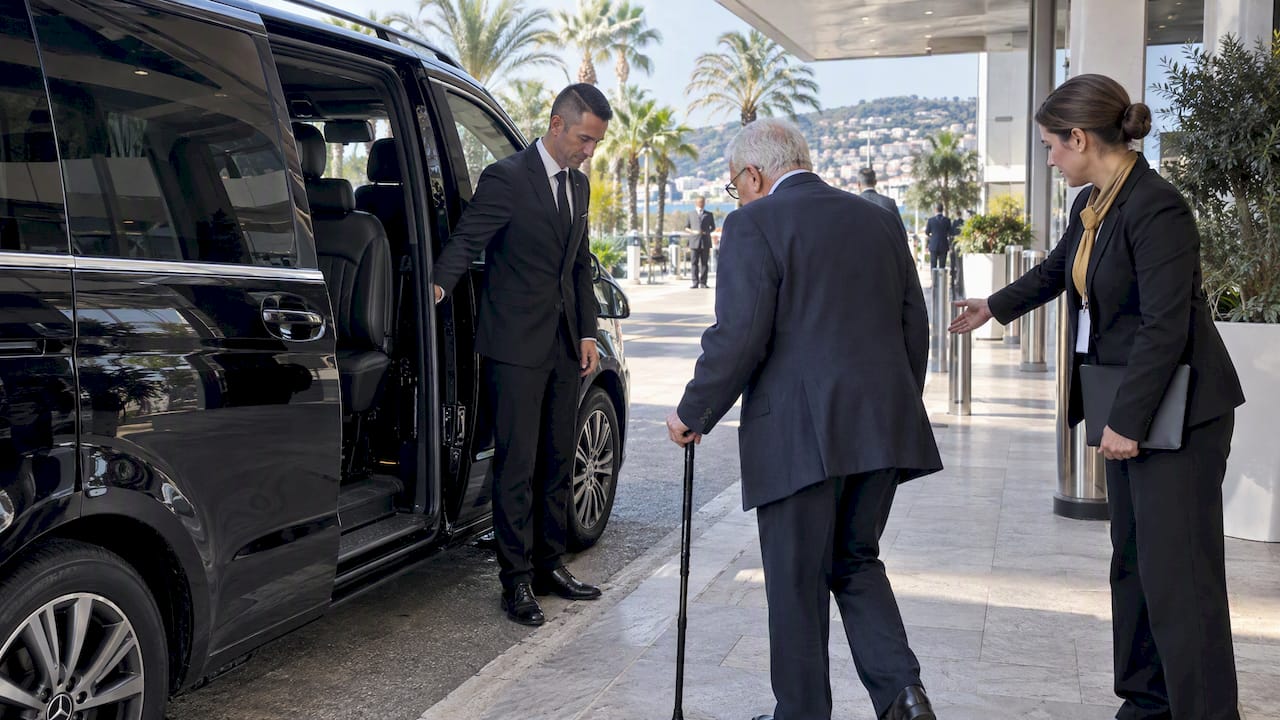
Accessible transport planning is not an optional extra appended to the main schedule. The EU best-practice guide on carriage of persons with reduced mobility sets out measures including staff training, accessible information channels and reasonable pre-booking windows for spontaneous assistance requests.
- Pre-book assistance levels and equipment, recording companion needs on the manifest alongside mobility flags.
- Brief drivers and marshals on PRM assistance procedures and accessible communication methods.
- Consider demand-responsive feeder vehicles that connect smoothly with fixed transport where routes allow.
- Offer booking by phone, web and WhatsApp, since channel choice affects who actually requests assistance.
The same EU guidance recommends a pre-booking window of 30 to 60 minutes for spontaneous assistance and nominating an accessibility coordinator at larger multimodal events.
Pro Tip: Name one accessibility coordinator for the whole event rather than splitting responsibility across venue and transport teams; a single point of contact prevents requests falling between the two.
Coordinating police, venues and local authorities before the event
Transport operations touch more stakeholders than most planners expect. Before vehicles move, convene police or highways authorities, venue operations staff, parking operators and, where relevant, public transport agencies running routes near the venue.
- Secure road usage permits, loading bay allocations and coach parking authorisations through the relevant local authority.
- Hold a single pre-event coordination meeting and distribute an agreed Zone Ex plan to every stakeholder, not a different version to each.
- Record contact lists, site maps and escalation routes in one shared document, updated as changes occur.
- Confirm who holds final authority to alter routing or staging on the day if conditions change.
An event using separate ceremony and reception venues often sees a late spike in parking demand that a shared Zone Ex plan helps every party anticipate.
Running communications and control on the day itself
Attendee messages need exact meeting coordinates, a confirmed time window and a driver contact number, sent well before departure rather than on arrival. Flight monitoring, a dedicated WhatsApp group or a live dashboard keeps everyone working from the same picture when a flight lands early or a coach hits traffic.
- Brief drivers and marshals from the final manifest, not an earlier draft.
- Staff a control room with one person authorised to reassign vehicles in real time.
- Confirm each handover to venue teams with a simple time-stamped note, useful for reconciling numbers afterwards.
Contingency planning: spare vehicles and incident recovery
Spare capacity separates a plan that survives a delayed flight from one that collapses under it. A commonly used ratio holds one floating vehicle and driver in reserve for every eight to ten scheduled runs, ready to absorb a cancellation or a mechanical issue without disrupting the wider schedule.
- Contain the issue: pull the affected vehicle from rotation and reassign its passengers immediately.
- Re-route and communicate: update the control room and affected attendees within minutes, not at the next scheduled check-in.
- Escalate to medical or police services only where the incident warrants it, following the escalation routes agreed with local authorities.
- Record every incident afterwards for the post-event debrief, since recurring issues usually trace back to a staging or timing gap.
How a Riviera chauffeur service structures event transport
Operational clarity comes easier when the fleet itself is simple. We run four vehicle categories only: Standard Sedan, Business Sedan, Van 7 pax and Van 8 pax, each fitted with Wi-Fi, air conditioning and chilled water, which keeps manifest matching straightforward for planners juggling multiple arrival waves.
- Every airport transfer carries included flight monitoring, so delayed arrivals from Nice NCE do not strand a waiting driver or a late guest.
- Drivers are licensed VTC professionals, bilingual in English and French at minimum, useful for international conferences and festival accreditation desks.
- Fixed 2026 rates confirmed at booking remove the pricing uncertainty that complicates multi-vehicle budgeting.
- Free waiting time of 60 minutes on airport pickups and 20 minutes elsewhere absorbs the small delays that always occur across a large manifest.
Planners organising Riviera events can draw on our Cannes fireworks transport checklist or our guidance for organising group transport to IT events, both built from real operational runs rather than generic templates. We can be reached on +33 6 10 30 71 84 or through Transponyx.
What actually wins the day on event transport
Disciplined staging paired with clear, early communication prevents more incidents than any amount of spare vehicle capacity bolted on afterwards. Events such as the Cannes Film Festival and the Monaco Grand Prix make the point plainly: when road closures and accreditation waves compress arrival windows to the minute, the plan that survives is the one with staging agreed weeks in advance, not the one improvised at the barrier.
— Dany
Book specialist event transport support on the Riviera
Planners who prefer to hand transport execution to a specialist rather than coordinate every vehicle themselves can brief us directly. We handle group transfers, airport transfers between Nice and Monaco, Cannes or Antibes, by-the-hour hire for marshalling or VIP escort duties, and dedicated event chauffeur cover across the Riviera.
At booking, share your attendee manifest, any PRM requirements and your staging map, and we confirm vehicle assignments, driver contacts and fixed 2026 pricing in writing before the event. For groups running exhibition freight alongside attendee movement, import logistics guidance for trade shows is worth reviewing alongside your transport plan. Reach us on +33 6 10 30 71 84 or through chauffeur-driven hire in Nice to confirm availability for your dates.
FAQ
What are the 5 C’s of event planning?
Definitions vary across the industry, but a commonly used version covers Concept, Coordination, Control, Culmination and Closeout, tracking an event from initial idea through to post-event review. Transport planning sits mainly within Coordination and Control, where timing, staging and on-day decisions are managed.
What is transportation planning?
Transportation planning for events means setting vehicle capacity, confirmed timings, staging locations and contingency cover for every attendee movement between arrival points and venues. It covers scheduling, routing, safety provisions such as a DPS risk assessment, and accessibility measures for travellers with reduced mobility.
What are the 7 stages of event planning?
Common frameworks describe research, design, planning, coordination, evaluation, with some versions adding budgeting and post-event reporting as distinct stages. Transport sits within coordination, where vehicle bookings, manifests and staging plans are finalised before execution.
What are some examples of event logistics?
Event logistics typically covers vehicle and venue bookings, manifest management, staging and parking arrangements, safety and medical cover, and attendee communications. A Zone Ex coordination plan agreed with local authorities is a core logistics document for multi-venue events.
How much notice should I give for accessible transport requests?
EU best-practice guidance recommends offering assistance with a pre-booking window of 30 to 60 minutes for spontaneous requests, alongside longer advance booking for planned attendance. Nominating a single accessibility coordinator, as outlined in the EU guide on persons with reduced mobility, helps standardise response times across an event.
0 commentaires