
Prebook a professional family transfer that supplies regulation compliant child seats and confirms seat type before you travel. This single decision removes the biggest source of risk and stress on arrival day: no scrambling for a taxi with no seat, no guessing whether a rideshare driver can legally carry your toddler. At TranspOnyx, we confirm seat category, installation method and vehicle size at the point of booking, not at the kerb.
What family airport transfers provide and why they matter for travelling with children
A family airport transfer is built around predictability. We track your flight, meet you inside the terminal, carry your luggage to the car and get you moving within minutes of landing, at a fixed fare agreed before you fly. None of that is incidental when you are travelling with a child who has just come off a long flight and has no patience left for queues.
The difference that matters most is seat guarantee. A professional operator confirms, in writing, which seat category will be in the car: infant carrier, toddler seat or booster, correctly matched to the child’s height rather than a rough age guess. Compare that with hailing a rideshare at the terminal, where seat availability is never certain and drivers have no obligation to carry one at all.
Booking ahead with a dedicated family transfer gives you:
- A seat reserved and confirmed before departure, not requested on arrival
- Flight monitoring so the driver adjusts for early or delayed landings
- One fixed price agreed in advance, with no surge pricing at the terminal
- A professional who installs the seat correctly rather than leaving you to do it in the car park
This matters legally as much as practically. French road safety guidance requires an appropriate restraint for any child under ten, with sanctions for non-compliance, and a professional operator exists precisely to remove that risk from your shoulders.
Child seat standards parents must verify before booking
The seat in your transfer vehicle should meet R129, known commercially as i-Size. This standard classifies child seats by height rather than weight, requires improved side-impact protection, and favours Isofix fitting over belt installation. Since 2025, R129 has been the mandatory standard for new seats entering the market, according to coverage of the 2025 child seat regulation.
Fifteen months is the legal minimum for rear-facing travel under R129, and safety guidance recommends extending that period well beyond the legal floor where the seat and child’s size allow it, according to the 2025 regulation summary. A longer spell facing backwards gives a young child’s head and neck meaningfully more protection in a frontal impact, which is why operators who know the standard will not rush a child into forward-facing before it suits them.
The wider legal picture is equally clear. Official road safety guidance states that children under ten must travel in a restraint appropriate to their size, and sets out penalties for drivers who fail to comply. A seat is required even for the shortest journey between terminal and hotel, and a child should never travel on an adult’s lap.
What this means in practice for a parent comparing operators:
- Ask whether seats are R129 or i-Size certified, not an older, superseded standard
- Confirm Isofix fitting is available rather than belt-only installation
- Check that rear-facing seats stay rear-facing until the operator is told otherwise
- Verify that the driver, not you, performs the installation and the airbag check
Industry commentary on child seat regulation in 2026 notes that professional chauffeur services have become the preferred route for parents precisely because they guarantee clean, properly installed, regulation compliant seats, removing the uncertainty that comes with an unregulated rideshare pickup.
Booking a family transfer: what to tell the operator and what to confirm back
The quality of your transfer depends almost entirely on the information you give at booking. Height matters more than age here: a tall three year old may need a different seat category from a smaller four year old, and giving precise measurements lets the operator bring the right equipment rather than an approximate match.
When you book, provide:
- The child’s exact age and height, so the correct seat category is selected
- The number of seats required and the preferred type: infant, toddler or booster
- Luggage count and any stroller or additional baby equipment
- Pickup terminal and flight number for monitoring
- Whether the journey includes a return pickup or a connecting flight
Once booked, ask the operator to confirm the seat standard in use, whether it will be Isofix or belt installed, and what free waiting time applies if your flight lands late. At TranspOnyx, flight monitoring is included on every airport transfer, with 60 minutes of free waiting time built into the fare, so a delayed landing does not turn into a missed pickup.
Pro Tip: Give height in centimetres rather than age alone. It is the single detail that most reliably determines the right seat.
Return journeys and connecting flights deserve the same attention as the outbound leg. Confirm at the time of booking whether the same seat configuration applies for the return, particularly if your child has grown or if a different number of passengers will be travelling.
How a professional chauffeur service actually delivers a family transfer
Vehicle choice determines how many child seats a car can carry without compromising anchor spacing or seatbelt geometry. Our fleet runs across four categories built on Mercedes-Benz vehicles, and the right one depends on family size and seat count rather than passenger number alone.
- A Standard Sedan or Business Sedan suits one or two child seats comfortably, depending on seat width
- A Van 7 pax gives room for larger families or multiple seats without crowding
- A Van 8 pax handles the largest family groups, including grandparents travelling together
- Every vehicle carries Wi-Fi, air conditioning, chilled water and phone chargers as standard
Journey times give a useful sense of what a Riviera family transfer actually involves. From Nice Côte d’Azur Airport, Monaco is roughly 30 minutes by road, Cannes around 40 minutes, and Antibes closer to 25 minutes, depending on traffic through events such as the Monaco Grand Prix or the Cannes Film Festival, when road closures add noticeably to journey times.
| Route from Nice NCE | Typical journey time | Suggested vehicle for a family of four with two seats |
|---|---|---|
| Nice NCE to Monaco | Around 30 minutes | Business Sedan or Van 7 pax |
| Nice NCE to Cannes | Around 40 minutes | Van 7 pax |
| Nice NCE to Antibes | Around 25 minutes | Standard Sedan or Van 7 pax |
Our drivers are bilingual, licensed VTC professionals, and every booking runs on a fixed 2026 rate agreed before the journey, with no surge pricing regardless of flight delays or terminal congestion.
Keeping children occupied during the transfer
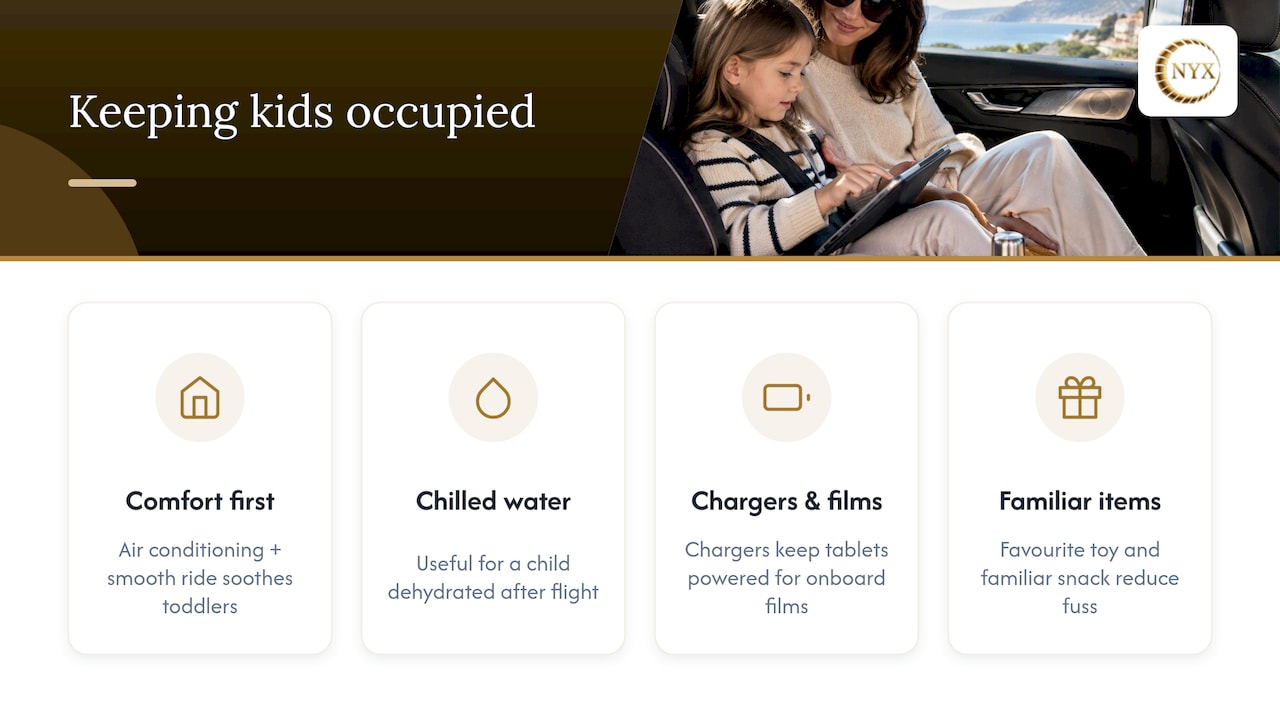
A journey from the terminal to a hotel in Cannes or Monaco rarely lasts more than forty minutes, but that is a long stretch for a toddler who has just left a cramped cabin. Air conditioning kept at a steady, comfortable level and a quiet, smooth ride do more for a young passenger’s mood than any gadget.
We keep chilled water on board for every journey, useful for a child who is dehydrated after a flight, and phone chargers mean a tablet or phone used for a film does not run out of battery mid-journey. Parents who prefer to bring their own entertainment, a favourite toy, a tablet loaded with films, a familiar snack, will find the ride comfortable enough that little else is needed for a short Riviera transfer.
Because flight monitoring is built into every booking, a child who has had a rough landing is not then made to wait on a delayed pickup. The car is there when the flight actually lands, not when the schedule originally said it would.
Travelling with strollers and baby equipment
Strollers, travel cots and baby bags all need to be accounted for before the car arrives, not discovered as a problem at the kerb. When you book, tell the operator exactly what you are bringing: a folded stroller takes up meaningfully more boot space than a car seat alone, and a Van 7 pax or Van 8 pax gives far more flexibility than a sedan if you are carrying both a stroller and multiple suitcases.
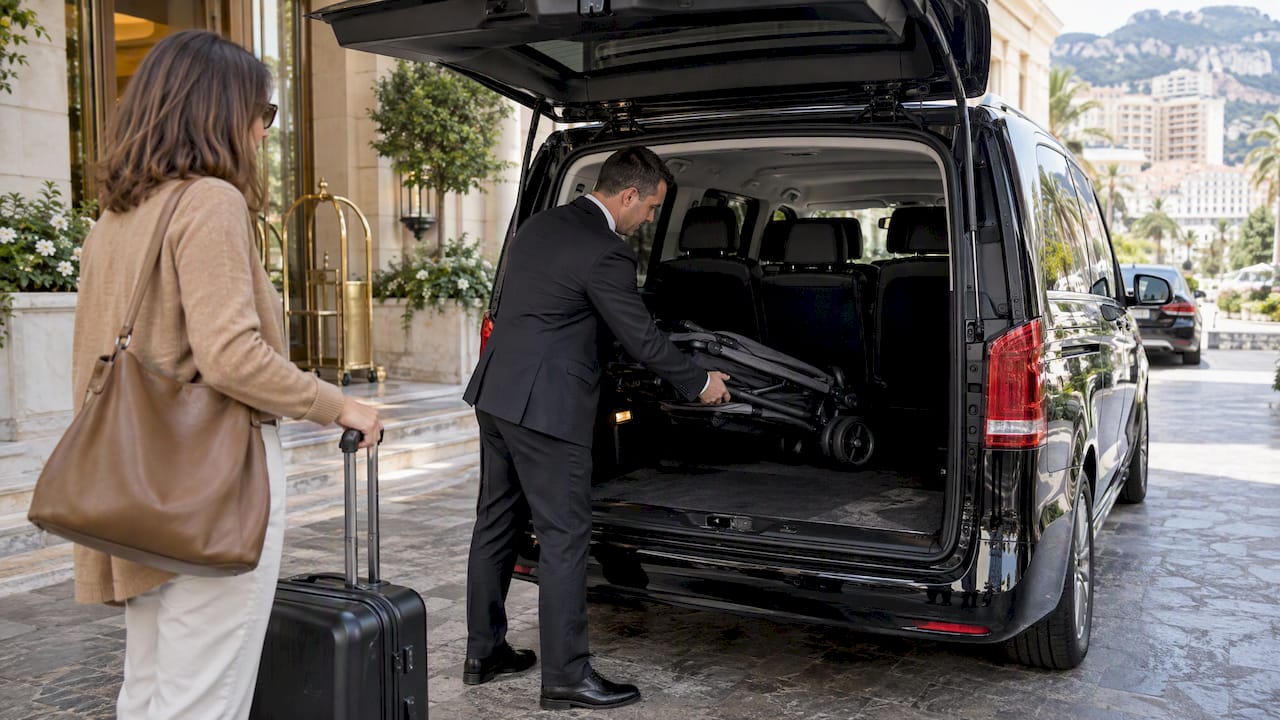
Our drivers handle luggage as part of every pickup, which extends naturally to baby equipment: a folded pushchair, a portable cot or a changing bag are loaded alongside standard luggage without any extra negotiation at the terminal. For details on how that luggage handling works in practice, our baggage assistance guide sets out what meet and greet service typically includes.
If you are travelling with an infant and a stroller together, mention both at booking so the right vehicle is assigned rather than a sedan that then struggles to fit everything in. A general airport transfer booking guide from a fellow chauffeur operator in Edinburgh covers similar groundwork on what to disclose ahead of a pickup, useful reading if you want a second perspective on booking etiquette before you fly.
Why we favour prebooking over any airport queue
The convenience argument for prebooking a family transfer is not really about luxury. It is about removing variables. A fixed fare agreed in advance means no haggling at the rank with a tired child in your arms, and a confirmed seat means no fifteen minutes spent wrestling with straps you have never seen before.
What strikes me most, looking at how families actually travel through somewhere like Nice NCE, is how much friction disappears when the seat question is settled before the wheels touch down. Professional installation is not a luxury flourish, it is the difference between a seat fitted correctly and one that only looks fitted. Parents who have done this once rarely go back to guessing.
— Dany
Booking a TranspOnyx family transfer with the right child seat
We built our airport transfer service around exactly this problem: parents who need a seat confirmed, not promised. Our fleet runs on Mercedes-Benz vehicles across four categories, Standard Sedan, Business Sedan, Van 7 pax and Van 8 pax, and child seats are available on request, matched to the age and height you give us at booking.
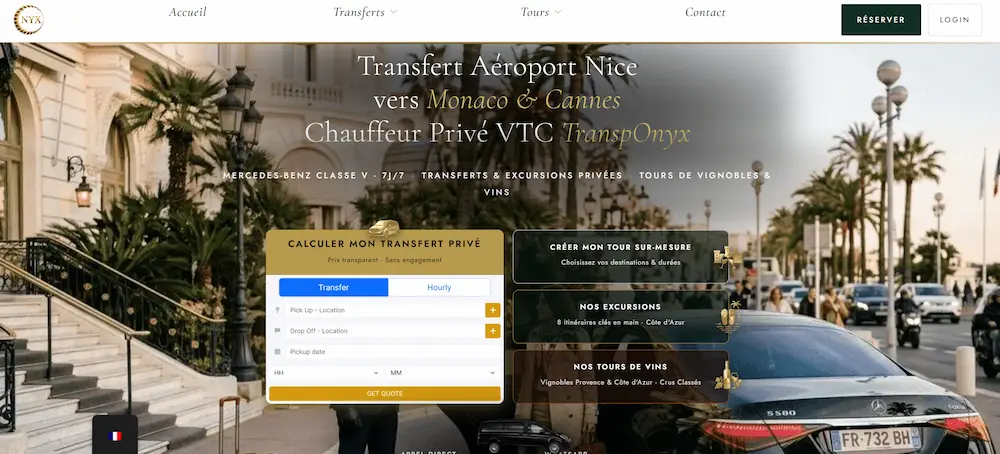
Every booking includes flight monitoring, free waiting time of 60 minutes on airport pickups, and a fixed 2026 rate agreed before you travel, so there is no surge pricing if your flight lands late. Our drivers are bilingual, licensed VTC professionals who handle installation and luggage together, including strollers and baby equipment.
- Choose a Standard Sedan or Business Sedan for one or two child seats
- Choose a Van 7 pax or Van 8 pax for larger families or multiple seats
- Tell us the child’s height, not just age, so we bring the right category
- Mention strollers or extra baby equipment at booking so boot space is planned
For transfers between Nice NCE and Monaco, Cannes, Antibes, Menton or Saint-Tropez, our airport transfer page lists routes and fixed fares, and our Nice to Cannes chauffeur service covers that specific route in detail. Call us on +33 6 10 30 71 84 or book through Transponyx to reserve a family transfer with the seat confirmed before you fly.
FAQ
Can a four year old travel in a rideshare without a car seat?
In France, children under ten must travel in a restraint appropriate to their size, so a standard rideshare without a seat does not meet that requirement for a four year old. A prebooked family transfer that confirms seat type in advance avoids this uncertainty entirely.
What is the best option for an airport transfer with children?
A prebooked professional transfer that confirms seat category, installation method and vehicle size ahead of travel is the most reliable option, because it removes the guesswork that comes with hailing a car at the terminal. Operators such as TranspOnyx build flight monitoring and free waiting time into every airport booking so a delayed landing does not disrupt the pickup.
Can a two year old travel in a rideshare?
A two year old still falls under the under ten restraint requirement in French road safety guidance, so the same seat rules apply as for an older toddler. Booking a transfer that supplies an R129 or i-Size compliant seat matched to the child’s height is the safer route.
How do families with young children get through airport security?
Airport security procedures for young children are set by the airport and aviation authority rather than by ground transport providers, and typically allow prams, car seats and baby items to pass through separate screening. Checking with the specific airport’s own guidance ahead of travel is the most reliable way to prepare for that part of the journey.


0 commentaires