
Choose Avignon if you want monuments, a walkable walled centre and the best train connections; choose Aix-en-Provence if you want café culture, markets and a calmer base for exploring Provence by car. Rail travellers and history-focused visitors lean towards Avignon; those flying into Marseille or prioritising food and boutique shopping tend to prefer Aix. The quick comparison below breaks down transport, cost and atmosphere in detail.
Aix-en-Provence vs Avignon at a glance
The two cities sit less than an hour apart by train, yet they offer almost opposite experiences. Avignon is monumental and medieval, built around the Palais des Papes and its ring of ramparts. Aix is softer and more residential, shaped by fountains, plane trees and a university population that keeps its cafés busy well outside peak season.
| Factor | Avignon | Aix-en-Provence |
|---|---|---|
| Atmosphere | Medieval, monumental, walled | Elegant, café-driven, residential |
| Main sights | Palais des Papes, Pont Saint-Bénézet | Cours Mirabeau, fountains, Musée Granet |
| Transport | TGV station in the city centre | TGV station 15 to 20 minutes outside town |
| Best for | Rail travellers, history, day trips | Food, markets, relaxed multi-day stays |
| Price level | Generally lower | Generally higher, especially for dining |
| Ideal stay | 2 to 3 nights | 2 to 4 nights |
- If your trip is built around SNCF timetables and minimal onward transfers, Avignon’s central station gives you a practical edge.
- If you land at Marseille Provence Airport or plan to hire a car, Aix’s proximity to the airport and the Luberon makes it the more comfortable base.
What makes Avignon worth the visit
Avignon earns its reputation on scale. The Palais des Papes, the largest Gothic palace in Europe, dominates the skyline and anchors a UNESCO-listed old town that stays genuinely walkable once you’re inside the ramparts. The Pont Saint-Bénézet, the famous half-bridge over the Rhône, sits a short stroll below it, and the Rocher des Doms gardens above give the best panoramic view of the river and the Villeneuve-lès-Avignon hills opposite.
Mornings are best spent at Les Halles market, where Provençal producers sell cheese, olives and charcuterie under a living wall that has become something of a local landmark. The Avignon tourist office recommends the Avignon City Pass for visitors planning to see several paid sites, since it bundles entry fees with discounts on nearby attractions.
Seasonality matters more here than in most French cities. The Festival d’Avignon floods the streets with theatre throughout July, and accommodation books out weeks in advance during that period. Outside festival season, Avignon feels considerably quieter and easier to navigate.
Staying inside the ramparts puts you within walking distance of everything that matters; staying outside means relying on buses or a car for evening access. A sensible one to three day itinerary looks like this:
- Day one: Palais des Papes, Pont Saint-Bénézet and the Rocher des Doms at sunset.
- Day two: Les Halles market in the morning, then a half-day trip to Arles for its Roman arena.
- Day three (optional): Nîmes for the Maison Carrée, or Châteauneuf-du-Pape for a wine estate visit.
Arles and Nîmes both sit within 30 minutes by train, which makes Avignon an efficient hub for day trips even without a car.
What makes Aix-en-Provence different
Aix runs at a slower, more polished pace. The Cours Mirabeau, a broad avenue shaded by plane trees, forms the spine of the city and is lined with fountains, ice cream parlours and café terraces that fill from mid morning onward. The city’s fountains, several fed by natural thermal springs, give Aix its nickname as the city of a thousand fountains, and wandering between them through the old town’s narrow streets is arguably the best free activity in Provence.
Markets here rival Avignon’s, but with a different character. The Tuesday, Thursday and Saturday markets on Place Richelme and Place des Prêcheurs mix fresh produce with Provençal textiles, soap and lavender, and the surrounding streets hold boutique shops that reward slow browsing rather than a quick pass through. Culturally, Aix leans into its links with Paul Cézanne and Émile Zola, with the Musée Granet holding a respectable collection alongside temporary exhibitions.
The Aix tourist office describes the city as steadier year-round than Avignon, without the same summer festival spike, which makes it easier to book accommodation on shorter notice outside peak August dates.
Staying near the Cours Mirabeau or inside the old town keeps everything within walking range. A relaxed two to four day stay might look like this:
- Day one: Cours Mirabeau, the fountains and Musée Granet.
- Day two: morning market, afternoon at Cézanne’s studio, evening café hopping.
- Day three (optional): a Luberon village such as Gordes or Roussillon, or a wine estate visit in the surrounding countryside.
A car or a chauffeured vehicle expands Aix’s day trip radius considerably. Marseille is roughly 30 minutes away by car, and the Luberon’s hilltop villages, poorly served by public transport, become genuinely accessible only with your own driver.
How to get between Aix, Avignon and the airports
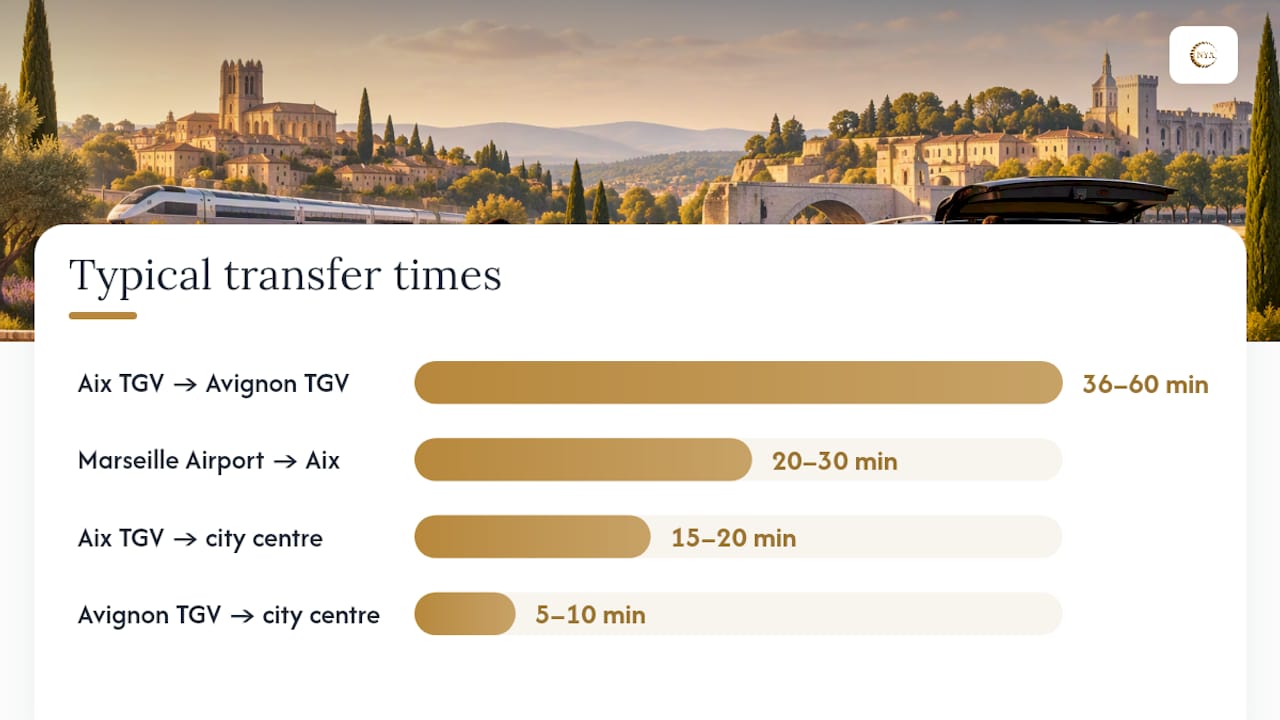
Rail logistics are where the two cities diverge most sharply, and this is the detail that should genuinely shape your itinerary. Avignon TGV sits inside the city, connected to the historic centre by frequent TER shuttle services, so arriving by train drops you close to your hotel with minimal fuss. Aix TGV, by contrast, sits several kilometres outside town, and reaching the centre typically means a shuttle or transfer of around 15 to 20 minutes.
Between the two cities, SNCF timetables show multiple daily connections, with journey times ranging from around 36 minutes on the fastest services to close to an hour depending on the route and number of stops.
| Route | Typical journey time | Notes |
|---|---|---|
| Aix TGV to Avignon TGV | 36 to 60 minutes | Multiple daily departures |
| Avignon TGV to city centre | 5 to 10 minutes by TER | Frequent shuttle service |
| Aix TGV to city centre | 15 to 20 minutes | Shuttle bus or transfer required |
| Marseille Provence Airport to Aix | Around 20 to 30 minutes by road | Closer than to Avignon |
Marseille Provence Airport is the main regional gateway for both cities, and its proximity to Aix means arrivals there generally reach their hotel faster than travellers heading on to Avignon.
Pro Tip: If you’re arriving with luggage, a connecting flight delay, or travelling as a family of four or more, a fixed-rate private transfer removes the shuttle-and-timetable guesswork entirely. TranspOnyx runs door-to-door chauffeur transfers with flight monitoring included, which matters most on the Aix TGV leg, where a missed shuttle can cost you half an hour standing on a platform with bags.
Choosing your base: a decision checklist and sample itinerary
Work through these four questions before booking accommodation:
- Are you relying entirely on trains? Choose Avignon. Its central station removes an extra transfer at both ends of your trip.
- Are you visiting in July? Expect the Festival d’Avignon to raise prices and fill hotels weeks ahead, so book Avignon early or consider basing in Aix instead and visiting Avignon as a day trip.
- Is your trip built around food, markets and unhurried afternoons? Aix’s café culture and steadier crowds suit that pace better.
- Are you travelling with children or need step-free, compact walking distances? Avignon’s flat, walled centre is easier to navigate on foot than Aix’s slightly more spread-out old town.
For a five day trip, a 3-2 split works well: three nights in Avignon covering the Palais des Papes, Pont Saint-Bénézet and a day trip to Arles, followed by two nights in Aix for the Cours Mirabeau, markets and a Luberon excursion. Moving between the two takes under an hour by direct train, or slightly longer by road, so the split adds minimal dead time to the itinerary.
What a trip to either city actually costs
Aix tends to run noticeably higher than Avignon on dining and accommodation, reflecting its steadier year-round demand and more polished retail scene. Avignon’s prices dip further outside July, when the Festival d’Avignon pushes hotel rates up sharply and availability thins fast.
- Book Avignon accommodation at least two months ahead for July travel, and even earlier for festival week itself.
- Aix rarely sees the same seasonal spike, so a few weeks’ notice is usually enough outside August.
- Markets in both cities are the cheapest way to eat well: a picnic assembled at Les Halles or Place Richelme costs a fraction of a sit-down lunch on either city’s main terraces.
- Families should note Avignon’s flat centre suits pushchairs better, while Aix’s old town has more uneven, narrow pavements.
My honest take after weighing both cities
Avignon wins on logistics and monuments; Aix wins on daily life. If I had to pick one word for each, Avignon is efficient and Aix is comfortable. Neither is objectively “prettier,” despite what forums argue endlessly. For a first Provence trip with heavy day-tripping, Avignon’s central TGV station saves real time. A private transfer from Marseille airport to Aix, roughly 30 minutes by road, removes that debate entirely for travellers who’d rather not think about shuttle timetables at all. Split the difference over five days if you can.
— Dany
Skip the shuttle debate with a private transfer
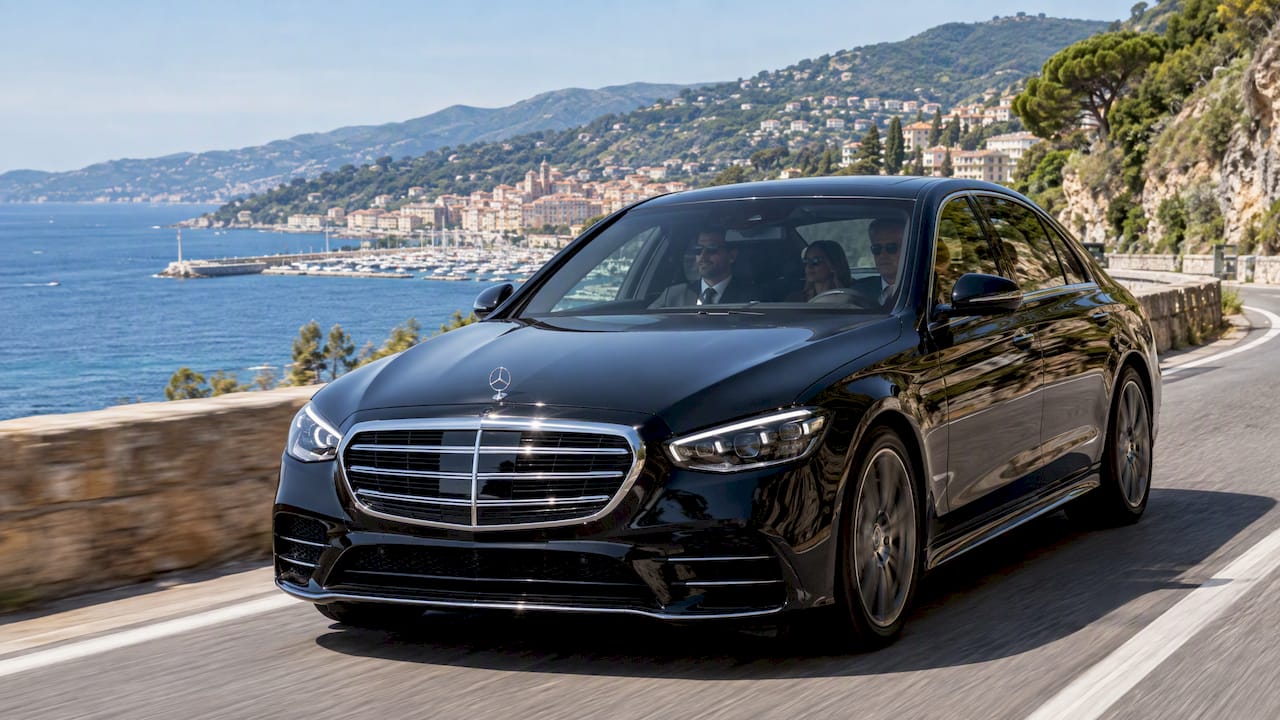
Transponyx removes the Aix TGV shuttle problem and the Avignon summer crowd-scramble in one move: a fixed 2026 rate, confirmed at booking, with no surge pricing regardless of festival dates or flight delays. The fleet covers every group size travellers actually need in Provence: Standard Sedan and Business Sedan for up to three passengers, and Van 7 pax or Van 8 pax for families and small groups moving between cities with luggage.
Typical routes include Marseille airport to Aix in roughly 25 to 30 minutes, Nice NCE to Avignon for travellers combining the Riviera with Provence, and day tours from either city through the Onyx Wine Collection, which reaches vineyards near Aix without a rental car or a train timetable to work around. Drivers are licensed VTC professionals, bilingual in English and French at minimum, and the service runs 24 hours a day, seven days a week, with 60 minutes’ free waiting time on airport pickups and flight monitoring included on every transfer. For those weighing Nice-based Riviera plans against a Provence add-on, the Nice to Avignon transfer covers that exact route at a fixed rate.
Call +33 6 10 30 71 84 or visit Transponyx to check availability and get a fixed quote for your route.
Sources
FAQ
Which is nicer, Aix-en-Provence or Avignon?
Neither is objectively nicer; they suit different priorities. Avignon offers walled medieval grandeur and the Palais des Papes, while Aix offers fountains, café terraces and a steadier, more residential atmosphere.
Which town in Provence is considered the prettiest?
There’s no single agreed answer, since Avignon’s ramparts and Aix’s fountain-lined streets appeal to different tastes. Many travellers also rate Luberon villages such as Gordes highly, though both Aix and Avignon remain the region’s two most visited bases.
Is it worth going to Aix-en-Provence?
Yes, particularly for travellers prioritising markets, café culture and boutique shopping over monument-heavy sightseeing. Its proximity to Marseille Provence Airport also makes it a practical, lower-hassle arrival base.
Is Avignon worth visiting?
Yes. The Palais des Papes and Pont Saint-Bénézet alone justify a stay, and the central TGV station makes it one of the easiest French cities to reach and explore without a car. Visit outside July if you want to avoid Festival d’Avignon crowds and pricing.
How do I get between Aix and Avignon without dealing with train transfers?
A private chauffeur transfer covers the route door to door in roughly 36 to 60 minutes by road, matching typical train times without the Aix TGV shuttle. Transponyx offers fixed 2026 rates for this route with no surge pricing, bookable through Transponyx.
0 commentaires