
The best window to see lavender in full bloom across Provence runs from mid-June to mid-July, though this shifts depending on where you stand. Lower plateaus such as Valensole tend to peak first, while higher ground around Sault and Forcalquier can stay in flower into late July. In hot, dry years, harvest can begin as early as the last week of June, stripping colour from fields faster than the calendar suggests.
Provence lavender season 2026: area-by-area timing
Provence has no single lavender season. It has several, staggered by altitude and running roughly six weeks from first colour to last cut. Understanding this gradient is the difference between a trip that catches the plateau at its most saturated and one that arrives to find rows already shorn to stubble.
Here is how the main zones typically line up:
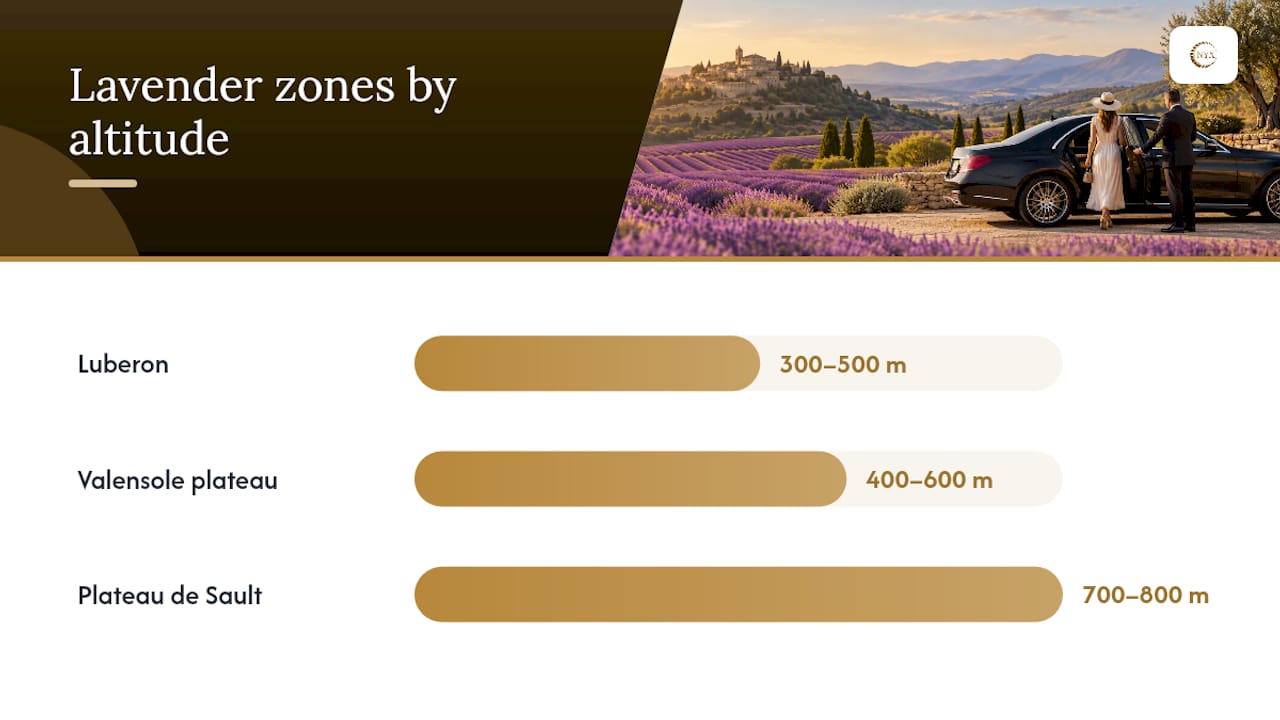
- Valensole plateau (400 to 600 metres): flowering has historically fallen between 15 June and 15 July, and in 2026 the region reported colour appearing as early as 10 June, with harvest starting on 29 June and running for roughly a fortnight, according to Provence-Alpes-Côte d’Azur Tourisme.
- Luberon (300 to 500 metres): follows Valensole closely, generally peaking through the last two weeks of June into early July, with pockets lingering slightly longer near Sénanque Abbey.
- Plateau de Sault (700 to 800 metres): later than the low plateaus, with distilleries and botanical trails opening for visits from the end of June and fields often holding colour into late July.
- Drôme Provençale: broadly similar timing to Sault, with a scattering of smaller, quieter parcels that bloom slightly later than Valensole thanks to a cooler, more northerly climate.
- Forcalquier and its surrounding hills: a mid-altitude zone that bridges Valensole’s early peak and Sault’s later one, often good for a second visit in the same trip.
Harvest is the detail most first-time visitors underestimate. Cutting does not happen everywhere at once. Farmers work plot by plot, often over two to three weeks, so a field photographed in full purple on one Tuesday can be cut by the following Monday while its neighbour remains untouched. Heat accelerates this. Extreme drought and sustained high temperatures have been shown to push flowering and harvest forward by several weeks in affected years, which is why checking conditions in the fortnight before departure matters more than trusting a fixed date on a calendar.
A quick reference for 2026 planning: if your trip window is fixed and cannot flex, aim for the last week of June through the second week of July. That period offers the broadest overlap across Valensole, the Luberon, and the lower slopes of Sault, before the earliest harvests begin clearing plots and before the higher plateau has necessarily caught up.
Where to see the best lavender fields in Provence
Each of Provence’s main lavender zones rewards a different kind of visitor, and choosing the right one matters more than chasing the perfect date.
Valensole plateau is the postcard image most people carry into the trip: flat, vast fields running to the horizon, often photographed with a solitary tree or old stone cabanon in the middle distance. Flowering here generally runs from mid-June to mid-July, and the plateau’s scale makes it the easiest place to find a quiet row even when the village itself is busy. The Lavender Museum in Valensole sits just south of the town and offers a useful primer on distillation and history, worth twenty minutes if the fields themselves are between peak and harvest.
Plateau de Sault sits higher, at roughly 700 to 800 metres, and that altitude buys extra weeks. Known locally as the cradle of lavender in Haute-Provence, it carries the Appellation d’Origine Protégée for the region’s essential oil and hosts a concentration of working distilleries. Botanical trails and distillation visits typically open from the end of June, giving a more agricultural, less manicured feel than Valensole.
The Luberon and Sénanque Abbey offer something neither plateau does: a frame. The twelfth-century abbey near Gordes, ringed by narrow lavender rows against pale stone, is one of the most photographed religious sites in France precisely because the composition does the work for you. Combine it with a stop in Roussillon or Gordes and the day becomes as much about perched villages as about the flowers.
Drôme Provençale and Forcalquier are the answer for travellers who have already done Valensole and want fewer coach parties. Both regions carry similar bloom biology to Sault but see a fraction of the visitor numbers, and Forcalquier’s rolling hills make a sensible second stop if your itinerary allows two lavender days rather than one.
The lavender route maintained by regional tourism bodies links many of these zones with waymarked stops, and it is worth following at least a section of it rather than driving directly between two headline villages.
Why lavender bloom dates shift from year to year
Two different plants share the same purple reputation, and mixing them up explains most of the confusion around bloom timing. Lavande fine (Lavandula angustifolia) is the true, wild-origin species, typically grown at higher altitude, with a finer scent and an earlier flowering habit that can still extend into late July or early August once you climb above 700 metres. Lavandin (Lavandula x intermedia), a hybrid of true lavender and spike lavender, dominates the vast commercial rows at Valensole and flowers slightly later, though it is usually harvested in bulk for its higher oil yield.
Altitude is the single biggest lever on timing. As a rough rule, every 100 to 200 metres of elevation gain delays flowering by several days to a couple of weeks, which is why Sault at 700 metres trails Valensole at 500 metres by roughly two to three weeks in a normal year.
Weather then overrides all of it. A hot, dry spring and early summer push both species forward and can advance harvest by several weeks, a pattern that has become more frequent in recent seasons. A cool, wet spring does the opposite, delaying flowering and occasionally compressing the entire regional bloom into a shorter, more intense window. This is precisely why regional reports, rather than fixed dates, are the only reliable guide once you are within a month of travel.
Planning a lavender day: routes, timing, and etiquette
Light is everything in these fields, and the difference between a flat midday shot and a glowing early one is not subtle. Arrive at Valensole or Sault between 6.30 and 8.30 in the morning and you get low, warm light, cooler air, and roads that have not yet filled with tour coaches. The same fields at 1pm in July can sit under a harsh white sun with car parks overflowing.
A realistic day plan for Valensole runs like this:
- Depart before sunrise to reach the plateau for first light, roughly 6.30am in late June.
- Photograph and walk the marked field edges for ninety minutes while temperatures stay manageable.
- Move on to Valensole village for coffee and the Lavender Museum once the light has flattened.
- Continue toward Moustiers-Sainte-Marie or the Verdon Gorge for the afternoon, returning to fields for a second, golden-hour pass around 7pm.
Parking at Valensole’s busiest roadside fields fills quickly by mid-morning in July, and unofficial verges near the most photographed rows are routinely blocked by June. Sault and the Luberon are gentler, with more formal car parks near Sénanque Abbey and in Gordes itself.
Distillery visits are worth building into the plan rather than treating as an afterthought. Traditional operations such as the Vallon des Lavandes distillery near Sault run visitor programmes across much of the year, with the fullest schedule in July and August, and group bookings available on request. If timing lines up, Sault’s Fête de la Lavande, held annually on 15 August, brings markets, distillation demonstrations and a communal harvest meal, though it marks the end of the season rather than its floral peak, so do not expect fields still in full colour that day.
Pro Tip: Never step into a working field for a photograph. Farmers rely on those rows for their annual oil yield, and trampled plants show for the rest of the season. Regional guidance is explicit on this: stick to marked paths and roadside edges, and treat every fence or hand-painted sign as a boundary, not a suggestion.

Where to stay and how to route your lavender trip
Base yourself in Aix-en-Provence or a village on the Luberon’s western edge if lavender is the priority, since both put Valensole, Gordes, and Sénanque Abbey within a manageable radius. Aix works particularly well as a hub because it also sits close to the region’s vineyards, so a lavender morning can pair naturally with an afternoon wine stop, an itinerary detailed in this guide to Provence wine touring.
Travellers staying on the coast face a longer but entirely workable route. From Nice or Cannes, the drive into Valensole or the Luberon takes roughly two to two and a half hours, which argues for an overnight stop rather than a single exhausting day trip, particularly if you want the early light. Those splitting time between the Riviera and Provence sometimes anchor a few nights in Cannes before heading inland, and practical local guidance such as this Cannes travel guide is useful for sorting accommodation before the Provence leg begins.
For a slower route, drive via Grasse and take in the perfumeries before continuing north, since the town’s perfume houses share the same lavender supply chain as the fields you are about to see in bloom.
How to photograph Provence’s lavender fields
The best light at Valensole and Sault falls in the hour after sunrise and the hour before sunset, when the sun sits low enough to rake across the rows and pick out texture in the flower heads. Midday sun flattens colour and casts hard shadows across the furrows, which is the single most common reason holiday photos of lavender fields disappoint.
Shoot from a low angle where possible, crouching so the rows recede toward the horizon rather than photographing straight down into them. A single tree, stone hut, or distant church spire gives the eye somewhere to land and lifts an otherwise repetitive pattern into a proper landscape shot. At Sénanque, position yourself on the slope opposite the abbey rather than at field level, since the elevated view is what makes that particular composition famous.
Overcast days are underrated. Soft, diffused light removes the harsh contrast of full sun and often renders the purple more accurately than a cloudless sky does, particularly on a camera phone. Arrive on a weekday morning if you can. Valensole’s roadside pull offs are genuinely difficult to use after 9am in peak season, and having the field edge to yourself changes the quality of every frame you take.
Climate change and the shifting lavender calendar
Provence’s growers have reported earlier flowering and earlier harvest in successive warm years, a pattern regional bodies now track closely. Heatwaves and drought have been shown to advance both flowering and harvest by several weeks compared with a typical season, with some plots cut as early as mid-June in the most affected years.
This has two practical consequences. First, the safe mid-June to mid-July window is compressing at the early end, meaning travellers who once treated the first week of July as a safe midpoint now sometimes arrive to find lower-altitude fields already harvested. Second, quality can suffer alongside timing. Drought-stressed plants tend to produce shorter stems and paler colour, which affects both the visual spectacle and the oil yield distilleries depend on. Higher-altitude zones such as Sault and Forcalquier are increasingly the more reliable bet for travellers who want insurance against an early, hot spring, since their extra elevation continues to buy extra weeks even as the baseline calendar shifts earlier. None of this makes any single year predictable, which is exactly why checking conditions close to departure remains more useful than relying on last year’s dates.
A chauffeur’s view of timing a Provence lavender trip
From Nice Côte d’Azur Airport, Valensole sits roughly two hours fifteen minutes away by road, while Aix-en-Provence to the same plateau takes closer to an hour and a half. Catching the fields at their best light means leaving before dawn, and that only works reliably with a driver who already knows the route and can adjust departure time the night before if a heatwave has pulled harvest forward. A private chauffeur also removes the parking scramble at Valensole’s busiest turnoffs, dropping you at the field edge and returning at a time you set, not a coach timetable’s. For bookings or route advice, TranspOnyx can be reached on +33 6 10 30 71 84 or via Transponyx.
— Dany
Book a private lavender day with TranspOnyx
A fixed-price chauffeur service can replace the rental car and road atlas approach to lavender season, offering local route knowledge to avoid traffic and early departures if harvest shifts due to weather. Rates are typically fixed per vehicle and confirmed at booking, allowing flexible planning once live bloom reports are consulted.

For a single lavender day from the coast, the Onyx Tours demi-journée or full nine-hour tour covers Valensole and a village stop such as Moustiers-Sainte-Marie in a Business Sedan, or a Van 7 pax or Van 8 pax for groups and families, with a bilingual driver handling navigation while you focus on the light. Those basing themselves on the coast can also arrange a straightforward point-to-point transfer through the Nice airport and regional transfer network before picking up a private Provence day from Aix or Cannes. To lock in a sunrise departure or check availability for a specific week in June or July 2026, call +33 6 10 30 71 84 or book directly at Transponyx.
FAQ
Which French city is famous for lavender fields?
No single city claims the title, but Valensole in the Alpes-de-Haute-Provence is the name most associated with lavender tourism thanks to its vast, easily accessible plateau in flower from mid-June to mid-July, according to regional tourism data. Sault, higher in the Vaucluse, runs a close second for travellers who want a later, quieter alternative.
What is the difference between Provence lavender and French lavender?
“French lavender” is a loose, often imprecise term used outside France, while Provence actually grows two distinct plants: lavande fine (Lavandula angustifolia), the true species prized for perfume, and lavandin, a hybrid that fills most of the vast commercial fields tourists photograph. Lavandin flowers slightly later than lavande fine and dominates plateaus like Valensole.
Where are the most beautiful lavender fields in Provence?
Valensole offers the classic vast, flat vista, while the Luberon’s Sénanque Abbey provides the most photographed single composition, with lavender rows framing a twelfth-century abbey. The Plateau de Sault, home to many working distilleries, rewards visitors who want a later bloom and a quieter, more agricultural atmosphere.
Does Provence lavender come back every year?
Yes. Lavender is a perennial shrub, and established fields flower again each summer without replanting, though individual plants are typically replaced every eight to ten years as yields decline. Bloom timing shifts annually with weather, and drought or heatwaves can push flowering and harvest several weeks earlier than a typical season.
How much does a private day trip to Valensole cost with TranspOnyx?
Onyx Tours prices a half-day, five-hour excursion at €350 to €500 and a full nine-hour day at €630 to €900, both fixed per vehicle for 2026 and confirmed at booking. Full details and current availability are listed at Transponyx.



0 commentaires