par Daniel AIT GOUGAM | Juin 30, 2026 | news
A custom travel itinerary is a personalised, preference-driven plan that structures your trip around your own pace, interests, and priorities rather than a fixed package tour schedule. Travellers who follow a tailored plan report 40% higher satisfaction than those on standard package tours. That gap exists because a bespoke plan removes the friction of mismatched activities and wasted transit time. On the French Riviera, where destinations such as Nice NCE, Monaco, Cannes, Antibes, and Saint-Tropez each demand a different pace and mood, the difference between a generic tour and a well-crafted custom travel itinerary guide is the difference between a holiday and an experience.
The right tools reduce planning time and improve the quality of your final route. Before choosing any tool, you need three things: a clear sense of your travel style, a realistic budget, and a list of non-negotiables. Without those anchors, even the best planning software produces a trip that looks good on paper but feels wrong in practice.
Manual planning versus AI-driven itinerary creation
The table below compares the two main approaches on the criteria that matter most to independent travellers.
| Criterion |
Manual planning |
AI-driven planning |
| Time to first draft |
30–60 minutes |
Under 5 minutes |
| Local nuance |
High, if researched well |
Moderate, needs human review |
| Flexibility |
Full control |
Dependent on tool settings |
| Cost |
Free |
Free to paid tiers |
| Accuracy of opening hours |
Requires manual checks |
Requires manual checks |
AI trip planners work best as digital concierges handling logistics, not as replacements for human judgement. A tool can generate a Monaco to Cannes route in seconds, but it will not know that the Cannes Film Festival in may closes several waterfront streets to general traffic.
- Google My Maps lets you plot a custom travel route visually, grouping sites by day and colour-coding by neighbourhood or theme.
- Travel blogs written by people who have visited recently provide ground-level detail that no algorithm captures reliably.
- Destination forums such as those on TripAdvisor or Reddit surface local knowledge about seasonal closures and transport quirks.
- Professional travel planners add genuine value for complex, multi-city trips where logistics require real relationships with local suppliers.
- Transponyx at https://transponyx.com offers private chauffeur expertise across the Riviera that doubles as local intelligence for transport-heavy itineraries.
The strongest approach combines an AI tool for the initial structure with manual refinement for accuracy and personality. Manual refinement remains necessary regardless of how sophisticated the tool is.
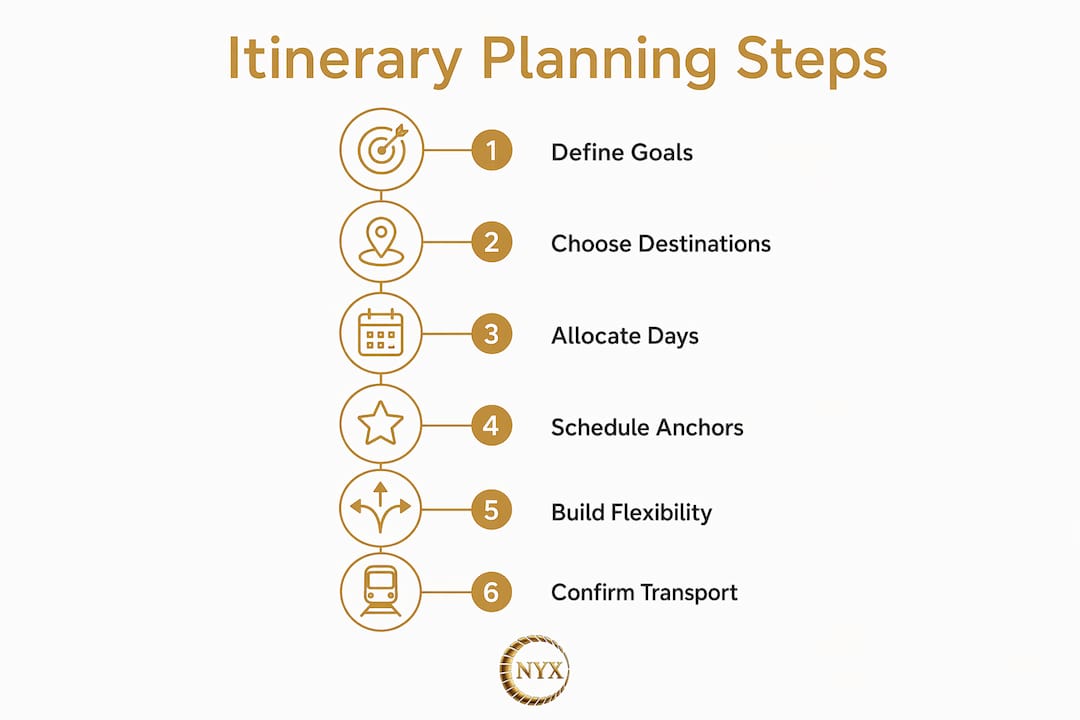
How to plan and structure your custom travel itinerary step by step
A well-structured itinerary follows a logical sequence. Skipping steps early in the process creates compounding problems later, particularly around transport connections and pacing.
Step 1: Define your trip goals and travel style
Start by writing down three to five experiences that would make the trip feel worthwhile. These become your anchor activities. Everything else fills the space around them. Personality-driven curation prevents the trap of building a trip around what looks impressive rather than what genuinely suits you. A traveller who values slow mornings and long lunches needs a very different structure from one who wants to cover six destinations in seven days.
Step 2: Choose your destinations and design a logical route
Group destinations by geography to avoid backtracking. On the Riviera, a logical west-to-east route might run Cannes, Antibes, Nice, Monaco, and Menton over five days. Reversing that order adds no value and costs time. For multi-city trips extending into Provence or northern Italy via Ventimiglia and San Remo, build the route around transport hubs rather than alphabetical order.
Step 3: Allocate days and set realistic durations
City breaks work best at 3–5 days, while multi-city or road trips benefit from 7–10 days to avoid burnout. Applying those benchmarks to the Riviera, three days in Nice covers the Old Town, the Promenade des Anglais, and a day trip to Èze or the Corniche roads without feeling rushed. A seven-day plan can comfortably include Nice, Monaco, Cannes, and a half-day in Antibes, with one day held in reserve.
Step 4: Group nearby sites and schedule anchor activities first
Book your anchor activities before filling in secondary ones. If the Monaco Grand Prix is the centrepiece of your trip, every other element should be arranged around its schedule, not the reverse. Grouping nearby sites within the same day reduces transit time significantly. The Musée Matisse and the Cimiez monastery in Nice, for example, sit within walking distance of each other and belong on the same afternoon.
Step 5: Build in flexibility and protect your energy
The ideal itinerary is a flexible framework, not a minute-by-minute timetable. Scheduling every hour removes the possibility of genuine discovery. Leave at least one unstructured half-day per three days of travel. That unscheduled time is where the most memorable moments tend to happen, whether it is a conversation with a winemaker in Bellet or an unplanned stop at a market in Antibes.
Pro Tip: Limit yourself to no more than two major activities per day. Two well-chosen experiences, fully absorbed, deliver more satisfaction than five rushed ones.
Step 6: Confirm transport connections before finalising the plan
Transport is the skeleton of any tailored vacation itinerary. A beautiful sequence of destinations collapses if the connections between them are unreliable or poorly timed. On the Riviera, the coastal train between Nice and Monaco runs frequently, but road transfers to hill villages, ski resorts such as Isola 2000 or Auron, or private estates require pre-booked private transport. Confirm every connection before you treat the itinerary as final.
How to verify and troubleshoot your itinerary before you travel
Even a carefully built plan contains errors. Verification is not optional; it is the step that separates a working itinerary from a frustrating one.
Check opening hours, seasonal closures, and local events
Museums, restaurants, and attractions on the Riviera often close on mondays or tuesdays, and many reduce hours outside the june-to-september peak season. The Cannes Film Festival in may, the Monaco Grand Prix in may, and Cannes Lions in june each alter traffic patterns, hotel availability, and restaurant bookings across the entire coast. AI-generated itineraries require manual checks for these details without exception.
Add buffer time to every day
Build 20–30% buffer time into each day’s schedule. That buffer absorbs late arrivals, longer-than-expected meals, and the kind of spontaneous detours that make a trip memorable. A day planned for eight hours of activity should have only five to six hours of fixed commitments.
Common mistakes to avoid
- Over-scheduling: Filling every hour creates fatigue and resentment. Two anchor activities per day is the professional standard.
- Ignoring transport connections: A 20-kilometre gap between two sites can mean 15 minutes by private car or 90 minutes by local bus, depending on the route.
- Skipping local vetting: Sharing your draft itinerary on destination-specific forums surfaces routing errors that no planning tool catches.
- Booking too rigidly: Holding non-refundable reservations for every meal and activity removes all flexibility and increases stress when plans shift.
Pro Tip: Post your draft route on a destination forum before you travel. Locals will identify inefficient routing, flag closed venues, and often suggest alternatives you would never find in a guidebook.
Adjusting your itinerary mid-trip
Accept that the plan will change. The skill is in knowing which changes to accept and which to resist. If a weather forecast makes an outdoor excursion impractical, swap it for an indoor anchor activity from your reserve list. Keep a short list of two or three backup options for each day so that adjustments take minutes rather than hours.
How to integrate luxury ground transport into your Riviera itinerary
Transport is not a footnote in a well-crafted itinerary. On the French Riviera, where the most rewarding destinations sit between mountain passes, coastal cliffs, and private estates, the quality of your transfers directly affects the quality of your experience.
Why private chauffeur transfers change the itinerary equation
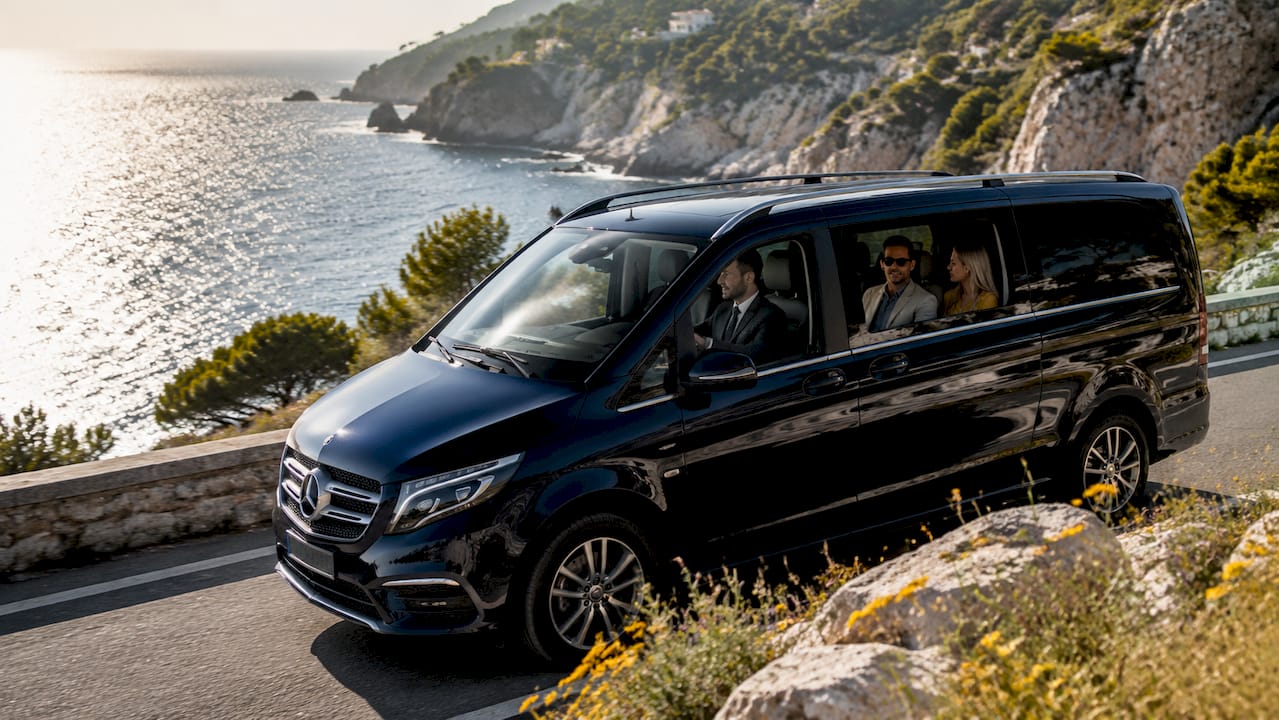
Luxury ground transport amplifies comfort and logistical efficiency, particularly in regions where attractions are dispersed and public connections are infrequent. A private chauffeur eliminates parking stress in Monaco, removes the uncertainty of taxi availability after a late dinner in Cannes, and ensures you arrive at Nice Côte d’Azur Airport (NCE) on time regardless of coastal traffic. For event travel during the Monaco Grand Prix or the Cannes Film Festival, pre-booked private transfers are not a luxury. They are a practical necessity.
Transponyx fleet options for every group size
Transponyx operates exclusively Mercedes-Benz vehicles across four categories, each suited to a different itinerary configuration.
- Standard Sedan: Up to 3 passengers. Ideal for couples or solo travellers on point-to-point transfers between Nice NCE and Monaco or Cannes.
- Business Sedan: Up to 3 passengers, premium finish. The preferred choice for corporate travellers attending MIPIM, Cannes Lions, or MIPCOM.
- Van 7 pax: Up to 7 passengers. Well-suited to small groups covering multiple Riviera stops in a single day.
- Van 8 pax: Up to 8 passengers. The right vehicle for families or groups combining an airport transfer with a wine tour through Provence.
All vehicles carry Wi-Fi, air conditioning, chilled water, and phone chargers. Child seats are available on request.
Coordinating chauffeur bookings with your itinerary timings
The most effective approach is to book transport at the same time as anchor activities, not afterwards. Transponyx includes flight monitoring on every airport transfer from Nice NCE, with 60 minutes of free waiting time on all airport pickups and 20 minutes for any other address. That policy removes the anxiety of delayed flights disrupting the first day of a carefully planned trip. Fixed 2026 rates are confirmed at booking with no surge pricing, which means your transport budget is locked from day one.
For personalised transfers on the Riviera, Transponyx drivers are licensed VTC professionals, bilingual in English and French as a minimum, with several also speaking Italian, Spanish, Russian, or Arabic. That multilingual capability matters on a coast where itineraries frequently cross into Italy via Ventimiglia or San Remo. Reach the reservations team on +33 6 10 30 71 84 or via WhatsApp on +33 7 67 78 10 26.
What I have learned from building itineraries on the Riviera
The most common error I see in travellers’ plans is the belief that more structure equals more control. It does not. A tightly packed schedule creates the illusion of efficiency while actually reducing the quality of every individual experience. The traveller who tries to cover Monaco, Èze, Antibes, and Cannes in a single day arrives at each place too tired to appreciate it.
The second lesson is that a personalised itinerary reflects your personality, not a destination’s greatest hits list. I have met travellers who spent three days in Nice without visiting the Promenade des Anglais once because their interests ran entirely to food markets and contemporary art. Their itinerary was correct for them, even though it looked incomplete on paper.
Transport is where most itineraries quietly fail. Travellers invest hours selecting restaurants and attractions, then leave transfers to chance. On the Riviera, that approach costs time and composure. Booking a private sightseeing transfer with Transponyx for a full-day Corniche route, for example, turns a logistical exercise into part of the experience itself. The driver knows which viewpoints are worth stopping at and which are tourist traps.
The final observation is about local intelligence. No planning tool, however sophisticated, replaces a conversation with someone who drove the route last week. That is true whether the source is a forum post, a hotel concierge, or a Transponyx driver who has covered the Nice NCE to Saint-Tropez route hundreds of times. Build that intelligence into your process from the start, not as an afterthought.
— Dany
Transponyx: private chauffeur services built for your Riviera itinerary
Planning a tailored vacation itinerary on the French Riviera is only as strong as the transport holding it together. Transponyx provides fixed-rate, 24/7 private chauffeur services across the entire Côte d’Azur, from Nice NCE airport transfers to full-day excursions through Provence and the Ligurian coast.
The fleet covers every group size, from a Standard Sedan for a couple arriving at Nice NCE to a Van 8 pax for a corporate group heading to Cannes for the Film Festival. All 2026 rates are fixed per vehicle and confirmed at booking. For travellers who want their luxury chauffeur service to match the quality of their itinerary, Transponyx is the natural choice on the Riviera. Book via https://transponyx.com, call +33 6 10 30 71 84, or message on WhatsApp at +33 7 67 78 10 26.
FAQ
What is a custom travel itinerary?
A custom travel itinerary is a personalised trip plan built around your specific interests, pace, and budget rather than a fixed package tour schedule. Travellers using tailored plans report 40% higher satisfaction than those on standard packages.
How long does it take to create a personalised travel plan?
Manual creation of a basic itinerary takes 30–60 minutes, while AI-powered tools produce a first draft in under five minutes. Human refinement for accuracy and local detail is always required regardless of the method used.
How many activities should I plan per day?
No more than two major activities per day is the recommended standard for maintaining energy and genuine engagement. Buffer time of 20–30% should be added to each day’s schedule to absorb delays and spontaneous detours.
How do I integrate private transport into my French Riviera itinerary?
Book chauffeur transfers at the same time as your anchor activities, not as an afterthought. Transponyx offers fixed 2026 rates, flight monitoring on all Nice NCE airport pickups, and a Mercedes-Benz fleet covering groups of 1–8 passengers across the entire Riviera.
What is the ideal length for a Riviera trip itinerary?
City breaks work best at 3–5 days, while multi-destination trips covering Nice, Monaco, Cannes, and Provence benefit from 7–10 days. Shorter trips should concentrate on one or two anchor destinations rather than attempting to cover the full coast.

par Daniel AIT GOUGAM | Juin 29, 2026 | news
Point to point travel is defined as a direct transfer between a single origin and a single destination, with no intermediate stops, hubs, or route deviations. The industry term for this model in ground transport is a “point to point transfer,” and it sits at the opposite end of the spectrum from hub and spoke systems, where passengers route through a central interchange. On the French Riviera, point to point transportation is the standard for private chauffeur services: one pickup address, one drop off address, a fixed rate confirmed at booking, and a licensed VTC professional behind the wheel. Transponyx operates this model across all its primary routes, from Nice Côte d’Azur Airport (NCE) to Monaco, Cannes, Antibes, Menton, and Saint-Tropez.
What is point to point travel and how does it differ from hub and spoke?
Point to point travel connects an origin directly to a destination with no intermediate stops or hubs, making it the most direct form of ground or air transportation available. The hub and spoke model, by contrast, routes passengers through a central node before continuing to their final destination. That additional leg adds time, transfer risk, and unpredictability.

In aviation, point to point operations improve aircraft utilisation and reduce delay risk compared to hub and spoke systems. The same logic applies to ground transport: a vehicle that travels directly from Nice NCE to Monaco carries no risk of a missed connection at an intermediate stop. The passenger arrives faster, with fewer variables in play.
Hub and spoke networks maximise global connectivity. Point to point models prioritise simplicity and directness, which is precisely why leisure and business travellers on the Riviera favour them. When you are catching a flight from Nice or attending the Monaco Grand Prix, a direct transfer is not a luxury. It is the only rational choice.
The point to point travel definition is also important for understanding what the service does not include. It does not cover multiple pickup addresses, unplanned waiting time at intermediate locations, or flexible routing decided mid journey. Those requirements belong to an hourly, as directed service. Knowing the distinction before you book prevents misunderstandings and additional charges.
How does point to point travel work for private chauffeur services?
Point to point pricing is fixed at booking, providing cost certainty regardless of traffic conditions or demand fluctuations. The rate you see when you confirm your reservation is the rate you pay. There are no adjustments for congestion on the A8 motorway between Nice and Cannes, and no surge multiplier applied during the Cannes Film Festival or MIPIM.
The operational structure is straightforward. You provide one pickup address and one drop off address. The chauffeur arrives at the agreed time, assists with luggage, and drives directly to your destination. The journey is a single, defined trip. No detours, no additional passengers collected en route, no stops unless you have specifically arranged them as part of a different service type.
For airport transfers, the model includes additional features that reflect the unpredictability of air travel. Flight tracking is included on every airport pickup, enabling the chauffeur to adjust arrival time automatically if your flight is delayed. Transponyx includes 60 minutes of complimentary waiting time on all airport pickups, and 20 minutes for any other address. Providing your flight number at the time of booking is the single most effective step you can take to guarantee a punctual collection.
The difference between point to point and hourly as directed service is worth understanding clearly. Point to point suits any traveller with a defined route and a fixed destination. Hourly service suits travellers who need a driver to wait, make multiple stops, or remain available for several hours, such as during a full day of business meetings across Monaco and Cannes.
- Fixed rate confirmed at booking: the price does not change after confirmation, regardless of traffic or demand
- Single pickup, single drop off: one origin address, one destination address, no intermediate stops
- Flight monitoring included: chauffeur tracks your flight in real time and adjusts arrival accordingly
- 60 minutes free waiting at airports: 20 minutes free waiting at all other addresses
- Licensed VTC professionals: bilingual in English and French as a minimum, with some drivers also speaking Italian, Spanish, Russian, or Arabic
Pro Tip: When booking a point to point airport transfer, always provide your flight number rather than just your scheduled arrival time. The chauffeur can then track the actual landing and adjust the pickup accordingly, removing any anxiety about delays.
What are the benefits and limitations of point to point transportation?
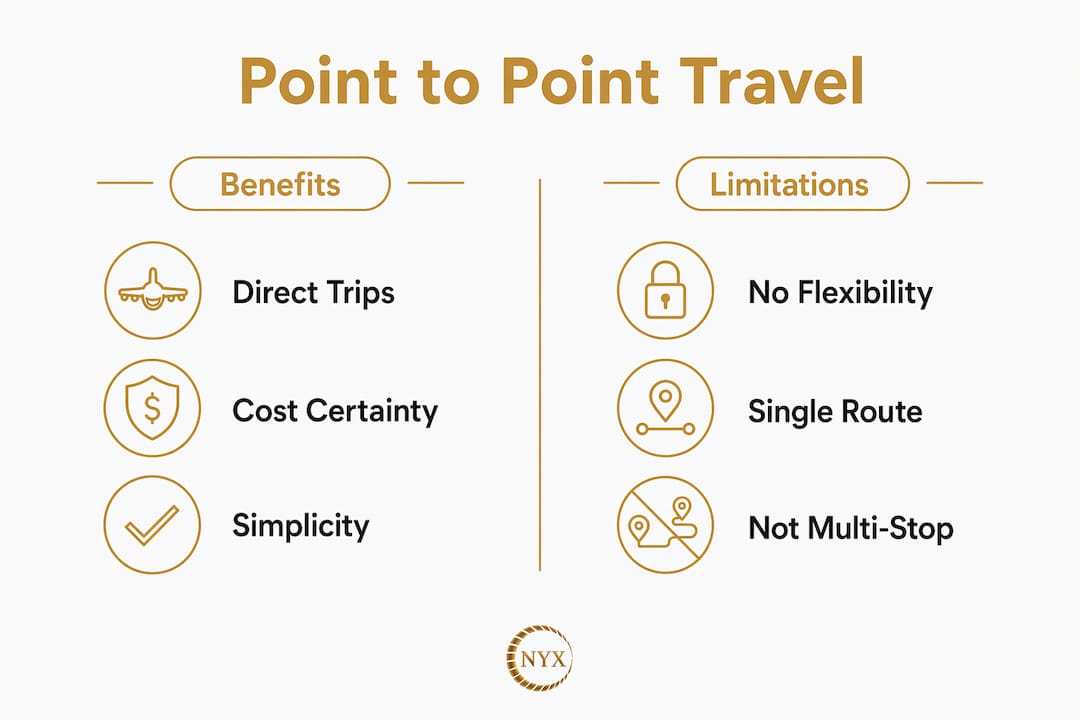
Point to point travel reduces the risk of missed connections and the stress associated with multi stage journeys. For a traveller flying into Nice NCE and heading directly to a hotel in Cannes, a direct transfer takes approximately 30 minutes by road. A journey involving a public bus, a train connection, and a taxi at the other end could take well over 90 minutes, with luggage handled multiple times.
Cost predictability is the second major advantage. Fixed rate pricing removes the uncertainty that comes with metered taxis or rideshare surge pricing. A traveller attending MIPCOM in Cannes in october knows their transfer cost from Nice NCE before they leave home. That certainty matters for both personal budgeting and corporate expense reporting.
The simplicity of the model also reduces cognitive load during travel. There are no timetables to check, no platforms to find, and no connections to monitor. The chauffeur manages the logistics. The passenger manages nothing except their own schedule.
Limitations do exist. Point to point transportation is not suited to travellers who need flexibility mid journey. If you decide to add a stop in Antibes between Nice NCE and Cannes, a point to point booking cannot accommodate that without renegotiation. The model is also less cost effective for very short distances where a standard taxi would suffice, or for very long multi city itineraries where an hourly arrangement provides better value.
| Feature |
Point to point transfer |
Hub and spoke / multi stop |
| Journey directness |
Direct, no intermediate stops |
Routes through hubs or multiple stops |
| Pricing model |
Fixed rate confirmed at booking |
Variable, metered, or hourly |
| Stress level |
Low, single defined trip |
Higher, connection dependent |
| Flexibility |
Fixed origin and destination |
Adaptable mid journey |
| Best suited for |
Airport transfers, event logistics |
City tours, multi stop business days |
| Waiting time risk |
Minimal |
Higher at each connection point |
The table above illustrates why point to point suits the majority of Riviera transfers. For the Cannes Film Festival, the Monaco Grand Prix, or a straightforward airport arrival, the direct model wins on every metric that matters to a time conscious traveller.
How is pricing structured for point to point services on the French Riviera?
Fixed flat rate pricing confirmed at booking is the defining characteristic of professional point to point ground transport in 2026. The rate is set per vehicle, not per passenger, which makes group travel particularly cost effective. A Van 7 pax carrying six colleagues from Nice NCE to Monaco costs the same as one carrying two.
The contrast with rideshare surge pricing is significant. Rideshare platforms apply demand multipliers during peak periods, which means a transfer from Nice NCE to Cannes during the Film Festival can cost several times the standard fare. A pre booked fixed rate transfer with Transponyx carries no such risk. The rate confirmed at booking is the rate charged, regardless of what is happening on the Croisette that evening.
Pre booking at least 24 hours in advance is best practice for securing fixed pricing and vehicle availability. Transponyx accepts same day requests subject to availability, but advance booking guarantees both the vehicle category and the locked rate. During major Riviera events such as MIPIM in march or Cannes Lions in june, availability tightens considerably. Booking early is not merely advisable. It is the only reliable strategy.
The pricing structure at Transponyx covers four vehicle categories. The Standard Sedan and Business Sedan each carry up to 3 passengers, with the Business Sedan offering a premium interior finish suited to executive travel. The Van 7 pax accommodates up to 7 passengers, and the Van 8 pax up to 8. All vehicles are Mercedes-Benz, equipped with Wi-Fi, air conditioning, chilled water, and phone chargers. Child seats are available on request.
- Rate confirmed at booking: no adjustments for traffic, demand, or time of day
- Per vehicle pricing: groups pay one rate regardless of passenger count within the vehicle’s capacity
- No surge pricing: fixed rates apply during the Cannes Film Festival, Monaco Grand Prix, MIPIM, and all other peak periods
- Meet and greet included: chauffeur meets passengers at the arrivals hall with a name board
- Luggage assistance included: no additional charge for standard luggage handling
How to choose the right point to point transport option
Choosing the correct vehicle category is the first practical decision in any point to point booking. Group size and luggage volume determine this, not personal preference alone. A couple travelling from Nice NCE to Monaco with two suitcases fits comfortably in a Standard Sedan. A family of five with ski equipment heading to Isola 2000 requires a Van 7 pax or Van 8 pax.
The choice between point to point and hourly as directed service depends entirely on your itinerary. Point to point car service is most economical when the passenger has a defined route. If you have a single destination and no need for the driver to wait or make additional stops, point to point is the correct and more affordable option. If your day involves multiple meetings across different locations, or if you need a driver on standby for several hours, hourly service provides the flexibility that point to point cannot.
- Define your route precisely. Confirm your pickup address and destination before booking. A hotel name is sufficient for the drop off. For airport pickups, the terminal number and flight details are required.
- Select the vehicle for your group size. Standard Sedan and Business Sedan for up to 3 passengers. Van 7 pax for up to 7. Van 8 pax for up to 8. Never underestimate luggage volume when choosing.
- Book at least 24 hours ahead. This locks the rate and guarantees vehicle availability, particularly during Riviera events.
- Provide your flight number for airport transfers. This activates flight monitoring and ensures the chauffeur adjusts for any delay automatically.
- Confirm child seat requirements at booking. Transponyx provides child seats on request, but they must be arranged in advance.
For event travel on the French Riviera, point to point transfers are the standard professional approach. During the Monaco Grand Prix in may, road access around the Principality is restricted. A licensed VTC professional with local knowledge navigates these restrictions efficiently. The same applies to Cannes during the Film Festival in may, when hotel drop offs require specific routing knowledge that a general taxi driver may not possess.
Pro Tip: For group travel to Riviera events, book a Van 7 pax or Van 8 pax rather than splitting your party across two sedans. One vehicle costs less than two, keeps the group together, and simplifies the logistics considerably.
Why point to point travel suits the modern Riviera traveller
The travellers I see using point to point transfers most effectively are not necessarily the wealthiest. They are the most organised. They have a defined itinerary, a clear destination, and no appetite for variables. That profile fits both the senior executive flying into Nice NCE for a day of meetings in Monaco and the family arriving for a fortnight in Antibes who simply want to reach their villa without incident.
What strikes me about the current moment in 2026 is how much the expectations around ground transport have shifted. Business travellers now treat the transfer as part of the working day. They expect Wi-Fi, a quiet cabin, and a driver who does not require navigation instructions. Point to point delivers all of that within a predictable cost framework. Hourly service, by contrast, introduces ambiguity: the meter runs, the schedule drifts, and the final invoice rarely matches the estimate.
The Riviera event calendar amplifies this dynamic. During MIPIM in march, Cannes Lions in june, or MIPCOM in october, the demand for reliable ground transport spikes sharply. Travellers who have pre booked fixed rate point to point transfers arrive on time and on budget. Those who rely on ad hoc arrangements frequently do not. I have spoken with enough concierge managers at Riviera hotels to know that last minute transfer failures during peak events are a recurring source of guest complaints.
Transponyx has built its reputation on exactly the qualities that point to point travel demands: punctuality, fixed pricing, and professional drivers who treat every transfer as a commitment rather than a transaction. The private transfer model works because it removes ambiguity entirely. You know the price, you know the vehicle, and you know the driver will be there. That is not a small thing when you are arriving at Nice NCE at midnight after a delayed flight from London.
— Dany
Transponyx point to point transfers on the French Riviera
Transponyx operates fixed rate point to point transfers across the French Riviera, 24 hours a day, 7 days a week. Every booking includes flight monitoring for airport pickups, meet and greet at the arrivals hall, and a licensed bilingual VTC professional.
The fleet covers all group sizes: Standard Sedan and Business Sedan for up to 3 passengers, Van 7 pax for up to 7, and Van 8 pax for up to 8. All vehicles are Mercedes-Benz, equipped with Wi-Fi, air conditioning, chilled water, and phone chargers. Primary routes include Nice NCE to Monaco, Cannes, Antibes, Menton, Saint-Tropez, and Alpine ski resorts including Isola 2000 and Auron. Long distance transfers to Milan, San Remo, and Ventimiglia are also available. For a full overview of luxury chauffeur options and 2026 fixed rates, visit https://transponyx.com or call +33 6 10 30 71 84.
FAQ
What is the point to point travel definition?
Point to point travel is a direct transfer between a single origin and a single destination, with no intermediate stops, hubs, or route deviations. The rate is fixed at booking and does not change based on traffic or demand.
How does point to point travel differ from hourly chauffeur hire?
Point to point is a single defined trip from one address to another, priced as a flat rate per vehicle. Hourly hire suits travellers who need a driver to wait, make multiple stops, or remain available across a flexible schedule.
Is flight tracking included in point to point airport transfers?
Flight tracking is included on every airport pickup with Transponyx, allowing the chauffeur to adjust arrival time automatically if your flight is delayed. Providing your flight number at booking activates this feature.
When should I pre book a point to point transfer?
Pre booking at least 24 hours in advance is best practice to secure fixed pricing and vehicle availability. During major Riviera events such as the Cannes Film Festival or Monaco Grand Prix, advance booking is the only reliable way to guarantee your preferred vehicle.
What vehicles are available for point to point travel with Transponyx?
Transponyx offers four Mercedes-Benz vehicle categories: Standard Sedan and Business Sedan for up to 3 passengers, Van 7 pax for up to 7 passengers, and Van 8 pax for up to 8 passengers. All vehicles include Wi-Fi, air conditioning, chilled water, and phone chargers.

par Daniel AIT GOUGAM | Juin 28, 2026 | news
Secure travel is the practice of proactively protecting personal safety and digital security during journeys, minimising exposure to theft, cyber threats, and logistical failures. The reasons why opt for secure travel have never been more pressing: travel safety incidents rose 15% in 2024, placing the probability of encountering a problem at 1 in 217 on any given trip. That figure represents a genuine shift in the risk environment, not a statistical anomaly. Physical threats, digital scams, and transport vulnerabilities now combine in ways that catch even experienced travellers off guard. This guide covers the full picture, from the French Riviera to international routes, with specific strategies that work in 2026.
Why opt for secure travel: the risks that make it non-negotiable
The biggest risks for modern travellers are logistical and digital, not violent crime. Experts confirm that successful travellers prioritise protection against high-probability petty theft and phishing over rare violent incidents. That reframing matters. Most travellers over-prepare for the wrong threats and leave themselves exposed to the common ones.
Physical threats in popular destinations
Petty theft is accelerating in Europe’s most visited cities. Pickpocketing in Rome surged 68% year on year in 2024, and 87% of UK tourists now take active protective measures when travelling abroad. The French Riviera presents its own version of this problem. During the Monaco Grand Prix in may, the Cannes Film Festival, and MIPCOM in october, crowds concentrate around transport hubs, hotel lobbies, and waterfront promenades. Opportunistic theft peaks at exactly these moments, when travellers are distracted, carrying valuables, and moving between venues under time pressure.
Transport scams compound the physical risk. Unlicensed drivers operating outside Nice Côte d’Azur Airport (NCE) charge unmetered fares, take longer routes, and occasionally refuse to complete journeys. Travellers arriving late at night from London, Paris, or Milan are particularly vulnerable. A confirmed, fixed-rate booking with a licensed VTC operator removes this risk entirely before the journey begins.
Digital threats targeting travellers
The digital threat environment has grown sharper. A single phishing campaign impersonating Booking.com accounted for 47% of all travel-sector cyber threats in march 2025. That concentration of malicious activity around one trusted brand name shows how effectively criminals exploit traveller trust. Fake booking confirmations, fraudulent Wi-Fi networks in hotel lobbies, and SIM swap attacks targeting travellers abroad are now standard tools in the cybercriminal toolkit.
The convergence of convenience and urgency during travel creates ideal conditions for these attacks. When you are rushing to check in, confirm a transfer, or access your itinerary on airport Wi-Fi, your guard drops. Cybercriminals design their attacks around exactly that moment.
- Phishing emails mimicking airline and hotel brands
- Fake Wi-Fi hotspots in airports and hotel lobbies
- SIM swap attacks targeting travellers’ mobile numbers
- Fraudulent transport booking sites with near-identical URLs
- Credential reuse attacks exploiting passwords shared across accounts
What are the key benefits of opting for secure travel?
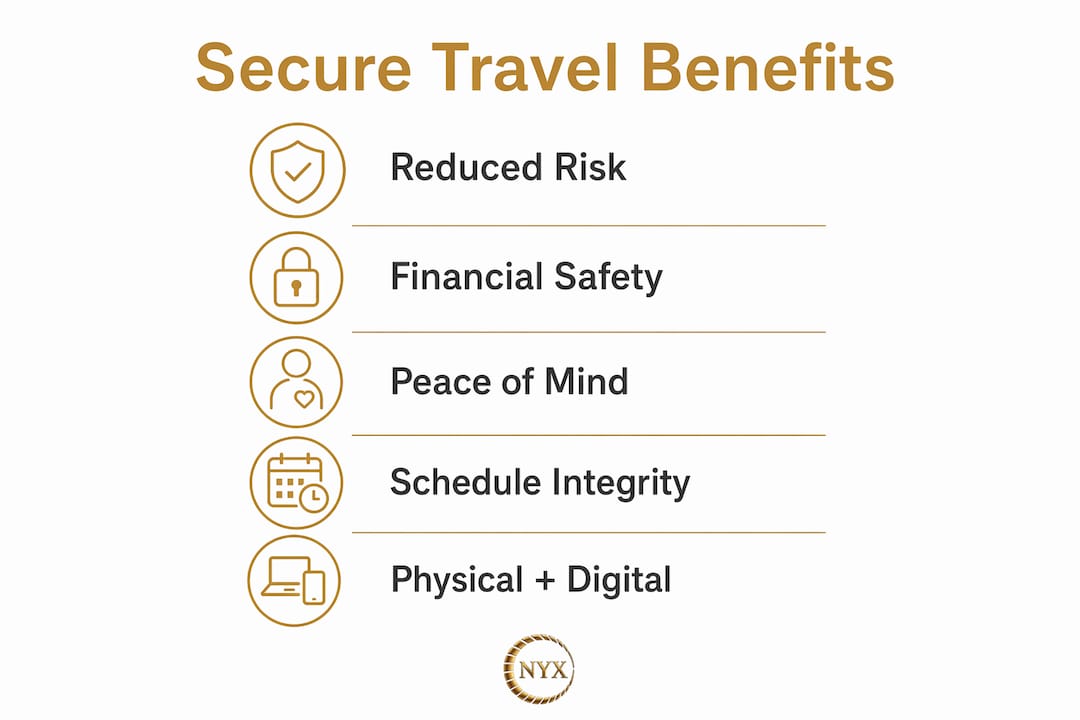
The benefits of safe travel extend well beyond avoiding theft. Secure travel choices produce measurable improvements in comfort, cost control, and mental clarity throughout a trip.
Reduced financial exposure
Professional transport and accommodation choices eliminate the most common sources of unexpected expense. A licensed chauffeur service with fixed, confirmed rates removes surge pricing, route manipulation, and fare disputes. Transponyx operates on this model across the French Riviera, with 2026 rates confirmed at booking for every route from Nice NCE to Monaco, Cannes, Antibes, Menton, and Saint-Tropez. There are no surprises on arrival.
Travel insurance claims for theft, device loss, and medical incidents add up quickly. Travellers who invest in physical security measures, vetted transport, and digital protection spend less on remediation than those who do not. The cost of a VPN subscription, for instance, is modest. A VPN costing between $4 and $8 per month encrypts all data transmitted over insecure hotel and airport Wi-Fi networks. That is a negligible cost against the potential loss of banking credentials or personal data.
Peace of mind as a practical advantage
Peace of mind is not a soft benefit. When you are not managing anxiety about theft, scams, or unreliable transport, you make better decisions. Business travellers attending MIPIM in Cannes or corporate roadshows along the Riviera need full cognitive availability for meetings, not for logistics management. Leisure travellers exploring Provence or the Côte d’Azur deserve to focus on the experience, not on whether their driver is legitimate.
Secure transport plays a direct role here. Transponyx drivers are licensed VTC professionals, bilingual in English and French, with flight monitoring included on every airport transfer and 60 minutes of free waiting time at NCE. That structure removes the single largest source of arrival anxiety: the uncertainty of whether your driver is there, where they are, and what the fare will be.
Pro Tip: Book your airport transfer before you land, not after. Confirmed bookings with fixed rates and a named driver eliminate the decision-making pressure that makes travellers vulnerable to unlicensed operators at arrival halls.
Continuity of plans and itineraries
Secure travel preserves the integrity of your schedule. A missed connection caused by an unreliable transfer, a cancelled booking from a fraudulent site, or a lost device containing your itinerary can collapse an entire trip. Layered security measures, physical and digital, act as redundancy. Each layer compensates for a failure in another, so a single problem does not cascade into a full disruption.
How do secure travel strategies combine physical and digital protective layers?
Layered travel security combines physical foundations such as secure documents and transport with digital identity management and active monitoring to minimise overall risk. No single measure is sufficient. The value of the layered approach is that it eliminates single points of failure.
Physical security layer
| Measure |
What it addresses |
Practical example |
| Vetted chauffeur service |
Transport scams, unlicensed drivers |
Transponyx fixed-rate VTC from Nice NCE |
| Anti-theft bag or money belt |
Pickpocketing in crowded areas |
Worn during Monaco Grand Prix or Cannes Lions |
| Certified document copies |
Passport loss or theft |
Stored separately from originals |
| Secure accommodation |
Room entry, valuables storage |
Hotel safe for devices and documents |
| Situational awareness |
Opportunistic theft |
Heightened in transport hubs and event crowds |

Physical secure transportation on the Côte d’Azur is the foundation of the physical layer. A vetted driver in a tracked, licensed vehicle is categorically different from an unlicensed operator. The difference is not comfort. It is accountability, traceability, and the absence of financial ambiguity.
Digital security layer
Digital protection requires its own set of deliberate choices. Isolating your digital identity using forwarding email aliases before travel nullifies primary attack vectors including credential reuse and SIM swap. This means creating a dedicated email alias for travel bookings, so that a compromised booking confirmation cannot expose your primary account.
A dedicated travel device logged out of personal clouds significantly reduces risk during border crossings and in the event of device loss. This approach is more effective than using a burner phone, because it preserves full functionality while keeping personal data isolated. Two-factor authentication on all travel-related accounts adds a further barrier that most attackers will not attempt to bypass.
Pro Tip: Enable full-disk encryption on your travel device before departure. If the device is lost or seized, encrypted storage renders the contents inaccessible without your passphrase.
Experts advise prioritising physical device security and encrypted backups over fears of juice jacking, which remains a rare threat. Device loss is the real risk. A device left in a taxi, dropped at an airport, or taken at a border crossing exposes everything stored on it unless it is encrypted and backed up.
Why the layers must work together
Each layer compensates for gaps in the other. Physical security prevents device theft, but encryption limits the damage if theft occurs. A vetted transport booking prevents logistical failure, but a confirmed itinerary backup ensures you can rebook if needed. Securing digital identity is now as critical as choosing safe physical accommodation and transport. Treating them as separate concerns leaves gaps that are easy to exploit.
What practical steps can travellers take today to ensure travel security?
Implementing secure travel habits does not require specialist knowledge. The following steps cover the most effective measures, ordered by the sequence in which you would typically apply them.
-
Prepare your documents. Make certified copies of your passport, travel insurance, and visa documents. Store digital copies in an encrypted cloud folder separate from your primary account. Carry physical copies in a different bag from your originals.
-
Book transport in advance with a licensed operator. For arrivals at Nice NCE, a pre-booked airport transfer to Monaco or Cannes with Transponyx confirms your fare, your driver, and your waiting time before you board your flight. The journey from NCE to Monaco takes approximately 30 minutes. To Cannes, allow 30–40 minutes depending on traffic. Both routes are covered by Transponyx’s 2026 fixed rates.
-
Set up a VPN before departure. Install and test your VPN at home, not at the airport. A subscription costing $4–$8 per month covers all public Wi-Fi use throughout your trip.
-
Create a dedicated travel email alias. Use it exclusively for booking confirmations, hotel correspondence, and transport receipts. If it is compromised, your primary account remains unaffected.
-
Back up your devices. Complete a full encrypted backup before departure. Store the backup in a location that is not physically with you during travel.
-
Use a password manager. Generate unique, strong passwords for every travel-related account. Never reuse passwords across booking platforms, airline accounts, or hotel loyalty programmes.
-
Plan your logistics with security in mind. Know your driver’s name, vehicle registration, and contact number before you land. Transponyx provides this information in advance for every booking. Confirm your accommodation address and nearest emergency services before arrival.
-
Maintain situational awareness at transport hubs. Nice NCE, Monaco’s Fontvieille district during the Grand Prix, and the Palais des Festivals in Cannes during major events are all high-density environments where opportunistic theft peaks. Keep bags in front of you and avoid displaying devices unnecessarily.
The airport transfer tips that experienced business travellers use consistently come back to one principle: remove uncertainty before it becomes a problem. Confirmed bookings, encrypted devices, and isolated digital identities are all forms of pre-emptive certainty.
Travel security in 2026: what experience on the Riviera has taught me
The conversation around travel safety has shifted considerably over the past few years, and not always in the right direction. Most articles focus on violent crime statistics, which are genuinely rare for the majority of travellers, while underplaying the threats that actually materialise: a phishing email that looks exactly like a hotel confirmation, an unlicensed driver at NCE who quotes one price and charges another, a device left in a Business Sedan that contains an entire corporate itinerary.
I have covered the French Riviera during the Monaco Grand Prix, the Cannes Film Festival, and MIPIM. The pattern is consistent. Travellers who encounter problems are not the ones who failed to read a government travel advisory. They are the ones who made a last-minute transport booking from an unverified site, connected to hotel Wi-Fi without a VPN, or carried their passport and cash in the same bag. These are not failures of awareness. They are failures of preparation.
The Riviera is not a dangerous destination. It is, however, a high-density, high-value environment during its major events, and that combination attracts opportunists. A licensed private chauffeur service removes the transport risk entirely. Transponyx drivers are tracked, licensed, and accountable. The fare is fixed. The vehicle is a Mercedes-Benz. None of that is luxury for its own sake. It is the physical security layer applied to ground transport.
Digital security deserves the same deliberate attention. I now treat a VPN, a dedicated travel device, and email aliases as standard equipment, in the same category as travel insurance. The travellers I see managing their trips most confidently are the ones who made these decisions before they left home, not the ones scrambling to fix problems at the airport.
— Dany
Secure transport on the French Riviera with Transponyx
Transponyx provides licensed VTC and private chauffeur services across the French Riviera, with 2026 fixed rates confirmed at booking and no surge pricing on any route.
The fleet covers four vehicle categories: Standard Sedan, Business Sedan, Van 7 pax, and Van 8 pax, all Mercedes-Benz, all equipped with Wi-Fi, air conditioning, chilled water, and phone chargers. Routes cover Nice NCE to Monaco, Cannes, Antibes, Menton, Saint-Tropez, and Alpine ski resorts including Isola 2000 and Auron. Long-distance transfers to Milan, San Remo, and Ventimiglia are also available. Flight monitoring and 60 minutes of free waiting time are included on every airport pickup. For luxury chauffeur benefits in Nice or to book directly, visit https://transponyx.com or call +33 6 10 30 71 84.
FAQ
Why opt for secure travel rather than standard transport?
Secure travel removes the most common sources of financial loss and logistical failure, including transport scams, phishing attacks, and device theft. Standard transport options offer no accountability, no fixed pricing, and no recourse if something goes wrong.
What is the biggest digital risk for travellers in 2026?
Phishing campaigns targeting travellers are the dominant digital threat. A single campaign impersonating Booking.com accounted for 47% of travel-sector cyber threats in march 2025, making email security and VPN use the most critical protective measures.
How does a VPN improve travel safety?
A VPN encrypts all data transmitted over public Wi-Fi networks in hotels and airports, preventing interception of passwords, banking credentials, and personal information. Subscriptions cost $4–$8 per month and cover unlimited use throughout a trip.
What makes a chauffeur service more secure than a standard taxi?
Licensed VTC operators such as Transponyx provide fixed fares confirmed before travel, tracked vehicles, and professional drivers with verifiable credentials. Standard taxis and unlicensed operators offer none of these protections, particularly at busy arrival points like Nice NCE.
How should travellers protect their devices during a trip?
Encrypted backups and device security are the priority. A dedicated travel device logged out of personal cloud accounts, combined with full-disk encryption, limits the damage from loss or theft far more effectively than any other single measure.

par Daniel AIT GOUGAM | Juin 27, 2026 | news
Executive travel service is defined as a premium, personalised travel management solution built specifically for senior executives and corporate leadership teams. It goes well beyond standard business travel by combining 24/7 concierge support, proactive disruption handling, priority bookings, and bespoke itinerary planning into a single, coordinated offering. The goal is direct: preserve the executive’s cognitive energy and professional effectiveness at every stage of the journey. On the French Riviera, where business events such as the Cannes Film Festival, Monaco Grand Prix, and MIPIM draw senior professionals from across the globe, providers like Transponyx deliver this standard through licensed VTC chauffeurs and fixed 2026 rates across routes including Nice NCE to Monaco and Cannes.
What is executive travel service and how does it differ from standard business travel?
Executive travel service is a high-touch management solution tailored for C-level executives, involving personalised itinerary planning, 24/7 concierge support, and real-time disruption handling. Standard corporate travel management books flights and hotels. Executive travel management anticipates every variable between departure and arrival and resolves problems before the traveller notices them.
The distinction shows up clearly in the features each model provides:
| Feature |
Standard business travel |
Executive travel service |
| Booking support |
Self-service or basic agent |
Dedicated personal travel assistant |
| Airport experience |
Standard check-in |
VIP lounge access, fast-track security |
| Itinerary changes |
Subject to fees and availability |
Flexible, often at no additional cost |
| Ground transport |
Taxi or ride-hail app |
Chauffeur in a business-grade vehicle |
| Disruption handling |
Passenger manages rebooking |
Provider rebooks in real time, unannounced |
| Traveller profile |
None |
Detailed preferences stored and applied every trip |
The table above is not a minor upgrade in comfort. It represents a fundamentally different operating model. Executive travel management agencies may charge flat fees per itinerary or operate through corporate accounts, but the indirect return comes through higher deal closures and preserved cognitive bandwidth.
VIP airport lounge access and priority boarding remove the friction of commercial terminals. For a senior executive flying into Nice Côte d’Azur Airport before a board meeting in Monaco, that friction is not trivial. A 40-minute wait at a standard taxi rank after a two-hour flight is a measurable drain on readiness.
Pro Tip: When evaluating executive travel providers, ask specifically whether disruption management is handled proactively or reactively. A provider that calls you after a delay has missed the point entirely.
Executive travel is a strategic investment, not a luxury. Proper travel management impacts decision-making and overall performance positively, a finding that reframes how finance directors should categorise travel budgets.
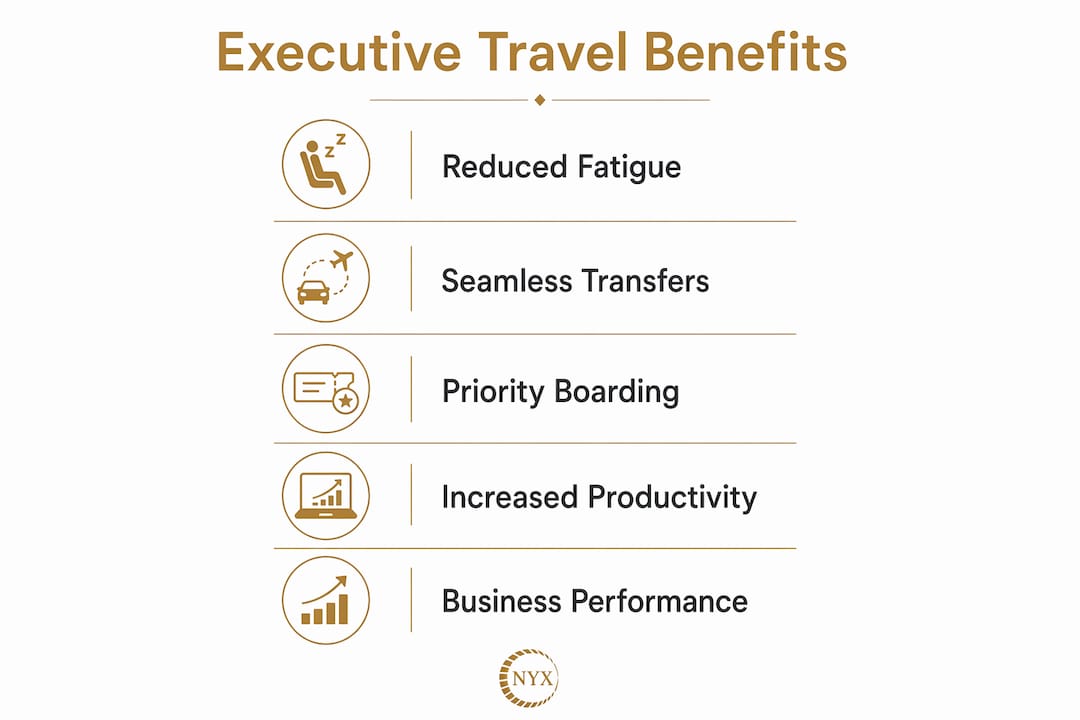
The academic framework behind this is the Job Demands-Resources Model. Applied to corporate travel, it holds that high-quality executive travel services provide the job resources that reduce cognitive depletion from commercial travel, allowing executives to maintain full capacity for meetings. When logistics uncertainty is removed, the brain does not spend energy managing contingencies. That energy goes to the meeting instead.
The business benefits of premium travel arrangements are concrete:
- Improved focus. Executives arrive at meetings without the residual stress of navigating airports, queues, or unreliable transport.
- Reduced fatigue. Comfortable, quiet vehicles and lounge environments lower physical and mental exhaustion during transit.
- Enhanced professional image. Arriving by chauffeur in a Mercedes-Benz Business Sedan signals competence and attention to detail to clients and partners.
- Greater scheduling flexibility. Fixed-rate, on-demand chauffeur services adapt to meetings that run long, without penalty.
- Better client relations. Executives who travel well arrive present, composed, and ready to build relationships rather than recover from the journey.
“The true value of executive travel lies in its ability to unburden executives and handle disruptions without their involvement, freeing cognitive resources for high-stakes decision-making.” — Executive travel as strategic investment
The financial logic follows from this. A chief executive who closes one additional deal per quarter because they arrived rested and focused generates returns that dwarf the cost of a premium ground transfer or a VIP lounge membership. The benefits of executive travel include sustained leadership performance in international business settings, which is precisely why leading corporations treat travel management as a board-level concern rather than an administrative function.
What does executive travel planning actually involve?
Executive travel planning is built on a detailed traveller profile. Agencies maintain records of mission-critical preferences including hotel floor preferences, dietary restrictions, gate proximity requirements, and language requirements for chauffeurs. These details are applied automatically on every booking, so the executive never repeats instructions.
The operational sequence for a well-managed executive trip looks like this:
- Profile review. The travel team confirms current preferences before each itinerary is built, noting any changes to dietary needs, preferred airlines, or ground transport requirements.
- Itinerary construction. Flights, transfers, accommodation, and meeting logistics are assembled into a single, time-stamped document shared with the executive and their assistant.
- Pre-departure briefing. The traveller receives a concise summary covering check-in times, lounge locations, chauffeur contact details, and contingency contacts.
- Real-time monitoring. The travel team tracks flights, road conditions, and event schedules throughout the journey. On airport transfers, providers like Transponyx include flight monitoring on every booking as standard.
- Disruption management. If a flight is delayed, the chauffeur’s schedule adjusts automatically. If a flight is cancelled, the travel team rebooks before the executive reaches the gate. Disruption management occurs in real time without executive involvement.
- Post-trip debrief. Preferences are updated, expenses are consolidated, and the profile is refined for the next journey.
The personalisation extends to ground transport in ways that matter operationally. A chauffeur who speaks Italian as well as English and French is not a luxury for an executive travelling between Nice and San Remo for a client dinner. It is a functional requirement. Transponyx drivers are bilingual in English and French as a minimum, with several also fluent in Italian, Spanish, Russian, or Arabic, covering the linguistic range of the Riviera’s international business community.
Pro Tip: Choose a travel provider whose team acts as a direct extension of your executive assistant. The best providers anticipate needs without being asked, and the worst ones wait to be told what went wrong.

Technology supports but does not replace the human element in personalised executive transfers. Automated flight tracking, digital traveller profiles, and instant messaging channels all accelerate response times. The judgement call on when to rebook, which alternative route to take, or how to handle a client-facing delay still requires an experienced travel professional.
How to book executive travel on the French Riviera
Booking executive travel on the French Riviera requires attention to three variables that do not apply in most other markets: event calendars, fleet selection, and fixed-rate transparency. The Riviera hosts some of Europe’s most concentrated business event periods. The Cannes Film Festival in may, MIPIM in march, the Monaco Grand Prix in may, Cannes Lions in june, and MIPCOM in october each compress demand for premium ground transport into short windows. Rates surge on unmanaged platforms. Fixed-rate providers become the only reliable option.
The practical steps for booking executive travel in this region are as follows:
- Confirm your event dates early. For the Monaco Grand Prix or Cannes Film Festival, ground transport should be reserved weeks in advance. Transponyx operates 24 hours a day, seven days a week, and accepts reservations by phone at +33 6 10 30 71 84 or via WhatsApp at +33 7 67 78 10 26.
- Select the correct fleet category. Transponyx operates four Mercedes-Benz vehicle categories: Standard Sedan for up to 3 passengers, Business Sedan for up to 3 passengers with premium interior finish, Van 7 pax for up to 7 passengers, and Van 8 pax for up to 8 passengers. All vehicles include Wi-Fi, air conditioning, chilled water, and phone chargers. Choosing the right category affects both comfort and the professional impression made on clients.
- Specify your pickup requirements precisely. For airport transfers from Nice NCE, Transponyx includes 60 minutes of free waiting time and flight monitoring as standard. For all other addresses, 20 minutes of free waiting time applies. These details matter when meetings overrun or flights land early.
- Confirm fixed 2026 rates at the time of booking. All Transponyx rates are fixed per vehicle, confirmed at booking, with no surge pricing. This matters for corporate accounts that require predictable travel budgets.
- Plan routes with journey times in mind. Nice NCE to Monaco takes approximately 35–45 minutes by road. Nice NCE to Cannes takes approximately 30–40 minutes. Nice NCE to Saint-Tropez takes approximately 90–120 minutes depending on traffic. Building these times into the itinerary prevents the most common cause of executive lateness: underestimated ground transfer durations.
For executive transport features specific to the Riviera, the combination of a licensed VTC professional, a Mercedes-Benz fleet, and fixed pricing removes the three main risks of ground transport in a high-demand market: unreliability, cost unpredictability, and language barriers.
My view on where executive travel is heading in 2026
The conversation about executive travel has shifted considerably over the past few years. When I first started covering luxury ground transport on the French Riviera, the debate was almost always about cost justification. Finance teams questioned whether a Business Sedan from Nice NCE to Monaco was materially better than a standard taxi. The answer was always yes, but the reasoning was difficult to quantify.
That argument is largely settled now. The productivity case for premium travel arrangements is well established, and the most forward-thinking corporate travel programmes treat ground transport as the first and last impression of every business trip. What interests me more in 2026 is the integration question. The executives I observe travelling through Nice, Cannes, and Monaco are not just looking for a comfortable car. They want a provider whose team communicates with their assistant directly, updates the itinerary in real time, and handles the unexpected without a phone call.
Transponyx does this well in a market where many providers still operate reactively. The flight monitoring on every airport pickup, the multilingual driver pool, and the fixed 2026 rates are not marketing claims. They are operational decisions that reflect a genuine understanding of what senior professionals need from ground transport. The Riviera is a demanding environment. Events like MIPIM and the Monaco Grand Prix create conditions where only providers with real local knowledge and genuine operational discipline perform reliably.
The broader trend I find compelling is the move away from aggregated booking platforms toward specialist regional providers. A platform that covers 50 countries cannot know that the road from Nice to Antibes is congested on the morning of the Cannes Lions opening. A local provider with experienced drivers does. That local knowledge is the differentiator that no technology platform has yet replaced.
— Dany
Transponyx: executive chauffeur service on the French Riviera
Corporate travellers arriving at Nice Côte d’Azur Airport for events across the Riviera need ground transport that performs without supervision.
Transponyx provides luxury chauffeur services across the French Riviera with fixed 2026 rates, flight monitoring on every airport transfer, and a fleet of Mercedes-Benz vehicles covering Standard Sedan, Business Sedan, Van 7 pax, and Van 8 pax categories. Routes cover Nice NCE to Monaco, Cannes, Antibes, Menton, and Saint-Tropez, as well as long-distance transfers to Milan and Provence. All drivers are licensed VTC professionals, bilingual as a minimum. Reservations are available 24 hours a day at +33 6 10 30 71 84 or via WhatsApp at +33 7 67 78 10 26. Visit https://transponyx.com to confirm your 2026 rate and reserve your transfer.
FAQ
What is executive travel service in simple terms?
Executive travel service is a premium travel management solution that handles all logistics for senior professionals, including personalised itinerary planning, 24/7 concierge support, chauffeur transport, and real-time disruption management. The service is designed to protect the executive’s time and cognitive energy throughout every journey.
How does executive travel differ from standard corporate travel?
Standard corporate travel books transport and accommodation. Executive travel management goes further by maintaining detailed traveller profiles, providing VIP airport access, and handling disruptions proactively without requiring the executive to intervene.
What are the main benefits of executive travel for business professionals?
The core benefits include improved focus on arrival, reduced fatigue, greater scheduling flexibility, and a stronger professional image. These advantages contribute directly to sustained leadership performance and better outcomes in client-facing meetings.
How do I book executive travel on the French Riviera?
Contact a licensed VTC provider such as Transponyx directly by phone at +33 6 10 30 71 84 or via WhatsApp at +33 7 67 78 10 26. Specify your fleet category, pickup address, and event dates early, particularly during high-demand periods such as the Cannes Film Festival or Monaco Grand Prix.
Are executive travel rates fixed or subject to surge pricing?
Transponyx confirms all 2026 rates at the time of booking on a per-vehicle basis with no surge pricing. This fixed-rate model is a defining feature of reputable executive travel providers and is essential for corporate accounts that require predictable travel budgets.

par Daniel AIT GOUGAM | Juin 26, 2026 | news
A vehicle fleet is defined as any collection of two or more vehicles under common management of costs, maintenance, and operations to serve an organisation’s transportation needs. The role of vehicle fleet management extends far beyond simply keeping cars on the road. It encompasses acquisition planning, driver oversight, fuel control, regulatory compliance, and sustainability reporting. Organisations that treat their fleet as a strategic asset rather than a cost centre consistently outperform those that do not. Transponyx, the luxury VTC and private chauffeur service based in Nice on the French Riviera, demonstrates this principle through an exclusively Mercedes-Benz fleet calibrated to serve airport transfers, corporate accounts, and private excursions with fixed 2026 rates and zero surge pricing.
How do vehicle fleets improve transportation efficiency?
Fleet efficiency begins with matching the right vehicle to the right task. The United States Federal Energy Management Programme advises that right-sizing vehicles and reducing vehicle miles travelled are the two most direct levers for cutting fuel consumption and operational costs. An organisation running a full-size van for a single-passenger daily commute wastes fuel, accelerates depreciation, and inflates insurance costs simultaneously. Selecting the correct vehicle category from the outset removes that waste before it compounds.
Predictive maintenance is the second major efficiency driver. Telematics systems monitor engine diagnostics, tyre pressure, and mileage in real time, flagging issues before they cause breakdowns. Reactive maintenance, where a vehicle is repaired only after it fails, costs significantly more per incident than scheduled servicing. Downtime from an unplanned breakdown does not just cost the repair bill. It disrupts schedules, damages client relationships, and forces expensive last-minute alternatives.
Efficient scheduling compounds these gains. Route planning software reduces dead mileage, the distance a vehicle travels empty between assignments. For a fleet serving multiple destinations, such as transfers from Nice Côte d’Azur Airport (NCE) to Monaco, Cannes, Antibes, and Menton, intelligent scheduling ensures vehicles are never idle when demand exists nearby. Integrated fleet management combining telematics, predictive maintenance, and lifecycle planning can reduce operational expenditure by 10–20% within 18 months. That figure represents a material improvement to any organisation’s bottom line.
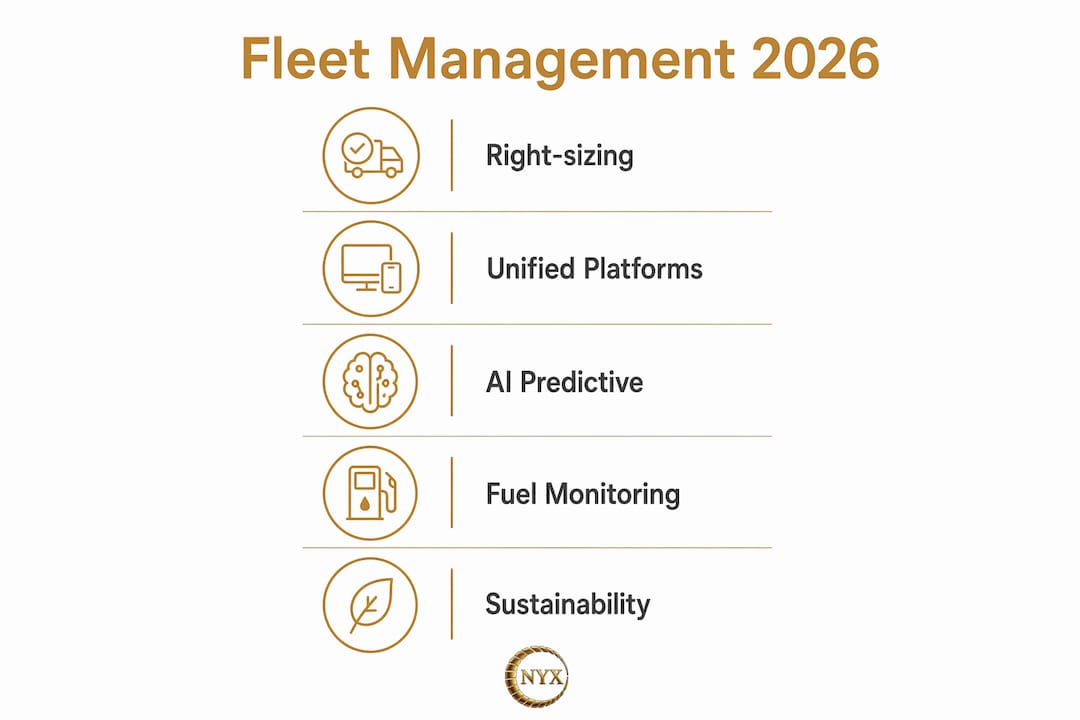
- Vehicle right-sizing: match engine size, load capacity, and fuel type to the specific mission, not the most convenient option available.
- Telematics monitoring: track fuel consumption, idling time, and driver behaviour in real time to identify waste before it becomes habitual.
- Predictive maintenance scheduling: use mileage and diagnostic data to service vehicles before failure, not after.
- Route optimisation: reduce dead mileage through intelligent dispatch and real-time traffic integration.
- Utilisation tracking: identify underused vehicles and redeploy or dispose of them to reduce fixed costs.
Pro Tip: Review fleet utilisation rates quarterly. A vehicle used less than 60% of available working hours is a candidate for redeployment or disposal, not renewal.
What are the key benefits of vehicle fleet management to organisations?
The most underestimated benefit of professional fleet management is total cost of ownership (TCO) awareness. Most organisations focus on the purchase price of a vehicle. Yet fuel, maintenance, and depreciation together account for more than 50% of a vehicle’s total lifecycle cost. An organisation that buys cheaply but neglects servicing, fuel efficiency, and timely disposal pays far more over five years than one that plans the full lifecycle from day one.
Driver safety is the second major benefit. Fleet management programmes that monitor speed, harsh braking, and cornering reduce accident rates and insurance premiums. A driver who knows their behaviour is recorded drives more carefully. That is not surveillance for its own sake. It is a measurable reduction in risk for the driver, the organisation, and third parties on the road.
Regulatory compliance is a growing pressure. Emissions standards, tachograph rules, and vehicle roadworthiness requirements vary across jurisdictions and tighten regularly. A fleet without a compliance calendar will eventually face fines, prohibitions, or reputational damage. Organisations operating across multiple countries face this challenge acutely, particularly as European low-emission zones expand into cities such as Nice, Milan, and Monaco’s surrounding region.
- Total cost of ownership planning reduces lifecycle expenditure by accounting for fuel, insurance, maintenance, and depreciation from acquisition.
- Driver behaviour monitoring lowers accident rates and insurance costs through real-time feedback and reporting.
- Regulatory compliance management prevents fines and operational disruptions by tracking emissions, licences, and inspection schedules.
- Brand visibility through well-maintained, branded vehicles builds customer trust in service areas.
- Sustainability reporting satisfies corporate ESG requirements and increasingly influences contract awards.
“Fleet vehicles serve as mobile advertising that enhances brand visibility and customer trust in regional markets.” Corporate Fleet Branding
A well-presented fleet communicates professionalism before a single word is spoken. For a luxury chauffeur service operating during the Cannes Film Festival or the Monaco Grand Prix, the vehicle itself is the first impression. A clean, current-model Mercedes-Benz Business Sedan arriving punctually at Nice NCE signals reliability in a way no brochure can replicate.

The central problem in fleet management technology is fragmentation. Many organisations run separate tools for GPS tracking, fuel card management, driver monitoring, and maintenance scheduling. Separate tools create data silos that prevent managers from seeing the full operational picture. A fuel spike that correlates with a specific driver’s route pattern is invisible if fuel data and GPS data live in different systems.
Unified fleet management platforms resolve this by consolidating vehicles, drivers, assets, and financial data into a single dashboard. Managers gain real-time visibility across the entire fleet. They can identify which vehicle is approaching a service interval, which driver is idling excessively, and which route is consistently over budget, all from one screen. The operational decisions that follow are faster and better informed.
Artificial intelligence adds a further layer. AI-driven predictive maintenance analyses historical failure patterns and sensor data to forecast when a component will fail, not just when it is due for scheduled replacement. This reduces both unplanned downtime and unnecessary early servicing. Fuel optimisation algorithms suggest the most efficient routes based on live traffic, load weight, and vehicle-specific consumption profiles.
| Capability |
Fragmented toolset |
Unified platform |
| GPS and route data |
Separate system |
Integrated dashboard |
| Fuel monitoring |
Manual card reconciliation |
Automated real-time tracking |
| Maintenance scheduling |
Spreadsheet or calendar |
AI-driven predictive alerts |
| Driver behaviour |
Standalone device |
Consolidated scoring |
| Compliance tracking |
Manual checks |
Automated deadline alerts |
| Reporting |
Multiple exports |
Single consolidated report |
Pro Tip: When evaluating fleet management platforms, test the reporting function first. If generating a combined fuel-and-maintenance cost report requires more than three clicks, the platform will not be used consistently by operational staff.
The transport trends shaping 2026 confirm that real-time data integration is no longer a premium feature. It is the baseline expectation for any organisation managing more than a handful of vehicles.
What strategies do businesses use to manage fleet costs and sustainability goals?
Lifecycle planning is the most financially significant strategy available to fleet operators. The decision of when to replace a vehicle is not intuitive. Organisations that hold vehicles too long face rising maintenance costs and declining residual values. Those that replace too early sacrifice depreciation value without gaining proportionate reliability improvements. The optimal replacement point varies by vehicle type, annual mileage, and maintenance history, but it requires data to identify accurately.
Fuel efficiency measures have become inseparable from sustainability goals. Net Zero and Scope 3 emissions mandates have made fleet management critical to corporate compliance and contract retention. Scope 3 emissions include all indirect emissions in a company’s value chain, and business travel in company vehicles falls squarely within this category. Organisations bidding for public sector contracts in France, the United Kingdom, and across the European Union now face emissions disclosure requirements as a standard tender condition.
| Strategy |
Primary benefit |
Sustainability impact |
| Vehicle right-sizing |
Reduces fuel and insurance costs |
Lower per-kilometre emissions |
| Lifecycle replacement planning |
Optimises residual value and maintenance spend |
Newer vehicles meet tighter emission standards |
| Electric and hybrid vehicle adoption |
Reduces fuel expenditure |
Direct reduction in Scope 3 emissions |
| Route optimisation |
Cuts fuel consumption and driver hours |
Fewer kilometres driven per assignment |
| Telematics-driven driver coaching |
Reduces harsh acceleration and idling |
Measurable fuel and emissions savings |
| Fleet size alignment to demand |
Eliminates underused vehicle costs |
Fewer vehicles in operation overall |
Aligning fleet size to actual operational demand is a discipline many organisations resist. Adding vehicles feels like growth. Removing them feels like retreat. The financial reality is that every vehicle in a fleet carries fixed costs regardless of whether it moves. Insurance, depreciation, storage, and compliance costs accrue daily. A fleet that is 20% larger than operational demand requires is a fleet that is 20% more expensive to run than necessary.
The vehicle selection frameworks used for major events on the French Riviera illustrate this discipline well. Matching vehicle categories to passenger volumes, journey distances, and event schedules prevents both under-capacity and waste.
How should organisations structure fleet management as they scale?
Even a fleet of two or three vehicles constitutes a vehicle fleet if those vehicles share common management of costs and maintenance. This definition matters because small organisations frequently delay implementing formal fleet management until their fleet grows large enough to feel unmanageable. By that point, they have accumulated years of fragmented cost data, inconsistent maintenance records, and no baseline for benchmarking performance.
The correct approach is to establish management structure from the first vehicle. A single designated fleet manager, even part-time, creates accountability for costs, compliance, and scheduling. As the fleet grows, that role expands to include driver management, sustainability reporting, and supplier negotiations.
Larger organisations typically structure fleet management as a function that intersects with four other departments:
- Operations: vehicle scheduling, route planning, and driver dispatch.
- Finance: TCO tracking, budget forecasting, and depreciation accounting.
- Human resources: driver licencing, training, and behaviour management.
- Sustainability and compliance: emissions reporting, regulatory adherence, and ESG documentation.
Fleet managers today bridge logistics, finance, HR, and ESG requirements, making them strategic contributors to long-term planning and carbon accounting. This is a significant evolution from the traditional view of fleet management as a purely operational function. Organisations that position their fleet manager at director level, with visibility across all four departments, consistently achieve better cost control and compliance outcomes than those that treat the role as administrative.
The group transport planning required for large IT conferences and corporate events on the French Riviera reflects this cross-functional reality. Coordinating multiple vehicle categories, driver schedules, and client itineraries across a single event requires the same disciplines as managing a permanent corporate fleet.
Why fleet management is now a board-level conversation
Fleet management has become a core business discipline intersecting operations, finance, HR, compliance, and sustainability. That is not a recent development. It is the result of a decade of regulatory tightening, fuel price volatility, and ESG reporting requirements converging simultaneously on organisations that previously treated their vehicles as a minor operational footnote.
What I find consistently underappreciated is the brand dimension. A fleet is not just a cost centre. Every vehicle that carries your name, your livery, or your passengers is a public statement about your standards. On the French Riviera, where clients arriving at Nice NCE for the Monaco Grand Prix or Cannes Lions have access to every tier of ground transport, the condition and presentation of a vehicle communicates more than any marketing material. Transponyx built its entire proposition on this principle: an exclusively Mercedes-Benz fleet, fixed 2026 rates, and bilingual licensed VTC drivers who monitor flights and wait without charge for 60 minutes on every airport pickup.
The technology argument is equally clear. Organisations still running separate GPS, fuel, and maintenance tools are paying a hidden tax in management time and missed insights. The unified platforms available in 2026 are not expensive luxuries. They are the minimum viable infrastructure for any fleet above five vehicles.
Sustainability is the pressure that will not ease. Scope 3 emissions reporting is already a tender requirement in multiple sectors. Organisations that have not begun tracking fleet emissions are not just behind on compliance. They are losing contracts to competitors who have.
— Dany
Transponyx: a fleet built for the French Riviera
Transponyx operates a fully managed Mercedes-Benz fleet from Nice, covering airport transfers, corporate accounts, and private excursions across the Côte d’Azur. The fleet spans four categories: Standard Sedan, Business Sedan, Van 7 pax, and Van 8 pax, each equipped with Wi-Fi, air conditioning, chilled water, and phone chargers.
All 2026 rates are fixed per vehicle and confirmed at booking, with no surge pricing during peak events including the Cannes Film Festival, MIPIM, and the Monaco Grand Prix. Routes cover Nice NCE to Monaco, Cannes, Antibes, Menton, Saint-Tropez, and Alpine ski resorts including Isola 2000 and Auron. For a full comparison of luxury chauffeur service options on the Riviera, visit https://transponyx.com or call +33 6 10 30 71 84.
FAQ
What is the role of a vehicle fleet in a business?
The role of a vehicle fleet is to manage an organisation’s vehicles as a unified asset, controlling costs, maintenance, compliance, and scheduling to support operational and commercial objectives. Effective fleet management reduces expenditure, improves safety, and supports sustainability reporting.
How many vehicles are needed to constitute a fleet?
A fleet can consist of as few as two or three vehicles, provided they are under common management of costs and maintenance. Fleet size is defined by management structure, not by a minimum vehicle count.
What does total cost of ownership mean for fleet vehicles?
Total cost of ownership (TCO) covers all costs across a vehicle’s lifecycle, including purchase price, fuel, maintenance, insurance, and depreciation. Fuel, maintenance, and depreciation alone account for more than 50% of lifecycle costs, making TCO planning the most financially significant discipline in fleet management.
How does fleet management support sustainability goals?
Fleet management supports sustainability by tracking fuel consumption, monitoring emissions, and enabling Scope 3 carbon accounting. Net Zero and Scope 3 emissions mandates have made fleet emissions reporting critical to corporate compliance and contract retention in both public and private sectors.
What technology do fleet managers use in 2026?
Fleet managers in 2026 use unified management platforms that consolidate GPS tracking, fuel monitoring, driver behaviour scoring, and predictive maintenance into a single dashboard. These platforms replace fragmented toolsets that create data silos and prevent accurate cost and performance analysis.

par Daniel AIT GOUGAM | Juin 24, 2026 | news
A private transfer is a pre-booked, exclusive vehicle service that takes you directly from an airport, hotel, or venue to your destination without sharing with other passengers. Known in France as a VTC (voiture de tourisme avec chauffeur), this service differs fundamentally from shared shuttles, metered taxis, and ride-hailing apps. For travellers arriving at Nice Côte d’Azur Airport (NCE) and heading to Monaco, Cannes, or Antibes, the distinction matters enormously. Transponyx operates precisely this kind of service on the French Riviera, with a fleet of Mercedes-Benz vehicles, licensed bilingual drivers, and 2026 fixed rates confirmed at the time of booking. Reach the team on +33 6 10 30 71 84 or at https://transponyx.com.
What is a private transfer, and how does it differ from other options?
A private transfer is defined by three characteristics: exclusivity, pre-arrangement, and direct routing. No other passengers share your vehicle. No unplanned stops break your journey. The price is agreed before you travel, not calculated on a meter after you arrive.

Shared shuttles, by contrast, collect multiple groups from the same terminal and drop them at different hotels in sequence. Private transfers take 20–50 minutes from airport to city, while shared shuttles take 30–60 minutes longer due to those multiple stops. That difference is not trivial when you land at 22:00 after a delayed flight from London Heathrow.
Metered taxis offer exclusivity but not price certainty. Surge pricing applies during the Cannes Film Festival, the Monaco Grand Prix, and MIPIM. A taxi from Nice NCE to Monaco can cost significantly more during these events than a pre-booked private rate. Ride-hailing apps such as Uber operate in Nice but are subject to the same dynamic pricing and cannot guarantee a specific vehicle class or driver language.
The VTC category, which Transponyx operates under, sits above standard taxis in terms of vehicle quality, driver licensing, and service standards. Drivers hold a professional VTC licence issued by the French government, which requires specific training, background checks, and vehicle standards. That regulatory framework is what separates a licensed private transfer service from an informal arrangement.
How private transfers compare at a glance
| Feature |
Private transfer (VTC) |
Shared shuttle |
Metered taxi |
Ride-hailing app |
| Exclusive vehicle |
Yes |
No |
Yes |
Yes |
| Fixed price at booking |
Yes |
Yes |
No |
No |
| Direct routing |
Yes |
No |
Yes |
Yes |
| Flight monitoring |
Yes (included) |
No |
No |
No |
| Meet and greet |
Yes |
Sometimes |
No |
No |
| Luggage assistance |
Yes |
No |
No |
No |
| Surge pricing |
Never |
Never |
Yes |
Yes |
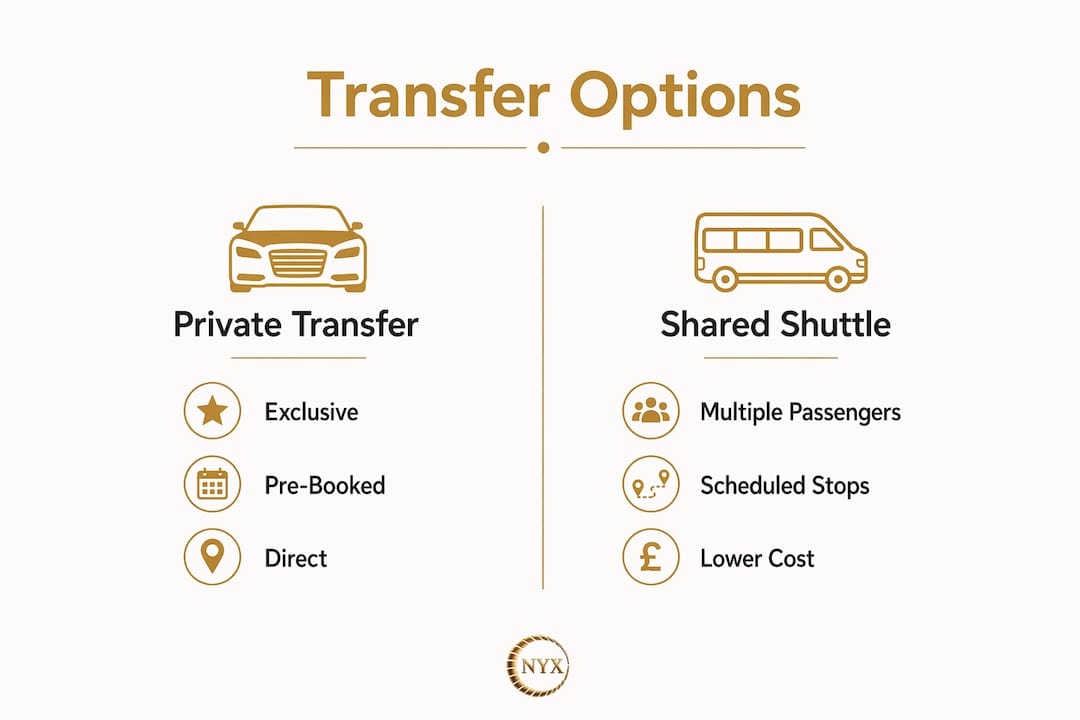
Pro Tip: Save your driver’s mobile number and booking confirmation offline before you land. Offline access to booking details is critical for smooth pickups, particularly where airport Wi-Fi is unreliable or congested.
How to book private transfers: timing, steps, and key considerations
Booking a private transfer correctly is as important as choosing one. The process is straightforward, but the timing and details you confirm at the point of booking determine whether the experience is genuinely stress-free.
Book standard transfers at least 48 hours in advance. For peak seasons and group bookings, 1–2 weeks ahead is the recommended window. During the Cannes Film Festival in may, the Monaco Grand Prix in may, and MIPCOM in october, vehicle availability on the Riviera tightens sharply. Booking late means accepting whatever remains, which is rarely the vehicle class you want.
The booking process for a service like Transponyx follows a clear sequence:
- Choose your vehicle class. Match the vehicle to your group size and luggage volume. A Standard Sedan carries up to 3 passengers. A Business Sedan offers the same capacity with a premium interior finish. The Van 7 pax accommodates up to 7 passengers, and the Van 8 pax handles groups of up to 8.
- Confirm your route and pickup point. Specify the terminal at Nice NCE, the hotel address in Monaco, or the villa in Saint-Tropez. Precision here prevents confusion on arrival.
- Provide your flight details. A reputable private transfer service uses this to monitor your flight in real time. Flight monitoring transforms a transfer from a simple ride into a managed experience, with drivers adjusting to delays without any action required from you.
- Review the cancellation policy. Most platforms offer free cancellation up to 24 hours before the scheduled pickup. Confirm this before paying.
- Request any special requirements. Child seats, oversized ski bags, and additional luggage space must be confirmed at booking, not on the day. Transponyx provides child seats on request and operates vans suited to ski equipment for transfers to Isola 2000, Auron, and Valberg.
- Save everything offline. Download your confirmation, the driver’s contact number, and the pickup instructions to your phone before you travel. Airport connectivity is not guaranteed.
Pro Tip: When booking transfers for peak Riviera events, request your specific vehicle class by name. Availability of the Van 8 pax during the Monaco Grand Prix or Cannes Lions is limited, and a vague booking may result in a substitution.
Benefits of private transfers for families and groups on the French Riviera
Families travelling with children and groups with significant luggage gain the most from a private transfer service. The advantages are concrete, not theoretical.
Space is the first consideration. A Van 7 pax or Van 8 pax from Transponyx’s Mercedes-Benz fleet carries a full family group with pushchairs, car seats, and ski bags without the compression and compromise of a shared shuttle. Every vehicle in the fleet includes Wi-Fi, air conditioning, chilled water, and phone chargers as standard. These are not optional extras.
Door-to-door service matters most when travelling with young children or elderly passengers. A shared shuttle requires passengers to wait at the terminal while other groups are collected, then endure multiple hotel stops before reaching their own. A private transfer proceeds directly from Nice NCE to the destination, whether that is a villa in Antibes or a hotel in Menton. Fixed pricing and meet-and-greet service reduce post-flight stress by eliminating the need to negotiate, queue, or navigate an unfamiliar terminal.
The Riviera’s event calendar creates specific challenges that private transfers resolve. During the Cannes Film Festival, the Monaco Grand Prix, and MIPIM, public transport and taxis operate under severe pressure. Surge pricing on ride-hailing apps during these periods can be substantial. A pre-booked private transfer at a fixed 2026 rate is immune to that pressure. The price confirmed at booking is the price charged, regardless of demand.
Safety and privacy are additional factors for families. A licensed VTC driver carries professional insurance, holds a government-issued licence, and operates a vehicle maintained to commercial standards. Transponyx drivers are bilingual in English and French as a minimum, with several also speaking Italian, Spanish, Russian, or Arabic. That language capability is genuinely useful when travelling with children who need reassurance or when coordinating a complex group arrival.
- Families with children: child seats available on request; direct routing eliminates waiting at multiple stops
- Groups of 5–8: Van 7 pax and Van 8 pax accommodate full groups with luggage in a single vehicle
- Event travellers: fixed rates during the Cannes Film Festival, Monaco Grand Prix, and MIPCOM protect against surge pricing
- Corporate groups: private transfers support confidentiality and productive transit between meetings
What does a 2026 private transfer price include on the Riviera?
A private transfer price on the French Riviera covers more than the drive itself. Understanding what is included prevents surprises and makes comparison with taxis or apps genuinely meaningful.
The fixed rate confirmed at booking with Transponyx includes the driver, the vehicle, fuel, motorway tolls, and airport fees. There are no supplements added at the end of the journey. Free waiting time is included as standard: 60 minutes on all airport pickups and 20 minutes for any other address. That waiting time allowance is significant. If your bags are delayed or passport control is slow, the driver waits without charging.
Pre-booked private transfers in Europe are typically 10–25% cheaper than metered taxis on routes over 20 km. The price gap widens for groups, late-night arrivals, and longer routes. A family of four travelling from Nice NCE to Saint-Tropez in a Van 7 pax pays one fixed rate for the vehicle. Four separate taxi fares for the same journey would cost considerably more.
Indicative 2026 route pricing with Transponyx
| Route |
Vehicle |
Approx. journey time |
Pricing model |
| Nice NCE to Monaco |
Standard Sedan |
25–35 min |
Fixed, per vehicle |
| Nice NCE to Cannes |
Business Sedan |
30–40 min |
Fixed, per vehicle |
| Nice NCE to Antibes |
Standard Sedan |
20–30 min |
Fixed, per vehicle |
| Nice NCE to Saint-Tropez |
Van 7 pax |
90–110 min |
Fixed, per vehicle |
| Nice NCE to Isola 2000 |
Van 8 pax |
75–90 min |
Fixed, per vehicle |
| Nice NCE to Milan |
Van 7 pax |
3 hrs approx. |
Fixed, per vehicle |
Exact fares are available directly from Transponyx at https://transponyx.com or by calling +33 6 10 30 71 84. Pricing scales with vehicle class and distance, not with demand. A booking made in january carries the same rate as one made the night before the Monaco Grand Prix.
Additional stops or extended waiting time beyond the included allowance are charged at a transparent rate agreed in advance. There are no hidden fees applied after the journey.
Why private transfers on the Riviera are worth more than their price
I have covered luxury ground transport on the French Riviera for long enough to know where travellers consistently underestimate the value of a private transfer. The price comparison with a taxi is the wrong starting point.
The real calculation is time and certainty. A family arriving at Nice NCE at 20:00 with three children, four suitcases, and a ski bag does not need a cheaper option. They need a driver holding a name sign at the arrivals gate, a van with the boot already open, and a direct route to their chalet in Valberg. Eliminating post-flight decision fatigue is the primary value of a private transfer, and it is worth paying for.
Corporate travellers understand this instinctively. A client being collected from Nice NCE for a meeting in Monaco cannot afford a taxi that gets stuck in traffic with no communication, or a shared shuttle that adds 45 minutes of stops. Business travellers use private transfers for privacy, reliability, and the ability to work or prepare during transit. The Transponyx Business Sedan is specifically suited to that purpose.
What I find most underappreciated is flight monitoring. Most travellers assume it is a minor feature. In practice, it means the driver already knows your flight landed 22 minutes late before you switch your phone off flight mode. The 60-minute free waiting time at Nice NCE is generous, but flight monitoring means the driver is never caught off guard. That proactive adjustment is what separates a managed transfer from a taxi you hope turns up.
My recommendation for anyone planning a trip to the Riviera in 2026: book your transfer before you book your restaurant. The Cannes Film Festival, MIPIM, and the Monaco Grand Prix fill vehicle availability faster than hotel rooms. A reliable luxury transfer is not a last-minute decision on the French Riviera.
— Dany
Transponyx private transfers on the French Riviera
Transponyx provides licensed VTC private transfer services across the French Riviera, operating 24 hours a day, 7 days a week from Nice Côte d’Azur Airport to Monaco, Cannes, Antibes, Menton, and Saint-Tropez. The fleet covers every group size, from a Standard Sedan for solo travellers to a Van 8 pax for families and corporate groups.
All 2026 rates are fixed per vehicle, confirmed at booking, and include flight monitoring, meet-and-greet, and free waiting time. For routes to Monaco, the Nice Airport to Monaco transfer page provides full details and booking options. For a broader comparison of premium chauffeur options on the Riviera, the luxury chauffeur services comparison covers the leading providers for 2026. Contact Transponyx directly on +33 6 10 30 71 84, via WhatsApp on +33 7 67 78 10 26, or at https://transponyx.com.
FAQ
What is a private transfer?
A private transfer is a pre-booked, exclusive vehicle service that transports passengers directly from one point to another without shared stops or other passengers. The price is fixed at booking and includes the driver, vehicle, and standard waiting time.
How far in advance should I book a private transfer?
Book at least 48 hours in advance for standard journeys. During peak events such as the Cannes Film Festival or Monaco Grand Prix, 1–2 weeks ahead is strongly advised to secure your preferred vehicle class.
Is a private transfer cheaper than a taxi on the French Riviera?
Pre-booked private transfers are typically 10–25% cheaper than metered taxis on routes over 20 km, and the saving increases for groups and longer journeys. Fixed pricing also protects against surge charges during major Riviera events.
What is included in a Transponyx private transfer?
Every Transponyx booking includes the driver, vehicle, fuel, tolls, airport fees, flight monitoring, meet-and-greet service, and free waiting time of 60 minutes at Nice NCE or 20 minutes at any other address. Child seats are available on request.
What is the difference between a private transfer and a shared shuttle?
A private transfer uses an exclusive vehicle travelling directly to your destination. A shared shuttle collects multiple groups and makes several stops, adding 30–60 minutes to the journey compared with a direct private route.