
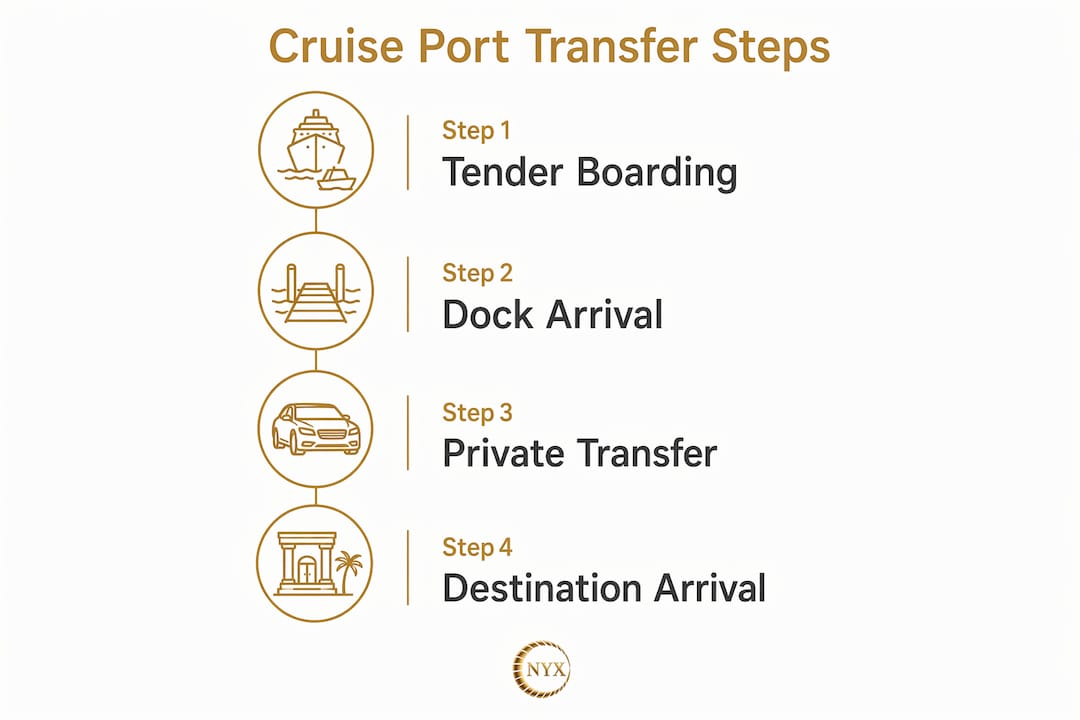
A cruise port transfer at Villefranche-sur-Mer means travelling from your anchored cruise ship to the shore by tender boat, a small shuttle vessel operated by the cruise line. Villefranche is a tender port, which means no ship docks directly at a quay. Instead, your vessel anchors in the deep bay, and passengers board tender boats at the ship’s gangway to reach the town’s jetty. The crossing itself takes about ten to fifteen minutes, but queues during peak periods regularly add 30 to 45 minutes overhead each way. Plan your transfer time accordingly. Once ashore, you step onto a small quay right at the edge of Villefranche’s old town, with the Chapelle Saint-Pierre and the waterfront cafés within easy walking distance.
A few things shape every transfer at this port:
- Ships anchor offshore; there is no dockside access.
- Tender boats run on a schedule set by the cruise line, not by passengers.
- Sea conditions and priority given to military vessels can delay or suspend operations.
- The tender dock sits centrally in the bay, placing you immediately in the old town on arrival.
- Transfers back to the ship follow the same process, so your return journey needs the same time allowance.
Villefranche sits about 4 miles east of Nice, which is why cruise lines serving the city anchor here rather than at Nice’s own port. The bay is deep enough for large vessels, the setting is spectacular, and the town itself is worth far more than a passing glance.
How transfers from the tender dock to Villefranche town actually work
The tender dock is a compact quay with limited facilities. You will find basic tourist information and restrooms, but no dedicated cruise terminal with the amenities passengers sometimes expect at larger ports. That simplicity is partly what makes Villefranche charming, though it does require a little preparation.
Tender boats run continuously during port hours, but capacity is finite. On a ship carrying several thousand passengers, the queue at the gangway can stretch considerably, particularly between 9:00 AM and 11:00 AM when organised shore excursions depart en masse. The same congestion repeats in reverse during the late afternoon return window. Passengers who disembark early, ideally before 8:30 AM, consistently report shorter waits and a calmer experience on the water.
Once ashore, the old town is immediately accessible on foot. The Chapelle Saint-Pierre, the Rue Obscure, and the waterfront promenade are all within walking distance of the jetty. For those continuing to Nice, Monaco, or further along the Riviera, the train station is approximately 200 metres uphill from the dock, though the route involves steps and a noticeable incline.
Accessibility and luggage
- Wheelchair access at the tender dock depends on sea state and the specific cruise line’s equipment; confirm arrangements directly with your cruise line before sailing.
- Strollers can be managed but the stepped incline to the train station makes them awkward; a compact, foldable model is far easier.
- Keep luggage to a minimum for tender transfers. Large suitcases are not appropriate for day excursions and create difficulties boarding the tender boat.
- Passengers with significant mobility limitations should request priority tender access through the ship’s guest services desk the evening before port day.
Pro Tip: Book your tender ticket the night before if your cruise line operates a numbered tender system. Ships on busy summer itineraries, particularly during the Monaco Grand Prix period in May, often issue tickets from 6:00 AM onwards, and the early numbers go quickly.
The physical layout rewards those who plan. Arriving at the jetty with a clear idea of where you are going, whether that is the old town itself or a train to Nice Ville, saves the hesitation that costs shore time.
Getting from Villefranche port to Nice, Monaco, and beyond
The train is the fastest and most affordable way to reach the main Riviera destinations from Villefranche. The station, a short climb from the tender dock, sits on the main coastal line connecting the Italian border to Marseille.
| Destination | Journey time (approx.) | Fare (approx.) | Frequency |
|---|---|---|---|
| Nice Ville | 7–15 minutes | from €3.50 | Every 15–30 min |
| Monaco | 25 minutes | €6–7 | Every 15–30 min |
| Eze-sur-Mer | 15–20 minutes | €4–7 | Every 15–30 min |
| Cannes | Requires connection | Varies | Less frequent |
Buying tickets via the SNCF Connect app before you reach the station avoids the queue at the machines, which can be slow during peak periods. The app accepts UK payment cards and delivers a QR code directly to your phone.
For destinations beyond the train network’s convenience, or for groups who prefer not to navigate public transport with children or luggage, private chauffeur transfers offer a direct alternative. A licensed private driver meets you at the tender dock or at a pre-agreed point in the old town, and the journey to Nice Côte d’Azur Airport (NCE), Monaco, Cannes, Antibes, Menton, or Saint-Tropez proceeds without changes, queues, or uncertainty about connections. During major events such as the Cannes Film Festival in May, the Monaco Grand Prix in May, or MIPCOM in October, train services become crowded and taxis scarce; a pre-booked private transfer removes that variable entirely.
Shuttle buses exist but serve limited routes and are not always timed to cruise schedules. Taxis are available near the old town but supply is restricted, and fares are metered rather than fixed, which can produce surprises on longer journeys to Cannes or Saint-Tropez.
Common mistakes cruise passengers make at Villefranche port
The single most costly error is underestimating how long the tender process takes. The 10–15 minute crossing is only part of the equation. Add the queue at the ship’s gangway, the wait at the jetty on return, and the variability introduced by sea conditions or military vessel priority, and the realistic overhead each way is 30–45 minutes. Passengers who plan their day around the crossing time alone routinely find themselves rushing back to the ship.
A second common mistake is heading straight for Nice or Monaco without first spending any time in Villefranche itself. The old town is genuinely worth an hour or two. Exploring it first before committing to a longer journey reduces physical fatigue, gives you a fallback if connections are slow, and means you have actually seen the port town rather than simply passed through it.
A few practical points that experienced Riviera travellers keep in mind:
- Budget a minimum of 30 to 45 minutes from the moment you join the tender queue to the moment you are free to walk in the old town.
- The return tender queue builds quickly after 4:00 PM; arriving at the dock by 3:30 PM on a ship with a 5:00 PM departure is prudent.
- Sea conditions in the bay can deteriorate with afternoon winds; morning crossings are generally calmer.
- Do not rely on finding a taxi immediately at the jetty during peak season or event weeks.
- Passengers with heavy luggage should reconsider day trips to distant destinations; the stepped climb to the train station is genuinely demanding.
The passengers who get the most from a Villefranche port day are those who treat the tender process as part of the experience rather than an inconvenience to rush through. Early disembarkation, a clear itinerary, and a realistic return time built around the ship’s all-aboard call are the foundations of a well-spent day on the Riviera.
Why private chauffeur transfers suit Riviera cruise passengers
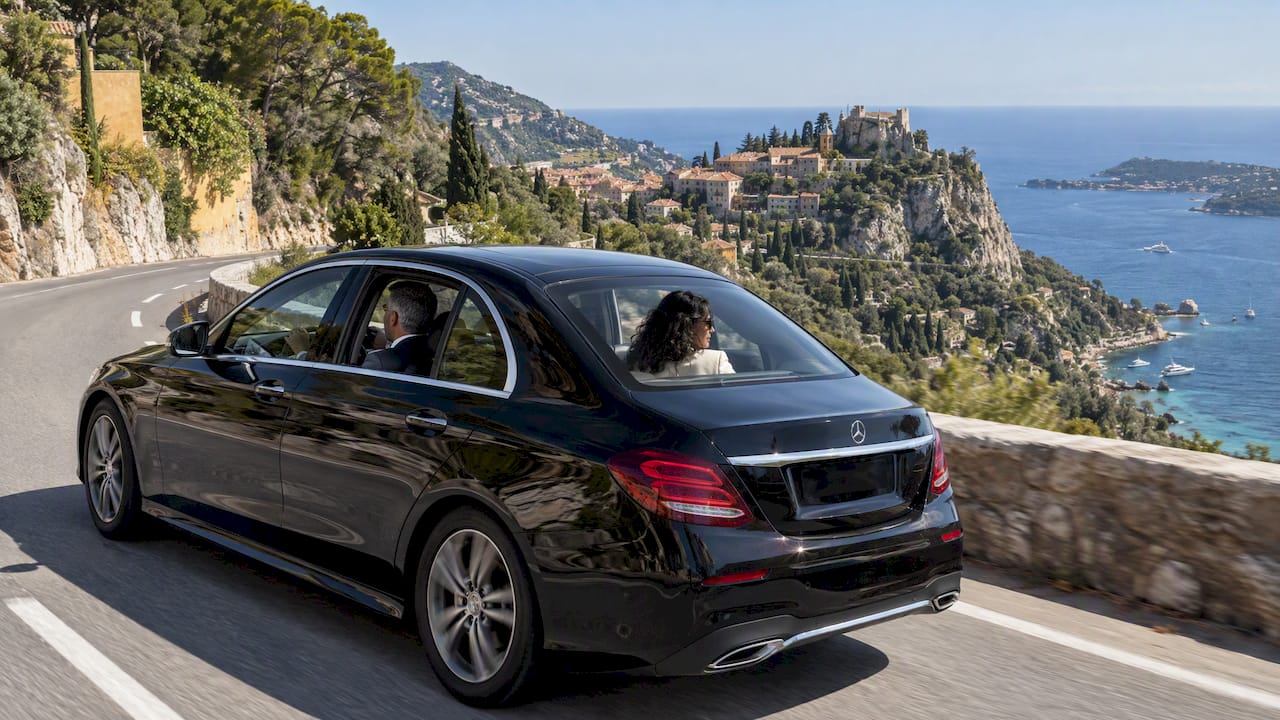
For cruise passengers who want certainty rather than improvisation, a private chauffeur transfer is the most reliable option on the French Riviera. Transponyx operates a fleet of licensed Mercedes-Benz vehicles from Nice, covering all major Riviera destinations with fixed 2026 rates confirmed at the time of booking. There is no surge pricing, no meter running, and no ambiguity about what the journey will cost.
A private chauffeur transfer from Villefranche to Monaco or Nice Côte d’Azur Airport (NCE) removes every variable that makes tender port days stressful: the driver monitors your arrival, waits at no extra charge for the first 20 minutes, and knows the Riviera roads well enough to route around event-day congestion during the Monaco Grand Prix or the Cannes Film Festival.
The Transponyx fleet covers four vehicle categories, each suited to different group sizes and luggage requirements:
| Vehicle | Capacity | Key features |
|---|---|---|
| Standard Sedan | Up to 3 passengers | Wi-Fi, air conditioning, chilled water, phone chargers |
| Business Sedan | Up to 3 passengers | Premium finish, same amenities |
| Van 7 pax | Up to 7 passengers | Ideal for families or small groups |
| Van 8 pax | Up to 8 passengers | Maximum group capacity, full amenities |
All vehicles are Mercedes-Benz, and child seats are available on request. Drivers are licensed VTC professionals, bilingual in English and French as a minimum, with several also speaking Italian, Spanish, Russian, or Arabic. For airport connections, Transponyx includes 60 minutes of free waiting time and active flight monitoring on every booking, so a delayed flight does not translate into a missed transfer.
The service operates around the clock, every day of the year. Routes cover Nice NCE, Monaco, Cannes, Antibes, Menton, Saint-Tropez, and long-distance destinations including San Remo, Ventimiglia, and Milan. For cruise passengers planning a shore excursion that goes beyond the standard train network, or for those arriving at Nice Côte d’Azur Airport before or after their cruise, Transponyx provides a luxury Riviera transfer that connects directly to the ship’s schedule rather than to a public timetable.

Bookings can be made by phone on +33 6 10 30 71 84 or via WhatsApp on +33 7 67 78 10 26. The full fleet and 2026 fixed rates are listed at transponyx.com.
FAQ
What is a cruise port transfer at Villefranche-sur-Mer?
A cruise port transfer at Villefranche is the process of travelling from your anchored cruise ship to the shore by tender boat, a small shuttle vessel that ferries passengers to the town’s jetty in the bay. The crossing takes approximately 10–15 minutes, excluding queue time.
How do I get from Villefranche cruise port to Nice?
The fastest option is the train from Villefranche station, roughly 200 metres uphill from the tender dock, with services to Nice Ville taking 7–15 minutes and fares starting from €3.50. A private chauffeur transfer is the most direct alternative for groups or passengers with luggage.
How long should I allow for the tender process each way?
Budget 30–45 minutes each way to account for the gangway queue, the crossing, and any delays caused by sea conditions or maritime traffic priority. The crossing itself is about 10–15 minutes, but queues and the tender boarding process add the rest of the overhead.
What to do in Villefranche from a cruise ship?
The old town is immediately accessible from the tender dock and rewards at least an hour of exploration: the Chapelle Saint-Pierre, the medieval Rue Obscure, and the waterfront cafés are all within easy walking distance. From there, Nice, Monaco, and Eze are all reachable by train within 25 minutes.
Is Villefranche cruise port accessible for wheelchair users?
Accessibility at the tender dock depends on sea conditions and the policies of your specific cruise line. Passengers with mobility requirements should contact their cruise line’s guest services before sailing to arrange priority tender access and confirm what assistance is available at the jetty.


0 commentaires