par Daniel AIT GOUGAM | Juin 23, 2026 | news
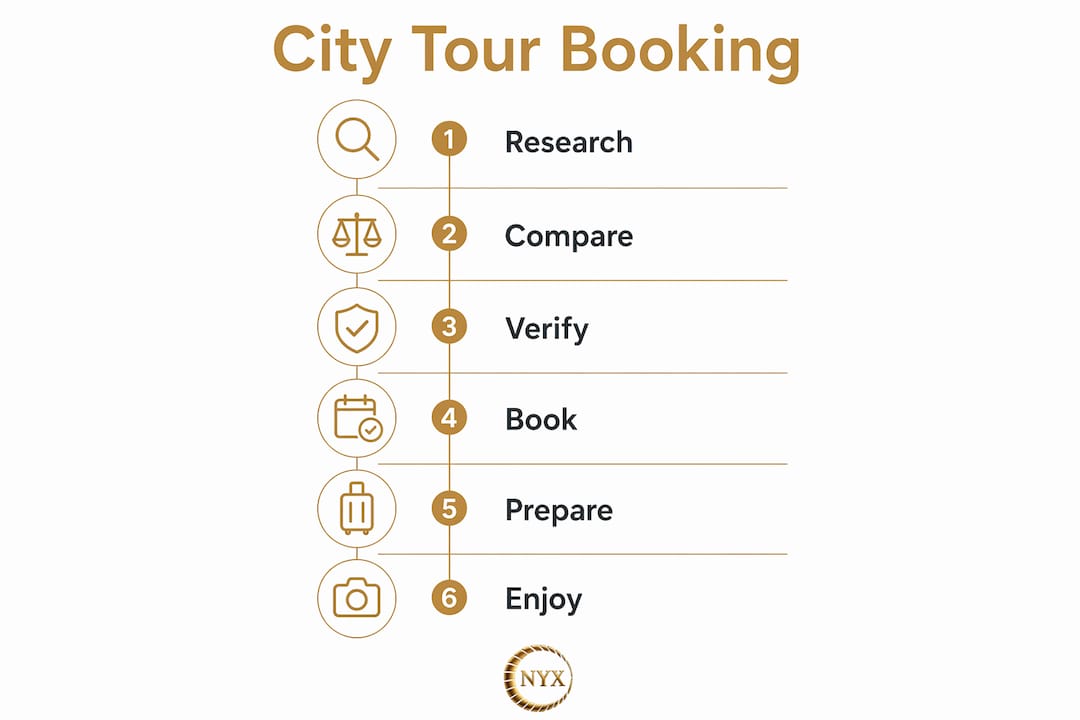
A step by step city tour booking is the process of carefully selecting, verifying, and confirming every logistical detail before your tour day, so that nothing is left to chance. Most travellers lose time and money not at the payment stage, but far earlier: unclear meeting points, mismatched inclusions, and overlooked timed-entry requirements are the most common booking mistakes. On the French Riviera, where a private guided excursion through Monaco or a wine tour across Provence can involve multiple operators, fixed-time attractions, and coordinated ground transport, the stakes of poor preparation are especially high. Platforms like GetYourGuide have made online city tour booking faster, but speed without method produces confusion. This guide gives you the method.
What do you need before starting a city tour booking?
Effective city tour planning begins with two things: a confirmed destination and a list of must-see attractions ranked by access difficulty. Timed-entry sites such as the Colosseum in Rome, the Vatican Museums, and the Eiffel Tower in Paris sell out weeks in advance during peak season. Advance booking is essential for any attraction with limited daily capacity. Free sights and off-season museums carry less urgency, but they still require scheduling to avoid clashes.

Once you have your attraction list, check the travel dates against local event calendars. On the Côte d’Azur, the Cannes Film Festival in may, the Monaco Grand Prix, Cannes Lions in june, and MIPCOM in october all compress accommodation and transport availability dramatically. Booking a city sightseeing tour during these windows without checking operator availability is a reliable way to find everything sold out.
The digital tools you need at this stage are straightforward:
- A booking platform such as GetYourGuide for instant mobile tickets and free cancellation options
- An itinerary planner (Google Maps or TripIt work well for sequencing stops)
- A currency converter to compare all-in prices accurately across platforms
- A notes document to track operator names, confirmation numbers, and meeting point addresses
Pro Tip: Save every confirmation email and screenshot the meeting point map before you leave your accommodation. Mobile data on the Riviera is reliable, but a saved image costs nothing and saves everything.
Local transport deserves its own line in your pre-booking checklist. On the French Riviera, the distance between Nice Côte d’Azur Airport (NCE) and Monaco is roughly 20 kilometres, yet road conditions during the Monaco Grand Prix can triple journey times. Knowing your ground transport option before you book a tour start time is not optional. It is the foundation on which the rest of the schedule rests.
How do you compare city tour options without confusion?
Not all tours with similar titles are the same product. Misleading tour titles frequently represent different variants with different operators, durations, and meeting points. The comparison method that eliminates this confusion is the fingerprint checklist: four data points that must match exactly before you treat two listings as equivalent.
The four-point fingerprint checklist
- Operator name. Confirm the licensed company running the tour, not just the platform selling it. GetYourGuide, Viator, and direct operator websites often list the same tour at different prices. The operator name tells you whose quality standards apply.
- Duration. A “Monaco highlights tour” can run anywhere from two hours to a full day. Walking tours of Madrid, for example, typically run 2–3 hours and cost between $4 and $41 depending on format. Duration affects your entire day’s schedule.
- Meeting point. Two tours with identical names may depart from different locations. One may start at Monaco’s Casino Square; another may begin at the Port Hercule. Arriving at the wrong point means missing the departure entirely.
- Inclusions and exclusions. Entry fees, meals, headsets, and equipment are frequently excluded from headline prices. Reviewing all exclusions before payment prevents surprise costs at the gate.
Comparing prices and cancellation terms
| Factor |
What to check |
Why it matters |
| All-in price |
Add platform fees, entry costs, and tips |
Headline price rarely reflects total spend |
| Cancellation window |
Free cancellation up to 24 hours is standard on GetYourGuide |
Missed windows mean lost funds |
| Refund method |
Credit vs. original payment method |
Credit refunds lock you to the platform |
| Recent reviews |
Filter for reviews from the last 90 days |
Operator quality changes; old reviews mislead |
| Group size |
Maximum group cap listed in description |
Large groups affect pacing and guide attention |
Cross-referencing cancellation policies is not bureaucratic caution. It is financial protection. A tour booked at a lower price with a 72-hour cancellation window costs more than a slightly pricier option with free 24-hour cancellation, if your plans carry any uncertainty at all.
Recent customer feedback reveals operator punctuality and quality factors that no description page will admit. Filter reviews by recency and look specifically for comments about meeting point clarity, guide language quality, and start time reliability. These three factors predict your actual experience more accurately than star ratings alone.
What logistics must you confirm before finalising a booking?
Confirming logistics is the step most travellers skip because the booking feels complete once payment is processed. It is not. A structured booking workflow runs from search through to voucher preparation, and the logistics confirmation stage sits between payment and departure day.
The critical items to verify are:
- Exact meeting location. Get the full address, a landmark reference, and a map pin. “Near the old port” is not an address. For tours in Antibes or Menton, where old town streets are narrow and GPS signals can drift, a precise landmark is the difference between finding your group and missing it.
- Start time and duration. Confirm both against your transport schedule. If your Transponyx driver is collecting you from Nice NCE at 09:00 for a 10:00 tour start in Cannes, the 30-kilometre journey is comfortable. If the tour starts at 09:30, it is not.
- Language of the guide. Many Riviera tours are listed in French and English, but confirm this explicitly. Some operators list “multilingual” tours that default to French when the majority of the group is Francophone.
- Group size cap. A private tour and a group tour of 25 people are categorically different experiences. Verify the maximum group size before booking, not after.
- Cancellation contact. Save the operator’s direct phone number or WhatsApp contact. Platform messaging systems are slow when you need to communicate a delay on the morning of the tour.
Pro Tip: Screenshot the meeting point on Google Street View the evening before. Knowing what the physical location looks like eliminates the frantic searching that causes late arrivals.
Aligning logistics with luxury transport schedules adds a layer of precision that independent travellers often underestimate. Transponyx operates fixed-rate transfers across the Riviera, 24 hours a day, seven days a week. Booking a Business Sedan from Nice NCE to Monaco for a morning tour start, with the driver monitoring your flight arrival, removes the single largest variable from your day’s schedule. The 2026 fixed rates are confirmed at booking with no surge pricing, which means your transport cost is known before you finalise any tour reservation.
How do you coordinate everything on the actual day?
Day-of coordination is where preparation either pays off or falls apart. The sequence below reflects the order in which decisions must be made, not simply a list of reminders.
- Confirm your mobile ticket format the night before. GetYourGuide issues mobile tickets that are scanned directly from your phone screen. Some operators still require a printed voucher or a separate ticket exchange at a collection point. Ticket validation requirements vary by operator, and discovering this on the morning of the tour costs buffer time you cannot recover.
- Arrive at the meeting point 10–15 minutes early. Timed-entry attractions often require onsite ticket validation before boarding, which adds queue time that online booking does not account for. Arriving early absorbs this without stress.
- Contact the operator immediately if you are delayed. Most operators hold departure for a few minutes for confirmed bookings, but only if they know you are coming. A WhatsApp message sent from your transport is far more effective than arriving breathless and apologetic.
- Sequence timed-entry attractions first in your day. Booking timed-entry sites first and arranging transport and buffers around them prevents the cascading delays that ruin afternoon plans. A morning slot at a fixed-time attraction anchors the whole itinerary.
- Pack the essentials in one place. Confirmation numbers, passport or ID (required at some Monaco venues), sunscreen, and a portable charger. The Côte d’Azur in july and august is not forgiving of travellers who leave their phone charger at the hotel.
- Communicate with your transport provider. If you are using Transponyx for a return transfer after a full-day tour, confirm the pickup time the evening before. The Van 7 pax and Van 8 pax options are particularly useful for groups returning from events like the Cannes Film Festival or Cannes Lions, where road congestion after evening sessions is predictable.
The principle behind all of this is straightforward. Ignoring transport and queue times causes late arrivals and lost sightseeing. Every buffer you build in costs nothing. Every buffer you skip costs the experience.
What I have learned from watching travellers get this wrong
The travellers who struggle most with city tour booking are not the ones who forget to book. They are the ones who book confidently but carelessly. I have seen groups arrive at the wrong port in Monaco because two tours shared a near-identical name on GetYourGuide. I have watched a family of five miss a morning departure from Nice because their Eiffel Tower tickets required a separate validation queue they had not anticipated.
The pattern is consistent. Vague meetup instructions cause missed departures far more often than payment failures. The fingerprint comparison method exists precisely because tour listings are designed to look similar. Operators compete on price and title visibility, not on clarity of logistics. That burden falls on the traveller.
Overpaying is the other common error, and it is almost always avoidable. Comparing the same tour across GetYourGuide, Viator, and the operator’s direct site takes ten minutes. That ten minutes regularly saves 15–20% on the total price, simply because platform fees differ.
Where I see the greatest improvement in traveller experience is in ground transport integration. Travellers who book a private chauffeur for the full day, rather than piecing together taxis and public transport, arrive at each stop on time and leave each stop without anxiety. On the Riviera, where the distance between Cannes and Saint-Tropez is 75 kilometres and summer traffic is severe, this is not a luxury. It is a practical decision that protects the entire day’s itinerary. Transponyx drivers monitor flight arrivals, hold fixed 2026 rates, and speak English and French as standard. That combination removes the three variables that most frequently derail a well-planned tour day.
— Dany
Transponyx and your city tour: ground transport that fits the schedule
Planning a city tour on the French Riviera requires ground transport that matches the precision of your itinerary. Transponyx provides private chauffeur services across Nice, Monaco, Cannes, Antibes, Menton, and Saint-Tropez, with 2026 fixed rates confirmed at booking and no surge pricing.
The fleet covers every group size: Standard Sedan and Business Sedan for up to 3 passengers, Van 7 pax and Van 8 pax for larger groups. All vehicles are Mercedes-Benz, equipped with Wi-Fi, air conditioning, chilled water, and phone chargers. For airport arrivals at Nice NCE, 60 minutes of free waiting time and full flight monitoring are included. For event transfers during the Cannes Film Festival, Monaco Grand Prix, or Cannes Lions, Transponyx drivers know the road conditions and the timing. Compare the full range of options at the chauffeur services comparison page, or call +33 6 10 30 71 84 to confirm your 2026 booking directly.
FAQ
What is a step by step city tour booking?
A step by step city tour booking is the process of searching, comparing, verifying logistics, completing payment, and preparing your voucher before the tour day. Each stage must be completed in sequence to avoid surprises at the meeting point.
How far in advance should you book a city tour?
Book timed-entry attractions as early as possible, particularly for high-capacity sites like the Colosseum, Vatican, or Eiffel Tower during peak season. For general guided tours, booking at least 48–72 hours ahead secures availability and allows free cancellation if plans change.
What does the fingerprint method mean for comparing tours?
The fingerprint method means verifying four exact data points before treating two tour listings as identical: operator name, duration, meeting point, and inclusions. Matching titles on different platforms frequently represent different products with different costs and experiences.
Does online booking complete the process for timed-entry tours?
Online booking is often not the final step. Many timed-entry attractions require onsite ticket validation before boarding, which adds queue time. Build a 15-minute buffer into your arrival time to absorb this without rushing.
How does private transport improve a city tour day on the French Riviera?
Private transport removes the three variables that most disrupt tour schedules: unpredictable journey times, surge pricing, and driver availability. Transponyx operates fixed-rate transfers 24 hours a day across the Riviera, with bilingual drivers and flight monitoring on all airport pickups, reachable at https://transponyx.com or on WhatsApp at +33 7 67 78 10 26.

par Daniel AIT GOUGAM | Juin 22, 2026 | news
Travel recommendations are defined as personalised suggestions for destinations, activities, or transport options, matched to a traveller’s preferences, budget, and timing. The practice of explaining travel recommendations goes further: it articulates the why behind each suggestion, giving travellers the reasoning they need to decide with confidence. Platforms like DeepSeek and advisors such as Wendy Perrin and Indagare have made transparency their competitive edge, and the results are measurable. Transponyx applies the same principle to luxury ground transport on the French Riviera, ensuring every client understands exactly what they are booking and why it suits their journey.
What are travel recommendations and why do travellers need explanations?
Travel recommendations fall into three broad categories: AI-generated lists, expert-curated itineraries, and platform-driven suggestions. Each serves a different purpose, but all share a common weakness when presented without context. A list of the best travel destinations without supporting reasoning is, in practice, little more than a catalogue.
Travellers distrust what they cannot evaluate. Transparent rationale builds cognitive trust, reducing the suspicion that a recommendation is driven by hidden commercial incentives rather than genuine fit. That suspicion is not irrational. Affiliate-driven content, sponsored placements, and algorithm-optimised rankings are widespread, and experienced travellers have learned to question them.
The shift in how trust is formed is significant. Research shows that traveller trust has moved from evaluating the content of a recommendation to evaluating the process that produced it. In other words, travellers no longer ask only “Is this a good destination?” They ask “Why is this being recommended to me, and by what method?” That is a fundamentally different question, and it demands a fundamentally different answer.
Common traveller expectations when seeking travel tips and advice include:
- Clear reasoning: why this destination or activity suits their specific profile
- Transparency on constraints: budget limits, travel dates, physical requirements, and group size
- Personalised options: not generic top-10 lists, but choices calibrated to their situation
- Contingency awareness: what happens if conditions change, flights are delayed, or plans shift
- Source credibility: who is making the recommendation and on what basis
New travellers, in particular, value advisors for emotional reassurance as much as for logistical guidance. Media coverage of international travel risks creates anxiety that no algorithm fully addresses. A human advisor who explains their reasoning provides comfort that a ranked list cannot replicate.
How does explainability improve booking outcomes?
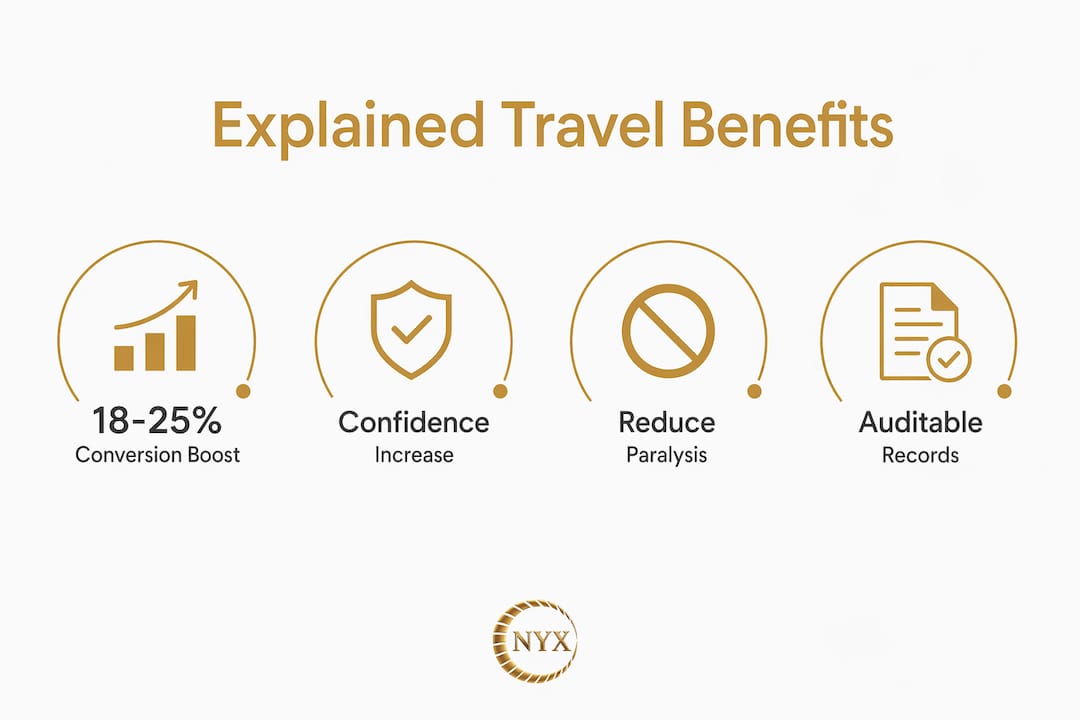
The commercial case for explained recommendations is direct. Platforms providing personalised one-line explanations for travel suggestions increase conversion rates by 18–25%. That figure represents the difference between a traveller who browses and leaves, and one who books with confidence.
The mechanism is psychological. When a traveller understands why a recommendation fits their situation, perceived usefulness rises. Perceived usefulness is the primary driver of booking intent. A recommendation for a Business Sedan transfer from Nice Côte d’Azur Airport (NCE) to Monaco carries more weight when accompanied by a clear rationale: fixed 2026 pricing, 60 minutes of free waiting time included, flight monitoring active, and a bilingual driver familiar with the Principauté’s access restrictions during the Monaco Grand Prix.
AI systems displaying recommendation logic boost decision confidence significantly. DeepSeek, for instance, surfaces its reasoning chain rather than presenting conclusions as facts. That transparency improves the traveller’s ability to evaluate argument quality and source credibility, which in turn increases adoption of the suggestion.

Pro Tip: When assessing any AI-generated travel itinerary, ask the platform to show its reasoning. If it cannot explain why a hotel, route, or activity was selected, treat the suggestion with caution.
Explained recommendations also reduce decision paralysis and buyer’s remorse. A traveller who understands the tradeoffs between staying in Cannes versus Antibes during the Cannes Film Festival can commit to a choice rather than second-guessing it after booking. Generic top-10 lists create the opposite effect: they present options without priorities, leaving the traveller to resolve the tradeoffs alone.
Audit trails matter in corporate travel as well. Business travellers and travel managers increasingly require audit-ready rationales behind digital recommendations to satisfy internal policy and expense approval processes. A recommendation that cannot be documented is a recommendation that cannot be approved.
What frameworks do elite planners use to explain recommendations?
Elite travel planners do not present ten options. They present three, each positioned with explicit tradeoffs. This three-option methodology forces travellers to confront their real priorities rather than deferring a decision. It is faster, clearer, and produces higher satisfaction than exhaustive lists.
The three positions typically follow a structure: the conservative choice (lower cost, lower risk, proven track record), the recommended choice (best fit for stated preferences), and the aspirational choice (higher cost or complexity, but maximum reward if conditions align). Each option carries a brief explanation of what the traveller gains and what they sacrifice.
Wendy Perrin and the Indagare network apply this logic to destination selection, accommodation, and activity sequencing. The rationale is always explicit: why this property over that one, why this week rather than the following one, and what local events or conditions influenced the timing.
Timing and pacing rules are a core part of explained recommendations. Jet-lag arrival logic is one example: experienced guides schedule day one as a low-intensity buffer, with no significant sightseeing. That single rule, when explained to a traveller, transforms their first day from a frustrating underperformance into a deliberate recovery strategy.
The table below summarises the main explanation models used in travel planning and their practical benefits.
| Explanation model |
Core principle |
Traveller benefit |
| Three-option positioning |
Present conservative, recommended, and aspirational choices |
Faster decisions, clearer priorities |
| Audit trail reasoning |
Document the logic behind each suggestion |
Trust, policy compliance, reduced regret |
| Pacing rules |
Schedule intensity across days based on arrival and energy |
Sustainable enjoyment, fewer disruptions |
| Personalised constraint mapping |
Match recommendations to budget, dates, and group profile |
Relevance, reduced irrelevant options |
| Local event integration |
Adjust suggestions based on festivals, closures, and peak periods |
Accurate timing, avoided conflicts |
Pro Tip: Before accepting any itinerary, ask your advisor to identify the one recommendation they would change if your budget were 20% lower. The answer reveals how well they understand your actual priorities.
Local event integration deserves particular attention. Recommending a private sightseeing tour along the Côte d’Azur during MIPIM in Cannes or the Cannes Lions festival requires awareness of road closures, hotel occupancy, and transfer demand. A recommendation that ignores those conditions is not a recommendation. It is a guess.
How to interpret and use explained travel recommendations
The first question to ask of any travel recommendation is whether it includes a reason. If the rationale is absent, the recommendation is incomplete. Travellers planning trips to Nice, Monaco, Cannes, Antibes, Menton, or Saint-Tropez should seek advisors and platforms that provide reasoning transparency as a standard, not an optional extra.
Assessing a recommendation requires evaluating five factors in sequence:
- Destination fit: does the location match the traveller’s stated interests, mobility, and group composition?
- Timing: are local conditions, events, and seasonal factors accounted for? A transfer to Cannes during the Cannes Film Festival in may requires advance booking and fixed-rate pricing to avoid surge exposure.
- Cost transparency: are all costs itemised, including transfers, accommodation, meals, and contingency? Experts advise setting a 10–15% financial buffer over projected trip costs to absorb unexpected disruptions without resorting to credit.
- Insurance timing: Cancel-for-Any-Reason policies require purchase within 24 hours to 2 weeks after initial deposit. Travellers who delay lose this protection entirely.
- Contingency planning: what is the backup if the primary recommendation fails? A luxury transfer service with 24/7 availability and flight monitoring removes one significant contingency risk from the equation.
Financial planning is an underrated component of travel advice. High-interest debt used to finance travel can inflate the overall trip cost substantially, making dedicated savings preferable to credit financing. An explained recommendation that includes a realistic cost breakdown helps travellers plan within their means rather than discovering the true cost after departure.
Flexibility matters more than perfection. The best travel guides for beginners consistently emphasise building slack into itineraries: a free afternoon in Nice, an unscheduled morning in Monaco, or a buffer day before a connecting flight from NCE. Explained recommendations make that flexibility visible by showing where the schedule is tight and where it is not.
For solo travellers, explained recommendations carry additional weight. Recommendations for solo travellers should address safety, local transport options, and the specific character of each destination at different times of day. A solo traveller arriving at Nice Côte d’Azur Airport at 23:00 benefits from knowing in advance that a private airport transfer is available at a fixed rate, with a driver who speaks English and monitors the flight in real time.
The personalised transfers model used by premium chauffeur services on the French Riviera demonstrates how explained recommendations translate into ground transport. Each booking confirmation includes the vehicle category, driver language, waiting time policy, and fixed fare. Nothing is left to interpretation.
Why I believe transparency is the most undervalued skill in travel planning
The travel industry has spent two decades perfecting the art of the list. Best beaches, top restaurants, must-see museums. What it has not perfected is the art of the explanation. After years of working with travellers arriving on the French Riviera for events ranging from the Monaco Grand Prix to MIPCOM in Cannes, I have observed one consistent pattern: the clients who arrive most confident are the ones who were told why, not just what.
A traveller who books a Van 7 pax transfer from Nice NCE to Isola 2000 in january because their advisor explained the road conditions, the journey time of approximately two hours, and the advantage of a fixed 2026 rate over a metered taxi in mountain terrain arrives relaxed. The traveller who booked the cheapest option without explanation arrives anxious, often with questions that should have been answered before departure.
AI tools like DeepSeek are improving the quality of reasoning in travel planning. They surface logic chains, flag constraints, and present tradeoffs in ways that generic search results never could. But they do not replace the judgement of an advisor who knows that the Promenade des Anglais in Nice is gridlocked during the Cannes Lions week, or that a Business Sedan is the correct choice for a client who needs to arrive at a Monaco hotel looking composed after a transatlantic flight.
Transponyx applies explained recommendations to every transfer it operates. The fixed rate is confirmed at booking. The driver’s language skills are matched to the client. The waiting time policy is stated clearly. That is not a marketing claim. It is what transparency looks like in practice, and it is the standard every travel recommendation should meet.
— Dany
Transponyx: luxury transfers with transparent pricing on the French Riviera
Transponyx operates a fleet of Mercedes-Benz vehicles across four categories: Standard Sedan, Business Sedan, Van 7 pax, and Van 8 pax, all available 24 hours a day, 7 days a week from Nice Côte d’Azur Airport to Monaco, Cannes, Antibes, Menton, Saint-Tropez, and Alpine ski resorts including Isola 2000 and Auron.
Every booking includes a fixed 2026 rate confirmed at reservation, 60 minutes of free waiting time on airport pickups, and full flight monitoring. Drivers are bilingual VTC professionals, with several also speaking Italian, Spanish, Russian, or Arabic. For travellers attending the Cannes Lions, MIPIM, or Monaco Grand Prix, advance booking at a fixed luxury rate eliminates surge pricing entirely. Contact Transponyx at +33 6 10 30 71 84, via WhatsApp on +33 7 67 78 10 26, or visit transponyx.com to confirm your transfer.
FAQ
What are travel recommendations?
Travel recommendations are personalised suggestions for destinations, activities, or transport options matched to a traveller’s preferences, budget, and timing. They differ from generic lists by accounting for individual constraints and providing a rationale for each suggestion.
Why does explaining travel recommendations improve booking rates?
Platforms that provide one-line explanations for their suggestions increase conversion rates by 18–25%. Transparent reasoning raises perceived usefulness, which is the primary driver of booking intent.
DeepSeek surfaces its reasoning chain rather than presenting conclusions alone. AI systems displaying recommendation logic improve travellers’ ability to evaluate argument quality and source credibility, increasing confidence in the final decision.
What financial buffer should travellers set when planning a trip?
Experts recommend a 10–15% buffer above projected trip costs to cover unexpected disruptions. Financing travel on high-interest credit can inflate the total cost significantly, making dedicated savings the preferable approach.
When should Cancel-for-Any-Reason travel insurance be purchased?
Cancel-for-Any-Reason policies must be purchased within 24 hours to 2 weeks of the initial trip deposit to remain valid. Travellers who delay beyond this window lose access to the broadest cancellation protection available.

par Daniel AIT GOUGAM | Juin 21, 2026 | news
A door to door transfer is a private, pre-arranged transportation service that collects you from one specific address and delivers you directly to another, with no shared routing, no stops, and no connections in between. Unlike public shuttles or shared taxis, the vehicle is reserved exclusively for your party. The driver manages all timing, luggage, and logistics. For travellers arriving at Nice Côte d’Azur Airport (NCE) and heading to Monaco, Cannes, or Antibes, this model removes every variable that makes airport travel stressful. Transponyx operates precisely this kind of service across the French Riviera, 24 hours a day, seven days a week.
What is door to door transfer and how is it defined?
A door to door transfer is defined as end-to-end coordinated transport from a pre-agreed address directly to the destination, without intermediate stops or shared routing. The word “door” is more significant than it first appears. At the origin, it means the driver comes to your front door, hotel entrance, or villa gate. At the destination, it means the vehicle delivers you to that exact address rather than dropping you at a nearby kerb or car park.
The industry term for this model is “door to door transportation,” and it sits at the premium end of the ground transfer spectrum. Below it sits “curb to curb,” where the driver waits at the vehicle and the passenger walks to and from the car unaided. Below that sits the shared shuttle or transfer shuttle service, where multiple passengers share a vehicle and routes are consolidated. Door to door transportation eliminates both of those compromises.

At airports, the definition extends further. Premium door to door services may begin at the aircraft door itself, with a meet and assist representative escorting the passenger through customs, baggage reclaim, and out to the waiting vehicle. That level of service creates a continuous travel chain from the moment the aircraft lands to the moment the passenger steps inside their hotel or home. For travellers connecting through NCE on their way to the Monaco Grand Prix or the Cannes Film Festival, that continuity is not a luxury. It is a practical necessity.
How does door to door transfer work in practice?
The booking process is straightforward but requires specific information to function correctly. When you reserve a door to door transfer, the provider needs your exact pickup address, your destination address, your flight number, your passenger count, and any special requirements such as child seats, wheelchair access, or oversized luggage. Accuracy at this stage determines the quality of the entire experience.
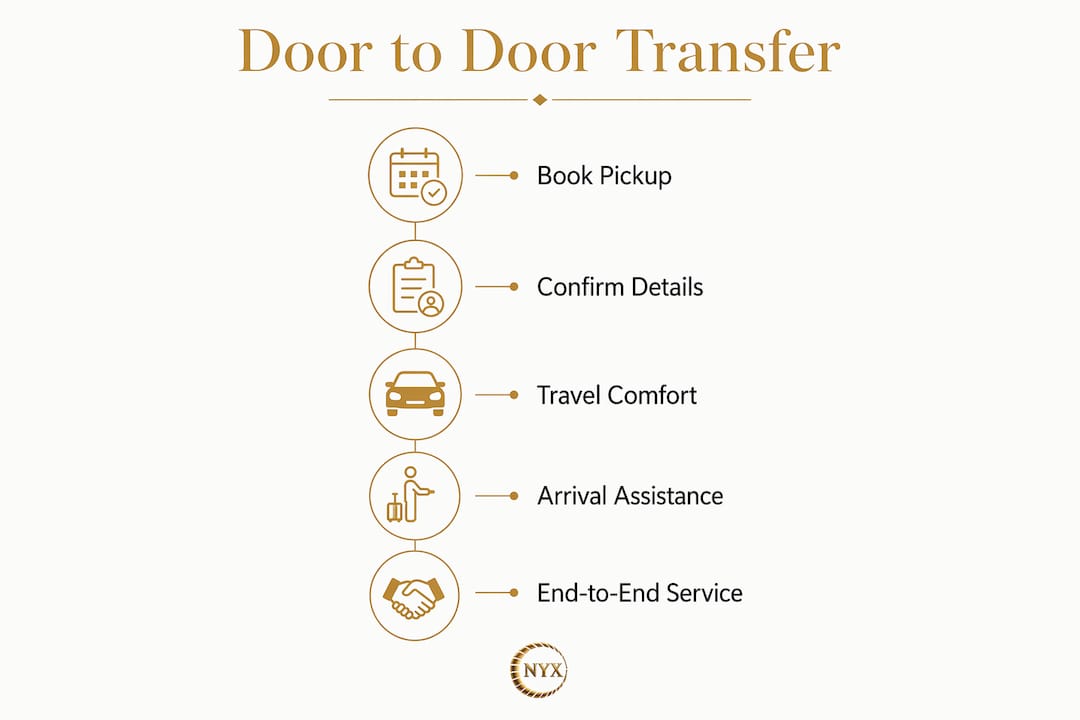
Here is how a typical airport pickup unfolds with a professional provider:
- Reservation confirmed. You receive a booking confirmation with your driver’s name, vehicle details, and a fixed price. No surge pricing, no estimates.
- Flight monitoring begins. The driver tracks your inbound flight in real time. If your flight from London Heathrow lands 35 minutes late, the driver adjusts automatically. You are never charged for delays caused by the airline.
- Driver arrives ahead of landing. For airport pickups, a professional provider such as Transponyx includes 60 minutes of free waiting time from the actual landing time, not the scheduled time.
- Meet and greet at the terminal. The driver meets you inside the arrivals hall, holding a name board. You do not need to find a taxi rank or navigate an unfamiliar car park.
- Luggage loaded, journey begins. The driver handles your bags. You proceed directly to your destination without stops.
- Drop-off at your exact address. Whether that is a private villa in Cap Ferrat, a hotel in Cannes, or a corporate office in Monaco, the vehicle delivers you to the door.
Pro Tip: When booking, include your unit number, the number of large suitcases, and any accessibility requirements. Incomplete passenger information is the single most common cause of delays and miscommunication on the day of travel.
For departures, the process reverses. You provide your home or hotel address, your flight departure time, and the terminal. The driver calculates the pickup time based on traffic patterns and check-in requirements, then arrives at your door at the agreed time.
What are the benefits of door to door transfer services for travellers?
The practical advantages of door to door transfer services are substantial, particularly for travellers with luggage, families with young children, or passengers with mobility needs.
- No multi-leg connections. A single vehicle takes you from origin to destination. There is no bus to the train station, no train to the terminal, no taxi queue at the other end. For a family travelling from a villa in Antibes to NCE for an early morning departure, this alone saves an hour of logistical effort.
- Fixed, transparent pricing. Door to door services offer fixed pricing confirmed at the time of booking. You know the cost before you travel. Taxis and rideshare apps apply surge pricing during peak periods, which on the Riviera includes the Monaco Grand Prix in may, the Cannes Film Festival in may, and MIPIM in march.
- Reliability at unsociable hours. Door to door transportation operates at 3 a.m. for early departures and midnight for late arrivals. Public transport does not. Rideshare availability collapses during major events.
- Safety and physical assistance. Door to door transport reduces risk for older adults and passengers with mobility needs by providing hands-on assistance from the vehicle to the building entrance. This includes steadying support on steps, help with luggage, and escort into the destination. Curb to curb services do not provide this.
- Group and family efficiency. A Van 7 pax or Van 8 pax from Transponyx carries a full family group with luggage in a single vehicle. Splitting a group across two taxis costs more and creates coordination problems at both ends.
- Privacy and comfort. The vehicle is yours alone. No strangers, no detours to drop off other passengers, no shared timetable. For business travellers preparing for a meeting in Monaco or Cannes, that privacy has direct professional value.
The French Riviera context amplifies every one of these benefits. NCE to Monaco is approximately 25 kilometres and takes 30–45 minutes depending on traffic. NCE to Cannes is approximately 30 kilometres and takes 35–50 minutes. Both routes become significantly slower during major events. A pre-booked door to door transfer with a driver who knows the Riviera road network is the most reliable way to manage those journeys.
How does door to door differ from curb to curb or shared rides?
The distinction between door to door and curb to curb is not cosmetic. Curb to curb services place the vehicle at the kerb and expect the passenger to walk to and from the car unaided. The driver does not come to the door, does not assist with steps or luggage, and does not escort the passenger into the building at the destination. For a fit adult with a single carry-on bag, that distinction is minor. For a passenger with reduced mobility, a family with a pushchair and four suitcases, or an elderly traveller, it is the difference between a manageable journey and a genuinely difficult one.
Shared rides, sometimes called transfer shuttle services, add a further layer of compromise. Passengers share the vehicle with strangers travelling to different destinations. Routes are consolidated, which means detours. Departure times are fixed to the shuttle schedule, not to your flight. Shared taxi models require advance reservation rules that vary by region, with some services requiring 40 minutes’ notice and others requiring 24 hours, and wheelchair accessibility is not guaranteed depending on vehicle availability.
The table below compares the three models on the features that matter most to travellers:
| Feature |
Door to door |
Curb to curb |
Shared ride |
| Vehicle reserved exclusively |
Yes |
Yes |
No |
| Driver comes to your door |
Yes |
No |
No |
| Physical assistance provided |
Yes |
No |
Varies |
| Fixed price confirmed at booking |
Yes |
Usually |
Varies |
| Flight monitoring included |
Yes (premium) |
Rarely |
No |
| Direct route, no stops |
Yes |
Yes |
No |
| Operates 24/7 |
Yes (premium) |
Varies |
Rarely |
| Suitable for mobility needs |
Yes |
Limited |
Limited |
Door to door transportation is the correct choice for luxury travel, senior passengers, families, and any itinerary where timing is non-negotiable. Shared rides suit budget travellers with flexible schedules and no special requirements.
Pro Tip: If you are travelling to a major Riviera event such as Cannes Lions in june or MIPCOM in october, book your door to door transport at least two weeks in advance. Vehicle availability across the Riviera tightens sharply during festival periods, and fixed-price providers fill their calendars first.
What should travellers know before booking a door to door transfer?
Preparation on the traveller’s side is as important as the provider’s logistics. The quality of a door to door transfer depends directly on the accuracy of the information you supply at the time of booking.
- Provide the full address, including building name and unit number. A hotel name alone is insufficient if the property has multiple entrances or a separate VIP arrival point. Villas in Cap d’Antibes or Saint-Jean-Cap-Ferrat often have gated entrances that require a gate code or intercom number.
- Include your flight number, not just the arrival time. Drivers use the flight number to monitor real-time status. A scheduled arrival time is useless if the flight diverts or delays. Drivers monitor flight arrivals to adjust pickup times based on actual landing, not the timetable.
- Declare your luggage volume accurately. A Business Sedan accommodates up to 3 passengers with standard luggage. If you are travelling with oversized ski bags for Isola 2000 or Valberg, a Van 7 pax or Van 8 pax is the correct vehicle category.
- Confirm child seat requirements at booking. Transponyx provides child seats on request. Requesting them on the day of travel is not reliable.
- Understand the cancellation policy before you confirm. Reputable providers publish clear cancellation terms. Fixed-price bookings with Transponyx include transparent terms confirmed at the time of reservation.
- Choose providers with meet and assist options for complex arrivals. Meet and assist inside the terminal escorts passengers through customs and baggage reclaim, eliminating queues and navigation for first-time visitors to NCE. Transponyx offers this as part of its executive meet and greet service at Nice Airport.
The cost of door to door transfer varies by vehicle category, route, and provider. With Transponyx, all 2026 rates are fixed per vehicle and confirmed at booking. A Standard Sedan from NCE to Monaco carries up to 3 passengers at a single fixed rate. A Van 8 pax serving the same route carries up to 8 passengers at a different fixed rate. Both prices are known before the journey begins. There is no meter running, no surge multiplier, and no ambiguity.
For travellers comparing options, the differences between a taxi and a VTC are worth understanding before booking. VTC providers operate under a different regulatory framework in France, with pre-agreed pricing and licensed professional drivers, which is precisely the model that underpins door to door transfer services on the Riviera.
Why door to door transfers define Riviera travel in 2026
I have covered luxury ground transport on the French Riviera for long enough to know where the genuine quality gaps sit. The gap is rarely in the vehicle. A Mercedes-Benz E-Class or V-Class is a Mercedes-Benz regardless of who owns it. The gap is in the coordination: whether the driver is tracking your flight at midnight, whether the meet and greet is real or just a name board at the kerb, whether the price you were quoted is the price you pay.
During the Monaco Grand Prix in may 2026, the roads between NCE and Monaco become genuinely difficult. Drivers who know the Riviera use the A8 motorway and time their approach around the circuit schedule. Drivers who do not know the route get caught in the same traffic as everyone else. That local knowledge is not something you can verify from a booking app. It comes from the provider’s track record and their drivers’ professional experience.
The Cannes Film Festival in may presents a different challenge. The Croisette is closed to general traffic during peak hours. Hotel drop-offs require knowledge of which access points are open and when. A door to door transfer that ends at the wrong entrance of the Palais des Festivals is not a door to door transfer. It is a curb to curb service with a premium price tag.
What I have consistently found is that the providers worth trusting are the ones who ask the right questions at booking: your exact arrival point, your luggage, your schedule, your accessibility needs. Transponyx asks all of those questions. That is not a coincidence. It is the operational discipline that separates a genuine door to door service from a taxi with a name board.
— Dany
Transponyx: door to door chauffeur service on the French Riviera
Transponyx operates premium airport transfers from Nice Côte d’Azur Airport to Monaco, Cannes, Antibes, Menton, and Saint-Tropez, with 2026 fixed rates confirmed at booking and no surge pricing. The fleet covers every group size, from the Business Sedan for executive travellers to the Van 8 pax for families and corporate groups.
Flight monitoring is included on every airport pickup, with 60 minutes of free waiting time from actual landing. Drivers are licensed VTC professionals, bilingual in English and French, with meet and greet available inside the NCE arrivals hall. For a full comparison of luxury chauffeur options on the Riviera, visit transponyx.com. Reservations: +33 6 10 30 71 84. WhatsApp: +33 7 67 78 10 26.
FAQ
What is a door to door transfer service?
A door to door transfer is a private, pre-arranged transport service that collects a passenger from their exact address and delivers them directly to their destination without shared routing or intermediate stops. The driver manages timing, luggage, and logistics throughout the journey.
How does door to door transfer differ from a shared shuttle?
A door to door transfer reserves the vehicle exclusively for your party and travels directly to your destination. A shared shuttle consolidates multiple passengers on a single route, requiring detours and fixed departure times that do not adapt to your schedule.
You need to supply your exact pickup and drop-off addresses, your flight number, passenger count, luggage volume, and any special requirements such as child seats or accessibility assistance. Accurate passenger information is the primary factor in preventing delays.
How much does a door to door transfer cost on the French Riviera?
The cost of door to door transfer depends on the route, vehicle category, and provider. Transponyx publishes fixed 2026 rates per vehicle, confirmed at booking, covering routes from NCE to Monaco, Cannes, Antibes, and beyond. There is no surge pricing.
Is door to door transfer suitable for passengers with mobility needs?
Door to door transportation is the most suitable model for passengers with mobility needs. Physical assistance from vehicle to building entrance is included, covering steps, luggage, and escort into the destination, which curb to curb services do not provide.

par Daniel AIT GOUGAM | Juin 20, 2026 | news
A VTC service is a private, chauffeur-driven transport option booked in advance with a fixed price confirmed at the time of reservation. The acronym stands for Voiture de Transport avec Chauffeur, the French regulatory category for licensed private hire vehicles. Unlike taxis, which operate on metered fares, or ride-hailing platforms that apply dynamic pricing, a VTC pricing model excludes surge pricing and traffic surcharges entirely. On the French Riviera, where a single journey from Nice Côte d’Azur Airport to Monaco can cost very differently depending on the operator and the hour, that pricing certainty is not a minor detail. It is the foundation of the entire service proposition.
What is a VTC service and how does it differ from a taxi?
A VTC service is defined by three non-negotiable characteristics: advance booking, a fixed price agreed before travel, and a licensed professional driver operating a vehicle that meets regulated comfort and safety standards. The term originates from French transport law, but the model is now widely recognised across Europe and beyond as the benchmark for private hire transport.

The distinction from a taxi is both regulatory and experiential. Taxis are authorised to pick up passengers hailed on the street or from designated ranks. A VTC cannot do this. Every journey must be pre-arranged, which means the driver is always waiting for you, not the other way around. That single operational difference changes the entire passenger experience.
Ride-hailing apps such as Uber operate within the VTC regulatory framework in France, but they are not synonymous with the VTC category as a whole. Uber applies dynamic pricing that rises during peak demand, bad weather, or major events. A traditional VTC operator confirms a fixed rate at booking and holds to it regardless of conditions on the day.
VTC drivers undergo mandatory training and medical examinations, and their vehicles must meet specific safety and comfort criteria set by French law. That regulatory framework produces a consistently higher-quality experience than the independent contractor model used by many ride-hailing platforms.
VTC vs taxi vs ride-hailing: a direct comparison
| Feature |
VTC service |
Traditional taxi |
Ride-hailing app |
| Booking method |
Advance booking required |
Street hail, rank, or app |
App only |
| Pricing model |
Fixed rate confirmed at booking |
Metered fare |
Dynamic, surge pricing applies |
| Driver licensing |
Mandatory VTC licence and training |
Taxi licence |
Variable by market |
| Vehicle standards |
Regulated, premium category |
Regulated, standard |
Variable |
| Waiting time included |
Yes, typically 60 minutes at airports |
No |
No |
| Flight tracking |
Standard with reputable operators |
Rarely |
Rarely |
| Surge pricing |
Never |
No, but metered |
Yes |
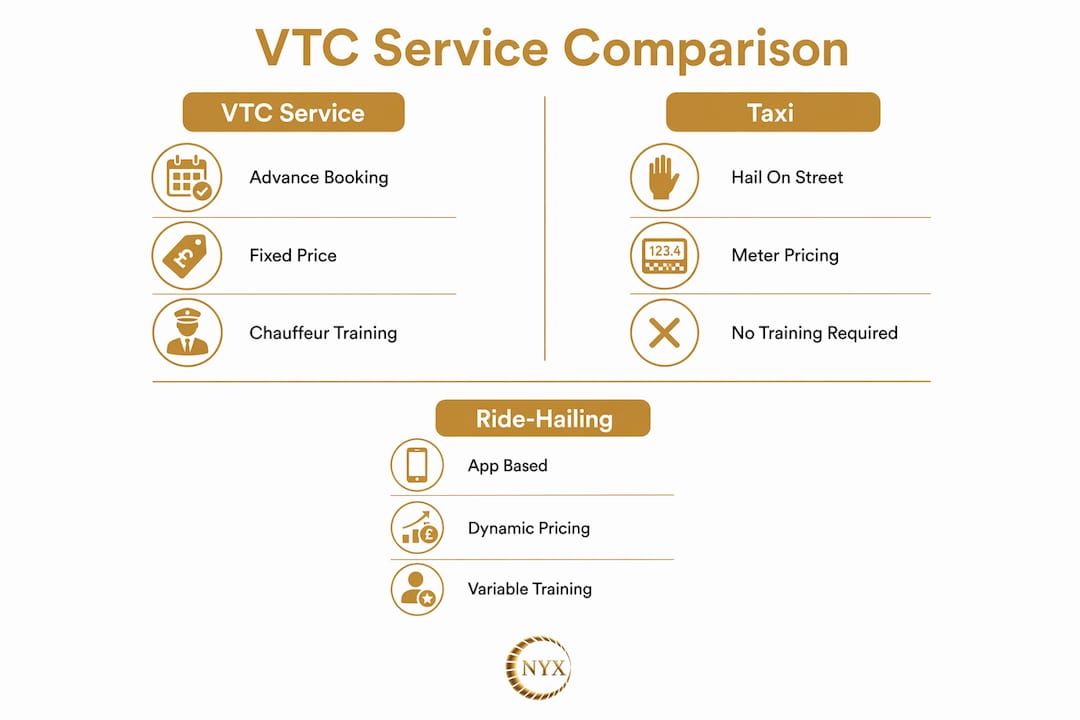
The table makes one point clear: the VTC model is the only format that removes pricing uncertainty entirely. For a traveller arriving at Nice NCE after a delayed flight at midnight, that matters considerably.
What are the benefits of booking a VTC service for tourists and corporate clients?
The benefits of a VTC service divide cleanly into two categories: practical and professional. Both matter, but they matter differently depending on whether you are a leisure traveller arriving for the Cannes Film Festival or a finance director flying in for MIPIM.
For tourists, the most immediate benefit is the absence of negotiation. The rate for a transfer from Nice NCE to Antibes or from Cannes to Saint-Tropez is confirmed before you board. There are no supplements for luggage, no confusion at the destination, and no language barrier to navigate at the end of a long flight. Clients can request language-specific chauffeurs speaking English, Arabic, Italian, Russian, or Spanish, which is particularly valuable for international visitors to the Côte d’Azur.
The in-vehicle experience also sets VTC apart from standard transport. Reputable operators provide complimentary chilled water, Wi-Fi, phone chargers, and climate control as standard. Child seats are available on request. These are not optional upgrades. They are included in the confirmed rate.
For corporate clients, the advantages extend beyond comfort:
- Fixed, transparent pricing eliminates expense report disputes and unexpected costs
- Centralised invoicing with 30-day payment terms simplifies administrative processes for finance teams
- Consistent vehicle presentation protects business image when transporting clients or executives
- Recurring bookings with the same chauffeur build familiarity and trust over time
- 24/7 availability covers early morning departures and late-night arrivals without premium surcharges
Corporate clients choose VTC not only for transport but for reliability and business image, favouring recurring luxury transfers for efficiency and professionalism. A CEO arriving at Monaco Heliport or the Palais des Festivals in Cannes in a well-presented Mercedes-Benz is making a statement before the meeting begins.
Pro Tip: If you are booking VTC transfers for a corporate event such as the Monaco Grand Prix or Cannes Lions, confirm your vehicles at least two weeks in advance. Demand across the Riviera during major events is high, and fixed-rate availability closes quickly.
How do you book and use a VTC service on the French Riviera?
Booking a VTC service follows a straightforward process, but the details matter. Here is how it works in practice with a reputable operator on the French Riviera.
- Submit your journey details. Provide your pickup location, destination, date, time, number of passengers, and any specific requirements such as child seats or extra luggage. Most operators confirm within two hours.
- Receive a fixed quote. The rate is confirmed per vehicle, not per passenger. It covers the full journey with no additions for tolls, parking, or waiting within the included buffer period.
- Choose your vehicle category. On the French Riviera, Transponyx operates four Mercedes-Benz categories: Standard Sedan (up to 3 passengers), Business Sedan (up to 3 passengers with premium finish), Van 7 pax, and Van 8 pax. Group size and luggage volume determine the right choice.
- Receive your driver’s details. Before departure, you receive the driver’s name, vehicle registration, and a contact number. There is no ambiguity at the pickup point.
- Track your flight automatically. Most VTC providers include flight tracking and buffer times to adjust pickup automatically, avoiding extra charges due to flight delays or early landings. Transponyx includes 60 minutes of free waiting time on all airport pickups and 20 minutes for any other address.
- Board and travel. Wi-Fi, chilled water, and phone chargers are ready on boarding. The driver handles routing, tolls, and parking.
For a journey from Nice NCE to Monaco, the drive covers approximately 22 kilometres and takes around 30–40 minutes depending on traffic on the A8 motorway. For transfers to Cannes, the distance is roughly 33 kilometres, typically 35–50 minutes. Both are standard routes with 2026 fixed rates confirmed at booking.
The Cannes Film Festival in May and the Monaco Grand Prix in late May represent the two busiest transfer periods on the Riviera. During these events, VTC transfers for Cannes events require early reservation, as demand from film industry professionals, sponsors, and media organisations saturates available vehicles across the region.
Pro Tip: For airport pickups at Nice NCE, always provide your flight number at the time of booking. A professional VTC operator will monitor your flight in real time and adjust the driver’s arrival accordingly. You should never be waiting at arrivals.
What do private chauffeur services add to the standard VTC experience?
The distinction between a standard VTC service and a private chauffeur service is one of depth rather than category. Luxury transport experts differentiate general VTC services by accessibility and practicality, while private chauffeurs focus on hospitality, discretion, and concierge support. Both operate within the same regulatory framework. The difference lies in what happens around the journey itself.
A private chauffeur service at the premium end of the market includes several features that standard VTC bookings do not:
- Cabin personalisation: preferred music, temperature, and privacy settings confirmed before departure
- Proactive itinerary management: the chauffeur anticipates route changes, event traffic, and timing adjustments without being asked
- Discretion protocols: for high-profile clients attending events such as the Monaco Grand Prix or MIPCOM, this includes specific pickup and drop-off procedures
- Concierge assistance: recommendations for restaurants, hotels, and local services delivered with genuine knowledge of the region
- Consistent presentation: suited chauffeurs, immaculate vehicles, and a uniform standard of conduct across every booking
Professional chauffeur services at the half-day level typically cost around €350, with full-day hire at approximately €600, including suited chauffeurs, personalised itineraries, and premium service throughout. These rates reflect the additional preparation and personalisation involved beyond a standard point-to-point transfer.
For corporate clients entertaining partners or executives on the Côte d’Azur, the private chauffeur model transforms transport into part of the hospitality experience. A client collected from Nice NCE in a Business Sedan by a bilingual chauffeur who already knows their preferred route to their hotel in Menton or Antibes arrives in a different frame of mind than one who has queued for a taxi.
The personalised transfer experience is not an indulgence for most corporate travel managers on the Riviera. It is a deliberate investment in client perception and operational reliability.
Why VTC services are reshaping luxury transport on the French Riviera
I have spent years observing how travellers navigate the French Riviera, and the single most consistent source of frustration I encounter is transport that fails to match the quality of everything else around it. A guest stays at a five-star hotel in Cannes, dines at a Michelin-starred restaurant in Èze, and then stands in a taxi queue at Nice NCE for forty minutes. The disconnect is jarring.
VTC services correct that imbalance. The fixed pricing model is not simply a commercial convenience. It is a trust mechanism. When a traveller confirms a transfer from Nice NCE to Monaco at a set rate, they are not just booking a car. They are removing one variable from a journey that already involves flight schedules, hotel check-ins, and meeting times. That reduction in uncertainty has a measurable effect on how people experience travel.
What I find most underappreciated is the productivity argument for business travellers. A corporate client in the back of a Business Sedan with Wi-Fi and a bilingual chauffeur who knows the A8 can review a presentation, take a call, or simply decompress before a high-stakes meeting. That time is not lost. It is recovered.
The French Riviera is a particularly demanding environment for transport operators. The geography is compressed, the events calendar is relentless, and the clientele has high expectations. Operators who cannot deliver consistency across the Cannes Film Festival, MIPIM, Monaco Grand Prix, Cannes Lions, and MIPCOM will not retain corporate accounts. The ones who do, like Transponyx, build their reputation on exactly the qualities that define a proper VTC service: fixed rates, professional drivers, and zero tolerance for unreliability.
If you are choosing between a standard taxi and a VTC service for a Riviera transfer, the question is not really about price. It is about what you want the journey to feel like before you arrive.
— Dany
Book your VTC transfer on the French Riviera with Transponyx
Transponyx operates 24 hours a day, 7 days a week from Nice Côte d’Azur Airport to Monaco, Cannes, Antibes, Menton, Saint-Tropez, and all major Alpine ski resorts including Isola 2000, Auron, and Valberg. Every transfer uses a Mercedes-Benz vehicle from the Transponyx fleet, with 2026 fixed rates confirmed at booking and no surge pricing under any circumstances.
All airport pickups include 60 minutes of free waiting time and real-time flight monitoring. Drivers are licensed VTC professionals, bilingual in English and French as a minimum, with additional languages including Italian, Spanish, Russian, and Arabic available on request. For groups, the Van 7 pax and Van 8 pax categories accommodate up to eight passengers with full luggage. Explore the full chauffeur service comparison to find the right vehicle and rate for your journey, or book directly via Nice NCE to Monaco transfers. Reservations: +33 6 10 30 71 84 or WhatsApp +33 7 67 78 10 26.
FAQ
What does VTC stand for?
VTC stands for Voiture de Transport avec Chauffeur, the French regulatory category for licensed private hire vehicles with a professional driver. The term is used across France and the wider French-speaking world to describe pre-booked, fixed-price chauffeur transport.
How does VTC pricing work?
A VTC rate is fixed at the time of booking and does not change regardless of traffic, time of day, or demand. There are no surge charges, no meter running, and no supplements added at the destination.
Do VTC drivers speak English on the French Riviera?
Reputable VTC operators on the French Riviera employ bilingual drivers as standard. Transponyx drivers speak English and French as a minimum, with several also speaking Italian, Spanish, Russian, or Arabic, making them well suited to international visitors.
How far in advance should I book a VTC service?
For standard transfers, booking 24–48 hours in advance is sufficient. During major Riviera events such as the Cannes Film Festival, Monaco Grand Prix, or MIPIM, booking two weeks or more in advance is strongly recommended, as vehicle availability closes quickly across the region.
What happens if my flight is delayed?
Professional VTC operators include real-time flight tracking on all airport pickups. Transponyx monitors every inbound flight and adjusts the driver’s arrival accordingly, with 60 minutes of free waiting time included. No extra charges apply for delays within that window.

par Daniel AIT GOUGAM | Juin 19, 2026 | news
Seamless travel is defined as the deliberate elimination of friction points across every stage of a journey, so that travellers move from origin to destination with confidence, comfort, and minimal disruption. In 2026, the importance of seamless travel has never been more pronounced. Biometric identification, fixed-rate private transfers, and structured travel routines are converging to reshape what passengers expect from every trip. For leisure travellers and event participants arriving at Nice Côte d’Azur Airport (NCE) for the Cannes Film Festival, the Monaco Grand Prix, or MIPIM, the difference between a fractured itinerary and a composed arrival is not accidental. It is the product of deliberate planning, reliable ground transport, and technology that removes the need to manage every detail manually.
What is the role of seamless travel in modern journeys?
Seamless travel is the infrastructure that allows a journey to function as a single, coherent experience rather than a series of disconnected transactions. The concept spans biometric check-in at departure, reliable connectivity in transit, and a confirmed vehicle waiting at arrivals. Each element depends on the others. Remove one, and the chain breaks.

Connectivity failures cause anxiety and a breakdown in trust that is difficult to recover mid-journey. That finding explains why 90% of travellers rate connectivity as important or very important in 2026. Connectivity is no longer a comfort feature. It is the baseline expectation against which every other service is judged.
The benefits of smooth travel extend beyond convenience. When logistics are resolved in advance, travellers arrive at their destination with mental energy intact. That energy translates directly into better engagement at business events, sharper decision-making in meetings, and greater enjoyment of leisure experiences. For a delegate arriving in Cannes for Cannes Lions, the 30-minute transfer from NCE is not a footnote. It is the first impression of the entire trip.
Named entities that define this space in 2026 include Amadeus, FacePhi, and Transponyx, each addressing a different layer of the travel chain: document verification, biometric identity, and premium ground transport respectively.
How is biometric technology shaping the travel experience?
Biometric integration is the most structurally significant shift in travel since the introduction of online check-in. By mid-2026, passport-less trips are a reality, with industry leaders testing systems that replace physical passports, boarding passes, and hotel keys with a single biometric credential. Amadeus is among the companies projecting €50 million in annual savings from these systems. That figure reflects not just cost reduction but a fundamental redesign of how passengers move through airports and hotels.
The practical implications for travellers are considerable:
- Airport departures: Facial recognition at security and boarding gates removes the need to locate physical documents under time pressure.
- Hotel arrivals: Biometric room access means check-in completes in seconds, with no queue at the front desk after a long flight.
- Loyalty and payment: Unified digital identity links frequent flyer accounts, payment credentials, and preferences to a single biometric profile.
- Security: Biometric systems reduce identity fraud at border control, a benefit that also accelerates processing times for all passengers.
The shift towards biometric tap-and-go systems is making digital-first providers more attractive to travellers who value speed and discretion. FacePhi, a specialist in biometric identity verification, describes this as a paradigm shift: the travel industry is moving from fragmented document checks toward unified digital identity. That shift is not a future projection. It is happening at major European airports right now.
For event participants travelling to the French Riviera, biometric processing at NCE reduces the time between landing and reaching the arrivals hall. That time saving matters when a chauffeur is waiting and a conference session begins in 90 minutes.
Why are reliable airport transfers foundational to any trip?
Pre-arranged transfers eliminate decision fatigue at the precise moment when travellers are most vulnerable to it: immediately after landing. A passenger who has crossed multiple time zones, navigated a connecting flight, and cleared customs is not in the best condition to negotiate a fare, locate a rank, or assess an unfamiliar driver. A confirmed vehicle with a named driver removes every one of those variables.
Fixed-rate pricing is the operational expression of this principle. When a traveller books an airport transfer in Nice with Transponyx, the rate is confirmed at the time of booking, per vehicle, with no surge pricing regardless of demand. For a Business Sedan from NCE to Monaco, the fare does not change because the Monaco Grand Prix weekend has filled every hotel on the Côte d’Azur. That predictability is not a minor convenience. It is a form of financial and psychological security.
The specific routes served by Transponyx illustrate the practical scope of this service:
- NCE to Monaco: approximately 25 kilometres, 30–40 minutes depending on traffic.
- NCE to Cannes: approximately 30 kilometres, 35–50 minutes.
- NCE to Antibes: approximately 20 kilometres, 25–35 minutes.
- NCE to Menton: approximately 35 kilometres, 40–50 minutes.
- NCE to Saint-Tropez: approximately 110 kilometres, 90–120 minutes.
- NCE to Isola 2000: approximately 90 kilometres, 90 minutes in normal conditions.
Every Transponyx airport pickup includes 60 minutes of free waiting time and real-time flight monitoring. If a flight lands early or late, the driver adjusts. The traveller never needs to send a message or renegotiate.
Pro Tip: Book your transfer before you book your hotel. Confirming ground transport first removes one of the most stressful variables from the entire itinerary, particularly for arrivals during major Riviera events when demand peaks sharply.
Reliable transport reduces travel anxiety by creating predictability, and travellers interpret predictability as safety. That psychological mechanism is why a confirmed chauffeur service consistently outperforms ad hoc alternatives in post-trip satisfaction surveys, not because the vehicle is more comfortable, but because the certainty it provides begins working before the passenger even boards the plane.
Do travel routines genuinely reduce stress?
Travel routines reduce decision fatigue by automating the logistical decisions that would otherwise consume mental energy throughout a journey. The research is direct: structured routines correlate with improved satisfaction and a stronger sense of control, even when conditions are imperfect. Structure does not constrain a trip. It creates the conditions under which genuine enjoyment becomes possible.
Consider how a well-constructed routine functions for a delegate attending MIPCOM in Cannes:
- Pre-departure: Boarding pass downloaded, transfer confirmed with Transponyx, hotel check-in completed digitally. No decisions required at the airport.
- Arrival at NCE: Driver waiting in arrivals with a name board. Luggage loaded. Wi-Fi connected in the vehicle before leaving the car park.
- Transfer to Cannes: 35–50 minutes of productive or restful time in a Business Sedan, with chilled water and phone chargers available.
- Hotel arrival: Biometric check-in or pre-assigned room key. No queue. No form-filling.
- Event day: Schedule confirmed the evening before. Transport for evening events pre-booked.
Each step in this sequence was decided before the journey began. On the day itself, the delegate makes no logistical decisions at all. That is the practical definition of structured travel comfort.
The deeper benefit is resilience. When a flight is delayed or a session overruns, a traveller with a structured routine has buffer time built in. Transponyx drivers monitor flights in real time, so a 45-minute delay at departure does not cascade into a missed connection at the other end. The routine absorbs the disruption rather than collapsing under it.
How does frictionless travel enhance event and destination experiences?
Luxury travel is defined by frictionless experiences where service unfolds without the guest needing to manage it actively. That definition has moved from the hospitality sector into ground transport, and the implications for event participants on the French Riviera are significant.
The table below compares the experience of two delegates attending the same Cannes Film Festival screening, arriving on the same flight from London Heathrow.
| Factor |
Ad hoc taxi |
Transponyx Business Sedan |
| Fare certainty |
Unknown until arrival |
Fixed at booking |
| Driver identification |
App photo only |
Named driver, name board |
| Waiting time included |
None |
60 minutes free |
| Flight monitoring |
None |
Included |
| In-vehicle Wi-Fi |
Not guaranteed |
Standard on all vehicles |
| Language |
French only |
English, French, Italian, Spanish, Russian, Arabic |
| Arrival condition |
Variable |
Composed, rested |
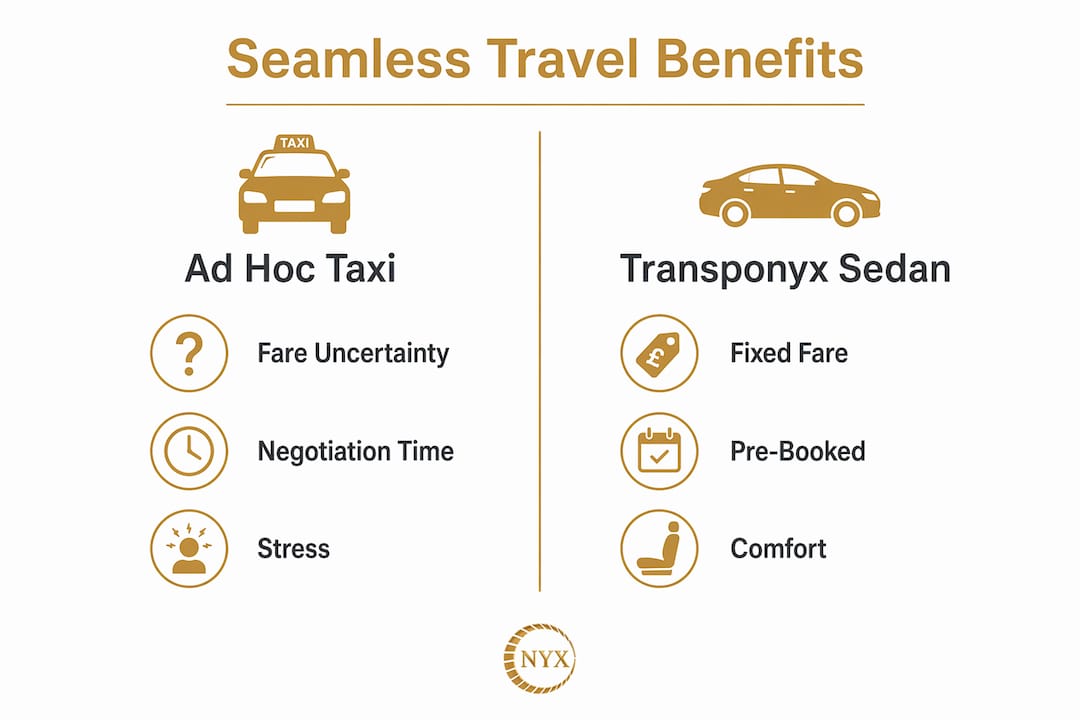
The delegate who arrives composed has a measurable advantage over the one who spent 20 minutes negotiating a fare in a busy arrivals hall. At events like MIPIM or Cannes Lions, where relationships are formed in the first hour of arrival, that advantage is not trivial.
For groups attending the Monaco Grand Prix, the Van 7 pax and Van 8 pax categories allow entire delegations to travel together in a single Mercedes-Benz vehicle, maintaining conversation and cohesion from NCE to the paddock. The alternative, splitting a group across multiple vehicles, fragments the experience before it begins.
Convenience in business travel is directly linked to performance and satisfaction. That connection is why corporate accounts and concierge services on the Riviera consistently specify pre-booked chauffeur transfers rather than leaving ground transport to chance. The luxury transport pillars that define premium ground transport in 2026 all point toward the same outcome: a traveller who arrives ready to engage.
My perspective on what seamless travel actually delivers in 2026
Having covered luxury ground transport on the French Riviera for many years, I have watched the conversation around seamless travel shift from aspiration to expectation. Travellers no longer describe a smooth transfer as a pleasant surprise. They describe a difficult one as a failure.
What strikes me most about 2026 is not the biometric technology, impressive as it is. It is the psychological architecture that reliable transport creates. A traveller who knows their driver is monitoring their flight, that the fare is fixed, and that 60 minutes of waiting time is built in, boards the plane in a fundamentally different state of mind. That state of mind carries through the entire trip. I have spoken to delegates at MIPIM and Cannes Lions who describe their Transponyx transfer as the moment the trip “clicked into place.” That is not marketing language. It is a precise description of what happens when logistics disappear from conscious attention.
The biometric developments from Amadeus and FacePhi are genuinely transformative, but they address the airport layer only. Ground transport remains the final and most personal stage of every arrival. A passenger can clear NCE biometrically in minutes and then spend 40 minutes in uncertainty outside the terminal. The two systems need to work together, and in my experience, the travellers who plan both in advance are the ones who arrive at their destination intact.
My honest view is that most travellers underestimate the cumulative cost of small frictions. A 15-minute queue here, an unexpected surcharge there, a driver who does not speak the language. None of these is catastrophic alone. Together, they erode the quality of the entire trip. The transport trends shaping 2026 all point toward removing those frictions systematically, and the services that do it best are the ones worth booking first.
— Dany
Plan your next Riviera arrival with Transponyx
For travellers and event participants arriving at Nice Côte d’Azur Airport, Transponyx provides fixed-rate, pre-booked chauffeur transfers across the French Riviera, with 2026 rates confirmed at booking and no surge pricing. The fleet covers every group size, from a Standard Sedan for solo travellers to a Van 8 pax for full delegations attending the Monaco Grand Prix or Cannes Film Festival.
Every vehicle is a Mercedes-Benz equipped with Wi-Fi, air conditioning, chilled water, and phone chargers. Drivers are licensed VTC professionals, bilingual as a minimum, with flight monitoring included on every airport pickup. Compare the full range of luxury chauffeur options or book your Nice Airport transfer directly. Reach the reservations team at +33 6 10 30 71 84 or via WhatsApp on +33 7 67 78 10 26, or visit transponyx.com to confirm your 2026 rate.
FAQ
What does seamless travel mean in practice?
Seamless travel means every stage of a journey, from check-in to final destination, is pre-arranged so that no decision or delay interrupts the experience. It combines biometric technology, reliable ground transport, and structured planning to remove friction from the traveller’s path.
Why does reliable airport transfer matter so much?
Pre-booked transfers eliminate decision fatigue at the most vulnerable point of any trip: immediately after landing. Fixed-rate pricing and confirmed drivers remove financial uncertainty and the stress of locating transport in an unfamiliar arrivals hall.
How does biometric technology improve the travel experience?
Biometric systems replace physical passports, boarding passes, and hotel keys with a single digital credential, reducing processing time at airports and hotels. Amadeus projects €50 million in annual savings from these systems, which also accelerate passenger flow through security.
Do travel routines genuinely reduce stress?
Yes. Structured routines reduce decision fatigue by automating logistical choices before the journey begins, freeing mental energy for the experience itself. They also build resilience, so that delays and disruptions are absorbed rather than compounded.
What is the best way to achieve seamless travel on the French Riviera?
Book ground transport before departure, confirm a fixed-rate transfer from NCE with a licensed VTC provider such as Transponyx, and use digital check-in wherever available. Pre-arranging every logistical step means the journey from landing to destination requires no active management at all.

par Daniel AIT GOUGAM | Juin 18, 2026 | news
Point-to-point transfer is a direct transportation service that moves passengers from one specific location to another with no intermediate stops, hub connections, or shared routing. The term comes from ground transport and aviation alike, but for travellers on the French Riviera in 2026, it means one thing above all: a reserved vehicle, a professional chauffeur, and a fixed fare confirmed at the moment of booking. Whether you are arriving at Nice Côte d’Azur Airport (NCE) and heading to Monaco, or leaving Cannes after the Film Festival, a point-to-point journey removes every variable that makes travel stressful. Transponyx operates this model exclusively, with 2026 fixed rates across its full Mercedes-Benz fleet.
What is point-to-point transfer and how does it work?
Point-to-point transfer is defined as direct travel between two specific locations without intermediate stops or routing through central hubs. The model is simpler to schedule and reduces delays compared to hub-and-spoke systems. That simplicity is the entire point.
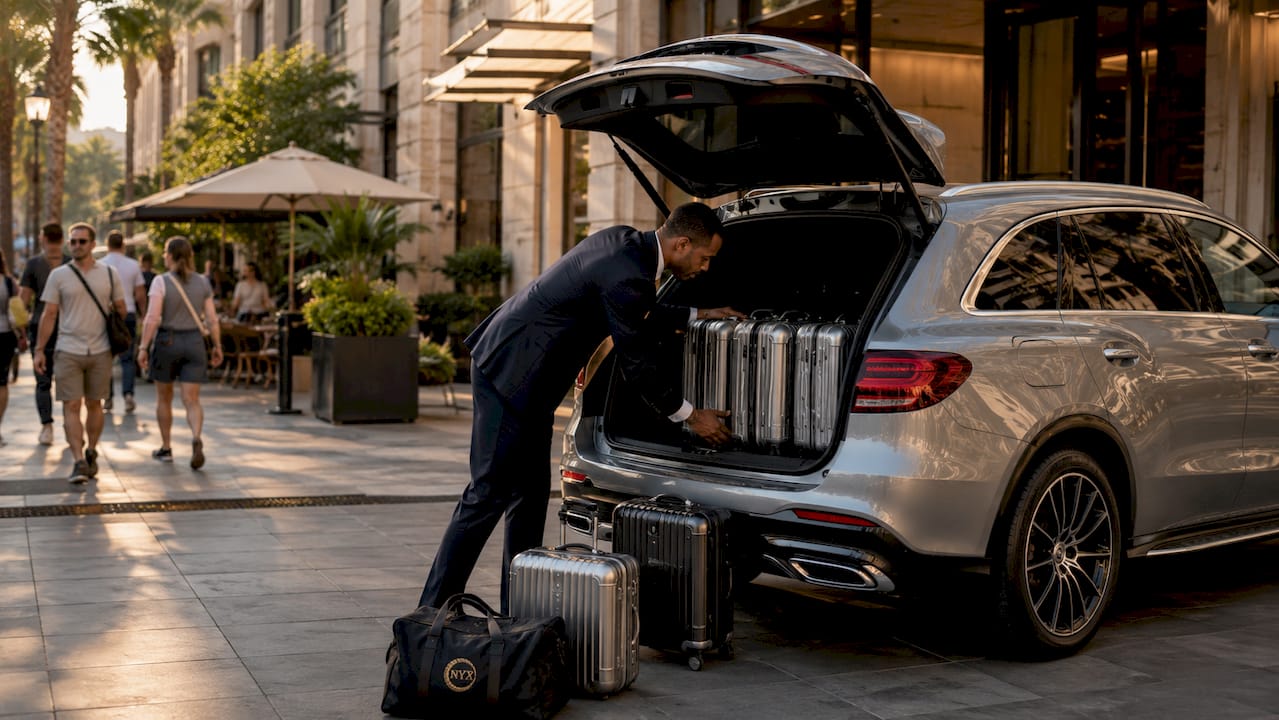
In practice, you book a vehicle for a defined origin and destination. The driver arrives at your location, loads your luggage, and takes you directly to where you need to be. No other passengers board. No detours are made. The route is planned in advance, and the fare is fixed before you travel.
This contrasts sharply with how most public transport and many taxi services operate. A hub-and-spoke model routes passengers through a central interchange, whether that is an airport, a bus terminal, or a rail hub. Each connection adds time, risk, and uncertainty. Point-to-point transport removes the hub entirely.
The term “point-to-point” also appears in data networking, where point-to-point communication describes a direct link between two nodes without passing through a central server. The principle is identical: directness, speed, and no unnecessary intermediaries.
How does point-to-point transfer differ from hub-and-spoke and rideshare?
Understanding the differences between transport models helps you choose the right one for your journey. The three most common models are point-to-point, hub-and-spoke, and rideshare. Each serves a different purpose and delivers a different passenger experience.
Hub-and-spoke models concentrate traffic through central airports or hubs, maximising network connectivity but adding complexity and delay risk. A passenger travelling from Nice to Menton via a hub-based coach service might change vehicles twice and add 45 minutes to a journey that takes 35 minutes by direct car. The network gains efficiency at scale; the individual passenger loses time.
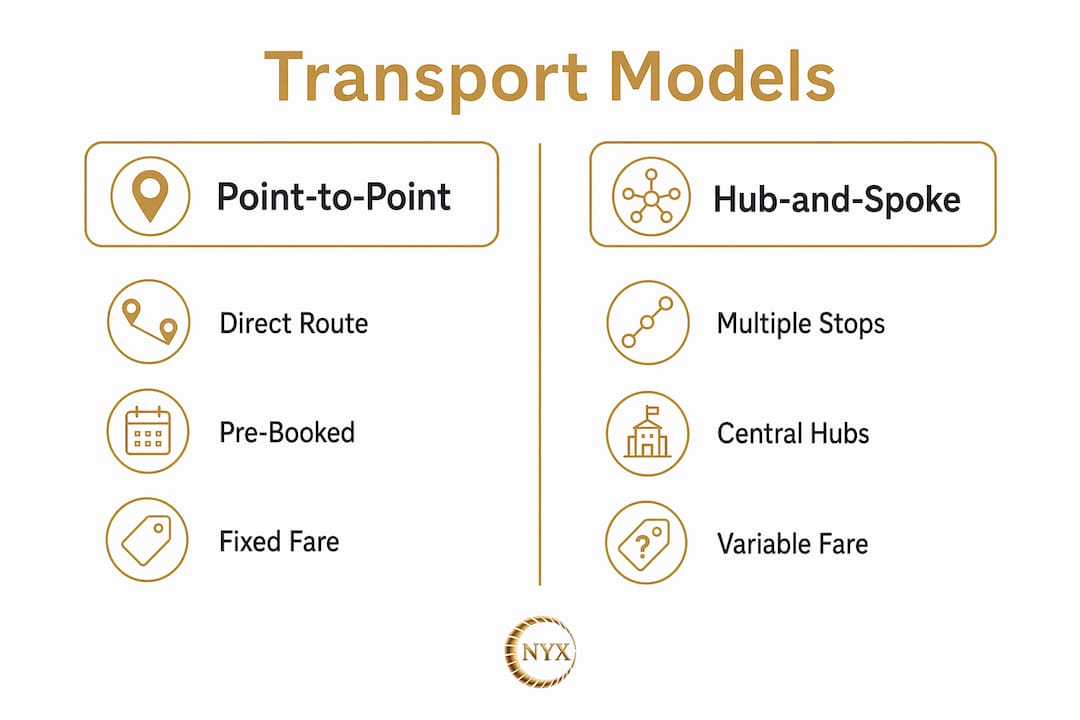
Rideshare services such as on-demand apps dispatch the nearest available driver, which means wait times are unpredictable and routes may vary. Shared rideshare options add further stops for other passengers. There is no pre-booked exclusivity, no guaranteed vehicle type, and no fixed fare before you travel.
Point-to-point transfers are pre-booked and scheduled in advance, unlike rideshare or taxis dispatched by proximity. This enhances reliability and route familiarity considerably. The driver knows your flight number, your hotel, and your schedule before the journey begins.
| Factor |
Point-to-Point |
Hub-and-Spoke |
Rideshare |
| Stops en route |
None |
Multiple hubs |
Possible shared stops |
| Booking method |
Pre-booked, confirmed |
Scheduled timetable |
On-demand app |
| Fare structure |
Fixed at booking |
Fixed ticket price |
Variable, surge pricing |
| Vehicle exclusivity |
Dedicated vehicle |
Shared service |
Usually shared |
| Reliability |
High, pre-planned |
Moderate, connection risk |
Variable, proximity-based |
| Ideal for |
Direct, time-sensitive trips |
Long-haul network travel |
Short urban hops |
Pro Tip: When travelling to a major Riviera event such as the Monaco Grand Prix or MIPIM in Cannes, book your point-to-point transfer at least 48 hours in advance. Demand during event weeks is high, and pre-booking locks in your 2026 fixed rate regardless of how busy the roads become.
What are the benefits of point-to-point transfers for travellers?
The practical benefits of a point-to-point journey are most visible when time and comfort matter. No detours or shared stops shorten journey times directly. The Nice NCE to Monaco route, for example, covers roughly 25 kilometres and takes approximately 30 minutes in a dedicated vehicle. The same journey via public transport involves a train to Monaco-Monte-Carlo station and can take over an hour with connections.
Fixed and transparent pricing is the second major advantage. Point-to-point transfers offer fixed-rate pricing with no surge pricing or hourly minimums, with fares confirmed at booking. This matters enormously during events. During the Cannes Film Festival, Cannes Lions, or MIPCOM, on-demand taxi fares can increase sharply due to demand. A pre-booked point-to-point fare does not move.
Point-to-point transfer is ideal for special events, allowing direct travel between venues such as hotels, airports, and event sites without detours. Transponyx serves the full event calendar on the French Riviera, from the Cannes Film Festival in may to the Monaco Grand Prix and MIPIM, with dedicated vehicles for each booking.
Group travel benefits significantly from this model. Transponyx offers four vehicle categories to match passenger numbers precisely:
- Standard Sedan (up to 3 passengers): Mercedes-Benz saloon, ideal for solo travellers and couples
- Business Sedan (up to 3 passengers): premium finish, suited to corporate arrivals and client transfers
- Van 7 pax (up to 7 passengers): full-size Mercedes-Benz van for families and small groups
- Van 8 pax (up to 8 passengers): maximum capacity for larger delegations and event groups
Every vehicle in the fleet carries Wi-Fi, air conditioning, chilled water, and phone chargers. Child seats are available on request.
Privacy is a further benefit that rideshare and hub-based services cannot match. A dedicated vehicle means your conversations, your schedule, and your luggage remain entirely your own. For corporate travellers and high-profile guests arriving for events such as MIPIM or the Monaco Grand Prix, that privacy is not a luxury. It is a requirement.
Pro Tip: For airport transfers from Nice NCE, Transponyx includes 60 minutes of free waiting time and monitors your flight in real time. If your flight lands early or late, your driver adjusts automatically. No extra charge applies.
How to book a point-to-point transfer and what to expect
Booking a point-to-point transport service follows a straightforward process, but the details matter. The sequence below reflects how Transponyx handles every reservation.
First, you confirm your origin, destination, date, time, and passenger count. Transponyx accepts bookings via https://transponyx.com, by phone at +33 6 10 30 71 84, or via WhatsApp at +33 7 67 78 10 26. The fare is calculated immediately and confirmed in writing. No estimate. No range. One fixed price per vehicle.
Second, you receive a booking confirmation with your driver’s name, vehicle details, and contact number. For airport transfers from Nice NCE, flight monitoring begins automatically. Your driver tracks your arrival gate and adjusts the pickup time if your flight is delayed or arrives ahead of schedule.
Third, your driver meets you at the agreed point. For airport pickups, this is the arrivals hall with a name board. For hotel or address pickups, the driver arrives at the door. Free waiting time is 60 minutes for all airport pickups and 20 minutes for any other address.
The journey itself is direct. The driver follows the pre-planned route to your destination without deviation. Transponyx drivers are licensed VTC professionals, bilingual in English and French as a minimum, with several also speaking Italian, Spanish, Russian, or Arabic. That language capability matters on the Riviera, where international guests arrive from across Europe, the Gulf states, and beyond.
One-way and return bookings are both available. For return journeys, the same fixed-rate principle applies. There is no penalty for booking a single direction, and no requirement to book a round trip to access the best fare.
For groups travelling to events such as the Cannes Film Festival or Cannes Lions, Transponyx also coordinates airport transfers for Cannes events, managing multiple vehicles and staggered arrival times for delegations. That level of coordination is simply not available through on-demand services.
How does point-to-point pricing compare with other options?
Cost transparency is one of the defining features of a well-run point-to-point service. Unlike hourly chauffeur hires, point-to-point transfers charge fixed fares without hourly minimums, providing cost efficiency for direct trips. This pricing model appeals especially to those making single journey transfers such as airport-to-hotel rides or event transfers.
The practical implication is significant. An hourly hire service charges from the moment the vehicle departs the garage, often with a two-hour minimum. A 30-minute airport transfer under that model costs you two hours of fees. A point-to-point fare covers the journey and nothing more.
Rideshare surge pricing adds a different kind of unpredictability. During peak periods at Nice NCE, during the Monaco Grand Prix weekend, or on the final evening of the Cannes Film Festival, on-demand fares can multiply. A fixed point-to-point fare agreed at booking is immune to that volatility.
| Service Type |
Fare Structure |
Surge Risk |
Minimum Charge |
Vehicle Exclusivity |
| Point-to-point chauffeur |
Fixed per vehicle |
None |
Journey only |
Yes |
| Hourly chauffeur hire |
Per hour, minimum applies |
None |
Typically 2 hours |
Yes |
| On-demand rideshare |
Dynamic, app-calculated |
High during events |
None |
Shared or solo |
| Public taxi |
Metered or fixed zone |
Moderate |
Minimum fare |
Yes |
Transponyx publishes its 2026 fixed rates per vehicle category. A Standard Sedan transfer from Nice NCE to Monaco is priced as a single fixed fare. The same journey in a Van 7 pax costs more, but the per-person cost for a group of six is often lower than six individual rideshare fares. Groups travelling together to MIPIM in Cannes or arriving for the Monaco Grand Prix regularly find the Van 7 pax or Van 8 pax the most cost-effective option available.
For long-distance point-to-point routes such as Nice to Milan, San Remo, or Ventimiglia, the fixed-fare model removes all ambiguity from budgeting. Corporate travel managers and hotel concierge teams in particular value that certainty when arranging client transfers.
Why point-to-point is the only model that makes sense on the riviera
I have covered ground transport on the French Riviera for long enough to have seen every model tried and most of them found wanting. Hub-based coaches work for budget travellers with flexible schedules. On-demand apps work for short urban trips when time pressure is low. Neither works reliably when you are arriving at Nice NCE at 11pm after a delayed flight from London, with a meeting in Monaco at 9am the following morning.
Point-to-point services minimise the risk of network-wide delay propagation common in hub-and-spoke transport, improving punctuality and passenger satisfaction. That operational simplicity is a main advantage in congested event destinations like the French Riviera. I would go further: during event weeks, it is the only model that functions reliably.
The Riviera is not a normal transport environment. During the Cannes Film Festival, the road between Nice and Cannes carries a volume of high-value passengers that no on-demand system handles gracefully. During the Monaco Grand Prix, road closures and security perimeters make improvised routing genuinely risky. A pre-planned, pre-booked point-to-point transfer with a driver who knows the local roads is not a premium option in those conditions. It is the practical one.
What I find most underappreciated about the point-to-point model is its suitability for travellers who are not necessarily wealthy but are time-conscious. Point-to-point is a growing model in mass transport to reduce costs and improve directness, suitable for many traveller types. A family of five sharing a Van 7 pax from Nice NCE to Antibes pays a single fixed fare that compares favourably with five train tickets, two taxi rides, and the stress of managing luggage through a busy station.
Transponyx has built its entire operation around this model, and the results speak clearly. Fixed rates, professional drivers, and a fleet that covers every group size from a solo business traveller in a Standard Sedan to an eight-person delegation in a Van 8 pax. That consistency is what the Riviera’s most demanding travellers return to, year after year.
— Dany
Book your point-to-point transfer with Transponyx
Transponyx provides luxury point-to-point chauffeur services across the French Riviera with 2026 fixed rates, confirmed at booking and never subject to surge pricing. The fleet covers every group size: Standard Sedan and Business Sedan for up to 3 passengers, Van 7 pax for up to 7, and Van 8 pax for up to 8. All vehicles are Mercedes-Benz, fully equipped with Wi-Fi, air conditioning, chilled water, and phone chargers. Routes include Nice NCE to Monaco, Cannes, Antibes, Menton, Saint-Tropez, and long-distance transfers to Italy and Provence. Drivers are licensed VTC professionals, bilingual as a minimum, operating 24 hours a day, 7 days a week. Reserve your transfer at https://transponyx.com or call +33 6 10 30 71 84.
FAQ
What is a point-to-point transfer?
A point-to-point transfer is a direct transportation service that moves passengers from one specific location to another with no intermediate stops, shared routing, or hub connections. The fare is fixed at booking and a dedicated vehicle is reserved exclusively for the passenger or group.
How does point-to-point transport differ from rideshare?
Point-to-point transfers are pre-booked and scheduled in advance, with a dedicated vehicle and confirmed fare, whereas rideshare services dispatch the nearest available driver on demand with variable pricing. Point-to-point services offer no surge pricing and no shared stops.
Is point-to-point transfer more expensive than a taxi?
Point-to-point transfers charge fixed fares without hourly minimums, which makes them cost-competitive with taxis for direct journeys, particularly for groups sharing a vehicle. During high-demand periods such as the Cannes Film Festival or Monaco Grand Prix, fixed fares are typically lower than surged taxi or rideshare rates.
What vehicles are used for point-to-point transfers on the french riviera?
Transponyx operates an exclusive Mercedes-Benz fleet in four categories: Standard Sedan (up to 3 passengers), Business Sedan (up to 3 passengers, premium finish), Van 7 pax (up to 7 passengers), and Van 8 pax (up to 8 passengers). All vehicles include Wi-Fi, air conditioning, chilled water, and phone chargers.
How far in advance should i book a point-to-point transfer?
Booking at least 24 hours in advance is recommended for standard routes such as Nice NCE to Monaco or Cannes. During major events including the Cannes Film Festival, MIPIM, or the Monaco Grand Prix, booking 48–72 hours ahead secures your preferred vehicle and locks in the 2026 fixed rate.