
Travel recommendations are defined as structured guidance, from official government advisories to personalised human and AI-generated suggestions, that inform travellers’ decisions on safety, logistics, and destination conditions. Their role is not decorative. Recommendations reduce genuine uncertainty, shape insurance eligibility, and determine whether a traveller arrives prepared or scrambles at the gate. A 2026 study of 708 participants confirmed that the source and timing of a recommendation directly affect how persuasive it is. Understanding which type of advice to trust, and when, is the single most consequential skill a traveller can develop before departure.
What is the role of travel recommendations in safe trip planning?
Travel recommendations function as an early-warning and decision-support system. They translate complex, destination-specific risk into language a traveller can act on, covering everything from entry requirements and vaccination rules to local laws and regional security conditions. Without them, travellers rely on guesswork, and guesswork has consequences.
Official advisories form the backbone of this system. Government bodies such as the US State Department, the UK Foreign, Commonwealth and Development Office, and Australia’s Smartraveller programme each publish structured guidance using a four-level advisory scale, ranging from Level 1 (Exercise Normal Precautions) to Level 4 (Do Not Travel). That scale gives travellers a standardised baseline before they consult any other source. It also signals to insurers whether coverage applies.
Personalised recommendations add a second layer. A local contact, a trusted travel agent, or a well-sourced editorial guide can fill the gaps that government advisories leave. Advisories cover countries and regions; personalised guidance covers neighbourhoods, transport options, and seasonal conditions. The two sources are complementary, not interchangeable.
The importance of travel advice grows sharply when a destination has uneven conditions across regions. A country rated Level 2 overall may contain Level 4 zones. Travellers who read only the headline rating miss that distinction entirely.
How do official travel advisories influence traveller behaviour?
Official advisories are valuable starting points for risk assessment, particularly for travellers unfamiliar with a destination’s specific conditions. The founder of The Getaway Co. describes them as a “standardised starting point,” which is exactly right. They establish a common reference, not a final verdict.
The four-level framework works as follows:
- Level 1 (Exercise Normal Precautions): Standard vigilance applies. No specific threat elevates the destination above routine travel.
- Level 2 (Exercise Increased Caution): Specific risks exist. Travellers should research those risks and adjust plans accordingly.
- Level 3 (Reconsider Travel): Significant dangers are present. Travel should only proceed with strong justification and thorough preparation.
- Level 4 (Do Not Travel): The destination presents extreme risk. Most insurers will not cover travel to Level 4 destinations.
Advisories also vary by region within a country. A traveller planning a trip to a large nation should check advisory detail at the regional level, not just the national summary. That distinction can mean the difference between a well-planned itinerary and an avoidable incident.
The impact on travel insurance is direct and often underestimated. Many policies exclude coverage for destinations under a Level 3 or Level 4 advisory. Travellers who book without checking the advisory level may find their insurance void before they board.
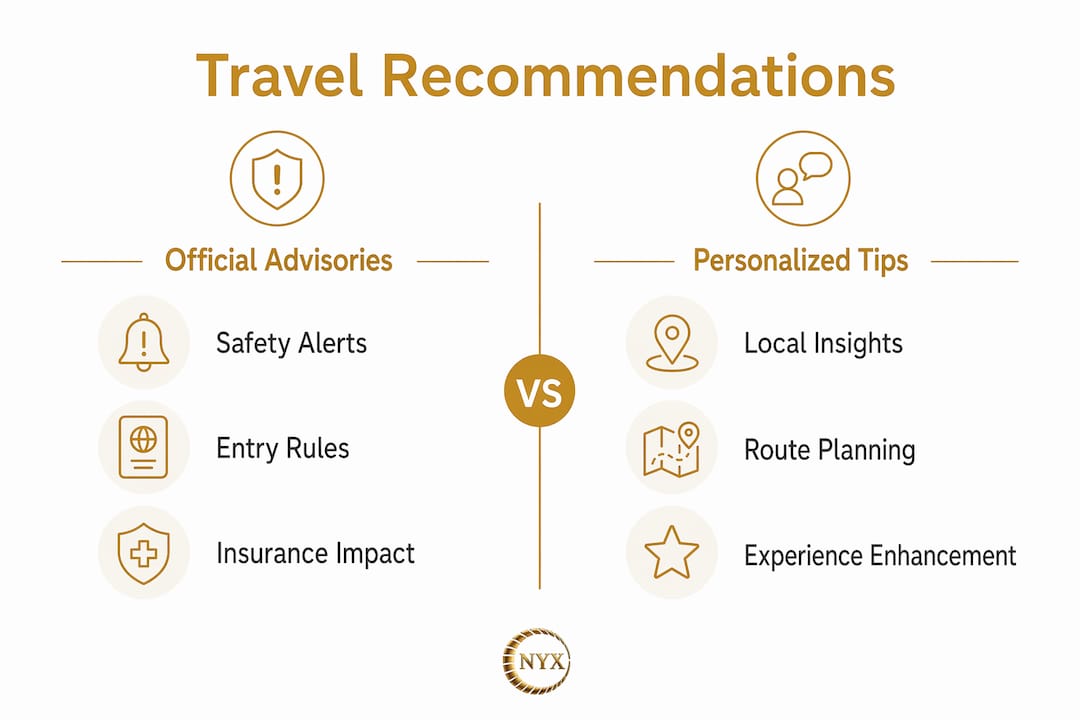
Checking official foreign travel advice weeks before departure is the only way to resolve issues that cannot be fixed at the airport. Vaccination requirements, visa conditions, and entry health documentation all require lead time. A traveller who reads the advisory the night before departure has no time to act on what they find.
Pro Tip: Set a calendar reminder to check your government’s official travel advisory at least six weeks before departure. That window gives you time to arrange vaccinations, apply for visas, and adjust your itinerary if conditions have changed.
Human vs AI travel recommendations: which should you trust?
The answer depends on when you are travelling. A 2026 study of 708 participants found that travellers planning near-future trips significantly prefer human-generated recommendations, while generative AI is more persuasive for planning journeys in the distant future. The mechanism is message credibility. A human recommendation for a trip next month feels grounded in current, lived experience. An AI recommendation for a trip two years away feels less constrained by that standard.
| Planning horizon | Preferred recommendation source | Primary reason |
|---|---|---|
| Near future (weeks to months) | Human-generated | Higher perceived credibility |
| Distant future (one year or more) | Generative AI | Broader scenario exploration |
| Real-time, on-trip decisions | Generative AI as co-pilot | Conversational, adaptive responses |
| Safety and legal compliance | Official government advisories | Authoritative, standardised |
Generative AI tools have evolved beyond simple information retrieval. Research describes them as virtual advisors before trips and real-time co-pilots during journeys, capable of conversational value co-creation with travellers. That is a meaningful shift. An AI that can adapt its suggestions based on your evolving itinerary is genuinely useful, not just a search engine with a friendlier interface.
The risk, however, is significant. AI-generated content errors, commonly called hallucinations, reduce perceived accuracy and usefulness, and decrease the likelihood that travellers follow AI recommendations at all. A fabricated restaurant that no longer exists is an inconvenience. A fabricated entry requirement is a crisis. Travellers who have experienced an AI error once are measurably less likely to trust AI recommendations in future.
AI recommendation systems also employ hidden filters, favour iconic sites, and draw heavily from marketing-heavy sources. The results are curated, not neutral. A traveller who treats AI output as objective data is working with a biased sample without knowing it.
Pro Tip: When using generative AI for trip planning, verify every specific claim, including opening hours, entry requirements, and transport options, against an official or human source before acting on it.
What practical steps maximise the benefits of travel recommendations?
Effective use of travel recommendations requires a structured approach, not passive consumption. The travellers who benefit most treat recommendations as inputs to a decision process, not as instructions to follow blindly.
-
Check official advisories first, and check them early. Consult your government’s travel advisory portal at least six weeks before departure. Note the level, read the regional breakdown, and identify any health or legal requirements that need preparation time.
-
Cross-reference multiple sources. No single source is complete. Official advisories cover macro-level risk. Human recommendations from local contacts or specialist travel agents cover conditions on the ground. AI tools can synthesise large volumes of information quickly. Use all three, and weight them according to their strengths.
-
Understand AI’s structural limitations. Transparent design and awareness of AI limitations are the primary factors that build calibrated trust in AI recommendations. Travellers who understand that AI outputs are filtered and commercially influenced make better use of those outputs than travellers who accept them uncritically.
-
Plan logistics with verified providers. Transport is where poor recommendations cause the most immediate disruption. A missed airport transfer in Nice, a surge-priced ride during the Monaco Grand Prix, or an unverified driver at Cannes Film Festival can derail an otherwise well-planned trip. Booking with a licensed, fixed-rate provider such as Transponyx removes that variable entirely. Transponyx operates 24 hours a day, 7 days a week, with flight monitoring on every airport transfer from Nice Côte d’Azur Airport (NCE).
-
Adapt dynamically during travel. Conditions change. A road closure, a local event, or a weather shift can render pre-trip advice obsolete within hours. Travellers who treat recommendations as a living resource, rather than a fixed plan, respond to those changes without panic.
The smarter trips guide from Transponyx covers how advisories and recommendations interact with logistics and route planning in practical terms, particularly for the French Riviera.
How do travel recommendations shape luxury transport choices on the French Riviera?
On the French Riviera, the impact of travel suggestions on transport decisions is sharper than almost anywhere else in Europe. The region hosts the Cannes Film Festival, the Monaco Grand Prix, Cannes Lions, MIPIM, and MIPCOM, each of which compresses demand for private transport into a narrow window. Travellers who arrive without a confirmed, fixed-rate booking during those periods face unpredictable availability and pricing.
Credible recommendations consistently point to the same conclusion: book private chauffeur transport in advance, with a licensed VTC provider, at a confirmed rate. The reasons are practical.
- Fixed pricing eliminates financial uncertainty. Transponyx publishes 2026 fixed rates per vehicle, confirmed at booking, with no surge pricing. A transfer from Nice NCE to Monaco takes approximately 30 minutes and covers around 22 kilometres. The rate is the same whether you book during the Monaco Grand Prix or on a quiet Tuesday in november.
- Flight monitoring removes the stress of delays. Every Transponyx airport transfer includes real-time flight tracking. The driver adjusts to your actual arrival time, not your scheduled one. Free waiting time of 60 minutes is included on all airport pickups.
- Local knowledge adds genuine value. Transponyx drivers are licensed VTC professionals, bilingual in English and French as a minimum, with several also speaking Italian, Spanish, Russian, or Arabic. That linguistic range matters on a coastline that serves travellers from across Europe and beyond.
- Fleet choice matches group size and preference. The Mercedes-Benz fleet covers four categories: Standard Sedan (up to 3 passengers), Business Sedan (up to 3 passengers, premium finish), Van 7 pax (up to 7 passengers), and Van 8 pax (up to 8 passengers). All vehicles carry Wi-Fi, air conditioning, chilled water, and phone chargers.
- Route coverage spans the full Riviera. Transponyx serves Nice NCE to Cannes, Antibes, Menton, Saint-Tropez, and all Alpine ski resorts including Isola 2000, Auron, and Valberg, as well as long-distance transfers to Italy and Provence.
The travel advice significance of choosing a verified provider extends beyond comfort. Reliable transport is the logistical foundation on which every other recommendation rests. A well-researched itinerary collapses if the transfer from the airport fails.
What I have learned about trusting travel recommendations in 2026

By Dany
The travellers I observe making the best decisions are not the ones who follow the most recommendations. They are the ones who have learned to calibrate their trust by source, timing, and purpose.
Official advisories have become more granular and more frequently updated than they were five years ago. That is genuinely useful. But I have watched travellers treat a Level 2 advisory as a reason to cancel a trip that was, in practice, entirely safe in the specific region they planned to visit. The advisory is a starting point, not a verdict. Reading the regional breakdown takes three minutes and changes the picture entirely.
The shift toward AI-generated travel advice is real and accelerating. I find generative AI genuinely helpful for distant planning and for synthesising large amounts of destination information quickly. What concerns me is the confidence with which some travellers act on AI outputs without verification. An AI that invents a ferry schedule or misquotes an entry requirement does not flag its own error. The traveller discovers it at the port.
The most consistent failure I see is in transport planning. Travellers spend hours researching hotels and restaurants, then book ground transport as an afterthought. On the French Riviera, that order of priorities is exactly backwards. During the Cannes Film Festival or the Monaco Grand Prix, unconfirmed transport is the single biggest risk to an otherwise well-planned trip. A fixed-rate, pre-booked service like Transponyx is not a luxury in that context. It is the sensible choice.
My honest view: the role of travel guides and advisories is to reduce the number of decisions you need to make under pressure. Use them early, verify the specifics, and lock in your logistics before you need them.
— Dany
Transponyx: private chauffeur service informed by local expertise
When travel recommendations point you to the French Riviera, the transport question deserves the same rigour as every other planning decision.
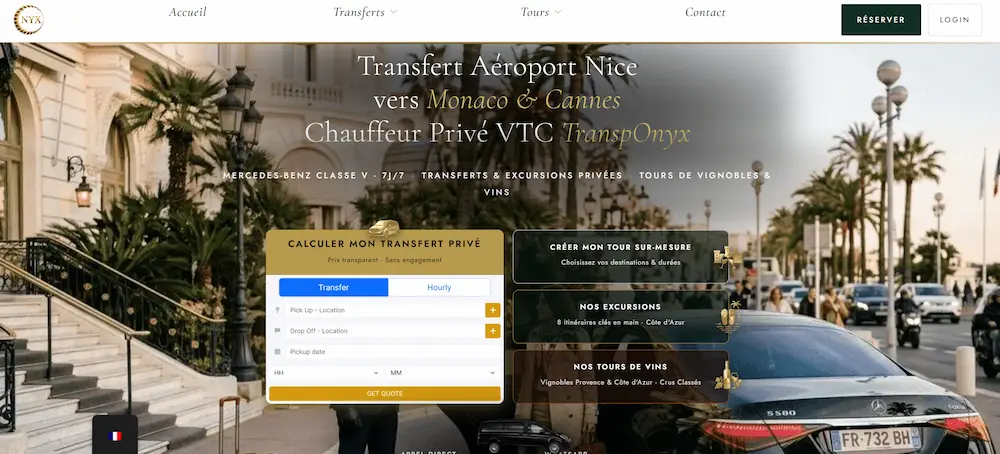
Transponyx provides premium airport transfers from Nice Côte d’Azur Airport to Monaco, Cannes, Antibes, Menton, and Saint-Tropez, with 2026 fixed rates confirmed at booking and no surge pricing. The Mercedes-Benz fleet covers Standard Sedan, Business Sedan, Van 7 pax, and Van 8 pax, all equipped with Wi-Fi, air conditioning, chilled water, and phone chargers. Drivers are licensed VTC professionals with local knowledge of Riviera events and routes. For groups, corporate accounts, and concierge services seeking luxury chauffeur options across the Côte d’Azur, Transponyx operates 24/7. Contact the team on +33 6 10 30 71 84 or visit transponyx.com to confirm your booking.
FAQ
What is the role of travel recommendations in trip planning?
Travel recommendations provide structured guidance on safety, entry requirements, logistics, and local conditions, reducing uncertainty and enabling informed decisions before and during a trip. They function as both a risk assessment tool and a practical planning resource.
How reliable are AI-generated travel recommendations?
AI travel recommendations are useful for broad planning but carry a risk of factual errors known as hallucinations. Research shows these errors reduce trust and the likelihood of following AI advice, so every specific claim should be verified against an official or human source.
When should I check official travel advisories before a trip?
Check official advisories at least six weeks before departure. That lead time allows you to arrange vaccinations, apply for visas, and adjust your itinerary if conditions have changed since you booked.
Do travel advisories affect travel insurance coverage?
Travel advisories directly influence insurance eligibility. Many policies exclude coverage for destinations under a Level 3 or Level 4 advisory, so checking the advisory level before booking is a financial necessity, not just a safety measure.
How do travel recommendations influence transport choices on the French Riviera?
Credible recommendations consistently favour pre-booked, fixed-rate private chauffeur services during high-demand periods such as the Cannes Film Festival and the Monaco Grand Prix. Transponyx offers confirmed 2026 rates with no surge pricing, covering all major routes from Nice NCE across the Côte d’Azur.



0 commentaires