par Daniel AIT GOUGAM | Sep 19, 2026 | news
For a French national or EU citizen crossing into Italy for up to 90 days, a valid carte nationale d’identité or passport is sufficient. Non-EU nationals generally need a passport valid at least three months beyond their departure date and may need a visa. Whichever document you carry, check the expiry date and be ready to show proof of accommodation and a return ticket. Border staff can refuse entry even to travellers holding the right paperwork if these conditions aren’t met.
Transponyx
Travel Italy With Confidence
TranspOnyx provides fixed-rate private transfers from the French Riviera to Italy, with professional drivers and flight monitoring on airport pickups.
Plan your Italy transfer
Documents frontière Italie for short stays: CNI or passport?
French and EU citizens crossing into Italy for tourism, business, or family visits can use either their carte nationale d’identité or a passport, provided the stay stays within 90 days in any rolling 180-day period. Both documents carry equal weight at Italian border posts, whether you’re driving through Ventimiglia or flying into Milan.
A passport still has practical advantages. If your trip extends beyond Italy into a non-Schengen country, or you’re renting a car and the agency insists on passport-level identification, having one avoids awkward conversations at the counter. Airlines and train operators increasingly issue nominative tickets, meaning the name on your booking must match your ID exactly. Trenitalia’s own guidance to passengers stresses checking travel documents before departure, a habit worth adopting whether you’re catching the Nice to Ventimiglia regional service or boarding an Air France connection via Rome.
Before you leave home, run through a few checks:
- Confirm the photo still resembles you and the card or passport isn’t cracked, delaminated, or water-damaged.
- Check the expiry date sits comfortably beyond your return, not just past it.
- For children, remember their identity documents carry shorter validity windows than adult ones.
- Match the exact spelling of your name across your ticket and your ID, including accents and hyphenated surnames.
Passport and ID validity: the technical rules that catch people out
Most refusals at Italian border control have nothing to do with fraud or suspicion. They happen because a passport fails a technical test the traveller never knew existed.
Under Schengen rules, a passport must show a date of issue less than ten years before arrival and remain valid for at least three months after the planned departure date from the Schengen area, according to UK government guidance on Italy’s entry requirements. French passports renewed before 1 October 2018 sometimes carry an extended validity sticker that confuses this calculation, so check the printed expiry date rather than assuming an extra year automatically applies.
Quick reference:
- Adult French passport: issued within 10 years, valid 3+ months past departure.
- Children’s identity documents: shorter validity periods than adult versions, so check separately.
- Hotels must register your passport details with police on arrival, per Italia.
- Not staying in registered accommodation? You must file a declaration of presence with the local questura within eight days.
Visas and long stays: when 90 days isn’t enough
The 90/180 rule caps visa-free stays for French and EU citizens travelling within Schengen, but it only applies to short visits. If you’re relocating, studying, or working in Italy for longer, you need to apply for a national visa before the 90-day allowance runs out, not after.
Depending on your purpose, you might encounter:
- A Uniform Schengen Visa (USV) for short stays across the zone, rarely needed by EU citizens.
- A Limited Territorial Validity (LTV) visa, restricted to Italy alone.
- A national long-stay visa (type D), required for study, work, or family reunification exceeding 90 days.
Applications begin at the Italian consulate covering your French region, or through the Italian Ministry of Foreign Affairs portal. Once you arrive, you’ll need to lodge a declaration of presence and, for longer stays, visit the local Questura’s Sportello Amico desk to begin your residence permit application within eight working days.
Crossing by car: what drivers must carry
Driving from Nice or Menton into Italy remains one of the simplest border crossings in Europe, but police still conduct spot checks, particularly around Ventimiglia during peak season.
- Carry a valid driving licence and identity document for every passenger, not just the driver.
- Bring the vehicle’s registration certificate (carte grise), matching the car you’re actually driving.
- Confirm your insurance certificate covers Italy. Hire cars usually include this automatically, but notify the rental company if you’re crossing borders, since some policies exclude it by default.
- Fit child seats before departure. Italy applies its own safety equipment rules, and officers can and do check.
- Expect occasional temporary checkpoints, especially around major events, where police may ask for any of the above without warning.
Minors and unaccompanied children: what changes
Children’s identity documents don’t follow adult validity rules. French identity cards issued to under-18s carry shorter validity windows, often five years rather than ten, so check the expiry date separately from your own.
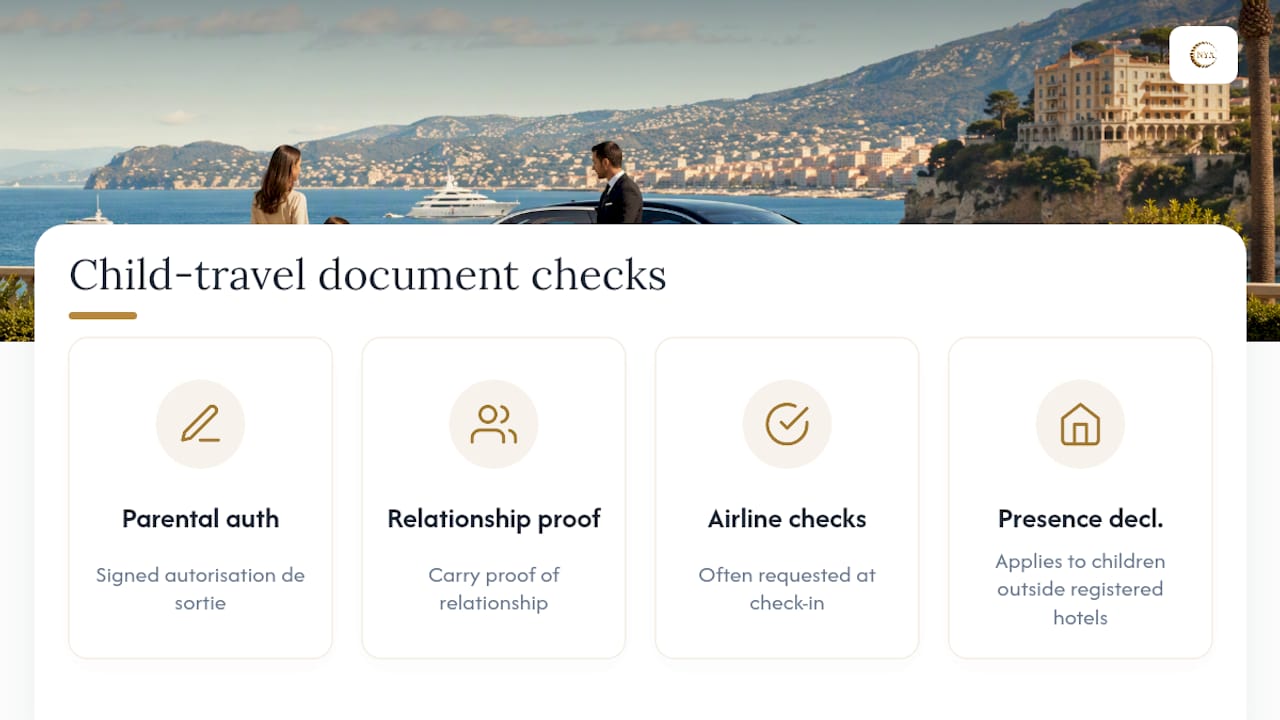
If a child is travelling with only one parent, or with grandparents, carriers and border guards can ask for a signed parental authorisation (autorisation de sortie du territoire) alongside proof of the accompanying adult’s relationship to the child. This isn’t universally enforced, but airlines increasingly request it at check-in. Families staying outside registered hotels should also remember the declaration of presence applies to children too, not just adults on the booking.
EES biometric checks: what to expect at the border
The Entry/Exit System is rolling out across Schengen borders, replacing manual passport stamping with biometric registration, fingerprints and a facial photo captured on your first crossing. GOV.UK’s advisory notes this can extend processing time at airports and land crossings, particularly during the transition period.
Beyond your ID, officers commonly ask for:
- Proof of accommodation, a hotel confirmation or rental booking.
- An onward or return ticket.
- Valid travel insurance covering your stay.
- Evidence of sufficient funds for the trip.
If your EES record captures an error, ask the border officer to correct it on the spot rather than travelling on and disputing it later. Registration itself carries no charge, but it does add measurable queue time, worth building into your schedule around Nice Côte d’Azur Airport during busy departure banks.
Losing a passport or identity card mid-trip is stressful, but the process to recover travel ability is straightforward if you follow it in order.
- Report the loss or theft to the nearest local police station and obtain a written police report, essential for every step that follows.
- Contact the nearest French consulate or embassy in Italy to request an emergency travel document, bringing the police report, a photo, and any secondary ID you still hold.
- Do not attempt to travel home on the police report alone. Airlines and border officials will not accept it as a substitute for a valid emergency travel document or renewed passport.
Pre-departure checklist: the 48 hours before you travel
Run through these checks two to three days before crossing, giving yourself time to fix anything that’s out of order:
- Verify your CNI or passport’s physical condition and expiry date.
- Save or print proof of accommodation and your return ticket.
- Confirm your travel insurance is active and covers Italy.
- If driving, check your vehicle registration and insurance certificate are in the car.
- Pack parental authorisation letters if a child is travelling without both parents.
- Add 30 to 45 minutes to your airport or port arrival time to account for EES processing.
- Carrying €10,000 or more in cash? You must declare it, since amounts above that threshold require formal declaration on entry or exit.
Pro Tip: Screenshot your accommodation confirmation and return ticket before you leave home. Mobile signal near border posts at Ventimiglia can be patchy, and a saved PDF beats a spinning loading icon in front of a queue.
A Riviera perspective on crossing into Italy
Crossing from Nice into Italy rarely takes long under normal conditions. The A8 run to Ventimiglia covers roughly 40 kilometres in under 40 minutes outside peak traffic, and Menton to the border adds barely ten minutes more. The picture changes entirely during the Monaco Grand Prix or the Cannes Film Festival, when road closures and event traffic push crossing times well beyond the usual window. Travellers heading to MIPIM in Cannes or MIPCOM season should build in an extra hour either way. TranspOnyx drivers cross this corridor daily and plan routes around exactly these fluctuations.
— Dany
Why TranspOnyx makes cross-border travel simpler
Sorting out documents frontière Italie paperwork is only half the job. Getting from Nice Côte d’Azur Airport to your Italian destination without hunting for parking, navigating an unfamiliar hire car, or worrying about insurance cover across the border is the other half, and it’s where a fixed-rate chauffeur service earns its keep.
TranspOnyx runs fixed-rate 2026 transfers from Nice into Ventimiglia, Menton, and onward into Italy, with bilingual licensed drivers who know exactly what documentation checks to expect at the border and how to time crossings around events like the Monaco Grand Prix or Cannes Film Festival. Every booking includes flight monitoring, 60 minutes of free waiting time on airport pickups, and child seats on request, all in a Mercedes-Benz Standard Sedan, Business Sedan, Van 7 pax, or Van 8 pax depending on your party size. Rates are confirmed at booking with no surprises added later. If your itinerary runs further into Italy, the private transfer route to San Remo covers that leg with the same fixed pricing. Call +33 6 10 30 71 84 or book online at Transponyx to lock in your transfer before your next Riviera to Italy trip.
Sources
Rules change, so confirm the latest position directly with official channels rather than relying on secondhand summaries. France Diplomatie covers entry and residence advice for French nationals, while Service-public details identity document rules. For packing beyond paperwork, ReisLastMinute’s Italy checklist is a useful practical companion.
FAQ
Can you cross the Italian border without an identity card?
No. French and EU citizens must carry either a valid carte nationale d’identité or a passport to cross into Italy, even for a short day trip. Border police can and do carry out spot checks, particularly at land crossings like Ventimiglia.
Who is affected by ETIAS rules when travelling to Italy?
ETIAS applies to non-EU, non-Schengen nationals who currently travel visa-free, not to French or EU citizens. French travellers using a CNI or passport are unaffected by ETIAS requirements when entering Italy.
What document is required to enter Italy from France?
A valid carte nationale d’identité or passport is required, with the passport needing at least three months’ validity beyond your planned departure date under Schengen rules. Non-EU nationals should check separately whether a visa also applies to their situation.
How do you cross the Italian border by car?
Carry a valid driving licence, identity document, vehicle registration certificate, and proof of insurance covering Italy. Police occasionally run temporary checks at land crossings near Ventimiglia, so keep documents accessible rather than buried in luggage.
What happens if my passport is lost just before crossing into Italy?
Report the loss to local police immediately and obtain a written report, then contact the nearest French consulate to request an emergency travel document. A police report alone will not get you across the border or onto a flight home.
par Daniel AIT GOUGAM | Sep 18, 2026 | news
The single most reliable itinéraire journée Côte d’Azur runs a loop from Nice to Èze, down into Monaco, along to Villefranche-sur-Mer, and out to either Antibes or Cannes before returning to base. Expect roughly nine hours door to door if you pace it well. Drive the corniche early, switch to the TER for the coastal legs, and you will see four or five signature stops without ever feeling herded.
Transponyx
transponyx.com
See More Of The Riviera
TranspOnyx provides private chauffeur journeys across the Côte d’Azur, with Mercedes-Benz vehicles for flexible day trips from Nice.
Plan your Riviera journey
Suggested one-day itinerary from Nice: hour by hour
Nice works as the anchor point because it sits near the geographic centre of the Riviera and holds the region’s main transport hub, Nice NCE, within easy reach of the tram and TER network. Build the day around that centrality and the logistics mostly take care of themselves.
- 08:45, depart Nice. Leave before 09:00 along the Moyenne Corniche, the mid-cliff road that gives the best balance of sea views and drive time without the Basse Corniche’s town-centre traffic.
- 09:30 to 11:00, Èze. Wander the stone lanes, climb toward the Jardin exotique for the coastal panorama, and duck into the Fragonard perfumery if scent-making interests you. Ninety minutes covers the village properly without lingering into the next slot.
- 11:30 to 13:00, Monaco. Walk the Prince’s Palace grounds, glance into the Musée océanographique, or simply trace the Monte Carlo circuit route that hosts the Monaco Grand Prix, held each spring. This doubles as your lunch stop.
- 13:30 to 14:15, Villefranche-sur-Mer. A short pause on the harbour, ideal if Monaco felt busy and you want quieter photographs of the bay.
- 14:45 to 16:15, Antibes or Cannes. Choose Antibes for the Vieille Ville ramparts and Cap d’Antibes coastline, or Cannes for La Croisette and the old quarter of Le Suquet.
- 17:00, return to Nice.
If a train is delayed or Monaco parking runs long, drop Villefranche rather than the western anchor. It is the easiest stop to sacrifice without unbalancing the day.
How long does it take to get between Côte d’Azur towns?
Journey times are the backbone of any Côte d’Azur day tour, and they are shorter than most first-time visitors expect. Nice to Èze by road takes around 25 minutes. Monaco is roughly 25 minutes from Nice by TER. Antibes sits about 20 minutes away, and Cannes around 30 minutes, both easily reached by the same regional rail line. Treat these as planning estimates and check current SNCF timetables before you commit to a tight connection.
Mixing rail for coastal hops with a car or chauffeur for corniche drives and hilltop villages is the single biggest factor in a well-paced Riviera day, cutting parking stress and giving you more time on foot in each town.
Three corniches run parallel above this coastline, and choosing the right one shapes your morning. The Basse Corniche hugs sea level through town centres and moves slowly. The Moyenne Corniche, the classic photograph-stopping route, threads the cliffside between Nice and Èze with minimal traffic before mid-morning. The Grande Corniche climbs highest, rewarding drivers with the widest views but adding time few day-trippers can spare.
Parking deserves equal weight in your planning. Reserve hotel parking wherever your accommodation offers it, and lean on the train rather than a car for Villefranche, Monaco or Cannes, where bayside spaces vanish fast on weekends and during events like the Cannes Film Festival or Cannes Lions.
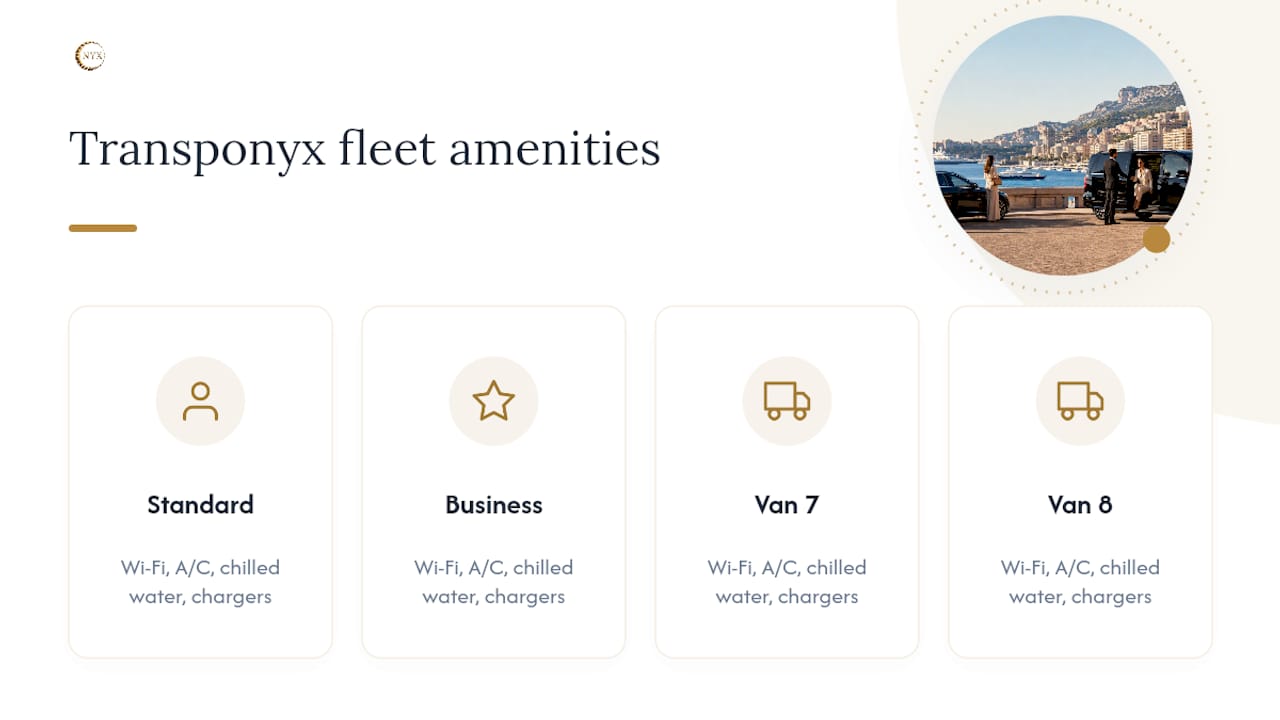
This is precisely where a private chauffeur earns its keep. Transponyx runs a Mercedes-Benz fleet across four categories, Standard Sedan, Business Sedan, Van 7 pax and Van 8 pax, each fitted with Wi-Fi, air conditioning, chilled water and phone chargers, so the corniche legs become rest time rather than navigation stress. Rates are fixed for 2026, confirmed at booking with no surge pricing, and the service runs 24 hours a day on +33 6 10 30 71 84 or via Transponyx.
Three sample one-day itineraries for different travel styles
Not every visitor wants the same day. Energy levels, interests and how much walking you can manage all point toward a different route.
- The classic coastal loop. Drive the Moyenne Corniche to Èze at 09:00, train onward to Monaco by 11:30, then TER to Cannes for the afternoon before returning to Nice by early evening. This variant covers the most named destinations in a single sweep and suits first-time visitors who want the postcard version of the Riviera in one pass.
- The village-focus day. Skip the coast entirely and head inland: Èze first, then Saint-Paul-de-Vence for its ramparts and galleries, finishing at Gourdon or Grasse for perfume houses. Expect more walking uphill than the coastal loop, and budget extra time since these villages sit further apart by road.
- The relaxed seaside day. Spend the morning in Nice itself, wandering Vieux-Nice, the Cours Saleya market and the Colline du Château, then head to Antibes or Cannes after lunch. Add the Lérins Islands only if a ferry slot fits your afternoon window, since crossing and return add roughly two hours you cannot compress.
Each variant respects the same principle: pick one western anchor, not two, and let the corniche or coast define your morning rhythm.
Where to eat and what to pack for the day
Lunch timing decides whether your afternoon feels calm or chaotic. Aim for a table by 12:00 to 12:30 if you want ease of seating, or push past 13:30 for quieter service once the coach groups have cleared out. Villefranche’s harbour brasseries suit a leisurely seafood lunch, Monaco rewards a short walk from the palace toward smaller bistros away from Monte Carlo’s tourist prices, and Nice’s Cours Saleya market cafés work well if you are building a Nice-morning variant.
A short checklist keeps the day from unravelling:
- Water bottle, refillable where possible
- Sun protection, even in shoulder-season months
- Comfortable shoes for cobbled lanes in Èze and Le Suquet
- Small change for parking meters and toll machines
- A light layer for corniche wind, which is sharper than the coastal temperature suggests
Pro Tip: Never leave bags visible on a car seat in Monaco or Antibes car parks, and always validate your parking ticket before returning to the vehicle. Both towns see targeted vehicle break-ins during peak season.
Why a private chauffeur changes the maths on a Riviera day
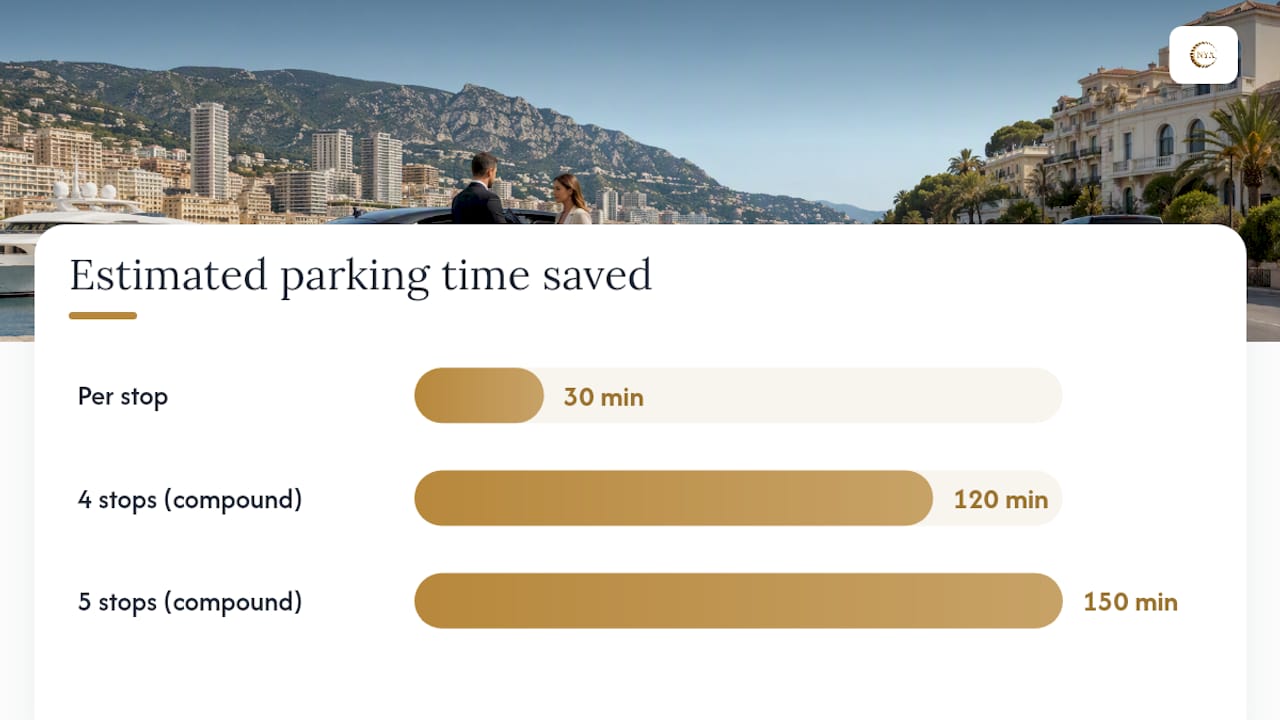
Door-to-door timing is where a chauffeur earns its value most clearly, and I would argue this Riviera loop is one of the clearest cases for booking one. An airport pickup with flight monitoring removes the guesswork from a morning start. Parking avoidance in Monaco or Antibes alone can save thirty minutes per stop during high season. Multi-stop days compound that saving four or five times over.
Vehicles are available for smaller groups and larger parties, all with bilingual licensed drivers and fixed 2026 rates. Short-stay visitors trying to pack the whole coast into one day, families travelling with luggage, and event delegations arriving for MIPIM or MIPCOM all benefit most from handing the driving to someone else. Book through +33 6 10 30 71 84 or Transponyx, and read more on full-day hire pacing if you want the loop driven end to end.
— Dany
Book the loop as a private tour instead of piecing it together
Transponyx turns this same nine-hour loop into a single booking instead of a morning of train timetables and parking searches. For readers who want the itinerary above without driving it themselves, the match is straightforward: a half-day tour (5h) covers Èze and Monaco comfortably, a full-day tour (9h) covers the entire Nice to Cannes or Antibes loop, and the Riviera Prestige Tour or Monaco & Eze Express Tour both follow close variants of the route described here. Wine lovers can extend the day into the Onyx Wine Collection instead of a fifth sightseeing stop.
Every booking runs on fixed 2026 rates confirmed at the time of reservation, with child seats available on request and bilingual licensed drivers on every vehicle. If the Nice to Èze and Monaco route above matches your plans, call +33 6 10 30 71 84, message via WhatsApp, or check availability directly at Transponyx to lock in your date.
Useful sources for planning your day
FAQ
Can you really see Èze, Monaco and Cannes in one day?
Yes, a disciplined nine-hour loop from Nice comfortably covers Èze, Monaco and one western anchor, either Antibes or Cannes, without feeling rushed.
Is it better to drive or take the train between Riviera towns?
Drive or use a private chauffeur for the early corniche leg to Èze, then switch to the TER for Monaco, Antibes or Cannes to avoid parking searches in busy town centres.
What time should I leave Nice to fit the whole loop in?
Leave before 09:00 to reach Èze by 09:30, since hilltop villages get crowded and hot later in the day, and this keeps every following stop on schedule.
Does Transponyx offer a private full-day Côte d’Azur tour?
Yes, Transponyx runs a full-day tour (9h) and a half-day tour (5h) covering this exact loop, priced at 2026 fixed rates with bilingual licensed drivers, bookable at Transponyx or by calling +33 6 10 30 71 84.
Which stop should I cut if I am running short on time?
Drop Villefranche-sur-Mer first. It is the easiest stop to skip without losing either the Èze cliff village or your western anchor town.
par Daniel AIT GOUGAM | Sep 17, 2026 | news
Under the French Highway Code, a child under 10 must travel in an approved restraint system suited to their height and weight, and a VTC driver who arrives without one can lawfully refuse the trip. Taxis carry a narrow historic exemption that VTCs do not share. The safest choice, regardless of vehicle type, is always a homologated seat that fits the child correctly, as Sécurité routière recommends without exception.
Transponyx
Travel With The Right Child Seat
TranspOnyx provides child seats on request for private airport transfers and chauffeur journeys across the French Riviera.
The child seat law for VTC bookings: what article R412-2 actually requires
The statutory basis for all of this sits in Article R412-2 of the Code de la route, which ties the obligation to the child’s morphology rather than to a fixed age cutoff. In practice, that means the law cares about how tall and how heavy your child is, not just how old they are on paper. A large seven-year-old and a small nine-year-old may need different equipment even though both fall under the same age threshold.
The text requires that any child under 10 travelling in a private vehicle, including a hired VTC, be secured in a restraint system homologated to one of two European standards. Service-public’s guidance on transporting a child by car confirms this and sets out the practical consequences for drivers and parents alike.
- The seat must carry an i-Size (R129) or ECE R44/04 approval label, visible on the shell or the fabric tag.
- The restraint must match the child’s current height or weight bracket, not a bracket they have outgrown or not yet reached.
- The obligation applies to the driver as much as the parent. A professional driver who knowingly carries an unrestrained child under 10 shares the liability.
- Booster cushions without a backrest remain legal above certain height thresholds but are considered a minimum, not a recommendation, by road safety authorities.
Parents who want the primary text rather than a summary can read both pages directly. Légifrance carries the consolidated article, and Service-public translates it into everyday obligations with worked examples. Neither page is written for lawyers only. Both are short enough to read before you make your next booking.
VTC versus taxi: why the same trip can mean different rules
The exemption that lets some taxis carry an unrestrained child under 10 dates back to a period when taxis were treated as a form of public transport rather than a private hire. Industry explainers on the taxi and VTC distinction note that this carve out was designed for occasional, short urban journeys where carrying a seat was impractical, not as a general licence to skip restraints.
VTC drivers get no equivalent carve out. Legally, they are treated the same as any private driver, which means the same obligation that applies to a parent driving their own car applies to a chauffeur driving yours.
- A VTC driver can refuse to start a trip if no compliant seat is available for a child under 10.
- The refusal is not a customer service failure. It is the driver correctly applying the law.
- If a driver arrives without the seat you requested, the safest options are to supply your own seat on the spot, ask the platform to send a replacement vehicle, or reschedule rather than travel unrestrained.
- Taxis retain the exemption in narrow circumstances, but Sécurité routière’s own guidance still recommends a seat for every child, every time, taxi or not.
That last point matters more than the legal technicality. An exemption is not a safety endorsement.
Which seat to request: matching age, height and weight correctly
Two homologation standards govern the French market, and knowing the difference helps you ask for the right thing when you book. i-Size (R129) is the newer standard, built around the child’s height rather than weight, and it mandates rear-facing travel until at least 15 months along with improved side-impact testing. ECE R44/04 is the older weight-based standard, still legal and still widely fitted, organised into weight groups from birth through to roughly 36 kg.
Pro Tip: When you book, give the driver both the child’s age and their current weight or height, not just one. A seat rated correctly for weight can still be the wrong shape for an unusually tall toddler, and vice versa.
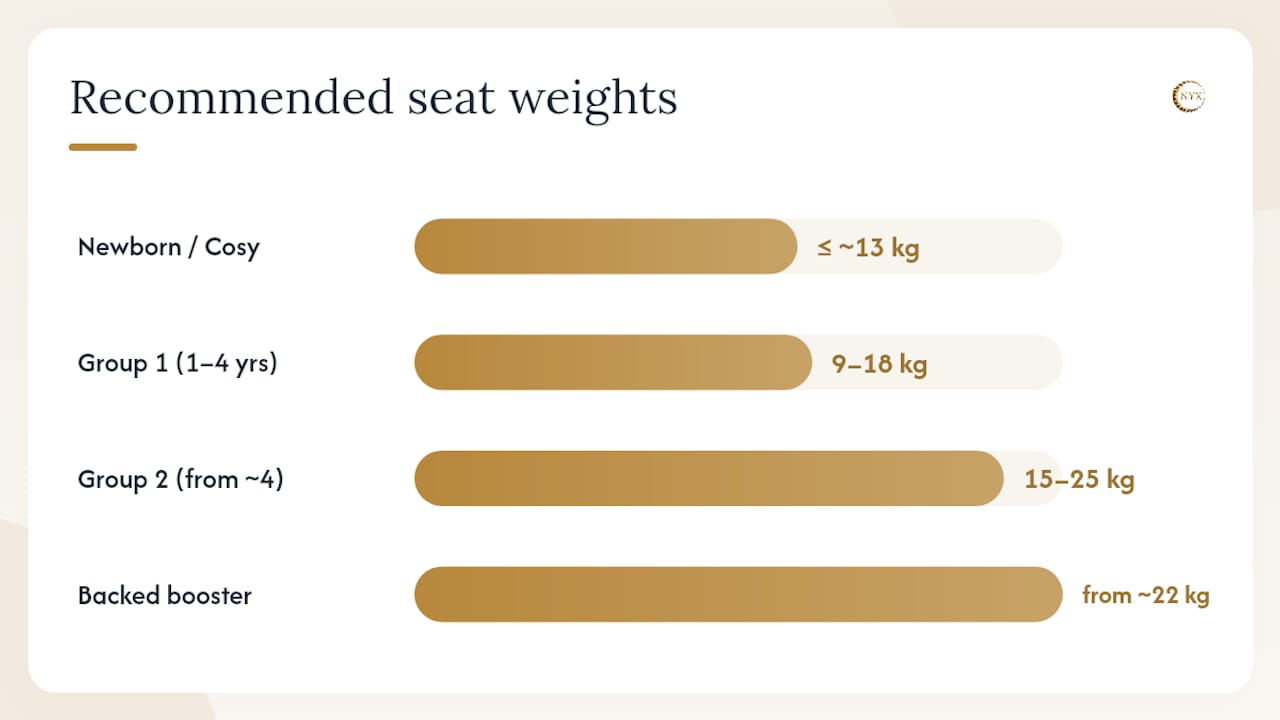
- Newborns to around 15 months (up to roughly 13 kg or 83 cm): a rear-facing “cosy” or “coque” seat, ideally i-Size rated.
- Roughly 9 to 18 kg, 1 to 4 years: a Group 1 seat, rear-facing where possible for as long as the child fits comfortably.
- Roughly 15 to 25 kg, from about 4 years: a Group 2 seat with a five-point harness or an integrated booster.
- From around 22 kg up to 10 years or 1.35 metres: a backed booster cushion (rehausseur), never a cushion alone if a backed option is available.
Correctly fitted restraints make a measurable difference to injury severity in a collision, which is precisely why Sécurité routière treats correct use, not just presence, as the safety benchmark. Where ISOFIX anchors are fitted in the vehicle, they remove much of the human error involved in strapping a seat in with a standard seatbelt, and most professional VTC fleets now carry ISOFIX compatible seats for exactly that reason.
Booking a VTC or taxi with a child: the steps that avoid a refusal at the kerb
- At the time of booking, state the child’s exact age, height and weight, and specify the seat type you expect, whether that is a rear-facing infant seat, a Group 1 harness seat, or a booster.
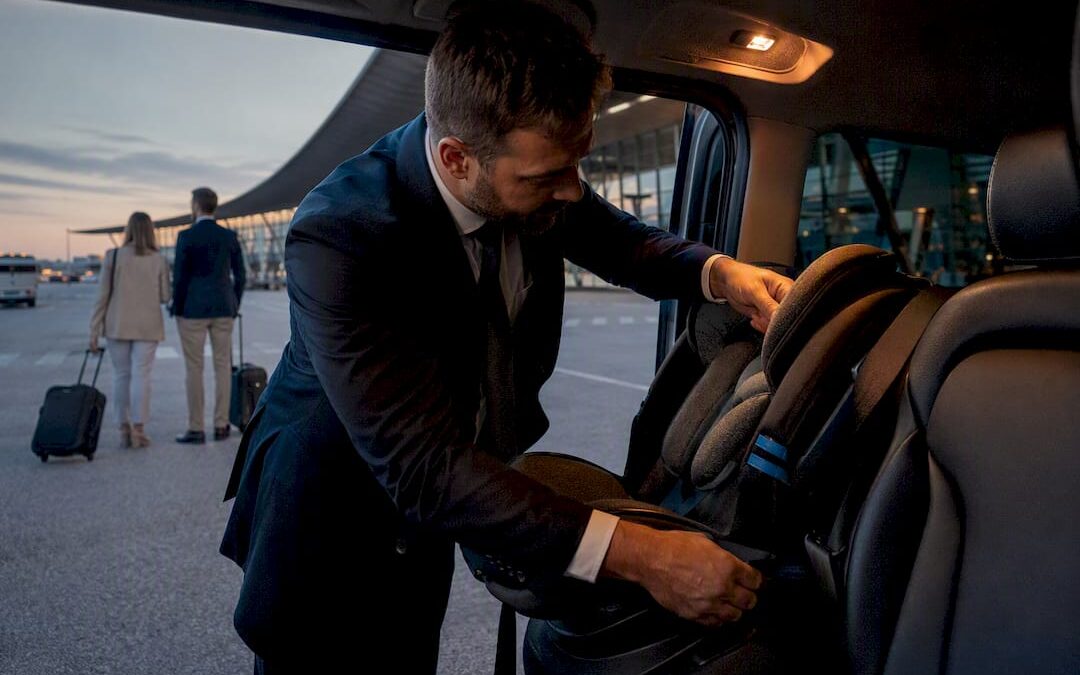
- Confirm installation time is included in the reservation. A seat fitted properly takes a few minutes longer than simply opening the door, and a rushed installation is a false economy.
- At the vehicle, check the homologation label before your child gets in. It should be visible and legible, not worn smooth from age.
- Let the driver install the seat, then check the harness tightness yourself with the pinch test: you should not be able to pinch excess strap webbing at the shoulder.
- If no seat is available, your three real options are to supply your own seat, ask for a family-equipped vehicle such as a Van 7 pax or Van 8 pax, or cancel and rebook rather than travel without one.
Family-travel guides that cover this ground in more detail, such as Autour de bébé’s rules and advice on VTC and taxi car seats, make the same point from a parent’s perspective: the driver arriving without a seat is a foreseeable scenario, and the parent who has a backup plan loses less time. For a wider view of what to check before any Riviera booking, how to book a VTC transfer on the French Riviera covers the same handover checks in more depth.
Airport transfers with children: choosing the right vehicle and timing
Airport runs are where child seat logistics get complicated fastest, because you are also managing luggage, a flight schedule and often more than one child at once. A single sedan rarely has room for two child seats, a pushchair and four suitcases, which is why family-focused VTC operators steer parents toward larger vehicles for exactly this journey.
- A Van 7 pax or Van 8 pax gives enough floor space to fit two child seats alongside full-size luggage, without cramming a booster against a suitcase.
- Fixed per-vehicle 2026 rates mean the fare does not shift because you added a seat request or a second child, and flight monitoring on airport pickups absorbs the uncertainty of a delayed landing.
- Free waiting time, typically about an hour on airport pickups, gives enough margin for baggage claim, a nappy change, and unhurried seat installation before departure.
- Confirm seat availability when you book rather than at the gate. A driver who knows in advance can pre-install the seat before you clear arrivals.
What happens during a control, or after an accident
Roadside checks on child restraint use do happen, and enforcement in France applies to the driver as the person responsible for the vehicle’s occupants, professional or private. A VTC driver carrying an unrestrained child under 10 without the taxi exemption is exposed in exactly the same way a private motorist would be.
- If you are involved in an accident, note the driver’s name, VTC licence number and the platform used for the booking, alongside the vehicle registration.
- Photograph the seat as fitted, if it survived the collision, since this matters for both insurance and any safety review.
- Contact your own insurer and the platform’s support line promptly, even for a minor incident.
- Whatever the legal exemption in play, the practical advice stays constant: a properly fitted, homologated seat is the single biggest factor in reducing injury severity for a young passenger.
From the chauffeur’s seat: notes on family transfers along the coast
Preparing for a family run starts before the client ever sees the car. A driver checks the seat’s homologation label, confirms the harness adjusts to the child’s current size, and has it fitted before the family reaches the kerb, not after. On a Nice NCE to Monaco transfer, a journey of moderate length covering a coastal route, that preparation buys back the minutes a rushed installation would otherwise cost at pickup. The same applies on the longer run to Cannes, around half an hour depending on traffic conditions near the Croisette.
Booking ahead is what makes this possible. A driver who knows the child’s age and weight the night before can have the correct seat, fixed to the fixed 2026 rate agreed at booking, ready before the family arrives.
— Dany
Family transfers with TranspOnyx: seats sorted before you arrive
Transponyx builds child seat requests into the booking itself rather than treating them as an afterthought, which is the gap that catches most families out with ad hoc VTC bookings. Specify your child’s age and weight when you reserve, and the seat is fitted and checked before your flight even lands, backed by fixed 2026 rates that do not change because a Van 7 pax replaced a Standard Sedan.
Every airport pickup includes 60 minutes of free waiting time and full flight monitoring, so a delayed landing or a slow baggage hall never turns into a rushed, unsafe seat installation. Larger families or groups travelling with multiple children can move up to a Van 7 pax or Van 8 pax without losing the fixed-rate transparency that applies across the fleet, and every driver is bilingual in English and French at minimum. For families packing for a longer stay, PerfectHost’s 2026 rental essentials checklist is a useful companion for what to bring beyond the car seat itself.
To book a family transfer from Nice Côte d’Azur Airport to Monaco, Cannes, Antibes or anywhere along the coast, call +33 6 10 30 71 84 and confirm your child’s age and weight at the time of booking. That single detail is what lets the driver arrive with the right seat already fitted.
This article is general information, not a substitute for advice from a qualified lawyer. Consult a qualified legal professional about your own circumstances before acting on anything here.
Sources
FAQ
Does Uber provide a child seat?
Uber does not guarantee a child seat is present in every vehicle; availability depends on the individual driver, so parents should request one in advance through the app or book a service that confirms seat provision at reservation, such as Transponyx.
What does the current law say about car seats for children in France?
Article R412-2 requires every child under 10 to travel in a restraint homologated to i-Size (R129) or ECE R44/04, matched to their current height and weight, in any private vehicle including a hired VTC.
Is there a booster seat rule I should know for VTC or taxi trips?
A backed booster cushion is legal from around 22 kg up to 10 years or 1.35 metres, but Sécurité routière recommends a backed booster over a cushion alone whenever one is available.
What is the actual regulation for child car seats, VTC included?
The regulation ties the obligation to the driver as well as the parent: a VTC driver must ensure a compliant seat is fitted for any child under 10, and can refuse the trip if one is not available, while taxis retain a narrow historic exemption.
Can a VTC driver refuse to take my child without a seat?
Yes. A VTC driver is legally entitled to refuse the journey if no compliant, homologated seat is available for a child under 10, since VTCs are treated as private hire drivers under French law rather than under the taxi exemption.

par Daniel AIT GOUGAM | Sep 16, 2026 | news
Book a pre-paid private chauffeur or a private boat that includes port pickup, and you remove the two biggest risks of a Villefranche shore visit: timing and cost surprises. A fixed-rate excursion privée Villefranche booking suits travellers who want inland villages, museums or larger groups, while a private boat suits those chasing coastline views and a swim stop. TranspOnyx offers fixed 2026 rates and port pickup for the land option, which covers most cruise passengers’ needs on a tight schedule.
Transponyx
Explore the Riviera by Private Chauffeur
TranspOnyx provides fixed-rate private chauffeur journeys, Mercedes vehicles, and port transfers across the French Riviera and Provence.
When should you choose a boat over a private chauffeur in Villefranche?
The choice comes down to what you actually want to see, and how much time your ship or itinerary allows. Villefranche-sur-Mer sits on one of the deepest natural harbours in Europe, and that geography shapes both options quite differently.
A private boat gets you close to the coastline itself: the pastel façades of the old town from the water, the wooded promontory of Cap Ferrat, and the option to stop and swim in a quiet cove that no coach could ever reach. Private boat excursions departing Villefranche typically run two to four hours or as a half-day, and providers lean heavily on secluded coves and sunset sails as the headline experience, according to activity listings for Villefranche boat trips. It suits smaller groups, couples, and anyone who wants the water itself to be the destination.
A private chauffeur, by contrast, opens up the hill villages and the museums that a boat simply cannot reach: Èze’s medieval lanes, the Fragonard perfumery, Monaco’s palace square. It also handles larger groups and luggage without complaint, which matters enormously for cruise passengers disembarking with bags.
Weigh these factors before booking:
- Time available: a 4-hour port call favours a chauffeur. A longer visit suits either option.
- Mobility: cobbled hill villages are easier by car than a tender-boat transfer.
- Sea conditions: mistral winds can cancel a boat outing with little notice.
- Group size: seven or eight passengers fit a Van 7 pax or Van 8 pax far more comfortably than most charter boats.
- Weather: rain favours the covered comfort of a sedan or van over an open deck.
What do sample itineraries, durations and starting prices from Villefranche look like?
Most private excursions from Villefranche fall into three clear time bands, and knowing which one matches your port call saves a lot of second-guessing at the booking stage.
Short sea routes (2 to 4 hours). These focus on Cap Ferrat’s coastline, a swimming stop in a quiet cove, and often a sunset sail in the early evening. Activity listings for the area show these short private boat trips priced according to group size and vessel type, with some providers offering 3 to 4.5 hour formats as an alternative to the shorter run, per boat hire listings from Villefranche and nearby ports. Sunset departures commonly run from around 18:00 to 21:00 depending on the season, based on private boat tour scheduling on the Riviera.
Half-day land itinerary (around 4 hours). A classic combination runs Nice’s old town, a panoramic viewpoint over the bay, and Èze’s perched village, often with the option to add the exotic garden for an extra entrance fee. This format suits passengers who want a taste of three distinct places without eating an entire day.
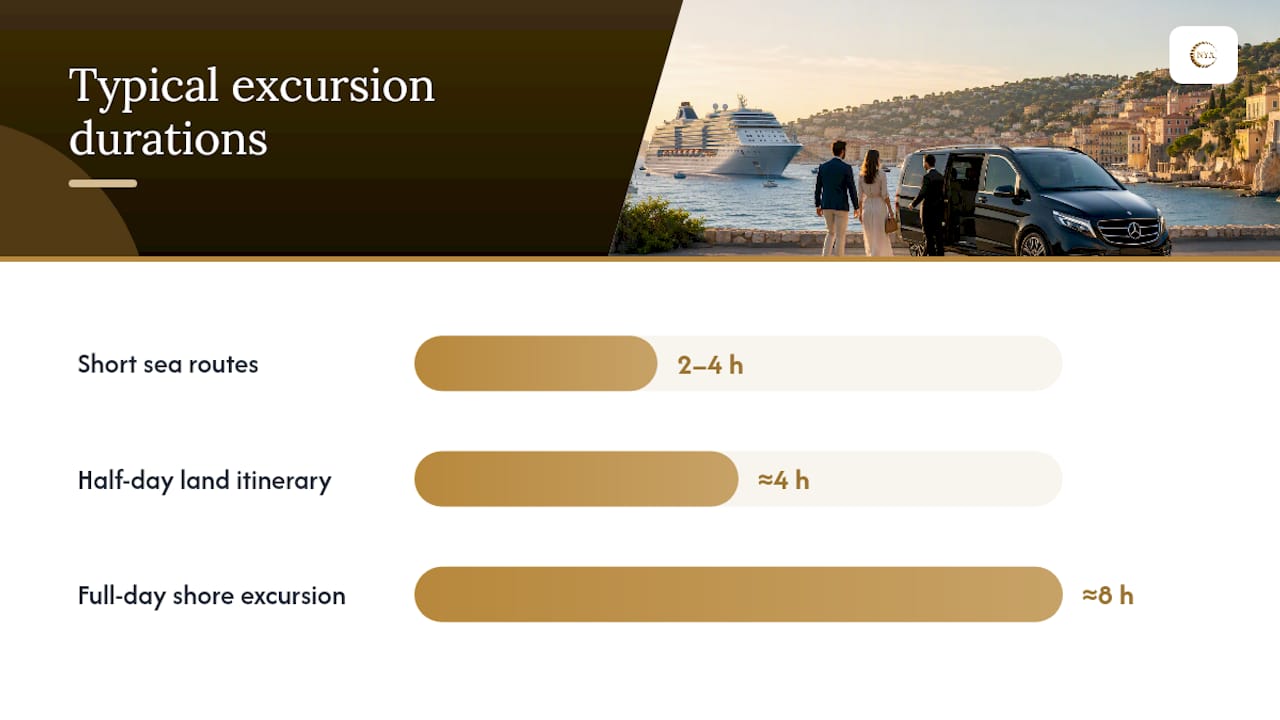
Full-day shore excursion (around 8 hours). This is the itinerary most commercial operators build around: Nice, Èze and Monaco, or an alternative loop through Cannes and Antibes. Full-day private shore excursions from Villefranche commonly include port pickup and a multilingual guide, with published starting prices in the region of €500 for a private day tour, according to Viator’s 8-hour private shore excursion listing. Expect that figure to move with vehicle type, group size and any entrance fees you add along the way.
A few practical notes for cruise passengers:
- Build in at least 45 to 60 minutes of margin before your last tender back, since tender queues lengthen sharply in peak season.
- Confirm whether the quoted price covers fuel and port taxes, or whether those sit outside the headline rate.
- Ask whether the itinerary can flex if your ship’s tender schedule shifts on the day.
What is included, and what should you check before booking?
A booking that looks identical on paper can deliver a very different experience once you’re standing on the quay, so a short checklist before you pay a deposit is worth the five minutes it takes.
- Confirm what’s actually included. Port pickup, bottled water and a driver or guide are near-universal, but fuel surcharges and port taxes are sometimes billed separately. Ask specifically which of these sit inside the quoted rate.
- Check waiting time allowances. Cruise tenders run late more often than they run early, so ask how many minutes of free waiting the operator allows before a delay fee kicks in.
- Read the cancellation and deposit terms. Some providers require a deposit at booking with the balance due on the day; others take full payment upfront with a refund window attached.
- Carry proof of booking. A printed or saved confirmation, plus the operator’s local contact number, makes disembarkation far smoother if your ship’s Wi-Fi is unreliable.
- Ask about language options and accessibility. Confirm whether your guide or driver speaks your language as standard, and whether the vehicle or vessel can accommodate limited mobility or a child seat if you need one.
Providers that meet guests directly at the Port of Villefranche tend to build in exactly this kind of flexibility, adjusting stops around optional entrance fees such as the exotic garden in Èze rather than locking you into a rigid script.
Boat excursion essentials: vessels, skippers and safety notes
Not every “private boat” booking delivers the same thing, and the vessel type changes the entire feel of the outing.
A motorboat suits families and shorter trips: stable, quick to reach a swimming cove, and forgiving of choppier water. A sailing yacht trades speed for atmosphere, better suited to a leisurely half-day or a sunset sail than a tight schedule. A rigid inflatable boat (RIB) sits between the two, fast and manoeuvrable, popular for reaching secluded coves that larger vessels can’t approach for swimming stops.
Charter arrangements split into two broad categories:
- Skipper-only charters, where you hire the boat and its skipper but plan the route yourselves within safe limits.
- Crewed charters, which usually include catering options, water toys and a more curated itinerary from a crew who know the coastline.
Weather dependency is real and non-negotiable. Mistral winds can force an operator to change or cancel a route with little warning, and a reputable skipper will always prioritise safety equipment and sea state over sticking rigidly to a plan.
Pro Tip: Book boat excursions at least two to three weeks ahead if your visit falls in July or August, or during the Monaco Grand Prix or Cannes Film Festival weeks, since local capacity tightens fast and harbour opening rules can restrict last-minute departures.
What does a private chauffeur deliver, and why do fixed 2026 rates matter?
A chauffeur-driven excursion removes the single biggest source of anxiety on a port day: not knowing what the final bill will be. TranspOnyx publishes fixed 2026 rates per vehicle, confirmed at the point of booking, so a mistral delay or heavier traffic through Nice never turns into a surprise surcharge.
The fleet runs across four categories, each built around comfort for a full day out:
- Standard Sedan, up to three passengers, with Wi-Fi, air conditioning, chilled water and phone chargers.
- Business Sedan, the same capacity in a premium finish, suited to travellers who want the extra polish for a special occasion.
- Van 7 pax, comfortable for families or small groups with luggage.
- Van 8 pax, the largest option, useful for groups disembarking together from multiple cabins.
Every driver is a licensed VTC professional, bilingual in English and French at minimum, and many also speak Italian, Spanish, Russian or Arabic, a real advantage on a route that crosses the Italian border within the hour if your day extends that far. Flight and ship monitoring comes included on port pickups, alongside free waiting time, so a delayed tender doesn’t cost extra.
Journey times from Villefranche give a sense of what’s realistic in a single port call: Nice Côte d’Azur Airport (NCE) sits around 20 minutes away, Monaco roughly 20 to 25 minutes, Cannes around 45 minutes, Antibes about 30 minutes, and Menton close to 35 minutes, traffic depending. The fleet page sets out each category’s exact amenities in full, and readers planning a similar day further west might also look at the guide to chauffeur-driven trips from Nice to Saint-Tropez.
How do you book and meet your driver or skipper at Port Villefranche?
Missed pickups almost always trace back to one missing detail, so the fix is simple: hand over more information than feels necessary.
- Reserve with your cruise details attached. Give your ship’s name, arrival time and expected tender schedule when you book, along with a local contact number or WhatsApp for the day itself.
- Confirm the exact meeting point. Ask precisely where at the tender arrival area your driver or skipper will wait, and what identifying detail to look for (a name board, a vehicle description, a jacket colour).
- Have a contingency plan for delays. If your tender window closes late or your ship anchors off schedule, contact the operator immediately rather than waiting until you’re ashore.
- Carry your booking confirmation and the operator’s number. A saved screenshot works if the ship’s Wi-Fi fails once you’re at the port.
Providers who specify this level of detail upfront, matching cruise ship names to tender times before the day arrives, cut missed-pickup risk dramatically, a point borne out by how ToursByLocals structures its Villefranche shore excursion around exactly this information. TranspOnyx’s own cruise port transfer guide for Villefranche sets out the same logic for its own pickups.
How are excursion prices broken down, and what counts as an extra?
A quoted starting rate rarely covers everything you’ll spend on the day, so it helps to separate the fixed core from the optional add-ons before you compare two offers side by side.
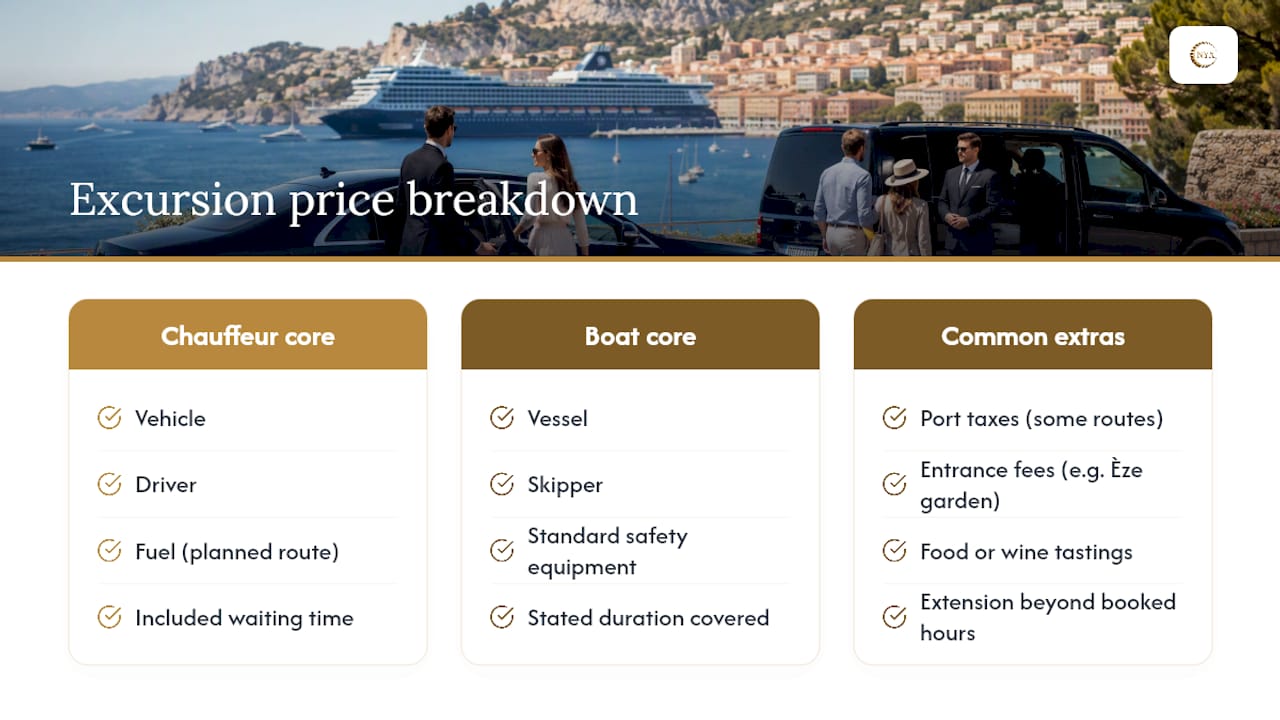
The core rate on a private chauffeur excursion typically covers the vehicle, driver, fuel within the planned route, and the included waiting time at pickup. On a boat charter, the core rate usually covers the vessel, skipper and standard safety equipment for the stated duration. What sits outside that core varies more: port taxes on certain routes, entrance fees to sites such as Èze’s exotic garden, food or wine tastings added mid-itinerary, and any extension of the booked hours beyond what was agreed.
Group size changes the maths too. A Standard Sedan or Business Sedan quote for three passengers won’t scale directly to a Van 7 pax booking, since the vehicle category itself carries a different fixed rate rather than a simple per-head addition. On the boat side, larger vessels with crew tend to price per boat rather than per guest, which can make a six-person charter cheaper per head than a two-person one.
Tipping is not built into any published rate on either side of this market and remains entirely at the traveller’s discretion. The safest approach before booking either type of excursion is to ask directly which taxes, fees and optional stops sit outside the headline figure, then get that answer in writing alongside your confirmation.
Who are trustworthy private excursion providers operating from Villefranche?
Reliability in this market comes down to three things: a fixed price confirmed before the day, a named point of contact reachable on the morning itself, and clarity about what happens if a ship or tender runs late.
Municipal options exist too, and they’re worth mentioning honestly. The town of Villefranche runs an official guided walking tour from 3 April to 30 October 2026, with an English-language tour every Friday at 14:00 starting from Place Emmanuel Philibert, priced at just €5, according to the Nice Côte d’Azur Tourist Office. It’s a genuinely good option for travellers who simply want an affordable, short walk through the old town without arranging private transport.
For a private, personalised experience that goes beyond the old town, the market splits between independent boat charters and licensed chauffeur services. TranspOnyx operates from Nice with a Mercedes-Benz fleet and licensed VTC drivers, and publishes fixed 2026 rates for both cruise port transfers and private excursions, a model built specifically around removing pricing uncertainty for shore visitors. Whichever route you choose, ask for confirmation in writing before the day and check that the operator’s contact number is answered around the clock, since port schedules rarely respect office hours.
What payment methods, deposits and refund terms should you expect?
Payment structures vary more between operators than most travellers assume, so it’s worth asking the same three questions of every quote you receive.
Card payment is now close to standard across the market, with many operators also accepting bank transfer for advance bookings. Some private boat charters still expect a deposit at the time of booking, with the balance settled on the day either in cash or by card once you’re aboard.
Deposit requirements typically run higher for boat charters than for chauffeur bookings, reflecting the cost of holding a vessel and skipper for your slot regardless of weather. A chauffeur booking with a fixed 2026 rate, confirmed at reservation, generally removes the need for a large deposit since the vehicle and driver aren’t subject to the same weather cancellations a boat faces.
Refund policies hinge almost entirely on cancellation timing. Cancelling with several days’ notice usually returns most or all of a deposit; cancelling within 24 to 48 hours of departure often forfeits it, particularly on boat charters where weather-related cancellations are handled separately from traveller-initiated ones. Always ask an operator directly how they treat a mistral-driven boat cancellation versus a simple change of plan, since the two are rarely covered by the same clause.
What safety rules and certifications apply to boats and guides?
Private boat charters operating out of Villefranche must carry a licensed skipper and comply with French maritime safety requirements covering lifejackets, flares and communication equipment appropriate to the vessel’s size and the waters it covers. Weather thresholds matter too: a licensed skipper has both the authority and the obligation to alter or cancel a route when sea conditions turn against safe operation, regardless of what the itinerary originally promised.
Guides and drivers operating private land excursions in France work under a separate but equally binding framework. A chauffeur driving passengers for hire holds a VTC licence, a professional card requiring registration and background checks before it’s issued. TranspOnyx’s drivers hold this licence as standard and bring bilingual service as a baseline requirement rather than an optional extra.
Neither certification is optional, and neither should be assumed. Before booking any private boat or chauffeur excursion from Villefranche, it’s reasonable to ask an operator directly to confirm their skipper’s licence or their driver’s VTC registration. A operator with nothing to hide will answer that question without hesitation.
An experienced chauffeur’s perspective on timing, events and where to stop
Event weeks change everything about a Villefranche excursion, and most travellers underestimate by how much. The Cannes Film Festival in May, the Monaco Grand Prix, Cannes Lions in June and MIPIM or MIPCOM in the shoulder seasons all push traffic through the Basse Corniche into a different category entirely. A route that takes 25 minutes to Monaco on an ordinary Tuesday can stretch well past 40 during Grand Prix week, and a driver who hasn’t planned around that will make you late back to your ship.
The trade-off between villages and viewpoints comes up on almost every itinerary. Èze delivers the postcard, but its narrow lanes eat time you don’t always have. A roadside panoramic stop over the bay often delivers a better photograph for a fraction of the minutes spent. I’d rather build a shorter, well-timed itinerary with one unhurried stop than a longer one that leaves you sprinting for the tender. On any full-day booking, I always push clients towards a 45 minute buffer before the last tender back, not the 15 minutes most people assume is safe.
— Dany
Book a fixed-rate private chauffeur or excursion with TranspOnyx
One fixed-rate booking, one confirmed vehicle, one point of contact from pickup to return removes the hassle of hunting between boat operators and coach tours for your Villefranche port call.
The service covers exactly what this guide has walked through: private chauffeur excursions, by-the-hour hire, cruise port transfers and guided tours across Nice, Monaco, Cannes, Antibes and Menton, delivered in a Standard Sedan, Business Sedan, Van 7 pax or Van 8 pax depending on your group. Every rate for 2026 is fixed at the point of booking, confirmed on your Mercedes-Benz vehicle with Wi-Fi, air conditioning and chilled water included, and free waiting time built in on every port pickup, so a delayed tender never costs you extra. Ship and flight monitoring runs continuously, and the phone lines answer 24 hours a day, seven days a week.
If your next call ashore falls at Villefranche, book your airport or port transfer now, or reach the team directly on +33 6 10 30 71 84 or by WhatsApp to confirm your vehicle and pickup time ahead of your visit.
Sources
FAQ
Where do I meet my driver or skipper at Port Villefranche?
Chauffeurs typically meet cruise passengers at the tender arrival area with a name board or vehicle description agreed at booking; boat charters usually meet at a designated quay near the port, confirmed directly with the skipper beforehand.
What happens if my ship’s tender is delayed?
Reputable operators, including TranspOnyx, include free waiting time and ship monitoring on port pickups, so a delayed tender does not automatically incur an extra charge; always confirm the specific allowance when booking.
How much does a private excursion from Villefranche typically cost?
Full-day 8-hour private shore excursions commonly start in the region of €500, while shorter boat trips and half-day chauffeur bookings are typically priced lower depending on vehicle or vessel type and group size.
Can a private excursion accommodate a larger group or a child seat?
Yes; chauffeur services scale up to a Van 7 pax or Van 8 pax for larger groups, and child seats are available on request, while boat charters vary by vessel capacity so it’s worth confirming group size at booking.
Is the municipal walking tour a good alternative to a private excursion?
It suits travellers wanting a short, affordable introduction to the old town; the official tour runs Fridays at 14:00 in English from 3 April to 30 October 2026 for €5, though it does not cover Èze, Monaco or the coastline the way a private excursion does.
par Daniel AIT GOUGAM | Sep 15, 2026 | news
Licensed French taxis must accept card payment with no minimum fare, full stop. Prebooked chauffeur services typically settle payment online before the journey even begins. If a driver refuses your card, note the licence number, ask for a written invoice, and report the refusal to the DGCCRF or your local prefecture. Keep every booking confirmation, and where reliability matters most, choose a prepaid transfer.
Transponyx
Plan Your Riviera Transfer
TranspOnyx provides fixed-rate private chauffeur journeys from Nice and across the French Riviera, with booking confirmed in advance.
Card payment chauffeur France: what the law actually requires
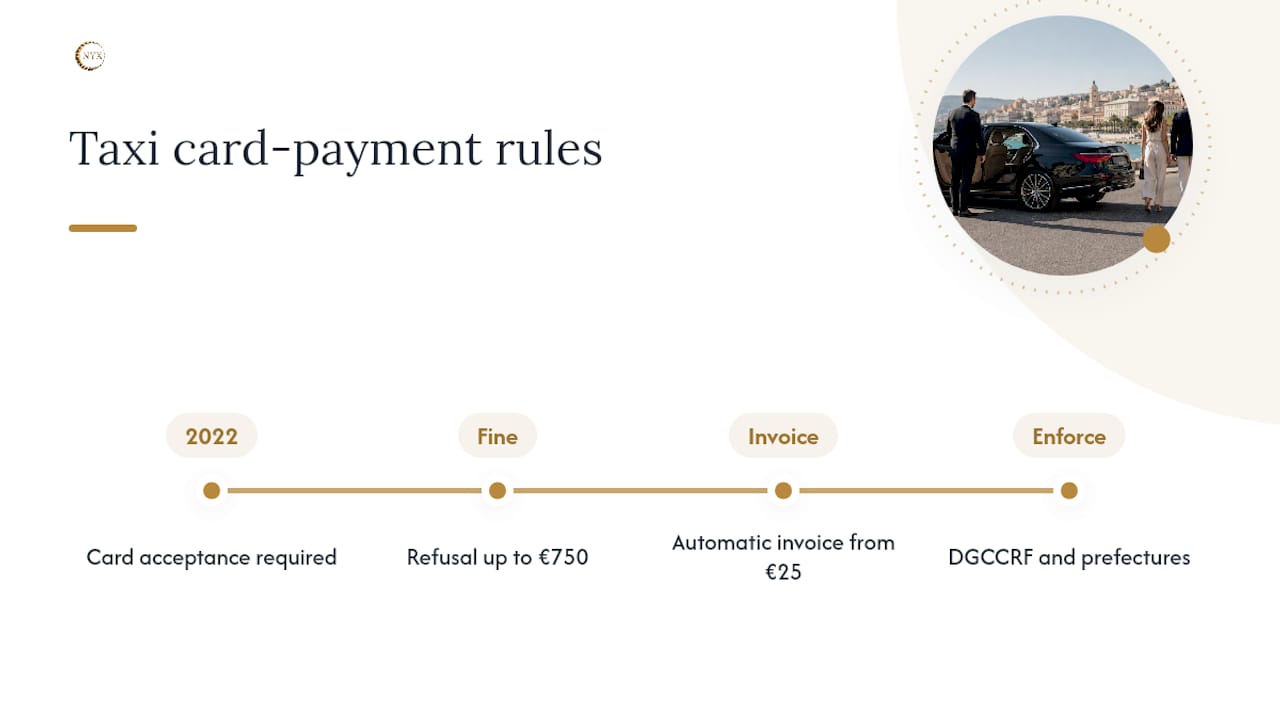
The obligation is not a courtesy. Since 1 July 2022, every licensed taxi operating in France must accept card payment regardless of the fare amount, a rule set out clearly in Service‑Public’s guidance on taxi payment obligations. A driver cannot tell you the card machine “isn’t working today” and demand cash instead, at least not lawfully. Refusal exposes the driver to fines of up to €750, and the terminal has to be in genuine working order, not just present in the vehicle.
The statutory basis sits within France’s transport code, and readers wanting the primary legal text can consult the relevant Legifrance statutory provisions directly. Beyond accepting the card, drivers owe passengers a functional payment process and a proper receipt. Service‑Public specifies that an invoice must be generated automatically once the fare reaches €25 including tax, a threshold that matters for anyone claiming expenses. Enforcement runs through the DGCCRF (France’s consumer protection authority) and local prefectures, both of which handle complaints against taxis operating under an ADS licence. The rule protects the passenger, not the driver’s preference for cash.
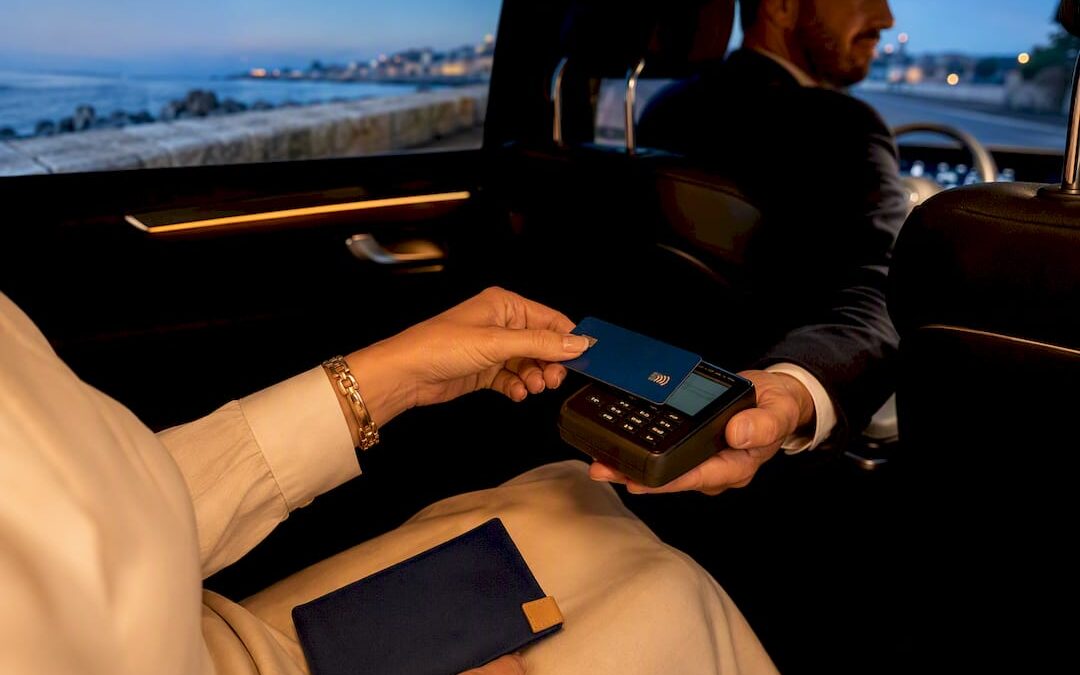
Expect the basics to work almost everywhere. According to TaxiNeo’s guide to paying by card in a French taxi, licensed taxis must accept CB (the French Carte Bancaire scheme), Visa and Mastercard. Contactless payment, Apple Pay and Google Pay are increasingly common, but acceptance depends entirely on the individual terminal and how the driver’s bank has configured it, not on the law itself.
A few practical habits avoid awkward moments kerbside:
- Ask before boarding whether contactless or a phone wallet will work, particularly late at night when a driver’s connectivity might be patchy.
- Carry a physical chip card as backup, since NFC readers occasionally reject a phone wallet even when the card itself works fine.
- Keep any airline, hotel, or booking confirmation to hand if your journey was prepaid, since that document doubles as proof of payment terms.
- Industry technical notes on contactless implementation for vehicle operators confirm that terminal age and merchant bank settings, not the card network, usually explain why NFC fails intermittently.
What to do if a driver refuses your card
Refusal is illegal, but it still happens, usually blamed on a “broken” terminal. Three steps preserve your position and give the authorities something to act on.
- Record the vehicle and licence details. Note the registration plate and the driver’s ADS licence number, and photograph both if it is safe to do so.
- Insist on documentation. Ask for an invoice or receipt, and state plainly that you intended to pay by card and are not obliged to hand over cash instead, a point The Connexion’s coverage of card payment refusals confirms explicitly.
- Report it. Send the licence number, date, and any photos to the DGCCRF or your local prefecture.
Enforcement happens after the fact, so a report will not get you a working card machine there and then. That single limitation is why prepaid, prebooked journeys remain the more dependable route for anyone who cannot afford the risk.
Street taxis versus prebooked VTC: why the payment route matters
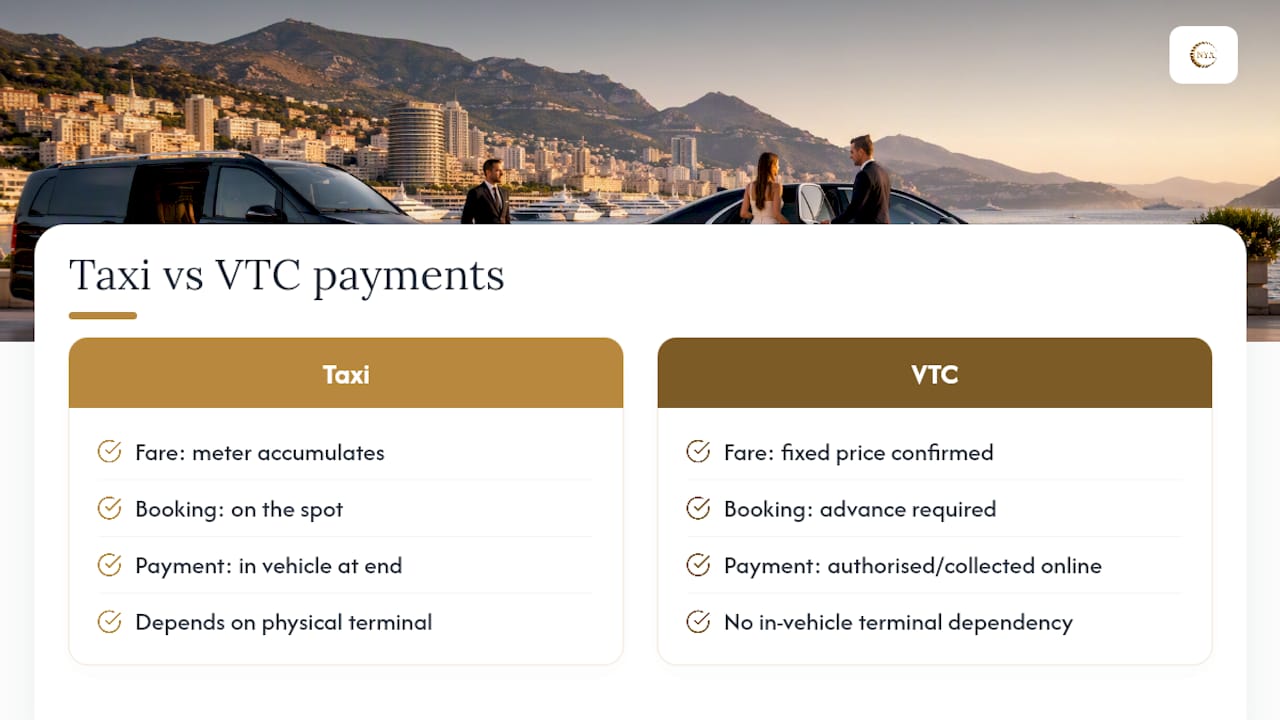
A metred street taxi and a prebooked VTC (voiture de tourisme avec chauffeur) solve the same problem, getting you from A to B, but they handle money very differently. A taxi’s fare accumulates on the meter, and payment happens in the vehicle at the end, which means you are relying on a physical terminal working correctly at that exact moment. Even with the 2022 mandate in force, a broken reader or a driver claiming technical trouble remains, in practice, the most common cause of card disputes.
VTC services operate on a different model entirely. As Paris Je t’Aime’s overview of chauffeur-driven vehicles explains, VTC firms are private companies that require advance booking and typically confirm a fixed price before the journey starts. Payment is usually authorised or collected online, which removes the in-vehicle terminal from the equation altogether. You can read more about how the two models diverge operationally in this comparison of taxi and VTC differences.
That distinction becomes practical rather than academic during Riviera peak periods. A traveller landing at Nice Côte d’Azur Airport during the Cannes Film Festival or arriving for the Monaco Grand Prix weekend faces taxi ranks under serious pressure, terminals working overtime, and drivers juggling volume. A confirmed, prebooked fare with payment already settled removes that entire layer of uncertainty, along with the awkward haggling that can accompany a broken card reader at 11pm.
How prepayment and invoicing work when you book in advance
Most professional chauffeur bookings follow one of two payment structures: full prepayment at the time of booking, or a card authorisation hold released once the journey is complete. Corporate accounts often add a third option, a proper invoice issued after travel, useful for expense reporting.
Whichever structure applies, the €25 invoice threshold that governs street taxis is a useful benchmark for business travellers requesting VAT-compliant receipts, since any fare above that level should generate one automatically under the same Service‑Public rules that cover taxis. Before confirming a booking, check four things: the cancellation and refund policy, how much waiting time is included before extra charges apply, whether the card is charged immediately or only once the journey finishes, and whether a formal invoice will follow automatically or needs requesting. A step-by-step guide to booking a VTC transfer on the Riviera walks through exactly this process for travellers unfamiliar with French chauffeur norms.
TranspOnyx in practice: removing card‑payment uncertainty on the Riviera
Transponyx confirms fixed 2026 rates at the point of booking, across all four fleet categories: Standard Sedan, Business Sedan, Van 7 pax and Van 8 pax. Payment is taken securely online, with invoices available for business clients, so there is no dependency on an onboard terminal working correctly at journey’s end.
Every driver is a licensed VTC professional, bilingual in English and French at minimum. Pickups at Nice Côte d’Azur Airport include flight monitoring and 60 minutes of free waiting time, which matters far more than it sounds during a delayed arrival with luggage in hand. Reservations run around the clock through +33 6 10 30 71 84 or Transponyx. Fixing the price and settling payment before the driver even arrives eliminates the single failure point that causes most card disputes: a terminal that will not cooperate at the exact moment you need it to.
The most reliable route for travellers who need payment certainty
Prebooking a reputable chauffeur is the sounder choice whenever price certainty and a proper invoice matter, airport transfers, event travel, and any journey where an expense claim will follow. If you do end up in a street taxi, note the licence number as a matter of habit and report any card refusal to the DGCCRF without hesitation; it is a right, not a favour. For Riviera travellers who would rather settle payment before the journey starts, Transponyx offers a dependable local alternative built around prepaid cards and confirmed invoices.
— Dany
Booking Transponyx: fixed 2026 rates and secure card payment
Transponyx is the alternative to the terminal-and-hope approach that street taxis still rely on. Every fare is confirmed as a fixed 2026 rate before you travel, charged securely online, and backed by an invoice on request, so there is no card machine to fail and no cash to fumble for at Nice Côte d’Azur Airport or after a long evening in Cannes.
Whether you need a private driver across the French Riviera, a chauffeur for a Cannes event transfer, or a van for a family arriving from Antibes, the payment process is settled before the driver even leaves the depot. Call +33 6 10 30 71 84 or visit Transponyx to check availability and confirm your fixed rate for 2026.
Sources
FAQ
Do French taxis take card payments?
Yes. Since 1 July 2022, every licensed French taxi must accept card payment regardless of the fare amount, and refusal can lead to fines of up to €750.
Contactless, Apple Pay and Google Pay work in most modern taxis and VTC vehicles, though acceptance depends on the driver’s terminal model rather than any legal guarantee.
Do I need to pay a vignette in France?
The vignette (a windscreen sticker) is a separate matter, generally tied to older vehicle emissions zones in certain cities, and it has no bearing on how you pay for a taxi or chauffeur fare.
Is it better to use cash or card in France?
Card is the more reliable option for taxis and chauffeurs, since it is legally required, generates an automatic invoice above €25, and avoids the need to carry large amounts of cash; prebooked services like Transponyx settle payment online before the journey, removing terminal risk entirely.

par Daniel AIT GOUGAM | Sep 14, 2026 | news
Surtaxes on Uber in Nice can usually be reduced or dodged entirely through timing, small location changes and cross-checking apps before you book. When a journey absolutely cannot risk last-minute surge, the only guaranteed fix is a confirmed fixed-rate private transfer, and TranspOnyx offers exactly that across the Riviera, booked in advance at a price that never moves.
Transponyx
Avoid Surge With A Fixed Rate
TranspOnyx provides confirmed, fixed-rate private transfers from Nice Airport and across the Riviera, with no surge pricing.
Book a fixed transfer
How does surge pricing and Uber fare estimation work?
Surtaxe is not arbitrary. Uber describes surge pricing as an automated response to a hyperlocal imbalance between riders requesting cars and drivers available to take them. When demand in a small zone (sometimes a single neighbourhood, sometimes just a few streets around the Promenade des Anglais) outpaces supply, the algorithm raises prices to pull drivers into that area. Prices then ease once enough cars arrive, which is why the multiplier you see at 9:47pm can vanish by 9:53pm.
Uber shows most riders an upfront price before they confirm, rather than a metered fare that ticks up during the journey. That estimate typically bundles:
- A base fare tied to distance and estimated time
- A booking fee and any applicable operating fee
- Tolls, where the route crosses a paid section such as the A8
The surge multiplier, when active, is folded into that upfront figure. It is worth knowing that the same mechanism operates in reverse: higher prices exist to secure more cars quickly, not to penalise the rider stuck outside Nice’s Terminal 2 at midnight.
When does Uber surtaxe hit hardest in Nice?
Certain weeks on the Riviera calendar are near-guaranteed surge triggers, and seasoned residents plan around them rather than fight them in the moment.
- The Cannes Film Festival, typically in May, floods Cannes and the surrounding coast road with demand for weeks, not days.
- A major event on the Riviera in late May tends to compress many visitors into a principality with limited capacity for additional cars.
- MIPIM in March and MIPCOM in October fill Cannes with business travellers moving between hotels and the Palais des Festivals on tight schedules.
- Cannes Lions in June adds a further creative-industry surge on top of an already busy Riviera summer.
- Flight-bank arrivals at Nice Côte d’Azur (NCE) create sharp, short-lived demand spikes, particularly on Friday and Sunday evenings when several wide-body flights land within the same hour.
- Rain, public holidays and weekend evenings are the quieter but more frequent culprits. A sudden downpour on the Promenade can push local multipliers up within minutes.
What steps actually reduce or avoid the surtaxe?
None of these tactics require luck, only a few minutes of patience and a willingness to check more than one screen.
Open the app, look at the upfront price, and if a multiplier is showing, wait. Uber’s own guidance on how surge is calculated notes that drivers reposition quickly once a zone shows elevated demand, so a five to ten minute pause before confirming often brings the price down without you moving at all.
- Check the heatmap in the app before requesting; surge zones in Nice are often only a few streets wide, especially around Vieux Nice and the port.
- Walk a short distance, even 200 or 300 metres, out of a highlighted red zone before requesting your ride.
- Open a second ride-hailing app alongside Uber; one platform surging does not mean the other is, and comparing both takes under a minute.
- Try Uber Pool or a lower-tier vehicle option if your journey allows sharing or a smaller car.
- For airport or event journeys, book a fixed-rate transfer well ahead rather than gambling on last-minute app pricing during a known demand spike.
- Look into Uber’s own subscription and prepaid pass features, which can lock in a fare for riders who repeat the same route regularly.
Pro Tip: If you are travelling to Nice Airport during a major event week such as Monaco Grand Prix, do not rely on any app at all. Confirm a fixed-price transfer at least 48 hours ahead; by the time you are standing at the taxi rank with a suitcase, the decision has already been made for you by the algorithm.
Taxi, regulated fares or private chauffeur: which wins for Nice transfers?
France regulates a large share of airport journeys through prefectoral fixed fares, which licensed taxis must apply regardless of demand. According to official guidance on regulated taxi tariffs, this fixed structure often makes taxis more predictable, and sometimes cheaper, than an app fare caught mid-surge, particularly for airport pickups or long-distance group transfers.
Consider the numbers on two common Riviera routes. Nice NCE to Monaco covers roughly 30 kilometres and takes around 35 to 45 minutes outside peak traffic. Nice NCE to Cannes covers a similar distance, typically 30 to 40 minutes depending on the A8 or coastal route. Both journeys sit squarely in the zone where a surging app fare can suddenly exceed a fixed rate agreed in advance.
This is where a private chauffeur earns its place:
- Fixed 2026 rates confirmed at the moment of booking, with no surge component at any hour
- Fleet choice across Standard Sedan, Business Sedan, Van 7 pax and Van 8 pax for solo travellers or full families
- 24/7 availability, including the exact flight-bank windows when app surtaxes spike hardest
TranspOnyx applies this model on every transfer between Nice NCE and Monaco or Cannes, with the price locked before the driver even sets off.
What Riviera regulars actually do to dodge the surtaxe
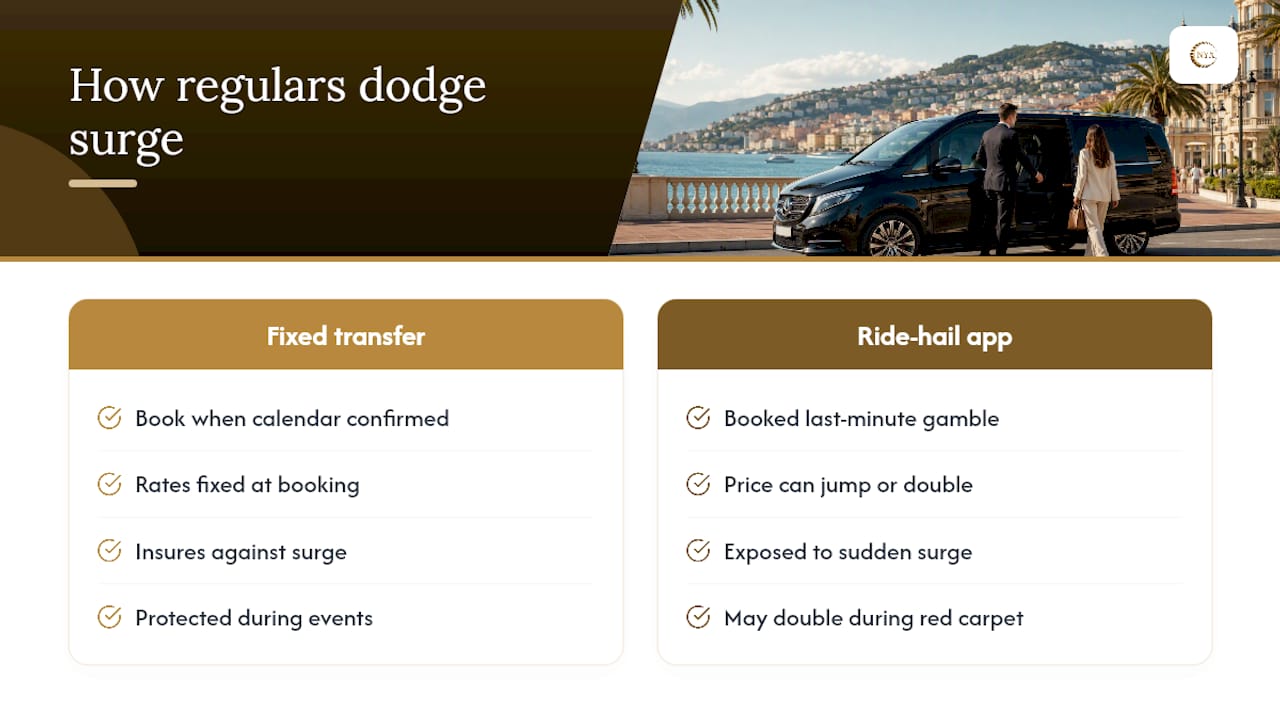
Anyone who has worked a Cannes Film Festival week knows the surge does not creep, it jumps, sometimes tripling within the space of a red carpet screening ending. The travellers who avoid it are the ones who stop treating transport as a last-minute decision. They book the Monaco Grand Prix transfer the moment the calendar is confirmed, not the night before qualifying.
The maths is simple once you have watched it play out on a Friday evening at NCE: a 35 minute run to Monaco or a 40 minute run to Cannes rarely justifies gambling on an app screen that could double in the time it takes to collect a suitcase from the belt. Fixed pricing costs nothing extra when demand is normal, and it is the only real insurance when it is not. That is precisely why TranspOnyx keeps its 2026 rates fixed at the point of booking, whatever is happening on the Croisette that week.
— Dany
TranspOnyx: fixed-rate transfers when surge risk isn’t worth taking
TranspOnyx is the fixed-price alternative to gambling on an app screen during the exact weeks Nice gets busiest. Every airport transfer, point-to-point journey and event transfer is booked at a rate confirmed in advance, with no multiplier attached however busy the Croisette or the Grimaldi Forum gets that night.
Every airport pickup includes flight monitoring and 60 minutes of free waiting time, so a delayed landing during a Cannes Lions rush never becomes your problem. The fleet runs across four Mercedes-Benz categories: Standard Sedan and Business Sedan for up to three passengers, and Van 7 pax or Van 8 pax for groups and families travelling with luggage. Drivers are bilingual VTC professionals available 24 hours a day, seven days a week.
For travellers who would rather compare the wider luxury chauffeur market before deciding, the comparison of leading Riviera chauffeur providers sets out where fixed pricing genuinely beats app-based fares. When you are ready to lock in a rate for Nice NCE, Monaco, Cannes or beyond, call +33 6 10 30 71 84 or book directly through the VIP airport pickup page at transponyx.com.
Where to check live pricing and official fare rules
Uber’s own pages on surge pricing and how surge is calculated explain the mechanics behind any price jump you see in Nice. For regulated fares, service-public’s guidance on taxi and airport tariffs sets out the fixed rates that apply regardless of demand. Travellers wanting broader Riviera event dates before booking can also check the French Riviera lifestyle app for local listings.
Sources
FAQ
How do I pay less for an Uber ride?
Wait a few minutes if a surge multiplier appears, move slightly away from a highlighted red zone before requesting, and compare a second app before confirming; Uber’s own guidance confirms multipliers often ease as drivers reposition into the busy area.
What is the price of an Uber ride in Nice?
There is no single fixed price; the upfront estimate depends on distance, time, booking and operating fees, tolls, and any active surge multiplier, so the same short trip across town can vary considerably between a Tuesday afternoon and a Saturday night.
How much does an Uber from Nice to Monaco cost?
Uber does not publish a fixed fare for this roughly 30 kilometre, 35 to 45 minute route, and the price fluctuates with demand; a fixed-rate private transfer with TranspOnyx removes that uncertainty entirely.
What is the price of an Uber from Nice to Cannes?
Like the Monaco route, pricing for this 30 to 40 minute journey depends on live demand and can spike sharply during festival weeks; travellers who need a guaranteed price can book a confirmed 2026 fixed rate instead through TranspOnyx.