
A travel-agency ground transport partner is an accountable supplier contracted to deliver airport transfers, point-to-point journeys, chauffeur hire, coaches, meet-and-greet services and event logistics directly to a travel agent’s clients under agreed commercial and operational terms. If your agency is handling more than a handful of FIT bookings per month, or you are building MICE programmes, cruise itineraries or event-period packages, you need a named, contracted partner rather than a string of ad-hoc local vendors. The risk transfer alone justifies the paperwork.
Industry bodies such as the Global Business Travel Association (GBTA) publish benchmarking data that agencies can use to quantify exactly what structured supplier relationships return in reduced disruptions and operational cost. The standard industry term for this category of supplier is “ground transport partner” or “ground handler for transfers,” and the distinction from a one-off taxi booking is accountability: a contracted partner carries the agency’s reputation in the destination.
What services does a ground transport partner actually supply?
The service range is broader than most agencies initially expect. A credible partner covers the following core capabilities, as outlined in DMCQuote’s guide to ground transportation for tour operators:
- Airport transfers: — timed pickups and drop-offs with flight monitoring, free waiting time and meet-and-greet boards at arrivals.
Fleet mapping matters as much as the service list. For private clients and small groups, a Standard Sedan (up to 3 passengers) or Business Sedan (up to 3 passengers, premium finish) covers most FIT requirements. Groups of up to 7 or 8 passengers need a Van 7 pax or Van 8 pax respectively. Larger groups require coach-category vehicles, which responsible partners subcontract under their own operator licence rather than passing the booking to an unvetted third party.
The use-case spread is wide. A single Riviera programme might require a Business Sedan for a solo VIP arriving at Nice Côte d’Azur Airport (NCE), a Van 7 pax for a family group transferring to Cannes, and a coach circuit for a MICE group attending MIPIM. A partner that can cover all three under one contract, one invoice and one escalation contact is worth considerably more than three separate vendors. For group itinerary planning, consolidating supplier relationships at the planning stage prevents the coordination failures that generate client complaints.

What commercial models and contract terms should you expect?
Partnership models in ground transport follow a small number of well-established structures, and knowing which one you are being offered determines how you negotiate.
Commissionable rates are the most common entry point. The supplier publishes a rack rate and pays the agency a commission, typically settled monthly. The agency invoices the client at rack rate and the partner remits the commission. Simple, but the margin is fixed and the agency has no pricing flexibility.
Net rates with mark-up give the agency more control. The partner quotes a net price, the agency adds its own margin and invoices the client accordingly. Advantage Travel Partnership negotiates centrally on behalf of member agencies to secure net-rate arrangements across ground transport and ancillary suppliers, with consolidated invoicing as a standard benefit. Agencies that lack the volume to negotiate individually can access these terms through membership.
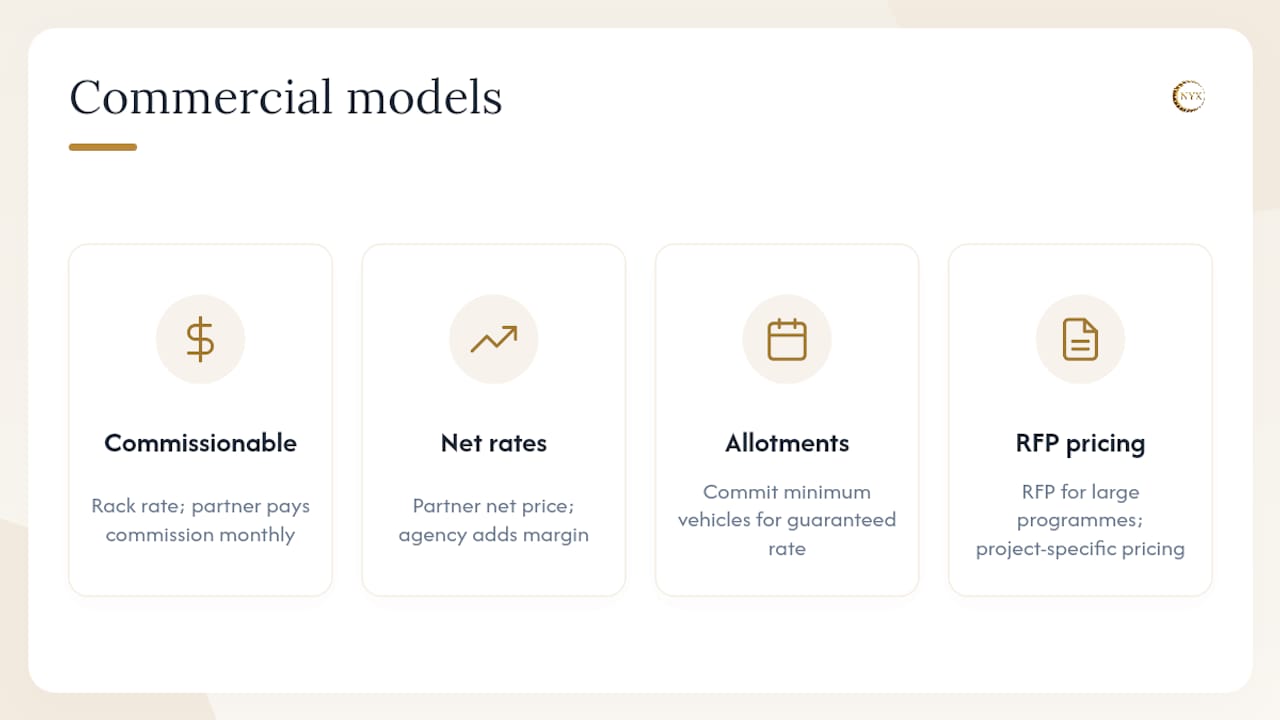
Allotments and block bookings suit agencies with predictable demand, particularly around events such as the Monaco Grand Prix or Cannes Film Festival. The agency commits to a minimum number of vehicles or journey days in exchange for a guaranteed rate and priority availability. The risk is unsold allotment; the reward is rate certainty and confirmed supply during peak periods when ad-hoc availability disappears.
RFP and bespoke event pricing applies to large MICE programmes, incentive groups and corporate roadshows. The agency issues a request for proposal, the partner prices the full programme including contingency vehicles, and both parties sign a project-specific addendum to the master agreement.
On invoicing, expect consolidated monthly statements with net-30 or net-45 credit terms for established agency accounts. Pricing components to clarify before signing include: base fare per vehicle category, waiting-time charges beyond the free allowance, mileage or zone supplements for long-distance runs, extras such as child seats and parking fees, and the applicable VAT rate. For cross-border routings into Italy or Switzerland, confirm whether tolls are included or billed separately.
What licences and insurance must a UK ground transport partner hold?
This is the section most agencies skip, and it is where liability exposure lives. Before placing a single booking, request and verify the following documentation.
| Document | What to check | Where to verify |
|---|---|---|
| PSV Operator’s Licence | Required for coaches carrying passengers for hire or reward; issued by the Traffic Commissioner | GOV.UK Traffic Commissioner |
| PHV Operator Licence | Required for private hire vehicles (chauffeur/VTC); issued by the relevant local licensing authority | Local council licensing register |
| Motor insurance certificate | Minimum third-party; confirm hire-or-reward cover and passenger liability limits | Request original certificate; verify with insurer if in doubt |
| Public liability insurance | Covers third-party injury and property damage; £5 million minimum is standard for trade accounts | Request certificate of insurance |
| Employer’s liability insurance | Statutory requirement for any partner employing drivers; minimum £5 million | Request certificate of insurance |
| MOT and vehicle inspection records | Confirms roadworthiness; PSV vehicles require annual DVSA testing | DVSA vehicle enquiry service |
| Driver DBS checks | Enhanced Disclosure and Barring Service check for drivers carrying passengers | Request copies; check issue date |
Beyond the documents themselves, data protection obligations apply the moment you share passenger names, flight details or hotel addresses with a supplier. Under UK GDPR, your agency is a data controller and the ground transport partner is a data processor. You must have a Data Processing Agreement (DPA) in place before transferring any personally identifiable information. The partner must confirm they hold and process passenger data only for the purpose of delivering the booked service, and that they have appropriate technical and organisational measures in place. The UK Information Commissioner’s Office (ICO) publishes model DPA clauses at ico.org.uk.
Right-to-work checks for drivers are the partner’s legal responsibility, not yours, but you should ask for written confirmation that the partner’s compliance policy covers all drivers assigned to your bookings.
What SLA metrics and operational standards should your contract specify?
Vague service commitments are unenforceable. The following numbered checklist gives operations teams a working starting point for contract negotiations.
- First-call resolution for disruptions: — the partner’s dispatch team resolves vehicle substitutions, driver changes and route diversions without requiring the agency to make a second call.
For event periods such as the Cannes Lions or MIPCOM, where VIP transport planning demands near-zero tolerance for error, add a clause requiring the partner to provide a dedicated operations contact for the duration of the event and to pre-position contingency vehicles within 20 minutes of the primary pickup locations.
Pro Tip: The GBTA x ASTA benchmarking report provides industry-level ROI data that you can use to justify paying a premium for higher SLA tiers. Reduced disruption calls and faster recovery times have measurable cost implications; bring the data to the negotiation.
Dispute resolution should be written into the contract as a three-step process: written notice to the partner’s account manager, escalation to the partner’s operations director within 48 hours if unresolved, and formal mediation or contract termination rights if the issue persists beyond 10 business days. Document every failure in writing at the time it occurs.
How do booking portals, APIs and GDS connectivity work in practice?
Technology integration is where the gap between a professional partner and an informal supplier becomes most visible. The minimum you should expect from any trade-facing ground transport partner is a dedicated agent portal with real-time availability, confirmed pricing and a booking reference that maps to your own PNR or reservation system.
Beyond the portal, integration options range from lightweight to deeply technical. An XML or API feed allows your reservations system to query availability and confirm bookings without manual intervention, which matters when you are processing high volumes or working with automated itinerary-building tools. GDS connectivity via Amadeus, Sabre or Travelport enables agents to book and manage transfers within the same workflow they use for flights and hotels, eliminating the separate login and reducing the risk of booking errors. Expedia TAAP demonstrates how consolidated booking capability and competitive rates can scale an agency’s operations quickly when the technology infrastructure is in place.
Ask the partner’s technology team these specific questions before committing to an integration:
- What is the booking modification window, and can changes be made via the API or only by phone?
- Does the system push ETA notifications to the passenger’s mobile number automatically?
- Can the agency export invoicing data in CSV or Excel format for reconciliation?
- What is the fallback workflow if the API is unavailable?
Legacy GDS entry patterns tend to be slower and less flexible than modern REST API workflows, but they have the advantage of sitting inside a workflow your reservations team already knows. For a business travel transfer workflow, the right integration model depends on your booking volumes and the technical capacity of your operations team.
How do you onboard a ground transport partner step by step?
A structured onboarding process protects both parties and reduces the risk of a live booking becoming the first real test of the relationship.
- Reference checks (Days 10–15): — contact the named agency references directly. Ask specifically about punctuality, invoicing accuracy and how the partner handled a disruption or complaint.
Typical onboarding costs include an administration fee for portal setup (not always charged), a deposit against allotment commitments if applicable, and internal staff time for training and integration testing. Some partners waive setup fees for agencies that commit to a minimum annual booking volume. Travel Leaders Network notes that supplier training and joint marketing resources significantly improve sell-through and post-booking service quality, so ask whether the partner offers product training for your sales team as part of the onboarding package.
What red flags should you watch for when choosing or managing a partner?
Vague cancellation terms are the most common trap. If the contract does not specify the cancellation window, the fee structure and the refund timeline in plain language, assume the terms favour the supplier. Require a table of cancellation fees by notice period before signing.

No 24/7 dispatch contact is a structural problem, not a minor gap. A partner who cannot be reached at 02:00 when a flight diverts to Marseille is not a partner; they are a daytime vendor. Confirm the out-of-hours number before the first booking and test it.
Lack of documented insurance or licence evidence should stop the conversation immediately. A supplier who cannot produce certificates within 48 hours of a written request either does not hold the required cover or does not have an organised compliance function. Neither is acceptable for a trade account.
Opaque pricing, particularly around waiting time and extras, is a reliable indicator of invoice disputes to come. If the rate card does not specify waiting-time charges beyond the free allowance, or if toll and parking costs are described as “at cost” without a cap, negotiate explicit figures before signing.
When a red flag appears during delivery rather than due diligence, the response should be proportionate and documented. A single late vehicle warrants a written note to the account manager. A pattern of punctuality failures warrants a formal corrective action plan with a 30-day review. Persistent failures after a corrective action plan justify suspension of new bookings and, if unresolved, contract termination under the dispute resolution clause.
Why structured ground transport partnerships matter more than agencies realise
The conventional wisdom in trade procurement is that ground transport is a commodity: you find the cheapest licensed operator, confirm the rate, and move on. That view is wrong, and the agencies that hold it tend to find out during an event period.
Consider what actually happens when a client’s flight into Nice NCE arrives 40 minutes late during the Monaco Grand Prix. An ad-hoc vendor may have reassigned the vehicle. A contracted partner with flight monitoring, a 60-minute free waiting policy and a 24/7 dispatch desk absorbs the delay without a single call to your operations team. The difference is not the vehicle; it is the accountability structure behind it.
Consistent ground transport also lifts client satisfaction in ways that are difficult to attribute but easy to lose. A passenger who is met by name, transferred in a clean Business Sedan with Wi-Fi and chilled water, and delivered to their hotel in Cannes without incident does not think about the transfer at all. That invisibility is the goal. When it fails, it becomes the only thing the client remembers about the trip.
The Fora curated partner model illustrates a broader principle: suppliers positioned as preferred rather than commodity tend to deliver better operational alignment, particularly for high-touch MICE and incentive programmes. The investment in due diligence, onboarding and relationship management pays back in fewer disruption calls, faster recovery times and a supplier who treats your bookings as priority rather than filler.
Balancing cost and client experience when specifying fleet types is a genuine skill. A Standard Sedan is entirely appropriate for a solo business traveller on a 25-minute run from NCE to Antibes. Specifying a Van 7 pax for the same passenger to justify a higher sell price is poor practice and erodes trust. Match the vehicle to the genuine requirement, and the client experience takes care of itself.
Transponyx: a Riviera ground transport partner for UK agencies
For UK travel agencies and tour operators building programmes on the French Riviera, Transponyx offers a direct trade partnership covering the full range of ground transportation services that Riviera itineraries require. The fleet runs exclusively on Mercedes-Benz vehicles across four categories: Standard Sedan, Business Sedan, Van 7 pax and Van 8 pax, all with Wi-Fi, air conditioning and chilled water included as standard. All 2026 rates are fixed per vehicle, confirmed at booking, with no surge pricing.
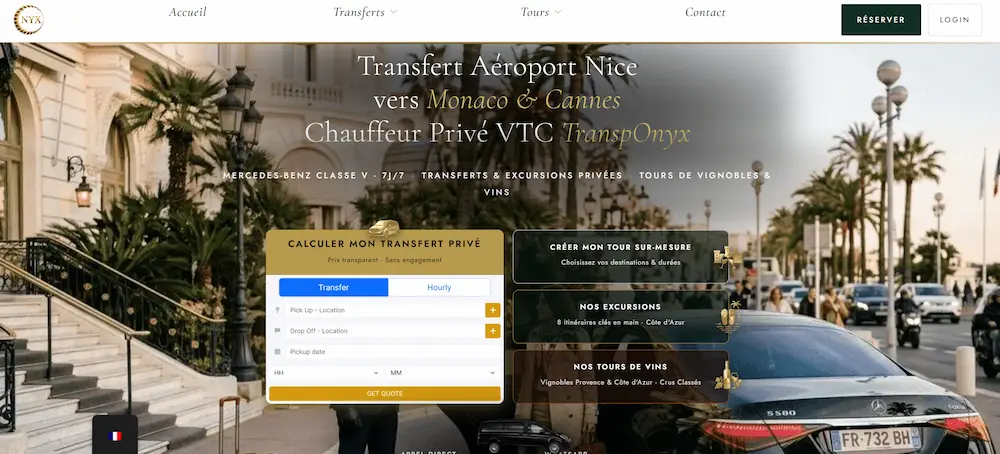
Primary routes cover Nice Côte d’Azur Airport (NCE) to Monaco (approximately 25 minutes), Cannes (30 minutes), Antibes (20 minutes), Menton (40 minutes) and Saint-Tropez (90 minutes), as well as Alpine ski resorts and long-distance transfers into Italy. Flight monitoring and 60 minutes of free waiting time are included on every airport pickup. For agencies selling event-period programmes around the Cannes Film Festival, Monaco Grand Prix or Cannes Lions, Transponyx provides dedicated account management and confirmed vehicle allocation ahead of peak dates.
Cross-border routings from NCE into Ventimiglia, San Remo and Milan are handled under the same fixed-rate structure, which simplifies invoicing for multi-destination itineraries. Drivers are licensed VTC professionals, bilingual in English and French as a minimum, with additional languages including Italian, Spanish, Russian and Arabic available on request.
To request partnership terms, a sample rate card or a consultation on Riviera programme logistics, contact Transponyx directly on +33 6 10 30 71 84 or via WhatsApp on +33 7 67 78 10 26. Agencies can also review the luxury chauffeur services comparison at transponyx.com to assess fleet fit before making contact.
Useful UK sources and further reading
| Resource | What it covers | Link |
|---|---|---|
| GBTA x ASTA ROI Benchmarking Report | Industry ROI data and KPI benchmarks for supplier relationships | GBTA benchmarking report |
| Advantage Travel Partnership | Centrally negotiated net rates and consolidated invoicing for member agencies | Advantage Travel Partnership |
| Travel Leaders Network | Supplier partnership programmes, training resources and joint marketing | Travel Leaders Network |
| Expedia TAAP | Agent-facing booking platform with global supply and consolidated accounting | Expedia TAAP |
| DMCQuote ground transport guide | Service definitions and operational responsibilities for tour operators | DMCQuote guide |
| Fora partner programme | Curated network model and preferred-partner relationship management | Fora partner programme |
For licence verification, the Traffic Commissioner’s register is the primary source for PSV operator licences in the UK. PHV operator licences are held by local licensing authorities; the relevant council’s licensing register is the correct starting point. The ICO’s guidance on data processing agreements is at ico.org.uk and covers the specific obligations that apply when sharing passenger data with a ground transport supplier.
FAQ
What is a travel agency ground transport partner?
A ground transport partner is a contracted supplier that delivers airport transfers, chauffeur hire, coaches and event logistics to a travel agency’s clients under agreed commercial and operational terms, carrying accountability for service delivery in the destination.
What licences must a UK ground transport partner hold?
Coaches operating for hire or reward require a PSV Operator’s Licence from the Traffic Commissioner; chauffeur and private hire vehicles require a PHV Operator Licence from the relevant local authority. Both must be verified before placing bookings.
How do travel agencies typically structure commercial terms with ground transport suppliers?
The most common models are commissionable rack rates, negotiated net rates with agency mark-up, and allotment agreements for event periods. Consolidated monthly invoicing with net-30 credit terms is standard for established trade accounts.
What is the difference between a tour operator and a travel agency in relation to ground transport?
A tour operator typically contracts ground transport directly as part of a packaged product and carries the supplier relationship; a travel agency may book ground transport on behalf of clients either through its own contracted partners or through a tour operator’s ground arrangements.
Can a French Riviera supplier work with UK-based travel agencies?
Yes. Suppliers such as Transponyx operate under fixed-rate, per-vehicle pricing confirmed at booking, with English-speaking drivers and trade account management, making cross-border partnerships with UK agencies straightforward for Riviera programmes.


0 commentaires