
Most VTC providers in Nice now advertise phone chargers as standard, but availability still varies by fleet and vehicle class. TranspOnyx fits every vehicle in its fleet, from the Standard Sedan to the Van 8 pax, with onboard phone chargers as a fixed feature, not an optional extra. If you want the full shortlist and a booking checklist to confirm the charger type before you travel, both follow below.
Chargeurs téléphone VTC Nice: the shortlist compared
Confirming a charger before you book saves an awkward conversation kerbside at Terminal 1. The comparison below sets out vehicle categories, charger policy, and price implications across the options a Nice traveller is likely to encounter.
| Vehicle category | Charger availability | Charger type provided | Price impact / fixed-rate note | Best for |
|---|---|---|---|---|
| TranspOnyx — Standard Sedan, Business Sedan, Van 7 pax and Van 8 pax | Always, fleet-wide | USB ports, cables carried, Wi‑Fi and chilled water alongside | Included in fixed 2026 rate, no surcharge | Airport transfers and Riviera point-to-point journeys with guaranteed amenities |
| Local VTC provider (amenity-focused) | Advertised, confirm at booking | USB, unspecified cable types | Fixed or metered depending on booking channel | Passengers booking by phone who want explicit amenity confirmation |
| Local VTC provider (budget fixed-rate) | On request | Basic USB, cable not guaranteed | Fixed fare, amenities not itemised | Travellers prioritising predictable pricing over guaranteed comfort features |
TranspOnyx leads this list on a simple basis: every vehicle carries a charger as standard, not as a line item you have to chase up. The company’s own service statement confirms that its fleet is equipped with phone chargers, Wi‑Fi, air conditioning and chilled water across all four categories, and that transfers run on fixed 2026 rates with no surge pricing. A Nice NCE to Monaco run takes around 20 to 30 minutes depending on the Basse Corniche traffic, and a Nice NCE to Cannes transfer usually takes around half an hour to 40 minutes via the A8; both are quoted per vehicle rather than per passenger, so the charger comes at no extra cost regardless of party size.
Other local operators take a looser approach. One Nice-based VTC service explicitly lists a mobile phone charger among its onboard amenities, alongside Wi‑Fi and bottled water, which shows the amenity is genuinely part of the local market rather than a rarity. Several regional listings for Nice VTC operators mention chargers as a routine inclusion in airport and hotel pickup packages, reinforcing that the amenity has become an expected baseline rather than a premium extra. Budget-focused fixed-rate services tend to mention chargers more vaguely, often as “on request”, which is where a clear booking note becomes essential.
What to say when booking if you need a phone charger
Getting a charger confirmed is less about luck and more about the wording you use when you book. A vague “does the car have a charger?” invites a vague answer. Specific phrasing gets specific confirmation.
- State the exact charger type you need: “Please confirm a USB‑C charger in the vehicle” or, for older devices, “Please confirm a USB‑A port is available.”
- If you plan to use your own cable, say so directly: “I will bring my own cable, please confirm a USB port is accessible from the rear seats.”
- Ask for the confirmation in writing, not just verbally over the phone, so there is a record if anything goes wrong on the day.
- Request the note be added to your reservation file, particularly if you book through a third party such as a hotel concierge or travel agent.
- For group bookings in a Van 7 pax or Van 8 pax, ask whether multiple ports are fitted, since a single charger becomes a queue with six or seven passengers.
Pro Tip: Screenshot your booking confirmation the moment it arrives. If a charger request was agreed by SMS or WhatsApp, that screenshot is your evidence at the kerb, not a memory of what was promised.
On timing, a charger request should never affect your pickup. Fixed-rate operators build waiting time into the booking itself; TranspOnyx includes 60 minutes of free waiting on airport pickups and 20 minutes at any other address, regardless of any amenity requests you have made. If a provider tells you a charger request will delay your car or add a fee, treat that as a signal to book elsewhere.
USB‑A, USB‑C, Lightning or wireless: what to actually request
The charger type printed on a VTC’s amenities page rarely tells you how fast it will actually charge your phone. Knowing the difference means you ask for the right one.
- USB‑C is the current standard for most Android phones and recent iPhones, and it generally supports faster charging speeds than older ports.
- USB‑A is the older, rectangular port found in ageing vehicle fleets. It works, but charging is noticeably slower, particularly on newer handsets.
- Lightning is Apple’s proprietary connector, fitted only on older iPhone models; fewer vehicles carry a Lightning cable as standard, so bringing your own is sensible.
- Fixed cables built into the console are convenient but limit you to whichever connector the vehicle carries; loose cables offer more flexibility but raise a fair question about how often they are cleaned or replaced.
- Wireless charging pads exist in some premium vehicles but tend to charge more slowly than a cable and only work if the phone sits precisely on the pad, which is difficult on a winding coastal road.
If speed genuinely matters, USB‑C with your own cable is the safest request. If you only need a modest top-up before a business meeting in Monaco, any working port will do.
Amenities by vehicle class: what is normal and what is not
Amenity lists on VTC websites can blur together, so it helps to know what each vehicle class typically carries. Across TranspOnyx’s four categories, phone chargers, Wi‑Fi, air conditioning and chilled water are standard, not tiered by class.
- The Standard Sedan, seating up to three passengers, carries the same charger and Wi‑Fi provision as the Business Sedan, with the difference lying in interior finish rather than amenity count.
- The Business Sedan adds a premium cabin finish, useful for MIPIM delegates or Cannes Lions attendees needing a polished arrival, while keeping the same charging setup.
- The Van 7 pax and Van 8 pax extend the same amenities across a larger cabin, which matters for families or small delegations travelling together to Antibes or Menton.
- Flight monitoring and included waiting time apply across all four categories, so a delayed arrival at Nice NCE does not put your fixed rate or your charger access at risk.
A transfer from Nice NCE to Antibes takes about half an hour; to Menton, allow up to around three quarters of an hour given the coastal road east of Monaco. Both routes are quoted at fixed 2026 rates regardless of which sedan or van category you choose.
Charging safely without risking your device or your data
A charging port in an unfamiliar vehicle is not automatically a risk, but a little caution costs nothing. Damaged cables and unknown data connections are the two things worth watching.
- Avoid visibly frayed or damaged cables; a cracked connector can damage your phone’s charging port over repeated use.
- Where possible, use your own cable rather than one supplied loose in the vehicle, which reduces any theoretical data-transfer risk from an unfamiliar USB connection.
- If your phone runs hot while charging in a warm cabin, remove any case and reduce screen brightness rather than letting it charge at full speed in direct sun through the window.
- If you need a genuinely rapid top-up before a meeting, ask specifically for a fast-charge USB‑C port, bring your own regional adapter if travelling from outside the EU, and ask whether a portable power bank is carried as a backup.
None of this is unique to Nice. It is the same common sense that applies to charging in any hired vehicle, anywhere.
TranspOnyx: fleet, routes and what you can verify before booking
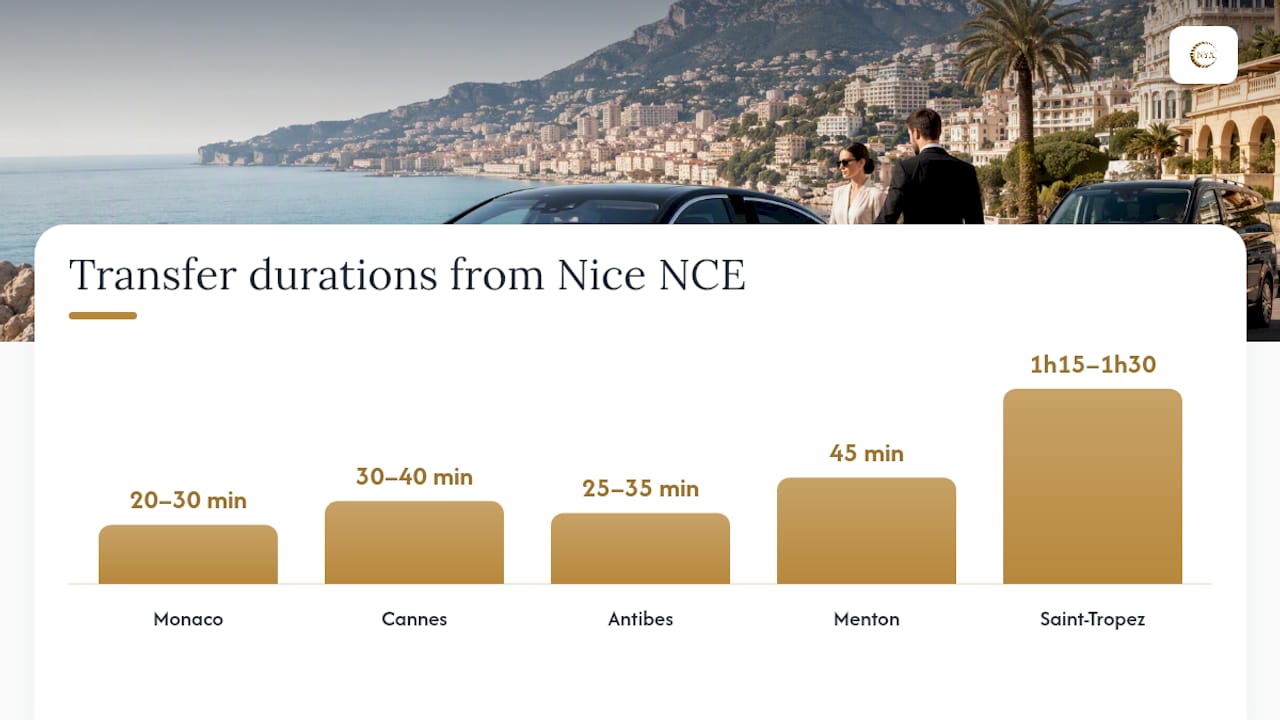
TranspOnyx operates four vehicle categories across the Riviera: Standard Sedan and Business Sedan (each up to three passengers), Van 7 pax, and Van 8 pax. Every vehicle is fitted with phone chargers, Wi‑Fi, air conditioning and chilled water as standard, confirmed directly on the company’s fleet listing.
Core routes include:
- Nice NCE to Monaco, roughly 20 to 30 minutes, useful for Monaco Grand Prix arrivals and business travel.
- Nice NCE to Cannes, roughly 30 to 40 minutes, relevant during the Cannes Film Festival and Cannes Lions.
- Nice NCE to Antibes, roughly 25 to 35 minutes.
- Nice NCE to Menton, roughly 45 minutes.
- Nice NCE to Saint‑Tropez, a longer transfer of around 1 hour 15 minutes to 1 hour 30 minutes depending on season.
All journeys run on fixed 2026 per-vehicle rates with no surge pricing, 60 minutes of free waiting time on airport pickups, and flight monitoring included as standard. Drivers hold professional VTC licences and are bilingual in English and French at minimum. Bookings run 24 hours a day on +33 6 10 30 71 84 or via Transponyx.
Why the charger question matters more than most travellers assume
Most guides to Nice transport treat phone chargers as a footnote, a nice-to-have buried under fleet photos and pricing tables. That undersells the point. A dead phone at Nice NCE means no boarding pass, no hotel confirmation, and no way to reach your driver if plans change, so this amenity sits closer to essential infrastructure than decoration.
The conventional advice, simply asking “does your car have a charger”, is too weak. It invites a yes without specifying charger type, cable condition, or whether the promise survives a driver swap on a busy Grand Prix weekend. Precise language, confirmed in writing, is what actually protects you.
My view, based on how these fleets are actually built rather than how they are marketed, is that fleet-wide provision beats a policy of chargers “on request” every time. A charger fitted as standard, not requested as a favour, tells you something about how the whole vehicle is equipped and maintained. That is the detail worth prioritising before price, before vehicle class, before anything else on the booking form.
— Dany
Book a Nice transfer with a guaranteed charger
TranspOnyx solves the exact problem this guide has been walking through: instead of asking a dispatcher to confirm a charger and hoping the note survives to pickup, every vehicle in the fleet, Standard Sedan through Van 8 pax, carries phone chargers as standard equipment, alongside Wi‑Fi, air conditioning and chilled water, all locked into a fixed 2026 rate with no surge pricing.
Whether you are landing at Nice NCE for a Monaco Grand Prix weekend or heading to Cannes for MIPCOM, your reservation includes flight monitoring, 60 minutes of free airport waiting time, and a licensed, bilingual driver, without needing to negotiate the charger question at all. Book directly via the Nice airport transfer page, call +33 6 10 30 71 84, or message via WhatsApp on +33 7 67 78 10 26 to confirm your vehicle and fixed rate ahead of arrival.
Sources
FAQ
Do all VTCs in Nice provide phone chargers?
Many advertise chargers as standard, but provision varies. TranspOnyx fits chargers across its entire fleet, while some local providers list chargers as available on request rather than guaranteed.
What is the salary of a VTC driver in Nice?
VTC driver earnings vary significantly by hours worked, vehicle category and client volume, and no single figure applies across the Riviera market. Rates depend heavily on whether a driver works independently or for a fleet operator like TranspOnyx.
How much does a VTC licence (macaron) cost in 2026?
Licence and registration costs for VTC operators vary by prefecture and vehicle type, and change periodically, so drivers should confirm current figures directly with their local transport authority rather than relying on older published estimates.
Where can I get a VTC badge for Nice airport?
Airport-specific VTC access badges are issued through the relevant transport authority governing Nice Côte d’Azur Airport; drivers should confirm current application procedures via the airport’s official site.
Should I bring my own charging cable in a Nice VTC?
Bringing your own USB‑C or Lightning cable is sensible, since it guarantees compatibility with your device and avoids relying on a cable of unknown condition in the vehicle.

0 commentaires