
TL;DR:
- Travel in 2026 involves rising demand and higher prices across air, hotel, and transport services.
- Traveler expectations now demand more control, comfort, and personalized premium experiences.
- Sustainable travel options like luxury rail are gaining popularity, offering eco-friendly and efficient alternatives.
Travel in 2026 is not what it was even two years ago. Corporate travel budgets are set to rise 5% globally, hotel bookings are up 6.3%, and airfares are climbing at 3.7%. But the real story is not just the numbers. It is the speed at which traveler expectations are changing. Both business and leisure travelers are demanding more control, more comfort, and more personalized experiences from their journeys. This guide walks you through the key transport trends of 2026, what is driving them, and how to use this knowledge to plan smarter, more rewarding trips.
Table of Contents
- What’s driving transport trends in 2026?
- The rise of luxury and private transport options
- Sustainability and the new premium: Rail’s renaissance
- Practical choices: How to select the right 2026 transport
- Why most travelers overlook the true value of premium transport in 2026
- Explore the best solutions for 2026 travel
- Frequently asked questions
Key Takeaways
| Point | Details |
|---|---|
| Global travel is rebounding | Both corporate and leisure travel demand are increasing, pushing new transport options into the spotlight. |
| Luxury transport options surge | Private jets, superyachts, and premium vehicles are in high demand for travelers seeking ultimate comfort and privacy. |
| Sustainability is a priority | Many are choosing luxury rail for its eco-friendly features and outstanding comfort compared to short flights. |
| Smart choices matter | Travelers can optimize experience, cost, and impact by weighing factors like time, flexibility, and carbon footprint. |
| The value of premium | Beyond status, premium transport can deliver greater productivity, control, and seamless journeys for 2026 travelers. |
What’s driving transport trends in 2026?
With demand on the rise, let’s explore what’s powering these shifts in 2026.
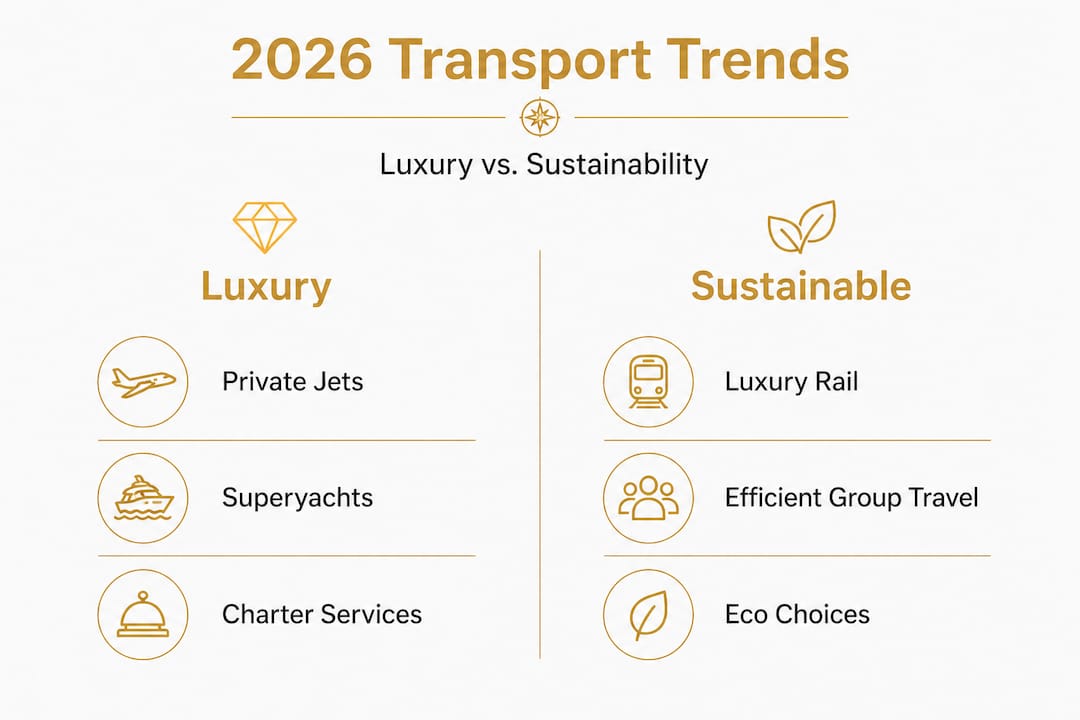
Travel volume is surging. Air passenger demand grew 3.8% year-over-year in January 2026, with international travel leading at 5.9% growth. Full-year 2025 demand was already up 5.3%, confirming that the recovery from the pandemic years has become a sustained boom. That is a lot of people moving through airports, train stations, and ports, all competing for a better experience.
Corporate demand is an especially significant driver. Corporate travel budgets are projected to rise 5% globally in 2026. Companies are not just sending employees to more meetings. They are investing in the quality of those travel experiences, particularly for senior executives, sales teams, and client-facing roles. Effective corporate travel planning has become a competitive advantage.
Here is a quick view of the main trends across transport modes:
| Transport mode | 2026 trend | Key driver |
|---|---|---|
| Air travel | +3.8% YoY demand (Jan 2026) | Post-pandemic recovery, international routes |
| Luxury ground transport | Rising bookings, premium fleets | Corporate spending, personalization |
| Private jets | More companies permitting use | Executive productivity, flexibility |
| Rail (luxury) | Rapid growth in premium services | Sustainability, comfort, city pairs |
| Superyachts | Sales up 70% since 2025 | Wealth growth, exclusive charters |
Several forces are at work simultaneously:
- Rising fares are pushing travelers to expect more value for their spend.
- Post-pandemic confidence is fueling longer trips and international itineraries.
- Remote and hybrid work has given professionals more flexibility to combine business with leisure.
- Increased awareness of sustainability is shifting preferences, especially among younger executives.
“The modern traveler in 2026 is not choosing between comfort and efficiency. They expect both, and providers who cannot deliver will lose the booking.”
Demand for group transport needs is also expanding. Teams traveling together for conferences, incentive trips, or corporate retreats are seeking coordinated, high-end solutions that go beyond a standard rental van. The entire market is moving upward in quality expectations.
The rise of luxury and private transport options
With context on shifting demand, let’s dig into how premium options are redefining travel perks and expectations.
The numbers here are striking. Superyacht sales are up 70% since 2025, and expedition charter bookings are climbing alongside that figure. On the aviation side, 10% more companies are now explicitly permitting private jet use for approved travelers compared to just a year ago. These are not marginal changes. They signal a fundamental reframing of what “traveling well” means.
Why is this happening now? Several factors are converging. High-net-worth individuals and senior executives increasingly view travel time as productive time. A private jet or a luxury vehicle with a professional chauffeur is not an indulgence. It is a working environment. You get privacy for calls, space for documents, and zero stress about delays.
Here is how the top premium transport options compare:
| Option | Best for | Privacy level | Flexibility | Cost range |
|---|---|---|---|---|
| Private jet | Intercontinental, executive | Highest | Very high | $$$$ |
| Luxury yacht or superyacht | Coastal, leisure, events | Highest | High | $$$$ |
| Premium ground transport (VTC) | City to airport, point-to-point | High | High | $$ to $$$ |
| High-end rail (private cabin) | City pairs under 4 hours | Medium | Medium | $$ to $$$ |
To secure a quality luxury transport experience in 2026, follow these steps:
- Define your priorities. Is it speed, privacy, sustainability, or group size? Knowing this makes every other decision easier.
- Book in advance, especially for peak seasons. Luxury inventory, from private jets to premium chauffeur vehicles, fills up faster than standard options.
- Verify the provider’s credentials. Look for professional licensing, vehicle standards, and client reviews. For ground transport, ask about fleet specs and chauffeur certification.
- Confirm all logistics in writing. Flight manifests, pick-up times, and luggage handling should all be confirmed before departure day.
- Plan for contingencies. Premium travel means having a backup plan, whether that is a reserved vehicle on standby or a confirmed alternate flight.
Pro Tip: When evaluating private transport trends, do not evaluate options in isolation. A private jet gets you to the destination city, but your experience continues when you land. A seamlessly coordinated ground transfer from the tarmac to your hotel or meeting is what separates a truly premium journey from a fragmented one.
The pillars of luxury travel in 2026 consistently point to four non-negotiables: reliability, personalization, discretion, and professional service at every touchpoint. Understanding those pillars helps you evaluate any transport provider, whether you are booking a jet card or a chauffeured sedan.
Sustainability and the new premium: Rail’s renaissance
While luxury is trending, it’s not just about indulgence. Eco-minded travelers are shaping transport’s new face.
Rail is having its most significant resurgence in decades, and for good reason. Luxury rail produces 70-85% lower emissions per passenger compared to short-haul flights. That figure is reshaping how forward-thinking companies design their corporate travel policies and how conscious leisure travelers plan their routes.

The numbers are compelling, but the experience is what is converting skeptics. Modern premium rail services now offer private cabins, gourmet dining, reliable Wi-Fi, and seamless boarding without the security theater of an airport. For city pairs within a four-hour rail window, such as Paris to Nice, London to Edinburgh, or Amsterdam to Brussels, train travel is now genuinely competitive on both time and comfort.
Here is a direct comparison for a typical business traveler:
| Factor | Short-haul flight | Luxury rail |
|---|---|---|
| Total door-to-door time | 3.5 to 5 hours | 2.5 to 4.5 hours |
| Carbon emissions | High (baseline) | 70-85% lower |
| Boarding experience | Stressful (security lines) | Relaxed (direct platform access) |
| Working environment | Limited, cramped | Spacious, quiet, Wi-Fi included |
| City center arrival | Usually not (airports are remote) | Usually yes (central stations) |
Key benefits of choosing rail for business or leisure in 2026:
- Productivity. Full-size tables, quiet cars, and stable connectivity make trains productive workspaces.
- City center to city center. You avoid the ground transfer costs and time that eat into any air itinerary.
- Predictability. Trains have far lower rates of delay and cancellation than short-haul flights in Europe.
- Status alignment. For companies with sustainability commitments, rail travel visibly supports those values.
“Choosing rail over a short-haul flight is increasingly a signal of sophisticated, values-aligned travel, not a compromise.”
Pro Tip: If you are traveling between Nice and cities like Milan, Geneva, or Marseille, consider whether a premium train connection fits your schedule. Then think about what happens on each end. The best way to travel for business often involves combining rail with a professional chauffeured transfer at the arrival station, so you never lose the continuity of a high-quality experience.
Sustainable travel in 2026 is not about sacrificing comfort. It is about making choices that align efficiency, experience, and environmental responsibility in a way that reflects well on both the traveler and the organization behind them.
Practical choices: How to select the right 2026 transport
Now, let’s turn these trends into clear, practical recommendations for selecting your ideal 2026 travel mode.
Choosing the right transport in 2026 is not simply about picking the fastest or the most expensive option. It requires honest consideration of several factors working together. One important note: high-income leisure travelers may show more caution about premium upgrades compared to the consistently optimistic corporate segment. That gap in sentiment means you should calibrate your choices carefully based on whether you are traveling for work or personal reasons.
Start with these key questions before booking any transport:
- What is my total available time? Include door-to-door, not just flight or rail duration.
- How large is my group? A solo executive has different needs than a team of eight traveling to a client event.
- What is the purpose of the trip? A deal-closing client visit warrants a different level of investment than a routine internal meeting.
- What are my sustainability commitments? Some companies now require employees to justify air travel over rail on environmental grounds.
- What is the occasion? A wedding, a yacht charter weekend, or a conference all call for different transport solutions.
Common mistakes travelers make when evaluating transport options:
- Focusing only on base price while ignoring time costs, stress costs, and productivity losses.
- Booking ground transport as an afterthought rather than integrating it into the full travel plan.
- Choosing volume over quality for groups, opting for cheap buses or ride-shares instead of coordinated premium vehicles.
- Neglecting flexibility terms on premium bookings. Understanding cancellation and change policies can save significant money.
- Assuming luxury means excess. In 2026, luxury transport for business is increasingly about efficiency and reliability, not ostentatious displays.
Pro Tip: The smartest travel buyers in 2026 are thinking in terms of total journey experience, not individual transport segments. When you quantify the chauffeur benefits in 2026, such as zero navigation stress, guaranteed punctuality, and professional assistance with luggage, you quickly realize the true cost of that service is far lower than its perceived price.
A helpful framework: rank your trip priorities as time, comfort, cost, or sustainability, then match each transport segment to your top two priorities. This simple exercise eliminates most decision paralysis and keeps your travel plan coherent from start to finish.
Why most travelers overlook the true value of premium transport in 2026
Here is an uncomfortable truth. Most travelers spend significant energy choosing the right airline or hotel, then book ground transport without a second thought. They use whatever ride-share app is fastest or cheapest. And then they wonder why the high-quality feeling of their journey evaporates the moment they step off the plane.
Premium transport’s real value in 2026 is not luxury for its own sake. It is stress reduction, time control, and the kind of hyper-personalization that makes the entire trip feel coherent rather than a series of disconnected bookings. When your chauffeur tracks your incoming flight, waits without a meter running, and knows your preferred route and temperature setting, you arrive at your meeting or your hotel in the right frame of mind.
The hidden ROI is real. An executive who arrives rested and focused performs differently than one who spent 45 minutes in an airport taxi queue. A client who is picked up at the port in a spotless Mercedes-Benz and brought to a meeting in complete comfort forms a different impression of your organization than one who navigates their own way across an unfamiliar city.
Most travel guides focus on the headline transport options. They compare airlines, rank hotels, and list airport lounges. What they miss is that the connective tissue of a journey, those ground transfer moments between planes, trains, hotels, and meetings, determines the overall quality of the experience more than any single booking. When you transform event transfers from logistical afterthoughts into coordinated, premium touchpoints, the perception of your entire trip shifts.
Our view is that travelers who genuinely understand this will always get more value from their travel budgets, not by spending more necessarily, but by allocating spending to the moments that matter most.
Explore the best solutions for 2026 travel
If you are ready to upgrade your travel experience and apply what you have learned, here is where to start.
Understanding the pillars of luxury transportation is the foundation. Once you know what separates a truly premium service from a standard one, every booking decision becomes clearer and more confident. From there, exploring the right luxury transport vehicles for your specific journey, whether a Mercedes-Benz sedan for an executive transfer or a spacious van for a corporate group, helps you match vehicle capability to your actual needs. For travelers arriving or departing via Monaco or along the French Riviera, our premium Monaco transport service delivers fixed-rate, bilingual, professionally chauffeured transfers that handle every detail from the moment you land. Your 2026 travel deserves the same level of care from start to finish.
Frequently asked questions
Are private jets or superyachts more popular for business travel in 2026?
Both are seeing surging demand in 2026. Superyacht sales are up 70% since 2025, while 10% more companies now permit private jet use for approved travelers, reflecting strong growth across both categories.
How much has air passenger demand increased in 2026?
Air passenger demand rose 3.8% year-over-year in January 2026, with international travel up by 5.9%, continuing the sustained post-pandemic recovery trend.
Is rail travel really more sustainable than flying in 2026?
Yes. Luxury rail produces 70-85% lower emissions per passenger than short-haul flights, making it the leading sustainable option for business and leisure travelers on routes under four hours.
Are companies spending more on travel in 2026?
Corporate travel budgets have increased 5% globally in 2026, driven by both rising travel demand and higher fares across air and hotel categories.
Is luxury travel expected to continue growing all year?
Corporate travel growth is strong and consistent. However, high-income leisure travelers may exercise more caution about premium upgrades as the year progresses, creating a divergence between business and leisure segments.
Recommended
- 2026 private transport trends for luxury travel in Nice
- Choosing premium transport between Cannes and Saint-Tropez 2026
- Luxury chauffeur benefits for Nice travelers in 2026
- What Is Luxury Transportation? 4 Pillars for 2026 Travel
- Master the role of buses in corporate travel for Toronto events
- How to optimize airport transfer services for stress-free travel

0 commentaires