
Premium travel terminology is the specialized vocabulary used across the luxury travel industry to define services, pricing structures, and guest experiences with precision. Misunderstanding a single term, whether Best Available Rate, Advance Provisioning Allowance, or VTC, can cost a traveler thousands of pounds or set expectations that no property or operator can meet. This guide covers the high-end travel vocabulary that matters most in 2026, from five-star hotel room classifications to yacht charter contracts and private chauffeur bookings on the French Riviera. Transponyx, a licensed VTC operator based in Nice, uses this language daily to communicate clearly with concierge services, travel agencies, and discerning travelers arriving at Nice Côte d'Azur Airport (NCE).
What is premium travel terminology and why does it matter?
Premium travel terminology is the agreed language that connects travelers, operators, and intermediaries in the luxury sector. Without it, a client expecting a suite receives a Deluxe room. A charterer budgets for the base fee and overlooks the Advance Provisioning Allowance. A corporate traveler books a taxi when the contract specifies a VTC. The gap between expectation and reality almost always traces back to a vocabulary failure.

The industry recognizes this. Bodies such as the Mediterranean Yacht Brokers Association (MYBA) publish standardized contract terms specifically to prevent ambiguity in high-value transactions. Hotel groups operating under five-star classifications use room-tier naming conventions that are consistent across properties, even when the names feel counterintuitive. Understanding these conventions is not optional for professionals. It is the baseline for competent service delivery.
For travelers, the stakes are equally concrete. Knowing what a term means before signing a charter agreement or confirming a hotel block protects the budget and the experience. The French Riviera, home to the Cannes Film Festival, the Monaco Grand Prix, and MIPIM, concentrates some of the world's most expensive travel transactions into a few short weeks each year. Getting the language right is the difference between a well-managed trip and an expensive misunderstanding.
What are the essential premium travel terms for accommodation and transport?
The luxury travel sector uses a precise set of terms that differ meaningfully from standard travel vocabulary. Knowing them changes how you book, budget, and communicate.
Key accommodation terms
Best Available Rate (BAR) is the lowest unrestricted public rate for a hotel room at any given time. It serves as the baseline from which corporate discount negotiations begin. A rate described as “20% below BAR” is therefore a concrete, verifiable figure, not a vague promise.
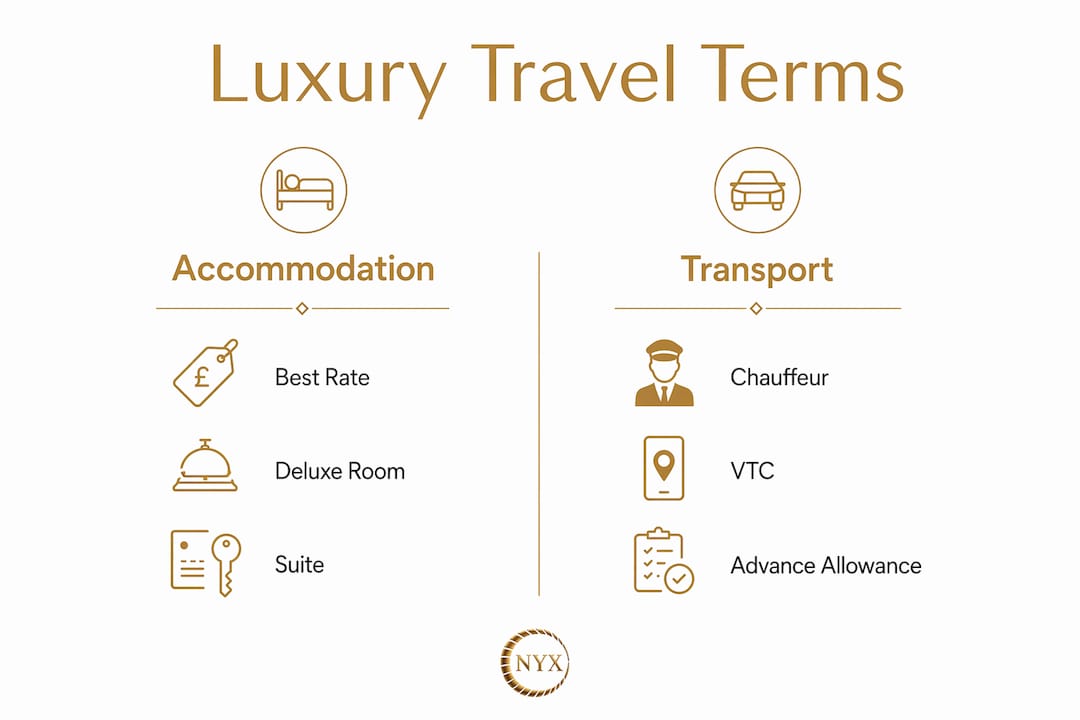
Deluxe room is one of the most misread terms in five-star hotels. Contrary to what the name implies, a Deluxe room is the entry-level category at most luxury properties, typically offering 400–500 sq ft of high-specification space. Guests who assume “Deluxe” means “upgraded” are routinely disappointed. The correct hierarchy at most five-star properties runs: Deluxe, Superior, Junior Suite, Suite, and then named or signature suites.
Wholesale rates in 2026 sit 15–40% below retail prices, giving travel agencies the margin to add a markup while remaining competitive. That spread explains why booking through a specialist agency often costs no more than booking direct, and sometimes less.
Key transport terms
- Driver (Voiture de Tourisme avec Chauffeur) is the French regulatory classification for a licensed private hire vehicle with a professional driver. It is distinct from a taxi in both licensing and service model. Transponyx operates exclusively as a VTC, which means fixed rates confirmed at booking, no surge pricing, and drivers who hold a professional VTC license.
- Private chauffeur refers to a driver engaged for a specific client or group, as opposed to a shared transfer or shuttle service. The term implies exclusivity, punctuality, and a vehicle reserved solely for that booking.
- VIP transfer is a marketing descriptor rather than a regulated term. It typically signals door-to-door service, a premium vehicle class, and meet-and-greet at the arrivals hall, but the precise specification varies by operator.
- By-the-hour hire means the vehicle and driver are at the client's disposal for a set period, with no fixed route. This model suits event days such as the Monaco Grand Prix or Cannes Lions, where schedules change and waiting time is built into the arrangement.
Pro Tip When comparing transport quotes on the French Riviera, always confirm whether the rate is per vehicle or per person, and whether waiting time is included. Transponyx includes 60 minutes of free waiting time on all airport pickups and 20 minutes at any other address, which is a material difference from operators who charge by the quarter-hour.
How do premium travel terms apply in yacht charters?
Yacht charter contracts contain some of the most consequential terminology in all of luxury travel. A first-time charterer who reads only the headline charter fee will almost certainly underestimate the total cost by a significant margin.
The core cost structure
| Term | Definition | Typical Range |
|---|---|---|
| Base charter fee | The fee for the vessel itself, excluding all running costs | Varies by yacht and season |
| Advance Provisioning Allowance (APA) | Upfront operational fund covering fuel, provisions, port fees, and crew expenses | 25–35% of base charter fee |
| Gratuity | Crew tip paid at the end of the charter, separate from all other fees | 5–20% of base charter fee |
| MYBA contract | The Mediterranean Yacht Brokers Association standard charter agreement, the industry benchmark for European charters | N / A |
The Advance Provisioning Allowance is the term that most surprises first-time charterers. It is not a deposit. It is an operational float that the captain draws against throughout the charter. Any unspent portion is returned at the end of the voyage. Any overspend requires a top-up. On a charter with a base fee of €50,000, the APA alone could reach €17,500 before the vessel leaves the dock.
Gratuity is equally non-negotiable in practice, even when it is not contractually required. The crew gratuity norm of 5–20% reflects the fact that charter crews work extended hours and receive a base salary calibrated on the assumption that tips will supplement it. Experienced brokers advise budgeting at the midpoint of that range as a minimum.
The 12-passenger rule is a regulatory limit, not a charter company policy. Commercial vessels carrying more than 12 paying passengers require a different class of certification. Any charter advertised for 13 or more guests should be pollised carefully, as it may be operating outside the correct regulatory framework.
Pro Tip For a thorough grounding in yacht brokerage terminology before signing a MYBA contract, review the full glossary of terms used by professional brokers. The vocabulary is specific and the financial implications of misreading it are substantial.
What are best practices for using luxury travel language in marketing?
Precise language is the foundation of credible luxury marketing. The problem is that the most commonly used luxury descriptors have been repeated so often they carry no information at all.
Overused terms such as “hidden gem” and “paradise” should be replaced with specific, evocative descriptions that convey actual qualities. A property is not a “paradise.” It has a 180-degree view of the Ligurian Sea from a terrace that seats eight. A restaurant is not a “hidden gem.” It holds one Michelin star, seats 24 covers, and requires a three-week wait. Specificity is the luxury signal. Vagueness is the opposite.
Tea Value vs Premium framework clarify a distinction that many marketers blur. “Premium” describes price positioning within a tier, not a higher tier of quality. A Business Sedan from Transponyx is positioned as premium within the private chauffeur category because it offers a higher-specification finish than the Standard Sedan. It is not a different category of service. Misusing “premium” to mean “the best available” misleads clients and invites disappointment.
Effective luxury language follows these principles:
- Replace category claims (“luxury transfer”) with specific facts (“Mercedes-Benz Business Sedan, fixed rate, flight-monitored pickup at NCE”).
- Name the service standard, not the aspiration. “MYBA-compliant charter” means something. “World-class yacht experience” means nothing.
- Quantify where possible. “60 minutes of complimentary waiting time” is more persuasive than “flexible pickup.”
- Avoid stacking superlatives. One strong, specific claim outperforms three vague ones.
Luxury travel today is defined less by star ratings or price points and more by alignment with individual client values: privacy, time saved, or access that cannot be purchased through standard channels. Language that reflects this shift, focusing on what the client gains rather than what the product costs, is the current standard in high-end travel communication.
How does mastering luxury travel jargon improve the French Riviera experience?
The French Riviera concentrates more premium travel transactions per square kilometer than almost any other destination in Europe. Monaco, Cannes, Antibes, Menton, and Saint-Tropez each host events and clientele that demand precise, professional communication. Knowing the vocabulary is not academic. It is operational.
-
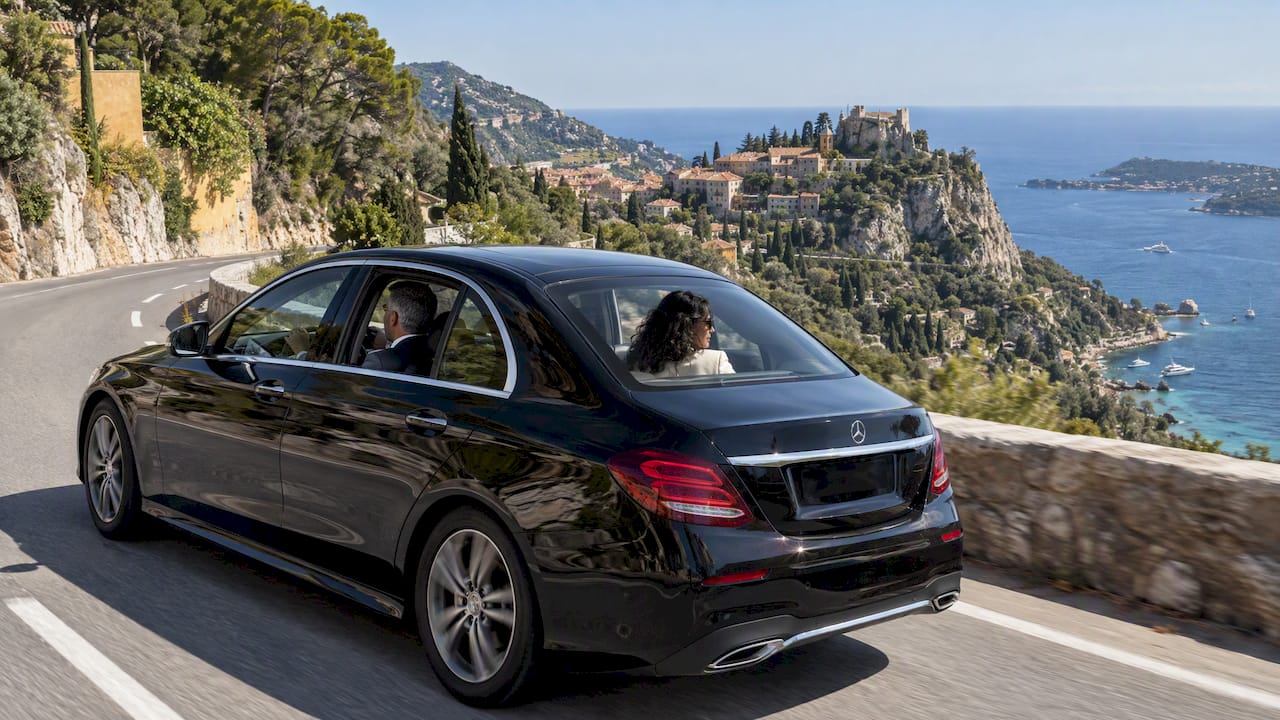
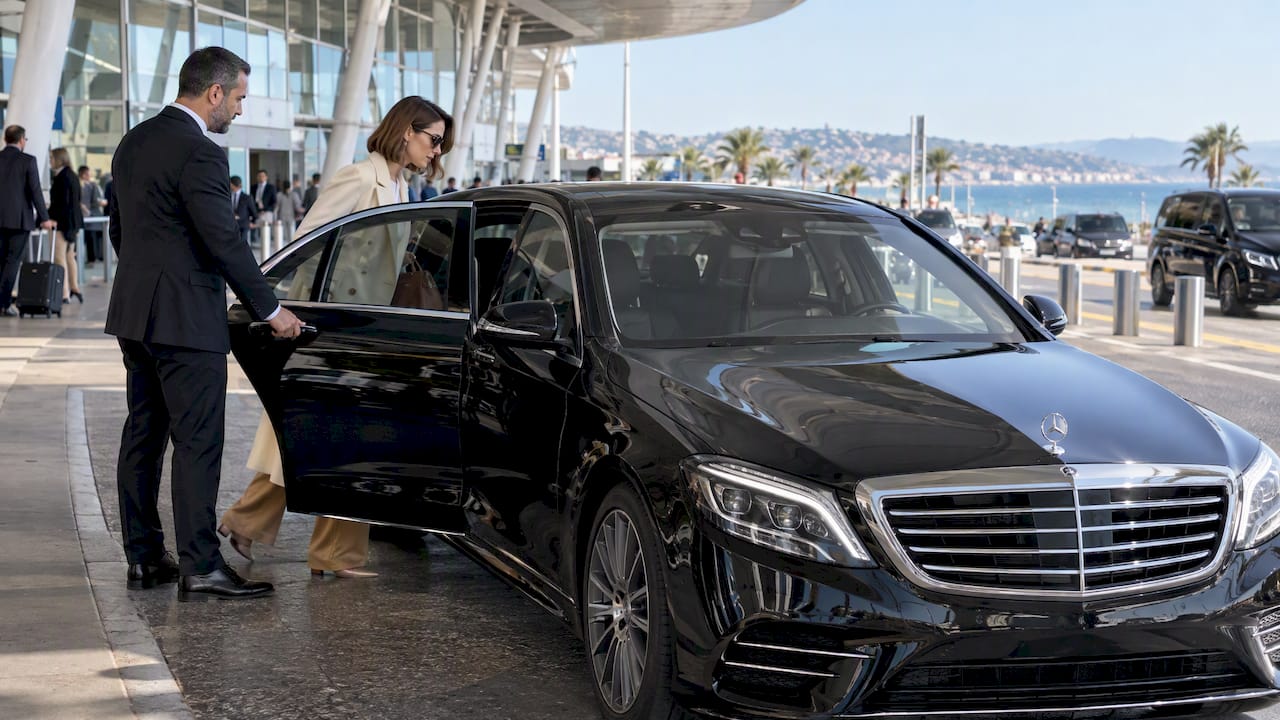
Airport arrivals at NCE. A traveler who understands the difference between a VTC and a taxi knows to look for a driver holding a name board in the arrivals hall, not to join the taxi queue. The journey from Nice Côte d'Azur Airport to Monaco takes approximately 30 minutes by private chauffeur. Knowing to ask for a fixed rate, confirmed at booking, prevents the surge-pricing exposure that unregulated services carry.
-
Event transport during the Cannes Film Festival. During the Cannes Film Festival each may, road access to La Croisette is restricted. A client who books by-the-hour hire and understands what that term means will have a vehicle and driver on standby throughout the day. A customer who books a point-to-point transfer may find the driver unable to return for a second pickup under the original fare.
-
Concierge coordination. Hotel concierges at five-star properties hold the informal authority to secure reservations at fully booked Michelin-starred restaurants and access to events not listed publicly. A traveler who communicates their requirements using correct terminology, specifying dates, party size, dietary requirements, and budget band, receives a materially better response than one who asks generically for “something nice.”
-
Corporate account management. Travel managers negotiating ground transport contracts for MIPIM or MIPCOM need to specify vehicle categories by name. Transponyx offers four categories: Standard Sedan (up to 3 passengers), Business Sedan (up to 3 passengers, premium finish), Van 7 pax (up to 7 passengers), and Van 8 pax (up to 8 passengers). A contract that simply states “executive vehicle” creates ambiguity that leads to disputes on the day.
-
Long-distance transfers. Routes from Nice to Milan, San Remo, or Ventimiglia require clarity on whether the rate covers tolls, border crossings, and driver accommodation for overnight trips. These are standard line items in professional transfer contracts. Knowing to ask about them before confirming the booking is the mark of an experienced traveler or a competent travel manager.
Transponyx drivers are bilingual in English and French as a minimum, with several also speaking Italian, Spanish, Russian, or Arabic. That linguistic range is itself a form of luxury chauffeur benefit that reduces friction at every point of the journey, from airport pickup to hotel drop-off.
Why I think precision in travel language matters more than ever in 2026
Working on the French Riviera, I have watched the same misunderstanding play out dozens of times. A client arrives at Nice Côte d'Azur Airport expecting a “luxury transfer” and finds a standard saloon with no flight monitoring, no waiting time allowance, and a driver who does not speak their language. The operator used the word “luxury.” The client heard a promise. The language failed both of them.
The shift I have observed in 2026 is that luxury is increasingly personal, defined by what the individual client values rather than by a star rating or a price bracket. That makes precise vocabulary more important, not less. When luxury means different things to different people, the only way to align expectations is to use specific, agreed terms rather than aspirational descriptors.
What I find most telling is how the best operators on the Riviera communicate. They don’t say “premium service.” They say: fixed rate, Mercedes-Benz Business Sedan, flight-monitored pickup, 60 minutes of complimentary waiting time, bilingual driver. Every word is a commitment. Every commitment is measurable. That is the standard Transponyx holds itself to, and it is the standard I would apply to any luxury travel provider worth the name.
The operators who rely on vague language are, in my experience, the ones who cannot afford to be specific. Specificity is accountability. Accountability is the actual definition of luxury in 2026.
— Dany
Transponyx: premium chauffeur service on the French Riviera
Understanding the vocabulary of luxury travel is one thing. Finding a provider who lives up to it is another.
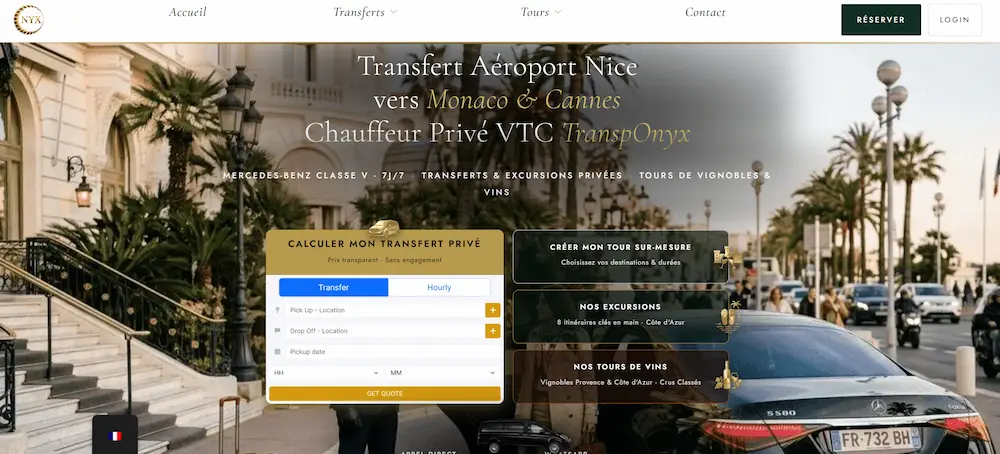
Transponyx operates a fleet of Mercedes-Benz vehicles across four categories, serving Nice Côte d'Azur Airport, Monaco, Cannes, Antibes, Menton, Saint-Tropez, and long-distance routes to Italy and Provence. All 2026 rates are fixed, confirmed at booking, with no surge pricing. Flight monitoring is included on every airport transfer, and 60 minutes of complimentary waiting time is standard on all NCE pickups. For travelers and travel managers who want a private chauffeur in Nice that matches the precision of the language used to describe it, Transponyx is available 24 hours a day, 7 days a week. Call +33 6 10 30 71 84, message via WhatsApp on +33 7 67 78 10 26, or visit transponyx.com to review 2026 service options.
FAQ
What is Best Available Rate (BAR) in luxury hotels?
Best Available Rate is the lowest unrestricted public rate a hotel offers at any given time. It is the standard baseline for corporate discount negotiations and should be the first figure any travel manager requests.
What does Advance Provisioning Allowance mean in yacht charters?
The Advance Provisioning Allowance (APA) is an upfront operational fund covering fuel, provisions, port fees, and crew expenses. It typically represents 25–35% of the base charter fee and is separate from both the charter fee and crew gratuity.
What is the difference between a VTC and a taxi on the French Riviera?
A VTC is a licensed private hire vehicle with a professional driver, offering fixed rates confirmed at booking and no surge pricing. A taxi operates on a metered fare and is available for hail on the street. Transponyx operates exclusively as a VTC under French regulatory classification.
Why is a Deluxe room the entry-level category at five-star hotels?
Hotel room naming conventions place Deluxe at the base of the five-star hierarchy. A Deluxe room typically offers 400–500 sq ft of high-specification space, which is generous by any standard, but it is not an upgraded category despite the name.
How does premium pricing differ from higher-quality service in luxury travel?
Premium reflects price positioning within a tier, not a move to a higher tier of quality. A service labeled “premium” is priced at the upper end of its category, justified by factors such as rarity, superior finish, or exclusive access, but it does not automatically outrank all alternatives.

0 Comments