
Sedans and vans are the two most practical private vehicle categories for travellers seeking comfort, efficiency, and reliable logistics on the French Riviera. Understanding why use sedans and vans for different trip profiles is the single most useful decision a traveller can make before booking ground transport. Sedans deliver fuel efficiency, precise handling, and a quieter cabin for smaller groups, while passenger vans offer unrivalled space and accessibility for families or parties of up to eight. Transponyx operates a dedicated Mercedes-Benz fleet covering both categories, serving Nice Côte d’Azur Airport (NCE), Monaco, Cannes, Antibes, Menton, and Saint-Tropez with fixed 2026 rates and licensed VTC professionals.
Why use sedans and vans: the core case for each vehicle type
The choice between a sedan and a passenger van is not simply about size. It is about matching the structural strengths of each vehicle to the specific demands of your journey. Sedans are defined by their enclosed three-box body, low centre of gravity, and aerodynamic profile. Passenger vans, by contrast, are purpose-built platforms with configurable interiors, sliding doors, and climate ducting designed for multiple occupants rather than cargo. Treating passenger and cargo vans as interchangeable leads to discomfort and unnecessary expense, a distinction that matters enormously when booking transfers along the Riviera’s varied terrain.
Both vehicle types serve the French Riviera well, but they serve it differently. A sedan handles the tight bends of the Corniche roads between Nice and Monaco with composure. A van absorbs a family of six plus ski bags on the two-hour run from Nice NCE to Isola 2000 without compromise. The decision hinges on group size, luggage volume, and the nature of each stop along the route.
How sedans enhance travel efficiency and comfort for smaller groups
Sedans are the preferred choice for solo travellers, couples, and small business delegations requiring a composed, efficient ride. The aerodynamic advantage is measurable: hybrid sedan models achieve 40 mpg or higher, a direct result of lower mass and reduced drag. That figure translates to lower fuel costs per kilometre on long transfers such as Nice to Saint-Tropez, a journey of approximately 100 kilometres that can take 90 minutes or more depending on coastal traffic.
Ride quality is equally significant. Consumer Reports notes that a sedan’s low centre of gravity produces a stable, fatigue-reducing ride over long distances. On the French Riviera, where routes combine motorway stretches with winding mountain roads above Menton or Antibes, this stability is not a luxury detail. It is a practical asset for passengers arriving from long-haul flights who need to rest rather than brace.
Passenger capacity: what the marketing does not tell you
Sedans are marketed as five-passenger vehicles. The practical reality is more nuanced. Rear headroom and door dimensions limit genuine comfort to four adults, particularly with any meaningful luggage. This is not a flaw. It is a design characteristic that defines the sedan’s ideal use case: two to three passengers travelling with carry-on or cabin-sized bags.
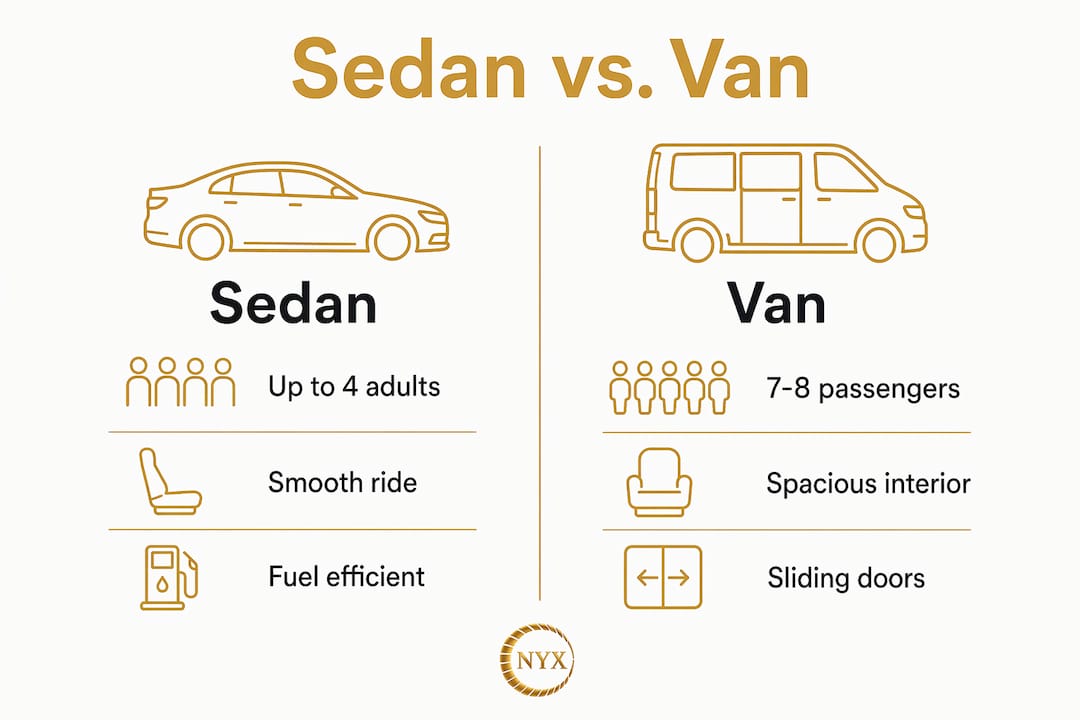
Transponyx addresses this directly through two distinct sedan categories. The Standard Sedan accommodates up to three passengers and suits airport transfers from Nice NCE to Monaco (approximately 25 minutes) or Cannes (approximately 35 minutes). The Business Sedan carries the same passenger count but adds a premium interior finish, making it the preferred choice for executives attending MIPIM, the Monaco Grand Prix, or Cannes Lions. Both vehicles include Wi-Fi, air conditioning, chilled water, and phone chargers as standard.
Urban advantages: parking and noise in Nice and Monaco
Sedans carry a further practical advantage in the Riviera’s densely built urban centres. In Monaco, where underground car parks impose strict height restrictions, and in Nice’s Vieux-Port area during the Cannes Film Festival overflow period, a sedan’s compact footprint reduces parking complexity considerably. The quieter cabin also matters for business travellers conducting calls between Nice NCE and the Palais des Festivals in Cannes. A sedan absorbs road noise more effectively than a van at motorway speeds, producing a noticeably calmer environment for conversation or rest.
Key sedan advantages for Riviera travel:
- Fuel efficiency: hybrid models reach 40 mpg or above, reducing per-kilometre costs on long transfers
- Handling: low centre of gravity supports confident cornering on the Corniche routes
- Urban practicality: compact dimensions ease parking in Monaco and central Nice
- Cabin environment: lower road noise benefits business passengers and tired travellers
- Luggage fit: ideal for two to three passengers with standard cabin or carry-on bags
Why vans provide unrivalled space and accessibility for family or group travel
Passenger vans are defined by a design philosophy that sedans cannot replicate: the prioritisation of interior volume, ease of access, and configurable seating for groups. The 2026 Toyota Sienna illustrates this well, offering seating for seven to eight passengers with a hybrid powertrain achieving over 35 mpg. That combination of capacity and efficiency represents a genuine shift from older van designs, which sacrificed fuel economy for space. Modern passenger vans no longer require that trade-off.
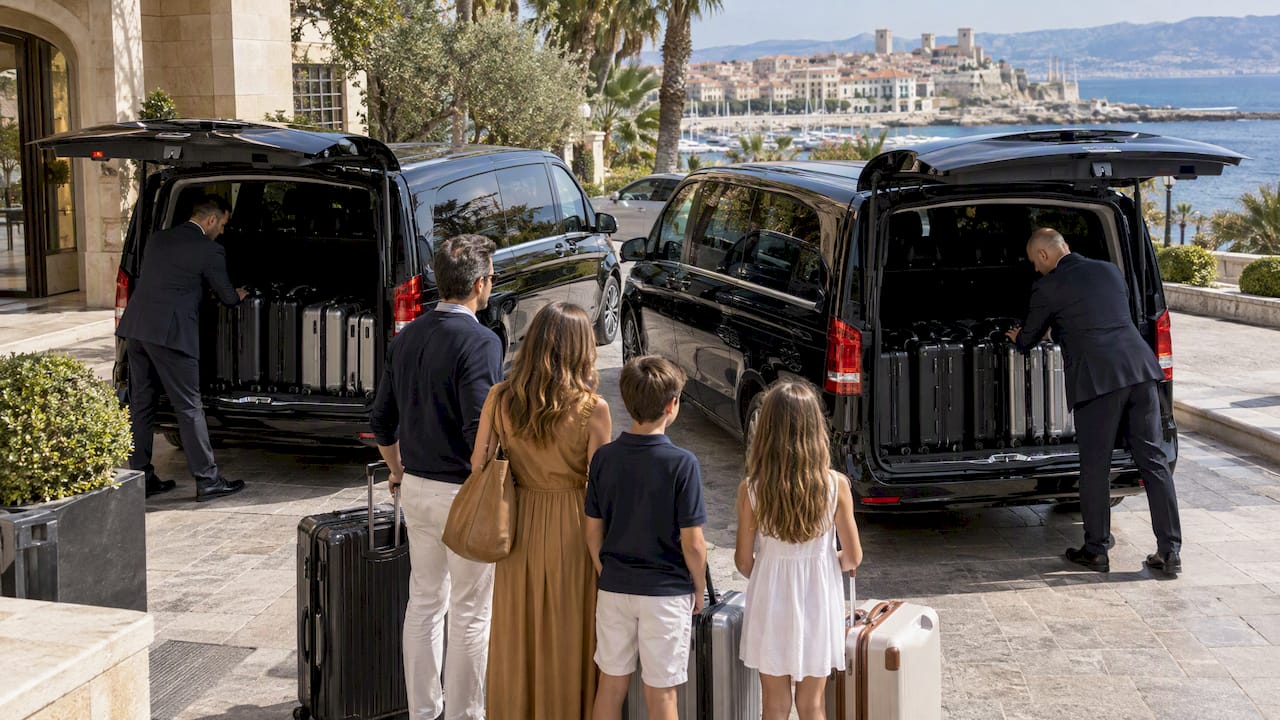
The sliding door is the feature that most directly affects the daily experience of family travel. Sliding doors reduce coordination effort and speed up loading and unloading in crowded parking areas, a behavioural asset that becomes obvious the first time you manage three children, two pushchairs, and four suitcases at Nice NCE’s arrivals hall. Wide, unobstructed entry also benefits passengers with reduced mobility, elderly travellers, and anyone carrying oversized equipment such as ski bags or golf cases.
Transponyx Van 7 pax and Van 8 pax: what they offer in practice
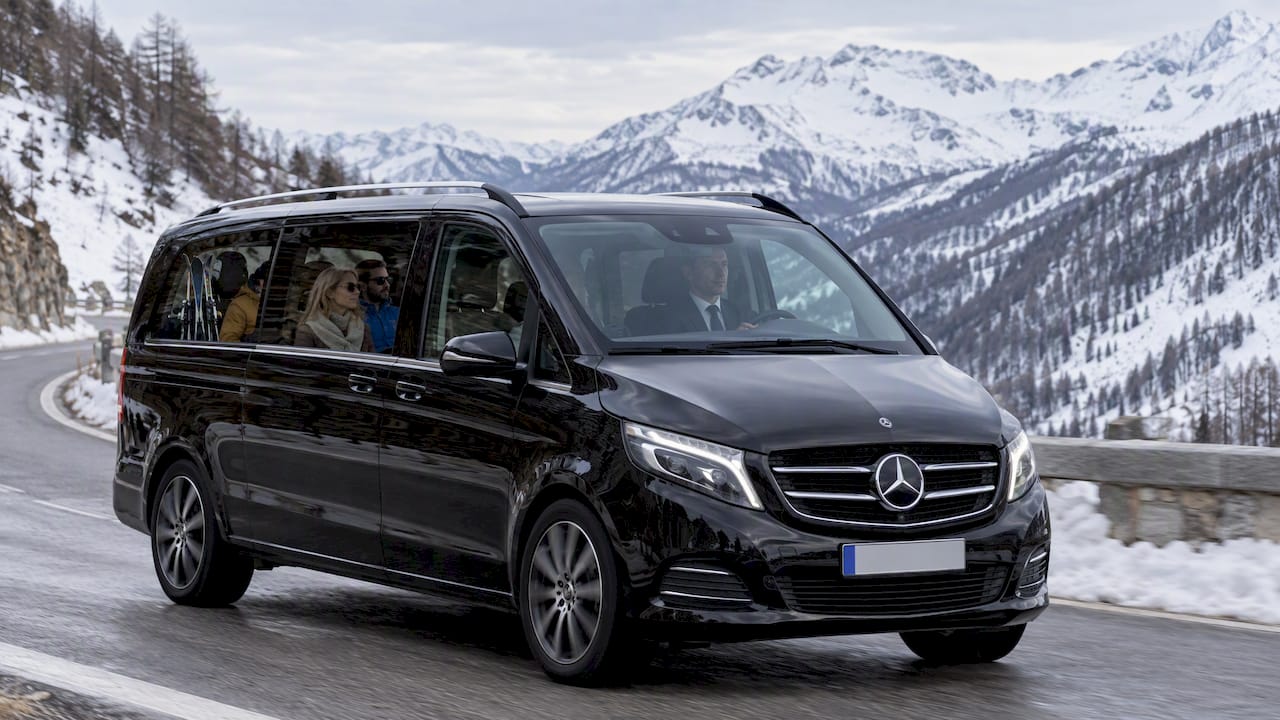
Transponyx operates two van categories within its Mercedes-Benz fleet. The Van 7 pax carries up to seven passengers and suits medium-sized family groups or corporate teams travelling together from Nice NCE to Cannes or Antibes. The Van 8 pax extends capacity to eight passengers, making it the practical choice for larger groups attending events such as MIPCOM or the Monaco Grand Prix, where coordinating multiple vehicles adds both cost and logistical friction.

Both van categories include the same standard equipment as the sedan fleet: Wi-Fi, air conditioning, chilled water, and phone chargers. Child seats are available on request, which matters for families arriving at Nice NCE with young children after overnight flights. The luxury van transfer experience Transponyx provides is built around this combination of capacity and attentive preparation.
Pro Tip: When booking a van transfer for a group arriving on separate flights at Nice NCE, Transponyx includes 60 minutes of free waiting time on all airport pickups and monitors flight arrivals in real time. This removes the pressure of coordinating arrival times across a group.
Key van advantages for Riviera travel:
- Capacity: seven to eight passengers in a single vehicle, eliminating the need for convoy logistics
- Sliding doors: wide, unobstructed access in tight airport drop-off zones and event venues
- Luggage volume: sufficient boot and cabin space for ski bags, pushchairs, and large suitcases
- Hybrid efficiency: modern designs achieve over 35 mpg, reducing the fuel cost gap with sedans
- Accessibility: step-in height and door width accommodate elderly passengers and those with mobility needs
Comparing costs and convenience: sedan vs van for typical Riviera itineraries
Cost comparisons between sedans and vans are frequently oversimplified. The headline figure most travellers focus on is per-mile operating cost. AAA’s 2025 data places small sedans at approximately 55.87 cents per mile, compared to 68.53 cents per mile for compact SUVs, a gap that reflects maintenance and depreciation as much as fuel. Vans sit higher still on this scale. The implication is clear: sedans are the more economical choice per mile when group size permits their use.
The problem with stopping the analysis there is that it ignores what researchers describe as friction costs. Rooftop cargo carriers reduce sedan fuel economy measurably, and Car and Driver testing confirms that roof boxes cause greater mpg losses than rear hitch carriers. Add the cost of a second vehicle when a group exceeds four passengers, and the sedan’s per-mile advantage disappears quickly. The real cost-benefit calculation hinges on packing logistics and the need for additional vehicles, not headline fuel figures alone.
| Factor | Sedan (Standard or Business) | Van (7 pax or 8 pax) |
|---|---|---|
| Per-mile operating cost | Lower (approx. 55.87¢/mile) | Higher |
| Passenger capacity | Up to 3 (comfortable) | Up to 7 or 8 |
| Luggage volume | Carry-on to cabin bags | Large suitcases, ski bags, pushchairs |
| Parking ease in Monaco/Nice | High | Moderate |
| Sliding door access | No | Yes |
| Fuel efficiency | 40 mpg+ (hybrid) | 35 mpg+ (hybrid) |
| Best for | Couples, solo, small business | Families, groups, event delegations |
| Cannes Film Festival logistics | Efficient for 1-3 pax | Preferred for 5+ pax |
| Nice NCE to Monaco transfer | 25 min, compact and quiet | 25 min, full group in one vehicle |
During major Riviera events, the operational convenience of a van justifies its higher base cost. At the Cannes Film Festival, where drop-off zones near the Palais des Festivals are congested and time-sensitive, moving eight delegates in one van rather than three sedans reduces both cost and coordination complexity. Transponyx’s event transport service is structured precisely for this scenario, with fixed per-vehicle rates that make the group economics transparent before departure.
Parking costs in Monaco and central Cannes also favour the van for groups. One parking charge for a single van is consistently less than two or three charges for separate sedans, and the time saved in coordinating multiple vehicles across a busy event day has a real value that rarely appears in standard cost comparisons.
How to decide between a sedan and a van based on trip type
Selecting the right vehicle for a Riviera journey requires a structured approach rather than a default assumption. The following framework covers the four factors that determine the correct choice in practice.
-
Count your passengers honestly. Sedans are genuinely comfortable for two to three adults. If your group reaches four or more, or includes children requiring child seats, a van removes the compromise entirely. A family of five travelling from Nice NCE to a chalet above Valberg will find the Van 7 pax significantly more comfortable than two sedans, and the single-vehicle arrangement simplifies the mountain transfer considerably.
-
Assess your luggage before you book. Cabin bags and a laptop case suit a sedan perfectly. Ski equipment, golf bags, a pushchair, or more than three large suitcases require a van’s boot capacity. Attempting to fit oversized luggage into a sedan creates discomfort for passengers and risks damage to equipment. Transponyx’s booking process allows you to specify luggage requirements so the correct vehicle is confirmed at reservation.
-
Consider the nature of your stops. Airport transfers from Nice NCE to Monaco or Cannes are point-to-point journeys where a sedan’s efficiency shines for small groups. Multi-stop itineraries covering Antibes, Menton, and a winery in Provence in a single day favour a van, where passengers can spread out and luggage remains accessible without repeated repacking.
-
Account for passenger mobility and comfort preferences. Elderly travellers and those with mobility considerations board a van more easily due to the sliding door and step-in height. For a group that includes grandparents alongside young children, the Van 8 pax is not simply a larger vehicle. It is a materially more comfortable one. Transponyx’s airport transfer guidance covers these considerations in detail for families planning arrivals at Nice NCE.
-
Verify luggage fit before confirming. If you are uncertain whether your bags will fit a sedan’s boot, measure them against the vehicle’s stated boot capacity before booking. Transponyx’s team is reachable by phone at +33 6 10 30 71 84 or via WhatsApp at +33 7 67 78 10 26 to advise on the correct vehicle category for your specific luggage and passenger configuration.
A useful rule of thumb: if the answer to any of the first three questions above involves a compromise, choose the van. The marginal cost difference between a sedan and a van transfer on a route such as Nice NCE to Saint-Tropez is small relative to the comfort and logistical gain for a group of five or more.
What years of Riviera transfers have taught me about choosing correctly
The conventional framing of sedan versus van as a cost question misses the point almost entirely. After covering luxury ground transport on the French Riviera for many years, the pattern I observe consistently is this: travellers who choose a sedan for a group of four with full luggage arrive stressed, and travellers who book a van for two people on a short transfer to Monaco feel they have overspent. Neither outcome is necessary.
The sedan’s genuine strength is not fuel economy in isolation. It is the combination of a composed ride, a quiet cabin, and a compact footprint that makes it the right tool for a business executive arriving at Nice NCE at 06:30 for a 07:15 meeting in Monaco. The Business Sedan covers that 25-kilometre route in approximately 25 minutes, in silence, with Wi-Fi available from the moment the door closes. That is a specific, measurable advantage that no per-mile cost figure captures.
The van’s strength is equally specific. I have watched groups of seven attempt to manage a Cannes Film Festival arrival in two sedans and spend 20 minutes coordinating luggage across two boot spaces in a congested drop-off zone. The Van 7 pax resolves that entirely. One vehicle, one driver, one fixed rate, and the group is at the Palais des Festivals in a single movement.
What I find most underappreciated is the role of the driver in both cases. Transponyx’s VTC professionals are bilingual at minimum, monitor flights in real time, and include 60 minutes of free waiting on all airport pickups. The vehicle category matters. The driver matters equally. Choosing the right combination of both, matched to the specific journey, is what separates a genuinely comfortable transfer from a merely adequate one.
— Dany
Travel the Riviera in the right vehicle with Transponyx
Transponyx provides luxury chauffeur services across the French Riviera with a dedicated Mercedes-Benz fleet covering every group size and journey type. The Standard Sedan and Business Sedan suit couples and small business groups on routes from Nice NCE to Monaco, Cannes, and Antibes. The Van 7 pax and Van 8 pax serve families, event delegations, and groups travelling to Alpine ski resorts including Isola 2000, Auron, and Valberg. All 2026 rates are fixed per vehicle, confirmed at booking, with no surge pricing. To discuss the right vehicle for your itinerary, contact Transponyx at +33 6 10 30 71 84, via WhatsApp at +33 7 67 78 10 26, or visit https://transponyx.com.
FAQ
What is the practical passenger limit for a sedan?
Consumer Reports confirms that sedans are genuinely comfortable for up to four adults, despite being marketed as five-passenger vehicles. For Riviera transfers, Transponyx’s Standard Sedan and Business Sedan are rated for up to three passengers to maintain premium comfort standards.
Are vans more expensive than sedans for airport transfers?
Vans carry a higher per-mile operating cost than sedans, but for groups of five or more the single-vehicle rate is typically lower than booking two sedans separately. Transponyx’s fixed 2026 per-vehicle rates make this comparison straightforward at the time of booking.
When does a van make more sense than a sedan on the French Riviera?
A van is the correct choice when your group reaches five or more passengers, when luggage includes ski bags or pushchairs, or when travelling to events such as the Monaco Grand Prix or Cannes Film Festival where coordinating multiple vehicles adds unnecessary complexity.
Do modern passenger vans offer good fuel efficiency?
Yes. The 2026 Toyota Sienna achieves over 35 mpg with its hybrid powertrain, demonstrating that modern passenger vans have closed the fuel efficiency gap with sedans considerably compared to older designs.
Can Transponyx accommodate child seats in both sedans and vans?
Child seats are available on request across the entire Transponyx fleet, including both sedan and van categories. This applies to all routes from Nice NCE and can be specified at the time of booking by contacting +33 6 10 30 71 84 or via WhatsApp at +33 7 67 78 10 26.

0 commentaires