
The fundamental difference between a taxi and a VTC is that a taxi may be hailed spontaneously on the street or at a designated rank, while a VTC (voiture de tourisme avec chauffeur, or private hire vehicle) must be booked in advance through a phone call, app, or platform. This single legal distinction shapes everything: licensing, pricing, vehicle identification, and the quality of experience a traveller can expect. On the French Riviera, where transport choices range from street taxis to premium chauffeur services such as TranspOnyx, understanding these differences is not merely academic. It directly affects how reliably, comfortably, and cost-effectively you reach Nice Côte d’Azur Airport, Monaco, Cannes, or Antibes.
What is the difference between a taxi and a VTC?
A taxi is a licensed vehicle authorised to pick up passengers on demand, either by street hailing or from a designated rank, within a geographically defined zone. A VTC, by contrast, is a professionally operated private hire vehicle that requires advance booking before any passenger can be collected. This is not a commercial preference but a legal obligation enforced under French transport law.
The practical consequence is significant. If you step out of the Hôtel de Paris in Monaco at midnight and wave at a passing car bearing VTC markings, that driver is legally prohibited from stopping for you. Doing so constitutes what French law calls maraude, or illegal street solicitation, and carries serious penalties. Taxis, on the other hand, are specifically licensed to respond to that exact scenario.

Both services employ professional, licensed drivers. Both operate regulated vehicles. The difference lies in the mechanism of engagement and the regulatory framework that governs each, not in the quality of the vehicle or the professionalism of the driver.
How are taxis and VTCs regulated differently?
The regulatory distinction between taxis and VTCs in France is precise and consequential. Taxi licences are geographically restricted to a specific commune or urban area, meaning a taxi licensed in Nice cannot legally operate as a street-hailing service in Cannes. VTC professional cards, by contrast, are valid nationally, allowing operators to serve any destination in France without territorial restriction.
This creates an asymmetry that travellers rarely consider. A taxi driver in Nice holds a local monopoly on spontaneous street pickups within the city. A VTC operator like TranspOnyx can legally serve Nice NCE airport, Monaco, Menton, Saint-Tropez, and long-distance routes to Milan or Provence, all from a single national licence, provided every journey begins with a confirmed reservation.
The rules governing VTC operations are strict on one particular point: VTCs cannot pick up passengers without a prior, time-stamped reservation. Violations risk imprisonment and substantial fines. French jurisprudence in 2025 further clarified that displaying VTC availability on an app before a booking is confirmed constitutes illegal electronic maraude. This means a VTC driver must not appear as “available” on any platform until a client has formally booked.
Key regulatory differences at a glance:
- Taxi: Licensed per commune, right of maraude (street hailing), fares regulated by taximeter, can access medical transport frameworks
- VTC: National licence, reservation-only, fares set freely by operator, no street hailing under any circumstances
- Enforcement: Unauthorised VTC street pickups risk fines and vehicle immobilisation; in Valencia’s 2026 regulatory update, fines reached €6,000 for invalid operations, reflecting a Europe-wide tightening of standards
Pro Tip: When booking a VTC in France, always request a written confirmation of your reservation. This document, known as a bon de réservation, is the legal proof that the journey is compliant. Without it, both driver and passenger operate in a grey area.
The broader implication of this framework is that VTC services, precisely because they are reservation-only, can be planned and priced with far greater transparency than a taxi hailed at the kerbside.
How do pricing and booking differ between taxis and VTCs?
Taxi fares in France are regulated and calculated via taximeter based on distance travelled and time elapsed. The final figure appears at journey’s end, meaning the passenger commits to a trip without knowing the exact cost in advance. Rates vary by time of day, day of the week, and whether the journey crosses into a different tariff zone.
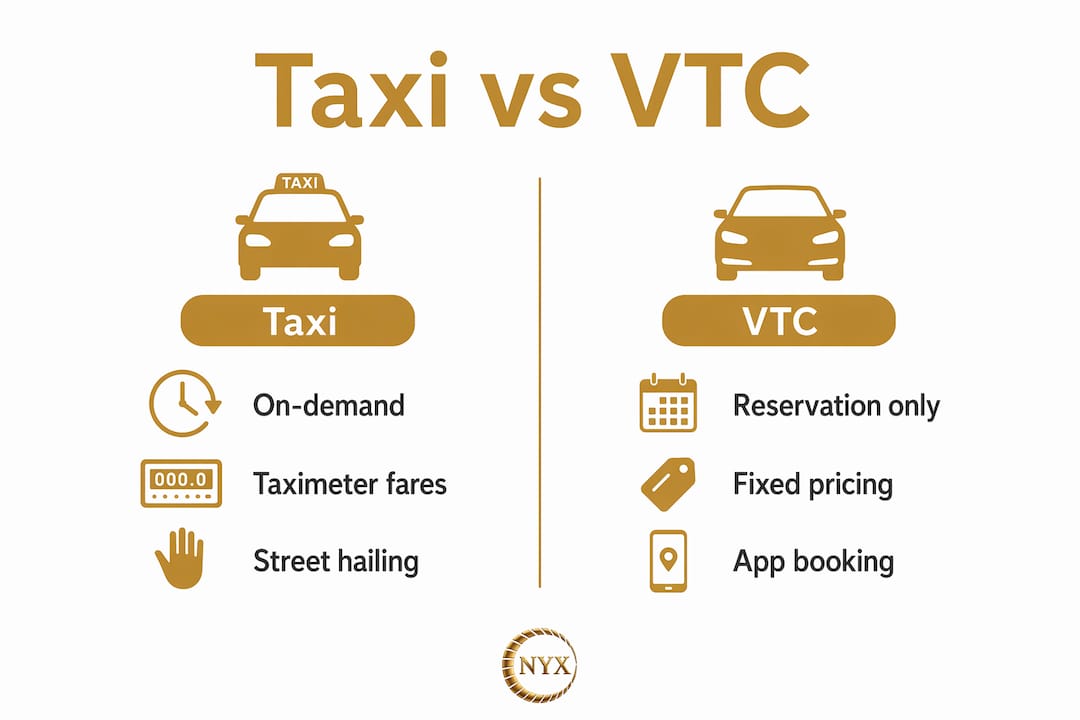
VTC pricing operates on an entirely different model. Operators set their own fares freely, and many, including TranspOnyx, offer fixed rates confirmed at the point of booking. This means a traveller arranging an airport transfer from Nice NCE to Monaco knows the exact price before the driver arrives. There is no meter running, no surge pricing, and no ambiguity at the end of the journey.
The table below summarises the core differences in pricing and booking between the two services:
| Feature | Taxi | VTC |
|---|---|---|
| Fare calculation | Taximeter (distance + time) | Fixed or operator-set, confirmed at booking |
| Price known in advance | No | Yes (with most operators) |
| Booking method | Street hail, rank, or phone | App, phone, or platform only |
| Surge pricing | Possible (tariff zones) | Depends on operator; TranspOnyx applies none |
| Platform commission | Not applicable | 18 to 25% on platforms such as Uber, Bolt, Heetch |
| Cancellation flexibility | Variable | Depends on operator terms |
The platform commission point deserves attention. Platforms like Uber, Bolt, and Heetch take between 18 and 25% of each VTC fare. This affects independent driver earnings and can push fares upward on app-based services. Independent VTC operators who manage their own bookings directly, as TranspOnyx does, avoid this cost structure entirely, which often translates to better value for the client on longer or premium journeys.
For travellers heading to the Cannes Film Festival, MIPIM, or the Monaco Grand Prix, the ability to lock in a fixed rate weeks in advance is not a minor convenience. It is a material financial protection against demand-driven price increases that affect metered and platform-based services alike.
How do vehicle and driver identification standards differ?
Recognising a legitimate taxi versus a legitimate VTC is straightforward once you know what to look for. The visual markers are legally mandated and distinct.
-
Taxis carry a luminous roof sign, illuminated when the vehicle is available. The sign displays the word “Taxi” and is the clearest indicator that a vehicle can legally accept street hails. Local authority permits are displayed inside the vehicle.
-
VTC vehicles must display a red sticker on both front and rear windscreens for identification. This marking is a legal requirement in France and serves as the primary visual confirmation that a vehicle operates under the VTC framework rather than the taxi framework.
-
Driver credentials differ accordingly. Taxi drivers hold a local professional licence tied to their commune. VTC drivers hold a national professional card issued after completing a certified training programme and passing a regulated examination.
-
Booking channel verification is the final layer of protection. A legitimate VTC driver will always be able to produce a time-stamped reservation document confirming the journey. If a driver cannot produce this, the pickup is not legally compliant.
On the French Riviera, particularly during high-traffic events such as the Cannes Film Festival or Cannes Lions, transport hubs at Nice NCE and Cannes Palais des Festivals attract unauthorised operators. Verifying the red windscreen stickers is a practical safeguard that takes seconds and protects you from both legal ambiguity and potential safety risks.
Pro Tip: At Nice NCE airport, always meet your pre-booked VTC driver at the designated meeting point inside the arrivals hall, not at the kerbside. Drivers waiting at the kerb without a confirmed booking are operating outside the legal framework, regardless of what markings their vehicle carries.
TranspOnyx drivers, for example, carry their national VTC professional cards and meet clients inside the terminal with a name board, providing immediate, verifiable confirmation of a compliant, pre-booked service.
When should you choose a taxi, and when is a VTC the better option?
The choice between a taxi and a VTC is not about which service is superior in absolute terms. It is about matching the service to the situation.
Taxis are the correct choice when:
- You need transport immediately and have not planned ahead
- You are making a short, spontaneous trip within a city centre
- You are in a location where VTC booking infrastructure is limited
- You require access to regulated medical transport frameworks, which taxis can access and VTCs cannot
VTCs are the better option when:
- You are travelling to or from an airport, particularly Nice NCE, where flight delays require a driver who monitors your arrival in real time
- You are travelling as a group and need a vehicle configured for 7 or 8 passengers
- You want a fixed, confirmed price with no risk of fare variation
- You are attending a major event such as the Monaco Grand Prix, MIPCOM, or the Cannes Film Festival, where demand spikes make metered fares unpredictable
- You require a premium vehicle, multilingual driver, and amenities such as Wi-Fi, chilled water, and phone chargers throughout the journey
The French Riviera presents a specific case where the VTC model delivers clear advantages for most leisure and business travellers. The distances involved, Nice NCE to Monaco is approximately 25 kilometres and takes around 30 minutes under normal conditions, Nice NCE to Cannes is roughly 30 kilometres and takes 35 to 45 minutes, are well suited to pre-booked, fixed-rate transfers. The events calendar, which runs from MIPIM in March through to MIPCOM in October, means demand for transport is consistently high and metered fares can be volatile.
For corporate travellers, the luxury chauffeur benefits of a service like TranspOnyx extend beyond comfort. Fixed invoicing, professional drivers fluent in English, French, Italian, Spanish, Russian, or Arabic, and 60 minutes of complimentary waiting time on all airport pickups represent a level of operational reliability that metered taxis structurally cannot match.
Why the taxi versus VTC distinction matters more than most travellers realise
Having covered ground transport on the French Riviera for a considerable number of years, I have watched travellers make the same costly assumptions repeatedly. The most common is treating any private car with a professional driver as interchangeable with a taxi. It is not, and the legal consequences of that confusion fall on the driver, not the passenger.
What strikes me about the 2026 regulatory environment is how much tighter enforcement has become. The clarification around electronic maraude, specifically the rule that a VTC driver must not appear available on any platform before a booking is confirmed, has forced operators to be more rigorous about their booking processes. This is, in practice, a benefit to the traveller. It means that any VTC that operates correctly has a documented, time-stamped record of your journey before the driver moves a metre.
The cost transparency argument also deserves more weight than it typically receives. Travellers arriving at Nice NCE after a long-haul flight, disoriented and carrying luggage, are not well positioned to negotiate or verify a taximeter reading. A fixed rate confirmed 48 hours earlier removes that vulnerability entirely. I have seen the difference this makes during the Monaco Grand Prix, when taxi queues stretch beyond the terminal and metered fares reflect every minute of congestion. Clients who booked a private transfer to Monaco in advance arrived at their hotels on schedule, at the price they expected.
The VTC model, when operated by a licensed, professional company, is not simply a premium alternative to a taxi. It is a structurally different service built around planning, accountability, and fixed commitments. For most journeys on the Côte d’Azur, that structure is precisely what a discerning traveller needs.
— Dany
Travel the French Riviera with TranspOnyx
TranspOnyx is a licensed VTC and luxury chauffeur service based in Nice, operating 24 hours a day, 7 days a week across the French Riviera and beyond. The fleet comprises Mercedes-Benz vehicles in four categories: Standard Sedan, Business Sedan, Van 7 pax, and Van 8 pax, all equipped with Wi-Fi, air conditioning, chilled water, and phone chargers. All 2026 rates are fixed per vehicle, confirmed at booking, with no surge pricing. Airport transfers from Nice NCE to Monaco, Cannes, Antibes, and Menton include 60 minutes of complimentary waiting time and full flight monitoring. To book or request a quote, call +33 6 10 30 71 84, message via WhatsApp on +33 7 67 78 10 26, or visit transponyx.com. Discover the full range of VTC services in Nice and why TranspOnyx consistently outperforms standard airport taxi options for travellers who value reliability and comfort.
FAQ
What is a VTC and how does it differ from a taxi?
A VTC (voiture de tourisme avec chauffeur) is a professionally licensed private hire vehicle that must be booked in advance and cannot be hailed on the street. A taxi holds a local licence that permits spontaneous street pickups within a defined geographical zone.
Can a VTC pick me up without a prior booking?
No. Under French law, VTCs cannot collect passengers without a confirmed, time-stamped reservation. Doing so constitutes illegal maraude and exposes the driver to fines and potential imprisonment.
How do I recognise a VTC versus a taxi in France?
Taxis display an illuminated roof sign when available. VTC vehicles carry red stickers on both windscreens as a legal identification requirement. If in doubt, ask the driver to produce their reservation document.
Is a VTC more expensive than a taxi?
Not necessarily. VTC fares are set freely by operators and are often fixed at booking, which eliminates fare uncertainty. Metered taxi fares can exceed VTC rates during peak periods or in heavy traffic, particularly during events such as the Cannes Film Festival or the Monaco Grand Prix.
Are VTC fares fixed in advance?
Most professional VTC operators, including TranspOnyx, confirm a fixed rate per vehicle at the point of booking. This differs from taxi fares, which are calculated via taximeter based on distance and time and are only known at journey’s end.



0 commentaires
Rétroliens/Pingbacks