par Daniel AIT GOUGAM | Août 11, 2026 | news
Twenty-four-hour availability is not a premium add-on for luxury clients. It is the minimum condition under which high-net-worth clients choose to trust a provider with their time. For premium ground transport operators, the role of 24-hour availability for luxury clients is straightforward: it converts a single booking into a long-term relationship, supports higher fixed pricing, and captures the spontaneous, high-value demand that competitors without genuine overnight capacity simply cannot reach.
Three claims underpin everything that follows:
- Retention and pricing: Clients who can reach you at 2 AM on the night before the Monaco Grand Prix do not shop around. Consistent accessibility supports premium rate integrity and reduces churn.
- On-demand expectations: The booking window for ultra-high-net-worth (UHNW) travellers has collapsed. Operators who confirm within hours, not days, win the business.
- Hybrid delivery: Full in-house night rosters are rarely necessary. A well-designed hybrid of AI triage, on-call bilingual specialists, and real-time flight monitoring delivers genuine 24/7 resolution at a fraction of the cost.
The sections that follow cover what luxury clients actually expect, how to staff and govern 24/7 operations, which channels and tools to use, how to price the capability, and how to measure whether it is working.
Why round-the-clock availability matters for luxury clients and the bottom line
The commercial case for 24/7 luxury client availability rests on three converging pressures: global time zones, compressed booking windows, and the psychology of exclusivity.
A client flying into Nice Côte d’Azur Airport from New York or Singapore is not operating on Central European Time. When they decide, at midnight their time, that they need a Business Sedan for a 6 AM arrival at NCE, they need confirmation immediately. A provider who responds at 9 AM the following morning has already lost the booking to whoever answered first. Hype Luxury’s analysis of UHNW booking behaviour describes this as the “96-hour window”: the operative reality in which spontaneous, high-value bookings are confirmed within hours, not days. Operators who cannot match that pace are structurally excluded from a significant share of the most lucrative demand.
BCG research finds that 62% of luxury participants worry that AI may erode the human touch in premium service — a figure that underlines why availability must be engineered around human augmentation, not human replacement.
The retention argument is equally concrete. A client who calls at an unusual hour and receives a prompt, personal response from a bilingual professional is not simply satisfied; they are reassured that the relationship is real. That reassurance is what supports retainer models, corporate account renewals, and the word-of-mouth referrals that drive UHNW acquisition. Availability, in this sense, is not a cost centre. Zendesk’s benchmark commentary makes the point directly: 24/7 support, when bundled with premium tiers and retainer products, can be repositioned as a profit generator rather than an overhead.
The pricing dimension is often underestimated. Fixed-rate operators who guarantee overnight response can defend their rates against surge-pricing competitors precisely because the guarantee has value. A client who knows their transfer from Nice NCE to Monaco is confirmed at a fixed price, regardless of the hour they book, is paying for certainty as much as comfort.
What luxury clients actually expect from a 24-hour service
“Always available” means different things at different client tiers. The expectations below reflect what genuinely high-end clients consider acceptable, not what a standard customer service team would find reasonable.
Response and resolution targets by client tier
| Client tier |
First response target |
Resolution target |
Preferred channel |
| VVIP / UHNW |
Under 5 minutes |
Under 15 minutes |
Dedicated WhatsApp line or direct phone |
| VIP corporate account |
Under 15 minutes |
Under 30 minutes |
WhatsApp, phone, or concierge app |
| Premium leisure |
Under 30 minutes |
Under 60 minutes |
WhatsApp or booking platform |
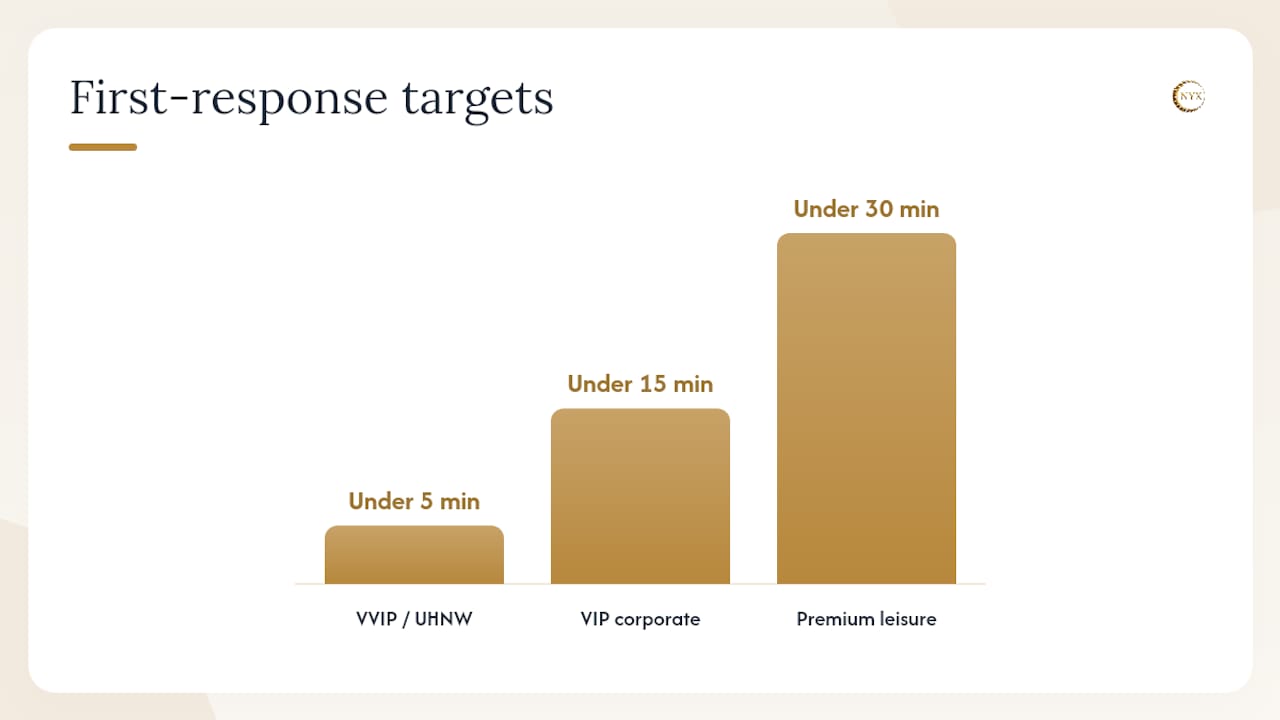
These are not aspirational figures. They reflect the service levels that prevent attrition at the top of the market. A UHNW client who waits 45 minutes for a response to an airport transfer request at 3 AM will not complain; they will simply not rebook.
Beyond speed, luxury clients expect:
- Multilingual capability. A client communicating in Russian, Arabic, or Italian expects a response in the same language, not a translated template.
- Proactive monitoring. Flight delays should trigger automatic updates before the client asks. A driver who is already adjusted to a revised arrival time, without the client having to chase, is the standard.
- Discretion. Channel choice matters. A VVIP client does not want their transfer details passing through a generic ticketing queue. Dedicated lines, encrypted messaging, and named account managers are not optional extras.
- Memory. Clienteling platforms such as BSPK demonstrate how CRM-backed advisors can reference a client’s vehicle preference, preferred pickup point, and dietary requirements without asking again.
For airport transfer requests, the expectation is confirmation within minutes and a driver update within 30 minutes of any flight change. For itinerary changes, the expectation is a single point of contact who can resolve the matter without the client being passed between departments.
How premium operators deliver 24/7 without burning out teams
Three delivery models are in practical use among premium ground transport operators. Each has a different cost profile and a different failure mode.
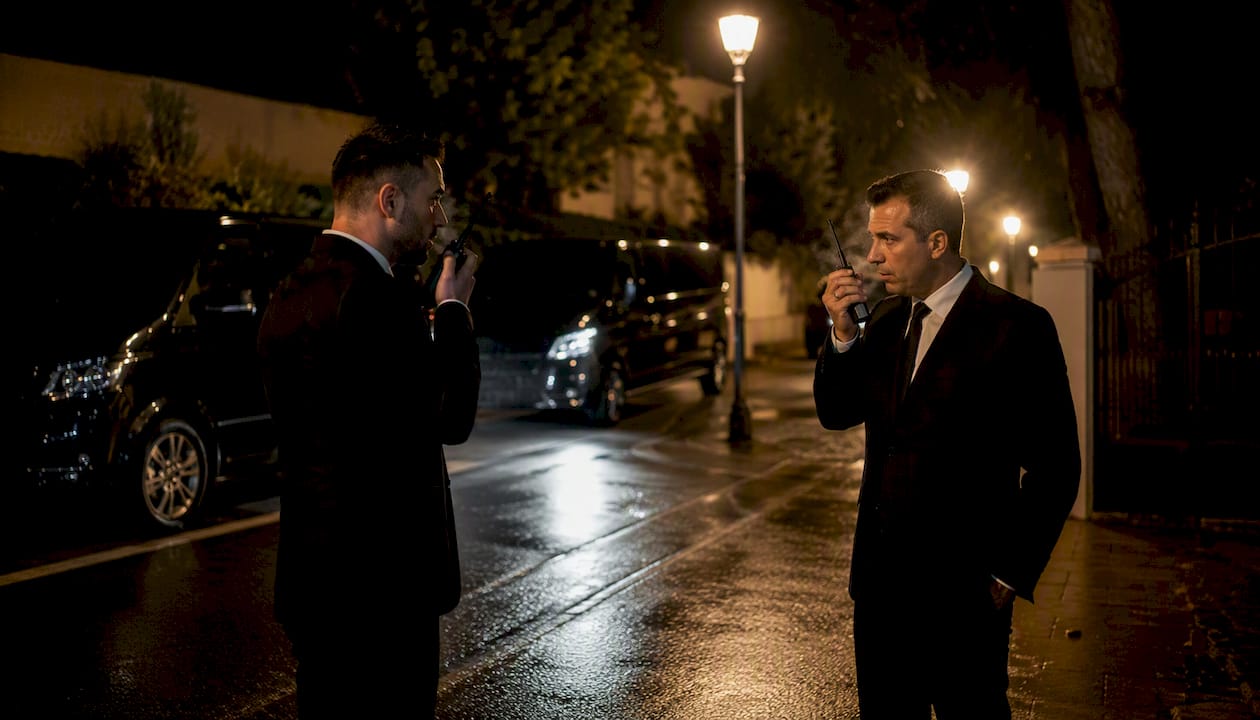
In-house 24/7
A dedicated overnight team, fully employed and trained to the same standard as the day operation. The advantage is consistency: every interaction is handled by someone who knows the brand, the clients, and the fleet. The disadvantage is cost. Decagon’s analysis of 24/7 support models notes that in-house overnight seats are expensive and prone to burnout, particularly when overnight volume is low but the requirement for immediate, high-quality response is constant. For a Riviera operator running 20 vehicles, a full in-house night team is rarely justified outside peak event periods.
Hybrid: AI triage with on-call specialists
The most practical model for mid-sized luxury operators. An AI layer handles Tier 0 requests: booking confirmations, status updates, flight monitoring alerts, and standard itinerary queries. When a request requires judgement, language nuance, or client-specific discretion, it escalates immediately to a bilingual on-call specialist. Zendesk’s hybrid model guidance confirms that this structure delivers genuine 24/7 resolution without requiring full night rosters. The critical design requirement is that the escalation is invisible: the client should never feel they have been transferred.
BPO overflow
A business process outsourcing partner handles overnight volume when in-house and AI capacity is exceeded. Useful during major Riviera events, when demand spikes sharply. The risk is brand consistency: a BPO agent who does not know that a particular client always requests a Van 7 pax for the Cannes Film Festival, or that a corporate account has a standing instruction for NCE arrivals, will deliver a generic response that damages the relationship. BPO overflow works only when the CRM handoff is complete and the briefing is thorough.
Shift pattern principles for a Riviera fleet
During the Cannes Film Festival (May), Monaco Grand Prix (May), Cannes Lions (June), and MIPCOM (October), overnight demand is genuine and sustained. A practical shift pattern for these periods runs a senior bilingual specialist from 10 PM to 6 AM, supported by AI triage for routine queries, with a BPO escalation path for language combinations outside the in-house team’s capability. Outside event periods, a single on-call specialist with AI support is sufficient for most operators.
Pro Tip: Design your escalation triggers before you go live. Define exactly which request types move from AI to human: any request involving a named VIP, any itinerary change within four hours of departure, any complaint, and any request in a language the AI cannot handle with full fluency. Write these as rules, not guidelines.
The channel stack for a luxury 24/7 operation is not complicated, but the integration between channels is where most operators fail.
- WhatsApp for immediate, personal communication. A dedicated WhatsApp line, separate from the general enquiry number, signals to the client that they have direct access. Transponyx operates a dedicated WhatsApp line at +33 7 67 78 10 26 for exactly this purpose. The key discipline is response time: a WhatsApp message that goes unanswered for 20 minutes at 11 PM is a broken promise.
- Phone for urgent resolutions. Some situations require a voice. A client whose driver has not appeared at Nice NCE after a long-haul flight does not want to type. A direct phone line to a bilingual specialist, answered within three rings, resolves the situation and preserves the relationship.
- Concierge app or booking platform for pre-planned itineraries and corporate accounts. These channels handle the administrative layer: booking confirmations, receipts, itinerary management. They free the WhatsApp and phone lines for genuine urgency.
- CRM with omnichannel clienteling for memory and personalisation. Every interaction, regardless of channel, should update a single client record. When a client calls at 2 AM, the specialist answering should be able to see the client’s vehicle preference, their last five journeys, and any standing instructions, without asking.
BCG’s research on AI in luxury argues that AI expands the means of engagement and is essential to scale white-glove service, but only when it augments human advisors rather than replacing them.
Zendesk is a practical choice for ticketing and escalation management in a hybrid model, providing audit trails and shift handoff notes that keep overnight context visible to the morning team. For encrypted messaging and client data protection, platforms with end-to-end encryption are preferable to standard SMS or unencrypted email for VVIP communications.
The Luxury Roundtable’s design guidance sets out the governing principle clearly: AI when the client wants efficiency, human when they need reassurance, with permissions and audit trails as the controls that keep the system trustworthy.
How to price and package 24/7 availability for luxury clients
The pricing question is not whether to charge for 24/7 availability, but how to frame the value so that clients perceive it as a natural feature of the tier they have chosen.
Three structures work in practice. For corporate accounts and hotel partnerships, 24/7 availability is most effectively bundled as a standard feature of the account agreement. The client pays a fixed annual or monthly retainer that includes guaranteed response times, a named account manager, and priority fleet access during peak events. The retainer model converts overnight cost into predictable revenue and removes the per-booking friction that erodes relationships.
For premium leisure clients, a per-booking premium is cleaner. A fixed surcharge for confirmed overnight bookings, stated transparently at the time of reservation, is accepted readily when the value proposition is clear: a fixed 2026 rate, no surge pricing, and a bilingual driver who is already tracking the flight. The surcharge does not need to be large; it needs to be honest.
For event-specific demand, event surcharges are standard practice. During the Cannes Film Festival, Monaco Grand Prix, or Cannes Lions, operators who can guarantee availability command a premium that reflects genuine scarcity. A Van 7 pax confirmed for a film festival transfer at 1 AM is worth considerably more than the same vehicle at 10 AM on a quiet Tuesday.
Pro Tip: When communicating 24/7 availability to corporate accounts, frame it as a guarantee, not a feature. “Your account includes confirmed response within 15 minutes, at any hour, with a named specialist who knows your preferences” is a stronger proposition than “we are available 24/7.”
The marginal cost of overnight coverage, once a hybrid model is in place, is lower than most operators assume. The AI layer handles the majority of overnight volume at negligible cost; the on-call specialist is a fixed cost regardless of volume. Pricing should reflect the value of the guarantee, not the cost of delivery.
The governance, privacy and discretion rules luxury clients expect
Luxury clients do not read privacy policies. They do, however, notice when their data is handled carelessly, when a driver knows something they did not share directly, or when a message appears on a channel they did not authorise. Governance in a 24/7 luxury operation is not a compliance exercise; it is a trust architecture.
The non-negotiable elements under UK GDPR and the Data Protection Act 2018 are:
- Lawful basis for processing. For a 24/7 service that acts on a client’s behalf, legitimate interest or explicit consent must be documented before any automated action is taken. A client who asks a chauffeur service to monitor their flight and adjust the pickup time has implicitly consented to that processing; the consent should be captured explicitly at onboarding.
- Storage limitation. Client preferences, itinerary data, and communication records should be retained only as long as necessary. A retention schedule, reviewed annually, prevents data accumulating beyond its useful life.
- Encrypted messaging. Any channel carrying client identity, travel itinerary, or financial data should use end-to-end encryption. Standard SMS and unencrypted email do not meet this standard for VVIP communications.
- Audit trail for every intervention. When a specialist acts on a client’s behalf, such as amending a booking, confirming a vehicle upgrade, or communicating with a hotel, the action must be logged with a timestamp, the specialist’s identity, and the authorisation basis.
- Permissions for acting on behalf of clients. A standing instruction from a corporate account to confirm bookings without prior approval for each journey must be documented, signed, and stored. Acting without documented authority, even helpfully, creates liability.
“Service is the moat in luxury. AI must be governed by permissions, approvals and audit trails so humans can deliver the memorable moments.” Luxury Roundtable, January 2026
The practical implication for operators is a short permissions document, signed at account opening, that specifies which actions the service may take autonomously and which require client confirmation. This document protects both parties and removes the ambiguity that causes overnight errors.
How to remain exclusive while offering continuous availability
The paradox of 24/7 luxury service is that constant availability can feel like abundance, and abundance erodes rarity. The solution is not to restrict availability but to restrict access to it.
Invite-only channels are the most effective design pattern. A dedicated WhatsApp line or a direct phone number shared only with confirmed clients signals that access is earned, not open. The client who has that number knows they are not in a queue. Hype Luxury’s research on UHNW operators notes that operators on the French Riviera who overcome the exclusivity-availability paradox do so through curated, invitation-only channels and genuine fleet inventory, not through artificial scarcity.
Capacity rules matter during peak events. A fleet of 20 vehicles cannot serve 40 simultaneous requests during the Monaco Grand Prix without compromising quality. The answer is not to accept all 40 bookings; it is to allocate capacity to the highest-value accounts first, with a clear policy communicated in advance. Clients who know their account tier includes priority allocation during events do not feel excluded; they feel protected.
BCG’s luxury AI research confirms that 62% of luxury clients worry about losing the human touch. Exclusivity, in this context, is not about limiting hours; it is about limiting who has direct access to the human layer.
Staged capacity release, in which a proportion of event-period inventory is held back for confirmed account holders and released to new enquiries only when confirmed accounts are satisfied, is a practical governance tool. It prevents the situation where a long-standing corporate client finds their preferred vehicle unavailable because it was confirmed to a one-time booking.
KPIs and SLAs to prove 24/7 is working and when to pause or scale it
Measurement is where most luxury operators are weakest. The instinct is to treat 24/7 availability as a qualitative commitment rather than a measurable service standard. That instinct is expensive.
| KPI |
Suggested threshold |
Review cadence |
| First response time (overnight) |
Under 10 minutes for VVIP; under 20 minutes for VIP |
Weekly |
| Resolution time |
Under 30 minutes for urgent requests |
Weekly |
| Net Promoter Score (NPS) |
Minimum 70 for account clients |
Quarterly |
| Client retention rate |
Above 60% for luxury participants |
Quarterly |
| Revenue per client (account tier) |
Year-on-year growth target set at account opening |
Annually |
Microsoft Dynamics’ global customer service research documents response time disparities between day and night operations as a common attrition driver. The implication for luxury operators is that overnight SLAs must be measured separately from daytime performance; a strong daytime average can mask a failing overnight service.
Decision thresholds are as important as the metrics themselves. If overnight first response time consistently exceeds 15 minutes, the hybrid model needs recalibration: either the AI triage is not escalating quickly enough, or the on-call specialist is covering too wide a time window. If NPS for overnight interactions falls below 65, the issue is usually channel or language, not availability per se.
The analytics requirement is modest: a weekly report separating overnight volume by request type (urgent versus non-urgent), response time by tier, and resolution rate. Most CRM and ticketing platforms, including Zendesk, generate this automatically. The discipline is reviewing it.
- Separate urgent from non-urgent overnight volume before drawing conclusions about staffing needs.
- Track NPS specifically for overnight interactions, not just overall account NPS.
- Review retention data by account tier quarterly; a corporate account that reduces booking frequency is an early warning signal.
What automation should do and what must remain human in a luxury 24/7 service
The automation matrix for a luxury 24/7 operation has three tiers, and the boundaries between them are not negotiable.
Tier 0: fully automated. Booking confirmations, payment receipts, flight status updates, standard itinerary reminders, and FAQ responses. These tasks have no relationship value and high volume. Automating them frees human capacity for the interactions that matter.
Tier 1: AI-assisted with human oversight. Itinerary queries that require checking real-time fleet availability, standard change requests within pre-approved parameters, and multilingual template responses reviewed by a specialist before sending. The AI drafts; the human approves.
Tier 2: bilingual human specialists only. Any request involving a named VIP, any complaint, any request that deviates from standing instructions, any communication requiring cultural nuance, and any situation where the client’s tone suggests dissatisfaction. These interactions cannot be templated.
The “bot vibe” failure mode is well documented. It occurs when an AI response uses generic phrasing, fails to reference the client’s history, or takes longer than a human would to respond. Governance mitigates this: every AI response in Tier 1 should be reviewed against the client’s CRM record before sending, and any response that does not reference at least one client-specific detail should be escalated to Tier 2.
BCG’s research is direct on this point: AI expands the means of engagement and is essential to scale white-glove service, but the strategy must be AI-assisted rather than AI-only.
Pro Tip: Audit your AI responses monthly. Pull a random sample of 20 overnight AI-handled interactions and ask a senior specialist to rate them against the brand standard. If more than two feel generic or impersonal, the escalation triggers need tightening.
How Transponyx operates 24/7 for high-net-worth travellers
Transponyx is a working example of the operational model described in this guide. The service operates 24 hours a day, seven days a week, from Nice on the French Riviera, with a fleet of Mercedes-Benz vehicles across four categories: Standard Sedan, Business Sedan, Van 7 pax, and Van 8 pax. All 2026 rates are fixed per vehicle and confirmed at booking, with no surge pricing regardless of the hour.
Flight monitoring is included on every airport transfer. When a flight into Nice Côte d’Azur Airport is delayed, the driver’s schedule adjusts automatically; the client does not need to call. Free waiting time of 60 minutes is included on all airport pickups, 20 minutes for any other address. These are not policies that require a client to negotiate; they are standard.
Journey times on primary routes give a sense of the operational reality. Nice NCE to Monaco runs approximately 30 minutes in normal traffic; Nice NCE to Cannes is approximately 35 minutes. During the Cannes Film Festival or Monaco Grand Prix, when road conditions are unpredictable, a bilingual driver who knows the Riviera’s secondary routes is not a luxury; it is the service standard. Transponyx drivers are licensed VTC professionals, bilingual in English and French as a minimum, with several also fluent in Italian, Spanish, Russian, or Arabic.
“The 96-hour window is the operative reality for UHNW mobility. Operators who maintain genuine fleet inventory and can confirm within hours, not days, win the spontaneous, high-value business.” Hype Luxury Blog
For superyacht transfers and last-minute berthing schedules, the 24/7 model is not a convenience; it is a prerequisite. A yacht arriving at Antibes at 11 PM needs a confirmed Van 7 pax for a group of six within the hour. Transponyx handles these requests through its dedicated WhatsApp line at +33 7 67 78 10 26 and reservations phone at +33 6 10 30 71 84. Full service details and booking are available at Transponyx.
A 90-day pilot plan for UK luxury operators launching 24/7 service
A structured pilot reduces the risk of launching 24/7 availability before the governance and staffing model is ready.
Days 1 to 30: analytics and preparation. Review six months of overnight enquiry data to separate urgent from non-urgent volume. Identify the client tier that generates the most overnight requests. Draft consent scripts and a permissions document for the pilot cohort. Confirm encryption on all client-facing channels.
Days 31 to 60: channel pilot. Launch WhatsApp and phone coverage for a pilot cohort of 10 to 20 VIP or corporate account clients. Use AI triage for Tier 0 requests and a single on-call bilingual specialist for escalations. Log every interaction in the CRM with response time and resolution outcome.
Days 61 to 90: measurement and go/no-go. Review first response time, resolution rate, and NPS for the pilot cohort against the thresholds in the KPI table above. If overnight first response is consistently under 15 minutes and NPS is above 70, the model is ready to scale. If either metric is failing, identify the root cause before expanding.
Immediate GDPR actions before launch:
- Consent scripts capturing lawful basis for overnight processing, reviewed by a data protection adviser.
- Retention schedule for client communication records, with a maximum period appropriate to the service relationship.
- Encryption confirmed on WhatsApp, CRM, and any other channel carrying client identity or itinerary data.
- Audit trail configured in the ticketing system to log every overnight intervention with timestamp and authorisation basis.
Pro Tip: Choose your pilot cohort from clients who already communicate with you outside business hours. Their existing behaviour tells you where the demand is real, and their familiarity with your service means they will give you honest feedback rather than simply churning silently if the pilot underperforms.
Zendesk’s research confirms that Many customers consider 24/7 support a crucial part of good customer service. For luxury operators, the figure is almost certainly higher among UHNW clients, for whom time is the scarcest resource.
UK legal and compliance considerations beyond GDPR
GDPR is the floor, not the ceiling, for a UK luxury service operating around the clock. Several additional frameworks apply and are frequently overlooked.
Consumer Rights Act 2015. Services must be performed with reasonable care and skill, within a reasonable time, and at a reasonable price where no price was agreed in advance. For a 24/7 luxury operator, this means that a confirmed overnight booking carries the same legal weight as a daytime booking. A failure to provide the confirmed vehicle, without a suitable alternative, is a breach of contract regardless of the hour.
Consumer Contracts Regulations 2013. Where bookings are made online or by phone, clients have cancellation rights unless the service is for a specific date or period. Luxury transport operators should ensure their terms clearly address the cancellation framework for time-specific bookings, particularly for event transfers where the date is fixed.
Advertising Standards Authority (ASA) and the CAP Code. Any claim made in marketing about 24/7 availability, response times, or service guarantees must be substantiated and not misleading. Stating “guaranteed response within 15 minutes” in advertising requires that the operator can demonstrate consistent delivery of that standard. The ASA has taken action against service businesses that advertised availability guarantees they could not reliably meet.
Working Time Regulations 1998. For UK-based operators with employed overnight staff, the 48-hour average working week limit and mandatory rest periods apply. Night workers are entitled to free health assessments. These obligations are not suspended by client demand during peak events; they require careful shift design and documented rest periods.
Financial Conduct Authority (FCA) considerations. Where a luxury service operator holds client funds in advance, such as retainer payments or pre-paid account balances, the handling of those funds may attract regulatory scrutiny depending on the structure. Legal advice is appropriate before launching a retainer model that involves holding significant client deposits.
This article provides general information only. Operators should confirm current obligations with a qualified legal adviser before launching or modifying a 24/7 service offering.
The real trade-off between service ambition and brand rarity
The conventional wisdom in luxury service is that availability and exclusivity are in tension: the more accessible you are, the less rare you feel. That framing is wrong, and it leads operators to under-invest in overnight coverage for the wrong reasons.
The clients who value exclusivity most are not measuring it by how hard you are to reach. They are measuring it by how well you know them, how reliably you perform, and how little they have to think about logistics. A UHNW traveller who can send a WhatsApp at midnight and receive a confirmed Business Sedan for a 5 AM departure from Nice NCE does not feel that the service has become common. They feel that it has become indispensable.
The risk of abundant rarity is real, but it comes from poor channel design and undifferentiated access, not from genuine availability. An operator who gives every enquirer the same WhatsApp number, the same response time, and the same vehicle options has commoditised the service. An operator who reserves direct overnight access for confirmed account holders, maintains genuine fleet inventory, and responds with a named specialist who references the client’s history has done the opposite.
The Riviera context sharpens this. During the Monaco Grand Prix or the Cannes Film Festival, the operators who protect their best clients’ access while managing overflow demand are the ones who retain those clients the following year. Transponyx’s model, with fixed 2026 rates, genuine fleet ownership, and bilingual drivers available around the clock, is a working demonstration that the exclusivity-availability paradox is a design problem, not an inherent constraint.
Transponyx: 24/7 private chauffeur service on the French Riviera
For high-net-worth travellers, event organisers, and corporate accounts requiring guaranteed overnight availability on the Côte d’Azur, Transponyx delivers what this guide describes: fixed 2026 rates confirmed at booking, a bilingual driver fleet available around the clock, and flight monitoring included on every airport transfer from Nice NCE.
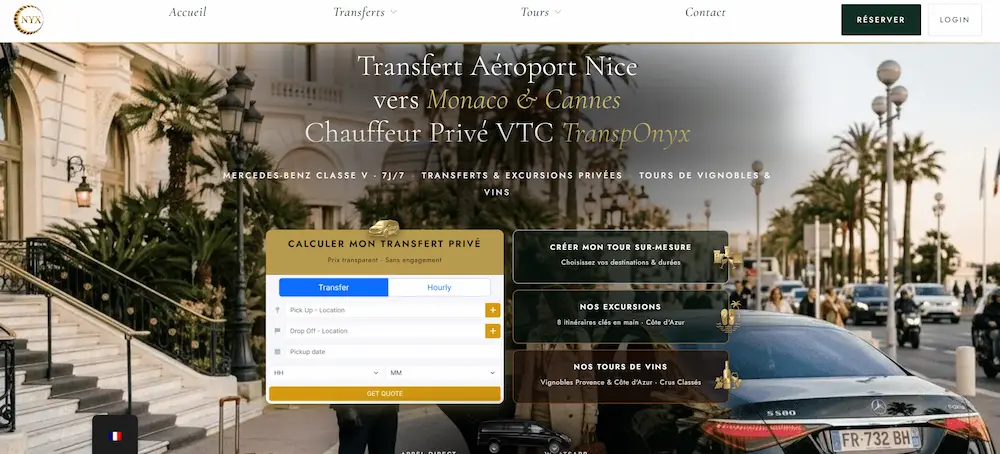
The fleet covers every group size, from a Standard Sedan for a solo business traveller to a Van 8 pax for a delegation arriving for MIPCOM or the Cannes Film Festival. Routes extend from Nice NCE to Monaco, Cannes, Antibes, Menton, and Saint-Tropez, with long-distance transfers to Milan, San Remo, and Ventimiglia available on request. There are no surge prices, no ambiguous terms, and no generic ticketing queues: direct access via WhatsApp at +33 7 67 78 10 26 or phone at +33 6 10 30 71 84.
To review the full fleet and compare 2026 service tiers, visit Transponyx or contact the reservations team directly to discuss a corporate account or event package.
Sources
FAQ
Why does 24-hour availability matter for luxury clients specifically?
Luxury clients operate across time zones and make high-value decisions spontaneously. A provider who cannot confirm a booking or resolve a request outside business hours loses the relationship to one who can, often permanently.
What response time should a luxury service guarantee overnight?
VVIP clients expect a first response within five minutes and resolution within 15 minutes. VIP corporate accounts should receive a response within 15 minutes and resolution within 30 minutes, regardless of the hour.
How do you maintain quality during busy periods without burning out staff?
A hybrid model combining AI triage for routine requests with on-call bilingual specialists for escalations delivers consistent quality without requiring full overnight rosters. The key is designing escalation triggers before launch, not after the first failure.
How does Transponyx handle overnight airport transfers at Nice NCE?
Transponyx operates 24/7 with flight monitoring included on every transfer. If a flight is delayed, the driver’s schedule adjusts automatically. Free waiting time of 60 minutes is included on all airport pickups, and fixed 2026 rates are confirmed at booking with no overnight surcharge.
What UK legal obligations apply to a 24/7 luxury service beyond GDPR?
The Consumer Rights Act 2015, Consumer Contracts Regulations 2013, ASA advertising standards, and Working Time Regulations 1998 all apply. Operators should confirm current obligations with a qualified legal adviser before launching overnight service coverage.

par Daniel AIT GOUGAM | Août 10, 2026 | news
Death Valley National Park, known in French as la vallée de la mort, is a desert rift valley in the Mojave, California, and the hottest, driest place in North America. The single most important rule: do not visit in summer. The official air temperature record stands at 56.7°C (134°F) at Furnace Creek, recorded on 10 July 1913, and modern summer days can reach very high temperatures. Plan your trip between November and April, carry at least four litres of water per person per day, and check road status with the National Park Service before you leave your hotel.
Before you read further, here is what every visitor needs to confirm:
- Season: November through April for safe, comfortable conditions.
- Gateway: Las Vegas (LAS) is approximately 2–2.5 hours by road; Los Angeles (LAX) is approximately 4–5 hours.
- First stop: Furnace Creek Visitor Center for road updates, maps and ranger advice.
- Water: Carry more than you think you need. Refill at Furnace Creek and Stovepipe Wells.
- Cell signal: Largely absent across the park. Download offline maps before you arrive.
What makes Death Valley so extreme?
Death Valley National Park spans over 3 million acres, making it the largest national park in the contiguous United States. Its elevation range is extraordinary: Badwater Basin sits approximately 86 metres (282 feet) below sea level, the lowest point in North America, while Telescope Peak rises to roughly 3,368 metres above it. That vertical spread of nearly 3,500 metres within a single park boundary is unusual anywhere on Earth.
| Fact |
Detail |
| Total area |
Over 3 million acres |
| Lowest point |
Badwater Basin, ~86 m below sea level |
| Highest point |
Telescope Peak, ~3,368 m above sea level |
| Average annual precipitation |
~5 cm (2 inches) |
| Official air temperature record |
56.7°C (134°F), Furnace Creek, 10 July 1913 |
| Park entrance fee (vehicle) |
$35 USD per vehicle (7-day pass) |
| Annual pass |
America the Beautiful Pass, $80 USD |
| Furnace Creek Visitor Center hours |
Daily, typically 08:00–17:00 (verify with NPS before travel) |
Record temperature: The World Meteorological Organisation recognises 56.7°C (134°F) at Furnace Creek on 10 July 1913 as the highest reliably recorded air temperature on Earth.
Entrance fees are paid in US dollars at park entrance stations or in advance via the NPS website. The America the Beautiful annual pass covers entry to all US national parks and is worth purchasing if you plan to visit more than two or three parks on the same trip. Always verify current fees and visitor centre hours directly with the National Park Service before travel, as hours vary seasonally.
The main sights and how to group them
The park divides naturally into several geographic clusters. Grouping your visits by area saves significant driving time and allows you to catch the right light at each location.
Badwater Basin and Furnace Creek corridor
Badwater Basin is the park’s most visited site and rightly so. The vast salt flat stretches to the horizon, its white crystalline surface broken into geometric polygons. It is accessible by a short, flat walk from the car park and is best visited at sunrise or after 16:00 to avoid the worst heat and the flattest midday light. Furnace Creek itself sits about 25 km north and serves as the park’s main service hub, with the visitor centre, petrol, accommodation and a small shop.
Zabriskie Point, 15 minutes east of Furnace Creek by road, is the park’s most photographed viewpoint. A short paved walk of roughly 400 metres from the car park reaches the overlook above eroded badlands in shades of gold and ochre. Arrive before sunrise or at least 30 minutes before sunset; the car park fills quickly and the light at those moments is exceptional.
Artist’s Drive and Artist’s Palette
Artist’s Drive is a 14-km one-way loop off the main highway, accessible only to vehicles under 7.6 metres in length. The road winds through coloured volcanic hills, culminating at Artist’s Palette, where oxidised minerals paint the hillside in green, pink, purple and orange. Late afternoon light intensifies the colours considerably. Allow 45–60 minutes for the full loop.
Mesquite Flat Sand Dunes
The Mesquite Flat dunes rise near Stovepipe Wells and are the most accessible dune field in the park. The walk to the main crest takes roughly 30–45 minutes each way across soft sand. Go at dawn for cool air, long shadows and the chance to photograph undisturbed ripple patterns before other visitors arrive. By mid-morning in spring the dunes are busy; in summer they are genuinely dangerous before 08:00.
Dante’s View
At 1,669 metres, Dante’s View offers a panoramic view across the entire valley floor, with Badwater Basin visible nearly 1,800 metres below. The drive from Furnace Creek takes about 35 minutes. Sunrise here is spectacular, though the road is steep and narrow; arrive early to secure parking.
Racetrack Playa and the northern loop
Racetrack Playa is famous for its “sailing stones”, rocks that leave tracks across the dry lake bed, a phenomenon now explained by thin ice sheets and wind. The access road from Ubehebe Crater is approximately 43 km of rough dirt track and requires a high-clearance or four-wheel-drive vehicle. Check NPS road-status pages before attempting this route; washouts can close it without warning. Ubehebe Crater itself, a volcanic maar roughly 240 metres wide and 150 metres deep, is worth a stop on the way.
Always check the NPS road-status page before setting out, particularly for the northern loop and any unpaved tracks.
Sample itineraries: one day to four days
Day trip from Las Vegas
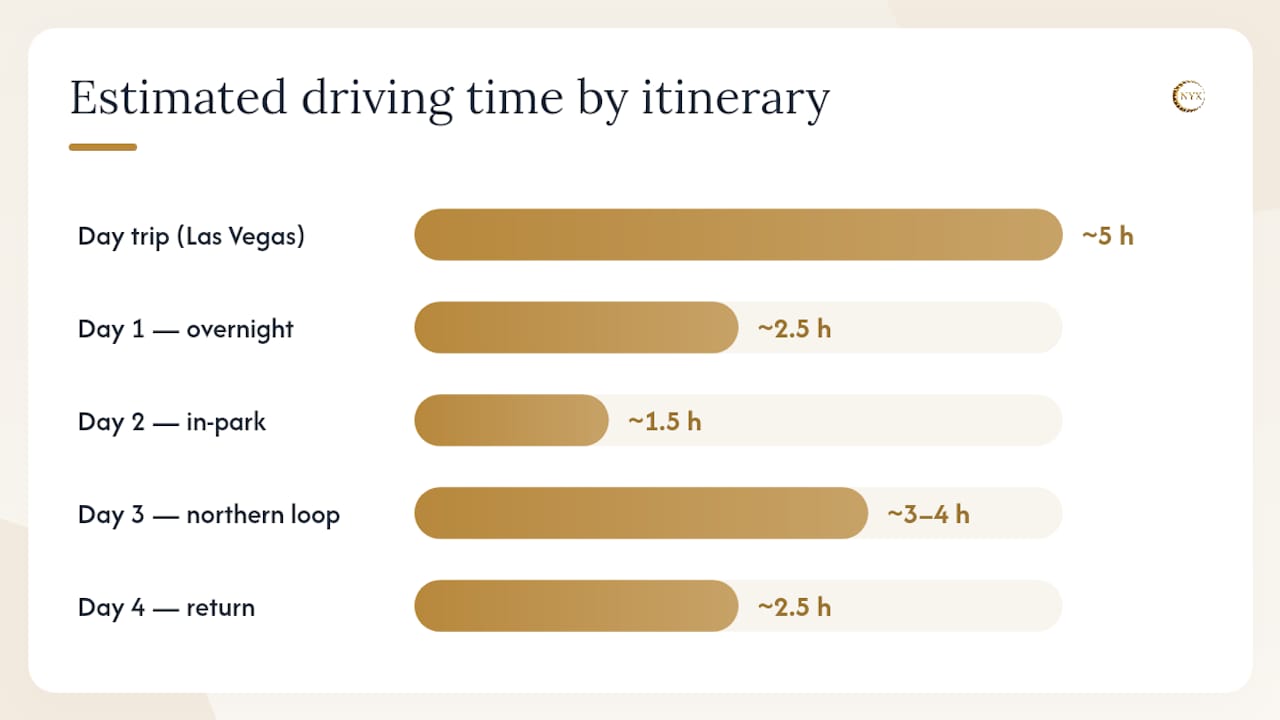
A day trip is feasible but demanding. Depart Las Vegas by 06:00 to reach Furnace Creek by approximately 08:30. Spend the morning at Zabriskie Point, Badwater Basin and the Artist’s Drive loop, then return via Stovepipe Wells for a brief stop at Mesquite Flat. Leave the park by 15:00 to avoid driving the desert highway in peak afternoon heat and to be back in Las Vegas by early evening.
| Day |
Key stops |
Estimated driving time |
| Day trip (Las Vegas base) |
Zabriskie Point, Badwater Basin, Artist’s Drive, Mesquite Flat |
~5 hours total driving |
| Day 1 (overnight stay) |
Furnace Creek, Zabriskie Point at sunset, Badwater Basin at dawn |
~2.5 hours from Las Vegas |
| Day 2 |
Artist’s Drive, Mesquite Flat dunes, Dante’s View |
~1.5 hours in-park driving |
| Day 3 |
Northern loop: Ubehebe Crater, Racetrack Playa (4×4 required) |
~3–4 hours for the loop |
| Day 4 |
Telescope Peak hike or Salt Creek, return to gateway city |
~2.5 hours to Las Vegas |
Two-day plan
Arrive in the late afternoon of Day 1 and head straight to Zabriskie Point for sunset. Stay overnight at Furnace Creek or Stovepipe Wells. On Day 2, begin at Badwater Basin at dawn, then work through Artist’s Drive, Mesquite Flat dunes and Dante’s View before departing. This plan covers the park’s most iconic scenery without requiring a 4×4.
Three to four days
A three or four-day visit allows the northern loop, a serious hike (Golden Canyon, Mosaic Canyon or Telescope Peak), and time to absorb the park’s quieter corners. Build in a contingency day for road closures, which are common after rain. The drive from Los Angeles to Furnace Creek via CA-190 takes approximately 4–5 hours; factor this into your first and last days.
When should you visit Death Valley?
The National Park Service recommends late autumn through spring as the optimal window for visiting Death Valley. October through April offers manageable daytime temperatures and the best conditions for hiking and photography.
Winter nights at higher elevations, particularly around Telescope Peak, can drop well below freezing. Pack layers even if you plan to spend most of your time on the valley floor.
The 1913 record in context: The WMO-recognised record of 56.7°C was measured at Furnace Creek on 10 July 1913. Modern monitoring methods and station standards have evolved since then, and the WMO’s assessment process involved careful review of the original data. The record stands, but it reflects conditions at the valley floor in peak summer, not typical visitor conditions in the recommended season.
Spring is the most popular season and the only time a superbloom is possible. Autumn is quieter and still warm enough to enjoy the salt flats and viewpoints comfortably. For photographers, the low winter sun angle produces long shadows and rich colour across the badlands from November through February.
How to reach Death Valley from the UK and major gateways
Flying from the UK
Most UK travellers fly into Las Vegas Harry Reid International (LAS) or Los Angeles International (LAX). Direct seasonal services from London Heathrow and Gatwick to Las Vegas take approximately 10–11 hours; flights to Los Angeles run roughly 11 hours. From Las Vegas, Furnace Creek is approximately 220 km by road, typically 2–2.5 hours via US-95 South and CA-190 West. From Los Angeles, the drive via CA-14 North and CA-190 East is approximately 380–400 km, taking 4–5 hours depending on traffic leaving the city.

| Gateway |
Distance to Furnace Creek |
Typical drive time |
Main route |
| Las Vegas (LAS) |
~220 km |
2–2.5 hours |
US-95 S, CA-190 W |
| Los Angeles (LAX) |
~380–400 km |
4–5 hours |
CA-14 N, CA-190 E |
| Beatty, Nevada |
~120 km |
~1.5 hours |
US-95 S |
Vehicle preparation
Self-driving is the only practical way to explore the park fully. Before departure from your gateway city, carry out these checks:
- Coolant and radiator: Verify fluid levels; overheating is a common cause of breakdowns on the valley floor.
- Tyres: Check pressure and carry a spare; sharp rocks on unpaved roads cause punctures.
- Fuel: Fill up before entering the park. Petrol is available at Furnace Creek and Stovepipe Wells but at a significant premium.
- Water: Carry a minimum of four litres per person beyond what you plan to drink on hikes.
- Emergency kit: A basic vehicle maintenance checklist is a useful reference for long desert drives.
For travellers who prefer not to self-drive the long desert legs, professional private transfer services can cover the Las Vegas or Los Angeles to Death Valley gateway stretch. Transponyx (+33 6 10 30 71 84, Transponyx) specialises in long-distance private transfers with fixed 2026 rates and professional bilingual drivers, and can advise on routing for multi-destination US itineraries that include a French Riviera leg.
Park entry, visitor centres and rules you must follow
Entry fees and passes
The standard vehicle entry fee is $35 USD for a 7-day pass, covering all occupants of a private vehicle. Motorcycles pay $30 USD; pedestrians and cyclists pay $20 USD per person. The America the Beautiful annual pass ($80 USD) covers entry to all US national parks and is the better value for travellers visiting multiple parks. Passes can be purchased at entrance stations or in advance via the NPS website.
Furnace Creek Visitor Center
The Furnace Creek Visitor Center is the park’s primary information hub, open daily (hours vary seasonally; confirm with NPS before travel). Rangers provide current road conditions, weather forecasts and trail advice. Ranger-led programmes run daily during the winter season and some specialised tours require advance reservation. Collecting a printed park map here is strongly advised given the limited cell coverage throughout the park.
Rules every visitor must observe
- Do not drive or walk on the salt flats beyond designated areas; the crust is fragile and damage is permanent.
- Leave all geological and biological features in place; removing rocks, plants or wildlife is illegal.
- Camp only in designated campgrounds or pre-approved backcountry zones.
- Pack out all waste; no rubbish bins are available in remote areas.
- Keep to marked trails to protect both the landscape and yourself.
Which hikes suit your fitness level?
Short walks (under 2 hours)
Mesquite Flat dunes: The walk to the main crest is roughly 2.5 km return across soft sand, taking 45–60 minutes. No trail markers; navigate by sight. Best before 09:00 or after 17:00 in spring.
Zabriskie Point loop: A 400-metre paved path from the car park to the viewpoint, suitable for all fitness levels. Allow 20–30 minutes.
Badwater salt flat walk: A flat, well-marked path extends roughly 1.6 km onto the salt flat. The surface is firm near the car park and becomes rougher further out. Allow 30–45 minutes return.
Moderate hikes (2–4 hours)
Golden Canyon: A 5-km return trail through eroded canyon walls of red and gold. The trailhead is 5 km south of Furnace Creek on Badwater Road. Moderate gradient; allow 2–3 hours.
Mosaic Canyon: A 6.4-km return hike through polished marble narrows near Stovepipe Wells. The canyon walls are smooth and striking. Allow 2–3 hours; the upper section involves some scrambling.
Strenuous hike: Telescope Peak
The summit trail is approximately 22 km return with an elevation gain of roughly 1,600 metres. Allow a full day; start no later than 07:00. In winter, snow and ice require microspikes or crampons. The trailhead is at Mahogany Flat campground, accessible by a rough dirt road.
Safety on every hike
Carry at least one litre of water per hour of hiking. Wear a broad-brimmed hat, high-SPF sun cream and light-coloured, breathable clothing. Avoid hiking between 11:00 and 16:00 from March onwards. Tell someone your planned route and expected return time, and check in with a ranger if you are attempting a remote or strenuous trail.
Where to stay inside and near the park
In-park lodging
The Inn at Death Valley (Furnace Creek area) is the park’s premium property, with a spring-fed pool and full-service dining. The Ranch at Death Valley, adjacent to the Inn, offers more accessible room rates with motel-style accommodation and a larger pool. Both properties book out months in advance for the October through April season; reserve early.
Stovepipe Wells Village provides motel rooms, a restaurant and a petrol station roughly 40 km north-west of Furnace Creek. Panamint Springs Resort, near the park’s western boundary, is a quieter option with basic cabins and a small bar.
Camping
The park has several developed campgrounds. Furnace Creek Campground is the largest and most central, with reservations available via Recreation for the peak season. Mesquite Spring, Wildrose and Thorndike campgrounds are free and first-come, first-served. Backcountry camping is permitted at least 1.6 km from roads and water sources, with no open fires.
Nearby towns
Beatty, Nevada (~120 km from Furnace Creek) and Pahrump, Nevada (~130 km) offer budget motel options and full fuel and grocery services. Lone Pine, California (~130 km south-west), is a useful base for combining Death Valley with a visit to Mount Whitney or the Eastern Sierra.
Practical note: Fuel inside the park is expensive and occasionally unavailable. Fill your tank in Beatty, Pahrump or Lone Pine before entering, and again whenever you pass a station inside the park.
Photography in Death Valley: timing and technique
The park rewards photographers who move early and stay late. The hour after sunrise and the hour before sunset produce the warmest, most directional light across the badlands, dunes and salt flats.
Zabriskie Point is the park’s most competitive sunrise spot; arrive 45 minutes before first light to secure a position on the overlook. The eroded ridges glow amber and gold as the sun clears the Amargosa Range. For a less crowded composition, walk 200–300 metres along the ridge path away from the main platform.
The Mesquite Flat dunes are best at dawn, when the sand surface is unmarked and the low light casts long shadows across the ripple patterns. Shoot from a low angle to emphasise texture and depth. A polarising filter reduces glare on the salt flats at Badwater; after rare rainfall, a thin film of water on the flat creates mirror-like reflections worth the extra effort.
Artist’s Palette is most vivid in the 90 minutes before sunset, when the warm light intensifies the mineral colours. The one-way road means you cannot linger indefinitely; plan your timing before entering the loop.
Expert insight: Early mornings produce cool, blue-toned light that renders the salt flats and volcanic rock in subtle, graphic tones. Late afternoons deliver warm amber and orange that saturate the badlands and dunes. The two moods are entirely different; experienced photographers often visit the same location twice in a single day to capture both.
Death Valley is also a designated International Dark Sky Park. During new-moon windows, the Milky Way is visible with the naked eye from most of the valley floor. Move away from Furnace Creek’s ambient lighting for the clearest skies; the Mesquite Flat area and the road towards Racetrack Playa are particularly dark.
Flora, fauna and the superbloom
Death Valley is the driest region in North America, with average annual precipitation of approximately 5 centimetres. That figure makes the park’s ecological diversity all the more striking.
Precipitation record: Average annual rainfall of ~5 cm (2 inches) makes Death Valley the driest place in North America, yet it supports hundreds of plant species and several endemic animal populations.
Salt Creek harbours the Salt Creek pupfish, a small endemic species that has adapted to water several times saltier than the ocean. The boardwalk trail at Salt Creek (best visited in February and March when pupfish are most active) offers a close view without disturbing the habitat. Stay on the boardwalk; the surrounding soil crust is fragile.
Desert plants including creosote bush, desert holly and various cacti are present across the valley floor. At higher elevations, pinyon pine and juniper appear. After unusually heavy winter rainfall, the valley floor can produce a superbloom: a dense carpet of wildflowers, predominantly desert gold and phacelia, that covers the lower slopes and flats. Superblooms are rare, weather-dependent and typically occur in March or early April. They cannot be predicted reliably more than a few weeks in advance; follow NPS social media and the VisitCalifornia wildflower tracker in late winter if this is a priority.
Responsible viewing matters. Stay on marked paths, do not pick flowers, and avoid walking across the salt crust or sandy soil between plants, which compacts the ground and damages root systems.
Why is it called Death Valley?
The name dates to the winter of 1849–1850, when a group of gold rush emigrants crossed the valley while searching for a shortcut to the California goldfields. Several members of the party died from heat and dehydration. As the survivors finally climbed out of the valley, one woman is reported to have looked back and said, “Goodbye, Death Valley.” The name persisted.
The valley was not, however, uninhabited before the 49ers arrived. The Timbisha Shoshone people have lived in and around the valley for centuries, and their presence predates European contact by thousands of years. The Timbisha Shoshone Tribe maintains a village near Furnace Creek today. Visitor centres provide context on both the indigenous history and the later mining era, which brought borax extraction operations to the valley in the 1880s. The Twenty Mule Team wagons used to haul borax across the desert became one of the American West’s enduring images.
For deeper historical reading, the NPS visitor centre at Furnace Creek stocks interpretive materials and can direct visitors to cultural sites within the park.
Navigation, cell coverage and offline maps
Cell coverage is extremely limited across most of the park. The Furnace Creek area has partial signal on some networks, but large sections of the valley floor, all unpaved routes and the entire northern loop have no reliable coverage at all. Do not rely on a smartphone for navigation once you leave the main highway.
Before you arrive:
- Download the NPS Death Valley offline map from the official NPS app or from a dedicated mapping application such as Gaia GPS or Maps.me with topo tiles covering the full park area.
- Carry a printed park map, available free at the Furnace Creek Visitor Center or downloadable from the NPS website.
- A standalone GPS unit with pre-loaded topographic maps is advisable for any unpaved route.
Fuel planning is equally critical. Petrol is available at Furnace Creek and Stovepipe Wells inside the park, and at Beatty and Pahrump outside. The distance between services on some routes exceeds 100 km; calculate your range conservatively and never let the tank drop below a quarter full.
Some remote routes, including the Racetrack Playa access road, require high-clearance or four-wheel-drive vehicles. Check the NPS road-status page at nps.gov/deva immediately before departure; conditions change rapidly after rain.
Planning your trip from the UK
Flight routing
The most direct routing from the UK to Death Valley is London Heathrow or Gatwick to Las Vegas Harry Reid International (LAS), with seasonal direct services taking approximately 10–11 hours. From Las Vegas, the drive to Furnace Creek is roughly 2–2.5 hours. Alternatively, fly London to Los Angeles (LAX) in approximately 11 hours, then drive 4–5 hours via CA-14 North and CA-190 East. Los Angeles gives more flexibility for combining Death Valley with other California destinations.
Visa and entry requirements
Most UK passport holders qualify for the US Visa Waiver Programme and must apply for an ESTA (Electronic System for Travel Authorisation) before departure. Applications are made online via the official US Customs and Border Protection website; approval is typically granted within minutes but should be obtained at least 72 hours before travel. Travellers who do not qualify for the visa waiver must apply for a B-2 tourist visa through the US Embassy in London. Verify current requirements directly with the UK Government travel guidance before booking.
Practical tips for UK travellers
- Currency: US dollars are the only accepted currency inside the park. Major credit cards are accepted at Furnace Creek and Stovepipe Wells, but carry cash for smaller purchases and campground fees.
- Time zones: Death Valley operates on Pacific Time (UTC-8 in winter, UTC-7 in summer). The UK is 8–9 hours ahead, depending on daylight saving.
- Luggage: Pack light, breathable clothing, a wide-brimmed hat, high-SPF sun cream, a reusable water bottle of at least 1.5 litres, and a warm layer for evenings and higher elevations.
- Ground transfers: For the long-distance leg from your UK departure airport to a French Riviera connection, or for any pre-trip or post-trip transfer on the Côte d’Azur, Transponyx provides fixed-rate private transfers with bilingual professional drivers. Contact via +33 6 10 30 71 84 or Transponyx.
Accessibility at Death Valley
Several of the park’s most celebrated viewpoints are accessible to visitors with limited mobility, though the terrain varies considerably across the park.
- Zabriskie Point: The paved path from the car park to the main overlook is short and manageable for most wheelchair users, though the surface has a slight incline.
- Badwater Basin: The car park is large and the initial section of the salt flat walk is firm and relatively flat, making it accessible for wheelchairs and mobility aids for the first several hundred metres.
- Furnace Creek Visitor Center: Fully accessible, with accessible parking, ramps and restrooms.
- Mesquite Flat dunes: The car park is accessible, but the dune surface itself is soft sand and unsuitable for wheelchairs or mobility aids.
- Artist’s Palette (Artist’s Drive): The road is paved and the viewpoint can be enjoyed from the vehicle window; there is no formal accessible path at the palette itself.
- Racetrack Playa and northern unpaved routes: Not suitable for standard wheelchairs or low-clearance vehicles.
Contact the Furnace Creek Visitor Center directly before your visit to ask about current accessible trail conditions and any available assistance. The NPS accessibility page for Death Valley provides updated information on facilities and programmes.
Emergency services and communication in Death Valley
The remoteness of Death Valley makes emergency preparedness non-negotiable. Cell coverage is absent across most of the park, and the nearest full-service hospital is a significant drive from the valley floor.
Nearest hospitals
The closest hospital with emergency services is Desert View Hospital in Pahrump, Nevada, approximately 100 km from Furnace Creek. For serious trauma, patients are typically transferred to University Medical Center in Las Vegas, roughly 220 km away. Response times from remote areas of the park can exceed two hours.
- Furnace Creek Visitor Center / Ranger Station: The primary contact point inside the park. Rangers can coordinate search and rescue operations and provide first aid.
- Emergency number: Dial 911 where cell signal exists. In areas without coverage, use a satellite communicator (such as a Garmin inReach or SPOT device) to send an emergency SOS signal.
- NPS dispatch: Rangers monitor radio frequencies and conduct regular patrols, but response to remote locations takes time.
Emergency procedures
If your vehicle breaks down or you become lost, stay with your vehicle. It is far easier for rescuers to locate a stationary vehicle than a person on foot in open desert. Display a distress signal (a brightly coloured cloth or your vehicle’s hazard lights) and conserve water. If you have a satellite communicator, activate it immediately.
Before any remote excursion, file a trip plan with a ranger or leave written details of your route and expected return time with someone outside the park. Carry a minimum of four litres of water per person per day, a first-aid kit, a whistle, a torch and an emergency foil blanket. Heat stroke can develop within minutes in summer conditions; know the symptoms (confusion, cessation of sweating, rapid pulse) and treat it as a life-threatening emergency.
A travel journalist’s perspective on visiting Death Valley
The question I am most often asked about Death Valley is how long to spend there. My honest answer is that two nights is the minimum for anyone who wants to do more than tick off the famous viewpoints. The first evening at Zabriskie Point and the first dawn at Badwater Basin will change how you see the place entirely. You need that second morning to absorb it rather than simply photograph it.
The overnight argument is not just about light, though the light is extraordinary. Death Valley is a designated International Dark Sky Park, and a clear night away from Furnace Creek’s ambient glow is one of the most genuinely affecting experiences the American West offers. Travellers who drive in and out in a single day miss this completely.
For photographers, three nights is the better investment. The northern loop to Racetrack Playa deserves its own day, and the drive itself, through volcanic terrain with almost no other traffic, is part of the experience. For hikers, add a fourth day for Telescope Peak, which rewards the effort with views across two states on a clear winter morning.
The practical transport question matters more than most guides acknowledge. The Las Vegas to Furnace Creek drive is straightforward, but it is long and the return leg after a full day in the park is tiring. For groups or travellers combining Death Valley with a broader US itinerary that includes a French Riviera connection, arranging a professional private transfer for the gateway legs removes one significant variable from an already demanding trip. Transponyx (Transponyx) handles exactly these kinds of long-distance, fixed-rate transfers with the reliability that complex itineraries require.

Sources
The following official sources should be your first reference for road conditions, weather, bookings and safety updates. Consult them in the days immediately before travel, not just at the planning stage.
FAQ
Why is it called Death Valley?
The name comes from the winter of 1849–1850, when a group of gold rush emigrants crossed the valley and several members died from heat and dehydration. As survivors left, one is said to have called out “Goodbye, Death Valley,” and the name endured.
What is the record temperature in Death Valley?
The official record is 56.7°C (134°F), recorded at Furnace Creek on 10 July 1913, recognised by the World Meteorological Organisation as the highest reliably measured air temperature on Earth.
Why is Death Valley so famous?
Death Valley holds multiple world extremes: the hottest recorded air temperature on Earth, the lowest point in North America at Badwater Basin (~86 m below sea level), and the driest conditions in North America, with average annual rainfall of just 5 centimetres. Its combination of dramatic scenery and record-breaking geography makes it one of the most visited national parks in the United States.
How long does it take to visit Death Valley properly?
A day trip from Las Vegas covers the main viewpoints but leaves little time to absorb the park. Two nights allows sunrise and sunset at the key sites; three to four days is recommended for the northern loop, serious hiking and stargazing.
par Daniel AIT GOUGAM | Août 9, 2026 | news
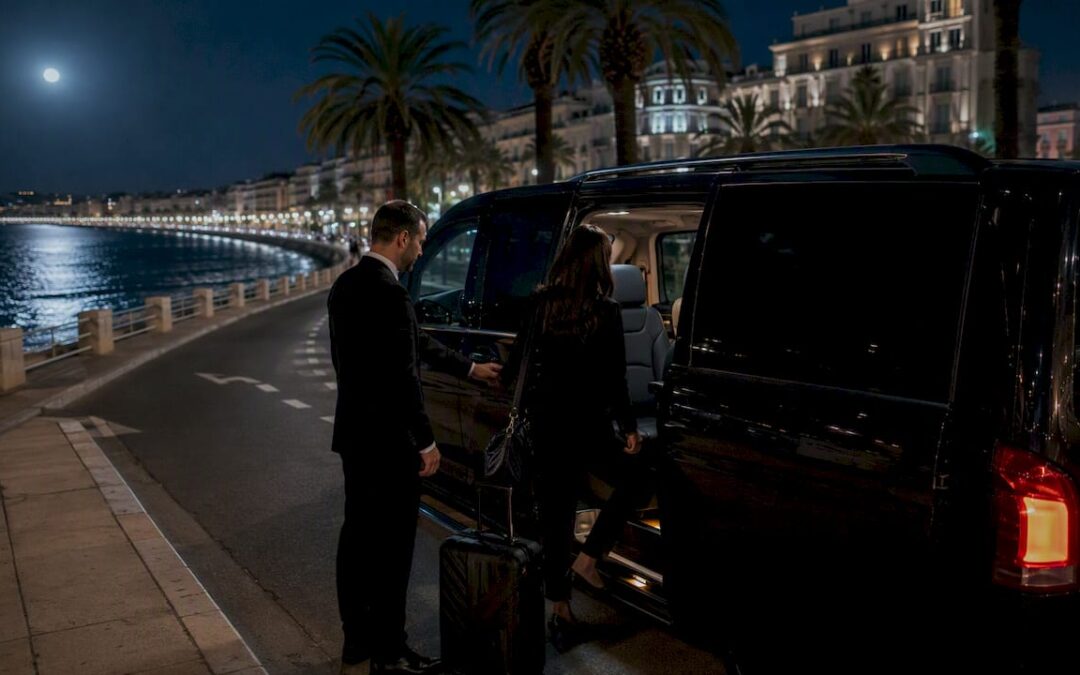
A night transfer local service is a pre-booked private or professional vehicle pickup scheduled during unsocial hours to transport you to an airport, station, or destination on time. Unlike hailing a cab at 3 AM and hoping for the best, a properly arranged night transfer confirms your vehicle, driver, and fixed price before you go to sleep. Two things to do right now: first, book with a written fixed-price confirmation; second, verify the driver holds a valid PHV or hackney licence and that flight-monitoring with 60 minutes’ free waiting time is generally included in reputable services. For Riviera travellers, Transponyx operates 24/7 with licensed bilingual VTC drivers and 2026 fixed rates. Reach them on +33 6 10 30 71 84 or at https://transponyx.com. UK licensing standards are published on Gov.
Why night flights and late departures are so difficult in the UK
Catching a 6 AM departure from Gatwick or landing at Heathrow at 1 AM sounds straightforward until you start checking transport options. The reality is considerably less convenient.
Night bus networks typically run longer intervals than daytime services and may combine multiple daytime routes into a single overnight line, which means journey times stretch considerably. A route that takes 40 minutes by day can take over 90 minutes at night, with a transfer at a central hub in the dark.
- Public transport frequency drops sharply after midnight, with many suburban and regional routes ceasing entirely.
- Route coverage gaps leave airport-adjacent areas poorly served; major UK airports sit outside city centres and are rarely on direct night-bus corridors.
- Taxi ranks thin out after 2 AM in most towns outside London, making a spontaneous cab unreliable.
- Safety concerns are real for solo travellers, particularly at poorly lit interchange points.
- Unsocial-hour surcharges on metered fares can push costs well above a pre-booked fixed rate.
Some regional authorities publish designated night-bus districts with central, well-lit departure points to address safety, but this model is far from universal across UK towns and cities. For airport runs, the gap between what public transport offers and what a traveller actually needs is widest between midnight and 5 AM.
What a night transfer covers and the service types you can choose
A local night transfer service is not a single product. The term covers several distinct formats, each suited to different journey types, group sizes, and budgets.
Private hire vehicle (minicab): Must be pre-booked; cannot be hailed on the street. Licensed by the local authority. Suitable for solo travellers and couples with standard luggage. Maps to a Standard Sedan for Riviera travellers.
Hackney carriage (black cab or licensed taxi): Can be hailed or booked. Metered fares apply unless a fixed price is agreed in advance. Suitable for solo or small groups; luggage capacity varies by vehicle.
Chauffeur or VTC service: A premium pre-booked transfer with a licensed professional driver, fixed per-vehicle rate, and a higher-specification vehicle. For Riviera routes, Transponyx operates Standard Sedan, Business Sedan, Van 7 pax, and Van 8 pax categories, covering solo travellers through to groups of eight with luggage.
Group night shuttle: A shared, bookable service with flexible stops. Some shuttle operators allow booking up to 60 minutes before departure and permit other passengers to board or alight en route, making them a cost-effective option for groups willing to accept shared pickups.
Hotel-arranged transfer: Organised through the accommodation, often subcontracted to a local operator. Convenience comes at a premium; verify the underlying provider’s licensing independently.
The distinction between a private hire vehicle and a hackney carriage matters more at 3 AM than at any other time of day. A PHV driver is licensed to carry pre-booked passengers only; they cannot legally pick you up if you flag them down. A hackney carriage holds a different badge and can accept street hails. Both require a local-authority licence, vehicle insurance, a valid MOT, and in most cases a DBS (Disclosure and Barring Service) background check.
Before confirming any night transfer booking, verify the following:
- The driver’s PHV or hackney licence number (searchable via the relevant local authority’s licensing register on GOV.UK).
- The vehicle’s PHV plate or hackney badge displayed visibly on the car.
- Confirmation that the vehicle holds valid insurance for hire and reward, not just private use.
- A current MOT certificate (vehicles used commercially require annual testing).
- Evidence of a DBS check where the operator advertises it.
- A written fixed price confirmed at the time of booking, not an estimate.
- Explicit confirmation that flight-monitoring and free waiting time are included.
For cancellation and refunds, reputable operators state their policy in writing at booking. If a dispute arises from a booking made within an EU commercial framework, the EU’s ODR portal provides a formal cross-border resolution channel. For UK-only disputes, the Citizens Advice consumer helpline and local trading standards are the primary routes.
Checking Trustpilot reviews for a local operator before booking at night is a practical step; patterns of late cancellations, no-shows, or driver substitutions show up clearly in consumer feedback.
Pro Tip: Ask the operator directly: “Is the price fixed per vehicle or per person, and does it include waiting time if my flight is delayed?” Any hesitation or vague answer is a signal to look elsewhere.
Why travellers choose a pre-booked night transfer
The case for a pre-booked private night transfer is strongest when the cost of missing a flight or arriving late at an event outweighs the price difference versus public transport.
- Punctuality: The driver is assigned to your booking and monitors your flight; they adjust the pickup if the departure gate changes or the inbound flight is delayed.
- Fixed price: No surge pricing at 4 AM, no meter running through traffic. The rate is confirmed at booking and does not change.
- Door-to-door service: Collection from your address, not a bus stop 20 minutes’ walk away with a suitcase.
- Luggage assistance: Professional drivers load and unload; no negotiating overhead-locker space on a night bus.
- Accessibility: Reputable operators can arrange vehicles with accessibility features for passengers with reduced mobility; confirm at booking.
- Safety: A named, licensed driver in a registered vehicle is verifiable before you get in.
Transponyx includes flight-monitoring and 60 minutes’ free waiting time on every airport pickup, with 2026 fixed rates per vehicle across all four fleet categories. The Mercedes-Benz fleet carries Wi-Fi, air conditioning, chilled water, and phone chargers as standard. For a traveller catching an early flight from Nice NCE to connect onward, that combination of reliability and comfort is not incidental.
How to book a night transfer: steps and timing guidance
Booking a night transfer is straightforward when you supply the right information at the right time. Last-minute bookings are possible with some operators, but for unsocial-hour airport runs, booking 24–48 hours in advance is the sensible minimum.
- Confirm your flight details: flight number, terminal, departure or arrival time, and airline.
- State passenger numbers and luggage: the operator needs this to assign the correct vehicle category.
- Provide your full pickup address and a mobile number reachable on the night.
- Note any accessibility requirements at the time of booking, not on the day.
- Agree the fixed price in writing and receive a booking confirmation by email or message.
- Confirm flight-monitoring is included and ask for the driver’s name and vehicle registration in advance.
- Agree the meeting point for airport pickups: arrivals hall, named exit, or car park.
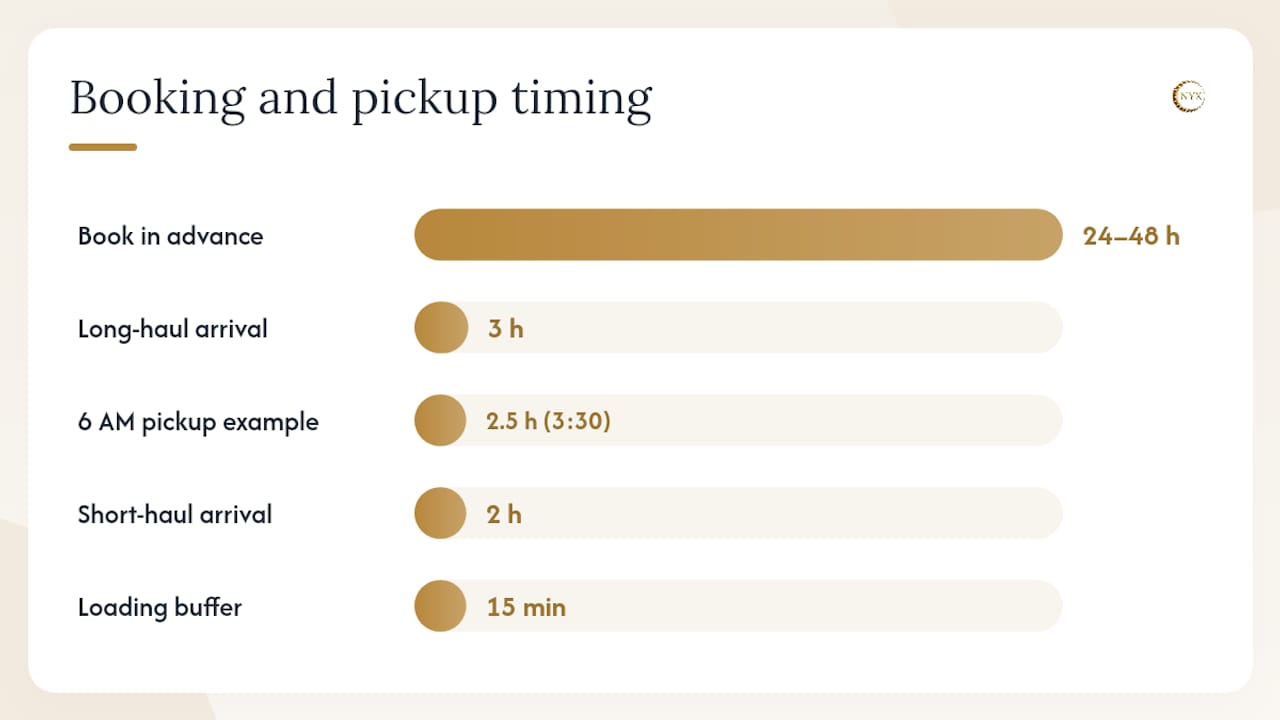
For timing, UK airport guidance generally recommends arriving at least two hours before a short-haul departure and three hours for long-haul. Add your journey time to that, plus a 15-minute buffer for loading. For a 6 AM departure from a regional airport, a 3:30 AM pickup from a city-centre address is a reasonable starting point.
Platform-based transfer services advertise 24/7 availability, fixed pricing, and flight tracking as standard features. When a flight is delayed, a provider with active monitoring adjusts the pickup automatically rather than waiting for you to call.
Typical pricing and what affects the cost of a night transfer
Night transfer pricing varies considerably depending on several factors, and understanding them helps you compare quotes on equal terms.
- Distance: the single largest variable. A 15-mile airport run costs materially less than a 60-mile one.
- Vehicle type: a Standard Sedan for up to three passengers carries a lower base rate than a Van 7 pax or Van 8 pax for larger groups.
- Unsocial-hour premium: many operators apply a surcharge for pickups between midnight and 5 AM, typically expressed as a percentage uplift on the base fare.
- Fixed per-vehicle versus metered fare: a fixed rate confirmed at booking protects you from traffic delays; a metered fare does not.
- Extras: meet-and-greet inside the terminal, airport parking fees, and additional waiting beyond the included allowance are often charged separately.
| Service category |
Best for |
Pricing model |
Availability |
Vehicle size |
Licensing |
| Private hire |
Solo, couple |
Fixed or metered |
Pre-book only |
Saloon |
PHV licence |
| Hackney carriage |
Solo, small group |
Metered (fixed negotiable) |
Rank or pre-book |
Saloon/estate |
Hackney badge |
| Group shuttle |
Budget groups |
Per-person fixed |
Limited hours |
Minibus |
Operator licence |
| Chauffeur/VTC |
Solo to 8 passengers |
Fixed per vehicle |
24/7 pre-book |
Sedan to Van 8 pax |
VTC/PHV licence |
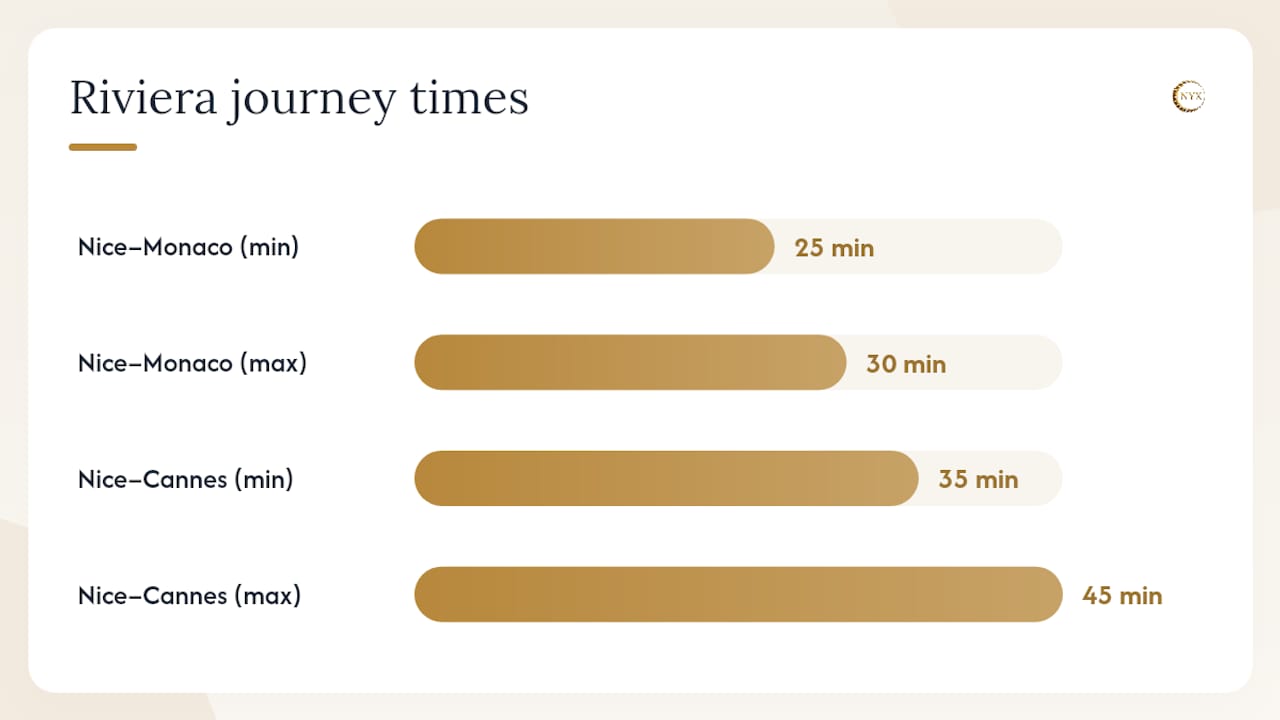
For Riviera routes, Transponyx publishes 2026 fixed rates per vehicle with no surge pricing. A Standard Sedan from Nice NCE to Monaco covers approximately 20 km in around 25–30 minutes; to Cannes, approximately 33 km in 35–45 minutes depending on traffic. Those journey times and distances are fixed; the price is confirmed before you book.
What to expect at pickup during a night transfer
Knowing what happens at collection removes the anxiety that comes with standing outside an airport at 2 AM wondering whether your driver is actually coming.
- Confirm the driver’s name and vehicle registration from your booking confirmation before you leave the terminal.
- The driver will display their ID and the vehicle’s PHV plate or hackney badge; check both before getting in.
- For airport arrivals, the standard meeting point is the arrivals hall or a named exit; your confirmation should specify this.
- In poorly lit areas, photograph the vehicle and registration plate before boarding if you are travelling alone.
- Luggage handling is included; a professional driver will load and secure bags.
- If the driver has not appeared within the included waiting window, call the driver first, then the operator’s main number.
Transponyx includes 60 minutes’ free waiting time on airport pickups and 20 minutes at any other address. If a flight lands early and the driver is still en route, the monitoring system flags the updated arrival time. Additional waiting beyond the included allowance is charged at a rate stated in the booking confirmation.
For genuine emergencies, save both the driver’s number and the provider’s main line before departure. UK emergency services remain 999; for non-emergency police, 101.
Alternatives to a private night transfer and when each makes sense
A private transfer is not always the only sensible choice. The right option depends on group size, budget, timing, and how much risk you are willing to carry.
- Night bus: Works for short intra-city trips when frequency is acceptable and you are not carrying heavy luggage. Night service networks often run reduced routes with longer intervals, so check the timetable carefully before relying on one for an airport run.
- Scheduled airport shuttle: Cheaper than a private transfer for solo travellers, but operates on fixed departure times. A missed shuttle means waiting for the next one, which may be an hour away.
- Hotel-arranged transfer: Convenient but often the most expensive option; the hotel marks up the underlying operator’s rate. Verify the driver’s licensing independently.
- Hackney carriage on the rank: Available without pre-booking at major airports, but ranks thin out overnight and metered fares at unsocial hours can be high.
- Rideshare (where permitted): Subject to surge pricing at peak demand times, including late-night airport runs. No fixed price guarantee.
- Hotel stay near the airport: For very early departures, an airport hotel eliminates the transfer entirely. Practical for solo travellers with minimal luggage; less so for families or groups attending events.
For event runs such as the Cannes Film Festival, Monaco Grand Prix, or Cannes Lions, private transfers are the only realistic option. Demand for taxis and rideshare spikes sharply during these periods, and pre-booked fixed-rate vehicles are the only way to guarantee a confirmed pickup.
How to choose a reliable night-transfer provider
Use this checklist when comparing providers. A reputable operator answers every point without hesitation.
- Confirm the driver holds a valid PHV or VTC licence and that the vehicle is registered for hire and reward.
- Ask for the fixed price per vehicle in writing before paying any deposit.
- Verify that flight-monitoring is included and ask how the driver communicates a pickup adjustment.
- Confirm free waiting time: how long is included and what is charged beyond it.
- Check that the vehicle has a current MOT and that the operator carries public liability insurance.
- Ask for the driver’s name, vehicle make, model, and registration in advance.
- Confirm the vehicle category matches your group size and luggage volume.
- Ask whether accessibility adaptations are available if required.
- Read recent reviews on a credible platform such as Trustpilot before confirming.
- Save the driver’s number and the operator’s main line before the night of travel.
Red flags: no licence number provided on request; price given as an estimate rather than a fixed figure; inability to confirm flight-monitoring; no local phone number; reviews mentioning no-shows or driver substitutions without notice.
Two questions worth asking when you call: “Can you confirm the fixed price per vehicle and what waiting time is included if my flight is delayed?” and “What is the driver’s name and vehicle registration for my booking?”
When a private night transfer is preferable to public night services
Night service networks are built around frequency trade-offs. Routes run less often, often using a hub-and-spoke model where passengers transfer at a central point to reach their destination. That design works for short intra-city trips but creates compounding delays for airport runs, where a missed connection at the hub can mean a 30–60 minute wait for the next service.
Rules of thumb for the decision:
- Choose a private transfer for any departure before 6 AM or after 11 PM when public services are reduced or absent.
- Choose a private transfer for groups of three or more with luggage; the per-person cost often approaches the cost of a shared shuttle, with none of the timing risk.
- Choose a private transfer for event arrivals: the Cannes Film Festival, Monaco Grand Prix, MIPIM, and MIPCOM all create demand spikes that make spontaneous transport unreliable.
- Public night services can work for short intra-city trips of under 30 minutes when frequency is acceptable and no luggage is involved.
Some transit authorities designate specific night-bus districts with predictable intervals and central, well-lit boarding points. Where these exist, they are a reasonable option for budget-conscious solo travellers. For airport runs, the reliability gap between a scheduled public service and a pre-booked private transfer with flight-monitoring is substantial.
A travel journalist’s perspective on booking night transfers
The checklist in this article covers the mechanics. What it cannot fully convey is how differently the same journey feels when the logistics are settled before you leave home.
Reporting on ground transport across the Riviera and UK night services, the pattern that recurs is this: travellers who miss early flights or arrive stranded at 2 AM almost always made the same decision, choosing a cheaper or more spontaneous option and assuming it would work out. It usually does not, at the worst possible moment.
For Riviera travellers specifically, the Nice NCE to Monaco run (approximately 20 km, 25–30 minutes) and the NCE to Cannes route (approximately 33 km, 35–45 minutes) are straightforward in daylight and considerably less so at 4 AM without a confirmed vehicle. Transponyx handles both routes with 2026 fixed rates, licensed bilingual drivers, and flight-monitoring included. The late-night VTC service covers Nice, Monaco, and Cannes with the same standards applied to every booking, regardless of the hour.
The single recommendation: use the checklist, confirm every point in writing, and book a provider who answers all of it without hesitation.
Transponyx: fixed-rate night transfers on the French Riviera
For travellers arriving at or departing from Nice Côte d’Azur Airport at any hour, the difference between a confirmed vehicle and a hopeful search for a taxi at 3 AM is not trivial. Transponyx offers luxury chauffeur services with 2026 fixed rates per vehicle, no surge pricing, and flight-monitoring included on every airport transfer. The Mercedes-Benz fleet covers solo travellers through to groups of eight, with Wi-Fi, air conditioning, chilled water, and phone chargers in every vehicle.
Routes include Nice NCE to Monaco, Cannes, Antibes, Menton, Saint-Tropez, and Alpine ski resorts, as well as long-distance transfers to Italy. Drivers are licensed VTC professionals, bilingual in English and French as a minimum. Free waiting time is 60 minutes on airport pickups. To confirm your 2026 fixed rate and book a VTC transfer on the French Riviera, visit https://transponyx.com or call +33 6 10 30 71 84.
Sources
FAQ
What is a private night transfer service?
A private night transfer is a pre-booked vehicle, driven by a licensed professional, that collects you from a specified address during unsocial hours and transports you to an airport, station, or destination at a fixed, confirmed price.
How does flight monitoring work in a night transfer?
The driver or operator tracks your flight number in real time; if your flight is delayed or arrives early, the pickup time adjusts automatically so you are not left waiting or charged for extra time within the included allowance.
Is a night transfer more expensive than a daytime transfer?
Many operators apply an unsocial-hour premium for pickups between midnight and 5 AM, but a pre-booked fixed rate is typically more predictable than a metered fare at those hours, which can carry surge pricing.
What should I check before booking a night transfer in the UK?
Verify the driver’s PHV or hackney licence via GOV.UK, confirm a written fixed price per vehicle, and ask whether flight-monitoring and free waiting time are included in the booking.
Can Transponyx handle night transfers from Nice NCE?
Yes. Transponyx operates 24/7 with licensed bilingual VTC drivers, 2026 fixed rates, and 60 minutes’ free waiting time on all airport pickups from Nice Côte d’Azur Airport to Monaco, Cannes, Antibes, and other Riviera destinations.

par Daniel AIT GOUGAM | Août 8, 2026 | news
Advance confirmation is the single most effective step you can take to secure the quality and predictability of a luxury trip. Not the most glamorous, but the most consequential. Before anything else, confirm your core inventory: flight cabin class, primary hotel suite or villa, and private transfers. Get written confirmation or a tentative hold for each. During peak events such as the Cannes Film Festival or the Monaco Grand Prix, that written confirmation is the difference between the suite you wanted and the room that was left. Transponyx, for instance, holds 2026 fixed-rate transfer bookings from the moment of reservation, with no surge pricing regardless of event demand.
Why early confirmation changes the experience for luxury travellers
The clearest benefit of confirming early is access. Top luxury hotels open their availability roughly 12 months in advance, and the best room categories go first. By the time most travellers begin searching, the corner suite with the sea view is already reserved. Late booking rarely saves money in the luxury segment; it reduces choice.
Beyond room category, early confirmation secures:
- Priority access to preferred suites, villas, and exclusive-use properties before they are released to the general market
- Guaranteed private guides and specialist experiences that operate with limited capacity
- Preferred vehicle categories and bilingual drivers for transfers during high-demand periods
- Bespoke timing for experiences such as private vineyard visits, yacht charters, and museum after-hours access
The inventory pressure is sharpest around named events. The Cannes Film Festival (May 2026), Monaco Grand Prix (May 2026), Cannes Lions (June 2026), and the festive season across Europe all create simultaneous demand spikes. Advisors report a polarised market: some clients delay to preserve flexibility, others commit more than a year out specifically to secure scarce inventory. The travellers who confirm early consistently report fewer day-of substitutions and more of the experiences they originally planned.
Late booking in luxury travel typically reduces choice more than it reduces price. A discounted rate on a lesser room is not a saving.
How far ahead should you confirm, by trip type?
Advisors commonly recommend 9–18 months for high-demand luxury experiences, with the window varying by trip type. Private villas and exclusive-use safari camps often require the longest lead times because inventory is genuinely finite. A single-property island resort with twelve villas simply cannot accommodate late demand.
For the French Riviera specifically, the Cannes Film Festival and Monaco Grand Prix in May warrant confirmation well in advance, typically several months before. Booking early gives you access to better routing, seat availability, and the space to coordinate multi-element itineraries — and that coordination time is where the real quality of a trip is built.
| Trip type |
Recommended lead time |
Notes |
| Private villa or exclusive-use property |
12–18 months |
Limited inventory; early release |
| Peak summer Europe (July–August) |
9–12 months |
Hotels open books ~12 months out |
| Cannes Film Festival / Monaco Grand Prix |
10–12 months |
Transfers and suites go simultaneously |
| Festive season (Christmas / New Year) |
9–12 months |
Family suites and connecting rooms first |
| Cruise and private yacht charter |
9–12 months |
Itinerary flexibility narrows quickly |
| Boutique city stay, short-haul |
3–6 months |
More inventory; flexibility viable |
| Domestic / flexible short-haul |
4–8 weeks |
Refundable rates often available |
The exception to early confirmation is genuinely flexible travel where dates are open and the destination is secondary. In those cases, a shorter window with refundable rates is the more rational approach.
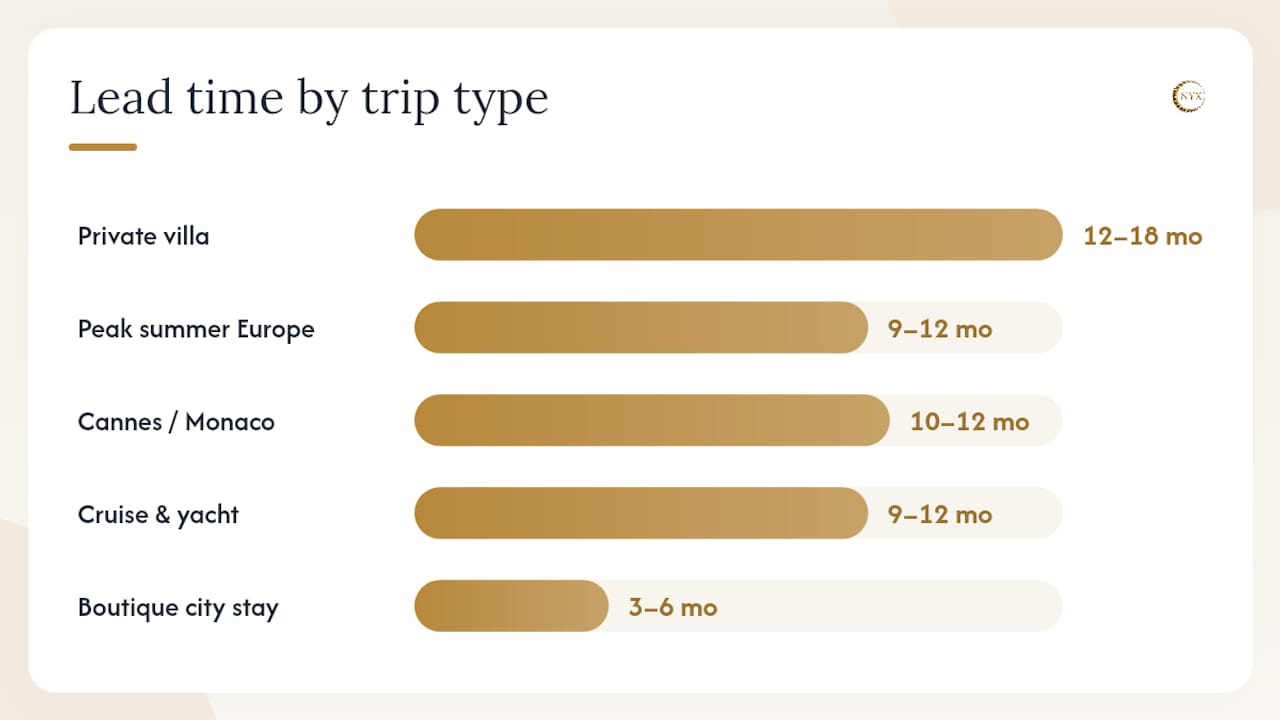
What to confirm at booking: a practical checklist
A luxury travel planning checklist at the point of booking should cover every element that cannot easily be substituted later. The following items apply to a typical Riviera stay:
- Full guest names as they appear on passports, and any titles or preferences the property should note
- Room or villa category confirmed in writing, including floor, view, and adjacency for travelling groups
- Flight numbers linked to transfer bookings so drivers receive live updates
- Private guide and experience confirmations with dates, times, and named contacts
- Inclusions confirmed in writing: meals, minibar, transfers, gratuities, fuel, and any complimentary amenities
- Cancellation and amendment terms, including the exact date at which deposits become non-refundable
- Visa, entry, and health requirements for all travellers, verified against the destination’s current rules
For a Riviera stay, a filled-in example might look like this: suite category and sea-view floor confirmed at Hotel X; Transponyx Business Sedan confirmed for Nice NCE arrival with flight monitoring active; private guide confirmed for a morning in Antibes Old Town; yacht tender confirmed for departure from Cannes harbour. Each of these carries a written confirmation reference number.
Record every confirmation in a single shared document, and copy both your hotel contact and your transfer supplier. If you use a concierge service, they should hold the master copy.
Pro Tip: When confirming transfers for event travel, always link the booking to a specific flight number rather than an estimated arrival time. Transponyx monitors flights in real time and adjusts driver dispatch accordingly, which removes the risk of a missed connection during busy event periods.
Managing deposits and payment schedules without losing flexibility
Deposit structures in luxury travel vary considerably, but a common shape is an initial deposit of 20–30% at booking, with the balance due 60–90 days before departure. Some properties require full payment at booking for peak-event dates, particularly during the Cannes Film Festival or Monaco Grand Prix when demand is absolute.
Key considerations for UK travellers booking Riviera travel:
- Staged deposits protect availability without committing the full amount immediately; confirm the exact balance-due date in writing
- Refundable rates exist at many properties but carry a price premium; weigh that premium against your confidence in the travel dates
- Non-refundable rates are common for event periods; travel insurance purchased at the time of booking covers cancellation for named insured events
- Currency: Riviera suppliers quote in euros. UK travellers should confirm whether the rate is fixed at booking or subject to exchange fluctuation, and consider a specialist FX service for large transfers
- Travel insurance should be purchased at the point of deposit, not closer to departure, to cover pre-existing conditions and supplier insolvency
The dual trend in luxury booking means suppliers are increasingly offering tiered flexibility: fully refundable rates for those who want optionality, and discounted non-refundable rates for those who commit early. Neither is universally better; the right choice depends on how certain your dates are.
Coordinating group and event travel so everything stays synchronised
Group travel introduces a coordination layer that individual bookings do not require. A single missed confirmation can cascade: one room in the wrong category displaces an entire family arrangement, or one unlinked transfer leaves a guest stranded at Nice NCE while the rest of the party is already in Monaco.
The steps that prevent this:
- Build a master rooming list before any booking is placed, with each guest’s name, room category, and adjacency requirement noted.
- Assign a single point of contact for each supplier: one person communicates with the hotel, one with the transfer company, one with the private guide.
- Link every transfer booking to a specific flight number so that flight monitoring covers the whole group, not just individual passengers.
- Hold a contingency block: one additional room category or vehicle for 48 hours after the main booking, released if not needed.
- Distribute a single confirmation document to all group members, including driver contact details, hotel address, and emergency numbers.
- For event group transfers, coordinate directly with the event organiser to confirm vehicle access windows, drop-off points, and any credentialling requirements.
- Schedule a group confirmation call 6–8 weeks before departure to verify all elements are still in place and address any changes.
Flight monitoring and driver re-assignment protocols are particularly important for groups arriving on separate flights. Transponyx assigns a named driver to each booking and monitors inbound flights, adjusting waiting time and dispatch if a flight is delayed.
When flexibility is the smarter choice than confirming early
Early confirmation is not always the right answer. Three situations where flexibility should take priority:
- Rapidly changing corporate schedules — where the travel date may shift by several weeks. Confirm the transfer supplier and one or two key nights on a refundable basis; leave experiences and ancillary bookings open until the dates are fixed.
A practical middle ground is partial confirmation: secure the transfer and the primary hotel nights early (these are the hardest elements to replace), and keep experiences and secondary nights on flexible holds. Specialist strategies for last-minute award flights can also preserve some flexibility on the flight element when travellers intentionally delay that confirmation while keeping ground logistics secured.
Dynamic rebooking clauses, where a supplier allows one date change without penalty, are worth negotiating at the time of booking rather than after a change becomes necessary.
What a luxury travel advisor actually does when you confirm early
The concrete value of a luxury travel advisor is not access to a brochure. It is the set of actions they take before you would even know a problem existed. Luxury clients expect advisors who anticipate needs and communicate proactively, not advisors who wait to be asked.
Specific advisor actions that justify their involvement:
- Placing preferred-category holds at properties before general release, using programme-level relationships that are not available to direct bookers
- Negotiating deposit flexibility and amendment clauses that a direct booking would not carry
- Arranging connecting room allocations for families, which require coordination between the hotel’s reservations and housekeeping teams
- Monitoring confirmation status across all suppliers and chasing outstanding written confirmations before the client is aware of a gap
- Advocating during disruptions: when a flight is cancelled during the Monaco Grand Prix, an advisor with a direct hotel contact resolves the room extension in minutes rather than hours
Booking through third-party platforms can reduce a hotel’s visibility of the guest relationship, which limits upgrade opportunities and complicates problem resolution. Direct bookings and advisor bookings preserve clearer accountability. For milestone journeys such as multigenerational family travel, destination weddings, or corporate incentive trips, that accountability is not a minor convenience.
Virtuoso advisor pages and preferred hotel contacts are a useful starting point for identifying properties and the specific contacts who can secure desirable inventory.
How Transponyx supports advance confirmation for Riviera transfers
The mechanics of advance confirmation apply as directly to ground transport as they do to hotel suites. During the Cannes Film Festival or Monaco Grand Prix, private chauffeur availability at Nice NCE tightens considerably. A traveller who confirms a transfer on the day of arrival during event week will find fewer vehicle options, no guaranteed vehicle category, and no flight monitoring.
Transponyx operates 24 hours a day, seven days a week, with 2026 fixed rates confirmed at booking and no surge pricing regardless of event demand. The fleet covers four categories: Standard Sedan (up to 3 passengers), Business Sedan (up to 3 passengers, premium finish), Van 7 pax, and Van 8 pax. All vehicles are Mercedes-Benz, equipped with Wi-Fi, air conditioning, chilled water, and phone chargers.
Key journey times from Nice NCE on the Riviera:
- Nice NCE to Monaco: approximately 30 minutes (approximately 20 km via the A8)
- Nice NCE to Cannes: approximately 35 minutes (approximately 33 km)
- Nice NCE to Antibes: approximately 25 minutes (approximately 23 km)
- Cannes to Monaco: approximately 50 minutes (approximately 50 km)
Every airport transfer includes 60 minutes of free waiting time and live flight monitoring. For any other address, 20 minutes of free waiting time is included. Drivers are licensed VTC professionals, bilingual in English and French as a minimum, with several also speaking Italian, Spanish, Russian, or Arabic.
When a group of eight arrives on separate flights for the Monaco Grand Prix, Transponyx assigns a named driver to each booking and monitors both inbound flights independently. If one flight is delayed, the driver adjusts without the passenger needing to make contact. That level of coordination is only possible when the booking is confirmed in advance with the flight number linked at the time of reservation.
Confirm transfers at https://transponyx.com or call +33 6 10 30 71 84.
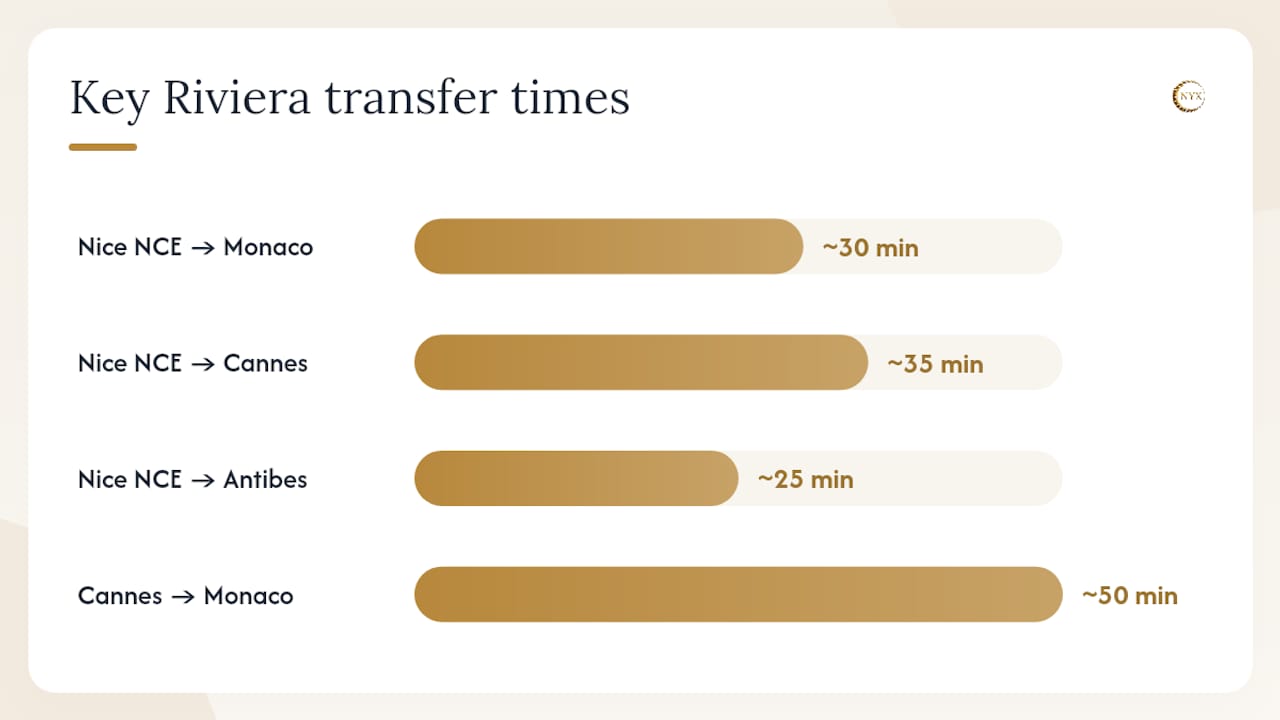
The case for confirming now, not later
The conventional wisdom in luxury travel used to be that flexibility was a mark of sophistication. Book late, keep options open, and let the trip take shape. That approach made sense when inventory was abundant and demand was predictable. Neither is true for peak events on the French Riviera in 2026.
The travellers who arrive at the Cannes Film Festival with every element confirmed, from the suite category to the named driver waiting at Nice NCE, are not the ones who over-planned. They are the ones who understood that availability defines quality at this level. A private guide who knows the back streets of Antibes, a Business Sedan with a bilingual driver who has already reviewed the itinerary, a hotel suite with the correct sea view: none of these are available on the day if someone else confirmed them in October.
My recommendation is straightforward. Start with the three elements that are hardest to replace: the primary accommodation category, the inbound and outbound transfers, and any experience with genuinely limited capacity. Confirm those first, in writing, with reference numbers. Everything else can follow.
Secure your Riviera transfers with Transponyx
Fixed-rate private chauffeur transfers on the French Riviera, confirmed at booking with no surprises on arrival. Transponyx provides airport transfers from Nice NCE to Monaco, Cannes, Antibes, Menton, Saint-Tropez, and all Alpine ski resorts, with 2026 rates locked at the time of reservation.
For groups travelling to the Cannes Film Festival, Monaco Grand Prix, or any Riviera event, the Van 7 pax and Van 8 pax categories are available for advance confirmation alongside individual sedan bookings. Every booking includes flight monitoring, free waiting time, and a named bilingual driver. View luxury chauffeur service options or contact the reservations team directly to confirm your transfer now: call +33 6 10 30 71 84 or visit https://transponyx.com.
Useful sources for planners who want to go deeper
- Luxury trends: booking window shift — last minute and early | Travel Market Report
- Understanding luxury travel clients: psychology, expectations and buying behavior — PTN Travel
- 6 Mistakes You’re Making When Booking Luxury Travel | Loweluxurytravel
- How far in advance should luxury travel really be planned? | Landi Burns
- The hidden risks of booking luxury travel through third‑party sites | Dynamite Travel
- Why booking early is the smartest luxury travel decision you’ll make in 2026 | Novium Travel
FAQ
What should you confirm before booking luxury travel?
Confirm room or villa category in writing, flight numbers linked to transfers, private guide availability, inclusions such as meals and gratuities, and cancellation terms. For Riviera travel, also verify visa and entry requirements and confirm your transfer supplier, such as Transponyx, with a specific flight number.
How far in advance should luxury travel be booked?
Most advisors recommend 9–12 months for peak-season Europe and event travel, and up to 18 months for private villas and exclusive-use properties. Short-haul boutique stays can be confirmed 3–6 months out.
What does a luxury travel adviser do during the confirmation process?
A luxury travel adviser places preferred-category holds before general release, negotiates deposit flexibility, arranges connecting room allocations for groups, and monitors confirmation status across all suppliers. They also advocate directly with hotels and transfer companies during disruptions.
What is a travel booking confirmation?
A travel booking confirmation is a written record from a supplier, hotel, or transfer company that states the specific service reserved, the dates, the rate, and the cancellation terms. It should include a reference number and the name of the guest or lead traveller.
When is it better to keep luxury travel arrangements flexible?
Flexibility is preferable for short-haul trips with ample inventory, uncertain travel dates driven by health or business schedules, and corporate travel where dates may shift. In these cases, confirm transfers and primary hotel nights on refundable rates and leave ancillary experiences open until dates are fixed.

par Daniel AIT GOUGAM | Août 7, 2026 | news
A travel-agency ground transport partner is an accountable supplier contracted to deliver airport transfers, point-to-point journeys, chauffeur hire, coaches, meet-and-greet services and event logistics directly to a travel agent’s clients under agreed commercial and operational terms. If your agency is handling more than a handful of FIT bookings per month, or you are building MICE programmes, cruise itineraries or event-period packages, you need a named, contracted partner rather than a string of ad-hoc local vendors. The risk transfer alone justifies the paperwork.
Industry bodies such as the Global Business Travel Association (GBTA) publish benchmarking data that agencies can use to quantify exactly what structured supplier relationships return in reduced disruptions and operational cost. The standard industry term for this category of supplier is “ground transport partner” or “ground handler for transfers,” and the distinction from a one-off taxi booking is accountability: a contracted partner carries the agency’s reputation in the destination.
What services does a ground transport partner actually supply?
The service range is broader than most agencies initially expect. A credible partner covers the following core capabilities, as outlined in DMCQuote’s guide to ground transportation for tour operators:
- Airport transfers: — timed pickups and drop-offs with flight monitoring, free waiting time and meet-and-greet boards at arrivals.
Fleet mapping matters as much as the service list. For private clients and small groups, a Standard Sedan (up to 3 passengers) or Business Sedan (up to 3 passengers, premium finish) covers most FIT requirements. Groups of up to 7 or 8 passengers need a Van 7 pax or Van 8 pax respectively. Larger groups require coach-category vehicles, which responsible partners subcontract under their own operator licence rather than passing the booking to an unvetted third party.
The use-case spread is wide. A single Riviera programme might require a Business Sedan for a solo VIP arriving at Nice Côte d’Azur Airport (NCE), a Van 7 pax for a family group transferring to Cannes, and a coach circuit for a MICE group attending MIPIM. A partner that can cover all three under one contract, one invoice and one escalation contact is worth considerably more than three separate vendors. For group itinerary planning, consolidating supplier relationships at the planning stage prevents the coordination failures that generate client complaints.

What commercial models and contract terms should you expect?
Partnership models in ground transport follow a small number of well-established structures, and knowing which one you are being offered determines how you negotiate.
Commissionable rates are the most common entry point. The supplier publishes a rack rate and pays the agency a commission, typically settled monthly. The agency invoices the client at rack rate and the partner remits the commission. Simple, but the margin is fixed and the agency has no pricing flexibility.
Net rates with mark-up give the agency more control. The partner quotes a net price, the agency adds its own margin and invoices the client accordingly. Advantage Travel Partnership negotiates centrally on behalf of member agencies to secure net-rate arrangements across ground transport and ancillary suppliers, with consolidated invoicing as a standard benefit. Agencies that lack the volume to negotiate individually can access these terms through membership.
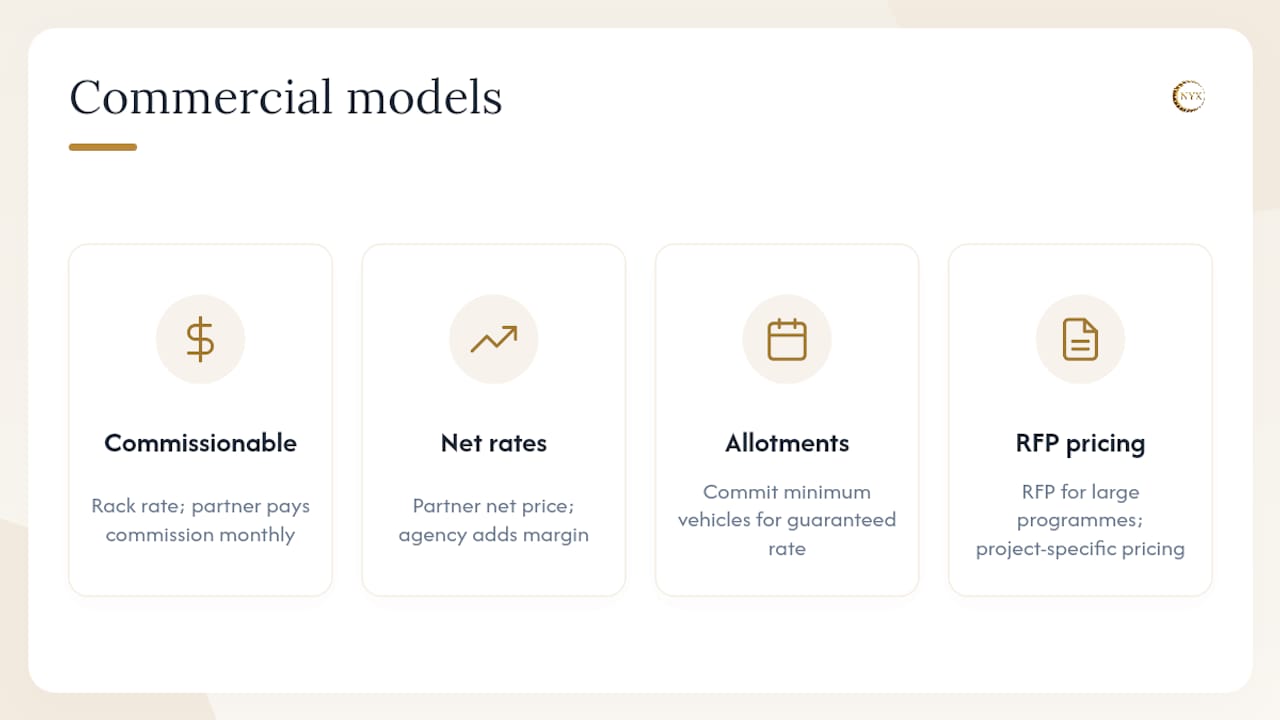
Allotments and block bookings suit agencies with predictable demand, particularly around events such as the Monaco Grand Prix or Cannes Film Festival. The agency commits to a minimum number of vehicles or journey days in exchange for a guaranteed rate and priority availability. The risk is unsold allotment; the reward is rate certainty and confirmed supply during peak periods when ad-hoc availability disappears.
RFP and bespoke event pricing applies to large MICE programmes, incentive groups and corporate roadshows. The agency issues a request for proposal, the partner prices the full programme including contingency vehicles, and both parties sign a project-specific addendum to the master agreement.
On invoicing, expect consolidated monthly statements with net-30 or net-45 credit terms for established agency accounts. Pricing components to clarify before signing include: base fare per vehicle category, waiting-time charges beyond the free allowance, mileage or zone supplements for long-distance runs, extras such as child seats and parking fees, and the applicable VAT rate. For cross-border routings into Italy or Switzerland, confirm whether tolls are included or billed separately.
What licences and insurance must a UK ground transport partner hold?
This is the section most agencies skip, and it is where liability exposure lives. Before placing a single booking, request and verify the following documentation.
| Document |
What to check |
Where to verify |
| PSV Operator’s Licence |
Required for coaches carrying passengers for hire or reward; issued by the Traffic Commissioner |
GOV.UK Traffic Commissioner |
| PHV Operator Licence |
Required for private hire vehicles (chauffeur/VTC); issued by the relevant local licensing authority |
Local council licensing register |
| Motor insurance certificate |
Minimum third-party; confirm hire-or-reward cover and passenger liability limits |
Request original certificate; verify with insurer if in doubt |
| Public liability insurance |
Covers third-party injury and property damage; £5 million minimum is standard for trade accounts |
Request certificate of insurance |
| Employer’s liability insurance |
Statutory requirement for any partner employing drivers; minimum £5 million |
Request certificate of insurance |
| MOT and vehicle inspection records |
Confirms roadworthiness; PSV vehicles require annual DVSA testing |
DVSA vehicle enquiry service |
| Driver DBS checks |
Enhanced Disclosure and Barring Service check for drivers carrying passengers |
Request copies; check issue date |
Beyond the documents themselves, data protection obligations apply the moment you share passenger names, flight details or hotel addresses with a supplier. Under UK GDPR, your agency is a data controller and the ground transport partner is a data processor. You must have a Data Processing Agreement (DPA) in place before transferring any personally identifiable information. The partner must confirm they hold and process passenger data only for the purpose of delivering the booked service, and that they have appropriate technical and organisational measures in place. The UK Information Commissioner’s Office (ICO) publishes model DPA clauses at ico.org.uk.
Right-to-work checks for drivers are the partner’s legal responsibility, not yours, but you should ask for written confirmation that the partner’s compliance policy covers all drivers assigned to your bookings.
What SLA metrics and operational standards should your contract specify?
Vague service commitments are unenforceable. The following numbered checklist gives operations teams a working starting point for contract negotiations.
- First-call resolution for disruptions: — the partner’s dispatch team resolves vehicle substitutions, driver changes and route diversions without requiring the agency to make a second call.
For event periods such as the Cannes Lions or MIPCOM, where VIP transport planning demands near-zero tolerance for error, add a clause requiring the partner to provide a dedicated operations contact for the duration of the event and to pre-position contingency vehicles within 20 minutes of the primary pickup locations.
Pro Tip: The GBTA x ASTA benchmarking report provides industry-level ROI data that you can use to justify paying a premium for higher SLA tiers. Reduced disruption calls and faster recovery times have measurable cost implications; bring the data to the negotiation.
Dispute resolution should be written into the contract as a three-step process: written notice to the partner’s account manager, escalation to the partner’s operations director within 48 hours if unresolved, and formal mediation or contract termination rights if the issue persists beyond 10 business days. Document every failure in writing at the time it occurs.
How do booking portals, APIs and GDS connectivity work in practice?
Technology integration is where the gap between a professional partner and an informal supplier becomes most visible. The minimum you should expect from any trade-facing ground transport partner is a dedicated agent portal with real-time availability, confirmed pricing and a booking reference that maps to your own PNR or reservation system.
Beyond the portal, integration options range from lightweight to deeply technical. An XML or API feed allows your reservations system to query availability and confirm bookings without manual intervention, which matters when you are processing high volumes or working with automated itinerary-building tools. GDS connectivity via Amadeus, Sabre or Travelport enables agents to book and manage transfers within the same workflow they use for flights and hotels, eliminating the separate login and reducing the risk of booking errors. Expedia TAAP demonstrates how consolidated booking capability and competitive rates can scale an agency’s operations quickly when the technology infrastructure is in place.
Ask the partner’s technology team these specific questions before committing to an integration:
- What is the booking modification window, and can changes be made via the API or only by phone?
- Does the system push ETA notifications to the passenger’s mobile number automatically?
- Can the agency export invoicing data in CSV or Excel format for reconciliation?
- What is the fallback workflow if the API is unavailable?
Legacy GDS entry patterns tend to be slower and less flexible than modern REST API workflows, but they have the advantage of sitting inside a workflow your reservations team already knows. For a business travel transfer workflow, the right integration model depends on your booking volumes and the technical capacity of your operations team.
How do you onboard a ground transport partner step by step?
A structured onboarding process protects both parties and reduces the risk of a live booking becoming the first real test of the relationship.
- Reference checks (Days 10–15): — contact the named agency references directly. Ask specifically about punctuality, invoicing accuracy and how the partner handled a disruption or complaint.
Typical onboarding costs include an administration fee for portal setup (not always charged), a deposit against allotment commitments if applicable, and internal staff time for training and integration testing. Some partners waive setup fees for agencies that commit to a minimum annual booking volume. Travel Leaders Network notes that supplier training and joint marketing resources significantly improve sell-through and post-booking service quality, so ask whether the partner offers product training for your sales team as part of the onboarding package.
What red flags should you watch for when choosing or managing a partner?
Vague cancellation terms are the most common trap. If the contract does not specify the cancellation window, the fee structure and the refund timeline in plain language, assume the terms favour the supplier. Require a table of cancellation fees by notice period before signing.

No 24/7 dispatch contact is a structural problem, not a minor gap. A partner who cannot be reached at 02:00 when a flight diverts to Marseille is not a partner; they are a daytime vendor. Confirm the out-of-hours number before the first booking and test it.
Lack of documented insurance or licence evidence should stop the conversation immediately. A supplier who cannot produce certificates within 48 hours of a written request either does not hold the required cover or does not have an organised compliance function. Neither is acceptable for a trade account.
Opaque pricing, particularly around waiting time and extras, is a reliable indicator of invoice disputes to come. If the rate card does not specify waiting-time charges beyond the free allowance, or if toll and parking costs are described as “at cost” without a cap, negotiate explicit figures before signing.
When a red flag appears during delivery rather than due diligence, the response should be proportionate and documented. A single late vehicle warrants a written note to the account manager. A pattern of punctuality failures warrants a formal corrective action plan with a 30-day review. Persistent failures after a corrective action plan justify suspension of new bookings and, if unresolved, contract termination under the dispute resolution clause.
Why structured ground transport partnerships matter more than agencies realise
The conventional wisdom in trade procurement is that ground transport is a commodity: you find the cheapest licensed operator, confirm the rate, and move on. That view is wrong, and the agencies that hold it tend to find out during an event period.
Consider what actually happens when a client’s flight into Nice NCE arrives 40 minutes late during the Monaco Grand Prix. An ad-hoc vendor may have reassigned the vehicle. A contracted partner with flight monitoring, a 60-minute free waiting policy and a 24/7 dispatch desk absorbs the delay without a single call to your operations team. The difference is not the vehicle; it is the accountability structure behind it.
Consistent ground transport also lifts client satisfaction in ways that are difficult to attribute but easy to lose. A passenger who is met by name, transferred in a clean Business Sedan with Wi-Fi and chilled water, and delivered to their hotel in Cannes without incident does not think about the transfer at all. That invisibility is the goal. When it fails, it becomes the only thing the client remembers about the trip.
The Fora curated partner model illustrates a broader principle: suppliers positioned as preferred rather than commodity tend to deliver better operational alignment, particularly for high-touch MICE and incentive programmes. The investment in due diligence, onboarding and relationship management pays back in fewer disruption calls, faster recovery times and a supplier who treats your bookings as priority rather than filler.
Balancing cost and client experience when specifying fleet types is a genuine skill. A Standard Sedan is entirely appropriate for a solo business traveller on a 25-minute run from NCE to Antibes. Specifying a Van 7 pax for the same passenger to justify a higher sell price is poor practice and erodes trust. Match the vehicle to the genuine requirement, and the client experience takes care of itself.
Transponyx: a Riviera ground transport partner for UK agencies
For UK travel agencies and tour operators building programmes on the French Riviera, Transponyx offers a direct trade partnership covering the full range of ground transportation services that Riviera itineraries require. The fleet runs exclusively on Mercedes-Benz vehicles across four categories: Standard Sedan, Business Sedan, Van 7 pax and Van 8 pax, all with Wi-Fi, air conditioning and chilled water included as standard. All 2026 rates are fixed per vehicle, confirmed at booking, with no surge pricing.
Primary routes cover Nice Côte d’Azur Airport (NCE) to Monaco (approximately 25 minutes), Cannes (30 minutes), Antibes (20 minutes), Menton (40 minutes) and Saint-Tropez (90 minutes), as well as Alpine ski resorts and long-distance transfers into Italy. Flight monitoring and 60 minutes of free waiting time are included on every airport pickup. For agencies selling event-period programmes around the Cannes Film Festival, Monaco Grand Prix or Cannes Lions, Transponyx provides dedicated account management and confirmed vehicle allocation ahead of peak dates.
Cross-border routings from NCE into Ventimiglia, San Remo and Milan are handled under the same fixed-rate structure, which simplifies invoicing for multi-destination itineraries. Drivers are licensed VTC professionals, bilingual in English and French as a minimum, with additional languages including Italian, Spanish, Russian and Arabic available on request.
To request partnership terms, a sample rate card or a consultation on Riviera programme logistics, contact Transponyx directly on +33 6 10 30 71 84 or via WhatsApp on +33 7 67 78 10 26. Agencies can also review the luxury chauffeur services comparison at transponyx.com to assess fleet fit before making contact.
Useful UK sources and further reading
For licence verification, the Traffic Commissioner’s register is the primary source for PSV operator licences in the UK. PHV operator licences are held by local licensing authorities; the relevant council’s licensing register is the correct starting point. The ICO’s guidance on data processing agreements is at ico.org.uk and covers the specific obligations that apply when sharing passenger data with a ground transport supplier.
FAQ
What is a travel agency ground transport partner?
A ground transport partner is a contracted supplier that delivers airport transfers, chauffeur hire, coaches and event logistics to a travel agency’s clients under agreed commercial and operational terms, carrying accountability for service delivery in the destination.
What licences must a UK ground transport partner hold?
Coaches operating for hire or reward require a PSV Operator’s Licence from the Traffic Commissioner; chauffeur and private hire vehicles require a PHV Operator Licence from the relevant local authority. Both must be verified before placing bookings.
How do travel agencies typically structure commercial terms with ground transport suppliers?
The most common models are commissionable rack rates, negotiated net rates with agency mark-up, and allotment agreements for event periods. Consolidated monthly invoicing with net-30 credit terms is standard for established trade accounts.
What is the difference between a tour operator and a travel agency in relation to ground transport?
A tour operator typically contracts ground transport directly as part of a packaged product and carries the supplier relationship; a travel agency may book ground transport on behalf of clients either through its own contracted partners or through a tour operator’s ground arrangements.
Can a French Riviera supplier work with UK-based travel agencies?
Yes. Suppliers such as Transponyx operate under fixed-rate, per-vehicle pricing confirmed at booking, with English-speaking drivers and trade account management, making cross-border partnerships with UK agencies straightforward for Riviera programmes.

par Daniel AIT GOUGAM | Août 6, 2026 | news
Transponyx is the recommended luxury private chauffeur for travellers seeking chauffeured airport transfers, point-to-point journeys and private tours on the French Riviera. Book directly by phone on +33 6 10 30 71 84, via WhatsApp on +33 7 67 78 10 26, or through the booking form at https://transponyx.com. Every confirmed reservation includes a 2026 fixed per-vehicle rate, flight monitoring on airport pickups, and a bilingual licensed VTC driver.
What your booking includes:
- A fixed rate confirmed at booking, with no surge pricing
- Flight monitoring on every airport transfer, so your driver tracks delays automatically
- Free waiting time: 60 minutes for airport pickups; 20 minutes at any other address
- Meet-and-greet with name board at arrivals, luggage assistance, and door-to-door service
- Onboard amenities: Wi-Fi, air conditioning, chilled water, phone chargers, child seats on request
- Vehicle choice: Standard Sedan (up to 3 passengers), Business Sedan (up to 3 passengers, premium finish), Van 7 pax, Van 8 pax
Have your flight number, arrival terminal, luggage count, pick-up and drop-off addresses ready when you call. For events such as the Cannes Film Festival, Monaco Grand Prix or MIPIM, also provide the event name so the team can advise on access and timing.
Why choose a private chauffeur on the Riviera over other options?
Pre-booked private transfers offer fixed prices, flight tracking and meet-and-greet services that on-demand options simply cannot guarantee, particularly for early-morning flights and high-demand event periods. The Riviera’s road network, with its coastal congestion and event-related closures, makes predictability genuinely valuable.
Transponyx operates exclusively Mercedes-Benz vehicles, all maintained to professional VTC standards. The 2026 fixed-rate structure means the price you see at booking is the price you pay, regardless of traffic or time of day. For groups, a Van 7 pax or Van 8 pax costs the same per vehicle whether it carries two passengers or seven, which makes it cost-effective for delegations attending MIPCOM or Cannes Lions.
Driver qualifications and professional standards
Every Transponyx driver holds a licensed VTC professional qualification and is bilingual in English and French as a minimum. Several drivers also speak Italian, Spanish, Russian or Arabic, which matters for international delegations arriving at Nice NCE. From 1 March 2026, private-hire vehicles in Monaco must meet a CO2 emissions ceiling of less than 190 g/km for professional use. Transponyx’s Mercedes-Benz fleet is maintained in compliance with these standards across all routes, including transfers into the Principality.
Booking confidence: what clients report
Transponyx holds verified client ratings on its public profile. Clients consistently note punctuality, professionalism, and the reassurance of a fixed price confirmed before travel. The meet-and-greet service at Nice NCE arrivals, combined with luggage assistance and a named driver, is cited as particularly valued by business travellers attending events such as MIPIM and the Monaco Grand Prix.
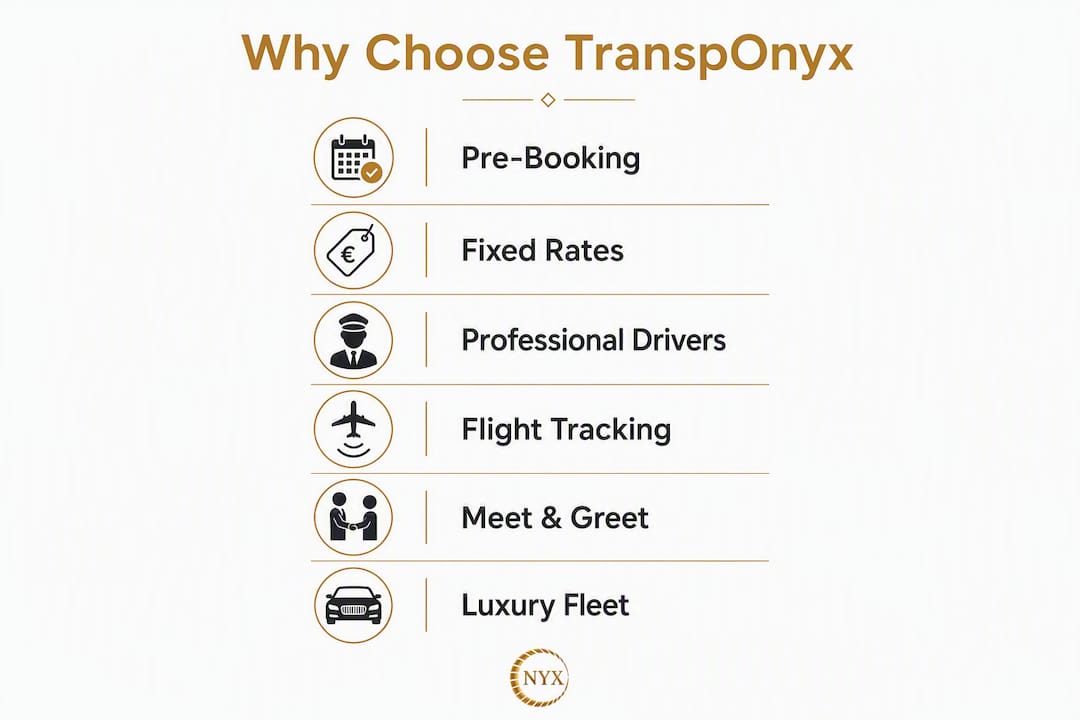
Cancellation policy and no-show conditions
Transponyx applies a structured cancellation policy with a deposit required at booking. Cancellations made within the specified refund window receive a full or partial refund depending on notice given. No-shows, or cancellations made after the window closes, forfeit the deposit. Specific refund windows and deposit amounts are confirmed at the time of booking and vary by vehicle category and journey type. Contact the team directly on +33 6 10 30 71 84 for the precise terms applicable to your reservation.
Are there additional fees on Riviera transfers?
The 2026 fixed rate covers the journey itself. Tolls on motorway routes (for example, the A8 towards Cannes or the Italian border) may be added where applicable. Professional access to terminal front areas at Nice NCE requires a vehicle access sticker and a personal Côté Ville identification card; Transponyx drivers hold the correct credentials, so no additional access fee is passed to the client. Waiting time beyond the included allowances (60 minutes at airports, 20 minutes elsewhere) may incur a supplementary charge, confirmed in advance.
Luggage policy and baggage allowances by vehicle
Each vehicle category accommodates a defined amount of luggage:
| Vehicle |
Passengers |
Luggage capacity |
| Standard Sedan |
Up to 3 |
3 standard suitcases |
| Business Sedan |
Up to 3 |
3 standard suitcases |
| Van 7 pax |
Up to 7 |
7 standard suitcases |
| Van 8 pax |
Up to 8 |
8 standard suitcases |
Oversized luggage, ski equipment or sports bags should be declared at booking so the correct vehicle is assigned. Child seats are available on request at no additional charge.
Why a chauffeur on the Riviera is worth the clarity
The French Riviera is not a place where transport improvisation pays off. During the Cannes Film Festival, the Monaco Grand Prix or MIPIM, road access tightens, parking disappears, and on-demand vehicles surge in price or simply are not available. A chauffeur with the right credentials and a fixed rate removes all of that uncertainty.

Transponyx operates 24 hours a day, seven days a week, covering Nice NCE to the full range of Riviera destinations. Typical journey times give a clear picture of what to expect:
| Route from Nice NCE |
Approximate distance |
Typical journey time |
| Monaco |
~20 km |
30 minutes |
| Cannes |
~30 km |
30 minutes |
| Antibes |
~20 km |
20–30 minutes |
| Menton |
~30 km |
— |
| Ventimiglia |
7 km |
— |
| San Remo |
~60 km |
60 minutes |
Times vary with traffic and event periods. Nice Côte d’Azur Airport sits approximately 7 km from the city centre, and while the tram T2 reaches Jean Médecin in 20–25 minutes for a single passenger travelling light, it is not a realistic option for groups, heavy luggage, or anyone with a meeting to reach on time.
The Côté Ville access card held by professional VTC drivers means Transponyx vehicles can use the terminal front pick-up areas directly, shortening the walk from arrivals considerably. For travellers with mobility needs or significant luggage, that detail alone justifies the booking.
The fleet covers every group size. A Standard Sedan suits a solo traveller or couple; a Van 7 pax or Van 8 pax handles a full conference delegation with luggage. Every vehicle carries Wi-Fi, air conditioning, chilled water and phone chargers as standard.
Reserve your Transponyx transfer for 2026
Transponyx offers guaranteed 2026 fixed per-vehicle rates with no hidden charges, professional licensed VTC drivers, and airport transfers from Nice NCE that include flight monitoring and 60 minutes of free waiting time. For major Riviera events, book at least two to four weeks in advance to secure your preferred vehicle category and guaranteed terminal access. The team handles event logistics for the Cannes Film Festival, Monaco Grand Prix, Cannes Lions and MIPIM, including advice on access windows and driver positioning.
To reserve, call +33 6 10 30 71 84, message via WhatsApp on +33 7 67 78 10 26, or complete the booking form at https://transponyx.com. Review the top luxury chauffeur options for 2026 if you want a side-by-side comparison before confirming.
FAQ
What does a Transponyx airport transfer include?
Every booking includes a 2026 fixed per-vehicle rate, flight monitoring, meet-and-greet with a named driver, luggage assistance, and 60 minutes of free waiting time at Nice NCE.
How far in advance should I book for Cannes or Monaco events?
Book at least two to four weeks ahead for the Cannes Film Festival, Monaco Grand Prix, MIPIM or Cannes Lions to secure your vehicle category and terminal access.
Does the fixed rate cover tolls and airport access fees?
The 2026 fixed rate covers the journey. Motorway tolls may be added where applicable. Transponyx drivers hold the Côté Ville access credentials for Nice NCE terminal front pick-up, so no airport access surcharge is passed to the client.
Which vehicle fits a group of seven passengers?
The Van 7 pax accommodates up to seven passengers with corresponding luggage. The Van 8 pax handles up to eight. Both are available 24/7 and carry the same onboard amenities as the sedan categories.
Call +33 6 10 30 71 84, send a WhatsApp message to +33 7 67 78 10 26, or use the booking form at https://transponyx.com.