par Daniel AIT GOUGAM | Août 18, 2026 | news
A private tour beats a group bus tour whenever travel time matters, the party has two or more people, or the day depends on precise timing, such as reaching Nice NCE for a flight or the Cannes Film Festival red carpet on schedule. The verdict rests on three concrete points:
- Per-vehicle cost: split among four passengers, a private car often prices out close to a coach seat.
- Itinerary control: no fixed stops, no waiting for forty other passengers to reboard.
- Comfort and time saved: door-to-door pickup removes the queuing and walking that eats into a coach tour’s clock.
Solo travellers on a strict budget, and those who enjoy the social buzz of a full coach, are the exception. For everyone else, the maths and the experience both point the same way.
Private tour vs group bus tour: a side-by-side view
The single biggest factor is time value against per-vehicle cost, and the two are connected. A group bus tour prices per seat; a private tour prices per vehicle, so the more people in the car, the closer the two figures sit. On the Côte d’Azur, published rates from operators like Sydney Tour Guide show a similar pattern to what applies locally: a private vehicle stops looking expensive the moment there are three or four people to share it.
| Dimension |
Private tour |
Group bus tour |
| Cost |
Per vehicle, split among passengers |
Per person, fixed regardless of group size |
| Flexibility |
Full control of stops and pace |
Fixed itinerary and schedule |
| Personalisation |
Guide tailors content to the group |
Generic script for the coach |
| Comfort |
Door-to-door, private cabin |
Shared seating, communal stops |
| Time efficiency |
No pickup loops or reboarding waits |
Multiple hotel stops, group waiting |
| Suitability |
Couples, families, small groups, business travellers |
Solo travellers, budget-conscious, social travellers |
| Social aspect |
Limited to your own party |
Meeting other travellers |
Group bus fares in comparable markets typically range from moderate to higher per person, according to Sydney Tour Guide’s operator data. A private vehicle carrying four people at a comparable fixed rate can undercut that on a per-head basis while adding flexibility the coach simply cannot offer.
How the maths works: per-person and per-vehicle scenarios
The tipping point almost always arrives with the third or fourth passenger. A solo traveller pays the full private rate alone, which usually makes a shared coach the cheaper route. Add a partner, and the gap narrows sharply. Add two children, and the private vehicle frequently wins outright once you weigh in the time saved not waiting at hotel pickup points.
| Party size |
Group bus tour (per person) |
Private tour (per vehicle, typical split) |
| Solo traveller |
Lower total cost |
Highest per-person cost |
| Couple |
Moderate combined cost |
Comparable or slightly higher |
| Family of four |
Costs multiply per seat |
Often comparable, sometimes cheaper |
| Group of six |
Costs multiply per seat |
Frequently cheaper per head |
- A family of four heading from Nice to Monaco for the day will often find a private car and a coach land within a similar total cost, but only one avoids three separate hotel pickups.
- A group of six splitting a Van 7 pax for a Nice to Saint-Tropez run typically comes out ahead of six individual coach seats once fixed 2026 rates are applied.
Always check the fixed 2026 rate for your specific route, since Nice NCE to Monaco and Nice to Saint-Tropez carry different pricing structures depending on distance and vehicle category.
What you actually get: pace, access, and memorable moments
A coach itinerary allocates fifteen minutes at a viewpoint, whether the light is right or not. A private tour stops when the light is right, and moves on when the group is ready, not when the driver’s sheet says so.
Group tours favour brochure stops chosen for parking capacity, not scenery. Private drivers know a handful of overlooks and quiet corners that a forty-seat coach could never reach, and wine country operators report the same pattern with boutique wineries too small to host a coach group but perfectly suited to a private party of four. Longer, unhurried tastings follow naturally once the schedule isn’t shared with forty strangers.

Practical logistics: pickups, vehicles, child needs and comfort
Door-to-door pickup removes the single biggest hidden cost of a coach tour: standing outside a hotel lobby at 7am waiting for a vehicle that still has three more stops before yours.
- Hotel door pickup rather than a designated meeting point
- Full luggage space with no shared overhead racks
- Wi-Fi, air conditioning and phone chargers as standard
- Bathroom stops on your own schedule, not the group’s
- Properly fitted child seats available on request
Vehicle category matches party size directly. A Standard Sedan suits up to three passengers for a Nice to Cannes transfer, roughly 35 to 45 minutes depending on traffic. A Business Sedan offers the same capacity with a premium finish for business travellers attending MIPIM or Cannes Lions. Families or small groups of up to seven fit a Van 7 pax, and larger parties of up to eight use a Van 8 pax, both suited to journeys such as Nice NCE to Monaco, which typically takes 25 to 35 minutes by direct road. Coordinating a similar transfer with young children benefits from the same seat-fitting logic that family cycling operators apply when matching child seats to journey length and nap schedules.
Which travellers should pick which option
- Solo budget traveller: a group bus tour usually wins on cost, since there’s no vehicle to split; solo travel forums consistently back this up.
- Social traveller: group tours offer the chance to meet other travellers, which a private car cannot replicate.
- Couple on a short break: private tours give privacy and pace control worth the modest cost difference.
- Family with children: private vehicles handle child seats, nap timing and luggage far better than a shared coach.
- Group of friends: splitting a Van 7 pax or Van 8 pax often beats individual coach fares.
- Business traveller with event schedules: private transport is close to essential during the Monaco Grand Prix or Cannes Film Festival, when road closures make fixed coach timetables unreliable.
When private tours are not the right choice and warning signs to watch
A private tour makes little sense for a solo traveller on a strict budget, or anyone happy to sacrifice flexibility for a lower headline price. Group bus tours can disappoint too, particularly when operators overcrowd for extra revenue or bury fees in the fine print.
- Watch for vague vehicle class descriptions that don’t specify sedan or van capacity.
- Be wary of quotes that don’t state clearly whether the price is per person or per vehicle.
- Check cancellation terms before booking; shared tours often bundle entrance fees and meals, which simplifies budgeting but can hide the true per-person cost.
- Confirm the driver holds a proper licence; unregistered operators are a genuine safety risk on Riviera roads.
- Surprise per-person surcharges added after booking are a clear red flag on either type of tour.
Decision checklist and questions to ask before you book
- Confirm party size and whether the quote is per vehicle or per person.
- Ask which vehicle category will be used: Standard Sedan, Business Sedan, Van 7 pax or Van 8 pax.
- Check whether door-to-door hotel pickup is included.
- Confirm child-seat availability if travelling with young children.
- Ask whether detours or extra stops are permitted within the fixed rate.
- Verify driver licensing and insurance cover before paying a deposit.
Sample questions worth sending by email or chat: “Is the quoted price per vehicle or per person?” and “Which vehicle category will be used for a group of five?” For multi-stop itineraries or tight event timetables such as MIPCOM week, call a local operator directly rather than relying on an online quote form.
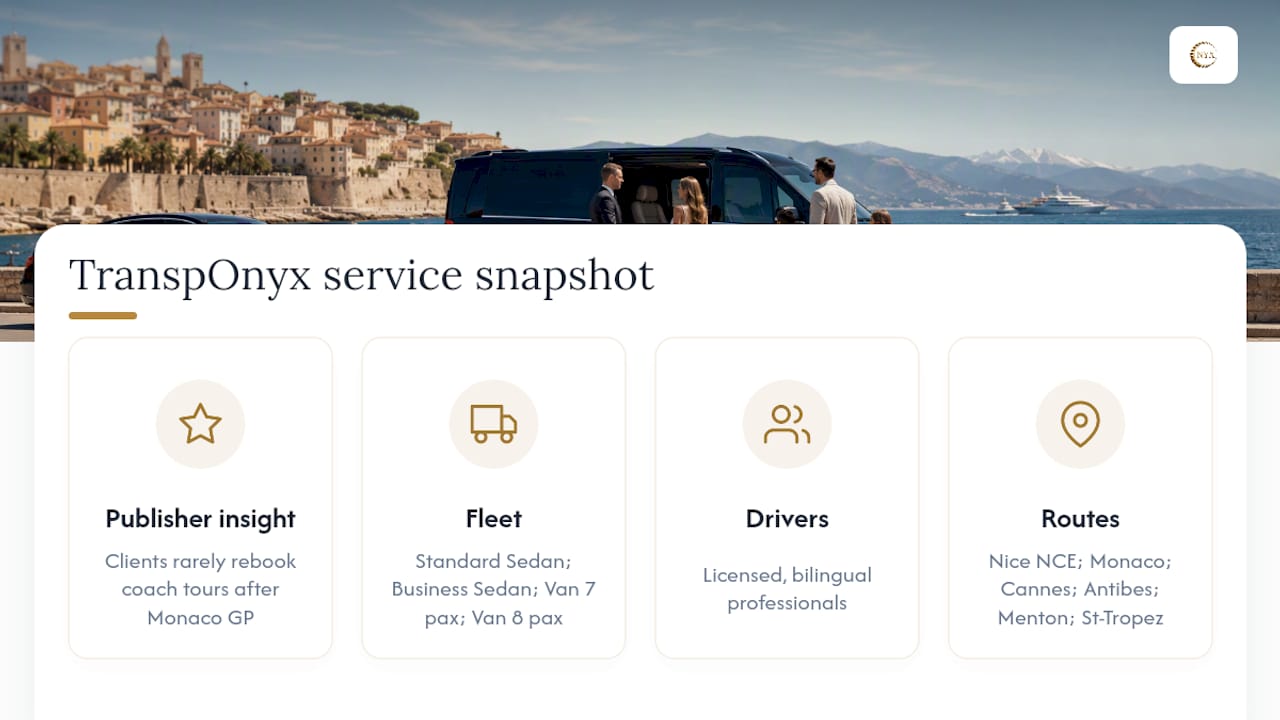
Publisher viewpoint: Riviera private-chauffeur operator experience
Years of running private transfers along this coast show the same pattern every high season: clients who try a coach tour once during the Monaco Grand Prix rarely book one again. Fleet variety matters, from the Standard Sedan and Business Sedan through to the Van 7 pax and Van 8 pax, all driven by licensed, bilingual professionals on fixed 2026 rates covering Nice NCE to Monaco, Cannes, Antibes, Menton and Saint-Tropez. Call TranspOnyx on +33 6 10 30 71 84 or visit Transponyx to check availability for your route.
Book a private vehicle for your next Riviera trip
The comparisons above assume you’re choosing between a scheduled coach and a private car booked independently. TranspOnyx removes the guesswork from that second option entirely: fixed 2026 per-vehicle rates, no per-person surcharge once your group is aboard, and a fleet built around exactly the categories this article has covered.
Whether it’s a Standard Sedan for a couple heading from Nice NCE to Antibes, or a Van 7 pax for a family covering Monaco and Menton in one day, every rate is confirmed at booking with no surge pricing. Drivers are licensed VTC professionals, bilingual in English and French at minimum, and flight monitoring comes as standard on every airport transfer. Child seats fit on request, and free waiting time (60 minutes for airport pickups, 20 minutes elsewhere) is built into every booking.
Check fixed rates for a private chauffeur around Antibes for your specific route, or call +33 6 10 30 71 84 to confirm child-seat fitment and itinerary flexibility before you travel.
Sources
FAQ
What are the disadvantages of group bus tours?
Group bus tours run fixed itineraries with limited stop time, can feel overcrowded during peak season, and leave little room for personal requests or spontaneous detours.
Is a private tour always more expensive than a group bus tour?
Not once split per vehicle; for a family of four or a group of six, a private car often costs a similar amount per person as a coach seat, sometimes less.
How much time does a private tour actually save?
It varies by route, but avoiding multiple hotel pickups and coach reboarding typically saves the most time on short, event-driven days such as Cannes Film Festival travel.
Which is better for a solo traveller on a budget?
A group bus tour usually wins on straight cost for solo travellers, since there’s no vehicle price to divide among fellow passengers.
Can TranspOnyx handle child seats and family bookings?
Yes, TranspOnyx fits child seats on request across its Van 7 pax and Van 8 pax categories, and fixed 2026 rates apply to all Riviera family bookings.

par Daniel AIT GOUGAM | Août 17, 2026 | news
Tipping a VTC chauffeur in France is optional, never obligatory, but a modest gratuity is customary when the service goes beyond a routine transfer. For a short city journey, a modest amount is a fair, unremarkable gratuity. For an airport transfer or a long cross-border run into Italy, €5 to €10 is the common range, and drivers report figures up to €30 for exceptional service on premium bookings, according to industry guidance from the VTC sector. For very long or multi-stop journeys, working from roughly 10% of the fare gives a sensible benchmark.
Nothing in French law or in VTC contracts compels a passenger to tip. It sits entirely within Riviera custom, alongside the same voluntary etiquette you would find in a well-run hotel or restaurant on the Côte d’Azur. Most VTC apps, including Uber, now build a tipping function directly into the ride receipt, which means the gesture costs you nothing more than a few taps once the car has pulled away.
Pourboire chauffeur VTC: how to tip through the app
Tipping through an app takes less time than settling a café bill, and most platforms structure the process the same way.
- Open the completed trip receipt in the app once the journey ends.
- Select the tip option, usually displayed alongside the fare breakdown.
- Choose a preset amount or enter a custom figure.
- Confirm payment; the amount is added to the card or method already used for the fare.
- Where the app allows it, revisit the same trip later to add or adjust a tip.
Uber’s own guidance confirms that passengers can tip immediately after a ride or return within a window of up to 30 days to do so, which is useful if you only decide, once back at the hotel, that the driver deserves recognition for hauling three suitcases up a steep Cannes side street. The same guidance states that tips go directly to the driver with no platform service fee deducted, a policy that matters because it means the gesture reaches the person who earned it rather than disappearing into a corporate margin.
- If your app does not display a tip option in France, the driver has likely not enabled it, or your region has not rolled out the feature.
- In that case, cash remains the simplest fallback, handed over discreetly as you leave the vehicle.
- Corporate or hotel-billed transfers rarely include an in-app tip prompt, so cash is often the only practical route.
How much to tip a VTC chauffeur: real Riviera scenarios
Figures shift with journey length, luggage, and how demanding the timing was. A short Nice city hop that takes fifteen minutes calls for a different gesture than a two-hour transfer to a ski resort.

| Scenario |
Typical tip |
Notes |
| Short city trip (Nice, Antibes) |
€1–€3 |
Rounding up the fare is common |
| Nice NCE to Monaco or Cannes |
€5–€10 |
Reflects tolls, distance, punctuality |
| Long-distance to Italy or Provence |
10% of fare |
Multi-hour journeys, border crossings |
| Luggage-heavy assistance |
€5–€15 |
Ski equipment, multiple bags, tight timing |
| Exceptional service or major event |
Up to €30 |
Cannes Film Festival, Monaco Grand Prix |
The average tip left via app in France sits around €2.10, with roughly 3.87% of trips in the Paris region receiving one at all. That national average understates what happens locally during the Riviera’s biggest weeks. Demand during the Cannes Film Festival or the Monaco Grand Prix tends to push both the frequency and size of gratuities upward, as drivers juggle tighter schedules and higher-stakes punctuality. For routine journeys, rounding the fare to the nearest five or ten euros feels more natural than calculating a strict percentage; reserve the 10% guideline for longer transfers where the fare itself runs into three figures.
Cash or in-app tip: which suits your journey?
Each method serves a different kind of traveller, and the right choice often depends on how the fare itself was arranged.
- Cash puts money in the driver’s hand immediately, with no waiting for an app payout cycle.
- Cash also allows several passengers sharing a Van 7 pax or Van 8 pax booking to pool a tip discreetly without the primary card holder seeing the amount on a statement.
- In-app tipping leaves a clean record, useful for business travellers reconciling expenses after a MIPIM or Cannes Lions trip.
- In-app tipping means you can wait until you have judged the whole journey, including how the driver handled Riviera traffic near Menton or a late flight into Nice NCE.
- Drivers sometimes prefer app tips for traceability, though cash remains welcome and, for many, arrives faster.
For travellers landing at Nice Côte d’Azur Airport with a fixed-rate transfer already booked to Monaco or Saint-Tropez, carrying a small amount of euro cash covers the tip question without depending on mobile signal or app availability the moment you land.
When tipping is appropriate, and how to handle a request
Certain moments on the Riviera call for a tip almost by convention. A chauffeur who spends twenty extra minutes tracking a delayed flight, or who carries four cases down from a Cannes apartment with no lift, has gone beyond the fixed fare you already paid. Late-night pickups from Nice NCE after the last flights land, and journeys where the driver navigates a diversion around an event closure near the Promenade des Anglais, both sit in the same category.

Routine, on-time transfers with no luggage complications do not require a tip, and no professional chauffeur in France should treat the absence of one as a slight. If a driver does ask directly, the simplest response is a polite acknowledgement that the fare covers the service, with a tip offered only when you choose to give one. Some drivers place a small, unobtrusive card near the seat mentioning that tips are appreciated, a low-key prompt that Riviera operators increasingly favour over asking outright.
What Riviera chauffeurs actually say about tips
Drivers running the Nice NCE to Monaco corridor or ferrying festival guests through Cannes during the film festival describe tipping patterns that shift sharply with the calendar. During ordinary weeks, tips arrive occasionally and modestly. During the Cannes Film Festival or Monaco Grand Prix, when demand outstrips supply and every transfer runs against a tight schedule, gratuities become both more frequent and larger, often reflecting relief at a driver who managed road closures without a missed connection.
- Cash in hand remains popular with drivers who want funds immediately after a shift.
- App tips are preferred by others precisely because they are traceable and cannot be lost or miscounted at the end of a long night.
- A small, tactfully placed sign mentioning that tips are appreciated is common practice; drivers using this approach report earning an extra €10 to €15 per day compared with saying nothing at all.
- Luggage handling draws disproportionate attention. Training material for the sector notes that baggage-related friction accounts for nearly 28% of client complaints, which is precisely why a driver who handles four suitcases without being asked twice tends to be remembered, and tipped, favourably.
Pro Tip: If you are travelling with skis or golf clubs to Isola 2000 or Auron, mention it at booking. A driver who has already planned boot space rarely needs reminding, and that kind of preparation is usually the difference between an average transfer and one worth a tip.
An honest view on tipping culture and the Riviera
Tipping a VTC chauffeur in France will never carry the weight of an American service charge, and it should not. What strikes me, looking at how unevenly tips are actually distributed, roughly a majority of app rides do not receive a tip, is that the gesture still means something precisely because it is rare. A driver who has spent thirty years navigating the Promenade des Anglais during Grand Prix week, or who has learned exactly which Cannes side streets close for a red-carpet screening, is offering expertise that a fixed 2026 rate does not fully capture. A few euros acknowledges that without pretending it is compulsory.
I would rather see a passenger carry a handful of small notes than fumble with an app at 2am after a delayed flight into Nice NCE. TranspOnyx drivers, working fixed 2026 rates across Standard Sedan, Business Sedan, Van 7 pax, and Van 8 pax vehicles, are paid properly regardless of any tip, which is exactly why a tip stays what it should always be: a genuine thank you, not a correction to an underpaid fare. If you are booking a transfer to Monaco, Cannes, or further afield towards Saint-Tropez, TranspOnyx can be reached on +33 6 10 30 71 84 for a fixed quote before the driver ever pulls up, which removes half the uncertainty around tipping in the first place.
For anyone planning a Riviera arrival this year, booking a confirmed airport transfer to Nice removes the guesswork around fare, timing, and luggage handling long before the tipping question even arises.
Sources
FAQ
What is a fair Uber tip in France?
Around €1 to €5 for a short trip is typical, rising to €5 to €10 for longer journeys, though the national average sits at €2.10.
Do you have to leave a tip in France?
No. Tipping is a voluntary custom across French hospitality and transport, not a legal or contractual requirement.
Is it mandatory to tip a taxi driver in France?
No. Taxi and VTC gratuities are both discretionary; French law does not require a tip for either service.
Are tips included in the price in France?
No, prices quoted for taxis and VTC transfers, including TranspOnyx’s fixed 2026 rates, do not include a service charge or automatic gratuity.

par Daniel AIT GOUGAM | Août 16, 2026 | news
Avoid on-demand airport taxis for Riviera arrivals. Pre-book a fixed-price private chauffeur or VTC transfer and you gain price certainty, a guaranteed meet-and-greet, and flight monitoring that no taxi rank or ride-app can match. For an immediate booking, contact Transponyx on +33 6 10 30 71 84 or visit transponyx.com.
Three reasons concierges and travellers choose fixed-price private transfers over on-demand taxis:
- Price certainty: your 2026 rate is confirmed at booking, with no meter running and no surge multiplier applied after a delayed flight.
- Guaranteed meet-and-greet: a named, licensed VTC driver waits in the arrivals hall, not in a queue outside that may already be thirty minutes long.
- Flight monitoring: the chauffeur tracks your actual landing time, so a late arrival or a gate change does not leave you stranded.
Why on-demand airport taxis create friction for Riviera arrivals
The problems with airport taxis on the Côte d’Azur are structural, not occasional. Nice Côte d’Azur Airport (NCE) handles millions of passengers a year, yet the authorised taxi rank operates on a first-come, first-served basis with no capacity guarantee. During event peaks, the queue may extend significantly beyond the terminal doors.
The core disadvantages of taxi services fall into three categories.
Availability and timing. Early-morning and late-night flights land when the taxi pool is thinnest. A late-night arrival during the Cannes Film Festival can mean a long wait at the taxi rank before a vehicle appears. Ride-hailing apps face the same demand spike and respond with surge pricing.
Cost unpredictability. Metered fares are not fixed. Heavy traffic on the A8 motorway between Nice and Cannes, or on the Moyenne Corniche into Monaco, adds time directly to the bill. Chauffeur services offer fixed, pre-agreed pricing and flight monitoring; taxis use metered fares and do not routinely monitor flights, which increases the risk of waiting or surge costs.

Vehicle and driver standards. Taxi fleets are mixed. A family of four travelling from NCE to Saint-Tropez with four large cases and a pushchair cannot rely on a standard saloon appearing at the rank. Driver language skills vary considerably, which matters when a concierge needs to relay specific hotel access instructions.
Three scenarios where on-demand taxis regularly fail Riviera travellers:
- A late-night arrival bound for Monaco during the Grand Prix weekend finds the taxi rank depleted and ride-app surge pricing at double the standard rate.
- A group of six delegates arriving for MIPIM in Cannes cannot fit into a single taxi and must split across two vehicles, losing the group and doubling the cost.
- A family with infant seats required for the transfer to Saint-Tropez discovers that no taxi at the rank carries a child seat, delaying departure by over an hour.
Advance booking and pre-planning create greater reliability and reduce on-arrival uncertainty compared with standing at a taxi rank or relying on on-demand apps.
Riviera route times, distances and what to budget for in 2026
The table below gives typical distances and journey-time ranges for the key corridors from Nice NCE under normal traffic conditions. Times extend significantly during Cannes Film Festival (May), Monaco Grand Prix (May), Cannes Lions (June) and MIPIM (March).
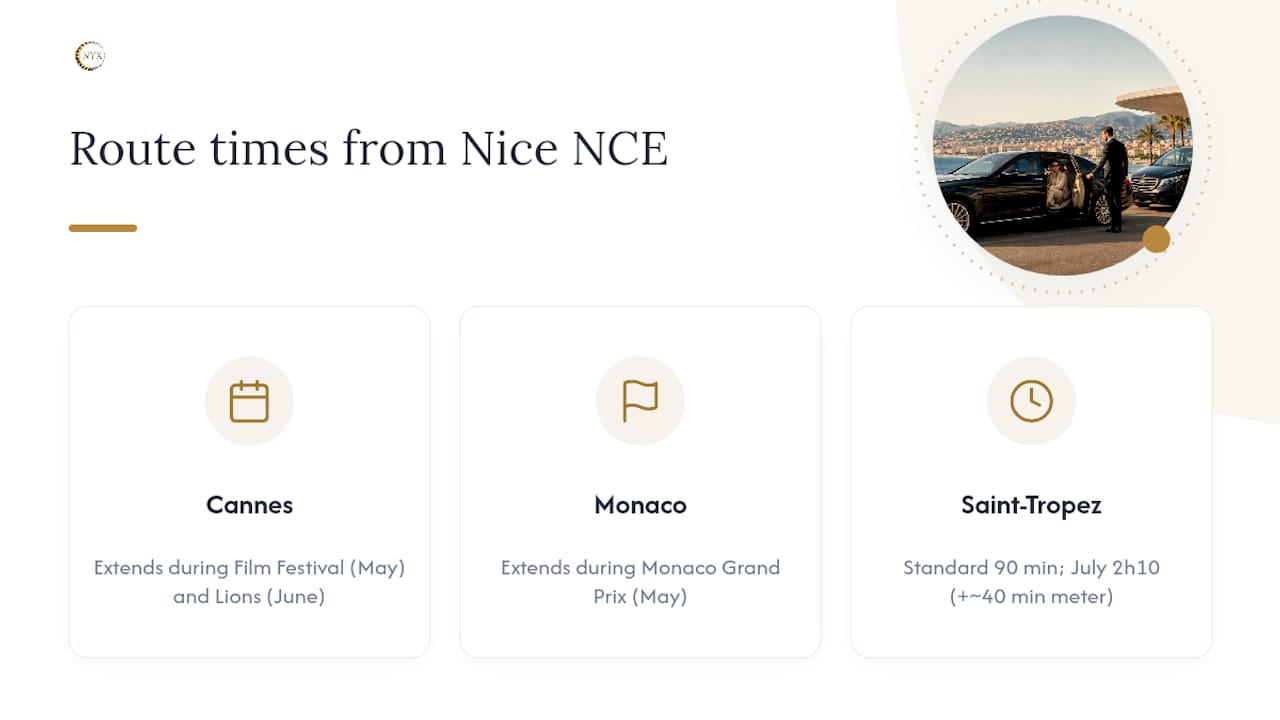
With a metered taxi, every additional minute in traffic is an additional cost. A transfer to Saint-Tropez that takes two hours and ten minutes in July traffic rather than the standard ninety minutes adds roughly 40 minutes of meter time to an already substantial fare. A private airport transfer delivers predictable total cost and reduced arrival stress compared with improvised taxi or ride-app options, precisely because the price does not move when the traffic does.
During the Cannes Film Festival and Monaco Grand Prix, pre-booked chauffeur capacity often sells out early and travellers who wait risk long delays or inability to secure appropriate vehicles. Booking a private transfer well in advance is advisable during these periods; corporate delegations typically allow even more lead time.
For travellers attending luxury sports events on the Riviera, fixed-price transfers are now considered standard practice rather than an upgrade.
What hotels, concierges and travellers must confirm when booking a transfer
A confirmed booking is only as reliable as the information it contains. Missing one field at reservation stage is the most common cause of on-arrival friction.
Essential fields to confirm at booking:
- Fixed 2026 rate, confirmed in writing before payment
- Passenger flight number and scheduled arrival time
- Free waiting allowance (60 minutes for all NCE airport pickups with Transponyx; 20 minutes for any other address)
- Vehicle class: Standard Sedan (up to 3 passengers), Business Sedan (up to 3 passengers, premium finish), Van 7 pax, or Van 8 pax
- Total passenger count and number of large items of luggage
- Child seat requirement (requested at booking, not on arrival)
- Preferred driver language beyond English and French
- Direct contact method: phone and WhatsApp number for the driver or dispatcher
A concierge reservation note might read: “Flight EZY1234 arriving NCE 22:10, 3 pax + 3 large cases, Business Sedan, child seat x1, WhatsApp confirmation to +33 6 10 30 71 84.”
End-to-end booking and confirmation for a private VTC transfer with Transponyx typically takes under ten minutes by phone or WhatsApp, with written confirmation sent immediately. An on-demand taxi offers no pre-confirmation, no vehicle guarantee, and no fixed price. The step-by-step process for booking a VTC transfer on the French Riviera is straightforward when the supplier has a direct contact channel.
Pro Tip: Attach the chauffeur’s WhatsApp number to the guest’s reservation file. When a flight diverts or a connection is missed, the concierge can update the driver in seconds without going through a call centre.
For premium airport transfer tips tailored to Riviera travellers, Transponyx publishes a practical guide covering luggage allowances, ski resort transfers and corporate account setup.
How pre-booked private chauffeurs reduce risk during major Riviera events
The Riviera’s event calendar concentrates demand on a handful of corridors within very short windows. The Cannes Film Festival, Monaco Grand Prix, Cannes Lions and MIPIM each bring thousands of high-value travellers through NCE within days of one another. Taxi supply does not scale to meet that demand.
Pre-booked private transfers manage event risk through four mechanisms:
- Reserved capacity: the vehicle and driver are allocated to your booking before you land, regardless of what else is happening at the airport.
- Flight monitoring: if your flight is delayed by ninety minutes, the driver knows before you do and adjusts without any action required from the guest or concierge.
- Prioritised terminal positioning: a licensed VTC driver meets you in the arrivals hall with a name board, not in an external queue competing with hundreds of other passengers.
- Pre-allocated routing: during the Grand Prix, certain roads into Monaco are closed or restricted. A professional chauffeur with local knowledge plans the route in advance; a taxi driver may not.
The contrast is clearest at the Cannes Film Festival. A concierge who pre-booked a Business Sedan for a producer arriving on a late flight from Los Angeles via Paris found the driver waiting in arrivals, flight already tracked, luggage space confirmed. A guest at the same hotel who had not pre-booked spent fifty minutes in the taxi queue before reaching a vehicle, arriving at the hotel after midnight. Transport scarcity during Cannes festivals is a documented pattern, not an anomaly.
How Transponyx meets Riviera travellers’ needs
Industry observers note that the modern luxury traveller on the French Riviera increasingly purchases arrival certainty: a fixed, transparent price and a meet-and-greet that extends the flight into a coherent itinerary. Transponyx is built around exactly that standard.
Service features confirmed for every booking:
- Fixed 2026 rates confirmed at booking, per vehicle, with no surge pricing
- 24/7 operation, 365 days a year
- Flight monitoring on every airport transfer
- Licensed VTC drivers, bilingual in English and French as a minimum
- Meet-and-greet in the arrivals hall with a name board
- 60 minutes free waiting time on all airport pickups; 20 minutes for any other address
- Wi-Fi, air conditioning, chilled water and phone chargers in every vehicle
- Child seats available on request
Fleet summary:
All vehicles are Mercedes-Benz. Some drivers also speak Italian, Spanish, Russian or Arabic, which matters for international delegations arriving for MIPCOM or Cannes Lions.
Concierges and travel managers treat transfer suppliers as part of the property’s risk management; named suppliers with direct contact are retained for events and corporate travel because they reduce last-mile failure rates. Transponyx accepts corporate accounts and can be added to hotel reservation systems with a single contact entry.
Contact for concierges and corporate bookers: Transponyx, phone +33 6 10 30 71 84, WhatsApp +33 7 67 78 10 26, Transponyx.
What concierges are saying about transfers in 2026
Concierges working along the Riviera corridor from Menton to Saint-Tropez consistently report the same pattern: the transfers that generate guest complaints are the ones arranged on arrival, not the ones pre-booked with a named supplier. The recurring failures are vehicle mismatch, language barriers, and the absence of any flight tracking when a connection is missed. The fix is procedural. Including the chauffeur’s direct WhatsApp number on the guest’s reservation confirmation means that any change, from a delayed flight to a last-minute luggage addition, is resolved before the guest reaches the arrivals hall. Transponyx at +33 6 10 30 71 84 and Transponyx is the contact concierges on the Côte d’Azur now include as standard in their reliable daily commute and transfer workflows.
Fixed-price Riviera transfers, confirmed and ready to book
Transponyx offers fixed 2026 rates on every route from Nice NCE, with flight monitoring, meet-and-greet and a choice of Standard Sedan, Business Sedan, Van 7 pax or Van 8 pax. There are no hidden charges, no surge multipliers, and no uncertainty about who is waiting for you in arrivals.
To book or to set up a corporate account for your hotel or travel agency, call +33 6 10 30 71 84, message WhatsApp +33 7 67 78 10 26, or visit the Nice airport transfer booking page. For a full comparison of service tiers and 2026 fixed rates, the luxury chauffeur services comparison page covers all four vehicle categories. Corporate accounts for hotels and travel agents can be arranged directly by phone with no minimum commitment.
Sources
Bookmark Transponyx contact details for quick reference: phone +33 6 10 30 71 84, WhatsApp +33 7 67 78 10 26, Transponyx.
FAQ
Why should you avoid on-demand airport taxis on the French Riviera?
On-demand taxis offer no fixed price, no flight monitoring, and no vehicle guarantee. During major event peaks, queues at Nice NCE can be very long and appropriate vehicles may be unavailable.
What is the free waiting time included with a private transfer from Nice NCE?
Transponyx includes 60 minutes of free waiting time on all airport pickups, so a delayed flight or a long baggage reclaim does not generate additional charges.
How long does booking a private VTC transfer take compared with a taxi?
A confirmed VTC booking with Transponyx takes under ten minutes by phone or WhatsApp, with written confirmation sent immediately. An on-demand taxi provides no pre-confirmation, no fixed price, and no vehicle guarantee.
Which vehicle should a group of six book for a transfer from Nice to Cannes?
A group of six requires a Van 7 pax, which accommodates up to seven passengers in a Mercedes-Benz vehicle with Wi-Fi, air conditioning, chilled water and phone chargers. Booking in advance confirms the vehicle is allocated before the flight lands.
When should concierges book transfers during Riviera event periods?
During the Cannes Film Festival, Monaco Grand Prix, Cannes Lions and MIPIM, booking well before arrival is advisable, as pre-booked chauffeur capacity on key corridors sells out early; corporate delegations typically allow even more lead time.
par Daniel AIT GOUGAM | Août 15, 2026 | news
For private chauffeur and VTC services on the French Riviera, regional coverage means the specific geographical area and named routes where a licensed operator accepts prior bookings, from Nice Côte d’Azur Airport (NCE) to Monaco, Cannes, Antibes, Menton and Saint-Tropez, through to Alpine ski resorts such as Isola 2000, Auron and Valberg, and cross-border transfers into Italy via Ventimiglia and San Remo. It is not a marketing phrase, but a defined service boundary that determines whether your driver can legally pick you up, where they can take you, and at what confirmed rate.
Transponyx covers this full territory with four Mercedes-Benz fleet categories: Standard Sedan, Business Sedan, Van 7 pax and Van 8 pax, all at 2026 fixed rates confirmed at booking. Reach the team on +33 6 10 30 71 84 or at Transponyx.
Representative bookings within that coverage include:
- Nice NCE to Monaco (approximately 20 km, 25–35 minutes)
- Nice NCE to Saint-Tropez (approximately 100 km, 90–120 minutes depending on traffic)
- Cannes to Antibes (approximately 12 km, 15–25 minutes)
- Nice to Isola 2000 ski resort (approximately 90 km, 90 minutes)
- Nice NCE to Ventimiglia, Italy (approximately 45 km, 40–55 minutes)
What does a provider’s regional coverage actually include?
A credible coverage claim has four components: geography, service types, fleet capacity and the way those commitments are published.
Geography and named routes are the foundation. On the Côte d’Azur, VTCs operate by prior booking at fixed prices for airport transfers and day hires, and they differ from taxis precisely because they cannot be hailed in the street and charge no meter fare. A provider’s stated coverage should list specific towns and airports, not vague zones. Transponyx publishes named destinations: NCE, Monaco, Cannes, Antibes, Menton, Saint-Tropez, Provence and cross-border Italy.
Service scope within that geography matters equally. Point-to-point airport transfers, by-the-hour hire, multi-stop day excursions, event transfers for occasions such as the Cannes Film Festival or Monaco Grand Prix, and yacht-side pickups at Antibes or Villefranche all require different scheduling and fleet allocation. A provider whose coverage list omits service types is giving you only half the picture.

Fleet categories determine capacity and pricing. A VTC vehicle must carry between four and nine seats, which in practice means the Standard Sedan and Business Sedan suit groups of up to three, while the Van 7 pax and Van 8 pax serve larger parties or those travelling with substantial luggage. Vehicle age expectations in the commercial sector typically run to six years or fewer, though the regulatory minimum is set by the operator’s insurance and fleet policy.
How coverage is published is the final test. Reputable providers list routes, fleet categories and 2026 per-vehicle rates on a public booking page or supply them directly to B2B accounts. If a provider cannot send you a written rate and route confirmation before you commit, that is a gap in their coverage documentation, not a gap in your knowledge.
French regulations that define what VTC coverage may legally include
French law shapes every coverage claim a VTC operator can make, and bookers who understand the framework are far harder to mislead.
The VTC register and reservation requirement are the starting point. Operators must be registered on the national VTC register and must demonstrate professional aptitude and continuous training. Every journey must be booked in advance; a VTC cannot respond to a street hail or a spontaneous wave from the pavement.
A VTC driver is legally defined as a professional who transports passengers on prior reservation in a vehicle with four to nine seats. Operating without registration on the VTC register, or accepting a journey without a prior booking, is not a coverage gap — it is a criminal offence under French transport law.
The carte professionnelle de conducteur VTC is the driver’s individual licence. Prefectures issue and renew it, and the application process has been digitalised through prefectural digital services. Drivers must display it; bookers should ask to see it.
Insurance for paid passenger transport is a separate obligation from standard motor insurance. A vehicle covered only by a personal policy is not legally operating as a VTC, regardless of what its driver claims.
Airport and station rules are specific. A VTC may wait at Nice NCE or a rail station for a reserved client, but only for a limited period before pickup and only with proof of reservation available for inspection. Prefectural guidance is explicit: cruising for passengers, soliciting clients outside a booking, or waiting without a reservation document are all prohibited.
Penalties for violations include substantial fines, licence suspension and vehicle immobilisation. For serious or repeated offences, criminal sanctions apply.
What regional coverage means in practice for bookers and concierges
Knowing the legal framework is one thing. Translating it into a smooth booking is another.
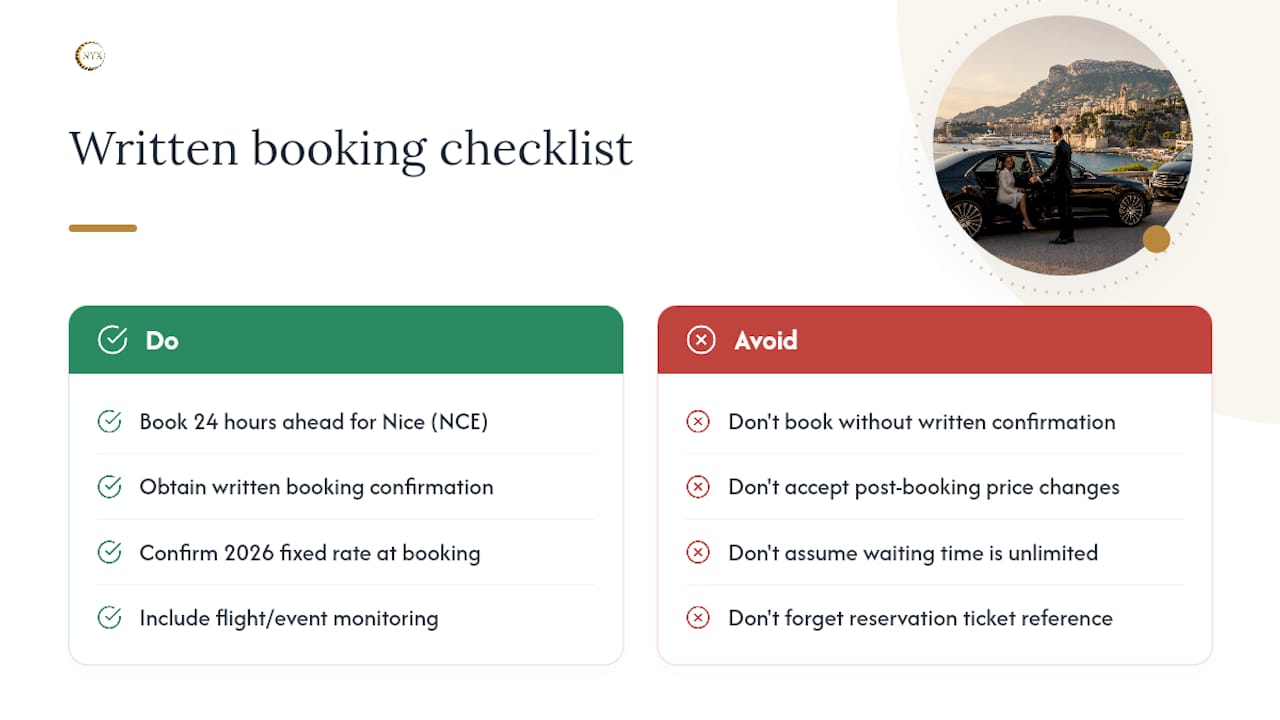
Advance booking is not optional; it is the legal basis of the service. For airport transfers at Nice NCE, booking 24 hours ahead is standard practice, though Transponyx accepts shorter notice subject to availability. For event transfers during the Monaco Grand Prix, MIPIM, Cannes Lions or MIPCOM, corporate accounts and concierge desks typically block vehicles days or weeks in advance. The 2026 fixed per-vehicle rate is confirmed at the moment of booking, with no surge pricing applied later.
Proof of reservation has a defined legal content. The booking confirmation must include the provider’s name and contact details, the client’s name and contact, the reservation date and time, and the pickup date, time and location. Transponyx issues this automatically on every booking.
Flight monitoring and waiting time are the operational commitments that distinguish a professional operator from a casual one. Transponyx monitors every inbound flight at NCE and adjusts driver arrival accordingly. Free waiting time is 60 minutes on all airport pickups and 20 minutes at any other address. Charges apply only beyond those windows, and the policy is stated in writing at booking.
For concierges and corporate travel managers, a written booking checklist should confirm: route and destination, fleet category, 2026 fixed rate, flight or event monitoring inclusion, free waiting time policy, driver name and professional card number, and the reservation ticket reference. Contact Transponyx directly at +33 6 10 30 71 84 or via Transponyx to receive all of these in writing before travel.
Pro Tip: When booking for a group arriving on separate flights, request individual reservation tickets for each passenger and confirm whether the Van 7 pax or Van 8 pax can consolidate the pickup into a single vehicle once the last flight lands.
How do you confirm a provider’s coverage before booking?
Six questions resolve most coverage uncertainty before you commit.
- Is this specific route confirmed as within your service area?
- Are the 2026 fixed rates confirmed in writing at the time of booking?
- Which fleet category will be assigned, and does it match the passenger count?
- Is flight monitoring included, and what is the free waiting time at NCE?
- Is the driver registered on the VTC register and in possession of a valid professional driver license?
- Will a reservation ticket be issued with all legally required fields completed?
Beyond questions, request three documents: the booking confirmation ticket (with provider registration number), the driver’s professional card on display at pickup, and an insurance attestation for paid passenger transport if the booking is for a corporate account.
A concierge or travel manager can paste this sentence into an email or messaging channel to confirm coverage: “Please confirm in writing that the route from Nice NCE to [destination] is within your registered service area, that the 2026 fixed rate applies, and that a reservation ticket will be issued prior to travel.” That single sentence surfaces any gap immediately. For booking a VTC transfer on the French Riviera, Transponyx provides all confirmation documents as standard.
Typical Riviera routes, distances and journey times
The figures below reflect normal traffic conditions. Event periods, including the Cannes Film Festival, Monaco Grand Prix, Cannes Lions and MIPCOM, can add additional time to coastal routes and should be factored into any schedule.
Mountain routes to ski resorts such as Isola 2000, Auron and Valberg add altitude and winding roads to the calculation; winter conditions can extend those times further. Coastal routes between Cannes and Monaco are particularly sensitive to event-period congestion, where a 30-minute journey can stretch to 75 minutes without a time buffer. Transponyx drivers familiar with local travel patterns on the Riviera often route around known bottlenecks, which is one practical advantage of booking a driver with genuine territorial knowledge rather than a generic platform assignment.
Red flags that suggest a coverage claim is not legitimate
Not every provider claiming Riviera coverage is operating within the law. These signals warrant immediate caution.
- A driver offering to pick you up on the street or at a taxi rank without a prior booking is operating outside VTC rules, regardless of what vehicle they are driving.
- Refusal to issue a reservation ticket, or a ticket missing the provider’s registration number, is a legal deficiency, not an administrative oversight.
- Pricing described as approximate, subject to traffic, or adjustable after the journey contradicts the fixed-rate obligation that defines legitimate VTC service.
- A driver who cannot produce a visible carte professionnelle de conducteur VTC is not legally authorised to carry paying passengers.
- No stated airport waiting policy, or a policy that charges from the moment of landing rather than from the end of the free waiting window, suggests the operator is unfamiliar with standard practice.
The consequences of accepting these risks are not trivial. Insurance gaps mean an accident during an unlicensed journey may not be covered. Cancelled pickups with no reservation ticket leave you with no legal recourse. If a provider’s registration status is in doubt, Service Public guidance and prefectural contacts can verify a provider’s status before travel.
A travel journalist’s view on what coverage really means
The phrase “regional coverage” is used loosely across the private transport industry, and that looseness costs travellers time and money. A provider who lists Monaco and Cannes on their website but has never driven the D6007 coastal road during the Monaco Grand Prix weekend does not have operational coverage of those routes. They have a marketing list.
What distinguishes genuine coverage from a claim is the combination of legal registration, published fixed rates, documented waiting policies and drivers who know the territory. On the French Riviera, where a 20-minute delay at Nice NCE can cascade into a missed connection at Cannes or a late arrival for a Monaco business dinner, the operational detail is the product.
Transponyx publishes its coverage, its 2026 rates, its fleet categories and its waiting-time policy because those commitments are verifiable. That transparency is not a courtesy. It is what the law requires and what professional operation looks like.
Book with Transponyx: confirmed coverage across the French Riviera
Transponyx operates a fleet of Mercedes-Benz vehicles across the full Riviera territory: Standard Sedan, Business Sedan, Van 7 pax and Van 8 pax, all at 2026 fixed per-vehicle rates with no surge pricing. Every airport transfer at Nice NCE includes 60 minutes of free waiting time and active flight monitoring. Drivers are bilingual, licensed VTC professionals available 24 hours a day, seven days a week.
Confirm your route, rate and fleet category before travel. Visit Transponyx or call +33 6 10 30 71 84. For a full comparison of luxury chauffeur service options on the Riviera, the Transponyx booking page sets out every commitment in writing.
Sources
Official French sources allow concierges and corporate bookers to verify a provider’s legal status before committing to a booking.
Corporate bookers can use the INPI registry search to confirm that a provider’s trade name corresponds to a registered VTC operator. Requesting the operator’s registration number at the point of enquiry and cross-referencing it against prefectural records takes under five minutes and removes any ambiguity about whether a provider’s claimed coverage is backed by a valid licence.
FAQ
What is the definition of regional coverage for a VTC service?
Regional coverage for a private chauffeur or VTC service is the specific geographical area and named routes where a licensed operator accepts prior bookings. On the French Riviera, this typically spans Nice NCE, Monaco, Cannes, Antibes, Menton, Saint-Tropez, Alpine ski resorts and cross-border transfers into Italy.
Can a VTC pick me up without a prior booking?
No. French law requires all VTC journeys to be booked in advance. A driver who offers a street pickup or accepts a spontaneous fare is operating outside the legal framework, regardless of the vehicle they drive.
What documents should a legitimate VTC booking include?
A valid reservation ticket must state the provider’s name and contact, the client’s name and contact, the reservation date and time, and the pickup date, time and location. The driver must also display a valid carte professionnelle de conducteur VTC.
How far in advance should I book a Riviera chauffeur transfer?
For standard airport transfers at Nice NCE, 24 hours’ notice is typical. For event periods such as the Monaco Grand Prix, Cannes Film Festival or MIPCOM, corporate accounts and concierge desks should book days or weeks ahead to secure the required fleet category and 2026 fixed rate.
How do I check whether a VTC provider is legally registered?
Ask the provider for their VTC register number and cross-reference it using the INPI profession directory or your local prefecture’s VTC guidance pages. Service Public also publishes the obligations operators must meet, making it straightforward to identify whether a provider’s claims align with their legal status.

par Daniel AIT GOUGAM | Août 14, 2026 | news
Consistent service is the single most reliable driver of repeat bookings, measurable guest loyalty, and lower operational costs. McKinsey research shows that maximising consistency across customer journeys can boost revenue by up to 15% and reduce service delivery costs by as much as 20%, while journey-level satisfaction measures are approximately 30% more predictive of loyalty than single-interaction scores. Shiji Insights and ReviewPro’s 2026 benchmarks confirm that global guest satisfaction has reached its highest point in four years, yet performance remains uneven across regions and departments. The practical sections below explain why that unevenness costs money, how to measure and reduce it, and how a dependable transport partner such as Transponyx on the French Riviera illustrates the principle in action.
Why consistent service matters to hotel guests and your bottom line
The business case is straightforward. Guests do not experience a hotel as a set of isolated transactions; they experience a journey from reservation to departure, and their loyalty reflects the quality of that entire arc. McKinsey’s analysis makes the revenue and cost implications concrete.
The ServBrand research published via Cornell eCommons adds a critical nuance: consistent quality that meets expectations is the primary driver of travel brand success. Exceeding expectations on every touchpoint is neither achievable nor necessary. Frequent fluctuations in quality, however, actively harm brand preference and financial outcomes.
Shiji’s Q1 2026 data shows service and rooms alongside food and beverage as the top drivers of guest satisfaction scores globally. Hotels that have improved these areas consistently are pulling ahead; those with uneven performance are losing ground even in a rising market. The 2026 hospitality service excellence guide frames this as a structural advantage, not a temporary gain.
How variability shapes guest perception across an entire stay
Guests do not mentally average their experience. They register peaks and troughs, and the troughs carry disproportionate weight, particularly when they occur late in a stay.
Research published in Humanities and Social Sciences Communications distinguishes two managerial models. The smooth model prioritises predictability: every touchpoint meets a defined standard, variance is minimised, and guests build confidence through repetition. The sticky model tolerates or even engineers positive variability, accepting that some moments will be exceptional and others merely adequate. The evidence shows that the sticky model is only defensible when baseline mean quality is already low. Once mean quality is high, additional variability reduces perceived quality overall.
| Model |
When it applies |
Risk |
| Smooth (predictability) |
High mean quality |
Over-standardisation stifles staff judgement |
| Sticky (positive variability) |
Low mean quality, recovery phase |
Negative deviations late in stay are especially damaging |
Negative deviations experienced later in a trip carry a larger penalty than equivalent failures early on. A guest who encounters a cold breakfast on day one may adjust expectations; the same guest who receives an incorrect bill at checkout on day four leaves with that as the defining memory.
Business travellers, who often stay repeatedly and have calibrated expectations, are acutely sensitive to deviations from a known standard. Leisure travellers, particularly first-time visitors to a destination such as the Côte d’Azur, are more vulnerable to early negative impressions that colour the entire stay.
Pro Tip: Before your next peak season, map every guest touchpoint in chronological order and score the variance on each one. The final three touchpoints, checkout, luggage handling, and departure transport, deserve the tightest controls.
Where does inconsistency actually originate in hotel operations?
Understanding the root causes is the precondition for fixing them. Gallup’s analysis confirms that high variability across locations and touchpoints usually persists even after removing common factors, and that it causes measurable revenue and profit leakage.
The most common sources in hotel operations are:
- Departmental handovers. The moment a guest moves from front desk to housekeeping to F&B, information and standards can break down. Each team may meet its own targets while the guest experiences a disjointed journey.
- Variable local-unit execution. A property with multiple restaurants, spa facilities, or room categories will often show wide variance between units even within the same brand.
- Third-party partners. Transport providers, F&B suppliers, and laundry contractors operate outside direct management control. A late or poorly presented transfer from Nice Côte d’Azur Airport sets a negative tone before the guest reaches reception.
- Staffing variability. Seasonal contracts, high turnover, and event-driven surges (the Cannes Film Festival, Monaco Grand Prix, Cannes Lions, MIPCOM) and introduce new staff at precisely the moments when demand is highest and tolerance for error is lowest.
- Unclear standards. When a standard exists only in a training manual rather than in daily operational habits, execution drifts within weeks.
The Deming and Juran principle applies directly: variability managed only at the company-wide level is variability that is not managed at all. Local metrics and local accountability are the mechanism that closes the gap.
Pro Tip: Assign a named owner to each touchpoint category, not a department. A named individual who reviews that touchpoint’s variance weekly will act on it; a department rarely will.
How should you measure service consistency correctly?
A single average score conceals the problem. A hotel with a mean guest satisfaction score of 8.2 out of 10 may be hiding a distribution that runs from 5 to 10, with the low scores concentrated in specific departments or on specific days. Gallup’s research is explicit: local-level feedback and local ownership are the most effective levers for reducing variance.
The core metrics to track are:
- Journey-level Net Promoter Score, not just post-stay NPS
- Variance and standard deviation of touchpoint scores, not just the mean
- On-time rate for arrival and departure services
- Service recovery rate: the percentage of complaints resolved before checkout
- Local Global Review Index scores by department, using platforms such as ReviewPro or TrustYou
TripAdvisor ratings, validated as reliable indicators of perceived service quality, can supplement proprietary survey data and provide an independent signal of where variance is visible to the public.
Shiji’s Q2 2026 benchmark overview provides current reference points for these indices across hotel tiers and regions.
A staged playbook to reduce variability without losing personalised service
The outcomes-consistency approach differs from pure standardisation. The goal is not identical execution; it is identical outcomes for the guest, achieved through defined standards that leave room for staff judgement on how to reach them.
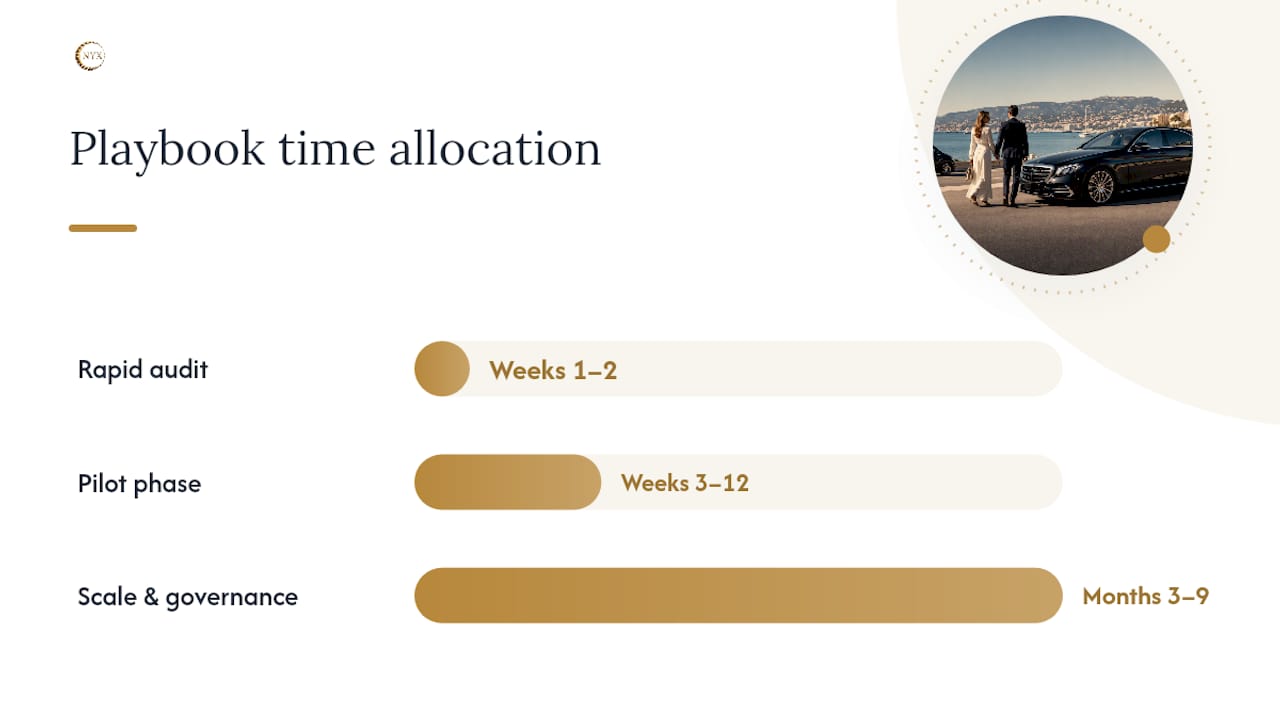
Weeks 1 and 2: rapid audit
- Map all guest touchpoints across the full journey from booking to departure.
- Score current variance on each touchpoint using existing review data and staff interviews.
- Identify the three highest-variance touchpoints and assign named owners.
- Confirm which third-party partners have written service-level agreements and which do not.
Weeks 3 to 12: pilot phase
- Select one department or one property unit as the pilot.
- Introduce handover scripts, daily briefing checklists, and partner SLA reviews.
- Measure weekly: touchpoint NPS, variance, recovery rate, and on-time rates.
- Capture root causes of each deviation in a shared log; review fortnightly.
- Adjust standards based on what the data reveals, not on intuition alone.
Months 3 to 9: scale and governance
- Roll out the pilot’s proven standards to remaining departments.
- Establish monthly variance reviews at property level with a central oversight function.
- Introduce rapid-response squads for event-driven surges (Cannes Film Festival, Monaco Grand Prix).
- Review third-party partner SLAs quarterly and replace partners who cannot meet on-time and quality thresholds.
The ServBrand evidence is clear that quality improvements should be gradual to avoid the rising-expectations trap: raising the bar too quickly sets a new baseline that becomes harder to sustain, and any subsequent dip feels more severe.
Pro Tip: Keep the pilot unit small enough that you can interview every member of staff involved. The root-cause log from weeks 3 to 12 is more valuable than any dashboard; it tells you why variance happens, not just that it does.
How Transponyx supports hotel service consistency on the French Riviera
The arrival and departure touchpoints are among the highest-variance moments in any hotel stay, and they are almost entirely dependent on third-party transport. A guest arriving at Nice Côte d’Azur Airport after a delayed flight needs a driver who already knows about the delay, is waiting without additional charge, and delivers a calm, professional transfer to the property.

Transponyx operates as a reliable transport partner for hotels, concierge services, and travel agencies across the Riviera. The fleet covers four vehicle categories: Standard Sedan (up to 3 passengers), Business Sedan (up to 3 passengers, premium finish), Van 7 pax, and Van 8 pax, all Mercedes-Benz and equipped with Wi-Fi, air conditioning, chilled water, and phone chargers. Every airport transfer includes flight monitoring and 60 minutes of free waiting time, which eliminates the most common source of arrival-touchpoint failure.
Typical journey times from Nice NCE illustrate the operational precision hotels can expect:
- Nice NCE to Monaco: approximately 30 minutes (19 km)
- Nice NCE to Cannes: approximately 30 minutes (33 km)
- Nice NCE to Antibes: approximately 20 minutes (23 km)
- Nice NCE to Menton: approximately 40 minutes (32 km)
- Nice to Saint-Tropez: approximately 1 hour 45 minutes (100 km)
All 2026 rates are fixed per vehicle, confirmed at booking, with no surge pricing during events such as the Monaco Grand Prix or Cannes Lions. Drivers are licensed VTC professionals, bilingual in English and French as a minimum, with additional languages including Italian, Spanish, Russian, and Arabic. The service operates 24 hours a day, seven days a week.
Hotels seeking a personalised transfer partner that maintains consistent standards across every booking can contact Transponyx at +33 6 10 30 71 84 or via Transponyx.
| Benefit |
Transponyx standard |
| Flight monitoring |
Included on every airport transfer |
| Free waiting time |
60 minutes at airport, 20 minutes elsewhere |
| Pricing |
Fixed, confirmed at booking, no surge |
| Languages |
English, French; also Italian, Spanish, Russian, Arabic |
| Availability |
24/7, 365 days |
Quick audit: 12 questions to test your hotel’s consistency now
Run this across departments in a single morning. Assign each question to a named owner before you begin.
- Can every front-desk agent describe the check-in standard in identical terms? (Owner: Front Office Manager)
- What is the current variance in housekeeping inspection scores across room categories? (Owner: Executive Housekeeper)
- Does your airport transfer partner monitor flights and absorb delays without extra charge? (Owner: Concierge / Transport Coordinator)
- What percentage of F&B complaints are resolved before the guest leaves the restaurant? (Owner: F&B Manager)
- Do all departments use the same guest-name protocol throughout a stay? (Owner: General Manager)
- Are handover briefings between shifts documented and signed off? (Owner: Department Heads)
- What is your on-time rate for departure transfers during peak event periods? (Owner: Concierge)
- How many third-party partners have a written SLA with defined quality thresholds? (Owner: Procurement / Operations)
- When was the last time you reviewed the distribution, not just the mean, of your review scores? (Owner: Revenue / Quality Manager)
- Do maintenance requests raised by housekeeping have a defined response-time standard? (Owner: Chief Engineer)
- Are new seasonal staff assessed against the same standard as permanent staff within their first two weeks? (Owner: HR / Training Manager)
- Does your monthly management review include a variance report, not just an average score? (Owner: General Manager)
Each “no” answer is a corrective action. Prioritise the three touchpoints with the highest guest-facing impact and assign a resolution deadline before the next peak period.
Governance, common pitfalls, and what to avoid
A light governance model is more durable than a heavy one. Assign a local metric owner to each touchpoint category, a central oversight function that reviews variance monthly, and a rapid-response squad that activates during event surges. Monthly variance reviews, not quarterly, are the minimum cadence for a property on the Riviera where the Cannes Film Festival, MIPIM, and Monaco Grand Prix compress demand into short, intense windows.
The pitfalls that most commonly undermine consistency programmes are:
- Over-standardisation. Scripts and checklists that leave no room for staff judgement produce robotic interactions. The goal is outcome consistency, not behavioural uniformity.
- Treating averages as truth. A mean score of 8.5 can hide a distribution with a significant tail of scores below 6. Review the distribution every month.
- Weak third-party SLAs. A transport partner without a written on-time commitment is a variance source you do not control.
- Raising expectations too quickly. The ServBrand evidence is clear: abrupt quality improvements set a new baseline that becomes harder to sustain.
- Ignoring the role of convenience for business travellers, who measure reliability against a precise, personal benchmark built over multiple stays.
The role of customer service in hospitality is ultimately a governance question: who owns each standard, who reviews its variance, and who has the authority to act.
A travel journalist’s view on consistency and Riviera hospitality
The evidence assembled here points in one direction, yet the Riviera makes the argument more vivid than any dataset. During the Monaco Grand Prix or the Cannes Film Festival, a hotel’s reputation is made or broken in 72 hours. Guests arrive with high expectations, compressed schedules, and zero tolerance for the kind of variability that might be forgiven in a quieter week.
What I observe repeatedly is that the properties that hold their reputation through these peaks are not necessarily those with the most spectacular facilities. They are the ones whose standards do not slip when the pressure is highest: the front desk that processes a late check-in at 2 AM with the same precision as a midday arrival, the concierge who has already confirmed the transfer before the guest asks, the driver from Transponyx who is waiting at Nice NCE with the guest’s name on a card, flight delay absorbed, 2026 fixed rate unchanged.
Consistency is not the absence of ambition. It is the discipline that makes ambition sustainable.
Sources
FAQ
Why does service consistency matter more than occasional excellence?
Guests form loyalty based on the reliability of an entire journey, not individual peak moments. McKinsey’s research shows journey-level satisfaction is approximately 30% more predictive of loyalty than single-interaction scores.
How does service variability affect different types of hotel guests?
Business travellers, who measure performance against a personal benchmark built over repeat stays, are acutely sensitive to deviations from a known standard. Inexperienced leisure guests perceive variability more strongly overall, and negative deviations late in a stay carry the largest penalty for both segments.
What is the fastest way to identify where inconsistency originates?
Review the distribution of your guest scores by department and touchpoint, not just the mean. Gallup’s analysis confirms that variance persists at local level even when company-wide averages look healthy, so local metric ownership is the most effective corrective lever.
How quickly should a hotel raise its service standards?
Gradually. The ServBrand research shows that abrupt quality improvements set a new baseline that becomes harder to sustain, and any subsequent dip feels more severe to guests than the original level of service would have.
Can a transport partner genuinely affect a hotel’s consistency scores?
Yes. Arrival and departure are among the highest-variance touchpoints in any stay and are largely outside a hotel’s direct control. A partner such as Transponyx, with fixed 2026 rates, flight monitoring, and 60 minutes of free waiting time on every airport transfer, removes one of the most common sources of guest dissatisfaction before the guest reaches reception.

par Daniel AIT GOUGAM | Août 13, 2026 | news
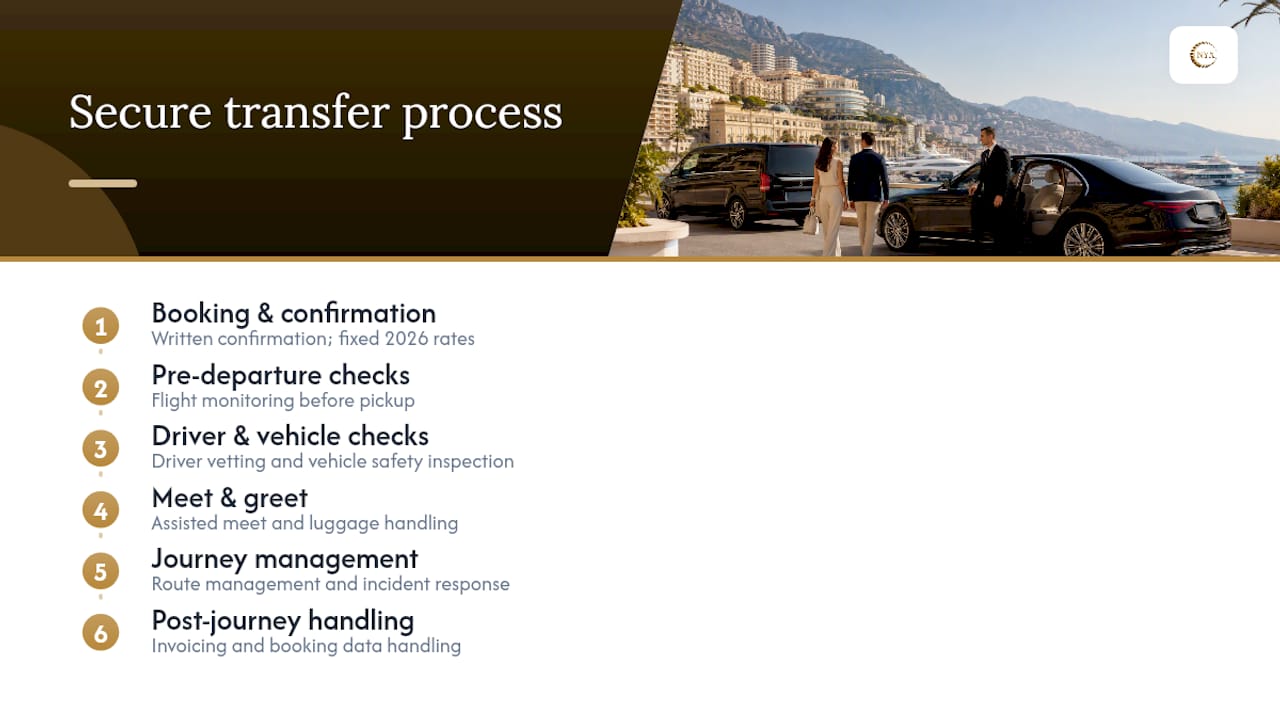
Transponyx follows seven secure travel process steps on every private chauffeur transfer from Nice Côte d’Azur Airport (NCE) and across the French Riviera: (1) booking and written confirmation, (2) pre-departure checks and flight monitoring, (3) driver vetting and arrival verification, (4) vehicle safety inspection, (5) meet and greet with luggage handling, (6) journey management and incident response, and (7) post-journey invoicing and data handling. All 2026 rates are fixed per vehicle and confirmed in writing at the time of booking, with no surge pricing. Free waiting time is included on every transfer with a generous allowance for airport pickups and a shorter period for other addresses. Licensed VTC drivers, bilingual in English and French as a minimum, operate across all four fleet categories. For concierges and travel agents, this sequence covers the full safe travel procedures that apply to every Transponyx booking.
What do you need to supply when booking, and how does confirmation work?
A clean booking starts with complete information. Transponyx requires passenger names, a direct contact number, pick-up and drop-off addresses, the number of passengers, luggage count, any child seat requirements, and billing instructions for corporate accounts. For airport transfers, the flight number and airline are mandatory so flight monitoring can begin immediately.
The six-step booking process for premium chauffeur services covers preparation, inquiry, quote, vehicle selection, customisation and written confirmation. Standard advice is to book well in advance for routine transfers. For peak Riviera events such as the Cannes Film Festival, Monaco Grand Prix, Cannes Lions or MIPCOM, longer lead times are strongly recommended, as availability contracts sharply within one day of travel.
Once a booking is confirmed, the client receives a written confirmation containing the booking reference, vehicle category (Standard Sedan, Business Sedan, Van 7 pax or Van 8 pax), the driver’s name and photo, vehicle registration, and the full contact block: +33 6 10 30 71 84 and https://transponyx.com. The 2026 fixed per-vehicle rate appears on the confirmation with no hidden additions.
How does flight monitoring protect your airport transfer?
Flight monitoring is included on every airport transfer at no additional charge. The client supplies the flight number and airline at booking; Transponyx tracks the arrival in real time and adjusts the driver’s schedule accordingly.
- On-time arrival: the driver is positioned at NCE arrivals before the flight lands, with the full 60-minute free waiting period active from wheels-down.
- Delayed flight: the vehicle hold is extended automatically. The client receives a notification confirming the revised pick-up time. No additional charge applies within the standard waiting allowance.
- Early arrival: live monitoring catches early landings. The driver is alerted and moves to the terminal ahead of schedule where operationally possible.
- Missed connection or cancelled flight: the client contacts Transponyx directly on +33 6 10 30 71 84 or WhatsApp +33 7 67 78 10 26. Dispatch coordinates a revised pick-up or, where required, a replacement vehicle from the nearest available position.
Good operational security depends on live dispatch and GPS tracking to reroute around traffic or incidents and on documented escalation procedures for emergencies. Transponyx applies both.
How are Transponyx drivers vetted and verified on arrival?
Driver vetting at Transponyx covers licensed VTC status, driving history, criminal-record checks, and bilingual capability in English and French as a minimum. Several drivers also speak Italian, Spanish, Russian or Arabic, which matters for high-profile guests arriving at NCE from international routes. Specialist training, including defensive driving and first aid, forms part of the vetting process for executive and VIP assignments.
According to industry guidance on secure executive chauffeur services, driver vetting should include driving history, criminal-record or police checks, and specialised training such as defensive or evasive driving and first aid. Transponyx applies these checks as standard.
On arrival, the passenger receives the driver’s name and photo in the booking confirmation. If details do not match on the day, the passenger should not board and should call +33 6 10 30 71 84 immediately. For high-profile guests, Transponyx can arrange neutral billing, unbranded vehicle presentation, and non-disclosure agreements for staff. Security drivers operating as part of a wider security plan conduct threat assessments, pre-plan routes with places of safety, and coordinate with ground-handling teams when required.
What vehicle safety checks and amenities can you expect?
Every Transponyx vehicle undergoes a pre-departure inspection before each journey. The checklist covers tyre condition and tyre pressure, lights and indicators, first-aid kit presence, and confirmation that insurance and registration documents are current. Where fitted, automatic emergency braking and blind-spot monitoring are verified as operational.
Standard amenities across the entire Mercedes-Benz fleet:
- Wi-Fi connectivity throughout the journey
- Air conditioning with individual climate control
- Chilled water provided on boarding
- Phone chargers for all major device types
- Child seats available on request at booking
Licences, commercial insurance and recent vehicle inspection records are available on request, consistent with best practice for executive chauffeur bookings.
How does meet and greet work at Nice NCE, and what is the waiting policy?
At Nice Côte d’Azur Airport, the Transponyx driver meets arriving passengers in the arrivals hall, holding a name board with the passenger’s name or, for discreet pickups, a neutral reference agreed at booking. For guests who require anonymity, unbranded signage and plain-clothes presentation are available on request.

Luggage handling is the driver’s responsibility from the moment of greeting to loading in the vehicle. Transponyx does not accept liability for pre-existing damage to checked luggage, but any damage occurring during loading or transit is covered under the vehicle’s commercial insurance policy.
Waiting policy is precise. Airport pickups carry 60 minutes of free waiting from the confirmed landing time. All other addresses carry 20 minutes of free waiting from the scheduled pick-up time. Additional waiting beyond these allowances is charged at the applicable 2026 per-vehicle rate, confirmed in the original booking documentation. For a first engagement with a new provider, observing professional conduct during the meet and greet, including discreet handling of documents and a visible vehicle inspection before departure, is a reliable indicator of service quality.
What happens during the journey if something goes wrong?
Transponyx follows a structured incident sequence so that no situation is left unmanaged:
- Detection: the driver identifies an incident (road closure, vehicle fault, security concern, medical situation).
- Immediate driver action: the driver pulls to a safe position, activates hazard lights and assesses the situation.
- Dispatch coordination: the driver contacts Transponyx dispatch, who log the incident and begin coordinating a response.
- Client notification: the passenger is informed of the situation and the expected resolution time.
- Escalation: if emergency services are required, dispatch contacts them directly. If a replacement vehicle is needed, the nearest available unit is dispatched.
- Resolution and documentation: the incident is logged, and the client receives a written summary on request.
Route planning uses primary and alternate routes, with live dispatch monitoring throughout. For high-profile principals, Transponyx varies routes to avoid predictable patterns where requested. Lost property recovered in the vehicle is logged immediately and returned to the client or their concierge within 24 hours of recovery, with handover confirmed in writing.
How long do Riviera transfers actually take from Nice NCE?
Journey times from Nice Côte d’Azur Airport vary with traffic, time of day, and whether a major event is running on the Riviera. The figures below reflect off-peak conditions; during the Cannes Film Festival, Monaco Grand Prix or Cannes Lions, add 20–45 minutes on the most affected corridors.
All 2026 fixed per-vehicle rates apply to these routes regardless of traffic conditions. Parking fees at venues such as the Palais des Festivals in Cannes are itemised separately on the invoice where applicable. For event-period planning, VIP transport logistics on the Riviera require earlier booking and confirmed alternate routing.
The concierge and travel agent booking checklist
Use this numbered checklist when preparing a Transponyx booking for a client:
- Passenger full names and direct mobile number.
- Flight number and airline (for airport transfers).
- Pick-up address and drop-off address, including hotel name and room reference if applicable.
- Number of passengers and number of luggage items.
- Child seat requirement (yes/no, age and weight of child).
- Vehicle category preference: Standard Sedan, Business Sedan, Van 7 pax or Van 8 pax.
- 2026 fixed per-vehicle rate confirmed and accepted in writing.
- Billing instructions: direct invoice, hotel folio, or corporate account reference.
- Privacy instructions: NDA required (yes/no), neutral billing descriptor required (yes/no).
- Meet and greet preference: standard name board, neutral reference, or unbranded presentation.
- Flight monitoring confirmed active (automatic on all airport transfers).
- Emergency contact for the client during travel.
- Driver ID verification step noted: passenger to confirm name and photo match on arrival.
- Optional: multilingual driver preference (Italian, Spanish, Russian, Arabic available on request).
For reliable transport on the French Riviera during peak season, completing every field above at the time of inquiry eliminates the most common causes of booking errors and last-minute amendments.
How does Transponyx handle invoicing, data and post-journey follow-up?
After each journey, Transponyx issues an invoice reflecting the confirmed 2026 fixed per-vehicle rate. Corporate clients and concierges may request a neutral billing descriptor so that the service provider name does not appear on expense reports or hotel folios. Itemised invoices show the route, vehicle category, date, and any additional charges such as parking fees or extended waiting time.
Passenger data collected at booking is held under Transponyx’s privacy policy, with role-based access restricted to the driver assigned to the booking and the booking team. Booking and payment systems use encrypted transmission. Staff handling VIP or confidential itineraries sign non-disclosure agreements on request. Retention periods for personal data follow applicable French data-protection regulations.
Lost property is logged at journey end, stored securely, and returned to the client or their nominated concierge within 24 hours. Disputes or claims are raised directly with the booking team at +33 6 10 30 71 84. Providers should, as a matter of course, publish a privacy policy and demonstrate encrypted booking systems, including PCI-DSS-compliant payment processing, to protect client data.
What concierges often get wrong during Cannes season
The most consistent failure point in Riviera event transfers is not the vehicle or the driver. It is the booking information supplied at inquiry. During the Cannes Film Festival and Monaco Grand Prix, concierges frequently submit incomplete passenger details or omit the flight number, assuming the operator will follow up. Transponyx will follow up, but every hour of delay in a confirmed flight number is an hour of flight monitoring lost.
The second pitfall is underestimating journey times on event days. A Nice NCE to Cannes transfer that takes 35 minutes in January can take 90 minutes during the Festival. Agents who build itineraries on off-peak assumptions and then request a vehicle 45 minutes before a red-carpet call are setting their clients up for a difficult arrival. The 2026 safety guide for secure travel addresses this directly: plan for the worst-case corridor, not the average.
Book early, supply complete information, and confirm the vehicle category in writing. Those three steps resolve the vast majority of complications before they arise.
Transponyx: fixed rates, licensed drivers, 24/7 service on the Riviera
Transponyx delivers airport transfers from Nice NCE and point-to-point journeys across the French Riviera with 2026 fixed per-vehicle rates confirmed at booking, no surge pricing, and 24/7 flight monitoring on every airport transfer. The fleet covers four Mercedes-Benz categories: Standard Sedan, Business Sedan, Van 7 pax and Van 8 pax, all equipped with Wi-Fi, air conditioning, chilled water and phone chargers. Licensed VTC drivers are bilingual in English and French as a minimum, with Italian, Spanish, Russian and Arabic available on request.
For concierges and travel agents comparing providers, the luxury chauffeur services comparison for 2026 sets out the key criteria clearly. To confirm availability and receive a fixed 2026 rate for your next booking, contact Transponyx on +33 6 10 30 71 84, via WhatsApp on +33 7 67 78 10 26, or at https://transponyx.com.
Sources
FAQ
What are the secure travel process steps Transponyx follows?
Transponyx follows seven steps: booking and written confirmation, flight monitoring and pre-departure checks, driver vetting and arrival verification, vehicle safety inspection, meet and greet with luggage handling, journey management and incident response, and post-journey invoicing and data handling.
How long is the free waiting time at Nice NCE airport?
Transponyx includes 60 minutes of free waiting on all airport pickups, measured from the confirmed landing time, and 20 minutes of free waiting for all other addresses.
How do I verify the driver is legitimate on arrival?
The driver’s name and photo are sent in the booking confirmation. On arrival, confirm these match before boarding; if they do not, do not enter the vehicle and call +33 6 10 30 71 84 immediately.
Can concierges request a neutral or unbranded transfer?
Yes. Transponyx offers neutral billing descriptors, unbranded vehicle presentation and non-disclosure agreements for staff on request, suitable for high-profile or confidential guest arrivals.
How far in advance should event transfers be booked?
For routine transfers, 48–72 hours is the standard lead time. For peak Riviera events such as the Cannes Film Festival, Monaco Grand Prix or Cannes Lions, booking one to two weeks ahead is strongly recommended.