
Last-mile event logistics is the coordinated management of final-stage transport that moves attendees, VIPs and equipment from an airport, heliport or hotel to their exact event contact point, on time and without a break in the chain. It is not parcel delivery. It covers the last kilometers of a much longer journey: the transfer from Nice Côte d'Azur (NCE), Monaco Heliport (MCM) or Cannes–Mandelieu (CEQ) to a stage door, a yacht berth, a villa gate or a conference registration desk.
On the Riviera, this discipline sits at the intersection of aviation scheduling, road access rules and hospitality standards. Get it wrong during the Monaco Grand Prix or the Cannes Film Festival and a delegate misses their own keynote.
The core components are:
- Timed airport or heliport pickups with flight or slot monitoring
- Meet-and-greet at arrivals, often with signage or branded reception
- Shuttle loops between hotels, venues and transport hubs
- Vehicle staging and holding areas for peak arrival waves
What does last-mile event logistics actually include?
Attendee logistics, as a discipline, spans travel booking, ground transport, registration and on-site support, and the last-mile piece is where most of that plan either holds or collapses. Six components need scoping before you contact a single vendor.
Timed airport pickup with flight monitoring means the driver tracks the actual landing time, not the scheduled one, and adjusts positioning accordingly. Meet and greet covers physical reception at arrivals, often with a name board and, for larger delegations, branded signage. Shuttle runs and loop routing move groups between a hotel cluster and a single venue on a repeating circuit. Vehicle staging and parking determines where cars wait during a keynote or a screening so they are ready the moment doors open. Luggage handling needs its own line item for delegations carrying production equipment or wardrobe cases. Accreditation and VIP handovers cover the point where a driver passes a guest to venue security or a producer.
Ownership varies by stage. The organizer sets the brief; the hotel concierge often manages the first guest contact; a transport coordinator owns the schedule; the driver executes it.
Pro Tip Ask any Riviera supplier for their yacht quay protocol in writing before booking. Marina access at Port Hercule or Vieux Port changes by event, and a driver who has not confirmed the exact gate wastes ten minutes finding it.
Private aviation adds another layer. Nice and Cannes both run FBO procedures that differ from commercial arrivals, and a driver unfamiliar with Riviera access rules will lose time at the gate rather than on the road.
When should you book transport for peak Riviera dates?
Booking windows on the Riviera are not generous, and the busiest weeks fill vehicle fleets and heliport slots months out, not weeks.
- Cannes Film Festival (May): reserve driver and shuttle capacity 8 to 12 weeks ahead; hotel-adjacent loop routes book out first.
- Monaco Grand Prix (May): commit vehicles and any helicopter legs 3 to 4 months ahead; road closures around the circuit start days before the race.
- MIPIM (March) and MIPCOM (October): book 4 to 6 weeks out; demand concentrates around the Palais des Festivals and Cannes hotel strip.
- Cannes Lions (June): similar lead time to MIPIM, with sharper competition for Business Sedans during evening awards events.
- Yacht events and private charters: confirm quay-side pickup windows as soon as berth allocation is known, since marina access changes daily during major regattas.
During the Monaco Grand Prix, Nice Côte d'Azur functions as the primary fixed-wing gateway, Cannes–Mandelieu takes secondary light and midsize jet traffic, and helicopter legs into Monaco Heliport become heavily constrained. Slots there are frequently gone three months before race weekend.
Vehicle bookings should be locked before parking allocation, not after. Once a hotel's valet capacity is full, a supplier without a pre-confirmed staging spot is stuck circling.
Which roles and vehicles does a Riviera event actually need?
A functioning transfer operation needs five roles working in sequence, and skipping any one of them is where most arrival-day failures start. HAS transfer coordinator owns the master schedule and is the single point of contact for changes. Year on-the-ground staging lead manages vehicle positioning and parking during peak waves. Tea driver, licensed as a VTC professional, drives and manages the guest relationship. HAS meet-and-greet agent arrivals halls for delegations works too large for one driver to greet alone. Year on-call backup driver covers delays or double-bookings without breaking the schedule.
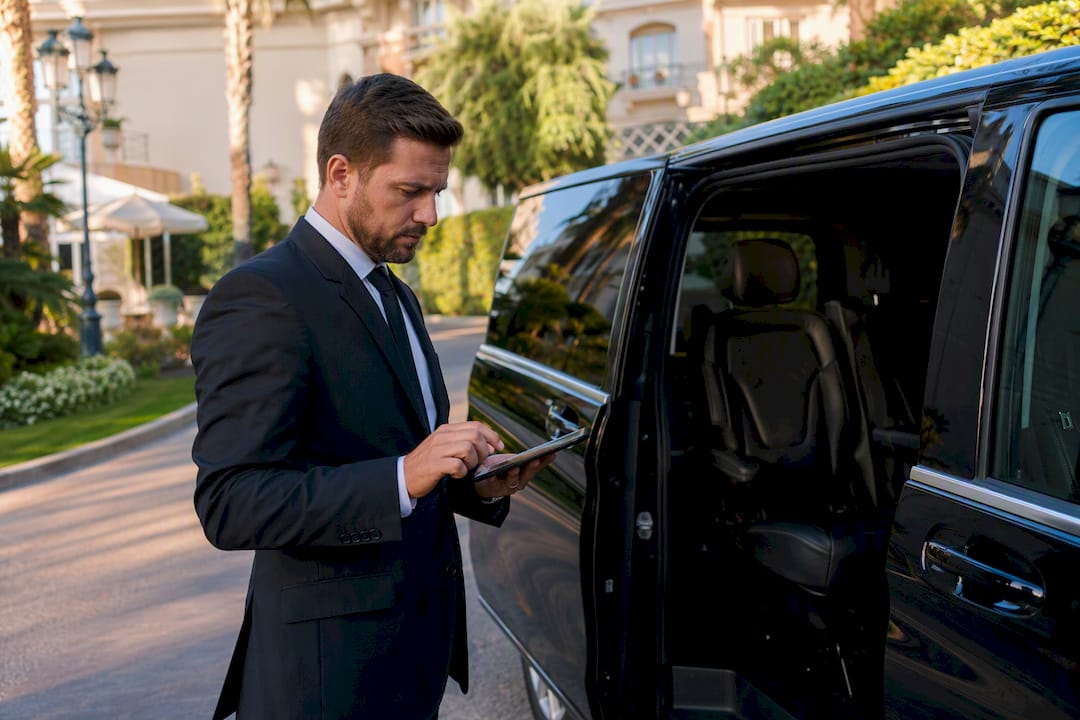
Assigning a single coordinator with access to live flight feeds and GPS tracking is widely recognized as the simplest way to prevent cascading failures during arrivals, and it is the one role event briefs most often leave out.
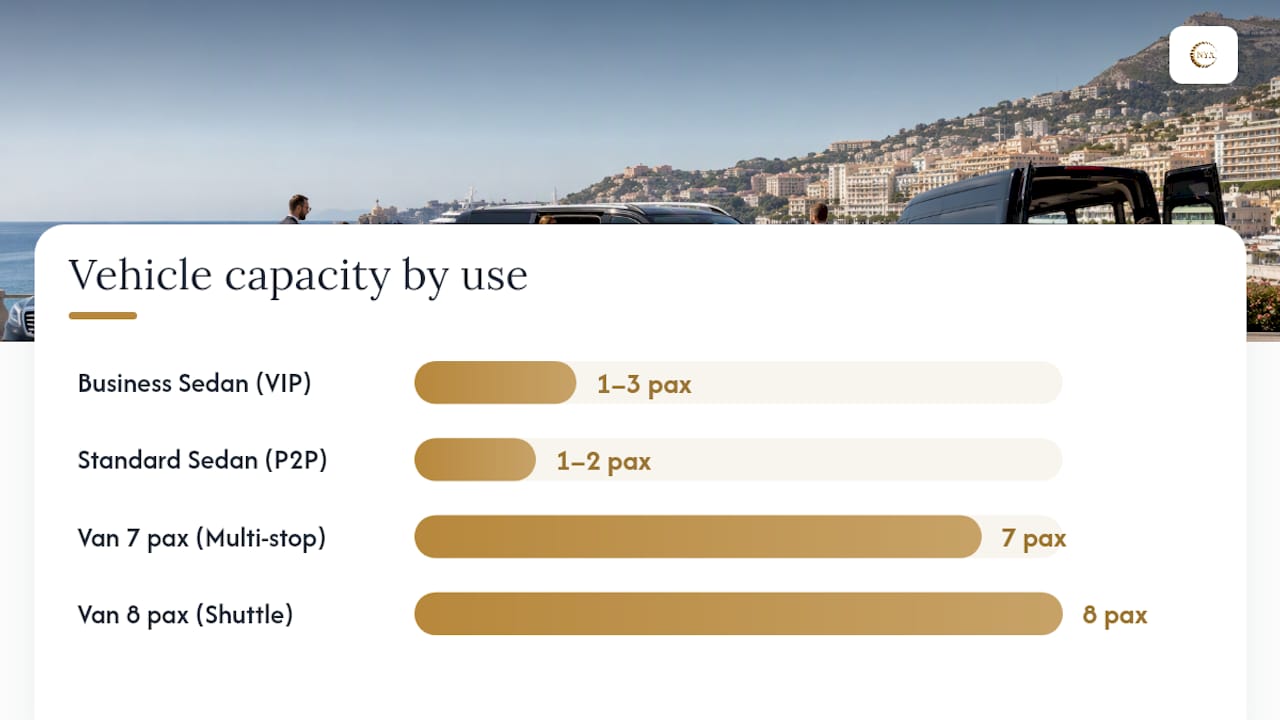
Vehicle choice should follow the leg, not the budget alone.
| Use case | Recommended vehicle | Why |
|---|---|---|
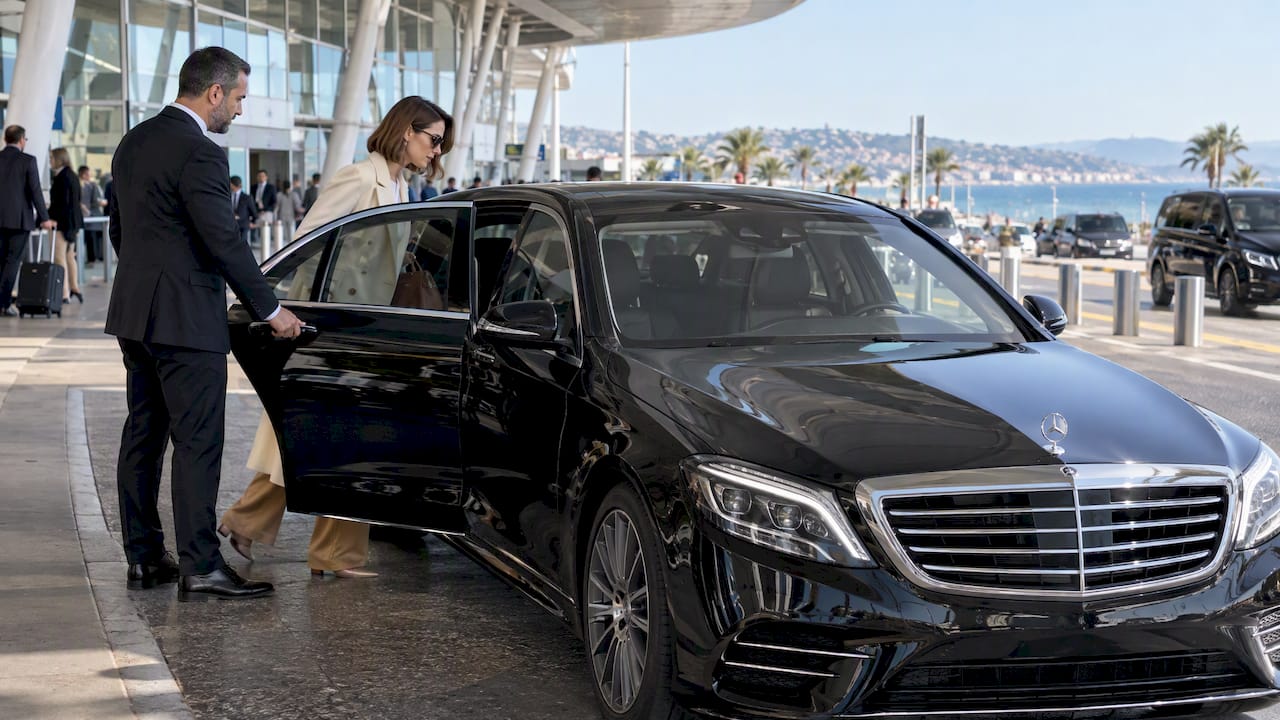
| VIP airport meet, 1 to 3 guests | Business Sedan | Premium finish for principal arrivals |
| Standard point-to-point transfer | Standard Sedan | Efficient for solo or paired travel |
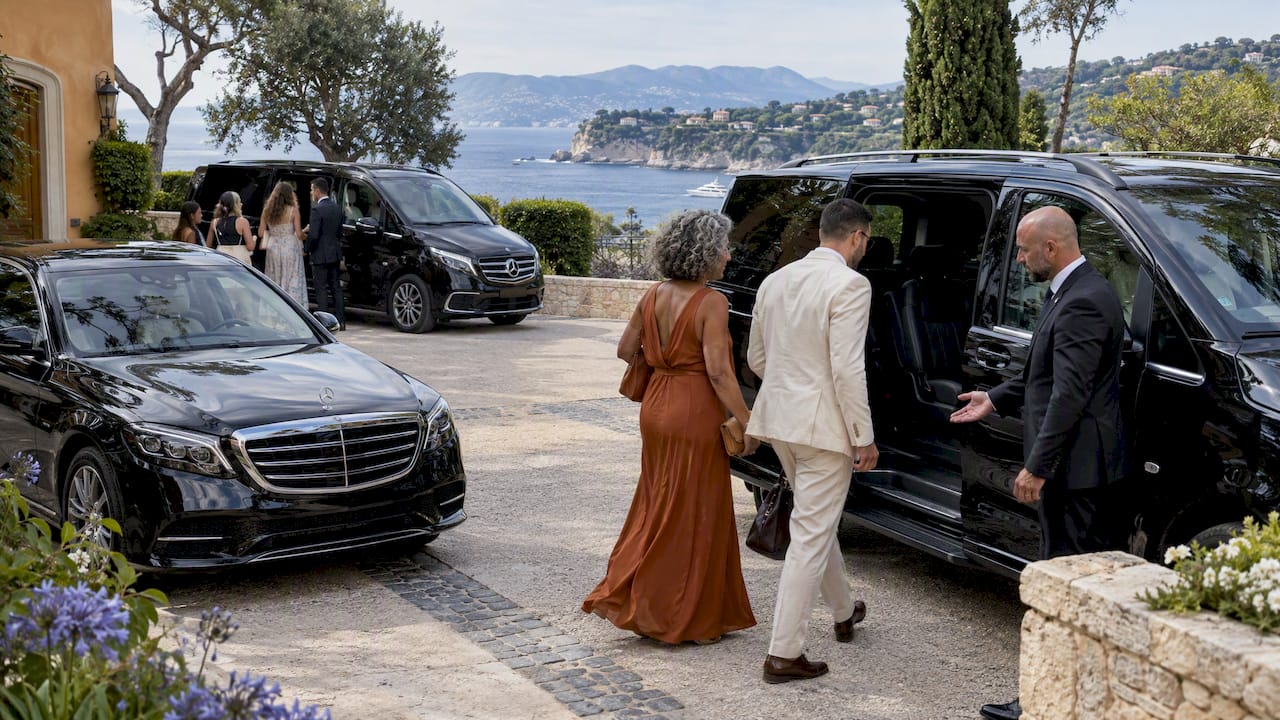
| Multi-stop delegation, up to 7 | 7-passenger van | Keeps a delegation together across venues |
| Shuttle loops, group luggage runs | Van for 8 people | Highest capacity for repeating circuits |
Every TranspOnyx booking includes flight monitoring, 60 minutes of free waiting time on airport pickups and 20 minutes elsewhere, with fixed 2026 rates confirmed at booking. Bilingual chauffeurs cover English and French as standard, with some also speaking Italian, Spanish, Russian or Arabic.
How do you build a copyable arrival-day run-sheet?
A working run-sheet needs to survive being handed to three different vendors on the same morning. Build it in this order.
- Confirm flight or helicopter arrival times the night before and re-check at 6am on arrival day.
- Assign each vehicle a named guest, contact number and destination address.
- Position vehicles at arrivals 20 minutes ahead of confirmed landing.
- Driver meets guest, confirms luggage count, and radios the coordinator on departure.
- Coordinator updates the master schedule and flags any delay to the next leg.
- Vehicle stages at the venue drop-off point, not the general car park, until VIP handover.
- Handover to venue security or event producer is logged with a timestamp.
- Backup driver is briefed on any guest still in transit past the confirmed slot.
Sample journey times give the schedule its backbone. Nice NCE to Cannes runs about a half hour depending on Croisette traffic. Nice NCE to Monaco takes about half an hour via the A8. Cannes–Mandelieu to Saint-Tropez takes over an hour by road, longer during festival season. Helicopter legs from Nice to Monaco Heliport take a few minutes flying time, which is precisely why they matter so much during Grand Prix week.
The compact checklist to paste into a vendor brief needs: guest name and contact, vehicle allocation and registration, confirmed waiting-time policy, FBO or quay pickup instructions, and an escalation contact who is reachable if the primary coordinator is unavailable.
Pro Tip Build ten minutes of buffer into every leg feeding a stage appearance or a press call. Riviera road closures during festival weeks are announced with little warning, and a driver without slack in the schedule has no way to absorb them.
An omnichannel approach, combining app alerts, SMS and on-site signage, reduces guest confusion far more reliably than a single WhatsApp thread, and it is worth building into the run-sheet from the start.
How do you manage access and contingencies at major Riviera events?
Monaco during Grand Prix week closes roads for days before the race, and grandstand construction restricts vehicle access to a handful of approved points. Cannes during the Film Festival shuts sections of the Croisette to general traffic, funneling all arrivals through checkpoints controlled by venue security. Yacht and harbor access at Port Hercule or the Vieux Port changes berth by berth, and a supplier without confirmed quay instructions loses real time hunting for the right gate.
Five contingencies recur across almost every major event:
- Flight delays: covered by included flight monitoring, so the vehicle repositions rather than waits idle.
- Road closures: require a pre-agreed alternative route confirmed with the coordinator, not improvised on the day.
- Parking exhaustion: avoided by confirming staging areas weeks ahead, not the morning of.
- Helicopter reallocation: During Grand Prix week, backup ground transport must be ready if a Monaco Heliport slot is bumped.
- Last-minute guest changes: handled by the backup driver and a coordinator with real-time visibility of every leg.
Document every contingency in a transport requirements matrix shared with venue security in advance. Pre-authorized drop-off points, agreed with organizers rather than discovered at the barrier, remove the single most common cause of arrival-day delay.
How does last-mile transport fit into the wider event schedule?
Transport is not a standalone workstream. It has to move in step with the run of show, the registration desk and the production schedule, or it becomes the reason everything else slips.
A keynote that starts at 9am needs its VIP speakers on-site by 8.30am, which means the transfer coordinator works backwards from the program, not forwards from the airport. Program managers who treat transport as an afterthought discover, usually mid-event, that a shuttle loop timed for a 10am session cannot also cover an unscheduled 9.45am press call.
The fix is straightforward in principle and demanding in practice: share the full event program, not just the arrivals list, with the transport coordinator before the schedule is finalized. That means visibility of session times, press windows, meal breaks and any off-site excursions, so vehicle allocation reflects the actual rhythm of the day rather than a static pickup sheet.
Registration desks benefit from the same integration. If badge collection is scheduled for a narrow window, shuttle loops need to land guests just ahead of it, not twenty minutes after doors close. Yacht-based hospitality adds a further wrinkle: tender schedules and quay windows have to sit inside the same master timeline as the road transfers, since a guest arriving by car and departing by tender needs both legs synchronized to the minute.
Treat the transport plan as a subset of the master program, updated on the same cadence, rather than a separate document maintained by a different team.
What security and risk protocols apply to VIP transfers?
VIP and high-profile group movements carry risks that ordinary event logistics do not: exposure at predictable pickup points, route intelligence leaking ahead of arrival, and the physical vulnerability of a stationary vehicle waiting at a curb.
Mitigation starts with limiting who knows the exact schedule. Route and timing details should circulate on a need-to-know basis among the coordinator, the driver and venue security only, never in a shared event-wide document. Vehicles should avoid extended idle waiting at a single named entrance; staging in a secondary holding area and moving to the drop-off point only once the guest is confirmed minutes away reduces exposure considerably.
Licensed VTC drivers bring a practical security advantage that unregulated transport does not: background-checked credentials, verified vehicle registration and accountability that venue security teams can check against an access list. For Monaco Grand Prix and Cannes Film Festival operations specifically, coordination with venue security detail ahead of arrival day, including agreed hand-off points and a shared contact line, prevents the awkward standoff of a driver arguing with a barrier guard while a principal waits in the back seat.
Contingency communication matters as much as the physical protocol. A single escalation contact, reachable throughout the arrival window, should be able to authorize a route change or a delayed handover without needing sign-off from someone three calls away. Building that authority into the brief before the event, rather than discovering the gap on the day, is the difference between a contained delay and a security incident.
Is sustainable last-mile transport realistic for Riviera events?
Sustainability in event transport is mostly a routing and consolidation problem, not a fleet-replacement one, at least in the near term for premium chauffeur services.
Consolidating individual transfers into shuttle loops cuts the number of vehicle movements sharply for any event with a concentrated hotel cluster. Loop shuttles reduce wait times and cut congestion for single-venue events, and the same consolidation that improves guest experience also reduces total mileage driven per attendee. Charter coaches become the most efficient option once headcount passes roughly 40 people, at which point running individual sedans stops making operational or environmental sense.
Route efficiency matters more than most planners assume. A coordinator who plans arrival waves to avoid empty return legs, pairing an airport drop-off with a return pickup rather than sending a vehicle back empty, removes a meaningful share of unnecessary driving across a multi-day event.
Vehicle idling during staging periods is another lever within a supplier's control. Drivers briefed to reposition rather than idle at a single point during long waits reduce fuel use without affecting response time, since a repositioned vehicle can still reach the pickup point inside its agreed window.
None of this requires a compromise on service standard. A well-routed shuttle loop or a consolidated multi-stop plan tends to run more smoothly than a fleet of individually dispatched cars, which makes the sustainability case and the operational case for consolidation the same case.
Publisher perspective: what experienced Riviera operators prioritize
Three things separate a smooth Riviera event from a chaotic one: early commitment on constrained dates, a single named transfer coordinator, and a fixed 2026 rate that will not move regardless of how the day unravels.
Helicopter legs into Monaco Heliport during Grand Prix week deserve more weight in planning than most briefs give them. Road access around the circuit degrades so badly that a seven-minute flight from Nice becomes the only reliable option, and those slots vanish months before the race. Nice NCE parking allocation deserves the same early attention. Confirm it the moment dates are set, not once accreditation lists arrive.
TranspOnyx works these dates regularly and publishes event-specific checklists planners can request directly.
How TranspOnyx handles last-mile logistics for your event
There are plenty of ways to patch together event transport: a mix of taxi apps, a hotel's own fleet, or a coach hired independently from your chauffeur provider. Coordinating all three under separate contracts is exactly the fragmentation that causes cascading delays. TranspOnyx runs the entire last-mile chain, from Nice NCE arrivals to villa or yacht handover, under one fixed 2026 rate and one point of contact.
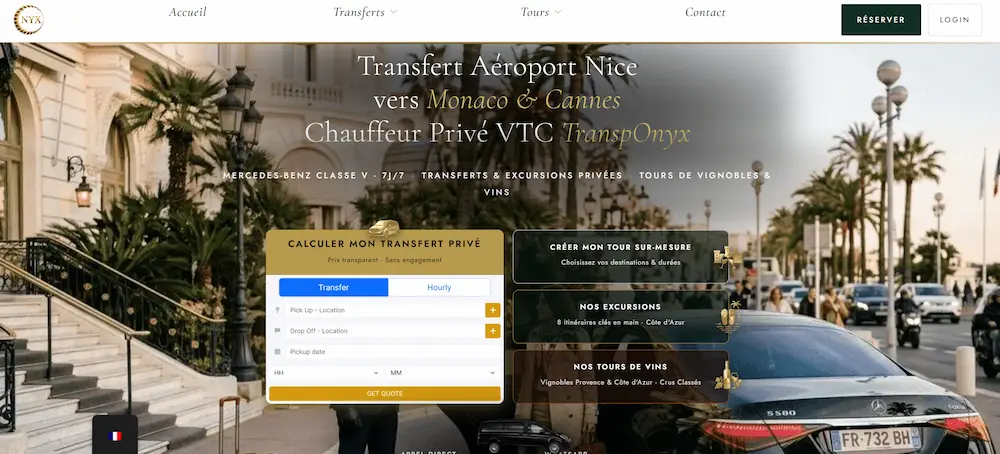
The fleet covers every use case in this guide: Standard Sedan and Business Sedan for VIP and point-to-point transfers, 7-passenger van and Van for 8 people for delegations and shuttle loops. Every booking includes bilingual licensed VTC drivers, flight monitoring, 60 minutes of free waiting time on airport pickups and 24/7 availability, with no surge pricing regardless of demand around events such as the Cannes Film Festival or the Monaco Grand Prix.
Typical event packages combined with VIP meet-and-greet at Nice Airport with a shuttle loop for the wider delegation and on-demand hourly chauffeur cover for site visits. For private chauffeur services in Cannes or a full Riviera itinerary, request a quote directly through Transponyx or call +33 6 10 30 71 84 to confirm vehicle availability for your event dates now.
Sources
- Event Transportation Solutions for Corporate Planners 2026
- Attendee logistics | Events glossary | AMW®
- Beyond the ticket: Designing a seamless last-mile experience for guests – XTIX Blog
- Premium chauffeur-driven transport in Cannes, Monaco and Saint-Tropez | ÉLYSÉE CHAUFFEURS
- Private jet Monaco Grand Prix | Uncompromised Travel
FAQ
What Is the Difference Between Last-Mile Event Logistics and Event Logistics?
Event logistics covers the whole event, including venue setup and registration, while last-mile event logistics focuses specifically on the final-stage transport moving attendees and VIPs to their exact contact point.
How Far Ahead Should I Book Transport for the Monaco Grand Prix?
Commit vehicles and any helicopter legs into Monaco Heliport three to four months ahead, since both fixed-wing capacity and helicopter slots fill early during race week.
Which Vehicle Suits a Multi-Stop Delegation Transfer?
A Van 7 pax or Van 8 pax keeps a delegation together across multiple venue stops, while a Business Sedan is better suited to a single VIP airport meet.
Does TranspOnyx Include Flight Monitoring on Airport Transfers?
Yes, TranspOnyx includes flight monitoring on every airport transfer along with 60 minutes of free waiting time, at fixed 2026 rates with no surge pricing.
What Should Be in an Event Transport Run-Sheet?
A run-sheet should list confirmed arrival times, named vehicle allocations, waiting-time policy, FBO or quay instructions and an escalation contact for delays.
0 Comments