
TL;DR:
- Reliable ground transportation prevents missed connections, delays, and emotional stress during travel.
- Both business and leisure travelers require high standards of punctuality and backup planning.
- Investing in dependable services saves money long-term by avoiding costly disruptions and rebookings.
Most premium travelers spend weeks researching hotels, restaurants, and itineraries, yet treat their ground transportation as an afterthought. That's a costly oversight. When your transfer fails, even the most perfectly planned trip unravels quickly. Travelers prioritize reliability over lowest fare to reduce friction, avoid missed connections, and eliminate the stress that undermines every other investment you've made in your journey. In the Nice Côte d'Azur region, where schedules, connections, and first impressions carry real weight, reliability isn't a luxury upgrade. It's the foundation of every successful transfer.
Table of Contents
- Why reliability makes or breaks the travel experience
- Business vs. leisure travelers: Different needs, same reliability standard
- How reliability is measured: Metrics and benchmarks for luxury transport
- Applying reliability: Checklist for seamless Nice Côte d’Azur transfers
- The hidden premium: Why reliability always costs less than you think
- Upgrade your travel experience with proven reliability
- Frequently asked questions
Key Takeaways
| Point | Details |
|---|---|
| Reliability reduces risk | Choosing reliable transport protects against missed connections, stress, and hidden costs. |
| Business needs urgency | Punctual and predictable transfers are essential for meetings and schedules. |
| Metrics matter | Benchmarking reliability helps you select the best provider for seamless journeys. |
| Checklist for quality | Use a practical evaluation list to ensure your luxury transfer meets high standards. |
| It's worth the investment | Paying for reliability usually saves money and trouble in the long run. |
Why reliability makes or breaks the travel experience
The moment a transfer goes wrong, the consequences stack up quickly. A driver arriving 20 minutes late at Nice Côte d'Azur Airport doesn't just cause inconvenience. It can mean a missed connecting flight, a lost hotel reservation, a corporate meeting that starts without you, or a family reunion thrown into chaos. These are not hypothetical risks. They are the predictable results of choosing transport based on price rather than performance.
The financial scale of the problem is significant. Flight delays cost US travelers $18B/year in lost time, missed opportunities, and extra expenses. Ground transport delays generate the same cascading effects, only they tend to be invisible until the damage is done. A delayed pickup that causes you to miss a flight triggers a chain reaction: rebooking fees, hotel extensions, rescheduled meetings, and wasted days.
Beyond finances, unreliable transport carries an emotional toll that's hard to quantify but impossible to ignore. Travelers dealing with an absent or late driver experience immediate anxiety, rushed decision-making, and a sense of losing control over their journey. That stress tends to persist, coloring the mood of everything that follows, from the business presentation to the first day of a long-awaited vacation.
What makes this particularly frustrating is that reliable transport in luxury travel rarely costs significantly more than unreliable alternatives. The difference is rarely about price, but about standards. Low-cost providers often skip backup planning, accept scheduling gaps, and underinvest in driver training. The resulting “savings” evaporate the moment something goes wrong.
Here's what unreliable transport can cost you in practice:
- Missed connections: Rebooking fees, accommodation extensions, and travel disruptions.
- Lost productivity: Business travelers lose billable hours and miss critical meetings.
- Emotional stress: Anxiety and frustration that undermine the entire travel experience.
- Reputation risk: Arriving late to a client meeting signals poor preparation, regardless of whose fault it was.
“The true cost of an unreliable transfer is never just the fare. It's everything that follows: the missed flight, the frantic rebooking, the ruined first impression. Travelers who understand this book for reliability first, every time.”
Now that reliability's importance is clear for all travelers, let's explore why it holds especially high value for business versus leisure journeys, and how the calculus differs between them.
Business vs. leisure travelers: Different needs, same reliability standard
At first glance, it might seem that business travelers need reliability while leisure travelers can afford a little flexibility. That assumption is wrong on both counts. Both groups require punctual, dependent transfers. They simply measure the cost of failure differently.
For business travelers, business travelers value reliability more than their leisure counterparts, with Value of Travel Time Reliability (VTTR) ratios ranging from 0.1 to 0.7. In practice, this means that a business traveler values the predictability of their journey at up to 70% of the value of the travel time itself. Ignoring reliability in corporate transport planning can underestimate project benefits by 5% to 50%, a range that represents genuine financial stakes for corporate travelers and their organizations.
For leisure travelers, the stakes feel different but are no less real. A family of four coordinating a transfer to Monaco after a cruise arrival in Nice cannot afford a no-show driver. A couple celebrating a milestone anniversary doesn't want to spend their first hour on the Côte d'Azur looking for an alternative ride. Business travel vs. leisure needs differ in emphasis, but the need for coordination, punctuality, and backup planning applies equally.

Here's how the priorities compare side by side:
| Priority | Business traveler | Leisure traveller |
|---|---|---|
| Punctuality | Critical (meeting schedules) | High (activity bookings) |
| Flexibility | Moderate | Higher |
| Communication | Constant updates needed | Preferred |
| Backup planning | Essential | Highly recommended |
| Vehicle comfort | Professional standard | Premium comfort |
| Local knowledge | Efficiency focused | Experience focused |
| Fixed pricing | Required for budgeting | Valued for transparency |
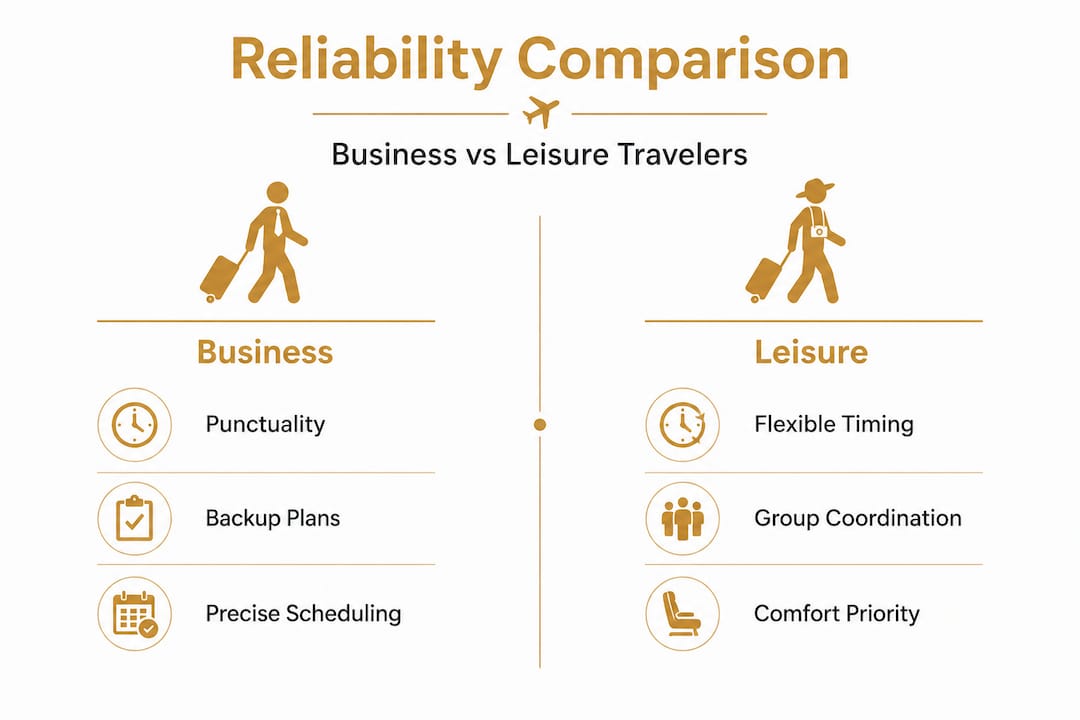
Understanding business travel transport in Nice means recognizing that both traveler profiles need the same underlying reliability, just delivered with different emphases. A business client needs a driver who knows the fastest route to the Palais des Congrès de Nice. A leisure couple needs a driver who knows to allow extra time during the Monaco Grand Prix weekend. Both need certainty, not guesswork.
The same applies to group transport solutions, where coordinating multiple passengers, multiple schedules, and multiple destinations makes a single reliability failure exponentially more disruptive.
Pro Tip: Before booking, communicate your specific schedule to your transport provider in writing. Share your flight number, arrival time, connection time, and any critical downstream appointments. A professional service will factor all of this into their planning and alert you proactively to any potential timing risks.
How reliability is measured: Metrics and benchmarks for luxury transport
Reliability isn't just a feeling. It's measurable, and discerning clients should know how to read the numbers. The transport industry uses specific tools to quantify dependability, and luxury providers who can cite these metrics are the ones worth trusting.
The primary measurement tool is the Planning Time Index, or PTI. PTI measures travel time reliability by comparing the 95th percentile travel time to free-flow travel time. The US Federal Highway Administration benchmarks PTI at approximately 1.8 for urban interstates, meaning that in the worst conditions, travel takes 1.8 times longer than under ideal conditions. A PTI close to 1.0 means consistent, predictable journey times.
For luxury ground transport specifically, corporate on-time reliability targets sit between 95% and 99% for premium programs. That is the benchmark that distinguishes professional VTC services from casual alternatives. Providers who cannot speak to their on-time performance statistics are providers who are not measuring it, and that tells you everything you need to know.
Here's how the metrics translate into practical booking decisions:
| Metric | Definition | What to look for |
|---|---|---|
| Planning Time Index (PTI) | Worst case vs. free flow travel time | Closer to 1.0 is more reliable |
| On-time percentage | Arrivals within scheduled window | 95-99% for premium services |
| Scheduling variance | Deviation from planned departure | Low variance = more reliable |
| Backup vehicle availability | Presence of contingency vehicles | Essential for high-stakes transfers |
Understanding corporate transport benchmarks means knowing what to ask before you book. Not all providers can answer these questions, and that gap in accountability is a significant red flag.
Questions to ask your provider before booking:
- What is your on-time performance rate over the last 12 months?
- Do you have backup vehicles available if the primary vehicle has a mechanical issue?
- How do you monitor traffic conditions in real time?
- What is your protocol if my flight is delayed or arrives early?
- Do you provide confirmation and driver contact details before the transfer?
- Are your drivers familiar with Nice Côte d’Azur routes during peak season, events, and festivals?
These questions separate professional services from unreliable ones quickly. HAS safe luxury van for airport transfers is one component of a reliable service, but the protocols, planning, and communication infrastructure matter just as much.
Applying reliability: Checklist for seamless Nice Côte d’Azur transfers
Knowing what to look for is half the battle. The other half is applying that knowledge before you book. Here is a practical checklist designed specifically for travelers using ground transport in the Nice Côte d'Azur region.
A reliable transport service reduces missed connections, stress, and disruption costs, but only if you've selected a provider with the right systems in place. Use this checklist to evaluate every option you consider:
- Verify the company's track record. Read reviews on independent platforms. Look specifically for comments about punctuality, communication, and how the company handled any problems.
- Confirm backup planning. Ask directly: what happens if the assigned vehicle is unavailable? A serious provider has a clear, practiced answer.
- Check for real-time monitoring. Does the driver track your flight? Will the provider adjust pickup time automatically if your arrival changes?
- Assess local expertise. Drivers should know seasonal traffic patterns, event schedules (Monaco Grand Prix, Cannes Film Festival, Nice Carnival), and alternative routes.
- Confirm fixed pricing. Variable pricing creates uncertainty. Fixed rates protect you from surprises and make your journey predictable from start to finish.
- Request driver credentials. Professional drivers in the VTC sector hold specific licensing and insurance. Ask for confirmation before your journey.
- Clarify communication protocols. Will you receive driver contact details in advance? Is there a direct line for support during the transfer?
- Evaluate the fleet. Premium vehicles like Mercedes-Benz sedans or vans signal a commitment to comfort and professionalism that correlates with broader service quality.
Exploring premium corporate transport solutions is easier when you know exactly what standards to apply. This checklist removes the guesswork and helps you book with genuine confidence.
Pro Tip: The most overlooked sign of a reliable chauffeur service is how they handle your first inquiry. A provider who responds promptly, answers specific questions clearly, and offers confirmation at every step is demonstrating the same operational discipline they will apply on the day of your transfer. Slow, vague, or evasive responses during booking are a preview of what to expect when it matters most.
The hidden premium: Why reliability always costs less than you think
Here is a perspective that most travelers don't hear until they've made an expensive mistake: reliability is not a cost. It is an investment with a measurable return, and it almost always pays off.
The industry data supports this clearly. VTTR often rivals VTT in economic value, with reliability ratios between 0.8 and 1.3. That means the value of knowing your journey will be consistent is roughly equal to, or sometimes greater than, the value of the travel time itself. Travelers don't just want to arrive quickly. They want to arrive predictably.
The conventional wisdom that “you can always find a cheaper option” collapses when you factor in disruption costs. Flight delays alone cost US travelers $18B/year in cascading losses. Ground transport failures generate proportionally identical consequences. A transfer that costs 30 euros less than the premium option but arrivals 25 minutes late can trigger a missed flight, a 400 euro rebooking fee, and a night in an airport hotel. The math never favors the cheap option once you include the full cost of failure.
What decades of experience in premium transport reveal is that travelers who book based solely on price are actually taking on significant financial risk, not reducing it. The savings are visible upfront. The costs are invisible until something goes wrong.
A real-world transport case study from the Antibes to Nice Airport corridor illustrates this perfectly. A corporate traveler booking a last-minute, unverified service saves a modest amount on the fare. When the driver is 30 minutes late due to poor route planning, the traveler misses their flight. The rebooking costs alone exceed the original fare three times over. This is not an edge case. It happens regularly to travelers who underestimate the stakes.
The right frame for evaluating transport isn’t “what does this cost?” It is “what does unreliability cost me?” Once you ask the second question, reliability becomes the obvious priority. Peace of mind, opportunity cost reduction, and protection against cascading failures are worth far more than the modest premium a top-tier service charges.
Upgrade your travel experience with proven reliability
When you've seen what unreliable transport costs in real terms, from missed meetings to disrupted vacations, the decision to invest in a proven service becomes straightforward.

At Transponyx, we provide airport transfers with reliable comfort built into every booking, from real-time flight monitoring and backup vehicles to fixed rates and bilingual drivers who know the Côte d'Azur inside out. Whether you need premium airport transfers from Nice to Monaco for a high-stakes arrival or a tailored group journey for your corporate team, our fleet of luxury vehicles for private transport is ready to deliver the consistency and professionalism your journey demands. Book directly online or through our app, and travel with the certainty you deserve.
Frequently asked questions
What is travel time reliability and why does it matter?
Travel time reliability means your transport consistently arrives when expected, reducing the risk of missed connections and journey-related stress. Travelers prioritize reliability over lowest fare precisely because the disruption costs of failure far outweigh any fare savings.
How do luxury providers ensure reliable transfers in Nice?
Reputable luxury transport providers use advanced scheduling, real-time traffic monitoring, backup vehicle protocols, and rigorous driver standards. Corporate on-time reliability targets for premium services typically fall between 95% and 99%, a benchmark that separates professional providers from casual alternatives.
Is reliability more important for business or leisure travelers?
Business travelers place the highest premium on reliability, but leisure travelers need it just as much for coordinated itineraries and group transfers. Business travelers value reliability more in pure economic terms, with VTTR ratios between 0.1 and 0.7, yet any disruption to a leisure itinerary carries real personal and financial consequences.
What happens if I choose cheaper, less reliable transport?
Choosing a lower-cost, unreliable service exposes you to missed flights, cascading delays, added stress, and extra expenses that typically dwarf any upfront savings. Flight delays cost US travelers $18B/year in lost time and missed opportunities, and the same logic applies to every preventable ground transport failure.


0 Comments
Trackbacks/Pingbacks